

Saved Bookmarks
This section includes 7 InterviewSolutions, each offering curated multiple-choice questions to sharpen your Current Affairs knowledge and support exam preparation. Choose a topic below to get started.
| 1. |
The time period of mass suspended from a spring is T. If the spring is cut into four equal parts and the same mass is suspended from one of the parts, then the new time period will be……. |
|
Answer» `2T` `T= 2PI sqrt((m)/(k)), 2pi, k` is constant. If the spring is cut into FOUR parts, the force constant of each part is DIFFERENT. Suppose, LENGTH of each part `l_(1)` and force constant `k_(1)` and length of whole spring is l and force constant k `therefore k_(1)l_(1) = kl` `therefore k_(1) (l/4)= kl` `therefore k_(1)= 4K` Periodic time of each part of spring `T.= 2pi sqrt((m)/(k_1))` `therefore T. = 2pi sqrt((m)/(4k))"""........"(1)` and periodic time of whole spring `T= 2pi sqrt((m)/(k))"""..........."(2)` `therefore (T.)/(T)= (1)/(sqrt(4))= (1)/(2)` `therefore T.= (T)/(2)`. |
|
| 2. |
A fighter aircraft is looping in a vertical plane. The minimum velocity at the highest point is (given r = radius of the loop) |
|
Answer» `SQRT(1/2 GR)` |
|
| 3. |
A vehicle travels different distances with different speeds in the same direction. Find the expression for the average speed of a vehicle. |
|
Answer» Solution :Suppose, a vehicle travels different distances `d _(1), d _(2), d _(3),…` with different SPEEDS `v _(1), v _(2) , v _(3),…` respectively in the same direction. Total distance TRAVELLED, `D = d _(1) + d_(2) +d _(3) +..` Total time taken, `t = t _(1) +t _(2) + t _(3) +...` But time `= ("distance")/("VELCITY")` `therefore t _(1) +t _(2) +t_(3) +...=(d _(1))/(v_(1)) + (d_(2))/(v_(2)) + (d_(3))/(v_(3)) +...` Average speed `= (D)/(t) = (d_(1) +d _(2) + d _(3) +...)/( (d_(1))/( v _(1) ) + (d_(2))/(v _(2)) + (d_(3))/( v _(3)) + ...)` |
|
| 4. |
A cannot engine extracts heat from water at 0^(@)C and rejects it to room at 24.4^(@)C. The work required by the refrigerator for every 1 kg of water converted into ice (latent heat of ice=336 kj/kg) is |
|
Answer» 30 KJ |
|
| 5. |
A body with an initial temperature theta, is allowed to cool in a surrounding which is at a constant temperature of theta_(0)(theta_(0)lt theta_(i)). Assume that Newton.s law of cooling is obeyed. Let k = constant. The temperature of the body after time t is best expressed by |
|
Answer» `(theta_(i)-theta_(0))_(E)^(-kt)` |
|
| 6. |
A satellite is seen after every 6 hr over the equator. It is known that it rotates opposite to that of earth.s direction. Thent the angular velocity of the satellite about the centre of earth will be (pi)/(n) rad/h. Find the value of n |
|
Answer» |
|
| 7. |
Which of the diagrams shown below most closely shows the variation in kinetic energy of the earth as it moves once around the sun in its elliptical orbit? |
|
Answer»
|
|
| 8. |
The acceleration due to gravity near the surface of the earth is vec(g) . A ball is projected with velocity vec(u) from the ground. (a) Express the time of flight of the ball. (b) Write the expression of average velocity of the ball for its entire duration of flight.Express both answers in terms of vec(u) and vec(g). |
|
Answer» |
|
| 9. |
mu_a,mu_b,mu_c are refractive indices of the media A, B, c respectively, so that mu_a gt mu_b gt mu_c. The critical angle arises when a ray of light travels from |
| Answer» Answer :D | |
| 10. |
A rope of negligible mass is wound round a hollow cylinder of mass 3 kg and radius 40 cm. If the rope is pulled with a force of 30 N, then the angular acceleration produced in the cylinder is |
|
Answer» Solution :`m=3kg, r = 40 cm = 0.40 m`, FORCE F = 30 N Angular acceleration `= alpha`= ? `tau = I alpha, tau = F xx r, FR = Ialpha` M.I. of the hollow cylinder about its axis, `I = MR^(2)` `alpha = (Fr)/(mr^(2)) = (30 xx 0.4)/(3 xx 0.4 xx 0.4) = 25 "rad" s^(-2)` Linear acceleration = a= ? `a= ralpha` `= 0.4 xx 25 ~~ 10 ms^(-2)` |
|
| 11. |
Calculate the mean free path of air molecules at STP. The diameter of N_(2) and O_(2) is about 3xx10^(-10)m |
|
Answer» SOLUTION :`P=1 atm =1.01xx10^(5)Pa,k_(B)=1.38xx10^(-23)JK^(-1),T=273K` from ideal fgas law,`N=P/(KT)` `n=(1.01xx10^(5))/(1.38xx10^(-23)xx273)=(1.01xx10^(5)xx10^(23))/(376.74)=2.68xx10^(-3)xx10^(28)` `n=2.68xx10^(25)" molecules"//m^(3)` Mean free path of the air molecule, `gamma=1/(sqrt2pind^(2))=1/(1.414xx3.14xx2.68xx10^(25)xx(3xx10^(-10))^(2))` `1/(1.0709xx10^(-18)xx10^(25))=0.9338xx1^(-7)` ` gamma =9.3xx10^(-8)m` |
|
| 13. |
Density of a liquid at 0°C is 13.6 gm/c.c., and its coefficient of real expansion is 18 xx 10^(-5)//""^(@) C. If the temperature is increased to 200^(@) C, percentage change in its density is |
|
Answer» `0.36%` |
|
| 14. |
A vernier callipers has 1mm marks on the main scale. It has 20 equal divisions on the Vernier scale which match with 16 main scale divisions. For this vernier callipers, the least count is |
|
Answer» 0.02mm |
|
| 15. |
If the unit of force is 100 N, unit of length is 10 m and unit of time is 100 s, what is the unit of mass in this system of units ? |
|
Answer» Solution :`[F]=[M^(1)L^(1)T^(-2)]=100 N ....(i)` `[L]10 m ...(II)` `[T]=100s....(III)` SUBSTITUTING VALUES of L and T from Eqs. (ii) and (iii) in Eq. (i) `:.Mxx10xx(100)^(2)=100` `:.(Mxx10)/(100xx100)=100` `:. M=10^(5)kg` |
|
| 16. |
Two bodies of masses 10kg and 20kg are located in x-y plane at (0,1) and (1,0) . The position of their centre of mass is |
|
Answer» `(2//3,1//3)` |
|
| 17. |
10 g of ice is added in 40 g of water at 15^@C. Calculate the temperature of the mixture. Sp. Heat of water= 4.2 xx 10^3 J kg^(-1) K^(-1),Latent of fusion of ice= 3.36 xx 10^5 J kg^(-1) |
| Answer» Solution :HEAT LOST by WATER to come from `15^@C` to `0^@C is H_1 = (40)/(1000) XX(4.2xx 10^3)xx(15 - 0) = 2520 J` Heat required to convert 10 g ice into 10 g water at `0^@C is H_2 = (10)/(1000) xx (3.36 xx 10^5) = 3360 J` Since `H_2 gt H_1` so the whole ice will not be converted into water, whereas the temperature of the whole water will be `0^@C.` Therefore the temperature of the mixture is `0^@C.` | |
| 18. |
Weight of a body on the surfaces of two planets is the same. If their densities are d_1 and d_2then the ratio of their radius |
|
Answer» `d_1/d_2` |
|
| 19. |
A particle is moving on a circular path of radius R with constant speed v. During motion of the particle form point A to point B |
|
Answer» Average speed is v/2 (B) Average speed `= ("Total distance") /("Total elapsed time") = (piR)/((piR)/v) = v` (C ) Average acceleration `= (v_f -v_i)/ "Total elapsed time" = (2v)/((piR)/v) = (2v^(2))/(piR)` 
|
|
| 20. |
A ring of mass m ca slide over a smooth vertical rod as show in figure. The ring is connected to a sprig of forceconstant k=4mg/R, where 2R is the natural length of the spring. The other end of spring is fixed the ground at a horizontal distance 2R from the base of the rod. If the mass is released at a heigt 1.5 R, then the velocity of the ring as it reaches the ground is |
|
Answer» `SQRT(GR)` |
|
| 21. |
A vector 3i + 4j rotates about its tail through an angle 37° in anticlockwise direction then the new vector is |
|
Answer» `-3 hat(i) + 4 hat(j)` |
|
| 22. |
A cube of mass m and height H slides with a speed v. It strikes the obstacle of height h = (H/4). Find the speed of the CM of the cube just after the collision. |
Answer» 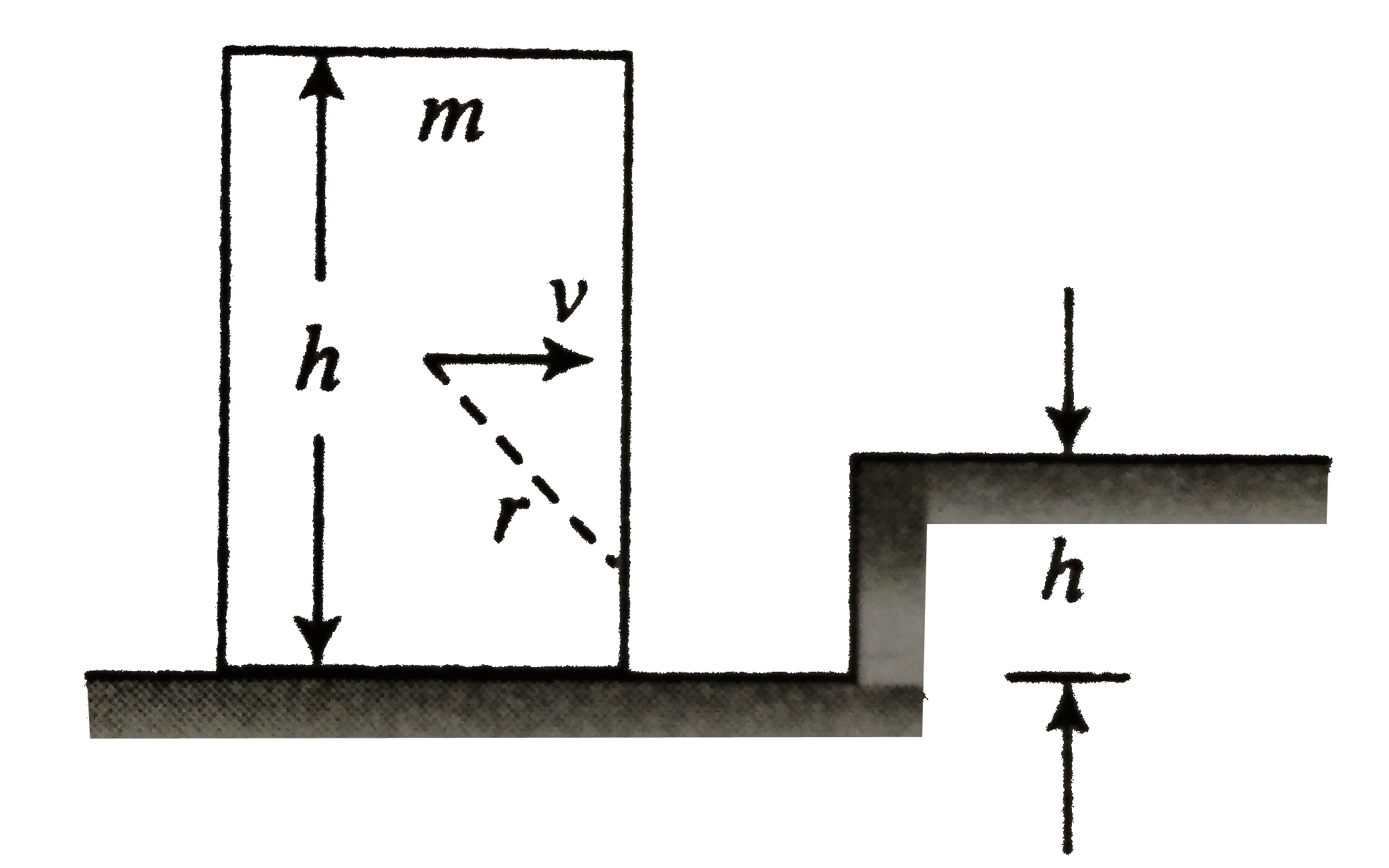 `omega=((H/2-h)v)/((H^(2))/6+(H^(2))/4+(H/2-h)^(2))` `v=romega=((H/2-h)v.sqrt((H^(2))/4+(H/2-h)^(2)))/(5/12H^(2)+(H/2-h)^(2))` If `h=H/4` we have `v'=(H/4v.sqrt((H^(2))/4+(H^(2))/16))/((5/12+1/16)H^(2))` `(v/4.sqrt(5)/4)/((15+3)/48)=(3sqrt(5))/18vimpliesv' (sqrt(5))/6v` |
|
| 23. |
Copper of fixed volume V is drawn into wire of length l. when this wire is subjected to a constant force F, the extension produced in the wire is Deltal , which of the following graphs is a straight line? |
|
Answer» `Deltal` versus `1//l` `THEREFORE Deltalpropl^2` |
|
| 24. |
At 27^@Ctwo moles of an ideal monatomic gas occupies a volume V. The gas expands adiabatically to a volume 2V. Calculatechange in its internal energy |
|
Answer» Solution :As`Delta U = nC_VDelta T= ( nRTDelta T )/( gamma -1)[ asC_V=(R )/( ( gamma -1))]` So ` Delta U= 2 xx (3/2)xx 8.31 xx (189- 300 ) =- 2767 .23J` NEGATIVE sign means internal ENERGY will decrease. |
|
| 25. |
At 27^@Ctwo moles of an ideal monatomic gas occupies a volume V. The gas expands adiabatically to a volume 2V. Calculatethe work done by the gas during the process. (R = 8.31 J/mol K) |
|
Answer» Solution :According to FIRST law of THERMODYNAMICS, `DELTAQ = DeltaU + Deltaw ` andasfor adiabaticchanges`DeltaQ=0` , ` Delta=-DeltaU = 2767.23 J` |
|
| 26. |
At 27^@Ctwo moles of an ideal monatomic gas occupies a volume V. The gas expands adiabatically to a volume 2V. Calculatefinal temperature of the gas |
|
Answer» Solution :in caseof adiabaticchange`pVr = ` constantwithPV= nRT Sothat`T_(1)V_(1)^( gamma -1) = T_2V_(2)^( gamma -1)= [" with"gamma= ( 5 //3 ) ] i.e.,300 xx V^(2//3)= T ( 2V)^(2//3)` `(or)T= 300// (2)^(2//3)= 189 K` |
|
| 27. |
The angular momentum of a particle relative to a certain point varies with time as L=a-bt^(2) , where a and b are Constant vectors, with abotb. Find the force moment tau relative to the point O acting on the particle when the angle between the vectors tau and Lequals 45^(@) |
| Answer» SOLUTION :`tau=2bsqrt((a)/(B))` | |
| 28. |
The temperature of an isolated black body falls from T_(1) to T_(2) in time t. Let C be a constant, then |
|
Answer» `t=C[(1)/(T_(2))-(1)/(T_(1))]` |
|
| 29. |
A steel sphere of mass 100 gm moving with a velocity of 4m/s collides with a dust particle elastically moving in the same direciton with a velocity of 1m/s. The velocity of the dust particle after the collision is |
|
Answer» 8m/s |
|
| 30. |
On a hypothetical scale X, the ice point is 40 and the steam point is 120^(@). For another scale Y the ice point and the steam point are -30^(@)and 130^(@) respectively. If x-reads 50^(@) the reading on Y is |
|
Answer» `-5^(@)` |
|
| 31. |
At constant pressure, out of H _(2) and O_(2) gas in which gas speed of sound is greater ? |
|
Answer» <P> Solution :At constant pressure, speed of sound in a given gas is `v prop (1)/(sqrt RHO) (because v = sqrt (( gamma P)/(rho )))`We know that `rho_(H2) lt rho _(O2) IMPLIES v _(H2) gt v _(O2)` |
|
| 32. |
Is pressure a scalar or a vector ? Give reason. |
|
Answer» Solution :PRESSURE is a scalar quantity . Because at a point fluid pressure is equal in all directions . So it shows that no DIRECTION is needed to show the pressure . MOREOVER `P=(F)/(A)` It is the COMPONENT of the force normal to the AREA under consideration and not (vector) force that appears in the numerator. Hence,pressure is a scalar physical quantity. |
|
| 33. |
An object is moving in a straight line with uniform acceleration, the velocity-displacement relation is |
|
Answer» (a) V=U+2as |
|
| 34. |
If the angle between vec(A) = 2hat(i)+4hat(j)+2hat(k) and vec(B) =2hat(i) +hat(k) " is " 30^(@), then find the projection of vec(B ) onA . |
| Answer» SOLUTION :`3 (SQRT(2))/2 " UNIT"` | |
| 35. |
The radius of a well is 7m. Water in it is at a depth of 20m and depth of water column is 10 m. Work done in pumping out water completely from the well is,(g= 10 ms^(-2)) |
|
Answer» `38.5 MJ` |
|
| 36. |
A 20g particle moves in SHM with a frequency of 3 oscillations per second and amplitude of 5 cm. Through what total distance does the particle move during one oscillation? What is its average speed |
|
Answer» 20 cm, `20cm//"SEC"` |
|
| 37. |
How will you arrange the two plane mirros so that whatever may be the angle of incidence, the incident ray and the reflected ray from the two mirrors will be paralle to each other ? |
|
Answer» The two PLANE mirros should be parallel toeach other. |
|
| 38. |
A mass of M kg is suspended by a weightless string. Find the horizontal force that is required to displace it until the string makes an angle of 45^(@) with the initial vertical direction. |
|
Answer» |
|
| 39. |
A farmer goes 500 m due north, 400 m due eastand 200m due south to reach hisfield.He takes 20 min to reach the field . What is the average velocityof the farmer during the walk ? |
|
Answer» `27 m*min^(-1)` |
|
| 40. |
A brass rod is in thermal contact with a heat reservoir at 127^(@)C at one end and a heat reservoir at 27^(@)C at the other end. Find the total change in entropy arising from the process of conduction of 1200 cal of heat through the rod. Does the entropy of the rod change? |
|
Answer» |
|
| 41. |
A ball of mass 100 gm is projected vertically upward from the ground with a velocity of 50 ms^(-1). At the same time another identical ball is dropped from aheight of 100 m to fall freely along the same path as that followed by the first ball. After some time the two balls collide, stick together and finally fall to the ground. The time taken by the combined mass to fall to the ground is approximately (g = 10 ms^(-2)) |
|
Answer» 4.5 s |
|
| 42. |
Obtain the relation between coefficient of performance and efficiency . |
|
Answer» Solution :Coefficient of performance `ALPHA=Q_2/W=Q_2/(Q_1-Q_2) [ because W=Q_1-Q_2]` `therefore alpha = (Q_2/Q_1)/(1-Q_2/Q_1)` `therefore alpha=(Q_2/Q_1)/eta`…(1) Now EFFICIENCY of carnot ENGINE based on cyclic process `eta=1-Q_2/Q_1` `therefore Q_2/Q_1=1-eta`..(2) `therefore` From equation (1) and (2) `alpha=(1-eta)/eta` |
|
| 43. |
Three equal -length straight rods, of aluminium invar and steel all at 20^(@)C, form an equilateral triangle with hinge pins at the vertices. At what temperature will the angle opposite to the invar rod be 59.95^(@)? alpha_("invar")=0.7xx10^(-6)//C^(@), alpha_("steel")=11xx10^(-6)//C^(@), alpha_("aluminium")=23xx10^(-6)//C^(@) |
|
Answer» |
|
| 44. |
In the above problem calculate the downward force on the frame if the fame placed vertically with its longest aide just touching the surface of water. |
|
Answer» |
|
| 45. |
If a vector vecA makes angles 45^@ and 60^@with x and y - axis respectively then the angle made by it with z - axis is |
|
Answer» `30^@` |
|
| 46. |
If a simple pendulum is arranged in an artificial satellite its a. Time period becomes infinity b.Frequency becomes infinity c. Both time period and frequency become infinity d.It does not oscillate |
|
Answer» a and d are CORRECT |
|
| 47. |
A bend in a level road has a radius of 100 m. What is the maximum speed which a car turning this bend may have without skidding if the coefficient of friction between the road and the tyres in 0.3. If the centripetal force is provided by 'banking' what is the angle of banking? |
|
Answer» Solution :`r=100m, MU = 0.3, v_("max") = ?` `v_("max") = sqrt(murg) = sqrt(0.3 xx 100 xx 9.8)= 17.1 m//s` Angle of banking = `theta` = ? `tan theta = V^(2)/(rg) =- 0.3 , theta = tan^(-1) 0.3 = 16.7^(@)` |
|
| 48. |
Two Brass rods of same length but with different diameters are heated by equal amounts of heat. The expansion is |
|
Answer» Same in both RODS |
|
| 49. |
A boy and a man carry a uniform rod of length .L. horizontally in such a way that the body get 1/4 of the load. If the body is at one end of the rod, the distance of the man from the other end is |
|
Answer» L/6 |
|
| 50. |
Three particles of masses m_1 = 1 kg, m_2 = 2 kg " and " m_2 = 3 kgare placed at the corners of an equilateral triangle of side 1m as shown in Figure. Find the position of center of mass. |
Answer» Solution :  The center of mass of an equilateral triangle LIES at its geometrical center G. The positions of the mass `m_1, m_2` and `m_3`are at positions A, B and C as SHOWN in the FIGURE. From the given position of the masses, the coordinates of the masses m, and m, are easily marked as (0,0) and (1,0) respectively. To find the position of m, the Pythagoras theorem is applied. As the `Delta ` DBC is a right ANGLE triangle, ` BC^2 = CD^2 + DB^2` ` CD^2 = BC^2 - DB^2` ` CD^2 = 1^2 - (1/2)^2 = 1 - (1/4) = 3/4` ` CD = (sqrt3)/(2)` The position of mass `m_3` is ` ( 1/2, (sqrt3)/(2) )` " or" `(0.5 , 0.5 sqrt3) ` X coordinate of centre of mass , ` v_(CM) = (m_1y_2 + m_2y_2 + m_3y_3)/(/(m_1 + m_2 + m_3)` ` v_(CM) = (sqrt3)/(4) m ` ` therefore ` the coordinates of centre of mass G ` (x_(CM). y_(CM))` is `(7/12, (sqrt3)/(4) )` |
|


