

Saved Bookmarks
This section includes 7 InterviewSolutions, each offering curated multiple-choice questions to sharpen your Current Affairs knowledge and support exam preparation. Choose a topic below to get started.
| 1. |
Find the ratio of the orbital speeds to two satellites one of which is rotating round the earth and the other around Mars close to their surface. (mass of the earth = 6 xx 10^(24) kg, Mass of the Mars = 6.4 xx 10^(23)kg, Radius of the earth = 6400 km and radius of Mars = 3400 km) |
|
Answer» Solution :The orbital speed of a SATELLITE close to the surface of a PLANET, `V_(0) = sqrt((GM)/(R))` The ratio of orbital speeds, `(V_(01))/(V_(02)) = sqrt(((M_(1))/(M_(2)))((R_(2))/(R_(1))))` `(V_(01))/(V_(02)) = sqrt(((6 xx 10^(24))/(6.4 xx 10^(23)))((3400)/(6400)))` `= sqrt((60 xx 34)/(6.4 xx 64)) = (2.232)/(1)` |
|
| 2. |
The triple - point of water is a standard fixed point in modern thermometry. Why ? What is wrong in taking the melting point of ice and the boiling point of water as standard fixed points (as was originally done in the Celsius scale) ? |
|
Answer» SOLUTION :In MODERN thermometry triple point of water is `273.16K`. Melting point of ice and BOILING point of water are not NEW because they CHANGE in pressure. |
|
| 3. |
A U-tube is made of capillaries of bore 2 mm and 4mm, respectively. The tube is held vertically inverted with the open ends below the surface liquid in a beaker. Calculate the difference in the levels of the meniscus in the two limbs. Take. Surface tension of liquid =48 dyne/cm density =0.8 g cm^(-3) Angle of contact between liquid and glass =0^(@) g=980 cm//s^(2). |
Answer» Solution : LET, `P_(p), P_(Q), P_(S) and P_(T)` be the pressure at points, P,Q,R and T RESPECT. We know that the pressure on the concave side of the liquid is greater than its other side by `2sigma//R` So, here `P_(Q)=P_(P)-(2sigma)/(r_(1))` `rArr P_(P)=P_(Q)+(2sigma)/(r_(1))` `and P_(S)=P_(T)+(2sigma)/(r_(2))` But `P_(P)=P_(S)` `therefore P_(Q)+(2 sigma)/(r_(1))=P_(T)+(2sigma)/r_(2)` `rArr P_(T)-P_(Q)=2 sigma (1/r_(1)-1/r_(2))` `rArr hpg=2 sigma (1/r_(1)-1/r_(2))` `rArr h=(2sigma)/(pg) (1/r_(1)-1/r_(2))` `=(2 xx 49)/(0.8 xx 980) ((1)/(0.2) -1/(0.4))` `=(2 xx 49)/(0.8 xx 980) (1/(0.4))` =0.3125 cm =3.125 mm |
|
| 4. |
A weight W is suspended by using two strings. One of the strings makes an angle of 30^(@) with the vertical. What should be the direction of the other string so that the tension in it becomes minimum? Find the tension in each string at this position. |
|
Answer» Solution :Let the angle between the two strings be `alpha` Fig. Given that the angle between the WEIGHT W and the first string =`180^(@)-30^(@)= 150^(@)` Hence, angle between the weight and the second string `=360^(@)-150^(@)-alpha` =`210^(@)-alpha` For equilibrium using Lami.s theorem, `T_(2)/(sin150^(@))=(W)/(sinalpha)or,(T_(2))/(0.5)=(W)/(sinalpha) or,T_(2)=(W)/(2sinalpha)` For `T_(2)` to be minimum, sin `alpha` should be maximum i.e., sin`alpha` =1 or `alpha=90^(@)` . Hence the tension in the second string will be minimum when it is at right angles to the first string. At this setting, `T_(2) = (W)/(2)` Also , `(W)/(sin90^(@)) = (T_(1))/(sin(210-90^(@)))= (T_(1))/(sin120^(@))` or, `W = (T_(1))/(sin60^(@))` `:. T_(1)= W sin 60^(@)= Wxx (SQRT(3))/(2)` `:." " T_(1) = (sqrt(3)W)/(2)" ""and"" "T_(2)=(W)/(2)`. 
|
|
| 5. |
A particle is subjected to two simple harmonic motions in the same direction having equal amplitudes and equal frequency. If the resulting amplitude is equal to the amplitude of individual motions, the phase difference between them is: |
|
Answer» `(PI)/(3)` |
|
| 6. |
Add 7.21, 12.141 and 0.0028 and express the result to an appropriate number of significant figures. |
|
Answer» Solution :`7.21+12.141+0.0028=19.3538` Correct SUM = 19.35 (Rounded off UPTO 2 decimal place) Here 7.21 has minimum NUMBER of decimal places (two), so result in rounded off upto second place of decimal point. |
|
| 7. |
Find the wavelength of sound wave of frequency 4.2 MHz travelling with a speed 1.7 km//s. |
|
Answer» Solution :We KNOW , `v = f lamda` `THEREFORE AMDA = (v)/(f) = (1.7 xx 10 ^(3))/(4.2 xx 10 ^(6)) =4.0476 xx 10 ^(-4) m` |
|
| 8. |
A rectangular block of dimensions 10m xx 6m xx 3m is lying on a horizontal surface with its smallest area in contact with the surface. If the work done in arranging it with its largest area in contact with the surface is 13.86MJ, the density of the body is (g = 10ms^(-2)) |
|
Answer» 2200 gm/C.c |
|
| 9. |
A horizontal tube, open at both ends, contains a column of liquid. The length of this liquid column does not change with temperature. Let gamma= coefficient of volume expansion of the liquid and alpha= coefficient of linear expansion of the material of the tube. Then gamma = K alpha, whereK= _________ |
|
Answer» |
|
| 10. |
Consider a particle undergoing simple harmonic motion. The velocity of the particle at position x_(1) is v_(1) and velocity of the particle at position x_(2) is v_(2). Show that the ratio of time period and amplitude is (T)/(A)=2pisqrt((x_(2)^(2)-x_(1)^(2))/(v_(1)^(2)x_(2)^(2)-v_(2)^(2)-x_(1)^(2))) |
|
Answer» Solution :Using equation `v=omegasqrt(A^(2)-x^(2))impliesv^(2)=omega^(2)(A^(2)-x^(2))` Therefore, at position `x_(1), v_(1)^(2)=omega^(2)(A^(2)-x_(1)^(2))""...(1)` Similarly, at position `x_(2), v_(2)^(2)=omega^(2)(A^(2)-x_(2)^(2))""...(2)` SUBTRACTING (2) from (1), we get `v_(1)^(2)-v_(2)^(2)=omega^(2)(A^(2)-x_(1)^(2))-omega^(2)(A^(2)-x_(2)^(2))=omega^(2)(x_(2)^(2)-x_(1)^(2))` `omega=sqrt((v_(1)^(2)-v_(2)^(2))/(x_(2)^(2)-x_(1)^(2)))impliesT=2pisqrt((x_(2)^(2)-x_(1)^(2))/(v_(1)^(2)-v_(2)^(2)))` Dividing (1) and (2), we get `(v_(1)^(2))/(v_(2)^(2))=(omega^(2)(A^(2)-x_(1)^(2)))/(omega^(2)(A^(2)-x_(2)^(2)))impliesA=sqrt((v_(1)^(2)x_(2)^(2)-v_(2)^(2)x_(1)^(2))/(v_(1)^(2)-v_(2)^(2)))""...(4)` Dividing equation (3) and equation (4), we have `(T)/(A)=2pisqrt((x_(2)^(2)-x_(1)^(2))/(v_(1)^(2)x_(2)^(2)-v_(2)^(2)x_(1)^(2)))` |
|
| 11. |
A frustum has been mounted with its axis vertical. It has a height h and radii of its upper and lower cross sections are R and r respectively. A particle is projected with horizontal velocity v_(0) along its upper brim. The particle spirals down the inner surface and leaves the lower face at point B. The inner wall of the frustum is smooth. (a) Find the vertical component of velocity of the particle as it leaves the frustum at B. (b) Find minimum value of h for which theparticle will never come out of the frustum. Take r = (R)/(2)for solving this part of the problem. |
|
Answer» (b) `h_("min") = sqrt((3)/(2g))v_(0)` |
|
| 12. |
Give any one characteristic of longitudinal wave motion. |
| Answer» Solution :A sequence of rarefaction ( EXTENSION ) and COMPRESSION is formed in a LONGITUDINAL WAVE MOTION. | |
| 13. |
Two balls B_(1) and B_(2) having difference but unknown masses collide. B_(1) is initially at rest and B_(2) has a speed u. After collision B_(2) has a speed u/2 and moves at right angles to its original motion. Find the direction (with respect to initial direction of B_(2)) in which ball B_(1) moves after collision |
|
Answer» `TAN^(-1)((1)/(2))` |
|
| 14. |
An object of mass m lying at rest at depth of .R/2. from the Earth.s surface is to be made an Earth.s satellite at a height of .R/2. from the Earth.s surface. The work required to do this is … (M-mass of the Earth, R-radius of the Earth and neglect the rotation of earth ) |
|
Answer» `(GMm)/(R )` |
|
| 15. |
Two linear simple harmoic motions of equal amplitude and frequencies omega and 2omega are impressed on a particle along the axes of x and y respectively . If the initial phase difference between them is pi//2 , find the resultant path followed by the particles. |
|
Answer» Solution :We have , x= A cos `OMEGA t , y = A cos (2OMEGA t + pi//2) = - A sin 2 omega t ` `=- A (2sin omega t cos omega t ) = - 2Asqrt(1-(x^2)/(A^2)) x/A =-2xsqrt(1-(x^2)/(A^2)) ` or `y^2 = 6x^2 (1-(x^2)/(A^2))` |
|
| 16. |
A bodyof mass m slides down a rough plane of uinclination alphaif muis the coefficent of frictionthen acceleratio of the body will be |
|
Answer» `g SIN alpha` |
|
| 17. |
A sphere of radius R, made from material of specific gravity SG, is submerged in a tank of water. The sphere is placed over a hole, of radius a, in the tank bottom. For the dimensions given, determine the minimum SG required for the sphere to remain in the position shown. |
|
Answer» |
|
| 18. |
What is the phase difference between the particles being on either side of a node ? |
| Answer» SOLUTION :`PI` RADIAN | |
| 19. |
Image formed by a plane mirror is always____and____ |
|
Answer» Real and inverted `0=600-2xx10^(5)t rArr 600=2xx10^(5)t` `t=3xx10^(-3)s rArr " Impulse"= int_(0)^(t)Fdt` `=int_(0)^(t)(600-2xx10^(5)t)dt=[600t-2xx10^(5)(t^(2))/(2)]_(2)^(3xx10^(-3))` `=600xx3xx10^(-3)-10^(5)xx9xx10^(-6)=0.9Ns` |
|
| 20. |
The weight of an aeroplane flying in the air is balanced by. |
|
Answer» vertical component of the thrust created by AIR currents striking the lower surface of the WINGS |
|
| 21. |
While negotiating a circular level road a cyclist has to bend by an angle from vertical to stay in an equilibrium is |
|
Answer» `tan THETA=(RG)/(r^(2))` |
|
| 22. |
Three identical particles each of same mass are placed touching each other with their centres on a straight line. Their centres are at A, B and C respectively. Then distance of centre of mass of the system from A is |
|
Answer» `(AB+AC+BC)/(3)` |
|
| 23. |
Equal mass of three liquids are kept in three identical cylindrical vessels A, B and C. The densities are rho_(A),rho_(B),rho_(C ) with rho_(A)ltrho_(B)ltrho_(C ). The force on the base will be |
|
Answer» MAXIMUM in VESSELS A |
|
| 24. |
Two enemy guns are placed at A and B at 10sqrt(3)km apart horizontally . A shell is fired from A horizontally with velocity 10m/s. At the same time a shell of double the mass of shell at A is fired from B at an angle 60^(@) with horizontal towards A with the same magnitude of initial velocity as that of A. Moving in the same vertical plane, two shells collide in air while sticking to each other and falling at the depest point of the valley C (neglect air resistance). Find the magnitude of horizontal component of the displacement vector (vecBC) (inkm). |
|
Answer» 11.55 For B `h_(2)=10sin 60^(@)t+(1)/(2)g t^(2)` `10cos 60^(@)xxt+10xt=10sqrt(3)` 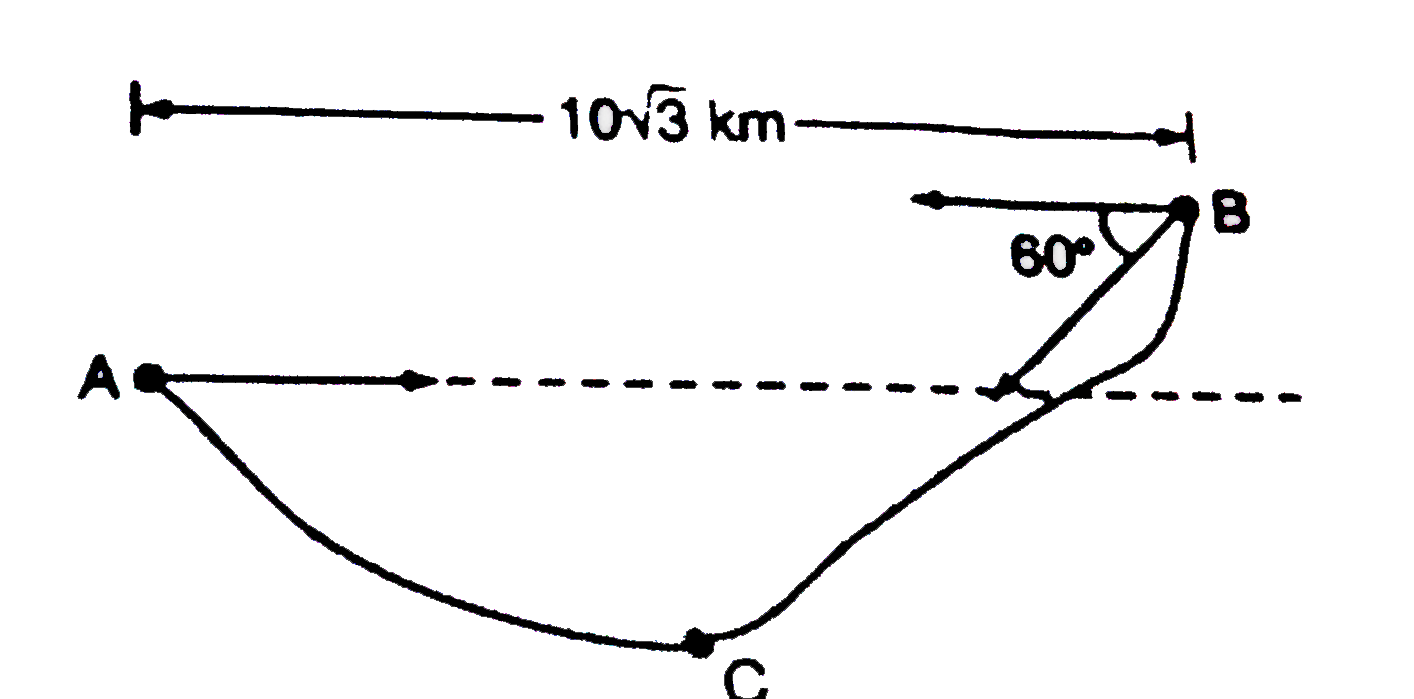
|
|
| 25. |
Two enemy guns are placed at A and B at 10sqrt(3)km apart horizontally . A shell is fired from A horizontally with velocity 10m/s. At the same time a shell of double the mass of shell at A is fired from B at an angle 60^(@) with horizontal towards A with the same magnitude of initial velocity as that of A. Moving in the same vertical plane, two shells collide in air while sticking to each other and falling at the depest point of the valley C (neglect air resistance). Calcu late how much above is the position B than position A (in km)? |
|
Answer» 5 For B `h_(2)=10sin 60^(@)t+(1)/(2)g t^(2)` `10cos 60^(@)xxt+10xt=10sqrt(3)` 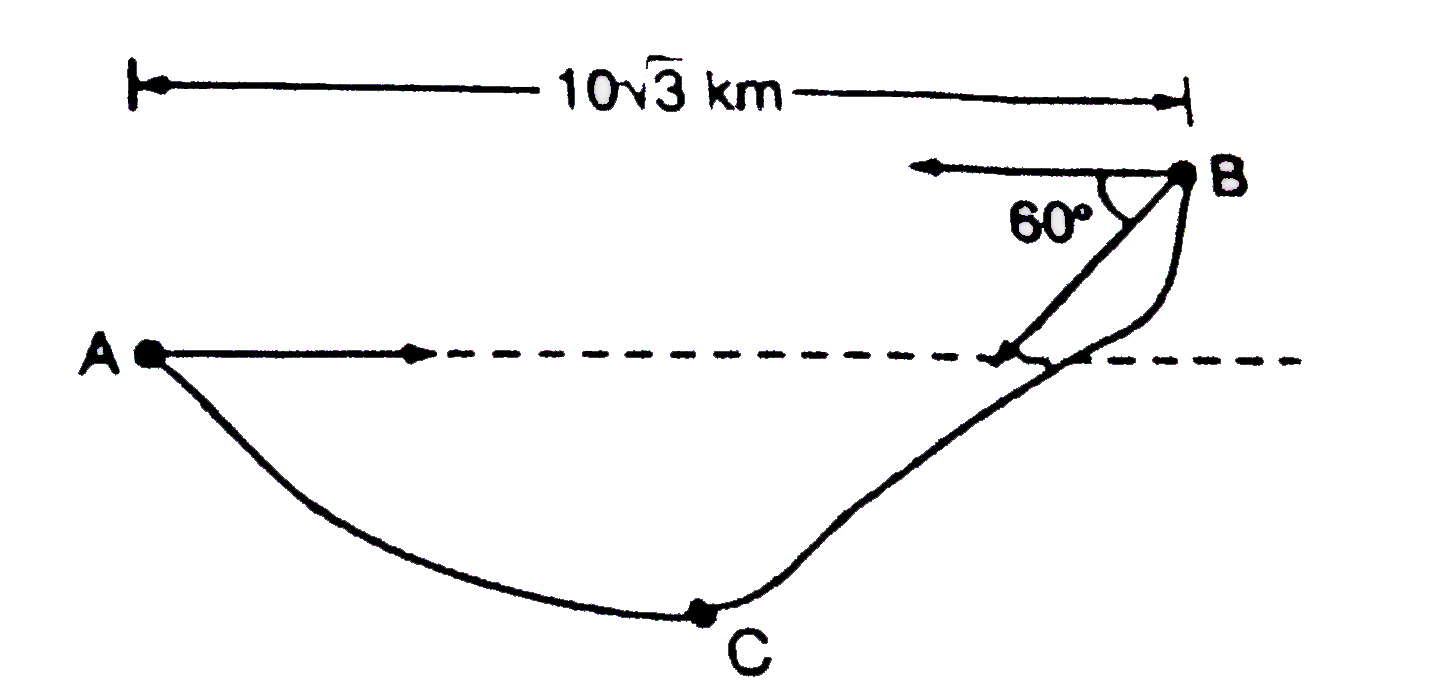
|
|
| 26. |
Two enemy guns are placed at A and B at 10sqrt(3)km apart horizontally . A shell is fired from A horizontally with velocity 10m/s. At the same time a shell of double the mass of shell at A is fired from B at an angle 60^(@) with horizontal towards A with the same magnitude of initial velocity as that of A. Moving in the same vertical plane, two shells collide in air while sticking to each other and falling at the depest point of the valley C (neglect air resistance). Find the time of collision of the two shells (in sec). |
|
Answer» `(200)/SQRT(3)` For B `h_(2)=10sin 60^(@)t+(1)/(2)g t^(2)` `10cos 60^(@)xxt+10xt=10sqrt(3)` 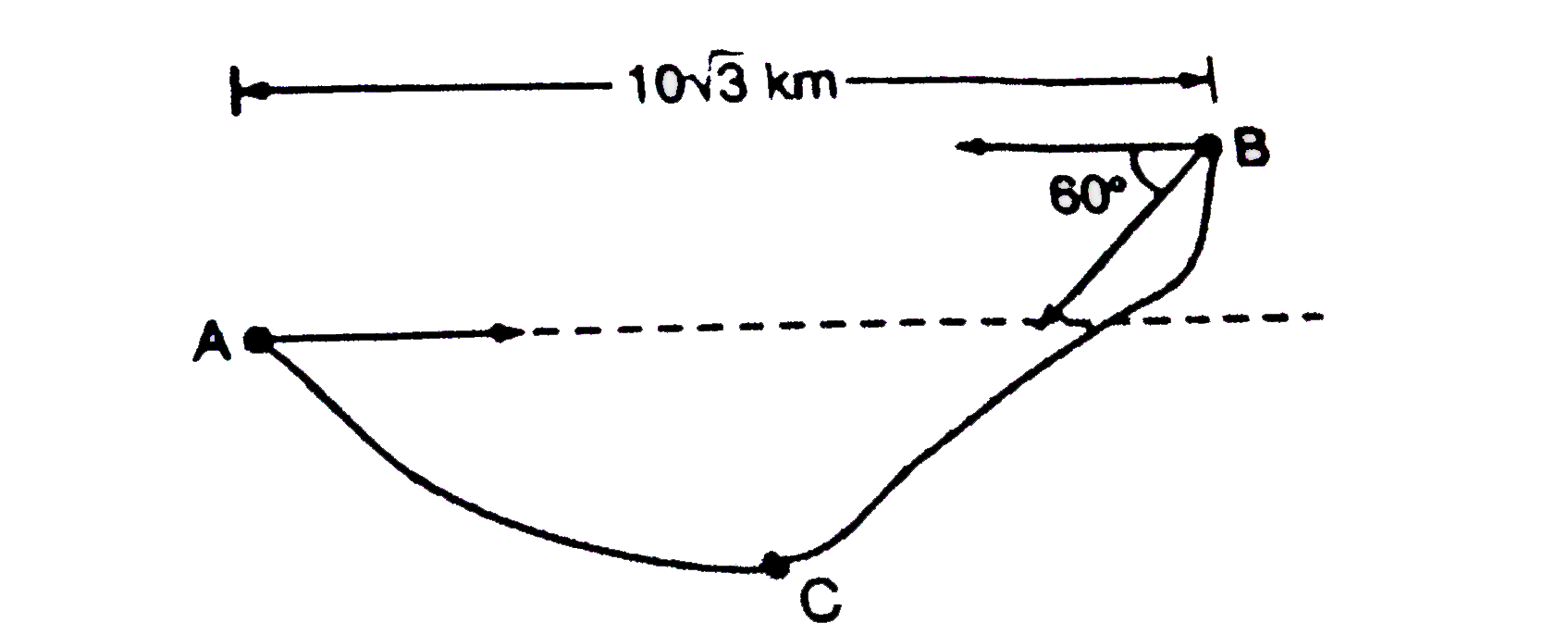
|
|
| 27. |
Whaat are the maximum number of rectangular components of a vector can be split in space and in the respectively. |
| Answer» ANSWER :A | |
| 28. |
Why are army troops not allowed to march in steps while crossing the bridge? |
|
Answer» SOLUTION :`(i)` Soliders are not allowed to march on a bridge. The reason behind this is RESONACE. `(ii)` If the frequency of soliders MARCHING on a bridge, EQUALS the frequency of vibration of bridge, then the displacement of the bridges movement will be maximum resulting what we call as as Resonance. `(iii)` DUE to this resonance the bridge may get broken or get dameged. |
|
| 29. |
A body cools from 60°Cto 50°Cin 10 min.if room temperature is 25°C ,the temperature of the body at the end of next 10 min will be |
|
Answer» 38.53°C |
|
| 30. |
What are the physical quantities having maximum value at the extreme position in SHM? |
| Answer» Solution :In SHM at extreme position displacement and POTENTIAL ENERGY will have MAXIMUM values. | |
| 31. |
200 cc of an ideal gas (gamma=1.5) expands adiabatically. If the rms speed of the gas molecules becomes half of the initial value. the final volume of the gas is |
|
Answer» 900cc |
|
| 32. |
A thread is tied slightlyloose to a wire frame as in figure and the frame is dropped into a soap solution and taken out. The frame is completely covered with the film. When the portion A is punchtured with a pin, the thread |
|
Answer» Becomes CONCAVE TOWARDS A |
|
| 33. |
A block of mass 5 kg is at rest on a smooth horizontal surface. Water coming out of a pipe horizontally at the rate of 2 kg s^(-1), hits the block with a velocity of 6ms^(-1). The initial acceleration of the block is, |
|
Answer» ZERO |
|
| 34. |
How would the time period of a simple pendulum be affected if (a) the length is doubled (b) the amplitude is doubled ? |
| Answer» SOLUTION :(a) T INCREASE `sqrt2`TIMES(B) No change | |
| 35. |
Which of the following examples represents periodic motion ? (i) A swimmer completing onė (return) trip from one bank of a river to the other bank. (ii) A freely suspended bar magnet displaced form its N-S direction and released. (iii) Halley's comet (iv) A hydrogen molecules rotating about its centre of mass. (v) An arrow released from a bow. |
| Answer» Solution :Examples (II), (III) and (IV) represent PERIODIC motion. | |
| 36. |
A chair is kept on the floor. When does friction act between them? Where does this force act? Is the magnitude of this force a constant ? |
| Answer» Solution :When the chair is at rest on the floor frictional force does not act. Friction comes into play when one TRIES to drag the chair over the floor and it CONTINUES to act when the chair is ACTUALLY in motion. The frictional force acts parallel to the surface of CONTACT between the chair and the floor and opposite to the direction of motion or relative motion. Magnitude of the force of friction is not a constant. As the force on the chair is gradually increased the force of friction also increases and reaches a LIMIT called the force of limiting friction . On further increase of the applied force , the frictional force decreases a little and thereafter remains constant . | |
| 37. |
A man is spinning in the gravity free - space changes the of the body by spreading his arms. By doing this he can change his (A) moment of inertia (B) angular momentum (C ) angular velocity (D) rotational kinetic energy Which one of the following are correct ? |
|
Answer» A, B and C |
|
| 38. |
Prove that, if theorbital speed of the moon increases by 42% , it would stop orbiting around the earth. |
|
Answer» Solution :Let mass of the earth =M and radius of the moon.s orbit =r Orbital speed of the moon `v=sqrt((GM)/r)`. The acceleration DUE to GRAVITY, `g^.=(GM)/(r^2) or, GM=g^.r^2` `therefore v=sqrt((g^.r^2)/r)=sqrt(g^.r)` Also the ESCAPE velocity of the moon with respect to the earth.s surface `v_e=sqrt(2g^.r)` `therefore (v_e)/(v)=sqrt((2g^.r)/(g^.r))=sqrt(2)=1.414` This implies, `v_e=1.414v=141.4%` of orbital speed v . Hence , if the orbital speed ofthe moon increases by 42% , which means that it changes to 142% of its present value ,it crosses the valueof the escapevelocity from the earth. As a result, the moon will move out of the earth.s gravitational field and will not move around the earth ANYMORE. |
|
| 39. |
The position x of a particle varies with time t as x=at^(2)-bt^(3).The acceleration of the particle will be zero at time t equal to |
|
Answer» `a/b` |
|
| 40. |
Velocity of body of 50 gram is 20 cm/s. When 50 dyne force act on it what will be its velocity at end of 5 sec. |
|
Answer» <P> SOLUTION :`F= (DELTA p )/( Delta t)``Delta p = F delta t` `50 xx 5` `=250` `P_(2)- p_(1) =250` `=100 + 250)` `=1250 "dyne" // sec` |
|
| 41. |
Three identical solid spheres move doen through three inclined planes A,B and C all same dimensions. A is without friction B is undergoing pure rolling and C is rolling with slipping. Compare the kinetic energies E_(A),E_(B) and E_(C) at the bottom. |
|
Answer» Solution :(i) In this case, when three identical solid spheres starts to move on the inclined planes, they all have same potential ENERGY. (ii) During the motion, the potential energy is converted into KINETIC energy. (iii) According to LAW of CONSERVATION of energy, at the bottom all the potential energy is converted into kinetic energy. (iv) Such that all three spheres have same kinetic energy at the bottom whatever be the TYPE of motion. i.e. `E_(A) = E_(B) = E_(C)`. |
|
| 42. |
Consider a heat engine as shown in Fig. Q_(1) and Q_(2) are heat added to heat bath T_(1) and heat taken from T_(2) in one cycle of engine. W is the mechanical work done on the engine If Wgt0, then possibilities are: a) Q_(1)gtQ_(2)gt0 b) Q_(2)gtQ_(1)gt0 c)Q_(2)gtQ_(1)lt0 d)Q_(1)lt0,Q_(2)gt0 |
|
Answer» |
|
| 43. |
Maximum and minimum magnitudes of the resultant of two vectors of magnitudes P and Q are found to be in the ratio 3:1. Which of the following relations is true ? |
|
Answer» <P>P= Q |
|
| 44. |
Steam at 100^@C is passed into 22 grams of water at 20^@C . When resultant temperature is 90^@C , then weight of the water present is |
| Answer» ANSWER :B | |
| 45. |
The value of 'g' on moon is five times less than that on the earth. If the length of the seconds pendulum on the earth is 100cm, its length on the moon is |
|
Answer» 20cm |
|
| 46. |
A block of mass 20 kg is lying on an inclined plane of angle 30^(@). In order to make it move upward along the slope with an acceleration of 25 cm/s^(2), a horizontal force of 400 N is required to be applied on it. (i) Frictional force on the block is .......N. (ii) Co-efficient of kinetic friction i s ......... |
|
Answer» 134,0.56  Accordingro thefiguretwocomponentsofweightmgaremg cos `theta`andmg sin `theta `and twocomponentsof weight`vec(F )` areF cos `theta`and F sin `theta`Supposeblockmovesupwardson theslopewithacceleration`a_(x )` Accordingro thefiguretwocomponentsofweightmgaremg cos `theta`andmg sin `theta `and twocomponentsof weight`vec(F )` areF cos `theta`and F sin `theta`Supposeblockmovesupwardson theslopewithacceleration`a_(x )` But`SIGMA F_(x ) = ma_(x )` `F cos30^(@) F -mg sin 30^(@)= ma_(x ) ( :., theta= 30^(2))` `:.346 .4 - f - 98=5` `:. 346 .4 -98-5 = f` Nowf= `mu_(s ) mg` `mu_(s ) = (f )/( mg )` `=(243 .4 )/( 20 XX 9.8) ` `=1.2418 ` `1.24` |
|
| 47. |
At the top of the trajectory of a projectile the acceleration is : |
|
Answer» maximum |
|
| 48. |
A water proofing changes the angle of contact |
|
Answer» From an obtuse to acute value |
|
| 49. |
Convert 76 cm of mercury pressure into "Nm"^(-2) using the method of dimensions. |
|
Answer» SOLUTION :In cgs system 76 cm of mercury pressure = `76 xx 13.6 xx 980` dyne `"cm"^(-2)` The DIMENSIONAL formula of pressure P is `[ML^(-1)T^(-2)]` , so `P_(1) [M_(1)^(a)L_(1)^(B)T_(1)^(c)] = P_(2)[M_(2)^(a)L_(2)^(b)T_(2)^(c)]` We have `P_(2) = P_(1) [(M_(1))/(M_(2))]^(a) [(L_(1))/(L_(2))]^(b) [(L_(1))/(L_(2))]^(c)` `M_(1) = 1 g, M_(2) = 1kg` `L_(1) = 1 cm, L_(2) = 1m` `T_(1) = 1 s, T_(2) = 1s` So, `a = 1, b = -1 and c = -2` Then, `P_(2 ) = 76 xx 13.6 xx 980` `[(1G)/(1kg)]^(1) [(1 cm)/(1 m)]^(-1) [(1s)/(1s)]^(-1) = 76 xx 13.6 xx 980 [(10^(-3)kg)/(1 kg)]^(1) [(10^(-2)m)/(1m)]^(-1) [(1s)/(1s)]^(-2)` `=76 xx 13.6 xx 980 xx [10^(-3)] xx 10^(2)` `P_(2) = 1.01 xx 10^(5) Nm^(-2)` |
|