

Saved Bookmarks
This section includes 7 InterviewSolutions, each offering curated multiple-choice questions to sharpen your Current Affairs knowledge and support exam preparation. Choose a topic below to get started.
| 1. |
(A) : The resultant of vecP and vecQ makes the angles alpha and beta with vecP and vecQ respectively. If |vecP|>|vecQ| then beta>alpha ( R) : Resultant is always closer to the vector of larger magnitude |
|
Answer» Both (A) and ( R) are ture and ( R) is the CORRECT EXPLANATION of (A) |
|
| 2. |
A particle moves in XY plane under the influence of a force such that its linear momentum is barP = A[(coskt)hati + (sin kt)(-hatj)] , where A and k are positive constants. |
|
Answer» The MAGNITUDE of the FORCE is Ak |
|
| 3. |
A uniform rod of mass 2kg and length 1m is lying on a horizontal surface. If the work done in raising one end of the rod through an angle 45^(@) is 'W', the work done in raising it further through 45^(@) is |
|
Answer» W |
|
| 4. |
The density of a non-uniform rod of length lm is given by lambda(x) =p(1+qx^(2))where p and q are constants and 0 le x le 1.The centre of mass of the rod will be at…………… |
|
Answer» `3/4[(2+q)/(3+q)]` |
|
| 5. |
State if each of the following statements is true or false. Give reasons for your answer. (a) In an elastic collision of two bodies, the momentum and energy of each body is ocnserved. (b) Total energy of a systemis always conserved, no matter what internal and external forces on the body are present. (c) Work done in the motion of a body over a closed loop is zero for every force in nature. (d) In an inelastic collision, the final kinetic energy is always less than the initial kinetic energy of the system. |
|
Answer» Solution :(a) False. The total momentum and total energy of the system are conserved and not of each body. (B) False. The external forces on the body MAY change the total energy of the body. (c) False. WORK done in the MOTION of a body over a closed loop is zero only when the body is moving under the action of conservative forces (like gravitational or electrostatic forces ). It is not zero when the forces are non-conservative e.g. frictional forces etc. (d) True, because in an INELASTIC collision, some kinetic energy usually changes into tsome other form of energy. |
|
| 6. |
One mole of an ideal monoatomic gas is taken round the cyclic process ABCA as shown in figure. CalculateThe heat rejected by the gas in the path CA and heat absorbed in the path AB |
| Answer» SOLUTION :`5/2P_0 V_0, 3 P_0 V_0` | |
| 7. |
One mole of an ideal monoatomic gas is taken round the cyclic process ABCA as shown in figure. CalculateThe net heat absorbed by the gas in the path BC. |
| Answer» SOLUTION :`(P_0 V_0)/( 2)` | |
| 8. |
If vec(A) = 3hat(i) - 4hat(j) and vec(B) = -hat(i) - 4hat(j), calculate the direction of vec(A) + vec(B). |
|
Answer» `tan^(-1) (4)` with + X-axis in CLOCK wise |
|
| 9. |
One mole of an ideal monoatomic gas is taken round the cyclic process ABCA as shown in figure. Calculate The work done by the gas |
| Answer» SOLUTION :`P_0 V_0` | |
| 10. |
One mole of an ideal monoatomic gas is taken round the cyclic process ABCA as shown in figure. Calculate The maximum temperature attained by the gas during the cycle |
| Answer» SOLUTION :`(25P_0 V_0)/( 8R)` | |
| 11. |
A car moves along a horizontal circular road of radius r with velocity v. The coefficient of friction between the wheels and the road is mu. Which of the following statement is not true ? |
|
Answer» The car will slip if `v gt SQRT(mu rg)` |
|
| 12. |
How friction force is provided on vehicle taking turn on level circular path ? |
| Answer» SOLUTION :Frictionforcebetweenroadanytyre. | |
| 14. |
What is the phase difference between particles being on either side of a node? |
| Answer» SOLUTION :`PI` RADIAN | |
| 15. |
A ball thrown vertically up retruns to the thrower after 6 s. find the velocity with which it was thrown and its position after 4 s. |
|
Answer» |
|
| 16. |
Coefficient of friction between the road and the tyre of a car is 0.6. What is the maximum safe limiting speed with which the car can overcome a bend of radius 150 m ? |
|
Answer» `60" "m CDOT s^(-1)` |
|
| 17. |
The M.I. of a thin rod about a normal axis through its centre is I. It is bent at the centre such that, the two parts are perpen-dicular to each other and perpendicular to the axis. The M.I. of the system about the same axis will be: |
| Answer» ANSWER :B | |
| 18. |
Give explanation of stationary waves produced in closed pipe and obtain equations of natural frequency (normal modes). |
|
Answer» Solution :Air column (glass tube) partially filled with water is example of closed pipe. The end in contanct with water is node and OPEN end is antinode. At nodes, pressure changes are maximum but displacement is minimum (ZERO). At antinodes, pressure changes are minimum but displacement is maximum If we take `X =0` at node and `x =L` at antinode, for ends, then `|sin kx| =1` `therefore |sinkL|=1 [because x =L]` `therefore kL = (n + (1)/(2) ) PI` `therefore (2pi )/(lamda ) L = (n + (1)/(2)) pi` `thereforeL = ( n + (1)/(2) ) (lamda )/(2)` `therefore L = (2n +1) (lamda)/(4)` where `n = 0,1,2,...,n` and possible wavelengths, `lamda = (2L)/((n + (1)/(2)) )= ( 4L)/( 2n +1 )` where `n = 0,1,2,3,...` Normal modes (Natural frequencies of system), `v _(n) = (n + (1)/(2)) (v)/(2L) = (2n + 1) (v)/(4L)` where ` n = 0,1,2,3..` By taking `n =0` for fundamental frequency, `v _(1) = (v)/(4L)` and odd number harmonic gives HIGHER frequencies. For example, `3 (v)/(4L), 5 (v)/(4L),...,(2n +1) (v)/(2L) ` are obtained. Thus only odd harmonic are obtained in closed pipe.   The above six figures shows the first 6 harmoniccs of air column in closed pipe. |
|
| 19. |
A vertical cylinder of cross-sectional area 0.1 m^2 closed at both ends is fitted with a frictionless piston of mass M dividing the cylinder into two parts. Each part contains one mole of an ideal gas in equilibrium at 300 K. The volume of the upper part is 0.1 m^3 and that of the lower part is 0.05 m^3. What force must be applied to the piston so that the volume of the two parts remain unchanged when the temperature is increased to 500 K? express force as ( x xx 100)R and find x? |
|
Answer» |
|
| 20. |
Which of the following functions of time represent (a) simple harmonic. (b) periodic but not simple harmonic. and (c) non periodic motion ? Give period for each case of periodic motion (omega is any positive constant): 1)sin omega t - cos omega t2 ) sin^3 omega t3) 3 cos (pi//4 - 2omega t) 4)cos omegat+ cos 3 omega t + cos 5 omega t5)e^(-omega^2 t^2)6) 1+ omega t + omega^2 t^2 |
|
Answer» Solution :`SIN omega t - cos omegat - sqrt2 [ sin omega t cos PI/4 - cos omega t sin (pi)/(4)] = sqrt2 sin (omega t- pi/4)` It is simple harmonic with a time period T =` (2pi)/(omega)` 2) `sin^3 omega t ` is a periodic function but not simple harmonic because `a ALPHA - y `condition is not satisfied. It is time period is `T= (2pi)/(omega)` 3) `3 cos (pi//4 - 2omega t) = 3 cos (2 omega t - pi//4) ` it is simple harmonic with a time period `T= (2pi)/(2omega) = pi/omega ` 4) `cos omega t + cos 3 omega t + cos 5 omega t ` is a periodic function but not simple harmonic . The time periods of each periodic function are `(2pi)/(omega) , (2pi)/(3omega) and (2pi)/(5omega)`. Since `(2pi)/(omega)` is the MULTIPLE of the other two periods, the given sum is periodic with the time period ` (2pi)/(omega` 5) `e^(-omega^2 t^2)` decreases and tends tozero as `t to oo` 6) `1 + omega t + omega^@ t^2 ` is not periodic as function with increase in t with out repetition. |
|
| 21. |
An inventor claims to have developed an engine that during a certain time interval takes in 110 MJof heat at 415 K, rejects 50 MJ of heat at 212 K while manages to do 16.7 kWh of work. Do you agree with the inventor.s claim? |
|
Answer» Inventors claim may be correct |
|
| 23. |
A student measured the length of a rod and wrote it as 3.50 cm. Which instrument did he use to measure it? |
|
Answer» A screw gauge having 100 divisions in the circular scale and pitch as 1 mm. Least count = 1MSD - IVSD ... (1). In vemier scale IMSD = IMM and 9MSD = 10VSD `:.` IVSD=0.9 MSD `:.` From equation (i) Least count of vernier calliper `=1MSD=0.9MSD` `=0.1 MSD =0.1 mm, 0.01 cm` |
|
| 24. |
For two systems to be in resonance, which of the following properties should be equal ? |
|
Answer» Wavelength |
|
| 25. |
The bob of a simple pendulum is made of a material of density (6)/(5)xx10^(3)k/gm^(3) The bob executes S.H.M in water with frequency v while the frequency of oscillation, the relationship between v and v_(0) is |
|
Answer» `V= sqrt3v_(0)` `g. = g - (5g)/(6) = (g)/(6)` In air, `v_(0) = (1)/(2pi) sqrt((g)/(l))` In water, `v = (1)/(2pi) sqrt((g.)/(l))` Dividing both expressions, we get `(v)/(v_(0)) = sqrt((g.)/(g)) = sqrt((g/6)/(g)) = sqrt((1)/(6))` ` v = (v_(0))/(sqrt(6))` |
|
| 26. |
A car travels the first half of a distance between two places a speed of 30 km/hr and the second half of the distance a 50 km/hr. The average speed of the car for the whole journey is |
|
Answer» 42.5 km/hr |
|
| 27. |
A rhombus ABCD is shown in the fig The sides of the rhombus can rotate about vectecc A, B, C and D velcity of 6 m//s in horizontal direction. Determine the veclocity of vertex A: |
|
Answer» `4.8 m//s` 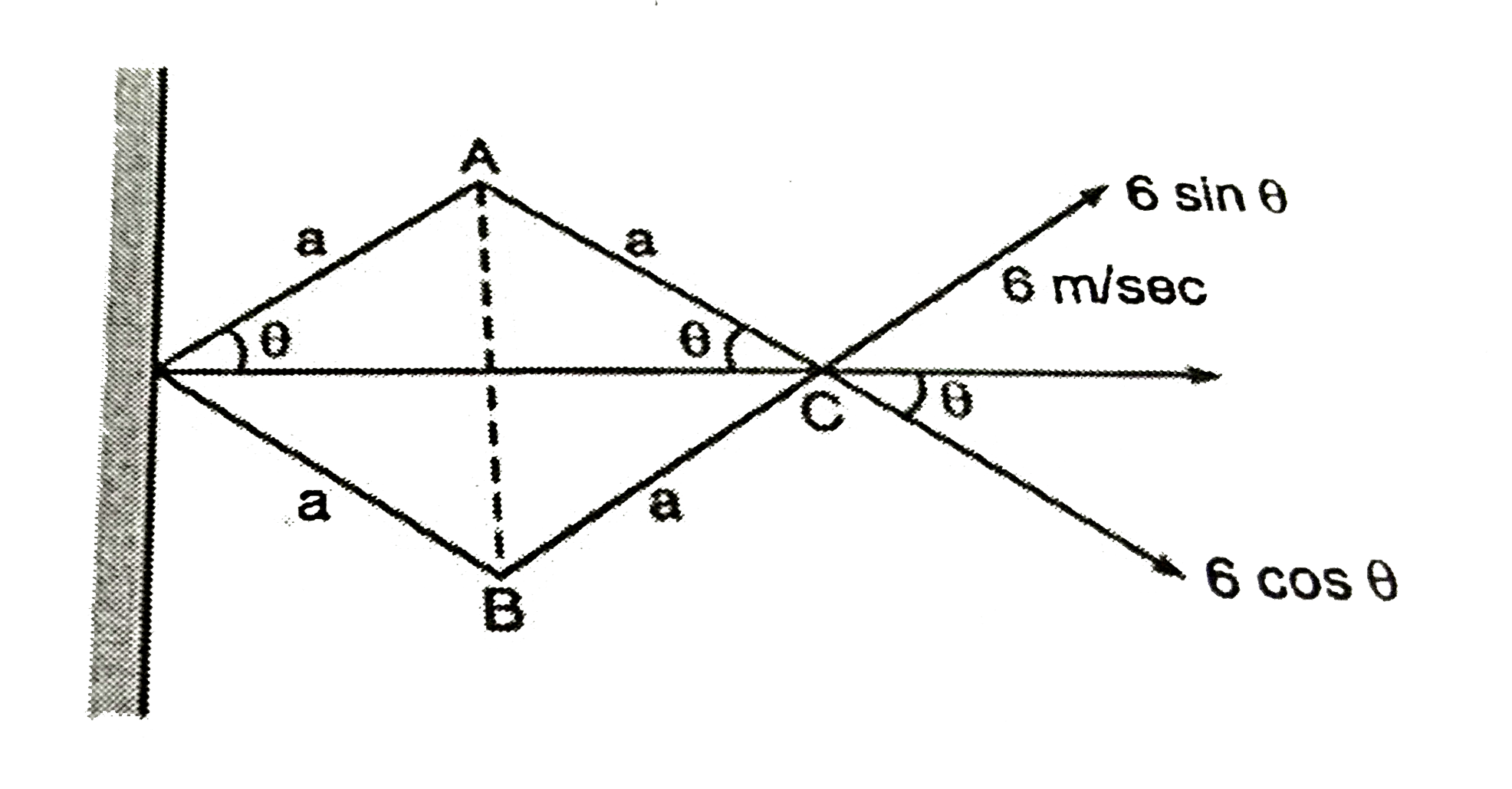 `W=((v_(C))/(2a SIN theta))` `v_(A)=Wxxr_(I)` |
|
| 28. |
Briefly explain how is a horse able to pull a cart |
|
Answer» Solution :Considerthe horseas thesystemthen thereare thereforcesactingon thehorse. (i) Downwardgravitationalforce(m g) (ii) forceexertedby theroad (f) (iii)Backwardforceexertedby thecart (f ) 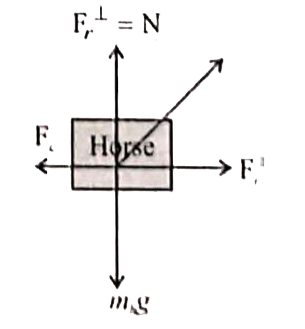 `F_(r)`forceexertedby the roadon the horse `F_(c )` - forceexertedby teh cart on thehorse. `F_(e )` II-Parallelcomponentof `F_(r )`whichis REASONFOR forwardmovement. Letthe forceexertedby theroadcan beresolved intoparalleland perpendicularcomponents. thereis parallelcomponent . so thereis netthan thebackwardforcealongforwarddirctionwhichcausedtheforwardmovementof the horse. (i)Downwardgravitationalforce (ii)Forceexertedby theroad (iii) Forceexertedby teh horse 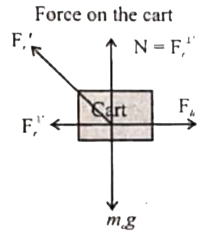 Theforceexertedby teh road`(vec(F )_(r))`can beresolovedintoparalleland perpendicualrcomponents . Theparallelcomponentactingin theopposibledirectionhencethereis an OVERALL unbalancedforcein theforwarddirectionthat causesthe carttoaccelerationforward. If wetakethe cartandhorseas asystemthenthereare twoforcesactingon thesystemthey are (i) Downwardsgravitationalforce (ii ) theforceexertedby theroad `(F_(r))`on THESYSTEM It isshown in the FOLLOWINGFIGURE. 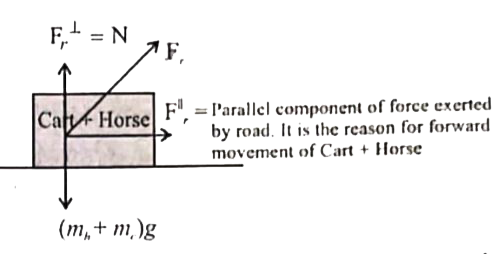 (iii)In thiscase the forceexertedby the road`(F_(r))`on thesystemisresolvedintoparalleland perpendicularcomponents . TheThe perpendicular componenetis the normalforcewhichcancelsthedownward gravitionalfore `(m_(H)+ m_(c ))`g.Theparallelcomponentof the forceisnotbalancedhencethe systemaccelerationand movesforwarddue to thisforce. |
|
| 29. |
In a double star system, two stars of masses m_(1) and m_(2) separated by a distance d rotate about their centre of mass. Then their common angular velocity would be |
|
Answer» `SQRT((Gm_(1))/(d^(3)))` |
|
| 30. |
A person standing near a speeding train has a danger of falling towards the train. Why? |
| Answer» Solution :According to BERNOULLI's theorem sum of PRESSURE head and velocity head is constant. The high speed moving train CREATES high speed WIND near the railway TRACK and the pressure near the railway line decreases. The high atmospheric pressure pushes the man towards the fast moving train. | |
| 31. |
When a man running on a level ground increases his speed by 4ms^(-1), if his kinetic energy increase by 125% his initial velocity is |
|
Answer» `4 ms^(-1)` |
|
| 32. |
Two gases have the same initial pressure,volume and temperature. They expand to the same final volume, one adiabatically and the other isothermally. |
|
Answer» The final TEMPERATURE is GREATER for theisothermal process |
|
| 33. |
Assertion : Work done by conservative forcesisindependentof path followedby the body. Reason : Work doneby non conservative forcesdependson the pathfollowed by thebody . |
|
Answer» If both assertion and reason are corretand reason is a CORRECT explanationof the assertion . |
|
| 34. |
On application of brakes, the velocity of a train decreases from 72 km .h^(-1) to 36 km.h^(-1) in 10 s, due to a constant retardation. Equilibrium of a box kept on a bunk of the train is about ot be disturbed. What is the coefficient of friction between the box and the bunk? |
|
Answer» |
|
| 35. |
A dog weighting 5 kg is standing on a flat boat so that he is 10 metre from the shore. He walks 4 metre on the boat toward shore and then halts. The boat weight 20 kg and one can assume that there is no friction between it and the water. How fat is the dog from the shore at the end of this time ? |
|
Answer» Solution :Given that initially the system is at rest so initial momentum of the system (Dog + boat) is zero. Now as in motion of dog no external force is applied to the system FINAL momentum of the system zero. So, `m vec(v)_(1)+M vec(v)_(2)=0` [as (m + M) = Finite] or `m(Delta vec(r )_(1))/(DT)+M(Delta vec(r )_(2))/(dt)=0 "" ["as "vec(v)=(d vec(r ))/(dt)]` or `m Delta vec(r )_(1)+M Delta vec(r )_(2)=0` [as `Delta vec(r )= vec(d)=` displacement]`md_(1)-Md_(2)=0` [as `vec(d)_(2)` is opposite to `vec(d)_(1)`] i.e., `md_(1)=Md_(2) ""`....(1)  Now when log MOVES 4 m towards SHORE relative to boat, the boat will shift a distance `d_(2)` relative to shore opposite to the displacement of dog so, the displacement of dog relative to shore (towards shore) will be `d_(2)=4-d_(1)(because d_(1)+d_(2)=d_(rel)=4) ""`......(2) substituting the VALUE of `d_(2)` from Eqn. (2) in (1) `md_(1)=M(4-d_(1))` or `d_(1)=(M xx 4)/((m+M))=(20xx4)/(5+20)=3.2m` As initially the dog was 10 m from the shore, so now he will be `10 - 3/2 = 6.8` m away from the shore. |
|
| 36. |
The equation of a wave is, y(x,t)=0.05sin[(pi)/(2)(10x-40t)-(pi)/(4)]m Find, The wavelength, the frequency and the wave velocity. (ii) The particle velocity and acceleration at x=0.5 m and t=0.05 s. |
|
Answer» Solution :The equation may be rewritten as, `y(x,t)=0.05sin(5pix-20pit-(pi)/(4))m` Comparing this with equation of plane progressive harmonic wave, `y(x,t)=ASIN(kx-omegat+phi)` Wave number `K=(2pi)/(lamda)=5pi` rad/m `:.lamda=0.4m` The angular FREQUENCY `omega=2pif=20pi` rad/s `:.f=10Hz` The wave velocity, `v=flamda=(omega)/(k)` `=4ms^(-1)` in + x direction. The particle velocity and acceleration are, `v_(p)=(dy)/(DT)` `=-(20pi)(0.05)COS((5pi)/(2)-pi-(pi)/(4))` `=2.22m//s` `a_(p)=(d^(2)y)/(dt^(2))` `=-(20pi)^(2)(0.05)sin((5pi)/(2)-pi-(pi)/(4))` `=140m//s^(2)` |
|
| 37. |
Tanks A and B open at the top contain two different liquids upto certain height in them. A hole is made to the wall of each tank at a depth 'h' from the surface of the liquid. The area of the hole in A is twice that of in B. If the liquid mass flux through each hole is equal, then the ratio of the densities of the liquids respectively, is |
|
Answer» `2/1` |
|
| 38. |
At a certain instant a stationary transverse wave is found to have maximum kinetic energy. The appearance of string at that instant is |
|
Answer» simusoidal SHAPE with AMPLITUDE `A//3` |
|
| 39. |
The greater and least resultant of two forces are 9 N and 5 N respectively. If they are applied at 60°. The magnitude of the resultant is |
|
Answer» 100 N |
|
| 40. |
The dimensions of coefficient of viscosity are |
|
Answer» `[ML^(-1)T^(-1)]` |
|
| 41. |
Define yield point. |
| Answer» Solution :The stage of a material when it YIELDS to the DEFORMING force and GOES on INCREASING in length even when the load is kept CONSTANT is called yield point. | |
| 42. |
Two identical bodies have temperatures 277^(@)C and 67^(@)C. If the surrounding temperature is 27^(@)C, the ratio of loss of heat of two bodies during the same interval of time is (approx). |
|
Answer» `4:1` |
|
| 43. |
How can we distinguish experimentally between longitudinal and transverse wwaves? |
| Answer» SOLUTION :By performing polarization experiments. TRANSVERSE waves can be POLARIZED while LONGITUDINAL waves cannot be polarized. | |
| 44. |
A satellite has potential energy -8 xx 10^(9)J, then what is its binding energy (escape energy)? |
|
Answer» Solution :Escape energy = `-(-8 XX 10^9)` `= 8 xx 10^(9)J` |
|
| 45. |
Figure shows a box of mass m is placed on a wedge of mass 'M' on a smooth surface. How much force 'F' is required to be applied on 'M' so that during motion 'm' remains at rest on its surface. |
|
Answer» Solution :The force acting on the bodies m and M are shown in the figure ALONG with free body DIAGRAMS of mass m and M. As the two bodies MOVE together, we can find the acceleration of system towards right directly as `a=(F)/(m+M)`  Here the condition is, the small block of mass .m. should remain at rest on the incline surface of the WEDGE block. Look at the FBD of m, the force acting on it towards left is .ma. . It is the pseudo force on it as its reference frame is the wedge. As wedge is moving with an acceleration, we consider m relative to it. Now with respect to wedge, block m is at rest or in equilibrium, we can balance all the forces along the tendency of motion of body (i.e., inclined plane)and perpendicular to it shown in FBD of it. For m to be at rest, from FBD of m, along the plane `mg sin theta = ma cos theta or a =G tan thetaor (F)/(m+M)=g tan theta , F=(m + M) g tan theta ` |
|
| 46. |
A box is put on a scale which is adjested to read zero , when the box is empty . Astream of pebbles is then poured into the box from a height h above its bottom at a rate of n pebbles . Each pebble has a mass m if the pebbles collide with the box such that they immediately come to rest after collision, find the scale reading at time t after the pebbles begin to fill the box . |
|
Answer» |
|
| 47. |
A particle moving along a straight line with initial velocity u and acceleration a continuous its motion for n seconds. What is the distance covered by it in the last nth second? |
|
Answer» Solution :`S=ut+1/2 at^2` Displacement in N SECONDS `=UN +1/2 an^2` Displacement in (n-1) seconds `=U(n-1)+1/2 a(n-1)^(2)` Displacement in nth seconds=Displacement in n seconds -displacement in (n-1) seconds. `S_n=u+a(n-1/2)` |
|
| 48. |
Mass m is split into two parts m and (M-m), which are then separated by a certain distance. What ratio (m/M) maximies the gravitation force between the parts. |
|
Answer» Solution :Ifr is the distance m and (M-m), the GRAVITATION FORCE will be `F = G(m(M-m))/(r^(2)) = (G)/(r^(2)) (mM-m^(2))` For F to be maximum dF/dm = 0 as M and r are constants. i.e., `(d)/(dm)[(G)/(r^(2))(mM-m^(2))] = 0` i.e., `M - 2m = 0` [as `G//r^(2) != 0]` or (m/M) = (1/2), i.e., the force will be maximum when the parts are equal. |
|
| 49. |
A small on rough inclined groove on rough inclined plane of inclination theta. Groove makes an angle alpha as shwon in Fig . 7.173, mu is the coefficient of friction . Which of the following is correct ? |
|
Answer» Normal force by inclined plane . N = mg cos `theta` `N_(2) = mg sin theta sin alpha` `N_(2)` is the plane of INCLINE perpendicular to groove . `N = sqrt(N_(1)^(2) + N_(2)^(2) ) = "If " mu = 0 ` Net force along groove is mg sin `theta cos alpha` . Hence , acceleration is g `sin theta cos alpha` . |
|