

Saved Bookmarks
This section includes 7 InterviewSolutions, each offering curated multiple-choice questions to sharpen your Current Affairs knowledge and support exam preparation. Choose a topic below to get started.
| 1. |
The electric lines of force never intersect one another - Explain this statement. |
| Answer» Solution :If two lines of force INTERSECT, at INTERSECTING point there will be two different directions for electric field, which is not POSSIBLE. Hence electric lines of force never intersect ONE ANOTHER | |
| 2. |
The wavelength of a line of the spectrum of any star as seen by the observer stationed on the earth, shifts towards red end. From this observation he concludes that - |
|
Answer» star is moving AWAY from the EARTH |
|
| 3. |
A rectangular frame of wire is placed in a uniform magnetic field directed outwards normal to the paper. AB is connected to a spring which is stretched to A'B' and then released at time t = 0. Explain qualitatively how induced emf in the coil would vary with time. Neglect damping of oscillations of spring. |
Answer» Solution :When the spring is stretched and released, it oscillates to and fro SIMPLE harmonically. As a result the wire AB ALSO oscillates to and fro about its equilibrium position AB. Due to oscillation of wire AB, magnetic flux linked with 10 the rectangular wire frame CHANGES and hence an INDUCED emf/current is SET up in it. The induced current also oscillates simple harmonically as shown in Fig. 6.45. 
|
|
| 4. |
Susceplibility of a magnetic substance is found to depend on temperature and the strength of the magnetising field. The material is a |
|
Answer» Diamagnet |
|
| 5. |
Suppose [epsilon_(0)] is permittivity of free sapce. If M = mass, L = length, T = time and A = electric current, then......... |
|
Answer» `|epsilon_(0)| = [M^(-1)L^(-3)T^(2)A]` `THEREFORE |epsilon_(0)| =(|q_(1)||q_(2)|)/(4piFr^(2))` `[therefore 4PI "dimensionless"]` `=((AT)(AT))/((M^(1)L^(1)T^(-2))(L^(2))) = M^(-1)L^(-3)T^(4)A^(2)` |
|
| 6. |
A 50 mu F capacitor is connected to a 100 V, 50 Hz a.c. supply. Determine the rms value of the current in the circuit. |
|
Answer» Solution :Here `C = 50 mu F = 50 xx 10^(-6)F = 5 xx 10^(-5)F` `E_(RMS) = 100 V` v = 50 Hz STEP 1 : Capacitive reactance, `X_(C) = (1)/(C omega) = (1)/(C xx 2pi v)` `X_(C) = (1)/(5 xx 10^(-5) xx 2 xx 3.14 xx 50) = 63.69 Omega` Step 2 : `I_(rms) = (E_(rms))/(X_(C)) = (100)/(63.69) = 1.57 A` |
|
| 7. |
If vecA xx vecB=vecC then |
|
Answer» C is prependicular`VECA` only |
|
| 8. |
The value of acceleration due to gravity at a depth of 1600 km is equal to [Radius of earth = 6400 km] |
|
Answer» `9.8 MS^(-2)` DEPTH (d) = 1600 km We KNOW that, `g_(d)=g(1-(d)/(R ))` Here, `g=9.8m//s^(2)` R = 6400 km `g_(d)=g(1-(1600)/(6400))` `= 9.8 (1-(1)/(4))` `=9.8((4-1)/(4))=(9.8xx3)/(4)` `g_(d)=7.35 ms^(-2)` |
|
| 9. |
Two masses m and M(m lt M) are joined by a light string passing over a smooth and light pulley (as shown) |
|
Answer» the ACCELERATION of each MASS is `((M-m)/(M+m))g` |
|
| 10. |
(A): When a body is projected at angle 45^(@) its range is maximum (R): For maximum of range, the value of sin 2 theta should be equal to one. |
|
Answer» Both (A) and (R) are TRUE and (R) is the CORRECT EXPLANATION of (A) |
|
| 11. |
How do you convert a galvanometer into an ammeter ? Why is an ammeter always connected in series? |
|
Answer» Solution :A galvanometer is converted into an AMMETER by joining a shunt resistance `r_s` in parallel. If a galvanometer gives full scale deflection for a current `I_g` and has a resistance `R_G` and we WANT to convert it into an ammeter of RANGE I, the VALUE of shunt resistance should be `r_s = (I_g)/(I - I_g) R_G` An ammeter is always connected in series so that total current passes through it and it gives CORRECT measurement of electric current. |
|
| 12. |
If the frequencies of carrier waves for AM and FM be f_(A) and f_(F) respectively, then |
|
Answer» `f_(A) APPROX f_(F)` |
|
| 13. |
What are the equations for C,E and V of a spherical plate capacitor? |
|
Answer» (I) (I) (J) |
|
| 14. |
A rectangular coil of 20 turns and area of cross - section 25 sq. cm has a resistance of 100 Omega. If a magnetic field which is perpendicular to the plane of coil changes at a rate of 1000 tesla per second, the current in the coil is |
|
Answer» SOLUTION :Induced current, `i=(epsilon)/(R )=((NAdB)/(DT))/(R )` `=(20xx(25xx10^(-4))xx100)/(100)=0.5A` |
|
| 15. |
In an A.C circuit, an inductance L and a capacitance C are joined in series. If it is found that the current in the circuit is maximum when L=0.5H and C=8muC. The angular frequency (omega) of the AC. Will be : |
|
Answer» 500rad/s |
|
| 16. |
A vector vecA makes on angle 30^(@) with the y-axis in anticlockwise direction. Another vector vecB makes on angle 30^(@) with the x-axis in clockwise direction. Find angle between vectors vecA and vecB |
Answer» SOLUTION :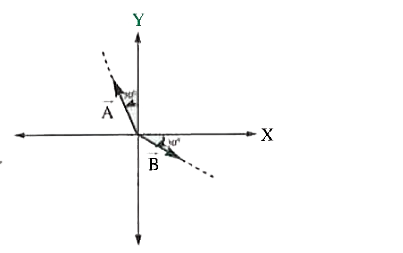 From the DIAGRAM the angle between `vecA and vecB` is `30^(@)+90^(@)=150^(@)` |
|
| 17. |
To determine the half life of a radioactive element, a student plots a graph of In |(dN(t))/(dt)| versus t. Here (dN(t))/(dt) is the rate of radioactive decay at time t. If the number of radioactive nuclei of this element decreases by a factor of p after 4.16 years. the value of p is........... |
|
Answer» Solution :In `A=-lambda t+C` `rArr ln (dN(t)//dt]=-lambdat+C` `lambda=[(4-3)//(6-4)]=1/2 ("from GRAPH")` We have, `t_(1//2)=ln 2//lambda=1.396` `N=N_(0)//2^(3)=N_(0)//8` P=8 |
|
| 18. |
In the circuit shown below C_(1) = 10 mu"F, " C_(2) = C_(3) = 20 muF, and C_(4) = 40mu F. if the charge on C_(1)is 20 muC then potential difference between X and Y is |
| Answer» Answer :B | |
| 19. |
Which special type of diode can act as a voltage regulator? Give the symbol of this diode and draw the general shape of its V-I characteristics. |
| Answer» | |
| 20. |
A current-carrying infinitely long wire is kept along the diameter of a circular wire loop, without touching it. The correct statement(s) is (are) |
|
Answer» The emf INDUCED in the loop is zero if the current is constant. |
|
| 21. |
What is meant by neutron number? |
| Answer» Solution :The NUMBER of NEUTRONS in the nucleus is CALLED neuuton number (N). | |
| 22. |
Figure shows a thin rod (mass M, length L) suspended in a vertical plane by tying ideal strings at ends A and B. Initially, rod makes an angle 30^(@) with horizontal and is at rest. Now, the string connected to the end B is cut. Let T be the tension in the string connected to A and a_(A) be the magitude of acceleration of point A just after the cutting event. Pick correct option (s): |
|
Answer» `T=(3mg)/13` `T l/2 COS THETA=(ml^(2))/12 alpha` By constraints, `a=(alpha l)/2 costheta` Thus, `T=(mg).(1+3cos^(2)theta)` and `a_(A)=(3gsinthetacostheta)/(1+3cos^(2)theta)` 
|
|
| 23. |
From the figure, the gravitational potential at '0' due to three point masses is |
|
Answer» `(GM)/(l)(2+(1)/(SQRT2))` `=-(Gm)/(l)-(Gm)/(l)-(Gm)/(sqrt2l)` `=-(Gm)/(l)[1+1+(1)/(sqrt2)]=-(Gm)/(l)[2+(1)/(sqrt2)]`. |
|
| 24. |
Secondary oocyte is formed in |
|
Answer» PRIMORDIAL follicle |
|
| 25. |
Statement : Two P - N junction diodes placed back to back work as a P - N - P transistor. Statement II : A transistor is current operated device while a triode value is a voltage operated device. |
|
Answer» STATEMENT I is true , statement II is false. |
|
| 26. |
Due to the motion of a charge, its magnitude |
|
Answer» changes |
|
| 27. |
Find the number of neutrons generated per unit time in a uranium reactor whose thermal power is p=100MW if the average number of neutrons liberated in each nuclear splitting is v=2.5. Each splitting is assumed to release an energy E=200MeV. |
| Answer» Solution :`N_(0)` of FISSIONS per UNIT time is clearly `P//E`. HENCE no. of neutrons produced per unit time to `(vP)/(E )`. Substitution gives `7.80xx10^(18) n eutrons//sec` | |
| 28. |
A particle of mass m is located in a unidimensional square potential well with infinitely high walls. The width of the well is equal to l. Find the permitted values of energy of the particle taking into accoint that only those states of the particle's motion are realized for which the whole number of de Broglie half waves are fitted within the given well. |
|
Answer» SOLUTION :The energy INSIDE the wll is all kinetic if energy is measured from the the VALUE inside. We require `l=N lambda//2= n(pi ħ)/(sqrt(2mE))` or `E_(n)=(n^(2)pi^(2) ħ^(2))/(2ml^(2)),n=1,2….` |
|
| 29. |
A ball of mass 0.4 kg thrown up in air with velocity 30 m/s reaches the highest point in 25 seconds. The air resistance encountered by the ball during upward motion is |
|
Answer» 0.48 N |
|
| 30. |
Which charge configuration produces a uniform electric field? |
|
Answer» POINT CHARGE |
|
| 31. |
A parallel beam of monochromatic light of wavelength 5000 Å is incident normally on a single narrow slit of width 0.001 mm. the emergent light is focussed by a convex lens on a screen placed at its focal plane. The first minimum will be formed for the angle of diffraction theta |
|
Answer» `0^(@)` |
|
| 32. |
(a) Calculate the energy released if ""^(238)Uemits an alpha -particle. (b) Calculate the energy to be supplied to ""^(238)Uif two protons and two neutrons are to be emitted 0000one by one. The atomic masses of ""^(238)U, ""^(234)Th and ^(4)Heare 238.0508 u, 234.04363 u and 4.00260 u respectively. |
|
Answer» |
|
| 33. |
In an atom the electron has a time period of 0.16 xx 10^( -15)s in a circular orbit of radius 0.5 A^(0). The magnetic induction at the centre of the orbit will be (in tesla) |
|
Answer» 12.56 |
|
| 34. |
Describe the function of a transistor as an amplifier with the neat circuit diagram.Sketch the input and output wave form. |
|
Answer» Solution :Transistor as an amplifier: A transistor operating in the ACTIVE region has the capability to amplify weak signals. AMPLIFICATION is the process of increasing the signal strength (increase in the amplitude). If a large amplification is required, the transistors are cascaded with coupling elements like resistors, capacitors, and transformers which is called as multistage amplifiers. Here, the amplification of an electrical signal is explained with a single stage transistor amplifier as shown in figure (a). Single stage indicates that the circuit consists of one transistor with the allied components. An NPN transistor is connected in the common emitter configuration. 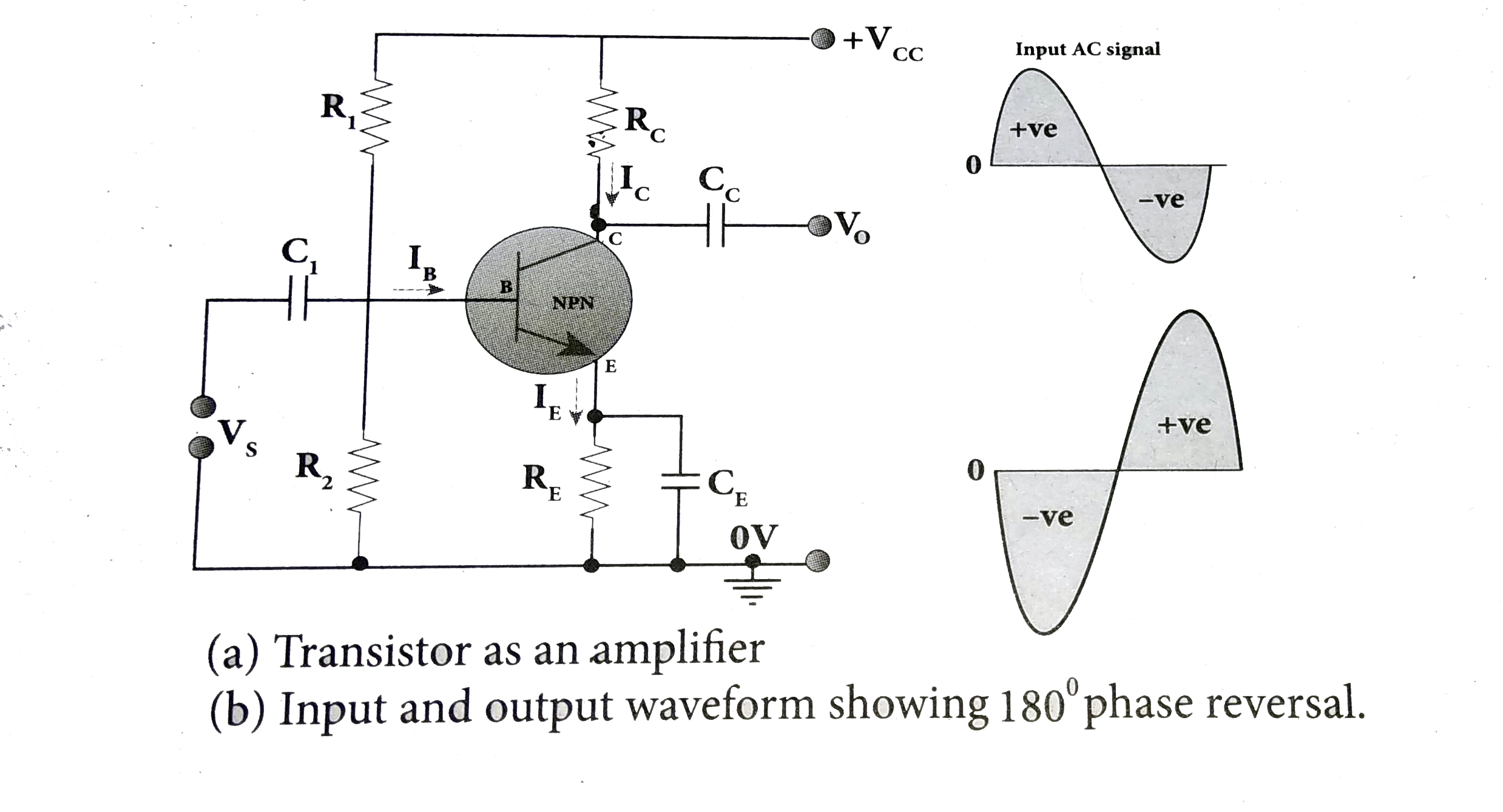 To start with, the point or the operating point of the transistor is fixed so as to get the maximum signal swing at the output (neither towards saturation point nor towards cut-off). A load resistance, `R_(C)`, is connected in series with the collector circuit to measure the output voltage. The capacitor `C_(1)`, allows only the ac signal to pass through. The emitter bypass capacitor CE provides a low reactance path to the amplified ac signal. The coupling capacitor C, is used to couple one stage of the amplifier with the next stage while constructing multistage amplifiers. V is the sinusoidal input signal source applied across the base-emitter. The output is taken across the collector-emitter. Collector current, `I_(C)=betaI_(B)[becausebeta=(I_(C))/(I_(B))]` Applying Kirchhoff.s voltage law in the output loop, the collector-emitter voltage is given by `V_(CE)=V_(CC)-I_(C)R_(C)` Working of the amplifier:. During the positive half cycle Input signal `(V_(s))` increases the forward voltage across the emitter-base. As a result, the base current `(I_(B))` increases. Consequently, the collector current `(I_(C))` increases B times. This increases the voltage drop across R, which in turn decreases the collector-emitter voltage `(V_(CE))`. Therefore, the input signal in the positive direction produces an amplified signal in the negative direction at the output. Hence, the output signal is reversed by 180° as shown in figure (b). • During the negative half cycle Input signal `(V_(s))` decreases the forward voltage across the emitter-base. As a RES base current `(I_(B))`. decreases and in turn increases the collector current `(I_(C))`. The increase in collector current (1) decreases the potential drop across R and increases the collector-emitter voltage `(V_(CE))`. Thus, the input signal in the negative direction PRODUCE an amplified signal in the positive direction at the output. Therefore, `180^(@)` phase reversal is observed during the negative half cycle of the input signal. |
|
| 35. |
The voltage applied across an X-rays tube is nearly equal to : |
|
Answer» 10 V |
|
| 36. |
A body of mass m is placed on earth surface which is taken from earth surface to a height of h=3 R, then change in gravitational potential energy is |
|
Answer» `(mgR)/(4)` Gravitational potential energy at a height h=3R `=-(GM m)/(R+h)=-(GM m)/(R+3R)=-(GM m)/($r)` `:.` Change in potential energy `=-(GM m)/(4R)-(-(GM m)/(R ))=-(GM m)/(4R )+(GM m)/(R )=(3)/(4)(GMm)/(r )` Again, we have, `(GM m)/(R^(2))=MG` (where g is acceleration due to GRAVITY on earth.s surface). `:. (GM m)/(R^(2))=mgR`. `:.` Change in potential energy `=(3)/(4)mgR`. |
|
| 37. |
Given the displacement of the body as x = (2t^4 + 5)m and mass is 2 kg. What is the increase in K.E. in one second : |
|
Answer» 8 J `:.` Velocity after 1 second = 8m/s. Now `K.E."1/2mv^(2)=1/2xx2xx(8)^(2)=64 J` |
|
| 38. |
(a) A current-carrying circular loop lies on a smooth horizontal plane. Can a uniform magnetic field be set up in such a manner that the loop turns around itself (i.e., turns about the vertical axis). (b) A current-carrying circular loop is located in a uniform external magnetic field. If the loop is free to turn, what is its orientation of stable equilibrium? Show that in this orientation, the flux of the total field (external field + field produced by the loop) is maximum. (c) A loop of irregular shape carrying current is located in an external magnetic field. If the wire is flexible, why does it change to a circular shape? |
| Answer» SOLUTION :(a) No, because that would require `tau`to be in the vertical direction. But `tau = IA xx B` ,and since A of the horizontal LOOP is in the vertical direction, τ would be in the plane of the loop for any B. (b) Orientation of stable equilibrium is one where the AREA vector A of the loop is in the direction of EXTERNAL magnetic field. In this orientation, the magnetic field produced by the loop is in the same direction as external field, both normal to theplane of the loop, thus giving rise to maximum flux of the total field. (c) It assumes circular shape with its plane normal to the field to MAXIMISE flux, since for a given perimeter, a circle encloses greater area than any other shape. | |
| 39. |
A balance point in a meter bridge experiment is obtained at 30 cm from the left. If right gap contains 3.5 Omega , what is the resistance in the left gap ? |
|
Answer» Solution :The BALANCING LENGTH from left l= 30cm Resistance in RIGHT gap R= `3.5 Omega` `R= S XX (l)/((100-l))`: `R= 3.5xx(30)/(70) impliesR= 1.5 Omega` |
|
| 40. |
Why cyanobacteria is one of the most independent organism. |
|
Answer» It DEPEND on NITROGEN FIXATION on fungi |
|
| 41. |
Name the electromagnetic radiations having the wavelength ranging from 1 mm to 700 mmGive it's two imortant applications. |
| Answer» SOLUTION :INFRARED radiation. They are USED (i) in remoe control devices and (ii) in HAZE photography. | |
| 42. |
The nuclei _6C^13 and _7N^14can be described as |
|
Answer» isobars |
|
| 43. |
A point source of sound emits waves equally in all directions. The medium surrounding the source of sound is non-absorbing. Two points A and B are situated at a distance of 40 m and 20 m respectively from the source. The ratio of the amplitudes of the waves at A and B is |
|
Answer» `1:2` |
|
| 44. |
What work is performed in dragging a sledge horizontal 15 metre by a force of 25 kg wt acting along a line making an angle 60^@ with the ground. Express in Joule. |
|
Answer» 1535 J |
|
| 45. |
Calculate the refractive index of the material of the lens using the given data. Radius of curvature of the first surface R_(1) = 0.2m Radius of curvature of the second surface R_(2) =0.2 m. |
|
Answer» Solution :Trial 1`:``F= ( D^(2) -S^(2))/( 4D)` `f = ((0.9)^(2) - (0.3)^(2))/(4 xx 0.9)` `f= ( 0.72)/( 0.35 ) = 0.2m` Trial 2 `:``f = ( (0.85)^(2) - ( 0.2)^(2))/(4 xx 0.85)` `f = (0.6784)/(0.34)` Average,`f = 0.199m` ` N = 1+ ( R_(1) R_(2))/(f(R_(1)+R_(2)))` `n = 1+ ( 0.2 xx 0.2)/( 0.1997 xx 0.4)` `n = 1.5 ` |
|
| 46. |
A proton ,a neutron ,an electron and an alpha-particle have same energy.Then their de-Broglie wavelength compare as |
|
Answer» `lambda_(p)=lambda_(n)gtlambda_(e)gtlambda_(alpha)` `lambda=(h)/(p)=(h)/(sqrt(2mk))`…….(1) (`THEREFORE` KINETIC energy of a PARTICLE `K=(p^(2))/(2m)`) Here ,K is same and so, `lambdaprop(1)/(m)`…….(2) Here `m_(alpha) gt m_(p)=m_(n)gtm_(e)` and so from equation (2),`lambda_(alpha)ltlambda_(p)=lambda_(n)ltlambda_(e)` |
|
| 47. |
Figure shows a capacitor having three layers between its plates. Layer x is vacuum, y is conductor, and z is a dielectric. Which of the following change (s) willresult in increase in capacitance? |
|
Answer» REPLACE X by conductor Here effective dielectric CONSTANT of conductor can be TAKEN as infinity. |
|
| 48. |
The volume of a metal sphere increases by 0 cdot 24% when its temperature is raised by 40^(@)C. The coefficient of linear expansion of the metal is…""^(@)C^(-1): |
|
Answer» `2xx10^(-5)` `RARR gamma =(V-V_(0))/(V_(0) Delta T)=(0 cdot 24)/(100xx40)=6xx10^(-5)""^(@)C^(-1)` Now `alpha =(gamma)/(3) =2xx10^(-5)^""(@)C^(-1)` `THEREFORE` Correct choice (a). |
|
| 49. |
The shunt resistance is (3//8)^(th) of that of the galvanometer, then fraction of the main current that passes through the galvanometer is |
| Answer» Answer :A | |
| 50. |
Mark the correct options - |
|
Answer» Gauss's law is valid only for uniform CHARGE DISTRIBUTIONS |
|