

Saved Bookmarks
This section includes 7 InterviewSolutions, each offering curated multiple-choice questions to sharpen your Current Affairs knowledge and support exam preparation. Choose a topic below to get started.
| 1. |
A point object is placed infront of a plane mirror as shown in figure. X_(OM) rArr x - co-ordinate of object relative to mirrorX_(IM) rArr x -x-co-ordinate of image relative to mirrorX_(IM) = -X_(OM)differentiating V_(IM) = 0-V_(OM)V_I - V_M = - (V_0 - V_M) Velocity if image relative to mirror = velocity of object relative to mirror. basing on this information answer the questions Two bodies A and B are moving towards a plane mirror with speeds V_A and V_B respectively as shown in fig. The speed of image of A with respect to the body B is |
|
Answer» `V_A + V_B` |
|
| 2. |
In Figure, a light wave along ray r_(1) reflects once from a mirror and a light wave along ray r_(2) reflects twice from that same mirror and once from a tiny mirror at distance L from the bigger mirror. (Neglect the slight tilt of the rays.) The waves have wavelength lambda and are initially exactly out of phase. What are the (a) smallest. (b) second smallest, and (c) fourth smallest values of L // lambda that result in the final waves being exactly in phase? |
| Answer» SOLUTION :(a) 0.25, (B) 0.75, (C) 1.25 | |
| 3. |
In Figure, a light wave along ray r_(1) reflects once from a mirror and a light wave along ray r_(2) reflects twice from that same mirror and once from a tiny mirror at distance L from the bigger mirror. (Neglect the slight tilt of the rays.) The waves have wavelength 350 nm and are initially in phase. (a)What is the smallest value of L that puts the final light waves exactly out of phase? (b) With the tiny mirror initially at that value of L, how far must it be moved away from the bigger mirror to again put the final waves out of phase? |
| Answer» SOLUTION :(a) 87.5 NM, (B) 175 nm | |
| 4. |
The deflection in a moving coil galvanometer is |
|
Answer» a. directly proportional to the torsional constant of the spring |
|
| 5. |
An object is placed at a distance of 20 cm from the pole of a concave mirror of focal length 10 cm. The distance of the image formed is |
|
Answer» Solution :`1/f=1/v+1/u` `1/(-10)=1/v-1/20` `1/v=1/20-1/10=(10-20)/200` `v=-20cm` |
|
| 6. |
Which of the following units denotes the dimension M^1 L^2 Q^(-2) ? (where Q denotes the electric charge) |
|
Answer» SOLUTION :Energy stored in inductor , `U=1/2LI^2` `therefore L=(2U)/I^2` `therefore` Dimension of L=`"Dimension of U"/("Dimension of" I^2)` `=(M^1L^2T^(-2))/(Q^1T^(-1))^2` `=(M^1L^2 T^(-2))/(Q^2T^(-2))` `=M^1 L^2 Q^(-2) =H` |
|
| 7. |
What is the magnetic moment of each piece when a bar magnet of moment 'M' is cut into two equal parts (i) along its axis and (ii) along its equatorial line. |
|
Answer» Solution : Magnetic moment of the magnet, M = 2LM i) When the magnet is cut ALONG its axis, LENGTH remains same but pole strength becomes m/2. Now the magnetic moment of each piece `= 2l xx (m)/(2) = (M)/(2)` ii) When the magnet is cut along its equatorial LINE, pole strength remains same but length becomes ` (2l)/(2)` Now the magnetic moment of each piece `=(2l)/(2) xx m =(M)/(2)` |
|
| 8. |
What did Gafur do out of hunger? |
|
Answer» He was SHIVERING with HIGH fever |
|
| 9. |
Name the part of electromagnetic spectrum whose wavelength lies in the range of 10^(10) m. Give its one use. |
| Answer» SOLUTION :X-rays REGION. X-rays are used as a DIAGNOSTIC TOOL in medicine. | |
| 10. |
There is anelectric field in + X-direction. If the work done on moving a charge of 0.2C through a distance of 2 m along a line making an angle of 60^(@) with + X-axis is 4j. The value of E is |
| Answer» Answer :D | |
| 11. |
A body is projected horizontally with a speed of 20m/s from the top of a tower . Whatwill be it's speed nearly after 5 sec? Take g = 10m//s^2 |
|
Answer» 54m/s `SQRT(v^2x +v^2y) =sqrt(20^2+50^2)= sqrt2900 = 54m//s` |
|
| 12. |
An electric current is passed through a circuit containing two wires of the same material, connected in parallel. The lengths of the wires are in the ratio of 4:3 and radii of the wires are in the ratio of 2:3 . Find the ratio of the currents passing through the wires. |
|
Answer» Solution :`1_1 : 1_2 = 4:3 , r_1 :r_2 = 2:3` We know that that `R PROP l/(r^2)` `(R_1)/(R_2) = (l_1)/(l_2) xx (r_2^2)/(r_1^2) = 4/3 xx 9/4 = 3/2` SINCE CONNECTED is parallel , current is INVERSELY proportional to resistance ` i prop 1/R implies(i_1)/(i_2) = (R_2)/(R_1) =1/3` |
|
| 13. |
The charges - q, Q, -q are placed along x-axis at x = 0, x = a and x = 2a. If the potential energy of the system is zero, then Q:q is |
| Answer» ANSWER :C | |
| 14. |
To a person going east in a car with velocity of 25km/h, a train appears to move towards north with a velocity 25sqrt3 km/hr. the actual velocity of the train is |
|
Answer» 25km/hr |
|
| 15. |
The distance travelled by an object along theX -axis are given byx= 3t^2, y = 2t^2 + 8 t and z= 6t - 5. The initial velocity of the particle is |
|
Answer» 20 units |
|
| 16. |
In forward biasing of the p-n junction |
|
Answer» <P> the positive terminal of the battery is connected to p-side and the depletion region BECOMES thick. |
|
| 17. |
A cube of side b has a charge q at each of its vertices. Determine the potential and electric field due to this charge array at the centre of the cube. |
| Answer» SOLUTION :POTENTIAL = `4q//(SQRT(3)pi epsilon_(0) b)`, field is zero, as EXPECTED by symmetry. | |
| 18. |
What is a solar cell. |
| Answer» SOLUTION :A SOLAR cell, also known as photovoltaic cell converts light ENERGY directly into ELECTRICITY of ELECTRIC potential difference by photovoltaic effect | |
| 19. |
A compound microscope is of magnifying power 100. The magnifying power of its eyepiece is 4. Find the magnification of its objective. |
|
Answer» 25 |
|
| 20. |
If a mass of 3.6 g is fully converted into energy , how many kilowatt hour of electical energy will be obtained ? |
|
Answer» Solution :The energy OBTAINED is `E = mc^(2) = (3.6 xx 10^(-3) KG ) (3 xx 10^(8) m s^(-1) ) ^(2) = 32.4 xx 10 ^(13) J. Now 1 kilowatt hour `=10^(3) J s ^(-1) xx 3600 s = 3.6 xx 10(6) J`. THUS , `E = 32. 4 xx 10^(13) / 3.6 xx 10^(6) kWh = 9 xx 10^(7) kWh. |
|
| 21. |
How many girls there in the film ? |
|
Answer» Two |
|
| 22. |
Define linear S.H.M. Show that S.H.M.Is a projection of U.C.M. on any diameter. A metal spherecools at the rate of 4^(@)C/min. when its temperatureis 50^(@)C.Findits rate ofcooling at 45^(@)Cif the temperatureof surroundings is 25^(@)C. |
|
Answer» Solution :Linear S.H.M.Is the simplestkind of OSCILLATORYMOTION in WHICHA bodywhen displcedfrom its MEAN position,oscillates 'toand fro'about meanposition and the restoringforce (or acceleration)is alwaysdirectedtowardsits mean positionand its magnitudeis directlytowardsits mean positionand its magnitudeis directly proportionalto the displacementform the meanposition. Consider a particleP movingalongthe circumferenceof a circleof radiusa with uniformangularspeed of `omega` inanticlockwise direction asshown. Particles P alongcircumferenceof the circlehas itsprojectionparticleon diameter ABat point M. 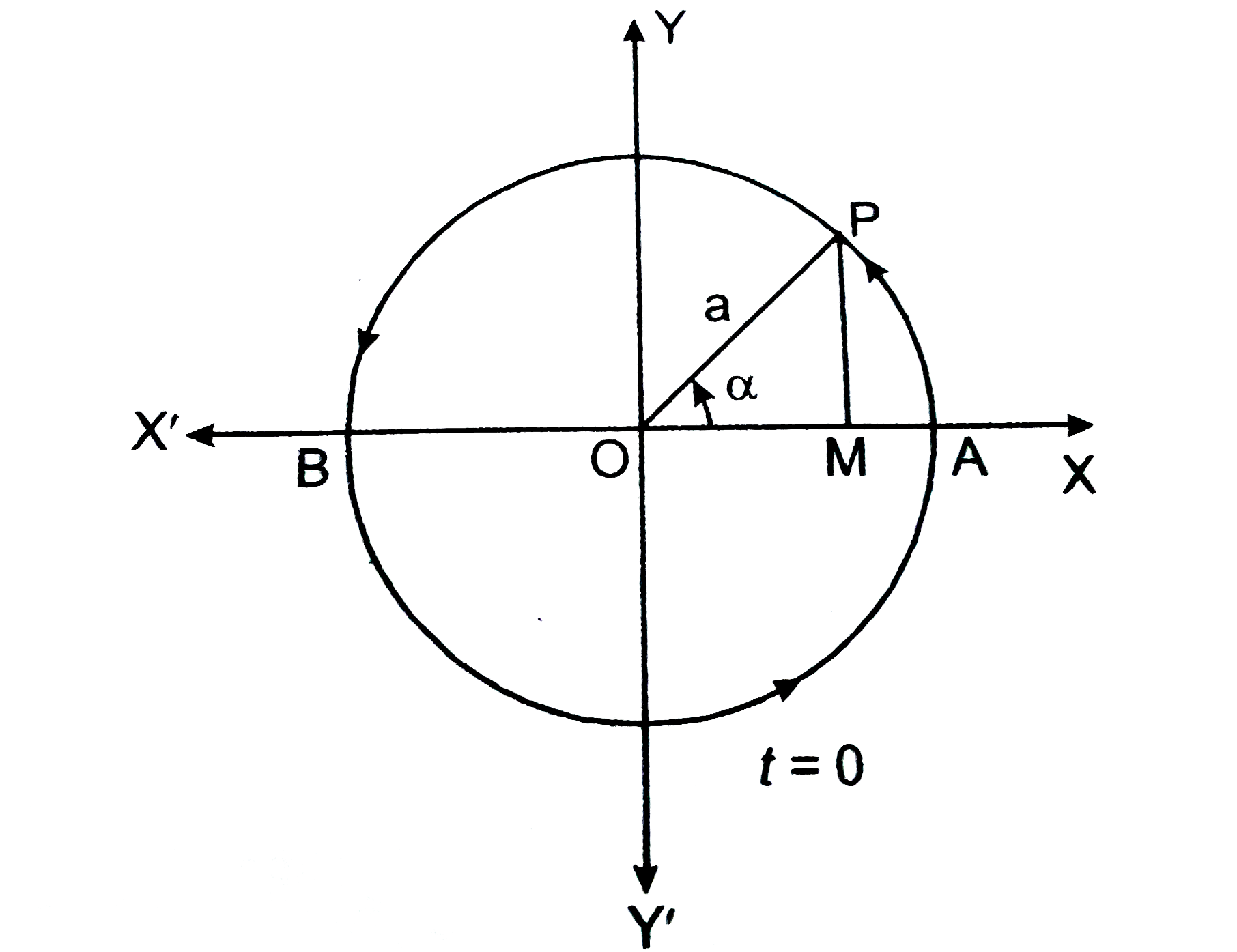 Supposethat particleP startsfrom the initialpositionwith initial phase angle `alpha` (angle betweenradiusOP and the X- axis at the time `t = 0` ) In time t, the anglebetween OP and X-axis is `(omegat + alpha)`particle P movingwith constantangularvelocity `(omega)`as shown. 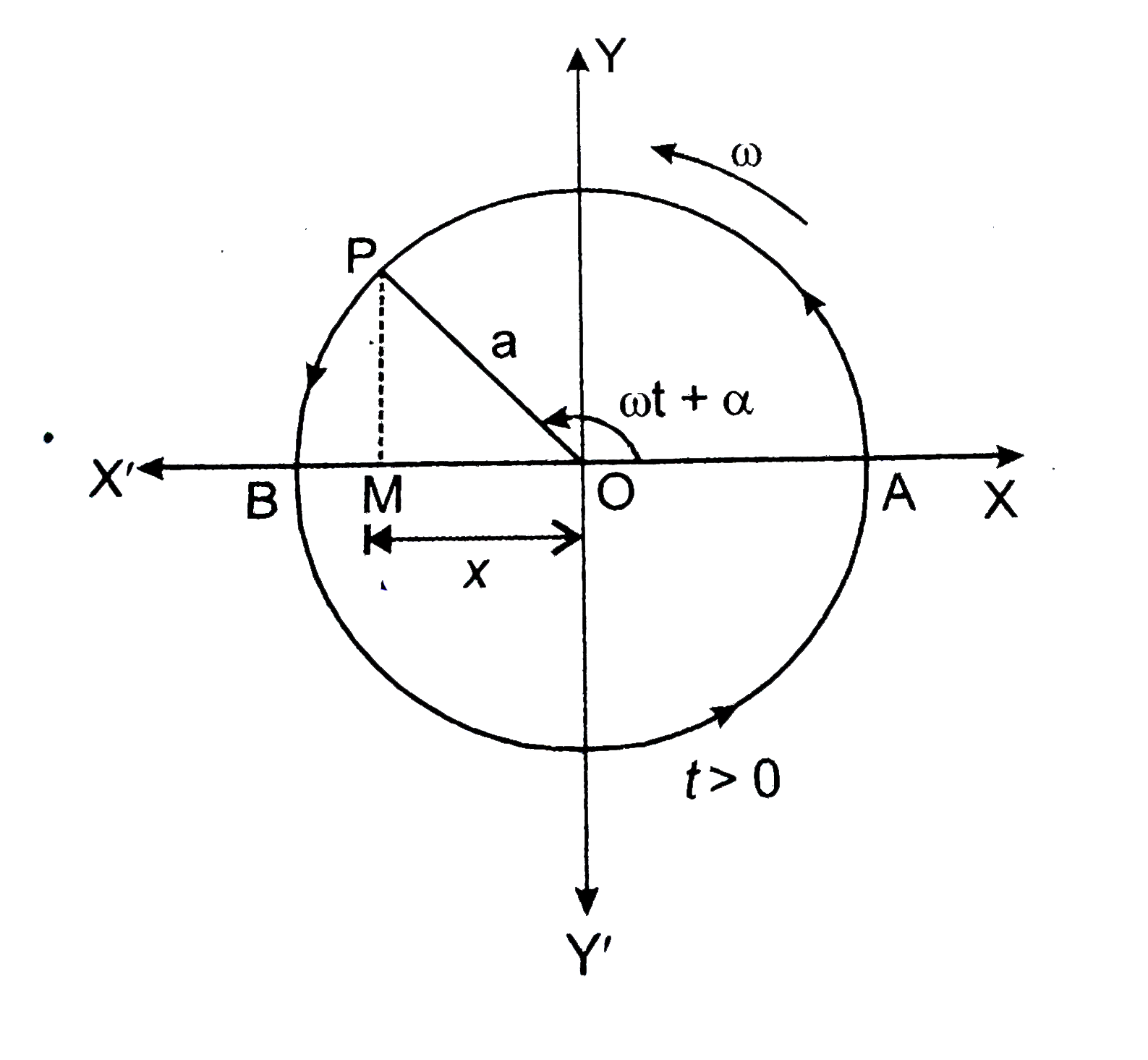 `cos (omegat + alpha) - x/a` `:.x= a cos (omega t + alpha) "..."(i)` This is the expansionfor displacementof particleM at time t. As VELOCITYOF the particleis the time rate of change of displacement then we have `v= (dx)/(dt) = (d)/(dt)` `[a cos (omegat + alpha)]` `:. v = - a omegasin (omegat + alpha) "..."(ii)` As accelerationof particle is the time rate of change of velocity,we have `a = (dv)/(dt) = d/(dt) [-aomega sin (omegat + alpha)]` `:. a = - aomega^(2) cos (omegat + alpha)` `:. a = - omega^(2)x` Hence, the projectionof a uniformcircular motion on a diameterof a circle is simple harmonicmotion. Numerical : Given thatfor the metalsphere, `((dtheta)/(dt))_(1) = 4^(@)C//"min"`. `theta_(1) = 50^(@)C, theta_(2) = 45^(@)C` and `theta_(0) = 25^(@)C` . By Newton's law of cooling, `((d theta)/(dt))= k(theta - theta_(0))` `:. ((d theta//dt)_(1))/((d theta//dt)_(2)) = ((theta_(1)- theta_(0)))/(theta_(2) - theta_(1)))` `:. ((d theta//dt)_(1))/((d theta//dt)_(2)) = ((50^(@) - 25^(@)))/((45^(@) - 25^(@)))` `:. ((d theta)/(dt))_(2) = (20^(@))/(25^(@)) xx ((d theta)/(dt))_(1) = (20^(@))/(25^(@)) xx 4 = 3.2` `:. ((d theta)/(dt))_(2) = 3.2^(@)C//"min"` |
|
| 23. |
The wires which connect the battery ofan automobile to its starting motor carry current of 300 A ( for a short time ). What is the force per unit lenght between the wire if they are 70 cm long and 1.5 cm a part ? Is the force attractive or repulsive ? |
|
Answer» Solution :I= 300 A , l= 70 cm, R= 1.5 cm `F = (mu_0I_1I_2)/(2pi r) = ( 4 pi xx 10^(-5) xx 300 xx 300 )/(2 xx 1.5 xx 10^(-2)) = 1.2 N` The force is REPULSIVE. |
|
| 24. |
Dipole moment of coil is 2hati+3hatj+5hatk. If this coil is placed in uniform magnetic field having magnitude 3hatkT, torque acting on it is _____ Nm. |
|
Answer» `sqrt35` `vectau=9hati-6hatj+0hatk=9hati-6hatj` `|vectau|=sqrt(81+36)` `therefore|vectau|=sqrt117` |
|
| 25. |
If the two ends of a p-n junction are joined by a wire |
|
Answer» <P>there will not be a steady CURRENT in the circuit |
|
| 26. |
Metal wire is connected in the left gap, Germanium connected in the right gap of metre bridge and balancing point is found at 50 cm. Metal wire is heated and Germanium is cooled so that variations of resistances in them are equal. Then the balancing point |
|
Answer» will not shift |
|
| 27. |
Two bodies of equal masses are heated at a uniform rate under identical conditions. The change in temperature in the two cases is shown graphically. The ratio of their specific heats in the solid state is |
|
Answer» `1:3` |
|
| 28. |
Refractive index (n) of a material medium is given by n = _____. |
| Answer» SOLUTION :`(1)/SQRT(mu_0epsilon_0)` | |
| 29. |
The radius of circular path for a charged particle of mass 'm' having charge q and kinetic energy K in a uniform , normal magnetic field B is ………………… . |
| Answer» SOLUTION :`r = (SQRT(2 MK))/(QB)` | |
| 30. |
A particle of mass m is suspended from a string so that it can move in a circular path in vertical plane. It is given v=3sqrt(gl)at the bottom most point. Match the values of tension in string at A,B,C,D {:("Column I",, "Column II"),("(A) "T_(A),,"(P)10 mg ),("(B)" T_(B),,"(Q)7 mg"),("(C) " T_(C),,"(R)4 mg "),("(D)" T_(D),,"(S)5 mg "),(,,"(T)5.5 mg"):} |
|
Answer» <P> Q R T |
|
| 31. |
Frequency of an oscillator is given by |
|
Answer» `2pisqrt(LC)` |
|
| 32. |
Say whether radio signals are plane polarised or circularly polarised? |
| Answer» Solution :RADIO SIGNALS transmitted to a satellite are circularly polarised radio waves in which ELECTRIC FIELDS are ROTATED. | |
| 33. |
The difference between kinetic energies of photoelectrons emitted from a surface by light of wavelength 2500 A^@ and 5000 A^@ will de : |
| Answer» Answer :B | |
| 34. |
A signal wave of frequency 12 kHz is modulated with a carrier wave of frequency 2-51 MHz. The upper and lower side band frequencies are respectively. |
|
Answer» 2512 KHz and 2508KHz The upper SIDE BAND FREQUENCY =2510+12=2522 KHz The lower side band frequency `=2510-12=2498KHz`. |
|
| 35. |
Two charges -q and +q are located at points (0,0-a) and (0,0-a), respectively. (a) What is the electrostatic potential at the points (0,0,z) and (x,y,0) ? (b) Obtain the dependence of potential on the distance r of a point from the origin when r//a gt gt1. (c) How much work is done in moving a small test charge from the point (5,0,0) to (-7,0,0) along the x-axis? Does the answer change if the path of the test charge between the same points is not along the x-axis ? |
|
Answer» <P> Solution :Here - q is at (0,0 -a) and + q is at (0,0 a)(a) Potential at (0,0,z) would be `V = (1)/(4 pi epsilon_(0)) ((-q)/(z + a)) + (1)/(4 pi epsilon_(0)) ((q)/(z - a))` `= (q(z + a - z + a))/(4 pi epsilon_(0) (z^(2) - a^(2))) = (q^(2) a)/(4 pi epsilon_(0) (Z^(2) - a^(2)))` `V = (P)/(4 pi epsilon_(0) (z^(2) - a^(2)))` potential at (x,y,0) i.e., at a point 1 to z axis where charges are located is zero We have proved that `V = (P cos THETA)/(4 pi epsilon_(0) (r^(2) - a^(2) cos^(2) theta))` if `(r )/(a) gt gt 1` then `a lt lt r :. V = (P cos theta)/(4 pi epsilon_(0) r^(2))` `:. V = (1)/(r^(2))` i.e., potential is inversly PROPORTIONAL to square of the distance (c ) Potential at (5,0,0) is `V_(1) = (-q)/(4 pi epsilon_(0)) (1)/(sqrt((5 - 0)^(2)) + (-a)^(2)))` `+ (q)/(4 pi epsilon_(0)) (1)/(sqrt((5 - 0)^(2) + a^(2)))` `= (-q)/(4 pi espilon_(0)sqrt(25 + a^(2))) + (q)/(4 pi epsilon_(0) sqrt(25 + a^(2))) = 0` Potential at (-7, 0,0) `V_(2) = (-q)/(4 pi epsilon_(0)) (1)/(sqrt((-7 -0)^(2) + a^(2)))` = zero As work done = charge `(V_(2) - V_(1))` W = zero As work done by electrostatic field is independent of the path connecting the two points THEREFORE work done will CONTINUE to be zero along every path. |
|
| 36. |
The total number of electrons in the human body is typically in the order of 10^(28) . Suppose due to some reason you and your friend lost 1% of this number of electrons. Calculate the electrostatic force between you and your friend separated at a distance of 1m. Compare this with your weight . Assume mass of each person is 60 kg and use point charge approximation. |
|
Answer» Solution :Number of electrons in the human body `=10^(28)` Number of electrons in me and my friend after lost of `1%= 10^(28)xx1%` `=10^(28)xx(1)/(100)` `n = 10^(26)` electrons Separation distance d= 1 m Charge of each person q `= 10^(26)xx1.6xx10^(-19)` `q= 1.6xx10^(7)`C ELECTROSTATIC FORCE `F= (1)/(4piepsilon_(0))(q_(1)q_(2))/(r^(2))= (9xx10^(9)xx1.6xx10^(7)xx1.6xx10^(7))/(1^(2))` `F=2.304 xx10^(24)N ` Mass of the person M = 60 kg Accelerationdue to gravity g = `9.8ms^(2)` Weight (W) = mg `=60 xx9.8` W = 588 N Comparison : Electrostatic force is equal to `3.92 xx10^(21)` times of weight of the person. |
|
| 37. |
A steel beam used in the construction of a bridge has a length of 30.0 m when the temperature is 15^(@)C. On a very hot day, when the temperature is 35^(@)C, what will the beam's change in length be? (The coefficient of linear expansion for structural steel is +1.2xx10^(-5)//""^(@)C.) |
|
Answer» Solution :The change in LENGTH o the beam is `DeltaL=alphaL_(0)DeltaT=(1.2xx10^(-5))/(""^(@)C)(30.0m)(35^(@)C-15^(@)C)=7.2xx10^(-3)m=7.2mm` As we're mentioned, substances also undergo volume changes when HEAT is lost or ABSORBED. The change in volume `DeltaV`, corresponding to a temperature change, `DeltaT`, is GIVEN by the equation `DeltaV=betaV_(0)DeltaT` Where `V_(0)` is the sample's initialvolume and `beta` is the coefficient of volume expansion of the substance. since we're now LOOKING at the change in a three-dimensional quantity (volume) rather than a one-dimensional quantity (length), for most solids, `beta=3alpha`. nearly all substances have a positive value of `beta`, which means they expand upon heating, an extremely important example of a substance with a negative value of `beta` is liquid water between `0^(@)C and 4^(@)C`. unlike the vast majority of substances, liquid water expands as it nears its freezing point and solidifies (which is why ice has a lower density and floats in water). |
|
| 38. |
What is resistance ? |
| Answer» Solution :The property by VIRTUE of which a MATERIAL OPPOSES flow of CURRENT in it, is called resistance. | |
| 39. |
2q and 3q are two charges separated by a distance 12 cm on X-axis. A third charge q is placed at 5 cm on yaxis as shown in figure. Find the change in potential energy of the system if q is moved from initial position to a point on X-axis in circular path |
|
Answer» `(q^2)/(4 PI epsi_0)` |
|
| 40. |
What is space wave propagation? State the factors which limit its range of propagation. Derive an expression for the maximum line of sight distance between two antennas for space wave propagation. |
|
Answer» Solution :Factors which LIMIT the RANGE of PROPAGATION : At frequencies HIGHER than 40 MHz , the space waves scatter more easily and the communication is limited to LINE- of -sight propagation. Because of the line- of nature of propagation, direct waves get blocked at some point by the curvature of the Earth. |
|
| 41. |
After absorbing a slowly moving neutron of Mass m_(N) (momentum ~~0 ) a nucleus of mass M breaks into two nuclei of masses m_(1)and5m_(1) (6m_(1)=M+m_(N)) respectively. If the de Broglie wavelength of the nucleus with mass m_(1) is lamda the de Broglie wavelength of the nucleus will be |
|
Answer» `5lamda` `P_(1)=P+P_(2)` `P_(1)=P_(2)` `0+P_(1)+P_(2)` `(P_(1)=-P_(2))` `lambda_(1)=(H)/(P_(1))` `lambda_(2)=(h)/(P_(2))` `|lambda_(1)|=|lambda_(2)|` `lambda_(1)=lambda_(2)` |
|
| 42. |
Calculate the cut-off wavelength and cutoff frequency of x-rays from an x-ray tube of accelerating potential 20,000 V. |
|
Answer» Solution :The cut-off wavelength of the CHARACTERISTIC x-rays is `lambda_(0) = (12400)/(V) Å = (12400)/(20000) Å = 0.62 Å` The corresponding frequency is `V_(0) = (C)/(lambda_(0)) = (3 xx 10^(8))/(0.62 xx 10^(-10))= 4.84 xx 10^(18)` Hz |
|
| 43. |
v_(1) and v_(2) are the velocities of sound at the same temperature in two monoatomic gases of densities rho_(1) and rho_(2) respectively. If (rho_(1))/(rho_(2))=(1)/(4) then the ratio of velocities v_(1) and v_(2) is |
|
Answer» `1:2` |
|
| 44. |
A body of mass M while falling vertically downwards under gravity breaks into two parts , a body B of mass (1)/(3)M and body C of mass (2)/(3)M. The centre of mass of bodies B and C taken together shifts compared to that of body A towards : |
|
Answer» DEPENDS on the height of BREAKING |
|
| 45. |
An infinitely long thin wire carrying a uniform linear static charge density lambda is placed along the z - axis. The wire is set into motion along its length with a uniform velocity V=v hat(k)_(z). Calculate the pointing vector S=(1)/(mu_(0))(vec(E )xx vec(B)). |
|
Answer» Solution :Electric field produced due to infinitely long CHARGED WIRE, `vec(E )=(lambda)/(2pi in_(0)a)HAT(j) ""` …(1) 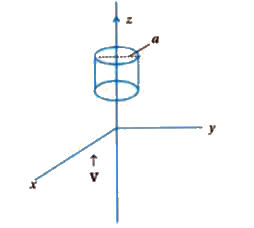 a = radius of cylinderical Gaussian surface AROUND wire. Magnetic field at .a. distance from current carrying conductor, `vec(B)=(mu_(0)I)/(2pi a)hat(i)` but `I=(Q)/(t)=(lambda L)/(t)=lambda v [because Q=lambda L " and " (L)/(t)=v]` Here L = length `therefore vec(B)=(mu_(0)lambda v)/(2pi a) ""`...(2) Now pointing vector, `S=(1)/(mu_(0))(vec(E )xx vec(B))` `therefore S=(1)/(mu_(0))[(lambda)/(2pi a)hat(j)xx(mu_(0)lambda v)/(2pi a)hat(i)]` `=(1)/(mu_(0))((lambda)/(2pi a)xx(mu_(0)lambda v)/(2pi a))(hat(j)xx hat(i))` `=(lambda^(2)v)/(4pi^(2)in_(0)a^(2))(-hat(k)) ""[because hat(j)xx hat(i)=-hat(k)]` `therefore S=-(lambda^(2)v)/(4pi^(2)in_(0)a^(2))hat(k)` |
|
| 46. |
An electric toaster uses nichrome for its heating element. When a negligibly small current passes through it, its resistance at 27^(@)C is found to be 73.2Omega. When the toaster is connected to a 230 V supply, the current settles after a few seconds, to a steady value of 2.748 A. What is the steady temperature of the nichrome element? The temperature coefficient of resistance of nichrome averaged over the temperature range involved, is 1.70xx10^(-4)""^(@)C^(-1) |
|
Answer» Solution :When the current through the element is very small, heating EFFECTS can be ignored and the TEMPERATURE T, of the element is the same as room temperature. When the toaster is connected to the supply, its initial current will be SLIGHTLY higher than its steady value of 2.748 A. But due to heating effect of the current, the temperature will rise. This will cause an increase in resistance and a slight decrease in current. In a few seconds, a steady state will be reached when temperature will rise no further, and both the resistance of the element and the current drawn will ACHIEVE steady values. The resistance `R_(2)` at the steady temperature `T_(2)` is `i_(1)` :`i_(2)`:..........`i_(n)`=`(1)/(R_(1))`:`(1)/(R_(2))`.........`(1)/(R_(n))` Using the RELATION `R_(2)` = `R_(1) [1 + a (T_(2)-T_(1) )]` with a = `1.70 xx 10^(-4)""^(@)C` we get `T_(2)-T_(1)`=`((83.7-73.2))/( (75.3)xx1.70x10^(-4))`=`843.78""^(@)C`that is, `T_(2)=(843.78+27.0)""^(@)C`=`870.78""^(@)C``T_(2)-T_(1)`=`((83.7-73.2))/( (75.3)xx1.70x10^(-4))`=`843.78""^(@)C` Thus, the steady temperature of the heating element (when heating effect due to the current equals heat loss to the surroundings) is `870.78""^(@)C`. |
|
| 47. |
Name the part of electromagnetic spectrum which is suitable for (i) radar system used in aircraft navigation (ii) treatment of cancer tumours. |
| Answer» SOLUTION :(i) MICROWAVE (II) GAMMA RAYS | |
| 48. |
A body projected at an angle 45° with horizontal has range 16 m. It explodes into two parts of equal masses at the highest point. One of parts falls downwards at the point of explosion. At what distance from the point of throw, the other will fall ? |
|
Answer» 8m `:.u=4sqrt(10)ms^(-1)` Applying law of conservation of momentum at the highest point. `mucostheta=m/2(-ucostheta)+m/2v` This gives `ucostheta=(-ucostheta)/2+v/2` `3ucostheta=v`…(i) or `v=3xx4sqrt(10)xx1/sqrt(2)=12SQRT(5)ms^(-1)` Max. height, `h=R_(max)/4=4m` TIME TAKEN for vertical fall `t=sqrt((2h)/g)=sqrt((2xx4)/10)=2/sqrt(5)s` `:.` Horizontal distance covered `x=vxxt=12sqrt(5)xx2/sqrt(5)=24m` Total distance=R/2+x Total distance = 8 + 24 = 32 m from point of THROW. |
|
| 49. |
Assertion : If a convex lens of glass is immersed in water its power decreases. Reason : In water it behavesas a convex lens. |
|
Answer» If both the ASSERTION and reason are true statement andreason is correct explanation of the assertion . |
|
| 50. |
Three identical rods A, B and C are placed end to end. A temperature difference is maintained between the free ends of A and C. The thermal conductivity of B is thrice that of C ands half of that of A. The effective thermal conductivity of the system will be (K_(A) is the thermal conductivity of rod A) |
|
Answer» `1/3K_(A)`  Given, `K_(B)=K_(A)//2` and `K_(B)=3K_(C)` `:.K_(C)=K_(A)//6` Rods are in series from so `(L)/(K)=(l_(1))/(K_(A))+(l_(2))/(K_(B))+(l_(3))/(K_(C ))""(becausel=l_(1)=l_(2)=l_(3))` `(3l)/(K)=(l)/(K_(A))+(l)/(K_(1)//2)+(l)/(K_(A)//6)` or `(3l)/(K)=(9L)/(K_(A))` or `K=(K_(A))/(3)` So, correct choice is (a). |
|