

Saved Bookmarks
This section includes 7 InterviewSolutions, each offering curated multiple-choice questions to sharpen your Current Affairs knowledge and support exam preparation. Choose a topic below to get started.
| 1. |
From what height a piece of ice at zero degree fall in order that it may melt on reaching the ground, assumin8 no loss of energY on the way : (J=4 cdot 2J// cal): |
|
Answer» `3 cdot 4xx10^(6) cm` `therefore` Work done W=mgh. Heat produced `Q=(W)/(J) =(mgh)/(J)` Heat REQUIRED to melt ice block Q.=mL `therefore (mgh)/(J)=mL` `h=(JL)/(g)=(4 cdot 2 xx80xx10^(3))/(9 cdot 8)` `=3 cdot 4xx10^(4)m =3 cdot 4 xx10^(6) cm` Thus, correct choice is (a). |
|
| 2. |
The wavelength of a microwave is 3.0 mm and it's electric field has an amplitdude of 4Vm^(1). Find the amplitude of the magnetic field of the micro wave? |
| Answer» SOLUTION :`lambda=3.0mm=3.0xx10^(-3) m`, Amplitude of magnetic FIELD `B_0=(E_0)/C=(4)/(3xx10^8)=1.33xx10^(-7)T`. | |
| 3. |
At absolute zero silver wire behaves as |
|
Answer» SUPER conductor |
|
| 4. |
Find the kinetic energy, potential energy and total energy in first and second orbit of hydrogen atom if potential energy in first orbit is taken to be zero. |
|
Answer» SOLUTION :`E_(1)=-13.60eV,K_(1)=-E_(1)=13.60eV` `U_(1)=2E_(1)=-27.20eV` `E_(2)=-3.40eV""K_(2)=3.40eV` and `U_(2)=-6.80eV` Now, `U_(1)=0`, i.e., potential energy has been INCREASED by 27.20eV. So, we willincrease U and E in all energy states by 27.20eV while kinetic energy will remain unchanged. Hence `K(eV),U(eV),E_(eV)` FIRST orbit are 13.6, 0, 13.6 in SECOND orbit 3.40, 20.40, 23.80 |
|
| 5. |
What is the path difference between the two waves,when the crest of one wave falls on the crest of the other? |
| Answer» SOLUTION :`delta=nlamda` | |
| 6. |
The kinetic energy of a compressed gas is less than that of a rarefied gas at the same temperature. Why? |
| Answer» Solution :Here the kinetic energy of MOLECULES is the same as both are at the same TEMPERATURE.. Now consider the case of compressed gas. In compression process, the molecules come closer and the mutual ATTRACTION between molecules increases. The potential energy is added to the internal energy. As the potential energy is negative and hence the TOTAL internal energy of the compressed gas decreases | |
| 7. |
The A.C. voltage and the current in a circuit are given by the following expressions. V=110sqrt2 cos (2000t + 25^@)V and I = 10sqrt2 cos (2000t - 20^@)A. Calculate impedance and resistance of the circuit. |
|
Answer» 7.679 `Omega` `V_m=110sqrt2V` `I_m=10sqrt2A` `omega`=2000 rad/s `delta=delta_2-delta_1=20^@-(-25^@)=45^@` Fro L-C-R series circuit `TAN delta=(omegaL-1/(OMEGAC))/R` `tan45^@ = (omegaL-1/(omegaC))/R` `therefore R=omegaL-1/(omegaC)`....(1) `[because tan45^@=1]` Now, `|Z| = sqrt(R^2+(omegaL-1/(omegaC))^2)` `=sqrt(R^2+R^2)` [From (1)] `therefore |Z|=sqrt2R` ...(2) But `|Z|=V_m/I_m=(110sqrt2)/(10sqrt2)=11Omega` `therefore` From EQUATION (2), `|Z|=sqrt2R` `11=sqrt2R` `therefore R=11/sqrt2` `=11/1.414` `therefore R=7.779 Omega` |
|
| 8. |
Refer .for what valueof R (in ohm) will the current in galvanmeter G be zero |
|
Answer» then POT DIFF across `R Omega = 7 V` pot diff across `5 Omega= 12 - 7= 5 V` current in `5 Omega` = (5)/(5) = 1A` Resistance, `R = (7)/(1)= 7 Omega ` |
|
| 9. |
How would you set up a circuit to obtain NOT gate using a transistor? |
Answer» Solution : For case I: When `A=0, I_(B)=0` `RARR I_(C )=beta I_(B)=0` Now `V_(C C)=I_(C )R_(C )+V_(CE)` `=0+v_(0)` `therefore v_(0)=V_(C C)=5V` `rArr` STATE of output `C=1rArrC=barA` For case II : When `A=1, I_(B)=` MAX. `rArr I_(C )=beta I_(B)=`max. Now `V_(C C)=I_(C )R_(C )+V_(CE )` `5=5+V_(CE)""(because I_(C )="max.")` `therefore v_(0)=V_(C C)=0` `rArr ` State of output `C=0 rArr C=barA` Thus, above circuit BEHAVES like NOT gate.  Thus, `C=barA` |
|
| 10. |
During alpha-decay , a nucleus decays by emitting an alpha-particle ( a helium nucleus ._2He^4) according to the equation ._Z^AX to ._(Z-2)^(A-4)Y+._2^4He+Q In this process, the energy released Q is shared by the emitted alpha-particle and daughter nucleus in the form of kinetic energy . The energy Q is divided in a definite ratio among the alpha-particle and the daughter nucleus . A nucleus that decays spontaneously by emitting an electron or a positron is said to undergo beta-decay .This process also involves a release of definite energy . Initially, the beta-decay was represented as ._Z^AX to ._(Z+1)^AY + e^(-)"(electron)"+Q According to this reaction, the energy released during each decay must be divided in definite ratio by the emitted e' (beta-particle) and the daughter nucleus. While , in alpha decay, it has been found that every emitted alpha-particle has the same sharply defined kinetic energy. It is not so in case of beta-decay . The energy of emitted electrons or positrons is found to vary between zero to a certain maximum value.Wolfgang Pauli first suggested the existence of neutrinoes in 1930. He suggested that during beta-decay, a third particle is also emitted. It shares energy with the emitted beta particles and thus accounts for the energy distribution. When a nucleus of mass number A at rest decays emitting an alpha-particle , the daugther nucleus recoils with energy K . What is the Q value of the reaction ? |
| Answer» ANSWER :D | |
| 11. |
Give the range of the value of alpha and beta. |
|
Answer» |
|
| 12. |
Theequation ofa simple harmonic motion is pi=0.34cos(3000t+0.74) wherex and t are in mm and s respectively. The frequency of the motion is : |
|
Answer» 3000 Comparing it with `x=r cos (omega t+phi)` We have `omega=300 s^(-1):.v=(omega)/(2pi)=(3000)/(2pi)` Hz Correct choice is ( C ). |
|
| 13. |
During alpha-decay , a nucleus decays by emitting an alpha-particle ( a helium nucleus ._2He^4) according to the equation ._Z^AX to ._(Z-2)^(A-4)Y+._2^4He+Q In this process, the energy released Q is shared by the emitted alpha-particle and daughter nucleus in the form of kinetic energy . The energy Q is divided in a definite ratio among the alpha-particle and the daughter nucleus . A nucleus that decays spontaneously by emitting an electron or a positron is said to undergo beta-decay .This process also involves a release of definite energy . Initially, the beta-decay was represented as ._Z^AX to ._(Z+1)^AY + e^(-)"(electron)"+Q According to this reaction, the energy released during each decay must be divided in definite ratio by the emitted e' (beta-particle) and the daughter nucleus. While , in alpha decay, it has been found that every emitted alpha-particle has the same sharply defined kinetic energy. It is not so in case of beta-decay . The energy of emitted electrons or positrons is found to vary between zero to a certain maximum value.Wolfgang Pauli first suggested the existence of neutrinoes in 1930. He suggested that during beta-decay, a third particle is also emitted. It shares energy with the emitted beta particles and thus accounts for the energy distribution.During beta^+ decay (positron emission) a proton in the nucleus is converted into a neutron, positron and neutrino. The reaction is correctly represented as |
|
Answer» `._Z^AX to ._(Z-1)^(A-1)X + E^(+) + v`+ ENERGY |
|
| 14. |
During alpha-decay , a nucleus decays by emitting an alpha-particle ( a helium nucleus ._2He^4) according to the equation ._Z^AX to ._(Z-2)^(A-4)Y+._2^4He+Q In this process, the energy released Q is shared by the emitted alpha-particle and daughter nucleus in the form of kinetic energy . The energy Q is divided in a definite ratio among the alpha-particle and the daughter nucleus . A nucleus that decays spontaneously by emitting an electron or a positron is said to undergo beta-decay .This process also involves a release of definite energy . Initially, the beta-decay was represented as ._Z^AX to ._(Z+1)^AY + e^(-)"(electron)"+Q According to this reaction, the energy released during each decay must be divided in definite ratio by the emitted e' (beta-particle) and the daughter nucleus. While , in alpha decay, it has been found that every emitted alpha-particle has the same sharply defined kinetic energy. It is not so in case of beta-decay . The energy of emitted electrons or positrons is found to vary between zero to a certain maximum value.Wolfgang Pauli first suggested the existence of neutrinoes in 1930. He suggested that during beta-decay, a third particle is also emitted. It shares energy with the emitted beta particles and thus accounts for the energy distribution. The beta particles (positron) are emitted with different kinetic energies because |
|
Answer» Neutrino shares a definite amount of energy with positron |
|
| 15. |
Three identical square plates rotate about the axes shown in the figure in such a way that their kinetic energies are equal. Each of the rotation axes passes through the centre of the square. Then the ratio of angular speeds omega_(1) : omega_(2) : omega_(3) is |
|
Answer» `1:1:1` or `OMEGA^(2)=(2K_(R))/I` Since `K_(R)` remains the same for all three configurations, `thereforeomegaprop1/(sqrtl)` LET m be the mass and a be side of each square PLATE In figure 1, MOMENT of inertia about the given AXIS,  `I_(1)=1/12ma^(2)` In figure 2, moment of inertia about the given axis, `I_(2)=1/12ma^(2)`  In figure 3, moment of inertia about the given axis `I_(3)=1/6ma^(2)` `thereforeI_(1):I_(2):I_(3)=1:1:2` As `omegaprop1/(sqrtl)` `thereforeomega_(1):omega_(2):omega_(3)=1:1:1/(sqrt2)=sqrt2:sqrt2:1` |
|
| 16. |
A radioactive substance emits 100 beta particles in the first 2s and 50 beta particles in the next 2s. The mean life of the samnle ise |
|
Answer» 4s `T_(1//2)=2s` Hence, `T_(m)=(T_(1//2))/(0.693)=(2)/(0.693)` |
|
| 17. |
In a balanced Wheatstone's network, the resistances in the arms Q and S are interchanged. As a result of this: |
|
Answer» galvanometer and the cell MUST be inter changed to balance |
|
| 18. |
A horizontal tube of small thickness having inner radius r=R//2 is placed in gravity free space. Magnet field of strength B is present perpendicular to plane of circular tube. A charged particle (q.m) inside, the tube is given tangential velocity v_(@)=(qBR)/m. The work done by friction long after motion is -(Kq^(2)B^(2)R^(2))/(8m). Find the value of K. [inner surface of tube is rough] |
|
Answer» `W_("friction")=0-1/2m[(qBR)/m]^(2)` `W_("friction")=-1/2(Q^(2)B^(2)R^(2))/m=(-Kq^(2)B^(2)R^(2))/(8M)` `K=4` |
|
| 19. |
The two plates X and Y of a parallel plate capacitor of capacitance C are given a charge of amount Q each. X IS now joined to the positive cumminal and Y to the negative terminal of a cell of emf E = Q/C: - |
|
Answer» Charge of amount Q will flow from the negative terminal to the POSITIVE terminal of the cell INSIDE |
|
| 20. |
A projectile is projected in vacuum at an angle 0, then square of the time it takes to reach the highest point shall be : |
|
Answer» 2g TIMES the GREATEST height `T=(usintheta)/g`or `T^(2)=(u^(2)sin^(2)theta)/g^(2)` `T^(2)/H=(u^(2)sin^(2)theta)/g^(2)XX(2g)/(u^(2)sin^(2)theta)=2/g` `T^(2)=2/g.H` |
|
| 21. |
Suppose that the electric field part of an electromagnetic wave in vacuum is E={(3.1 N/C) cos [(1.8 rad/m)y+{5.4xx10^(6) rad/s} t]} i. What is the direction of propagation ? |
|
Answer» Solution :(a) `-hat J` (b) 3.5m, (c ) 86 MHz, (d) 100 NT, `{(100 nT) cos [(1.8" rad/m")y+(5.4xx10^(6)" rad/s")t]} hat K` |
|
| 22. |
Why sky wave propagation is not possible for wave having frequency more than 30 MHz ? |
|
Answer» Solution :Ionospheric reflection of radio waves, BACK towards the earth, is known as sky wave communication. The ionospheric layers act as a reflector for a certian range of frequencies (3-30 MHz). Electromagnetic waves of frequencies HIGHER than 30 MHz (or few upto 40 MHz) penetrate the ionosphere and ESCAPE. |
|
| 23. |
A current carrying loop is in the shape of an equilateral triangle of side length a. Its mass is M and it is in vertical plane. There exists a uniform horizontal magnetic field B in the region shown. (a)The loop is in equilibrium for y_(0) = sqrt(3)/ 4a. Find the current in the loop. (b)The loop is displaced slightly in its plane perpendicular to its side AB and released. Find time period of its oscillations. Neglect emf induced in the loop. Express your answer in terms of a and g. |
|
Answer» (B) `T=pisqrt(sqrt(3)a)/g` |
|
| 24. |
A tennis ball with (small) mass m_(2) rests on the top of a basketball of mass m_(1)which is at a height h above the ground, and the bottom of the tennis ball is at height h+ d above the ground. The balls are dropped. To what height does the tennis ball bounce with respect to ground? (Assume all collisions to be elastic and m_(1)gt gt m_(2)) |
|
Answer» h |
|
| 25. |
In the middle of the depletion layer of a reverse biased p-n junction, the |
|
Answer» ELECTRIC FIELD is zero |
|
| 26. |
A p-n junction (D) shown in the figure can act as a rectifier. An alternating current source(V) is connected in the circuit. The current (I) in the resistor (R) can be shown by: |
|
Answer»
|
|
| 27. |
A wire ring is radius is r and a liquid film is formed across it. F is force required to break the film. The surface tension of liquid is |
|
Answer» `4pirF` |
|
| 28. |
Current through ABC A'B'C' is I. What is the magnetic field at P? BP= PB' = r (Here C'B' PBC are collinear) |
|
Answer» `B= (1)/(4pi) (2I)/(r )` `B_(AB) = (mu_(0))/(4pi) (I)/(r ) Ox` The magnetic field at point P due to current I in BC is `B_(BC)=0` (As the point P is along the BC). The magnetic field at point P due to current I in A.B. is `B_(A.B.)=(mu_(0))/(4pi) (I)/(r ) ox` The magnetic field at point P due to current I in B.C. is `B_(B.C.)= 0` (as the point P is along the BC)  `:.` The net magnetic FIELDAT P is `B= B_(AB) + B_(BC) + B_(A.B.) + B_(B.C.)` `=(mu_(0)I)/(4pi r) +0 + (mu_(0)I)/(4pi r) + 0= 2 ((mu_(0)I)/(4pi r))= (mu_(0))/(4pi) ((2I)/(r ))` |
|
| 29. |
A charged particle of charge e and mass m is moving in an electric field vecE and magnetic field vecB. Construct dimensionless quantities and quantities of dimension [T]^(-1). |
|
Answer» SOLUTION :When electron enter in perpendicular magnetic field than magnetic force balance with CENTRIPETAL force, `(mv^(2))/R=qvB` `therefore(qB)/m=v/R=omega` `thereforeomega=v/R=(M^(0)L^(1)T^(-1))/L^(1)=T^(-1)` Thus, ANGULAR frequency having dimension equal to `T^(-1)`. |
|
| 30. |
An electron is accelerated by a potential difference of 10^(2) V Find the group and the phase velocities of the de Broglie waves. Do the same for a potential difference of 10^(6) V. |
|
Answer» `u_(1)=e^(2)/v_(1)=e^(2)sqrt(m/(2ePhi_(1)))` (2) At the accelerating potential `Phi_(2)=10^(5)V` the electron is a relativistic particle. Its momentum is found from the condition `sqrt(epsilon_(2)^(2)+p^(2)c^(2))=epsi_(0)+ePhi_(2)`, from which is follows that `p_(2)=1/csqrt(ePhi_(2)(2epsi_(0)+ePhi_(2)))`. The mass is found from the condition `m_(2)c^(2)=epsi_(0)+ePhi_(2)`, where `m_(2)=1/c^(2)(epsi_(0)+ePhi_(2))`. The group velocity is `U_(2)=v_(2)=p_(2)/m_(2)=(csqrt(ePhi_(2)(2epsi_(0)+ePhi_(2))))/(epsi_(0)+ePhi_(2))` The phase velocity is `u_(2)=c^(2)/v_(2)=(c(epsi_(0)+ePhi_(2)))/(sqrt(ePhi_(2)(2epsi_(0)+ePhi_(2))))` Note that in this case the energy is conveniently expressed not in JOULES, but in kiloelectron-volts, since `epsi_(0)=520keV`. |
|
| 31. |
In a circuit the coil of a choke |
|
Answer» increase the current |
|
| 32. |
An electromagnetic wave passing through vacuum is described by the equationE=E_(0) sin(kx-omegat) and B=B_(0) sin(kx-omegat) then |
|
Answer» `E_(0)=B_(0)` |
|
| 33. |
Figure 32-15a, drawn in perspective, shows a system of three polarizing sheets in the palh of initially uL1polarized light. The polarizing direction of the first sheet is parallel to the y axis, that of the second sheet is al an angle of 60° counterclockwise from the y axis, and thaL of the third sheet is parallel to the x axis. What fraction of the initial intensity I_(0) of the light emerges from the three-sheet system. and in which direction is that emerging light polarized? |
|
Answer» Solution :1. We work through the SYSTEM sheet by sheet, Crom the first one encountered by the light to the last one. 2. .Tufind theintensity transmitted by any sheet, we apply either the one-half rule or the cosine-squared rule, depending, on whether the light reaching the sheet is UNPOLARIZED or already polarized. 3. The light thaL is tTansmitted by a POLARIZING sheet is always polarized parallelto the polariring direction of the sheet. First sheet: The original light wave is represented in Fig. 32-lSb, using, the head-on,double-arrow representation of Fig. 32-10 b. Because the light is initially unpolarized, the intensity `I_(1)`of the light tnmsmitted by the first sheet is GIVEN by the one-half rule (Eq. 32-31): `I_(1) =(1)/(2) I_(0)` Because the polarizing direction of the first sheet is parallel to the y axis, the polarization of the light transmitted by it is also, as shown in the head-on view of Fig. 32-15c. Second sheet: Because the light r eaching the second sheet is polarized, the intensity `I_(2)`of the light transmitted by that sheet is given by the cosine-squared rule (Eq. 32-33). The angle `theta`in the rule is the angle between the polarization direction of the entering Light (parallel to the y axis) and the polarizing direction of the second sheet `(60^(@)` counterclockwise Crom the y axis), and so `theta`is `60^(@)` . (The larger angle between the two dfrections, namely `120^(@)` , can also be used.) We have `I_(2) =I_(1) cos^(2) 60^(@)` . The polarization of this transmitted light is parallel to the polarizing di reclion of the sheet transmitting it-that is `60^(@)` counterclockwise from they axis, as shown in the head-on view of Fig. 32-15 d. 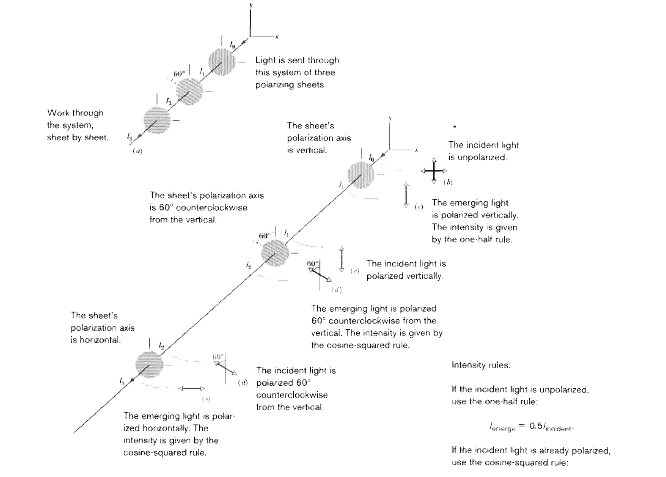 Figure(a) Initially unpolarized light or intensity `I_(0)` is sent into a system of three polarizing sheets. The intensities `I_(1) , I_(2)`and `I_(3)`of the light transmitted by tbe sheets are LABELED. Shown also are the polarizations, from bead-on views, of (b) the initial light and the light lransmicted by (c) the first sheet, (d) the second sheet, and (e) the third sheet. Third sheet: Because the Hght reaching the third sheet is polarized, the intensity `I_(3)`of the light transmitted by that sheet is given by the cosine-squared rule. The angle `theta`is now the angle between the polarization direction of the entering light (Fig. 32-15 d) and the polarizing direction ofthe third sheet (parallel to the x axis), and so `theta = 30°` . Thus `I_(3) =I_(2) cos^(2) 30^(@)` . This final transmitted light is polarized parallel to the x axis (Fig. 32-15e). We find its intensity by substituting first for `I_(2)` and then for `I_(1)` in the equation above: `I_(3) =I_(2) cos^(2) 30^(@) = (I_(1) cos^(2) 60^(@)) cos^(2) 30^(@)` `=((1)/(2)I_(0)) cos^(2) 60^(@) 30^(@) =0.094I_(0)` . Thus `(I_(3))/(I_(0)) =0.094` . ( Answer ) That is to say, 9.4% of the initial intensity emerges from the three-sheet system. (Ifwe now remove the second sheet, what fraction of the initial intensity emerges from the system?) |
|
| 34. |
A magnetic field of (4.0 xx 10^(-3) hat k) T exerts a force (4.0 hat i + 3.0 hat j) xx 10^(-10) N on a particle having a charge 10^(-9) C and moving in the x-y plane. Find the velocity of the particle. |
|
Answer» Solution :Given Magnetic force `vecF_(m) = (4.0 hati + 3.0 hatj) xx 10^(-10)N` Let veloctiy of the particle in X-y plane be, ` vec v = v_x HAT i + v_y hat J` Then from the relation `vec F_m = q(vec v xx vec B)` we have `(4.0 hati + 3.0 hatj) xx 10^(10) = 10^(-9)[(v_x hat i + v_y hatj) xx (4 xx 10^(-3) hat k)]` `= (4v_y xx 10^(-12) hat i- 4v _x xx 10^(-12) hat j )` COMPARING the coefficient of `hat i` and `hatj` we have, `4 x 10^(-10) = 4 v_y xx 10^(-12)` `thereforev_y = 10^2 m//s = 100 m //s` and `3.0 xx 10^(-10) = -4 v_x xx 10^(-12)` `thereforev_x = - 75 m//s` `therefore vec v = -75 hat i + 100 hat j` |
|
| 35. |
Bats detect obstacles in their path by receiving the reflected |
|
Answer» INFRASONIC WAVES |
|
| 36. |
Explain briefly, with the help of a labelled diagram, the basic principle of working of an a.c. generator. In an a.c. generator, coil of N turns and area A is rotated at upsilonrevolutions per second in a uniform magnetic field B. Write the expression for the emf produced. A 100-turn coil of area 0.1m^(2) rotates at half a revolution per second.It is placed in a magnetic field 0.01 T perpendicular to the axis of rotation of the coil. Calculate themaximum voltage generated in the coil. |
|
Answer» Solution :A.C. GENERATOR Principle :Whenever a closed coil is rotated in a uniform magnetic field about an AXIS perpendicular to the field, the magnetic flux linked with coil changes and an induced emf is set up across its ends. The essential parts of an a.c. generator are shown in the above figure. Initially the armature coil ABCD is horizontal . As the coil is rotated clockwise, the arm AB moves up and CD moves down By Fleming's right hand rule, the induced current flows along ABCD. In second half rotation, the arm CD moves up and AB moves down. The induced current flows in the opposite direction i.e., along DCBA. Thus, an alternating current flows in the circuit. 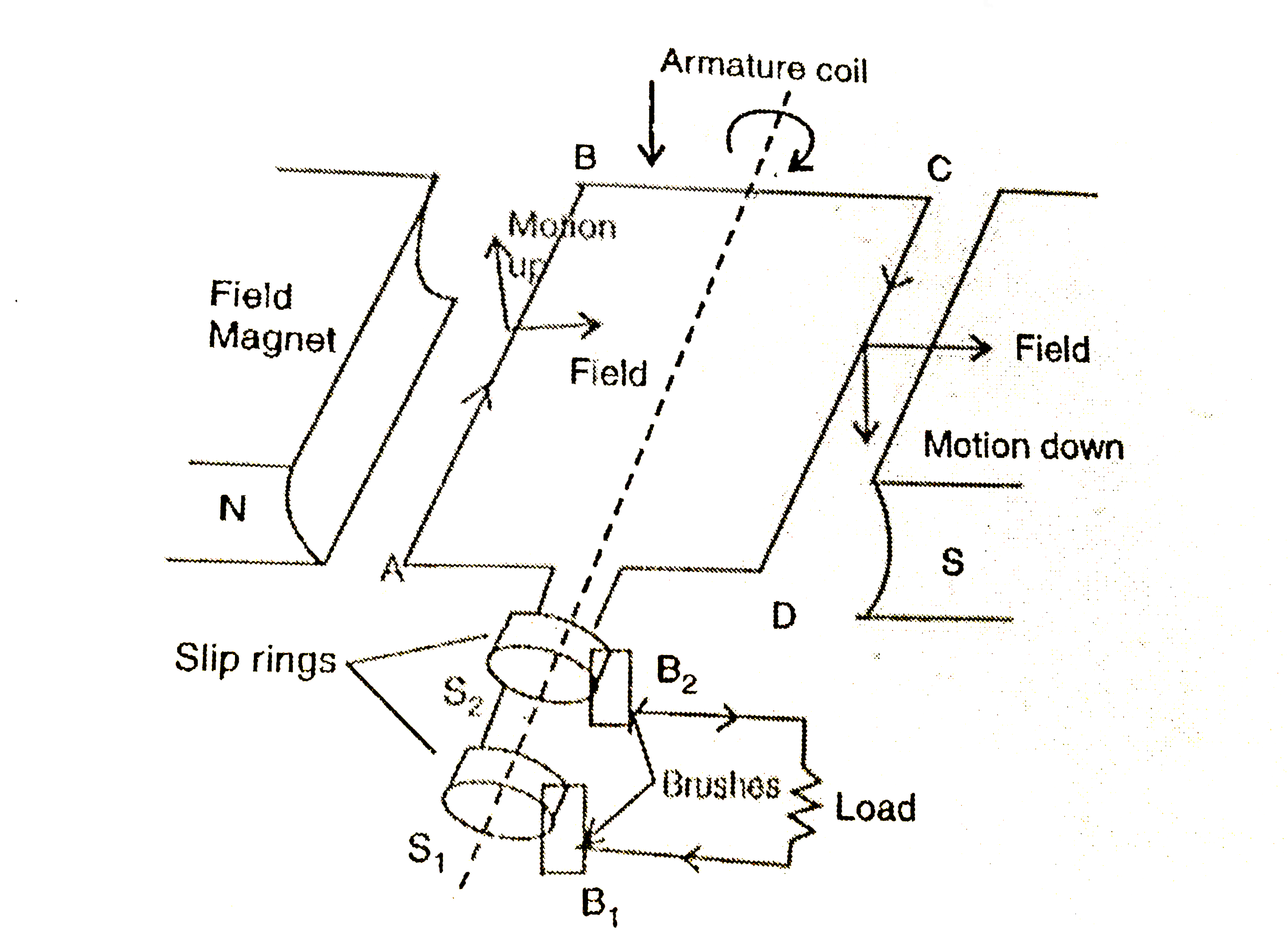 The magnetic flux linked with the coil at any instant is `phi=NB A cos omega t` Induced emf will be `E=-(d phi)/(dt)=-(d)/(dt) (NBA cos omega t)= NBA omega sinomega t` or `E=E_(0) sin omega t` where `E_(0)=NBA omega = ` peak value of induced emf Numerical : `N=100, A = 0.1 m^(2), B=0.01T` `V=(1)/(2)` revolution per sec =0.5 r.p.s `:. ` Maximum voltage generated `e_(0) = NBA omega = NBA (2 PI upsilon)` `e_(0) = 100 xx 0.01 xx 0.1xx2xx(22)/(7) xx 0.5` `=(2.2)/(7) = 0.314 `Volt `e_(RMS)=(e_(0))/(sqrt(2))=(0.314)/(1.414)=0.22 V`. |
|
| 37. |
The parameters of two small identical current-carrying coils are as follows: the radius of winding is 20 mm, the number of turns is 10^3, the current is 0.5 A. the distance between the coils is 300 mm. What is the force of interaction between the coils? |
|
Answer» |
|
| 38. |
In an electromagneticwave, the directionof propagation of wave is inclined to the electric and magnetic fields at |
|
Answer» `45^(@)` and `45^(@)` |
|
| 39. |
Three vectors vec(A),vec(B) and vec(C) satisfy the relation vec(A).vec(B)=0 and vec(A).vec(C )=0. The vector vec(A) is parallel to: |
|
Answer» `vec(B)` `IMPLIES vec(A)` is PARALLEL to `vec(B)xxvec(C)` |
|
| 40. |
In fig 25-39 the capacitances are C_1=1.0 mu F and C_2=3.0 mu F and both capacitors are charged to a potential difference of V=200V but with opposite polarity as shown. Switches S_1 and S_2 are now closed. (a) What is the now the potential difference between points a and b? What now is the charge on capacitor (b) 1 and (c) 2? |
| Answer» SOLUTION :`a) 100V B) 1.0 TIMES 10^-4 C c) 3.0 times 10^-4 C` | |
| 41. |
Two circular coils A and B with their centres lying on the same axis have differents in the same sence. The coil B lies exacity midway between coil A and the point P. The magnetic field at point P due to coils A and B is B_(1) and B_(2) respectively. |
|
Answer» `B_(1) gtB_(2)` |
|
| 42. |
A sonometer wire of 70cm length fixed at one end has a solid mass M, hanging from its other end to produce tension in it. The wire produces a certian frequency. When the same mass 'M' hanging in water, it is found that the length of the wire has to be changed by 5 cm. in order to produce the same frequency. Then the density of the material of mass 'M' is |
| Answer» Answer :D | |
| 43. |
Huygen was the figure scientist who proposed the idea of wave theory of light he said that the light propagates in form of wavelengths. A wavefront is a imaginary surface of every point of which waves are in the same. phase. For example the wavefront for a point source of light is collection of concentric spheres which have centre at the origin w_(1) is a wavefront w_(2) is another wavefront. The radius of the wavefront at time 't' is 'ct' in thic case where 'c' is the speed of light the direction of propagation of light is perpendicular to the surface of the wavelength. the wavefronts are plane wavefronts in case of a parallel beam of light. Huygen also said that every point of the wavefront acts as the source of secondary wavelets. The tangent drawn to all secondary wavelets at a time is the new wavefront at that time. The wavelets are to be considered only in the forward direction (i.e., the direction of propagation of light) and not in the reverse direction if a wavefront w_(1) and draw spheres of radius 'cDeltat' they are called secondary wavelets. Draw a surface w_(2) which is tangential to all these secondary wavelets w_(2) is the wavefront at time t+Deltat Huygen proved the laws of reflection and laws of refraction using concept of wavefront. Q. The wavefrot of a light beam is given by the equation x+2y+3z=c (where c is arbitrary constant) then the angle made by the direction of light with the y-axis is |
|
Answer» `cos^(-1)((1)/(14))` |
|
| 44. |
The figure shows a diagonal symetric arrangement of capacitors and a battery. Identify the correct statements |
|
Answer» Both the `4MUF`CAPACITORS carry equal charges in OPPOSITE sense |
|
| 45. |
What is the effect of mutual inductance on the coils between which it exists ? |
| Answer» Solution :Mutual inductance comes into picture when two coils are PLACED CLOSE together in such WAY that flux PRODUCED bv one coil links the other. | |
| 46. |
Two capacitors C_(1) and C_(2) are charged seperately to potentials 20 V and 10V, respectively. The terminals of capacitors C_(1) and C_(2) are marked as (A-B) and (C-D), respectvely. A is connected with C and B is connected with D. i. Find the final potential dsifference across each eapacitors. ii. Findthe final charge in both capacitors iii. How much heat is produced in the circuit. |
|
Answer» `128muC` `142muC` `60 uJ` 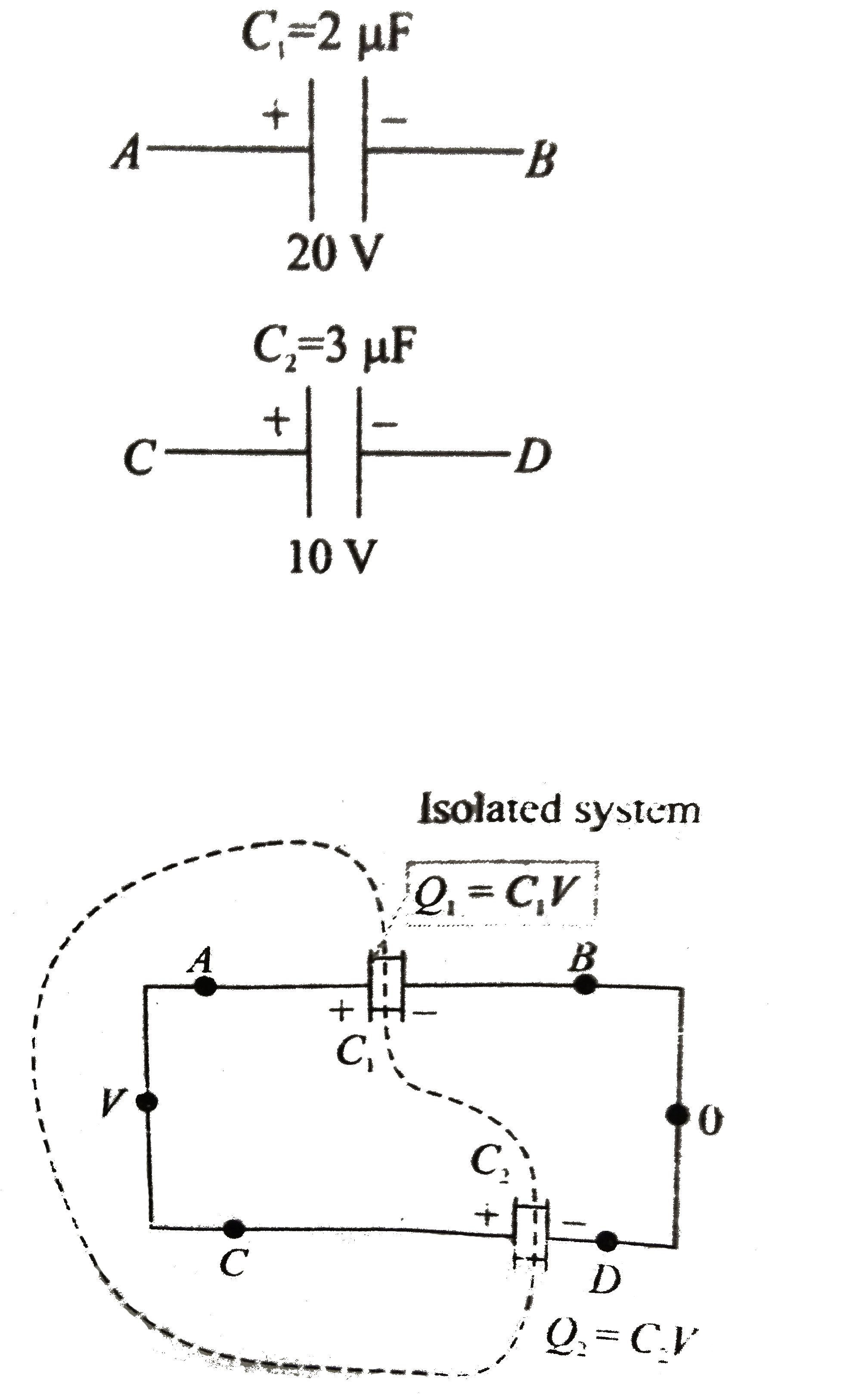 `(Q_(1))_("initial")=C_(1)V_(1)` `=2xx20=40 mu C` Initial charge in capacitor `C_(2)` is 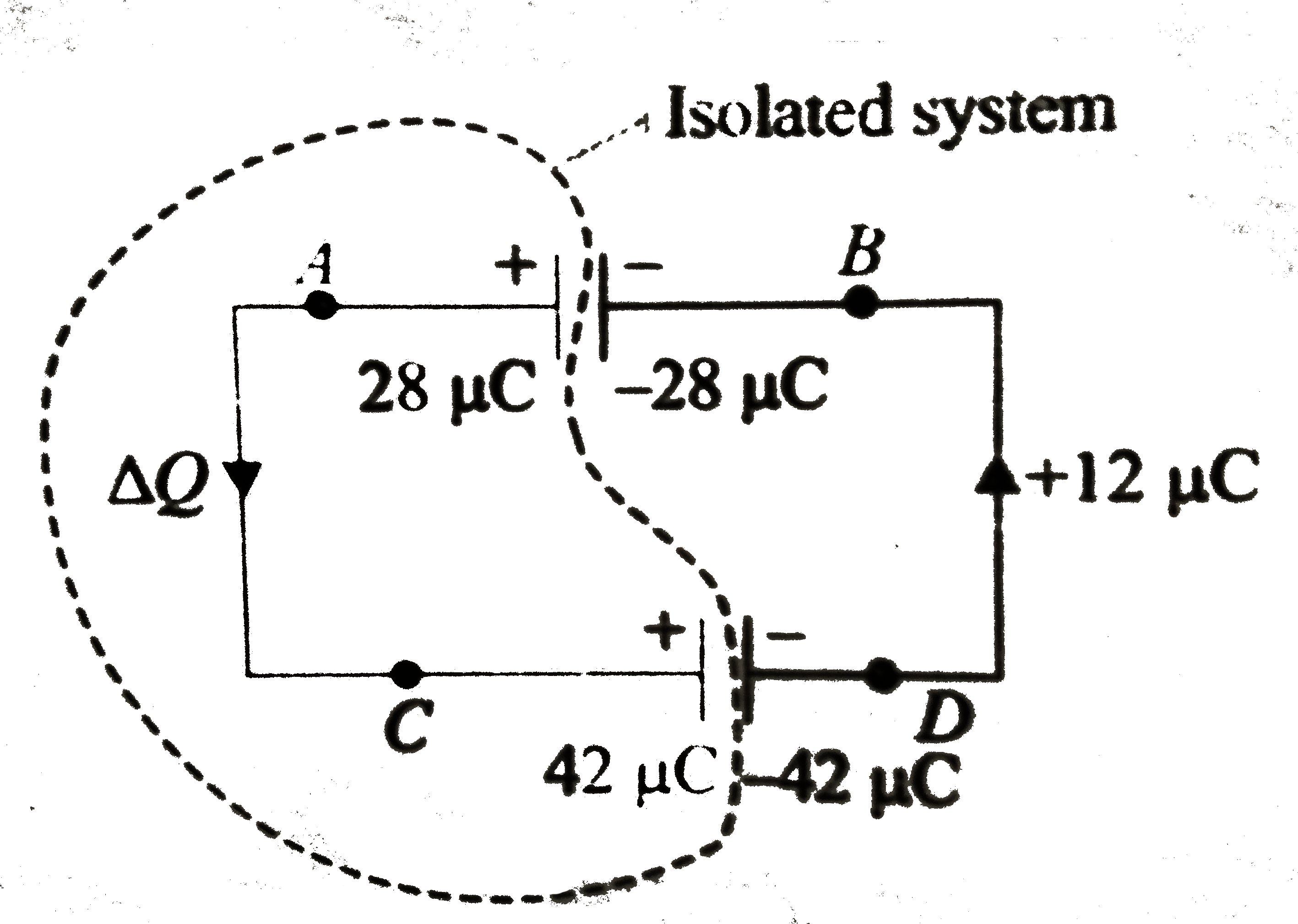 `(Q_(2))_("initial")=C_(2)V_(2)` `=3xx10=30muC` Let the potential of `B` and `D` be zero and the common potential difference across the capacitors be `V`, then the potentials at `A` and `C` will be `V`. FROMIT is clear that the left plates of capacitors `C_(1)` and `C_(2)` are forming an isolated system, i.e, they are not CONNECTED from outside. From chatrge conservation, `C_(1)V+C_(2)V=3V+2V` `=40+30` `5V=70` or `V=14 V` Final charge in capacitor `C_(1)` is `(Q_(1))_("final")=2xx14=28muC` Final charge in capacitor `C_(2)` is `(Q_(2))_("final") = 3 xx 14 = 42 mu C` The charge flowing in the ciruit in the direction from `A` to `C` is `Delta Q = 40-28=12mu C` Now final charges on each plate are SHOWN in. II. Heat produced in the circuit is `H=[1/2C_(1)V_(1)^(2)+(1)/(2)C_(2)V_(2)^(2)]-[1/2(C_(1)+C_(2))V^(2)]` `=[1/2xx2xx(20)^(2)+1/2xx3xx(10)^(2)]-[1/2xx5xx(14)^(2)]` `=400+150-490=550-490=60muJ`. |
|
| 47. |
A short bar magnet is placed in an external magnetic field of 600 G. When its axis makes an angle of 30° with the external field, it experiences a torque of 0.012 Nm. What is the magnetic moment of the magnet ? |
|
Answer» `0.2 "Am"^(2)` `THEREFORE m- (tau)/( B sin theta) = (0.012)/(600 XX 10^(-4)xx sin30^(@) )` `therefore m= (0.012)/(6 xx 10^(-2)xx (1)/(2) ) therefore m= 0.4 "Am"^(2)` |
|
| 48. |
The equivalent capacitance between the point A and C is given by |
|
Answer» `(10)/(3)C` |
|
| 49. |
If lamda_(K_(alpha)),lamda_(K_(beta)) and lamda_(L_(alpha)) are the wavelengths of K_(alpha),K_(beta) and L_(alpha) lines, then |
|
Answer» `lamda_(K_(BETA))=(lamda_(K_(ALPHA))lamda_(L_(alpha)))/(lamda_(K_(alpha))+lamda_(L_(alpha)))` |
|
| 50. |
Defineionisationenergy. Howwould theionisationenergywhenelectron in hydrogenatom is replaced byparticleof mass 200 times thatof theelectron buthavingthe samecharge ? |
|
Answer» Solution :Ionisationenergyof anatom is definedas theenergyrequiredto removean electron from groundstateenergylevel to itsfree state . Ionisation energyof hydrogen is `E = + (me^(4))/( 8 in_(0)^(2) n^(2) h^(2)) = + 13.6eV` IFELECTRON in hydrogen atom is replaced bya particleof mass 200 times that of electron (i.e., m = 200 m) but havingthe SAMECHARGE then new ionisationenergyof atom will be . `E =+(m e^(4))/( 8 in_(0)^(2) n^(2) h^(2)) + ((200m)e^(4))/(8 in_(0)^(2) n^(2) h^(2)) = 200 E = 200 xx 13.6 EV= 2720 eV = 2.72 ke V` |
|


