Saved Bookmarks
This section includes 7 InterviewSolutions, each offering curated multiple-choice questions to sharpen your Current Affairs knowledge and support exam preparation. Choose a topic below to get started.
| 1. |
What do you known about GPS? Write a few applications of GPS. |
|
Answer» Solution :(i) GPS stands for Global Positioning system. It is a global navigation satellite system that offers geolocation and time information to a GPS receiver anywhere on or near the EARTH. (ii) GPS system works tha ssistance of a satellite network. (iii) Each of these satellites broadcasts a precise signal and these signals convey the location data are RECEIVED by a low-cost aerial which is then translated by the GPS software. (iv) The software is able to recognize the satellite, its location, and the time TAKEN by the signals to travel from each satellite. (iv) The software then process the data it ACCEPT from each satellite to estimate the location of the reciver. Application : Global positioning system is highly useful many fields such a fleet vehicle management (for tracking cars, TRUCKS and buses), wildlife managements (for counting of wild animals) and engineering (for making tunnels, bridges etc). |
|
| 2. |
A small circular flexible loop of wire of radius r carries a current I. It is placed in a uniform magnetic field B. The tension in the loop will be doubled if ______ . |
|
Answer» I is doubled `F=mBsintheta` but MAGNETIC moment `m=Ipir^(2)` `thereforeF=Ipir^(2)Bsintheta""...(1)` Suppose RADIUS `r_(1)`, magnetic FIELD `B_(1)` and current `I_(1)` then force acting is `F_(1)` and when radius `r_(2)` magnetic field `B_(1)` and current `I_(2)` then the force acting is `F_(2)`. `therefore` From EQUATION (1), If `F_(2)=2F_(1)`, then `F_(1)/F_(2)=(r_(1)^(2)I_(1)B_(1))/(r_(2)^(2)I_(2)B_(2))` becomes `2(r_(1)^(2)I_(1)B_(1))=r_(2)^(2)I_(2)B_(2)""...(2)` Now only if `r_(2)=2r_(1)`, then equation (2) is not solved, so option ( C) is wrong and if `B_(2)=B_(1)/2` is done then also equation (2) is not solved so option (B) is wrong too. If `B_(1)=2B_(1)andI_(2)=2I_(1)` then also equation (2) is not solved so option (D) is also wrong. But if r and B are kept constant and only `I_(2)=2I_(1)` then F can be doubled. so option (A) is TRUE. |
|
| 3. |
The shortest wave lengths of Paschen, Balmer and Lymann series are in the ratio : |
|
Answer» `9:1:4` For Paschen `n_(1)=3` For Balmer `n_(1)=2` For Lyman `n_(1)=1` `lambda_(P): lambda_(B) : lambda_(L)=9:4:1` |
|
| 4. |
A police car moving at 22 ms^(-1) chases a motor cyclist. The police man sounds horn at 176 Hz. While both of them move towards a stationary siren of frequency 165 Hz. If the number of beats heard by the motor cyclist per second is zero, then the speed of motorcycle is (Speed of sound in air = 330 ms^(-1)) |
| Answer» ANSWER :B | |
| 5. |
An astronomical telescope consisting of two convex lenses of focal length 50 cm and 5cm is focussed on the moon. What is the distance between the two lenses in this position ? If the telescope is then turned towards an object 10 m a way, how much would the eye-piece have to be moved to focus on the object without altering the accommodation of the eye ? Calculate the angular magnification produced by the telescope in the two adjustments. |
|
Answer» |
|
| 6. |
Which of the following phenomenon is not explained by hugen's construction of wavefront? |
|
Answer» Refraction |
|
| 7. |
What electric field should be set up in the device discussed in the previous problem to return the electrons to the centre of the screen? |
|
Answer» WHENCE `E=(2 Psi d)/(l (L^(-3) l//2))`. |
|
| 8. |
An equiconvex lens, with redii of curvature of magnitude 10 cm each, is put over a liquid layer poured on top of a plane mirror. A small needle, with its tip on the principal axis of the lens, is moved along the axis until its inverted real image coincides with the needle itself. The distance of the needle, from the lens, is measured to be 15 cm . On removing the liquid layer, and repeating the experiment the distance is measured to be 10 cm . Given that the two values of the distance measured represent the force length values in the two cases, calculate the refractive index of the liqiud. |
| Answer» SOLUTION :REFRACTIVE INDEX of the LIQUID `=4//3` | |
| 9. |
A uniform electric field and a uniform magnetic field are produced, pointed in the same direction. An electron is projected with its velocity pointing in the same direction. |
|
Answer» The electron will TURN to its RIGHT |
|
| 10. |
a.Which mirror is used as driver's mirror ? b.Why ? |
|
Answer» Solution :a. Convex mirror B. Field of view is large. PRODUCES ERECT and diminished image. So that the DRIVER can see large part of the traffic coming from the back of the driver. |
|
| 11. |
What is the barrier potential ofSi Ge ? How does it change with increase in temperature ? |
| Answer» Solution :The BARRIER potential of Si is 0.3 V and. that of Ge is 0.7 . The CHANGE in barrier potential is `DeltaV=-0.0025DeltaT` This means the barrier potential decreases by 2.5 m V for each Celsius DEGREE rise. | |
| 12. |
Assertion : All the photoelectrons emitted from the matal do not have the same energy. Reason : The maximum kinetic energy of photoelectrons depends on the light soures and the emitted plate material. |
|
Answer» If both ASSERTION and REASON are true and reason is the CORRECT explanation of assertion. |
|
| 13. |
What is a defibrilator ? Explain briefly. |
|
Answer» Solution :A defbrilator is a device used to save the life of a person suffering a heart stroke. DUE to rapid, unco - ordinated twitching of the heart muscles , the heart undergoes ventricular fibrillation.To save the person's life, regular beatingof the heart is to be restored by deliveringa jolt to the heart USING a DEFIBRILLATOR. Suppose a `70 mu F` a capacitorof a defibrillator is chargedto a potentialof 5000V. The energy stored `= (1)/(2) CV^(2) = (1)/(2) (70xx10^(-6)) (5000)^(2) J = 875 J`. Typically about 200J of energyis allowedto passthroughperson's body in a pluselasting2 milli second. THEREFORE, power deliverd to the body `(200)/(2xx10^(-3)) = 10^(5) W = 100 kW`, which is much largerthan thepowerdelivered by the battery. Thus energystoredin the capacitordischargedat a muchhigherpower providesthe much neededjolt to savethe person's life. |
|
| 14. |
Anearly model for an atom consider it to have a positively charged point inucleus ofcharges ze surronded by awhole is neutral for this model what is the electric fieldat a distance r from the nucleus |
|
Answer» <P> Solution :The charge distributionfor this model of the atom is asthe total chargein the uniform sperical of charge z e + negative harge is neutral this immedialtely gives us the negative charge density p since we must have`(4piR^(3))/(3) p= 0-Ze` to FIN d the electricfieldE(r ) at apointP whichis a distance r awayfrom the nucleuswe usegausslawits direction is alongtheradius vector rfrom the origin to the pointthe obvious gaussian SURFACE is a spherical surface centredto the point P the obviousgaussian surfaceis a spherical surfacecentred at the nucleus we consider twosituation namely `rgtR` and `rlt R` (i) `r gt R`the electricflux `Phi`enclosedbythe spherical surface is `Phi =E(r )xx4 pi r^(2)` where E(r )is the magnitude of the electricfieldat r this is because the field at any pointon the sphericaland has the same magnitude at all points on the surface i.e `q=Ze+(4pir^(3))/(3) P` substituting for the charge density p OBTAINED earlier we haveM (ii)`r gt R`in this case the totalenclosed by the gaussiansperical surface is zerosince the atom is neutral thus from gauss law at r =R both cases given the same result E =0 |
|
| 15. |
A convex lens is place over a plane mirror. A pin is now positioned so that there is no parallax between the pin and its image formed by this lens-mirror combination . How can this observation be used to find the focal length of the convex lens? Give appropriate reasons in support of your answer. |
Answer» Solution :The rays must fall normally on the PLAN mirror so that the IMAGE of the pin coincide with itself. 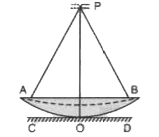 Hence rays, like CA and DB form a parallel beam incident on the lens. `:.` P is the position of the focus of the lens. `:.` Distance OP equals the focus LENGTH of the lens. |
|
| 16. |
In the given electric circuit find (a) current (b) power output (c ) relation between r and R so that the electic power output (that means power given to R) is maximum. (d) value of maximum power output. ( e) plot graph between power and resistanace of load (f) From graph we see that for a given power output there exists two values of external resistance, prove that the product of these resistances equals r^(2). (g) what is the efficiency of the cell when it is used to supply maximum power. |
|
Answer» Solution :(a) In the circuit shown if we assume that potential at A is zero then potential at A is zero then potential at B is `EPSI-ir`. Now SINCE the connecting wires are of zero resistance `thereforeV_(D)=V_(A)=0rArrV_(C)=B_(B)=epsi-ri` Now current through CD is also i (because it's in series with the CELL). `therefore i=(V_(C)-V_(D))/R=((epsi-ir)-0)/R"Current i"=epsi/(r+R)` Note : After learning the concept of series combination we will be able to CALCULATE the current directly (b) Power output `P=i^(2)R=epsi^(2)/((r+R)^(2))R` ( c) `(dp)/(dR)=epsi^(2)/((r+R)^(2))-(2epsi^(2)R)/((r+R)^(3))[R+r-2R]` 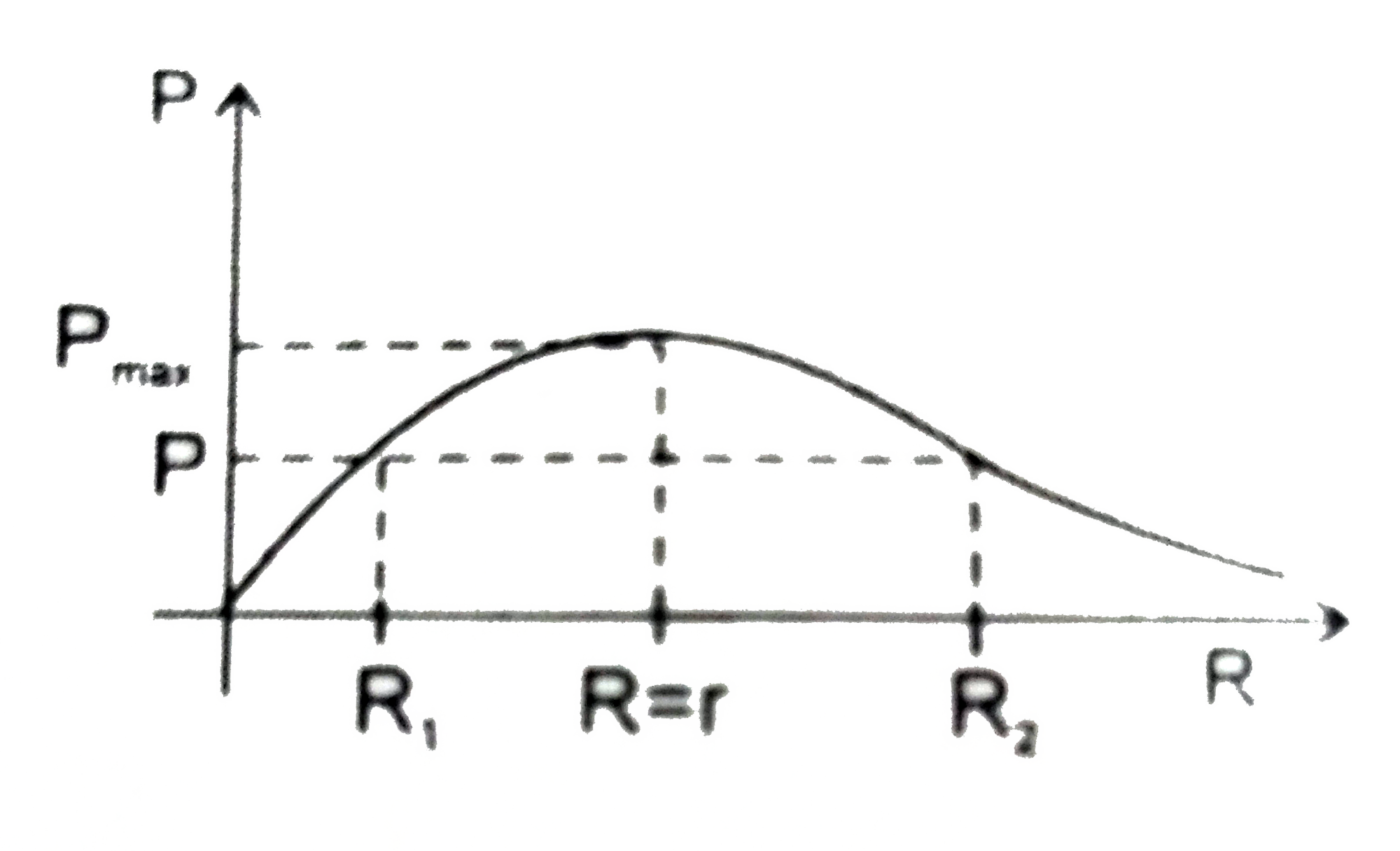 for maximum power supply `(dp)/(dR)=0` `rArr r+R-2R=0rArrr=R` Here for maximum power output outer resistance should be equal to internal resistance (d) `P_("max")=epsi^(2)/(4r)` ( e) Graph between 'P' and R maximum power output at R=r `P_("max")=epsi^(2)/(4r)rArri=epsi/(r+R)` (F) Power output `P=(epsi^(3)R)/((r+R)^(2))` `P(r^(2)+2rR+R^(2))=epsi^(2)R` `R^(2)+(2r-epsi^(2)/P)R+r^(2)=0` Above quadratic equation in R has two roots `R_(1)" and "R_(2)` for given values of `epsi,` P and r such that `thereforeR_(1)R_(2)=r_(2)("product of roots")` `r^(2)=R_(1)R_(2)` (g) Power of battery spent `=epsi^(2)/((r+)^(2)),2r=epsi^(3)/(2r)` Power (output)`=(epsi/(r+r))^(2)xxr=epsi^(2)/(4r)` `"Efficiency ="("Power output")/("total power by cell")=(epsi^(2)/(4r)xx100)/(epsi^(2)/(2r))=1/2xx100=50%` |
|
| 17. |
A train takes t sec to perform a journey ,if travel for t/n sec with uniform acceleration then for ((n-3)/(n)t) sec with uniform speed v and finally it comes to rest with uniform retardation .Then average speed of train is |
|
Answer» `(3N-2)(V)/(2N)` |
|
| 18. |
Prove theoretically the relation between e.m.f. induced in a coil and rate of change of magnetic flux in electromagnetic induction. A parallel plate air condenser has a capacity of 20 muF. What will be the newcapacity if: (a) the distance between the two plates is doubled ? (b) A marble slab ofdielectric constant 8 is introducedbetween the two plates ? |
Answer» Solution :Consider a rectangular loop of conducting wire PQRS partly placed in uniform magnetic field of induction 'B' which is perpendicular to the plane of paper and directed into the paper. 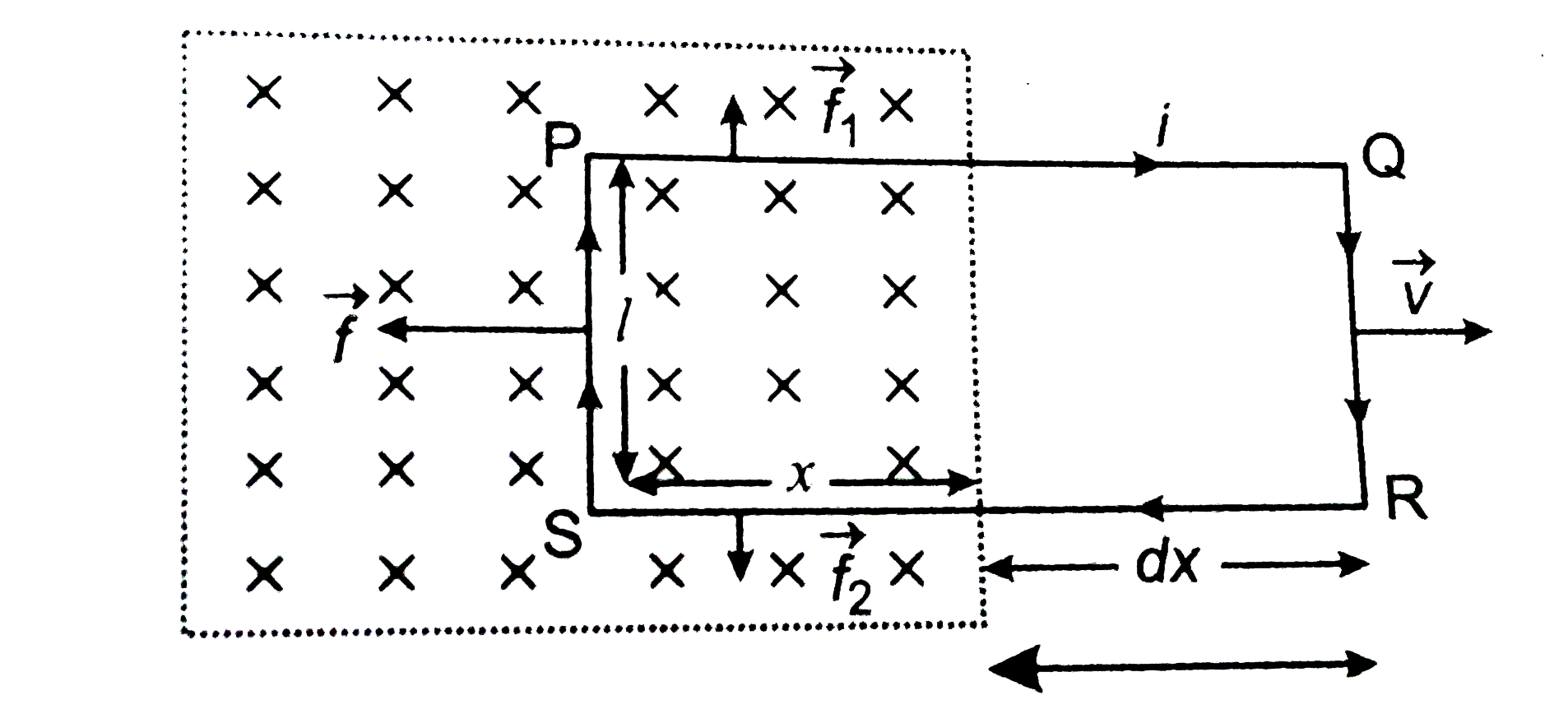 Let `l` be the length of the side PS and x be the length of the loop within hte field. Therefore, `A=lx`, area of that loop which lies inside the field. The magnetic flux `(phi)` through the area A at certain time 't' is`phi =BA=Blx.` The loop is PULLED out of the magnetic field of induction 'B' to the right with a uniform velocity `vecv`. The rate of change of magnetic flux, `(dphi)/(dt)=(d)/(dt)(Blx)` `therefore (d phi)/(dt)=Bl((dx)/(dt))` But,`v=((dx)/(dt))` `therefore (dphi)/(dt)=BLV "" `...(i) Due to change in magnetic flux, induced current is set up in the coil. The direction of this current is clockwise according to Lenz's law. Due to this the sides of the coil experiences the forces `f_(1),f_(2) and f.` The magnitude of force `f` acting on the side PS is `f=Bil ""(because vecf=i vecl xx vecB)` Since, `vecf_(1) and vecf_(2)` are equal and opposite, so they cancel out. The unbalanced force which opposes the motion of the coil is `f`. Hence, the external agent like hand must do work against this force in order to pull the coil. The work done in time dt during displacementdx is `dW= -fdx` (Negative sign shows that `vecf and vecdx`are opposite to each other) `therefore dW=-(Bil)dx "" `...(ii) The work done must be equal to the electrical energy generated. If e is the induced e.m.f. and i is the induced current, ELECTRIC work `=(dW)/(dt)=ei` `dW=eidt "" ` ...(iii) Equating equations (ii) and (iii), we get `eidt = -Bil dx` `therefore e=-Bl((dx)/(dt))` `therefore e= -Blv` Using equation (i), `e=(dphi)/(dt)` Numerical : (a) Given, `C=20muF.` We know, Capacitance, `C=(Ka epsilon_(0))/(d)` For air, `K=1` `therefore C=(A epsilon_(0))/(d) "" `...(i) Then, New capacitance, `C'=(A epsilon_(0))/(d')` `therefore d'=2d` `=(A epsilon_(0))/(2d)` `=(C)/(2) "" ` [From equation (i)] `=(20)/(2)` `=10muF` So, if the distance between the plates is doubled capacity of condenser becomes `10 MUF`. (b) When K = 8 `therefore C''=(K'A epsilon_(0))/(d)=8(A epsilon_(0))/(d)` `=8C "" [because (A epsilon_(0))/(d)=C]` `=8xx20` `=160 muF "" `[From equation (i)] If a slab of dielectric constant 8 is introduced between the plates, the capacity becomes 8 times i.e., `160muF.` |
|
| 19. |
The property by virtue of which a current changing in the first results in the induction of an e.m.f. in the second is called? |
| Answer» SOLUTION :MUTUAL INDUCTION. | |
| 20. |
Draw a graph between potential energy of a pair of nucleons and separation between them. Also write its main features. |
|
Answer» 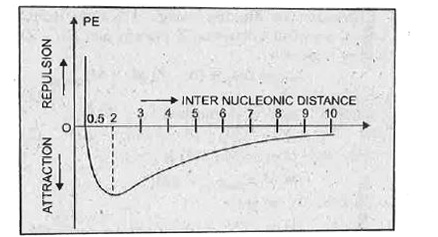 Main features : (i) Nuclear force comes into action only upto a distance of `10xx10^(-15)m` (10 fm) and zero beyond it. (ii) They vary distance. As distance decreases, force of ATTRACTION increases slowly upto 5 fm. This attractive force is maximum at distance 1.5 fm. (iii) If distance is further decreased at distance 0.5 fm, it changes to repulsive. This repulsive part save the nucleus from COLLAPSING. |
|
| 21. |
2 A current is passed through a solenoid which has 5 cm diameter, 10 turns and 10 cm length. Now, near to one of its two ends, a circular loop of radius 2 cm is kept perpendicular to axis of solenoid. Then magnetic flux passing through this loop is ...... Wb. (mu_0=4pixx10^(-7)TmA^(-1) and take pi^@=10) |
|
Answer» `3.2xx10^(-8)` `B=mu_0nI` `B=mu_0 (N/l)I` Now, magnetic flux linked with the loop , mentioned in the statement is : `phi=BA cos theta` `=(mu_0NI)/l xx pir^2xxcos0^@` `=(4pixx10^(-7)xx10xx2xxpixx4xx10^(-4))/0.1` `=32pi^2xx10^(-9)` `=3.20xx10^(-7)` `=3.2xx10^(-7)` WB |
|
| 22. |
The critical velocity v of a body depends on the coefficient of viscosity n the density d and radius of the drop r. IfK is a dimensionless constant then v is equal to |
| Answer» Answer :C | |
| 23. |
In the circuit shown in the figure, cell is ideal and R_(2) = 100 Omega. A voltmeter of internal resistance 200 Omega reads V_(12) = 4 V and V_(23) = 6 V between the pair of points 1-2 and 2-3 respectively. What will be the reading of the voltmeter between the points 1-3. |
|
Answer» |
|
| 24. |
Predict the directions of induced currents in metal rings 1 and 2 lying in the same plane where current I in the wire is increasing steadily [Fig. 6.11]. |
| Answer» Solution :In RING 1 the induced current is in clockwise direction but that in ring 2 is in anticlockwise direction [FIG. 6.12] | |
| 25. |
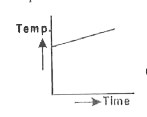
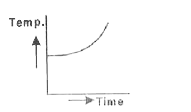
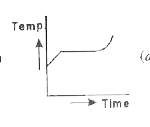
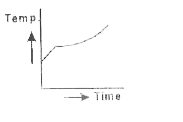
Liquid oxygen at 50 K is heated to 300 K at constant pressure of 1 atm. The rate of heating is constant. Which of the following graphs represents the variation of temperature with time ? |
|
Answer»
|
|
| 26. |
A long solenoid with 15 turns per cm has a small loop of area 2.0 "cm"^2 placed inside the solenoid normal to its axis. If the current carried by the solenoid changes steadily from 2.0 A to 4.0 A in 0.1 s, what is the induced emf in the loop while the current is changing ? |
| Answer» SOLUTION :`7.5 XX 10^(-6) V` | |
| 27. |
A transformer is used to light a 100 W and 110 V lamp from a 220 V (Mains). If the main current is 0.5 A, the efficiency of the transformer is approximately |
|
Answer» 0.1 |
|
| 28. |
It is not convenient to use a spherical Gaussian surface to find the electric field due to an electric dipole using Gauss's theorem because: |
|
Answer» GAUSS's law fails in this case |
|
| 29. |
A sphere of solid material of R.D. 8 has a concentric cavity and just sinks in water. Then ratio of the radius of the cavity to that of outer radius of the sphere must be: |
|
Answer» `1/2xx(3)^(1//3)`  `4/3pir^(3)xx1xxg=4/3pi(R^(3)-r^(3))pg` `R^(3)=(R^(3)-r^(3))p=(R^(3)-r^(3))8` `1/8=1-(r/R)^(3)` `(r/R)^(3)=1-1/8=7/8` `r/R=(7/8)^(1//3)=((7)^(1//3))/2` Correct choice is (C). |
|
| 30. |
Under the cover of night, Gafur secretly came around to? |
|
Answer» A.Tarakratna |
|
| 31. |
What is energy bands in solids ? |
| Answer» SOLUTION :The GROUP of discrete but closely spaced energy LEVELS for the electrons in a particular ORBIT is called energy bond. | |
| 32. |
What is a potentiometer? |
| Answer» SOLUTION :The Potentiometer is an INSTUMENT USED for the measurement of potential difference. | |
| 33. |
For satellite moving in a circular orbit around the earth, what is the ratio of it’s KE of to the PE |
|
Answer» a)16/20 |
|
| 34. |
(a) In a single-slit diffraction experiment, a slit of width 'd' is illuminated by red light of wavelength 650 nm. For what value of 'd' will (i) the first minimum fall at an angle of diffraction of 30^(@) and (ii) the first maximum fall at an angle of diffraction of 30^(@) ? |
|
Answer» Solution :(a) (i) Here wavelength of light `l=650nm=6.5xx10^(-7)m`. As first minimum (n=1) falls at an angle of DIFFRACTION `theta=30^(@)`, hence `dsintheta=nlamda=(nlamda)/(sintheta)=(1xx6.5xx10^(-7))/(SIN30^(@))=(6.5xx10^(-7))/(0.5)=1.3xx10^(-6)m` ((II) As first maximum (n=1) falls at an angle of diffraction `theta=30^(@),` hence, (ii) As first maximum (n=1) falls at an angle of diffraction `theta=30^(@)`, hence, `dsintheta=(2n+1)(lamda)/(2)=((2n+1)lamda)/(2sintheta)=((2xx1+1)xx6.5xx10^(-7))/(2xxsin30^(@))=(3xx6.5xx10^(-7))/(2xx0.5)=1.95xx10^(-6)m`. (b) For central diffraction maximum whole wavefront CONTRIBUTES towards the intensity. however, for SUCCESSIVE diffraction maxima only `(1)/(3),(1)/(5),(1)/(7)`th part of the wavefront contributes towards the intensity of maxima. consequently intensity of successive maxima become less and lesser as compared to the central maximum. |
|
| 35. |
A bat emits a sound whose frequency is 91 kHz. The speed of sound in air at 20.0^@ C is 343 m/s. However, the air temperature is 35^@C , so the speed of sound is not 343 m/s. Find the wavelength of the sound. |
|
Answer» `5.0 XX 10^(-2) s ` |
|
| 36. |
A neutral point in a combined magnetic field is the point |
|
Answer» Where the lines of forces intersect |
|
| 37. |
In non-uniform magnetic field, a diamagnetic substance experiences a resultant force ......... . |
|
Answer» from the REGION of strong magnetic field to the region of weak magnetic field  Since in a non-uniform field the induced magnetization is in the direction OPPOSITE to that of external field. Force on induced south pole TOWARDS STRONGER side of the field is less than that on the induced north pole towards weaker side of the field. Hence, resultant force is towards weaker side of the field. |
|
| 38. |
In the circuit shown , a potential difference of 60 V is applied across AB. The potential difference between the points M and N is : |
|
Answer» 10 V |
|
| 39. |
State and explain Charles' law |
|
Answer» SOLUTION :The magnetic susceptibility `(chi)` of aparamagnetic SUBSTANCE is INVERSELY proportional to the absolute temperature (T). `chi = C(mu_(0))/(T)` C - Curie constant |
|
| 40. |
What is virtual power of an a.c. supply out containing inductance only ? |
|
Answer» SOLUTION :`P_av= E_0I_0/2 COS PHI` here `phi = pi/2 RARR cos phi = 0` `P_av = O` |
|
| 41. |
A charged particle moves uniformaly with velocity v along a circle of radius R in the plane xy (fig.) An observer is located on the x axis at a point P which is removed form the centre of the circle by a distance much exceeding R. Find: (a) the relatiship between the observed valuesof the y projection of the particle's acceleration and the y corrdinate of the particle: (b) the ratio of electromagnetic radiation flow densities S_(1)//S_(2) at the point P at the moments of time when the particle moves, form the standpoint of the observer P, toward him and away from him, as shwon in the figure. |
|
Answer» Solution :Along the circule `x = R sin omega t, y = R cos omegat` where `omega =(v)/(R )`. If `t` is the parameter in `x(t), y(t)` and `t'` is the observer time then `t' = t+(l-x(t))/(C )` where we have neglect the effect of the `y-`cordinate which is of second order. then observed cordinate are `x'(t') = x(t),y'(t') = y(t)` then `(dy')/(dt') = (dy)/(dt') = (dt)/(dt')(dy)/(dt) = (-omegaR sin omegat)/(1-(omegaR)/(c ) cos omegat) = (-omegax)/(1-(omegay)/(c )) =(-vx//R)/(1-(vy)/(CR))` and `(d^(2)y')/(dt'^(2)) = (dt)/(dt')(d)/(dt) ((-vx//R)/(1-(vy)/(cR)))` `=(1)/(1-(vy)/(cR)){(-(v^(2))/(R^(2))y)/(1-(vy)/(cR))+((vx)/(R )(v^(2)/(cR^(2))x))/((1-(vy)/(cR))^(2))} = (v^(2))/(R)(((v)/(c )-(y)/(R)))/((1-(vy)/(cR))^(3))` This is the observed acceleration. (B) Energy flow density of `EM` radiation `S` is proportional to the square of the `y`-projecton of the observed acceleration of the partcile (i.e `(d^(2)y')/(dt'^(2)))`. THUS `(S_(1))/(S_(2)) =[(((v)/(c)-1))/((1-(v)/(c))^(3))//(((v)/(c)+1))/((1+(v)/(c))^(3))]^(2) = ((1+(v)/(c))^(4))/((1-(v)/(c))^(4))` 
|
|
| 42. |
Obtain the equation for critical angle. |
|
Answer» Solution :(i) When a ray passes from an optically denser medium to an optically rarer medium, it bends away from normal. (II) Because of this, the angle of refraction R on the rarer medium is greater than the corresponding angle of incidence i in the denser medium. (iii) As angle of incidence i is gradually increased, r rapidly increases and at a CERTAIN stage it becomes `90^@`or gracing the BOUNDARY. (iv) The angle of incidence in the denser medium for which the refracted ray graces the boundary is called critical angle `i_c` (v)If the angle of incidence in the denser medium is increased BEYOND the critical angle, there is no refraction possible into the rarer medium. (vi) The entire light is reflected back into the denser medium itself. This phenomenon is called total internal reflection. (vii) The two conditions for total internal reflection are, (a) light must travel from denser to rarer medium, (b) angle of incidence in the denser medium must be greater than criticalangle ` (i gt i_c)` (viii) Snell's law in the product form, equation(1) for critical angle incidence becomes, `n_1 sin i_c = n_2 sin 90^@ "" ..(1)` `n_1 sin i_c = n_2""because sin 90^@ = 1` ` sin i_c = (n_2)/(n_1)` here , ` n_1 gt n_2` (ix) If the rarer medium is air, then its refractiveindex is 1 and can be taken as n itself. i.e. `(n_2 = 1) " and " (n_1= n)` ` sin i_c = (1)/(n) " or " i_c = sin^(-1) (1/n)` |
|
| 43. |
A bomb of mass 9 kg explodes into two pieces of mass 3 kg and 6 kg. The velocity of mass 3 kg is 16 ms^( -1) The K.E. of mass 6 kg is: |
|
Answer» 96 J |
|
| 44. |
1 parsec in the unit of |
|
Answer» time |
|
| 45. |
How will you connect (series and parallel) 24 cell each of internal resistance 1 ohm so as to get maximum power output across a load of 10 Omega ? [a= number of rows that are connected in parallel b=number of cells in series in each row] |
| Answer» Answer :C | |
| 46. |
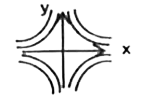
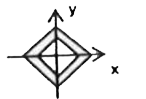
The gravitational field in a region is given by vecE=(yhati+ xhatj) N/kg, where x and y are in metres. The equipotential lines are plotted as |
|
Answer»
|
|
| 47. |
Each question contains statements given in two Columns, wihich are to be matched. Statements in Column-I are labelled as A, B, C and D whereas statements in Column-II are labelled as p, q, r and s. Match the entires of Column-I with appropriate entries of Column-II. Each entry in Column-I may have one or more than one correct option from Column-II. The answers to these questions have to be appropriatelybubbled as illustrated in the given example. If the correct matches are A to (q,r), B to (p,s), C to (r, s) and D to (q),then correctly bubbled matrix will look like the following: |
|
Answer» `B to (p, r, s)`: One capacitor is having charge but the other is UNCHARGED so there is no chance of neutralisation of charge so total charge remains unchanged. In the charge redistribution process, heat is generated and both the CAPACITORS acquire a common potential difference. `C to (p, r, s)`: Plates with similar CHARGES are connected to each other so there is no neutralisation of charge so total charge remains the same. In the charge redistribution process, heat is generated and finally both the capacitors acquire a common potential difference. `D to (Q, r, s)`: Plates with opposite charges are connected to each other so there is neutralisation of charge so total charge does not remain the same. In the charge redistribution process, heat is generated and finally both the capacitors acquire a common potential difference. |
|
| 48. |
A plano-convex lens of radius of curvature 30 cm and refractive index 1.5 is kept in air. Find its focal length (in cm). |
|
Answer» 30 In `1/f=(mu-1)[(1)/(R_1)-(1)/(R_2)],R_1=infty,R_2=-30` CM `therefore 1/f=(1.5-1.0)[(1)/(infty)-(1)/(-30)]` `therefore 1/f=0.5 XX(1)/(30)=(1)/(60)` `therefore` f=60 cm |
|
| 49. |
The intensity of a light pulse travelling along an optical fibre decreases exponentially with distance according to the relation l = i_(0) e^(-0.0693x) where x is in km and l_(0) is intensity of incident pulse. The intensity of pulse reduces to (1)/(4) after travelling a distance |
|
Answer» 1km |
|