

Saved Bookmarks
This section includes 7 InterviewSolutions, each offering curated multiple-choice questions to sharpen your Current Affairs knowledge and support exam preparation. Choose a topic below to get started.
| 1. |
State the law of radioactive decay. Plot a graph showing the number (N) of undecayed nuclei as a function of time (t) for a given radioactive sample having half life T_(1//2). Depict in the plot, the number of undecayed nuclei at (i) t=3T_(1//2) and (ii) t=5T_(1//2). |
Answer» Solution :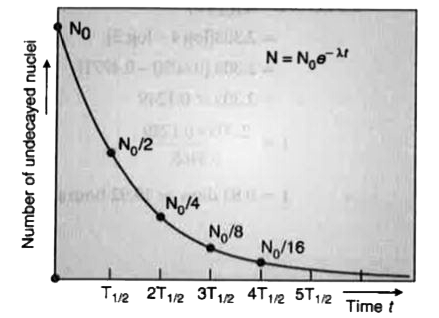 The number of nuclei UNDERGOING decay per unit time, at any instant, is proportional to the TOTAL number of nuclei in the SAMPLE at that instant. Alternatively : `- (d N)/( dt) prop N` `RARR (dN)/( dt ) = - lambda N` |
|
| 2. |
Light of wavelength 3500 A^(@) is incident on two metals A and B. Which metal will yield photoelectrons, if their work functions are 4.2 eV and 1.9 eV respectively ? |
|
Answer» Solution :`lambda=3500A^(@)=3500xx10^(-10)m, h=6.63xx10^(-34)JS` `F=h upsilon=h(c )/(lambda)=(6.63xx10^(-34)xx3xx10^(8))/(3500xx10^(-10))J=(6.63xx10^(-34)xx3xx10^(8))/(3500xx10^(-10)xx1.6xx10^(-19))=3.546eV` |
|
| 3. |
The resultant of three vectors 1, 2 and 3 units whose directions are those of the sides of an equilateral triangle is : |
|
Answer» at an angle of 30° with the first vector or `R_(x)=1+2(-1/2)+3(-1/2)=-3/2` 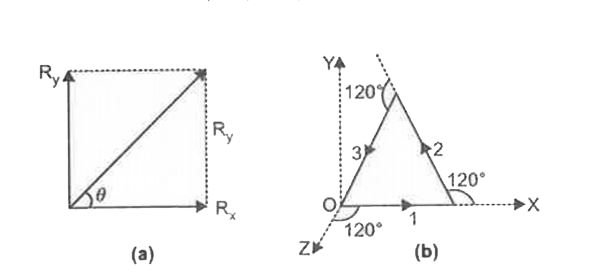 `R_(y)=2sin120^@+3sin240^@` `tantheta=R_(y)/R_(x)=(-sqrt(3)/2)/(-3/2)=sqrt(3)/3=1/sqrt(3)` `theta=tan^(-1)(1/sqrt(3))=30^@` |
|
| 4. |
A narrow slit of width 1 mm is illuminated by monochromatic light of wavelength 600 nm. The distance between the first minima on either side of a screen at a distance of 2 m is |
|
Answer» 1.2 cm |
|
| 5. |
The coefficient of reflection is the ratio of |
|
Answer» RADIANT energy reflected from the body to the radiant energy INCIDENT on it |
|
| 7. |
Calculate the (a)Momentum ,and (b)de-Broglie wavelength of the electrons accelerated through a potential differene of 56 V. |
|
Answer» Solution :V=56 V Kinetic energy of electron , `K=Vxxe` `p=sqrt(2mK)` `=sqrt(2xx9.1xx10^(-31)xx56xx1.6xx10^(-19))` `=sqrt(1630.72xx10^(-50))` `=40.38xx10^(-25)` `~~4.04xx10^(-24)KG ms^(-1)` (B)de-Broglie wavelength, `LAMBDA=(h)/(p)=(6.63xx10^(-34))/(4.04xx10^(24))` `=1.64xx10^(-10)m` 1.64 Å |
|
| 8. |
A plano convex lens has a thickness of 4 ck. When placed on a horizontal table with the curved surface in contact withit, the apparent depth of the bottom most point of the lens is found to be 3 cm. If the lens inverted such that the plane face is in contact with the table, the apparent depth of the center of plane face is found to be 25/8 cm. Find the focal length of lens. Assume the thickness to be negligible while finding its focal length. |
|
Answer» 75 cm |
|
| 9. |
A parallel plate capacitor with circular plates of radius 1m has a capacitance of 1nF. At t = 0, it is connected for chargeing in series with a resistor R=1 M Omega across a 2V battery (Figure). Calculate the magnetic field at a point P, halfway between the centre and the periphery of the plates, after t=10^(-3)s. (The charge on the capacitor at time t is q(t)=CV[1-exp((-t)/(tau))], where the time constant tauis equal to CR). |
|
Answer» Solution :The time constant of the CR circuit is `tau = CR=10^(-3)s`.Then, we have `q(t)=CV[1-EXP((-t)/(tau))]` `=2xx10^(-9)[1-exp((-t)/(10^(-3)))]` The electric field in between the PLATES at time t is `E=(q(t))/(epsilon_(0)A)=(q)/(pi epsilon_(0)), A = pi(1)^(2)m^(2)=`area of the plates Consider now a circular loop of radius `((1)/(2))` m parallel to the plates passing through P. The magnetic field B at all points on the loop is along the loop and of the same value. The flux `phi_(E )=E xx` area of the loop `=E xx pi xx ((1)/(2))^(2)=(pi E)/(4)=(q)/(4epsilon_(0))` The displacement current `i_(d)=epsilon_(0)(d phi_(E ))/(dt)=(I)/(4)(dq)/(dt)=0.5xx10^(-6)exp(-1)` at`t=10^(-3)s`. Now, APPLYING Ampere Maxwell LAW to the loop, we get `B xx 2pi xx ((1)/(2))= mu_(0)(i_(c )+i_(d))=mu_(0)(0+i_(d))` `=0.5xx10^(-6)mu_(0)exp(-1)`or`B=0.74xx10^(-13)T` |
|
| 10. |
The angle between the two vectors when there sum is equal to their difference is |
| Answer» ANSWER :C | |
| 11. |
The magnetic dip angle at two places are 30° and 45°. Calculate ratio of horizontal components of earth's magnetic field at the two places. Magnetic field at the places is equal to ....... |
|
Answer» (A) `sqrt(2) :sqrt(3)` `B_h= B cos phi` Taking ratio of `B_(h_(1) ) = B cos phi_(1)and B_(h_(2) ) = B cos phi_(2) ` `THEREFORE (B_(h_(1) ) )/( B_(h_(2) ) ) = ( cos phi_(1) )/( cos phi_(2 )) ""[phi_(1) = 30^(@) , phi_(2) = 45^(@) ]` `= ( cos 30^(@) )/( cos 45^(@) ) ` `= ( sqrt3//2)/( 1//2) = (sqrt(3)xxsqrt(2) )/( 2 ) = (sqrt(3) )/( sqrt(2))` |
|
| 12. |
Show that m=(f-v)/(f) for a lens. |
|
Answer» SOLUTION :w.k.t. `(1)/(f)=(1)/(v)-(1)/(u)` By DEFINITION, `m=(v)/(u) and u=(v)/(m)` hence, `(1)/(f)=(1)/(v)-(m)/(v)` `(f-v)/(vf)=(m)/(v)` `thereforem=(f-v)/(f)` |
|
| 13. |
Polaroids are used |
|
Answer» to ELIMINATE head light glare in automobile |
|
| 14. |
An e.m.f of 5 volt is produced by a self inductance, when the current changes at a steady rate from 3A to 2A in 1 millisecond. The value of self inductance is |
|
Answer» Zero |
|
| 15. |
A rectangular, horizontal conducting frame carries current, flowing clockwise as seen from above,. P is a point vertically above the centre of the frame. The direction of the magnetic field at P due to the current is |
|
Answer» VERTICALLY upwards |
|
| 16. |
A persin moves 30 m north, then 20 m east and finally 30sqrt(2) m south-west. The displacement from the original position is : |
|
Answer» 14 m south-WEST `vec(S_(3))=-30sqrt(2)(cos45hati + sin45hatj)` `vec(S)=vec(S_(1)) + vec(S_(2)) + vec(S_(3))=30hatj + 20hati -30hati-30hatj=-10 hati` 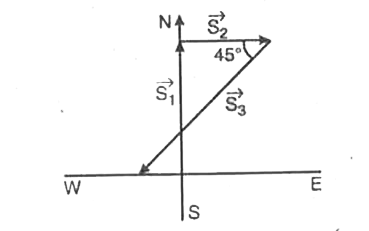 Hence RESULTANT displacement is 10 m (west). |
|
| 17. |
A ring is made from a dielectric with polar molecules. What will happen to the dielectric, if a magnet is inserted into it? |
|
Answer» |
|
| 18. |
Elinstein was awarded Nobel Prize in 1921 for his work on photoelecric effect.Which of the following is not a photosensitive material for visible light? (I) Sodium (II) Magnesium (III) Rubidium (IV) Caesium |
| Answer» SOLUTION :MEGNESIUM | |
| 19. |
A particle is confined to the one-dimensional infinite potential well of Fig. 38-2. If the particle is in its ground state, what is its probability of detection between (a) x = 0 and x 0.25L, (b) x =0.75L and x = L, and (c) x = 0.25L and x 0.75L? |
| Answer» SOLUTION :(a) 0.091, (B) 0.091, (C) 0.82 | |
| 20. |
Determine the current in each branch of the network shown in fig. |
Answer» Solution : Apply KVL in loop ABDA `-10I^(1)=5(I-2I^(1))+5(I-I^(1))=0` `2I=5I."………(i)"` Apply kVL in ADCEFA loop `-5(I-I^(1))-10I^(1)+10-10I=0` `2I=5I."…..(i)"` `"from equation (1) and (2) "I=(10)/(17),I^(1)=(21)/(5)=(4)/(17)A` CURRENT in AB BRANCH `=(4)/(17)=I-I^(1)=(10)/(17)-(4)/(17)=(6)/(17)A` Current in DB branch `I-2I.=(10)/(17)-(8)/(17)=(2)/(17)A` |
|
| 21. |
A: It is not possible to have an interference between sound waves produce from two violins. R: The phase difference for two waves in interference must be constant. |
|
Answer» Both ASSERTION and reason are TRUE and the reason is CORRECT EXPLANATION of the assertion. |
|
| 22. |
When a 60 mH inductor and a resistor are connected in series with an AC voltage source, the voltage leads the current by 60^(@). If the inductor is replaced by a 0.5 mu F capacitor, the voltage lags behind the current by 30^(@). What is the frequency of the AC supply ? |
|
Answer» `(1)/(2pi)xx10^(4)Hz`  Now,`tan 60^(@)=(X_(L))/(R )=(omega L)/(R ) ""`….(i) Again, `tan 30^(@)=(X_(C ))/(R )=(1)/(omega CR)` Now, from EQN. (i) and (ii), we get `(tan 60^(@))/(tan 30^(@))=(omega L)/(R )xx (1)/((1)/(omega CR))=omega^(2)LC` `RARR (sqrt(3))/(1//sqrt(3))=omega^(2)xx 60xx10^(-3)xx0.5xx10^(-6)rArr omega = 10^(4)` As `omega = 2pi upsilon` or `2pi upsilon=10^(4)rArr upsilon = (10^(4))/(2pi)Hz` |
|
| 23. |
There is a uniform electric field of strength 10^3 Vm^(-1) along Y-axis. A body of mass lgm and charge 10^(-6) C is projected into the field from origin along the positive X-axis with a velocity of 10 ms^(-1) Its speed in ms^(-1) after 10s is (Neglect gravitation) |
|
Answer» `10` |
|
| 24. |
The central core of the sun is called |
|
Answer» chromosphere |
|
| 25. |
A circular coil carrying current behaves as a |
|
Answer» BAR magnet |
|
| 26. |
Optical fibre communication uses the frequency range of |
|
Answer» `10^(9)-10^(10)` Hz |
|
| 27. |
Define electric potential and explain it. Write its SI unit and give its other units. |
Answer» Solution :The work REQUIRED to be done against the electric field to bringa unit positive charge from infinite distance to the given point in the electric field is called the electrostatic or electric potential at that point. It is indicate by .V.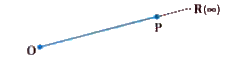 Consider a positive charge Q at the origin O and point P at certain distance and point R at infinite distance from its electric field. Work done in brininga unit positive charge from infinity to the point P is the potential energy of that charge. Hence, work done by an external force in bringing a unit positive charge without acceleration from infinity to a point is the electrostatic potential at that point. 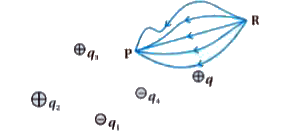 For this definition two remarks should kept in mind: (1) Work done on a test charge q by the electrostatic field due to any given charge| configuration is independent of the path and depends only on its initial and final positions . (2) To obtain the work done per unit test charge, we should take an INFINITESIMAL test charge `deltaq` obtain the work done `deltaW` in bringing it from infinity to the point and determine the ratio `(deltaW)/(deltaq)`.The external force at every point of the path is to be equal and opposite to the electrostatic force on the test charge at that point. Electric potential is a vector quantity. Its SI unit is `(J)/(C )` or Volt V in memory of the sclentist VOLTA. Other UNITS `: V=(I)/(C )=(Nm)/(C)=(Wb)/(C)=(Wb)/(S)=(Tm)/(A)` and dimensional formula : `[ M^(1)L^(2)T^(-3)A^(-1)]` |
|
| 28. |
The horizontal component of earth's magnetic field at a place is 3.6 xx 10^(-5) T. if the angle of dip at this place is 60^(@), the vertical components of earth's field at this place is |
|
Answer» `1.2 xx 10^(-5)` T `B_(v) = 6.2 xx 10^(-5) ` T |
|
| 29. |
An air-cored solenoid is of length 0.3 m, area of cross section 1.2 xx 10^(-3) m^2and has 2500 turns. Around its central section, a coil of 350 turns is wound. The solenoid and the coil are electrically insulated from each other. Calculate the emf induced in the coil if the initial current of 3 A in the solenoid is reversed in 0.25s. |
|
Answer» Solution :`M = (mu_0 N_1N_2 A_2)/(l)` ` = (4PI xx 10^(-7) xx 2500 xx 350 xx 1.2 xx 10^(-3))/(0.3) H = 4.4xx 10^(-3) H` ` e = M (dI)/(DT)` ` e = 4.4 xx 10^(-3) xx (3-(-3))/(0.25) V = 0.1056V` If two solenoids are of unequal length, then length of bigger solenoid is to be CONSIDERED. |
|
| 30. |
In the circuit shown in figure the voltmeters V_(1) & V_(2) are identical. If readings of ammeter A_(2), Voltmeter V_(2) and V_(1) are 400 muA, 100 V and 2 V respectively, find the resistance of ammeter A_(1). Is the value realistic ? |
|
Answer» |
|
| 31. |
1 ohm =_______ stat ohm =______ ab ohm . |
| Answer» SOLUTION :`[9xx10^n,10^8]` | |
| 32. |
A cyclotron's oscillator frequeney is 10 MHz. What should be the operating magnetic field for accelerating protons ? If the radius of its dees is 60 cm, what is the kinetic energy (in MeV)of the proton beam produced by the accelerator. (e= 1.60 xx 10^(-19) C, m_p = 1.67 xx 10^(-13)kg) |
|
Answer» Solution :The oscillar frequency should same as proton.s cylotron frequency . We have `B= (2PI m upsilon)/(q) = (6.3 xx 1.67 xx 10^(-27)xx 10^(7))/((1.6 xx 10^(-19))) = 066 T` Final velocity of proton is `v= r xx 2 pi upsilon = 0.6 m xx 6.3 xx 10^7 = 3.78 10^7 ` m/s `E = 1/2 mv^2 = (1.67 xx 10^(-27) xx 14.3 xx 10^(14))/((2 xx 1.6 xx 10^(-13)))=7 MeV` |
|
| 33. |
A short bar magnet with magnetic dipole moment 1.6 "Am"^(2) is kept in magnetic meridian in such a way that its north pole is in north direction. In this case, the null (neutral) point is found at a distance of 20 cm from the centre of the magnet. Find the horizontal component of the Earth's magnetic field. |
Answer» Solution :From the figure, it is observed that on the MAGNETIC equator of the magnet, horizontal field lines of the earth.s magnetic field and the magnetic field lines due to the magnet are in mutually opposite directions.  Hence, one finds two points on magnetic equator of the magnet at equal distance from the magnet in such a way, that at these points the above mentioned two magnetic fields are equal in magnitude and opposite in direction. At such points the resultant magnetic field is zero. These points are called neutral or null points. Here, `m= 1.6 "Am"^(2)` Let, the distance of neutral points from the CENTRE of the magnet is `d_1`, `therefore d_(1) = 20 cm = 0.2 m` Now the magnetic field due to a short bar magnet on its equatorial plane `B_1` must equal `B_H` `B_1 = (mu_0)/( 4 pi ) . (m)/( d_(1)^(3) ) = B_(H)` `therefore B_(H) = (10^(-7)xx 1.6) /( (0.2)^(3) ) = 2 xx 10^(-5)` T Now if the bar magnet is kept as in part (b) of the figure, then it is clear that on the magnetic axis, `B_H` and the magnetic field due to the magnet are in mutually opposite directions and so the neutral points are on the axis. Let `d_2` is the distance of such neutral point from the centre of magnet `therefore B_(2) = (mu_0)/( 4PI) . (2m)/( d_(2)^(3) ) = B_H` `therefore d_(2)^(3) = (10^(-7) .2m) /( B_H)= (10^(-7) xx 2 xx 1.6)/( 2 xx 10^(-5) ) ` `= 16 xx 10^(-3) ` `therefore d_(2) = 2.52 xx 10^(-1) m= 25.2` cm |
|
| 34. |
Give some examples of Newon's third law of motion. |
| Answer» Solution :When a bullet is FIRED from the gun, the bullet moves forward and gun pushes backward DUE to reaction force. (ii) When a man JUMPS on the SHORE from a boat, the boat pushes backward due to reaction force.(iii) When a man walks on a surface, the man pushes the surface backward while the surface pushes him forward. | |
| 35. |
A linear aperture whose width is 0.02 em is placed immediately in front of a lens of focal length 60 cm. The aperture is illuminated normally by a parallel beam of wavelength 5 xx 10^(-5) cm. The distance of the first dark band of the differation pattern from the centre of the screen is ....... |
|
Answer» `0.20` cm `-d sin theta_(m)=m lambda` `:. sin theta_(1)=((1)lambda)/(d)` but `sin theta_(1)=(x_(1))/(D)` `:.(x_(1))/(D)=(lambda)/(d)` `:.x_(1)=(D lambda)/(d)` `=(60xx5xx10^(-5))/(0.02)=0.15 cm` |
|
| 36. |
Five capacitors each of capacitance C and breakdown voltage V are connected as shown in the figure. The capacitance and breakdown voltage of the combination (applid across AB) will be |
|
Answer» `(7C)/(6), V/2` `C_(AB) = (Cxx2C)/(C+2C) +(CxxC)/(C+C)` `=(2C)/(3) +C/2 = (7C)/(6)` Also , breakdown voltage of combination will be `(3V)/(2)` |
|
| 37. |
An unpolarised beam of light is incident on a group of four polarising sheets which are arranged in such a way that the characteristic direction of each polarising sheet makes an angle of 30^(@) with the preceding sheet. What fraction of light is transmitted? |
|
Answer» `(27)/(54)` `I_(3) = I_(2)cos^(2)30^(@)` and `I_(4) = I_(3)cos^(2)30^(@)` `therefore I = (I_(0))/(2)(cos^(2)30^(@))^(3) = (I_(0))/(2) = (I_(0))/(2) cos^(6)30^(@)` `therefore (I)/(I_(0)) = (27)/(128)` |
|
| 38. |
A uniform disc of radius R has a hole cut out which has a radius r. The centre of hole is at a distance (R )/(2) from the centre of disc. The position of centre of mass is : |
|
Answer» `(R-r)/(R )` (t = THICKNESS) Mass of SCOOPED out disc = `pir^(2)trho` Mass of remaining disc = `pi(R^(2)-r^(2))trho` Now `pi(R^(2)-r^(2))trhoxx x=pir^(2)trho(R)/(2)x=(r^(2)R)/(2(R^(2)-r^(2)))` |
|
| 39. |
Suppose the colours on the resistor as shown in Figure are brown, yellow, green and gold as read from left to right. Using the table, find the resistance of the resistor |
Answer» Solution : `=14xx10^(5)(1 pm(5)/(100))Omega` `=(1.4pm0.07)10^(6)Omega=(1.4pm0.07)M Omega` Some times TOLERANCE is MISSING from the code and there are only three bands. Then the tolerance is `20%`. |
|
| 40. |
Two inductors of self inductances L_(1) and L_(2) of reistances R_(1) and R_(2) (not shown in the diagram) respectively, are connected in the circuit as shown in the figure. At the instant t=0, key K is closed,obtain the condition for which the galvanometer will show zero deflection at all times after the key is closed. |
|
Answer» Solution :Since there is no current through `BD` therefore points `B` and `D` are at same potential, `V_(B)=V_(D)` Potential difference, `V_(AB)=V_(AD)` `L_(1)(di_(1))/(dt)+i_(1)R_(1)=L_(2)(di_(2))/(dt)+i_(2)R_(2)`………`(1)` Similarly, `V_(BC)=V_(DC)` `i_(1)R_(3)=i_(2)R_(4)` ........`(2)` From equation `(1)` and `(2)` `L_(1)(R_(4))/(R_(3))(di_(2))/(dt)+i_(2)(R_(1))/(R_(3))=L_(2)(di_(2))/(dt)+i_(2)R_(2)` `(L_(1)(R_(4))/(R_(3))-L_(2))(di_(2))/(dt)=i_(2)[R_(2)-(R_(1))/(R_(3))]`........`(3)` At `t=0`, `i_(2)=0` `:. L_(1)(R_(4))/(R_(3))-L_(2)=0` as `(di_(2))/(dt) ne 0` `:. (L_(1))/(L_(2))=(R_(3))/(R_(4))`..........`(4)` At `t=oo`, `(di_(2))/(dt)=0`, `RARR i_(2)=((epsilon)/(R_(2)+R_(4)))=`constant `rArr R_(2)-(R_(4)R_(1))/(R_(3))=0` `:. (R_(1))/(R_(2))=(R_(3))/(R_(4))`.......`(5)` From `(4)` and `(5)` `(L_(1))/(L_(2))=(R_(1))/(R_(2))=(R_(3))/(R_(4))` 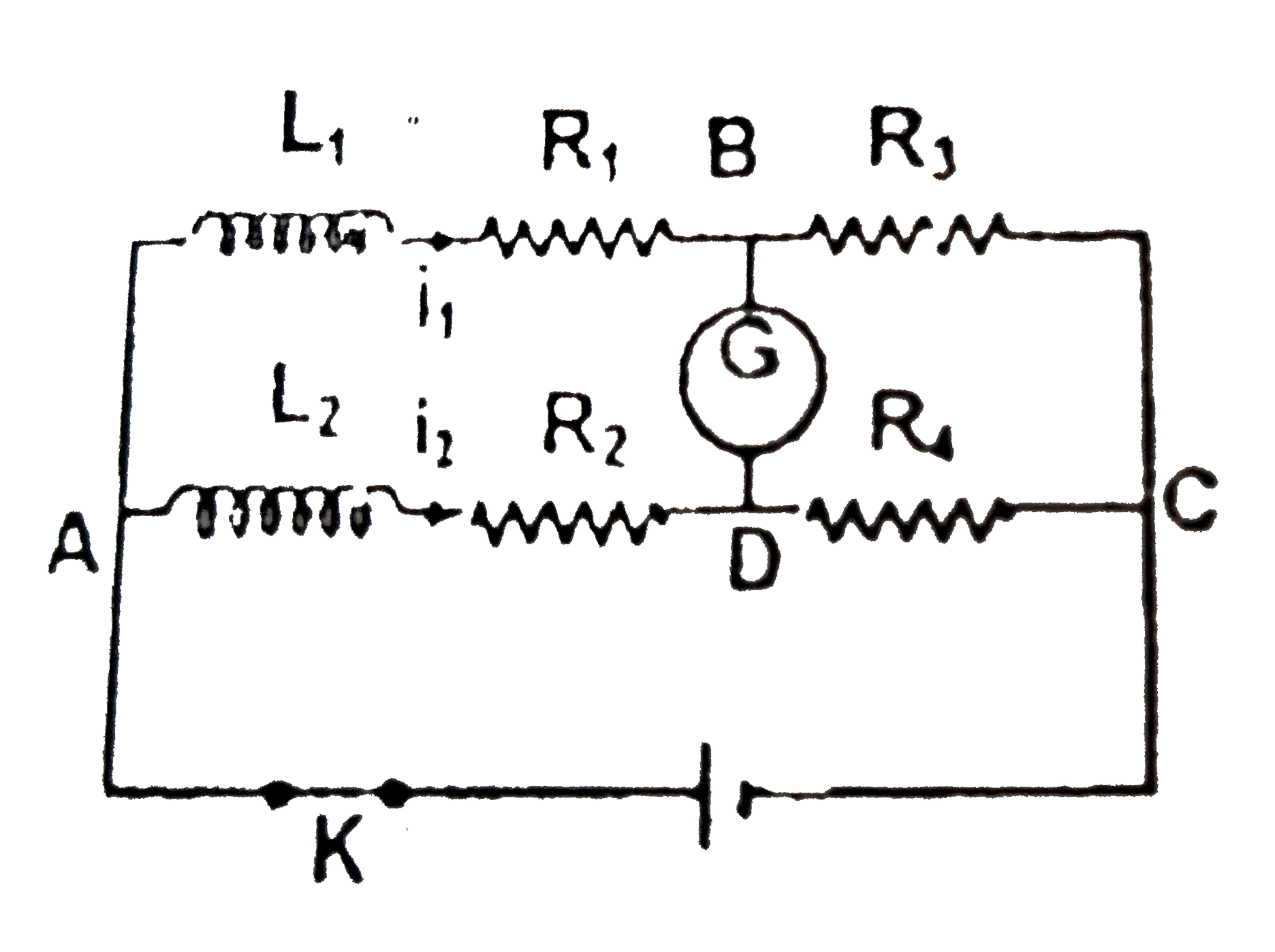
|
|
| 41. |
The binding energy per nucleon for deuteron (""_(1)H^(2)) and helium (""_(2)He^4) are 1.1 MeV and 7.0 MeV respectively. The energy released when two deuterons fuse to form a helium nucleus is |
|
Answer» 36.2 MEV |
|
| 42. |
The horizontal and vertical component are _____ of each other. |
|
Answer» |
|
| 43. |
If x, v, a, K.E. and P.E. represent displacement, velocity, acceleration, kinetic energy and potential energy at any instant respectively for a particle executing S.H.M., then which of the following statements is INCORRECT? |
|
Answer» V and X MAY have same direction |
|
| 44. |
The decay of proton to neutron is possible only inside the nucleus. Why ? |
| Answer» Solution :UNLIKE neutron, PROTON is highlystable . Moreover ,REST mass energy of proton is LESS than that of neutron. | |
| 45. |
If the intensity of the waves obvserved by two coherent sources is 1. Then the intensity of resultant waves in constructive interferences will be: |
|
Answer» 21 |
|
| 46. |
At what temperature will the speed of sound be double of its value at 0^@C? |
| Answer» SOLUTION :`819^0C` | |
| 47. |
Two electrons separated by distance .r. experience a force F between them. The force between a proton and a singly ionized helium atom separated by distance 2r is |
|
Answer» 4F |
|
| 48. |
Find the velocity of image of a moving particle 'O' in the situation as shown in the figure. |
|
Answer» `sqrt164` m/s, at `tan^(-1)` (4/5) with horizontal |
|
| 49. |
A pipe 2cm in diameter has a constriction of diameter 1cm. Find the velocity of flow at the constriction and the rate at which water is discharge through the pipe if the velocity of flows in the broader region og the pipe is 5cm/s. |
|
Answer» Solution :For horizontal flow of water, we have from Bernoulli's THEOREM `P_1 + (1)/(2)p v_1^2 = P_2 + (1)/(2)p v_2^2` therefore `P_2 = p_1 + (1)/(2) p (v_1^2 - v_2^2)` ` p_1 and p_2` are pressure where the VELOCITIES are `v_1 and v_2` RESPECTIVELY. On substituting the given value `P_2 = 1400 + (1)/(2) XX 1000 (0.3^2 - 0.3^2) = 1265 N/ m^2`. |
|
| 50. |
A wire length 2.5km and resistance 35 ohm has fallen from a height of 10m in earth's horizontal field of 2xx10^-5T. What is the current through the wire? |
|
Answer» SOLUTION :`V^2` = 2gh` ` THEREFORE v = sqrt2gh = 14m/s.` `E = B_Hlv = 2xx10^-5xx2.5xx10^3xx14` ` = 70xx10^-2 ` ` therefore i = e/R = 2xx10^-2 = 0.02A`. |
|