Saved Bookmarks
This section includes 7 InterviewSolutions, each offering curated multiple-choice questions to sharpen your Current Affairs knowledge and support exam preparation. Choose a topic below to get started.
| 1. |
The scale of M.C.G. is linear because of |
|
Answer» LARGE NUMBER of turns of the coil |
|
| 2. |
The wavelength of H_(beta) spectral line of Balmer series is 4860 Å then find out the wavelength of H_(alpha)spectral line of the same series |
|
Answer» Solution :For `H_(beta)` LINE of Balmer series of hydrogen ATOM H `(1)/(lambda_(beta))=R[(1)/(2^(2))-(1)/(4^(2))]=R[(1)/(4)-(1)/(16)]` `(1)/(lambda_(beta))=(3R)/(16).....(1)` `rArr` For `H_(alpha)` line of Balmer series of hydrogen atom `(1)/(lambda_(alpha))=R[(1)/(2^(2))-(1)/(3^(2))]=R[(1)/(4)-(1)/(9)]` `(1)/(alpha)=(5R)/(36)...(2)` `rArr` Taking the ratio of equation (1) and (2) `(lambda_(alpha))/(lambda_(beta))=(3R)/(16)xx(36)/(5R)` `lambda_(alpha)=lambda_(beta)xx(27)/(20)` `=4860xx(27)/(20)` ` :. lambda_(alpha)=6561Å` |
|
| 4. |
An object 1.5 cm in size is placed on the side of the convex lens in the arrangement (a) above. The distance between the object and the convex lens is 40 cm. Determine the magnification produced by the two-lens system, and the size of the image. |
|
Answer» Solution :For convex lens, Object distance u = - 40 C, FOCAL length f = + 30 cm Lens formula , `(1)/(f_1) = (1)/(v_1) - (1)/(u_1)` `therefore (1)/(v_1) = (1)/(f_1) + (1)/(u_1)` `therefore (1)/(v_1) = (1)/(30) - (1)/(40) = (4-3)/(120) = (1)/(120)` `thereforev_1 = 120 cm ` `rArr` Magnification by 1st (convex) lens, `m_1 = (v)/(|u|) = 120/40 = 3 ` `rArr` This image is virtual for another lens, `thereforeu_2 = (120 -8) = + 112 cm ` `f_2 = - 20 cm ` From lens formula , `(1)/(f_2) = (1)/(v_2) - (1)/(u_2)` `therefore(1)/(v_2) = (1)/(-20) + (1)/(112) = (-112 + 20)/(112 xx 20) = (-92)/(112 xx 20)` `therefore (1)/(v_2) = - (112 xx 20)/(92) = - 24. 9 cm ` `rArr` Magnification by another lens (CONCAVE), `m_2 = (|v_2|)/(u_2) = (112 xx 20)/(92 xx 112) = (20)/(92) ~~ 0.217 ` `rArr` Resultant magnification of combination, `m = m_1 xx m_2` `= 3 xx 0.217` = 0.651 `rArr` Image height `m = (h_2)/(h_1)` `therefore h_2= m xx h_1 = 0.651 xx 1.5` `thereforeh_2 = 0.9765 ` `therefore h_2 = 0.9765` `thereforeh_2 ~~ 0.98` cm |
|
| 5. |
The MKS unit of stefan -Boltzmann constant is |
|
Answer» WATT`m^-1k^-4` |
|
| 6. |
Which of the following wiring diagrams could be used to experimentally determine R using ohm's law? Assume an ideal voltmeter and an ideal ammeter. |
|
Answer»
|
|
| 7. |
A wheel of moment of inertia 5xx10^(-3) kgm^2 is making 20 revolutions per second.It is stopped in 20 second. Then angular retardation is |
|
Answer» `PI`RADIAN/`s^2` |
|
| 8. |
A parallel beam of monochromatic light of wavelength 500nm is incident normally on a perfectly absorbing surface. The power through any cross- section of the beam is 10 W. Find (a) the number of photons absorbed per second by the surface and (b) the force exerted by the light beam on the surface. |
|
Answer» SOLUTION : (a) The ENERGY of each photon is `E = hc/ lambda = ((4.14 xx (10^-15)eVs) xx (3 xx (10^8) m (s^-1))/500NM) ` ` 1242 eVnM/ 500nm = 2.48 eV.` In one second, 10J of energy passes through any cross section of the BEAM. THUS, the number of photons crossing a cross section is ` n= (10J/2.48 eV)= 2.52 xx (10^19)`. This is also the number of photons falling on the surface per second and being absorbed. (b) The linear momentum of each photon is ` p = (h/lambda)= hv/c. ` The total momentum of all the photons falling per second on the surface is ` = nhv/c = 10J/c = (10J/ 3 xx (10^8)m(s^-1))= 3.33 xx (10^-8) Ns.` As the photons are completely absorbed by the surface, this much momentum is transferred to the surface per second. The rate of change of the momentum of the surface, i.e., the force on it is. ` F= dp/dt= (3.33 xx (10^-8)Ns / 1s) = 3.33 xx (10^-8)N` |
|
| 9. |
Two slabs are of the thicknesses d_(1) and d_(2). Their thermal conductivities are K_(1) and K_(2) respectively. They are in series. The free ends of the combination of these two slabs are kept at temperatures theta_(1) and theta_(2) . Assume theta_(1)gttheta_(2). The temperature theta of their common junction is : |
|
Answer» `(K_(1)theta_(1)+K_(2)theta_(2))/(theta_(1)+theta_(2))`  HEAT current, `H_(1)=(K_(1)(theta_(1)-THETA)A)/(d_(1))` For second slab, Heat current, `H_(2)=(K_(2)(theta-theta_(2))A)/(d_(2))` As slabs are in series `H_(1)=H_(2)` `:.(K_(1)(theta_(1)-theta)A)/(d_(1))=(K_(2)(theta-theta_(2))A)/(d_(2))` `rArr""theta=(K_(1)theta_(1)d_(2)+K_(2)theta_(2)d_(1))/(K_(2)d_(1)+K_(1)d_(2))` So, correct choice is (c ). |
|
| 10. |
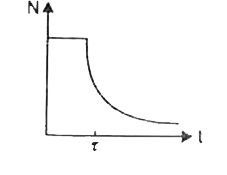
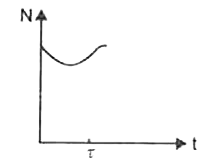
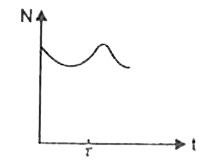
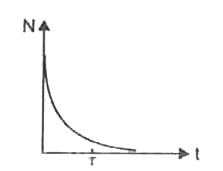
A radioactive sample consists of two distinct species having equal number of atoms initially. The mean life time of one species is tau and that of the other is 5 tau. The decay products in both cases are stable. A plot is made of the total number of radioactive nuclei as a function of time. Which of the following figures best represents the form of this plot. |
|
Answer»
|
|
| 11. |
A man standing still finds rain pouringat angle 30^(@) with vertical , whenhs starts walkingforward at a speed of 4Kmph it appers to him that rain pours vertically down. Whenhe runs attriple the speed, whatis the angleat whichrain appers to pour ? |
|
Answer» Solution :Case I : When the MAN is still `V_(R)` = ACTUAL (ABSOLUTE ) velocityof rain. Case : II Whenman walksat 4kph. rain fall vertically mean horizontal component of rains.velocity= 4 `therefore V_(R) sin30^(@) = 4 rArr V_(R) = 8` 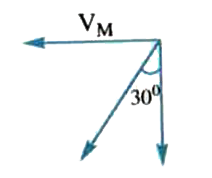 Case : III The man runsat triple the speed `V_(M) = 12kph`. we have superimposed `V_(M) ` to `V_(R) ` to get theresultant . Fromfigurewe see `TAN phi = (O.B)/(OO.) = (12-4)/(sqrt(8^(2) - 4^(2)) = (8)/(sqrt(48)) = (2)/(sqrt(3)) thereforephi = 49` andraindrop makes an angle of `49.6^(@)` in oppositedirection. 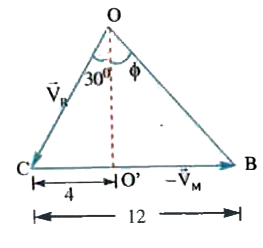
|
|
| 12. |
A particle is moving with a constant speed v in a circle. What is the magnitude of average velocity after half rotation? |
|
Answer» Solution :For half REVOLUTION, time TAKEN is `t=(nR)/(v)` |Average velocity| `=(2R)/(nR/v) =(2)/(N) v` |
|
| 13. |
A convex lens of focal length f produces an image 1/n times than that of the size of the object. The distance of the object from the lens is: |
| Answer» Answer :3 | |
| 14. |
A wooden block of 100 kg is about to be pushed on a floor of coefficient of friction 0.4. The magnitude of the force of friction on the wooden block when it is just pushed is |
|
Answer» 392 N |
|
| 15. |
The amount of heat required to convert 1 gnm of ice at- 10^(@)C to steam at 100^(@)C is: |
|
Answer» 725 CAL `Q=mC_(1)DeltaT_(1)+mL_(1)+mC_(2)DeltaT_(2)+mL_(2).` `=1xx0 cdot 5xx10+1xx80+ bot xx1xx100+1xx540.` `=5+80+100+540=725 cal`. HENCE, correct choice is (a). |
|
| 16. |
For sound waves, the Doppler formula for frequency shift differs slightly between the two situations : (i) source at rest, observer moving and (ii) source moving, observer at rest. The exact Doppler formulas for the case of light waves in vacuum are, however, strictly identical for these situations. Explain why this should be so. Would you expect the formulas to be strictly identical for the two situations in case of light travelling in a medium? |
| Answer» Solution :SOUND waves require a material medium for propagation. That is why situation (i) and (ii) are not identical physically though relative motion between the source and the observer is the same in the TWO cases. INFACT, relative motion of the observer relative to the medium is different in two situations. That is why Doppler's formulae for sound are different in the two cases. For light waves TRAVELLING in vacuum, there is nothing to distinguish between the twc situations. That is why the formulae are strictly identical. For light propagating in a medium, situation (i) and (ii) are not identical. The formulae governing the two situations would obviously be different. | |
| 17. |
Which of the following represents the variation of inductive reactance (X_L) with the frequency of voltage source (upsilon) ? |
|
Answer»
`X_(L)=2pifgammaL` `X_(L)propgamma` |
|
| 18. |
Prove that the vectors A=3i+j-2k ,B=-i+3j+4k and C=4i-2j-6k can form a triangle. |
|
Answer» SOLUTION :Let US ADD the VECTORS `vecB` and `vecC` `vecB+vecC`=(-i+3j+4k)+(4i-2j-6k)=(-i+4i)+(3i-2j)+(4k-6k)=3i+j-2k=`vecA` |
|
| 19. |
In Fig. an electron (e) is to be released from rest on the central axis of a uniformly chargeddisk of radius R. The surface charge density on the disk is +5.00 mu C//m^(2). What is the magnitude of the electron's initial acceleration if it is released at a distance (a) R, (b) R/100, and (c ) R/1000 from the center of the disk ? (d) Why does the acceleration magnitude increase only slightly as the release point is moved closer to the disk ? |
| Answer» Solution :(a) `1.45 xx 10^(16) m//s^(2)`, (B) `4.93 xx 10^(16) m//s^(2)`, (c ) `4.96 xx 10^(16) m//s^(2)` | |
| 20. |
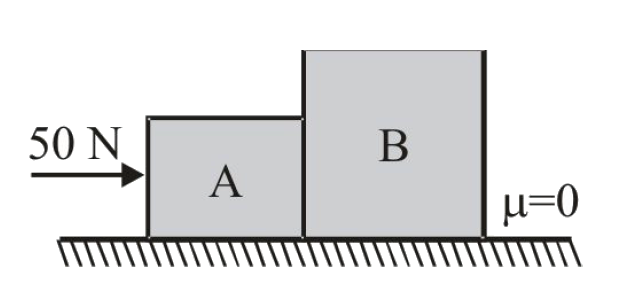
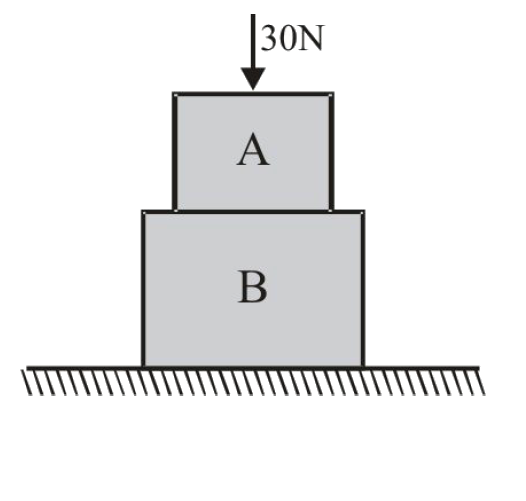
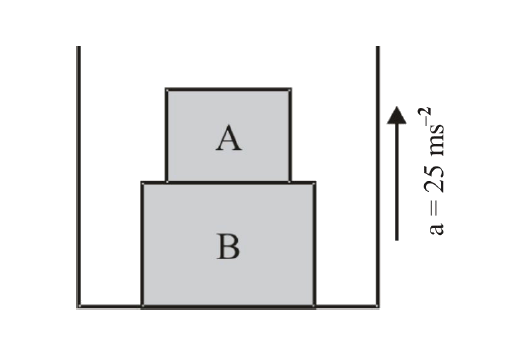
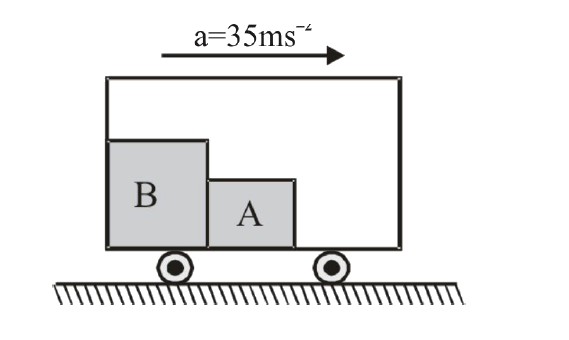
In which of the following cases the contact force between A & B is maximum?(m_A=m_B=1kg,g=10ms^(–2)) |
|
Answer»
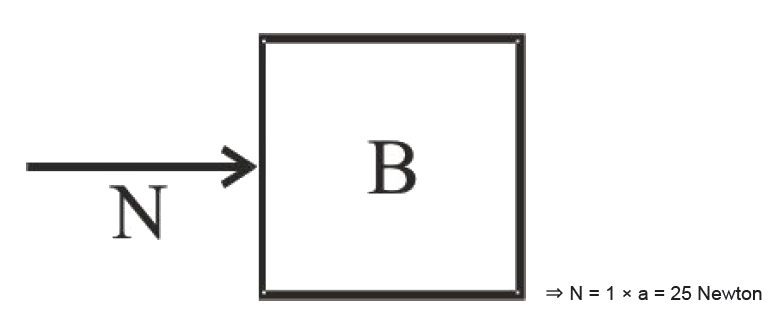 ` (##NEET_MJT_10_E01_034_S02.png" width="80%"> `N=ma` `N=1xx35=35` Newton |
|
| 21. |
If a hole is drilled along the diameter of the earth and a stone is dropped into it. The stone : |
|
Answer» reaches the centre of earth and stops At depth `d,g.=g(1-(d)/( R ))=g((R-d)/( R ))=g(y)/( R )` Hence correct choice is ( c ). |
|
| 22. |
A fly wheel rotation about a fixed axis has a kinetic energy of 360Joule, when it's engular speed is 30rad/sec. What is the moment of inertia of the fly wheel about it's axis of rotation? |
| Answer» SOLUTION :`E=1/2Iomega^2 THEREFORE 360=1/2I XX (30)^2 thereforeI=720/900=0.8 kgm^2` | |
| 23. |
Forty one tunity forks are arrenged in increasing order of frequency such that every fork gives 5 beats with the next. The last fork has a frequency that is double the frequency of the first fork. The frequency of the first fork is : |
| Answer» ANSWER :C | |
| 24. |
Define work function. Write Einstein's photoelectric equation and explain the terms. |
|
Answer» Solution :The minimum energy required to LIBERATE an electron from the metal surface is CALLED the work function of the metal. Einstein.s photoelectric equations, `K_("max")= HV - phi_(0)` |
|
| 25. |
Monochromatic light waves of intensitiesI_(1) and I_(2), and a constant phase difference phi produce an interference pattern. State an expression for the resultant intensity at a point in thepattern. Hence deduce the expressions for the resultant intensity, maximum intensity and minimum intensity if I_(1)=I_(2)=I_(0). |
|
Answer» Solution :Consider a two-source interference PATTERN produced by monochromatic light waves of intensities `I_(1) and I_(2),` and a constant PHASE difference `phi`. The resultant intensity at a point in the pattern is `I=I_(1)+I_(2)+2 sqrt(I_(1)*I_(2))*cos phi ""` ...(1) If`I_(1)=I_(2)=I_(0),` `I=I_(0)+I_(0)+ 2 sqrt(I_(0) * I_(0))* cos phi ` `=2I_(0)(1+cos phi) "" ` ...(2) At a point of constructive interference with maximum intensity, `cos phi =1` and `I_(max) =2I_(0)(1+1)=4I_(0) "" `...(3) At a point of destructive interference with minimum intensity,`cos phi = -1` and `I_(min) =2I_(0) (1-1)=0 ""`...(4) |
|
| 26. |
What role does electrostatics playin the reproductionof floweres ? |
|
Answer» Solution :Two important partsof a flower are : flower's ANTHER and flower'sstigma, Fig. The formeris electrically insulatedand the laatter is electricallyconnectedto groundthroughflower'sinerior. The beesare usuallypositively chargedand pollengrains are moderatelelyconducting. When a bee hoversneara flower'santher, poltengrainsbeing so light jumpto the bee on ACCOUNTOF ELECTROSTATIC FORCE or attraction. The grainsclingto the bee duringitsflightto the next flower. As the beecomescloser to that flower'ssligma, thepollen grainsjump from the bee to thestigma ( in the directionof electric field betweento beeandthe SIGMA) resulting in ferilizationof the flower. 
|
|
| 27. |
A charged particle is rotating in uniform circular motion in a uniform magnetic field . Let r= radius of circule, v= speed of particle k = kinetic energy, a= magnitude of acceleration , p= magnitude of linear momentum, q/m = alpha=specific charge and omega= angular speed. then match the following two columns. |
|
Answer» <P> |
|
| 28. |
A small sphere S of radius ,r and mass m rolls without slipping, inside a large hemispherical bowl B of radius R as shown in figure. S starts from rest at the top point of the hemisphere |
|
Answer» The fraction of translational KINETIC ENERGY at the sphere is 5/7. At this position (bottom of B), the translational kinetic energy of the sphere is GIVEN by `E_(1)=1/2mv^(2)`, where m is the mass of the sphere. As the sphere rolls down without slipping, we have, `v = romega`, r is the radius of the sphere. `thereforeE_(2)=1/5mr^(2)omega^(2)=1/5mv^(2)` Therefore, total kinetic energy of the sphere at the bottom of the bowl is `E=E_(1)+E_(2)=1/2mv^(2)+1/5mv^(2)=7/10mv^(2)` Fraction of translational kinetic energy of the sphere `=(E_(1))/E=(1/2mv^(2))/(7/10mv^(2))=5/7` Fraction of rotational kinetic energy of the sphere `=(E_(2))/E=(1/5mv^(2))/(7/10mv^(2))=2/7` |
|
| 29. |
What is doping? |
| Answer» Solution :The process of adding either PENTAVALENT or trivalent i.Impurity in a CONTROLLED and small QUANTITY in a pure semiconducting material is called doping. | |
| 30. |
Six forces lying in a plane and forming angles of 60^(@) relative to one another are applied to the center of a homogenous sphere with a mass m = 6 kg. These forces are radially outward and consecutively IN, 2N, 3N, 4N, 5N and 6N. The acceleration of the sphere is |
|
Answer» ZERO |
|
| 31. |
Zener diode is fabricated by heavily doping both p- and n-sides of the junction so breakdown occurs at a voltage of about 5 V in reverse bias. |
|
Answer» |
|
| 32. |
The energy released by fusion of 1.0 kg of hydrogen and fission of 1.0 kg of ""^(235)Uin a fission reactor are (Q values for fusion, fission are 26 MeV, 200 MeV per reaction) |
|
Answer» `4xx10^(27) J , 5 xx10^(26)J` |
|
| 33. |
A double slit experimentis performed with light of wavelength 500 nm. A thin film of thickness 2mum and refractive index 1.5 is introduced in the path of the upper beam . The location of the central maximum will |
|
Answer» remain unshifted |
|
| 34. |
Mark the correct statements : |
|
Answer» EQUATIONS of special relativity are not applicable for SMALL speeds. |
|
| 35. |
Explain the principle of a potentiomater. |
|
Answer» SOLUTION :Principle of a potentiometer : The potential difference across any length of a potentiometer wire is directly proportional to that length. field Explanation: The potentiometer consists of a long uniform wire AB of length L, stretched on a wooden board. A CELL of constant emf E is connected across AB, as shown in the figure. 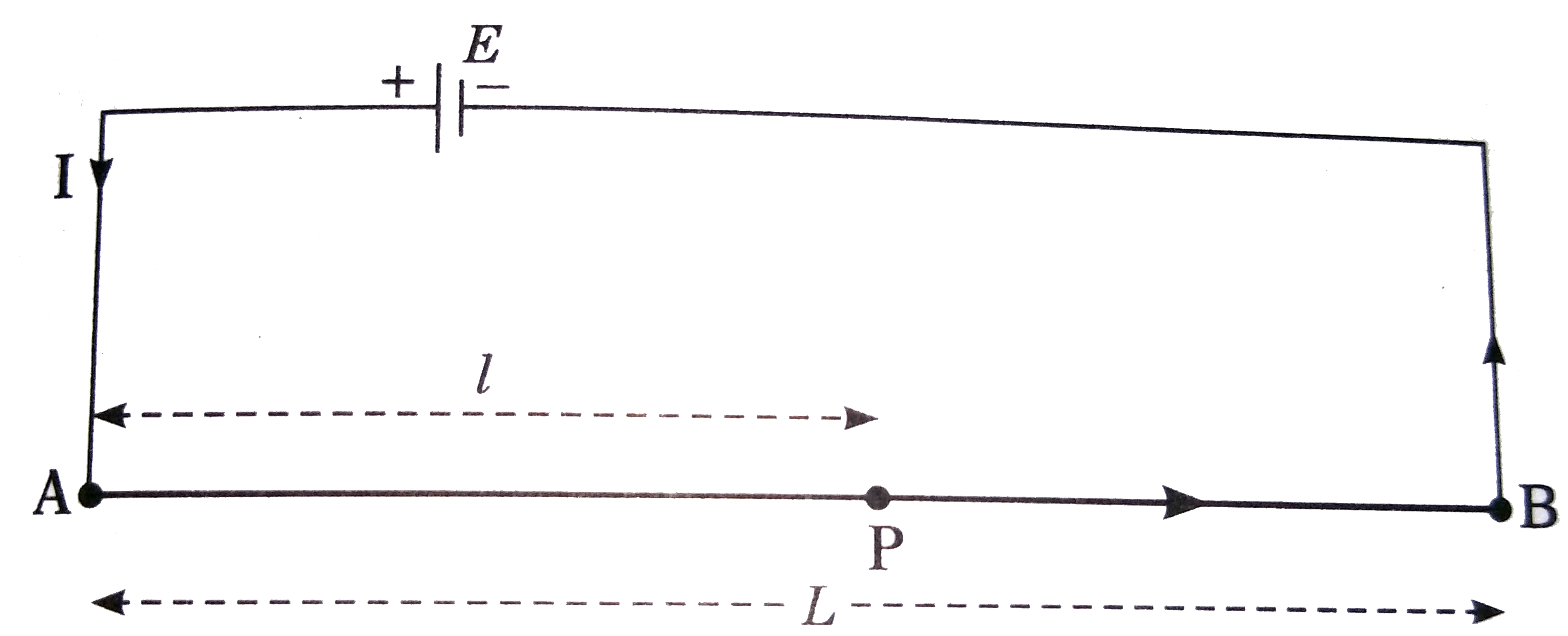 As the steady current PASSES through the wire from A to B, there is a tall of potential along the wire from A to B. As the wire has a uniform cross section, its resistance per unit length `lamda` is constant. Hence, the resistance of the wire is `Llamda`Therefore, the potential difference (p.d.) across the wire is `V_(AB)="current"XX "resistance"=ILlambda` `therefore I=V(V_AB)/(L lamda)` Let P be any point of the wire between A and B. Let AP-L Then the resistance of the wire AP is 2. The p.d. between A and P is `V_(AP)="current" xx "resistance of AP"=Illambda` where `=(V_(AB))/(L)=k` (constant), as `V_(AB) and L` are CONSTANTS. The quantity k represents the fall of potential per unit length of the wire, which is called the potential gradient along the wire. `therefore V_(AP)=kltherefore V_(AP) alpha l` Thus, the p.d. across any length of the potentiometer wire is directly proportional to that length. |
|
| 36. |
An object of weight Wand density p is dipped in dipped in a fluid of density p_(1). Its apparent weight will be : |
|
Answer» <P>`W(p-p_(1))` `=W-W/p.p_(1)` `=W(1-(p_(1))/p)` So correct choice is (b) |
|
| 37. |
In a boiling water reactor, the boiling water is used as a |
| Answer» Answer :A | |
| 39. |
Electrons accelerated by a p.d. of V=5000 volts are allowed to impinge normally on a plate. If the current constituted by the impinging electrons be I=0.02 mA, find the force experienced by the plate. Assume complete absorption of electrons by the plate. m=9.0xx10^(-31) kg and e=1.6xx10^(-19) C |
|
Answer» |
|
| 40. |
A dipole having dipole moment P is placed in front of a solid netural conducting sphere as shown in figure. The net potential at point A on the surface of sphere is |
|
Answer» `(kpcosphi)/(R^(2))` |
|
| 41. |
Discuss the applications of Nanomaterials in various fields. |
|
Answer» Solution :(i) Automotive industry: • Lightweight construction • Painting (fillers, base coat, clear coat) • Catalysts • Tires (fillers) • Sensors • Coatings for window screen and car bodies (ii) Chemical industry: • Fillers for paint systems • Coating systems based on nanocomposites • Impregnation of papers • Switchable adhesives • Magnetic fluids (iii) Engineering • Wear protection for tools and machines (anti blocking coatings, scratch resistant coatings on plastic parts, etc.) • Lubricant-free bearings (iv) ELECTRONIC industry • Data memory Displays • Laser diodes • Glass fibres • Optical switches • Filters (IR-blocking) • Conductive, antistatic coatings (v) Construction: • Construction MATERIALS • Thermal insulation • Flame retardants • Surface-functionalised building materials for wood, floors, stone, facades, tiles, roof tiles, etc. • Facade coatings • Groove mortar (vi) Medicine: • Drug delivery systems • Active agents • CONTRAST medium • Medical rapid tests • Prostheses and implants • ANTIMICROBIAL agents and coatings • Agents in cancer therapy (vii) Textile / fabrics / non-wovens: • Surface-processed textiles • Smart clothes (viii) Energy: • Fuel cells Solar cells • Batteries • Capacitors (ix) Cosmetics: • Sun protection Lipsticks • Skin creams • Tooth paste (x) Food and drinks: • Package materials • Storage life sensors • Additives • Clarification of fruit juices (xi) Household: • Ceramic coatings for irons • Odors catalyst • Cleaner for glass, ceramic, floor, WINDOWS (xii) Sports / outdoor: • Ski wax • Antifogging of glasses/goggles • Antifouling coatings for ships/boats • Reinforced tennis rackets and balls |
|
| 42. |
On fogy day two drivers spot in front of each other when 80 m apart, they were travelling 70 kmph and 80 kmph. Both apply brakes simultaneously which retards the car at the rate of 5 m//s^2. Which of the following statement is correct? |
|
Answer» The COLLISION will be AVERTED |
|
| 43. |
The safe current in an insulated aluminium wire of1mm^(2) cross section is 8 A. Find the average drift velocity of the conduction electrons. |
|
Answer» |
|
| 44. |
Assetion The magnetism of magnet is due to the spin motion of electrons Reason Dipole moment of electron is smaller than that due to orbit motion around nucleus. |
|
Answer» Both assertin and reason are true and reason is the correct explanation of assertion |
|
| 45. |
Two point charges q_(1) and q_(2) (like) are seperated by a distancer and fixed. Locatethe point on the line joining those charges where resultantor net field is zero. |
|
Answer» Solution :Let P BETHE null point where `barE_("net") =0` ` rArr barE_(1)+barE_(2) =0` (due to thosecharges) or `barE_(1) = -barE_(2) and E_(1)=E_(2)` `rArr (1)/(4PI in_(0)) (q_(1))/(x^(2)) =(1)/( 4pi in_(0)) (q_(2))/((r-x)^(2)) or (q_(1))/(x^(2)) =(q_(2))/( (r-x)^(2))` From this we get x. If the chargesare like, the neutral point will be between the charges, ifthe chargesare unlike the neutralpoint will be outsidethe charge on the line joining them.  `:.` In this case `(q_(1))/(x^(2)) =(q_(2))/((r+x)^(2))`. |
|
| 46. |
A balloon os mass 2 KG is rising up with an acceleration of 4m/s^2 . The upward force acting on the balloon is (g = 10 ms^(-2) |
|
Answer» 0.8 kgf |
|
| 47. |
An ac-circuit having supply voltage E consists ofa resistor of resistance 3Omega and an inductor of reactance 4Omega as shown in the figure. The voltage across the resistane at t=pi/omega is |
|
Answer» 6.4V |
|
| 48. |
Energy E of a hydrogen atom with principal quantum number n is given by E_n=-(13.6)/n^2eV. The energy of a photon ejected when the electron jumps from n=3 state to n=2 state of hydrogen is approximately. |
|
Answer» 1.5 eV |
|
| 49. |
Is it possible to move with constant speed but not constant velocity ? Is it possible to move with constant velocity but not constant speed ? |
|
Answer» Solution :The answer to the first QUESTION is yes. For example, if you set your car's CRUISE control at 55 miles per hour but turn the STEERING wheel to follow a curved section of road, then the direction of your velocity changes (which means your velocity is not constant), even though your speed doesn't CHANGE. The answer to the second question is no. Velocity means speed and direction, if the velocity is constant, then that means both speed and direction are constant. If speed were to change, then the velocity vector's magnitude would change (by definition), which immediately implies that the vector changes. |
|
| 50. |
The refractive indices of violet and red light are 1.54 and 1.52 respectively. If the angle of prism is 10^(@), then the angular dispersion is |
|
Answer» 0.02 |
|