

Saved Bookmarks
This section includes 7 InterviewSolutions, each offering curated multiple-choice questions to sharpen your Current Affairs knowledge and support exam preparation. Choose a topic below to get started.
| 1. |
Explain how Biot-Savart's law enables one to express the Ampere's circuital law in the integral form , viz., oint vecB .vec(dl) = mu_0 I where I is the total current passing through the surface. |
|
Answer» Solution :Let us consider an infinitely long straight WIRE in which a current I is flowing. To find magnetic field at a point P situated at a normal distance R from the wire consider a circular loop of RADIUS R AROUND the wire and in a plane perpendicular to the wire so that magnetic field `vecB` is tangential to the circumerence of the circle. For such a case `oint vecB. vec(dl) = int B dl = B int dl = B . 2 pi R` But as per Biot-Savart.s law we know that magnetic field B at a normal distance R from a long long straight current carrying wire is `B = (mu_0 I)/(2 pi R)` Hence, we get : `oint vecB . vec(dl) = ((mu_0 I)/(2 pi R)) 2 pi R = mu_0 I`. which is the INTEGRAL form of Ampere.s circuital law. 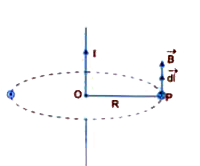
|
|
| 2. |
(a) With the help of a labelled digram, explain the working of a step-up transformer. Give reason to explain the following, (i) The core of the transformer is laminated. (ii) Thick copper wire is used in windings. (b) A conducting rod PQ of length 20 cmn and resistance 0.1 Omega rests on two smooth parallel rails of negligible resistance AA' and CC'. It can slide on the rails and the arrangement is positioned between the poles of a permanent magnet producing uniform magnetic field B=0.4T. The rails, the rod and the magnetic field are in three mutually perpendicular directions as shown in the figure. If the ends A and C of the rails are short circuited, find the (i) external force required to move the rod with uniform velocity v= 10 cm/s, and (ii) power required to do so. |
|
Answer» SOLUTION :(a) A step up transformer is shown here. It consists of two coils of enamelled copper wire wound on a laminated soft iron core. Number of turns in secondary coil is greater than that in primary coil When an alternating emf/voltage source is applied across the P coil, the input current and, hence, magnetic flux through P coil soft iron core keeps on changing with time. The changing magnetic flux GETS linked up with S coil through the iron core, which in turn producesinduced voltage across the secondary coil. It coupling of two coils is good then all flux lines across P coil link up with Scoil too. If at any time, the flux linked per unit tum of primary be `phi_(B)` then TOTAL magnetic flux of P coil, `phi_(P)=N_(P), phi_(E)" [where "N_P=" Total number of turns in P coil")` and instantaneous value of induced emf in P coil, `epsi_(p)=-(d phi_(P))/(dt)=-N_(P) (d phi_(B))/(dt)` If total number of turns in S coil be `N_S` then magnetic flux of S coil `phi_(s)= N_s. phi_(B)` and instantaneous value of induced emf in S coil, `epsi_(s)= (d phi_(s))/(dt)=-N_(s) (dphi_(B))/(dt)` For an ideal transformer `|epsi_(p)|`= input voltage `V_p and epsi_(s)=V_s` = output voltage obtained across secondary coil. Then, `|epsi_s|/|epsi_p|=V_s/V_p=N_s/N_p` Again for an ideal transformer input power output power `therefore V_(p). I_(p)=V_(s).I_(s)` `rArr V_(s)/V_(p)=I_(p)/I_(s)=N_(s)/N_(p)=k` (the transformer ratio) Since `N_(s) gt N_(p)` in a step up transformer, `V_(s) gt V_(p`) i.e, transformer ratio k has a value greater than unity. (i) The core of the transformer is laminated one so as to minimise setting up of eddy currents in it. (ii) Thick copper wire is used in windings of coils so that resistance of the coils is small and least possible electrical energy is dissipated as heat due to Joule.s heating. (b) Her length of rod l=20cm =0.2m, resistance `R=0.1 Omega`, magnetic field B=0.4T and uniform velocity or rod `v=10 CM s^(-1) =0.1ms^(-1)` (i) Induced current `I=(BLV)/(R)` and hence force required to move the rod `F=BIl =(B^(2) l^(2) v)/(R)=((0.4)^(2) xx (0.2)^(2) x(0.1))/(0.1) =6.4 xx 10^(-4)n` (ii) Power required `P=Fv=(6.4 xx 10^(-4)) xx 0.1=6.4 xx 10^(-5)W` 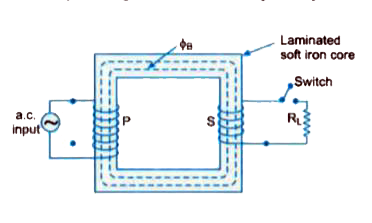
|
|
| 3. |
The relation between time and displacement is t=alphax^(2)+betax where alpha and beta are constants. What is retardation of the body: |
|
Answer» `2alphav^(3)` Differentiating both sides w.r.t . Time, `1=2alphax.(dx)/(dt)+beta(dx)/(dt) 1=2alphaxv +betav` `1=(2alphax+beta)v impliesv=(1)/(2alpha+beta)` Differentiating equation (i)w.r.t. time again `0=2alphax.(dv)/(dx)+2alphav.(dv)/(dt)+beta(dv)/(dt)` or `0=2alphaxa+2alphav^(2)+betaa` `0=(1alphax +beta)a+2alphav^(2)` `a= -((2alphav^(2))/(2alphax+beta))` Using equation (ii) `a= - 2alphav^(3)` THUS retardation=2 `alphav^(3)` |
|
| 4. |
A ball of mass m when suspended by a spring stretches the latter by Delta l. Due to external vertical lforce varying according to a harmonic law with amplitude F_(0) the ball performs forced oscillations. The logarighmic damping decrement if equal to lambda. Neglecting the mass the spring, find the angular frequency of the external force at which the displacemetn amplitude of the ball is maximum. What is the magnitude of that amplitude ? |
|
Answer» Solution :For the SPRING `mg= k Delta l` where `k` is its stiffness coefficient. Thus `omega_(0)^(2)=(k)/(m)=(g)/(Deltal)` The equation of motion of the ball is `ddot(x) + 2 beta dot (x) + omega_(0)^(2)x=(F_(0))/(m) cos omegat` Here, `y=(2pibeta)/( sqrt(omega_(0)^(2)-beta^(2)))` or ` ( beta)/( omega)=( lambda // 2pi )/( sqrt(1+ ( lambda//2pi)^(2)))` To find the solution of the above equation we look for the solution of the auxiliary equation `cancel(ddot(x))+2 betacancel(dot(x))+ omega_(0)^(2)cancel(z)=(F_(0))/(m)e^(iomegat)` Clearyl we can TEK Re `cancel(z)=x.`Now we look for a particular integral for `cancel(z)` of the form `cancel ( z)=A e^(iomegat)` Thus, substitution gives `A` and we get `cancel(z) =((F_(0)//m)e^(iomegat))/(omega_(0)^(2)-omega^(2)+2 i betaomega)` so taking the REALPART `x=((F_(0)//m)[(omega_(0)^(2)-omega^(2))cos omegat+ 2 beta omega sin t])/( ( omega_(0)^(2)-omega^(2))^(2)+ 4 beta^(2)omega^(2))` `=(F_(0))/( m)(cos ( omegat-varphi))/(sqrt((omega_(0)^(2)-omega^(2))^(2)+ 4 beta^(2) omega^(2))), varphi= tan ^(-1) .( 2beta omegat)/( omega_(0)^(2)- omegat^(2))` The AMPLITUDE of this OSCILLATION is maximum when the denominator is minimum. This happens when `omega^(4)-2 omega_(0)^(2) omega^(2)+ 4 beta^(2) omega^(2)+omega_(0)^(4)=( omega^(2)-omega_(0)^(2)+ 2 beta^(2))+ 2 beta ^(2) omega^(2) - 4 beta ^(4)` is minimum `i.e.` for `omega^(2)=omega_(0)^(2)- 2 beta^(2)` Thus` omega_(res)^(2)=omega_(0)^(2)(1-(2beta^(2))/(omega_(0)^(2)))` `=(g)/(Deltal)[1-(2((lambda)/( 2pi))^(2))/(1+((lambda)/( 2pi))^(2))]=(g)/(Deltal)(1-((lambda)/(2pi))^(2))/(1-((lambda)/(2pi))^(2))` and `a_(res)=(F_(0)//m)/(sqrt(4 beta^(2) omega_(0)^(2)- 4 beta^(4)))=(F_(0)//m)/(2 beta sqrt(omega_(0)^(2)-beta^(2)))=(F_(0)//m)/(2 beta^(2)). ( lambda)/( 2pi)` `=(F_(0))/( 2 m omega_(0)^(2)). (1+ ((lambda)/(2pi))^(2))/( lambda//2 pi)=(F_(0)Deltallambda)/( 4 pi m g ) ( 1+ (4pi ^(2))/( lambda^(2)))` |
|
| 5. |
A radioactive sample S_(1) having an activity of 5 muCi has twice the number of nuclei as another sample S_(2) which has an activity of 10 muCi. The half lives of S_(1) and S_(2) can be |
|
Answer» 10 YEARS and 5 years, respectively |
|
| 6. |
A particle is travelling along a straight line OX. The distance r of the particle from O at a timet is given by x = 37 + 27t- t^(3), where t is time in seconds. The distance of the particle from O when it comes to rest is |
|
Answer» 81 m VELOCITY `nu=(DX)/(dt) =(d)/(dt) (37+27t-t^(3))` `=27-3t^(2)` It come to REST `nu=0` `:. 27-3t^(2)=0 "or " 3t^(2) = 27` or `t^(2) = (27)/(3) =9 ` or t=3 s At t=3 s , `x=37+27(3) -(3)^(3) = 37 +81 -27 =91 ` m |
|
| 7. |
During refraction what remains contant and which changes. |
| Answer» SOLUTION :FREQUENCY,VELOCITY,and WAVELENGTH | |
| 8. |
A 1.5 muF capacitor is charged to 57V. The charging battery is then disconnected, and a 12 mH coil is connected in series with the capacitor so that LC Oscillations occur. What is the maximum current in the coil? Assume that the circuit has no resistance. |
| Answer» SOLUTION :`10^(-6)` F. | |
| 9. |
Define the distance of closest approach. An alpha-particle of kinetic energy K is bombarded on a thin gold foil. The distanceof the closest approach is r. What will bethe distance of closest approach for an alpah-particle of double the kinetic energy ? |
|
Answer» SOLUTION :The distance of closest approach is the distance from thenucleuswhere total kineticenergy of `alpha` -particles is completely convertedinto POTENTIAL energy . The distance of closest approach, `R=(2Ze^2)/(4pi in_0K)` `therefore r prop 1/K` If the kinetic energy of the `alpha` -particle is doubled, then the distance of closest approach will become HALF. |
|
| 10. |
An infinite number of charges , each equal to q , are placed along the x - axis at x = 1, x=2,x=4,x=8 and so on . Thepotential at x = 0 due to this set of charges is |
|
Answer» `(4Q)/(2piepsilon_(0))`  Potential at x=0 , due to the above set of charges is `V=(1)/(4piepsilon_(0))[(q)/(1)+(q)/(2)+(q)/(4)+(q)/(8)+........]` `=(q)/(4piepsilon_(0))[1+(1)/(2)+(1)/(2^(2))+(1)/(2^(3))+..........]` `=(q)/(4piepsilon_(0))[(1)/(1-(1)/(2))]=(2q)/(4piepsilon_(0))` |
|
| 11. |
A length of uniform ‘heating wire’ made of nichrome has a resistance 72Omega. At what rate is the energy dissipated if a potential difference of 120V is applied across (a) full length of wire (b) half the length of wire (wire is cut into two). Why is it not advisable to use the half length of wire ? |
| Answer» SOLUTION :(a)200 W, (B) 400 W, 400 W ` gt gt `200 Wbutsincecurrentbecomeslargeso it is notadvisabletousehalfthe LENGTH | |
| 12. |
Diffraction is commom in sound but not commom in light waves ? Why ? |
| Answer» Solution :Diffraction effect is more pronounced if the SIZE of obstacle or APERTURE is of the order of the wavelength of waves. As the wavelength of light `(10^-8m)` is much SMALLER than the size of the objects around SOUND so, diffraction of light is not easily SEEN. But sound waves have large wavelength. They get easily diffracted by the objects around us. | |
| 13. |
The electron drift arises due to the force experienced by electrons in the electric field insidethe conductor. But force should cause acceleration. Why then do the electrons acquire a steady average drift speed ? |
| Answer» SOLUTION :Each .FREE. electron does accelerate increasing its drift speed until it collides with a positive ION of the metal. It loses its drift speed after COLLISION but starts to accelerate and increases its drift speed again only to suffer a collision again and so on. On the AVERAGE, therefore, electrons acquire only a drift speed. | |
| 14. |
For TV transmission the frequency range employed |
|
Answer» 30-300 MHz |
|
| 15. |
In the Fig., a long uniform potentiometer wire ABis having a constant potential gradient along its length. The null points for the two primary cells of emf epsi_1 andepsi_2connected in the manner shown are obtained at adistance of 120 cm and 300 cm from the end A. Find (i) epsi_1//epsi_2and (ii) position of null point for the cell epsi_1. How is the sensitivity of a potentiometer increased ? |
|
Answer» Solution :(i) If the constant potential gradient be k volt/cm then as PER question `epsi_1 + epsi_2 = k xx 300`....(i) `epsi_1 - epsi_2 = k xx 120`....(ii) `rArr (epsi_1+ epsi_2)/(epsi_1- epsi_2) = 300/120 = 5/2 rArr epsi_1/epsi_2 = 7/3` (ii) If for the cell `epsi_1` the null point be at a distance of 1 from end A, then `epsi_1 = kl` Dividing (i) by (iii), we have `(epsi_1 + epsi_2)/(epsi_1) = 1 + epsi_2/epsi_1 = (300)/(l) " or"1 + 3/7 =(300)/(l)` ` rArr l = (300 xx 7)/(10) = 210 cm` The SENSITIVITY of a POTENTIOMETER can be increased by (i) increasing the length of thepotentiometer WIRE, and (ii) introducing a high resistance in series of potentiometer. |
|
| 16. |
In an endoergic nuclear reaction an incoming particle collides with stationary nucleus |
|
Answer» kinetic energy of INCOMING PARTICLE is greater than Q-value of REACTION in ground frame |
|
| 17. |
ABCD is a uniform circular wire of resistance 16 Omega and AOC and BD are two uniform wires forming diameters at right angles, each of resistance 2 Omega. The two straight wires do not touch each other at O. A battery of emf 10V is placed in AO as shown. (a) Find the current through the battery (figure a) (b) If the straight wires are tied at O so as to form a junction, find the current through the battery (figure b) |
|
Answer» (b) `(35)/(12) A` |
|
| 18. |
Radioactivity is the property by virtue of which................without being forced by............. . |
|
Answer» |
|
| 19. |
Two charges -q and +q are located at points (0,0,-a) and (0,0,a) respectively. a. What is the electrostatic potential at the points (0,0,z) and (x,y,0)? b. Obtain the dependence of potential on the distance r of a point from the origin which r/a gt gt 1. c. How much work is done in making a small test charge from the point (5,0,0), (-7,0,0) along the x-axis? Does the answer change if the path of hte test charge between the same points is not along the x-axis? |
|
Answer» Solution :a. The configuration is similar to dipole. `V=V_(1)+V_(2) =(1)/(4pi epsi_(0)) ((q)/(z-a))+(1)/(4pi epsi_(0)) ((-q))/((z+a))` `=(q)/(4pi epsi_(0)) ((1)/(z-a) -(1)/(z+a))` `=(1)/(4pi epsi_(0)) xx q (z+a-a+a)/(z^(2)-a^(2))=(p)/(4pi epsi_(0) (z^(2)-a^(2))` 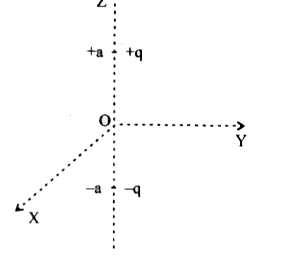 In the case of (x,y,0), it is the EQUATORIAL plane and hence potential is ZERO. (b). The denpendence on R is as `1/r^(2)` TYPE. (c). Zero. No, because work done by electrostatic field between two points in independent of the path concecting the two points. |
|
| 20. |
If one penetrates a uniformly charged sphere the electric field |
|
Answer» dicereases |
|
| 21. |
Which of the following is not diamagnetic ? |
|
Answer» Copper |
|
| 22. |
An object O is located 40cm from the first of two thin converging lenses (each of focal length 20cm), as shown in the figure below. If speed of the right lens is 7cm//s rightwards, speed of final image is 7x//4cm//s at the instant shown, find the value of x. |
|
Answer» `x=-40cm` `V=40cm` For SECOND lens `u=20cm` `V=10cm` `(dV)/(dt)=((V)/(u))^(2)((DU)/(dt))` `V_(I//L)=((10)/(20))^(2)V_(0//L)` `(V_(I)-V_(L))=(1)/(4)(V_(0)-V_(L))` `(V_(I)-7)=-(7)/(4)` `V_(I)=(21)/(4)` `x=3` |
|
| 23. |
When a beam of light is polarised by reflection, there is a change in its : |
|
Answer» Wavelength |
|
| 24. |
The activity of a radioactive substance is 4700 per minute. Five minute later the activity is 2700 per minute. Find (a) decay constant and (b) half-life of the radioactive substance. |
|
Answer» Solution :GIVEN : intial activity `A_(0)=lambda N_(0)=4700` finalactivityA= `lambda=N=2700` t=5 min `N=N_(0)E^(-lambda tau)` `lambda=(2.303)/(5xx60) log_(10)(4700)/(2700)` `lambda=(0.693)/(T_(1/2))` `T_(1/2)=(0.693)/(0.00184)` `T_(1//2)=376.63 sec` `T_(1//2)=6.2 min` |
|
| 25. |
If the length of a cylinder is measured to be 4.28 cm with an error of 0.01 cm . The percentage error in the measured length is nearly |
|
Answer» `0.4%` |
|
| 26. |
What are spectroscope, spectrograph and spectrometer ? |
| Answer» SOLUTION :This can be DONE by FILLING the LIQUID in ahollow | |
| 27. |
(A): Total current entering a junction in a circuit is equal to leaving the junction by Kirchhoff's law. (R): Total current entering a junction in a circuit is equal to leaving the junction is based on conservation of charge. |
|
Answer» Both 'A' and 'R' are true and 'R' is the correct explanation of 'A' |
|
| 28. |
Which one of the following forces is non-conservative ? |
|
Answer» ELECTROSTATIC FORCE |
|
| 29. |
In case of Face Centred, atoms are not present at |
|
Answer» BODY centre |
|
| 30. |
Transformer are used in ………. |
|
Answer» DC CIRCUITS only |
|
| 31. |
A 2muF capacitor is charged to 100 V and then its plate is connected by a wire. How much heat will be produced ? |
|
Answer» 1 J |
|
| 32. |
A cubical container is filled with a liquid whose refractive index increase linearly from top to bottom.Which of the following represents the path of a ray of light inside the liquid : |
|
Answer»
|
|
| 33. |
In which of the following remote sensing echnique is not used? |
|
Answer» FOREST density |
|
| 34. |
when a cosntant potential difference is applied across the ends of a conducter, the temperature of the conductor increases after sometime, then what is the effect on drift velocity of electron? Discuss it. |
|
Answer» SOLUTION :When a potential difference is applied across the ends of a conductor, an electric field is set up inside the conductor Due to it, the free electrons of the conductor get accelerated towards the positive end of the conductor and gain kinetic energy, which is transferred to the ATOMS IONS of the conductor through collisions, and frequency, showing the increase in vibrational energy of the ions/atoms of conductor. This accounts for the RISE in temperature of the conductor. Duet ot increase in vibrational energy of the ions/atoms of the conductor, the free electrons accelerated towards the positive end of the conductor suffer more frequent collisions with the ions/atoms of the conductor. As a result of it, the time of relaxation `(tau)` decreases. As `v_(d)=(eF)/(m)tau`, so drift velocity of electron decreases. |
|
| 35. |
(a) Write the expression for the force vec(F)acting on a particleof mass m and charge q moving with velocityvecVin a magneticfield vecB .Under whatconditionswill it move in (i) a circular path and (ii) a helical path ? (b) Show that the kinetic energy of the particle moving a magneticfield remains constant. |
|
Answer» Solution :(a) Expression for magneto Lorentz Force is `vec(F)= q(vecv xx VECB)`, where `vecF`is forceexperienced by charge q movingwith velocity `vecV`in magneticfield `vec(B)`. If `vec(B)` is perpendicular to `vec(V)` then `theta = 90^(@)`and from `vecF= q(vecv xx vecB) = qVsin theta = qvB` This force is always perpendicular to the direction of motion of particle as well asmagnetic well. Thus, the path of chargedparticle is circular. When the component of velocity of the chargedparticle is parallel to the direction of force of `vec(E)` then `F= qvB sin theta = 0`and particle moves in a straightpath force experiencedby perpendiculareffect of bothcomponentstake theparticle in helical path. (b) From the relation, `(mv^(2))/(r) = qvB rArr r = (mv)/(qB)` and `T = (2pir)/(v)= (2pi)/(v) xx (mv)/(qB) = (2pim)/(qB) rArr T = (2nm)/(qB)` So, `v = (qB)/(2pir)`i.e, periodic frequency is independentof speed of particle and RADIUS of circular path `omega =2piv= (qB)/(m)` So, speed hence KE of particlein circularpath remains same. Also from the workenergy theorem change in KE is equalto WORK DONE and work done in this, case is zero. |
|
| 36. |
Can a slab of p - type semiconductor be physically joined to another n type semiconductor slab to form p -n junction ? Justify your answer. |
| Answer» SOLUTION :No, because surface of both CRYSTALS have some roughness and contact at ATOMIC level is not possible when slabs of p - type of n - type semiconductor are PHYSICALLY JOINED. | |
| 37. |
In an oscillating LC circuit with C = 64.0 muF, the current is given by i = (1.60) sin(4100t + 0.680), where t is in seconds, i in amperes, and the phase constant in radians. (a) How soon after t=0 will the current reach its maximum value? What are (b) the inductance L and (c) the total energy? |
|
Answer» |
|
| 38. |
In the circuit shown, switch S is placed in position 1 till the capacitor is charged to half of the maximum possible charge in this situation. Now, the switch S is placed in position 2. The maximum energy lost by the circuit after switch S is placed in position 2 is |
|
Answer» `(1)/(2) CE^(2)` Energy stored in the capacitor=`(1)/(2)((Q)/(2))^(2)xx(1)/(C)=(1)/(8)(Q^(2))/(2)IMPLIES(1)/(8)CE^(2)=U_(i)` Finally, energy stored in the capacitor,`U_(f)=(1)/(2)CE^(2)` therefore Work done by the battery =`((3)/(2)CE)xxE=(3)//(2)CE^(2)` Heat energy LOST = `=(3)/(2)CE^(2)-(U_(f)-U_(i))=(3)/(2)CE^(2)-((1)/(2)CE^(2)-(1)/(8)CE^(2))=(9)/(8)CE^(2)` HENCE, (D) is CORRECT. |
|
| 39. |
What lens we used in a simple microscope? |
| Answer» SOLUTION :Of CONVERGING of SHORT FOCAL LENGTH | |
| 40. |
The system of two fictitious poles separated by certain distance is called as _____ |
| Answer» SOLUTION :MAGNETIC DIPOLE | |
| 41. |
An amplitude modulated wave is as given in figure. Calculate the percentage modulation, |
|
Answer» `66.67%` |
|
| 42. |
A copper wire ab of length l, resistance r and mass m starts sliding at t=0 down a smooth, vertical, thick pair of connected condcuting rails as shown in figure.A uniform magnetic field B exists in the space in a direction perpendicular to the plane of the rails which options are correct. |
|
Answer» The magnitude and direction of the induced current in the WIRE when speed of the wire `v` is `(vBl)/r`, `a`to b `mg-Bil=(Bl(Bv_(m)l))/r,v_(m)=(mgr)/(B^(2)l^(2))` ( C)` underset(0)overset(v)INT(bv)/(g-(B^(2)l^(2)v)/(mr))=underset(0)overset(t)int(bt) therefore v=v_(m)(1-e^((-"gt")/v_(m)))`(D) `(ds)/(dt)=v underset(0)overset(s)intds=underset(0)overset(t)intv_(m)(1-e^((-"gt")/v_(m)))dt` `s=v_(m)t-(1-e^((-"gt")/v_(m))) rArr ` (g) Heat produced per SEC=`i^(2)r=((B^(2)V_(m)^(2)l^(2))/r^(2))r=mgv_(m)` |
|
| 43. |
The telescopes on some commercial surveillance satellites can resolve objects on the ground as small as 85 cm across (see Google Earth), and the telescopes on military surveillance satellites reportedly can resolve objects as small as 10 cm across. Assume first that object resolution is determined entirely by Rayleigh's criterion and is not degraded by turbulence in the atmosphere. Also assume that the satellites are at a typical altitude of 420 km and that the wavelength of visible light is 550 nm. What would be the required diameter of the telescope aperture for (a) 85 cm resolution and (b) 10 cm resolution? (c) Now, considering that turbulence is certain to degrade resolution and that the aperture diameter of the Hubble Space Telescope is 2.4 m, what can you say about the answer to (b) and about how the military surveillance resolutions are accomplished? |
| Answer» SOLUTION :(a) 0.33 m, (b) 2.8 m, (C) the MILITARY satellites do not USE HUBBLE Telescope-sized apertures | |
| 44. |
A negative charge q_(1)=50 xx 10^(-9)C and a positive charge q_(2)=25 xx 10^(-9)C are fixed at a distance l=20cm. Where should a thrid charge q be placed on the line joining the charges so that they may be in equillibrium? What is the nature of equillibrium with respect to its longitudenal displacement along the line joiing the two charges? Plot a grapgh showing dependence of this force on distance from q_(@). |
|
Answer» |
|
| 45. |
A person in a lift which descends down with an acceleration of 1.8 m//s^2 drops a stone from a height of 2 m. The time of decent is |
|
Answer» `SQRT2` SEC |
|
| 46. |
Hoe does the (i) pole strength and (ii) magnetic moment of each part of a bar magnet change if it is cut into two equal pieces along its length ? |
| Answer» Solution :Each piece is a MAGNET with reduced POLE strength and reduced MAGNETIC MOMENT. | |
| 47. |
Explain quantization of charge. |
| Answer» SOLUTION :Ingeneral the charge on a body `q=+-"ne"` . THISIS known as law of quantisation of charge (n is an INTEGER and e is the charge on anelectron ). According to this law a charge on electron can NEVER be given to a body . The CHAGE on an electron e=1.6xx10^(-19)` coulomb. | |
| 48. |
Derive D_m = A(n_(21) - 1) for thin prism. |
|
Answer» Solution :Thin prism : "The prism which has small prisn angle is CALLED thin prism". Refractive index of prism, `n=(SIN((A+delta_m)/(2)))/(sin(A/2))` …........ (1) If A and `delta_m` is kept small then, `(sin((A+delta_m)/(2)))/(sin(A/2))` =`(A+delta_m)/(2)` radian `sin(A/2)=A/2` radian `THEREFORE` Then equation (1) will be `n=((A+delta_m)/(2))/(A/2)` `n=(A+sin_m)/(A)` `therefore` nA=A+`delta_m` `therefore delta_m=A(n-1)` `delta_m` depends on refractive index and prism angle of prism. |
|
| 49. |
A 0.5 m long solenoid of 10 turns/cm has area of cross-section 1 cm^(2). Calculate the voltage induced across its ends if the current in the solenoid is changed from 1 A to 2 A in 0.1 s. |
|
Answer» Solution :Here length of SOLENOID I= 0.5 m, number of turns per unit length n = 10 turns/em = `10 xx 100 m^(-1) =1000 m^(-1),` area of cross-section `A = 1 cm^(2) = 10^(-4) m^(2)`, change in current `deltal = I_(2) - I_(1) = (2 - 1) A = 1 A` and time `DELTAT = 0.1 s.` `therefore` Self-inductance of solenoid `L = mu_(0)n^(2)lA = (4pi xx 10^(-7)) xx (1000)^(2) xx 0.5 (10^(-4) = 6.28 xx 10^(-5) H` `therefore` Magnitude of induced voltage, `|varepsilon|= L(DeltaI)/(Deltat) = 6.28 xx 10^(5) xx 1/(0.1)= 6.28 xx 10^(-4) V or 0.628 mV` |
|


