Saved Bookmarks
This section includes 7 InterviewSolutions, each offering curated multiple-choice questions to sharpen your Current Affairs knowledge and support exam preparation. Choose a topic below to get started.
| 1. |
What did the Maharaja do when the tigers got extinct? |
|
Answer» He married the PRINCESS of a state with large tiger population |
|
| 2. |
The specificrotation of liquidof length 1 dm , concentration 2.5 kg//m^(3) is40^(@) . The angleof rotation is |
|
Answer» `10^(@)` |
|
| 3. |
An inductor 20 mH, a capacitor 50 muF and a resistor 40Omega are connected in series across a source of emf V = 10sin 340t. The power loss in A.C. circuit is |
|
Answer» 0.67 W `therefore P=(10/sqrt2)^2 XX 40/(R^2+(omegaL-1/(omegaC))^2` `therefore P=100/2xx40/(1600+(340xx20xx10^(-3)-1/(340xx50xx10^(-6))))^2` `therefore P=(50xx40)/(1600+(6.8-58.8)^2)` `therefore P=2000/(1600+(-52)^2)` `therefore P=2000/(1600+2704)` `therefore P=2000/4304` `therefore` P=0.4646 W `therefore P approx` 0.51 W (NEAR most VALUE ) |
|
| 4. |
In Young's double slit experiment using monochromatic light of wavelength lamda, the intensity of light at a point on the screen where path difference is lamda is K units. What is the intensity oflight at a point where path difference is(lamda)/3? |
|
Answer» Solution :Inteference of waves from the two slits gives, Intensity`I=I_(1)+I_(2)+2sqrt(I_(1)I_(2)). cos phi` Phase difference `phi=(2pi)/(lamda)xx` PATH difference `=(2pi)/(lamda)xx lamda =2pi =0^(@)` `:.` Intensity `I=I+I+2sqrt(I.I) . cos 0^(@)=I+I+3I=4I=K` units (GIVEN) For path difference `(lamda)/3, phi=(2pi)/(lamda)xx(lamda)/3=(2pi)/3=120^(@)` `:.` Intensity`I.=I+I+2sqrt(I.I). cos 120=I+I+2I(1/(-2))=I=I/4` (Unit) |
|
| 5. |
If the temperature of body is increased by 10% the percentage increase in the emitted radiation with be : |
|
Answer» `46%` `:.(E_(2)-E_(1))/(E_(1))xx100=(T_(2)^(4)-T_(1)^(4))/(T_(1)^(4))xx100` `((110)^(4)-(100)^(4))/((100)^(4))xx100` `=[(1.1)^(4)-1]xx100` `=(1.46-1)xx100=46%` Correct choice is (a). |
|
| 6. |
If vec(E ) equals zero at a given point mus V equal for that point . |
| Answer» Solution :No, SINCE E = `(dV)/(DX)`, then E = 0 MEANS V should be constant . It may or may not be ZERO | |
| 7. |
The double slit in Young.s experiment is replaced by a single narrow slit( illuminatedby a monochromatic source). Then,Derive an expression for the bandwidth of the central fringe. |
| Answer» Solution :A broad pattern with a CENTRAL bright region is seen.On both sides,there are ALTERNATE dark and bright REGIONS of decreasing INTENSITY. | |
| 8. |
Whichof the following represents unit Faraday ? |
|
Answer» `VC^(-1)` Faraday ` = CV^(-1)` |
|
| 9. |
Explain vector form of Coulomb's law and its importance. |
Answer» Solution :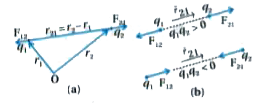 Suppose, position vectors of `q_1` and `q_2` are `r_(1)`and `r_2` respectively as shown in figure (a). LET, force acting on `q_(1)` by `q_2` is F and force on`q_2` by `q_1` is `vecF_(21)`. If 1 and 2 numbers are given to `q_(1)` and `q_2`, then `barr_(21)`is position vector from 1 to 2 and `barr_(12)`is position vector from 2 to 1. By using TRIANGLE method for vector addition, `vecr_(1) + vecr_(21) = vecr_(2)` `therefore vecr_(21) = vecr_(2) - vecr_(1)` and `vecr_(12) = vecr_(1) - vecr_(2) =-vecr_(21)` and `|vecr_(12)| = r_(12)` also `|vecr_(21)| = r_(21)` `therefore vecr_(12) = vecr_(12)/vecr_(12)` and `vecr_(21) = vecr_(21)/vecr_(21)` Force acting on `q_(2)` by `q_(1)` `vecF_(21) =1/(4pi epsilon_(0)).(q_(1)q_(2))/r_(21)^(2).hatr_(21)` and Force acting on `q_(1)` by `q_(2)` `vecF_(12) = 1/(4pi epsilon_(0)).(q_(1)q_(2))/r_(12)^(2).hatr_(12)` but `hatf_(12) =-hatr_(21)` `vecF_(21) =-vecF_(12)` |
|
| 10. |
Inside a horizontally moving box, an experimenter finds that when an object is placed on a smooth horizontal plane and is released, it moves with an acceleration of 10 m//s^(2). In this box if 1 kg body is suspended with a light string, find the tenion in the string in equilibrium position (w.r.t experi-menter) (g=10m//s^(2)). |
|
Answer» SOLUTION :ACCELERATION of BOX `= 10 m//s^(2)` `T=SQRT((mg)^(2)+(ma)^(2))` `T=sqrt(10^(2)+10^(2))T=10 sqrt(2)N` 
|
|
| 11. |
A proton accelerator produces a narrow beam of protons, each having an initial speed of v_0. The beam is directed towards an initially uncharged distant metal sphere of radius R. The sphere is fixed and centered at point O. The initial path of the beam is at a distance of (R/2) from the centre, as indicated in the diagram. The protons in the beam that collide with the sphere get absorbed and cause it to become uniformly charged. The subsequent potential field at the accelerator due to the sphere can be neglected. Assume the mass of the proton as m_P and the charge on it as e. (a) After a long time, when the potential of the sphere reaches a constant value, sketch the trajectory of proton in the beam. (b) Once the potential of the sphere has reached its final, constant value, find the minimum speed v of a proton along its trajectory path. (c) Find the limiting electric potential of the sphere. |
|
Answer» (B). `v_(0)//2` (C). `(3m_(P)v_(0)^(2))/(8e)` |
|
| 12. |
A book with many printing errors containsfour different expressions for the displacement y of a particle executing simple harmonic motion. The wrong formula on dimensional basis (v = velocity) (i) y = A sin (2pi t //T)(ii) y = Asin (Vt) (iii ) y = A/ T sin (t/A) (iv) y =(A)/(sqrt(2)) (sin omegat+cos omegat) |
|
Answer» II only |
|
| 13. |
Give the direction in which the induced current flows in the coil mounted on an insulating stand when a bar magnet is quickly moved along the axis of the coil from one side to the other as shown in the Fig. 6.18. |
|
Answer» Solution :(i) INITIALLY when S-pole of magnet is coming towards the coil, current flows CLOCKWISE when seen rom the right hand side. (ii) Finally when magnet is moving away from the coil on left side, INDUCED current flows ANTICLOCKWISE when seen from the right hand side. |
|
| 14. |
Two coherent sources emit light waves which superimpose at a point where these can be expressed as E_1 = E_0sin (omega t + pi//4), E_2 = 2E_0) sin (omega t - pi//4)where E_1 and E_2are the electric strengths of the two waves at the given point. If I is the intensity of wave expressed by field strength E_1 , find the resultant intensity. |
|
Answer» Solution :I being the intensity of wave expressed by field strength `E_1 , I alpha E_0^2`(intensity `alpha" (amplitude)"^2` ] Intensity of wave expressed by` E_2` `I. alpha (2E_0)^2` ` therefore (I.)/(I) =4, I.= 4I` Phase difference between the TWO waves` = (omegat+ pi//4) - (omega t -pi//4) = pi/2` Resultant intensity is given `I_R = I + I.+2 SQRT(II.) cos PHI` `therefore I_R = I + 4I = 2 sqrt(I(4I)) cos pi//2` `I_R = 5I` THUS resultant intensity is five times the intensity of wave expressed by `E_1` . |
|
| 15. |
Tennis ball is dropped on the floor from a height of 100 m. It rebounds to a height of 100 m. Ir the ball was in contact with the floor for 3.16 3. then the average acceleration during the contact is: |
|
Answer» 700 `m//s^(2)` After rebound, v=`-sqrt(1960)` 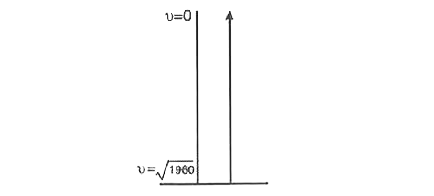 acceleration`=("CHANGE in velcocity")/("time")` `(2sqrt(1960))/(3.16)=28 ms^(-2)` |
|
| 16. |
Assertion: With the help of Gauss theorem we can find electric field at any point. Reason:Gauss theorem cannot be applied for any type of charge distribution |
|
Answer» Both ASSERTION and REASON are true and Reason is the CORRECT explanation of Assertion |
|
| 17. |
A zener diode is specified as having a brakedown voltage of 9.1V,with a maximum. Power dissipation of 364mW.What is the maximum current the diode can handle. |
|
Answer» 40mA |
|
| 19. |
12 cells of each e.m.f 2V are connected in series among them, if 3 cells are connected wrongly. Then the effective e.m.f. of the combination is |
|
Answer» 18 V |
|
| 20. |
Resistance of an ideal ammeter is ………………..and that of an ideal voltmeter is ……………….. . |
| Answer» SOLUTION :ZERO, INFINITE | |
| 21. |
A horizontal frame KLMN moves with a uniform velocity of 30 cm/s into a uniform magnetic field of strength B=10^(-3) Tesla acting verticaly downwards. KN = 12 cm and KL = 25 cm and resistance of the frame is 10Omega. The sides LM and KN enter the field in a direction perpendicular lar to the field boundary. Calculate the current in the metal frame when, a. LM just enters the field b. the entire frame inside the field c. LM just leaves the field through the other side |
Answer» Solution :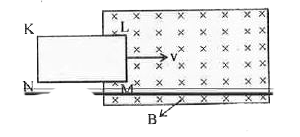 `KL=MN=0.25m""LM=KN=0.12m""B=10^(-3)T""v=0.3m//s` a. KL and MN are parallel. Hence no INDUCED e.m.f. on these sides. Induced e.m.f. on LM is `varepsilon_(LM)=Blv=10^(-3)xx0.12xx0.3=36xx10^(-6)V=36muV` `therefore I=(varepsilon_(LM))/(R)=(36muV)/(10Omega)=3.6muA` b. When the frame is completely inside, there is no change in flux. i.e., flux through the frame remains constant. Hence there is no induced current. c. As LM just leaves the FIELD again there is a current, but in the opposite direction. `therefore I=3.6muA` |
|
| 22. |
An audio signal of V_(m) = 5 sin 6pi xx 10^(3)tis to be modulated on a carrier wave given by V_(c) = 15sin 2pi xx 10^(5) t The frequencies of side bands and band width |
|
Answer» 103 KHz, 97 KHz, 6 KHz |
|
| 23. |
Which century was called the era of books? |
|
Answer» TWENTIETH Century |
|
| 24. |
A hollow conducting sphere of inner radius r_1 and outer radius r_2 has a charge Q on its surface. A point charge - q is also placed at the centre of the sphere . (a) What is the surface charge density on the (i) inner and (ii) outer surface of the sphere ? (b) Use Gauss' law of electrostatics to obtain the expression for the electric field at a point lying outside the sphere. |
|
Answer» Solution :Let us have a hollow CONDUCTING sphere of inner radius `.r_1.` and outer radius `.r._2` having a charge Q on its outer surface and let a point charge - q is also place at the centre point O of the sphere . (a) (i) Surface charge density on inner surface of the sphere. `sigma_("inner")=(+q)/(4pir_1^2)"".....(i)` (ii) Surface charge density on outer surface of the sphere `sigma_(outer)=((Q-q))/(4pir_2^2)""...(ii)` (b) To obtain the expression for the electric field `vecE` at a point P situated at a DISTANCE r from centre . O of the sphere (where `r gt r_2`) let us consider a GAUSSIAN sphere of radiusa as shown here. Obviously `vecE and vec(DeltaA)` are insame direction and so TOTAL electric flux over the entire Gaussian surface. `phi_(E)=sumvecE.vec(DeltaA)=sumEDeltaA=EsumDeltaA`[Since E is having same magnitude at all points of the sphere] `impliesphi_E=E(4pir^2)""....(iii) ` As PER Gauss law, `phi_(E)=1/(in_0)(sumq_("enclosed"))=1/in_0[-q+q+(Q-q)]=(Q-q)/(in_0)""...(iv)` Comparing (iii) and (iv) , we get `E4pir^2=(Q-q)/in_0` `impliesE=((Q-q))/(4piin_0r^2)" or " vecE=((Q-q))/(4piin_0r^2)hatr` 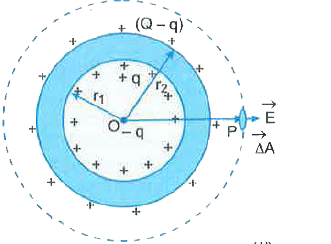
|
|
| 25. |
How would you suggest measuring the temperature of (a) The sun (b) The Earth's upper atmosphere (c) The moon (d) The ocean floor, and (e) Liquid helium ? |
|
Answer» Solution :(a) Sun, by pyrometry (b) Earth.s upper TEMPERATURE. As Plp is a FUNCTION of temperature so temperature can be DETERMINED by knowing the density. (c) The moon, by absorption pyrometry using absorption lines. (d) The ocean FLOOR : By using Baythoscope. (e) Liquid HELIUM : By using the principle of adiabatic demagnetisation |
|
| 26. |
E.M. waves with frequencies greater than critical frequency of ionospherecan not because for communication because |
|
Answer» R.I of ionosphere becomes very HIGH for `fgtf_(C)` |
|
| 27. |
A point charges +10 mu Cis a distance5 cm directly above centre of a square of side 10 cm as shown in What is the magnitude ofthe electric flux through the square? |
|
Answer» SOLUTION :To find the electric flux consider an IMAGINARY CUBE of side 10 cm such that the charges of `+10 muC ` is located at the centre of cube. Now in accordance with Gauss theorem, total electric flux over the entire `phi_E =(q)/(in_0)=(10xx10 ^(-6))/(8.85xx10^(-12))=1.13 xx 10^(5)N m^(2)C^(-1) ` As chargesis situated at the centre of teh cube having six surface in all and the given square is one of thesesix, HENCE electric flux through the given square ` =(1)/(6) phi_in =(1.13xx10^(6))/(6) =1.9 xx10 ^(5)Nm^(2) C^(-1) ` 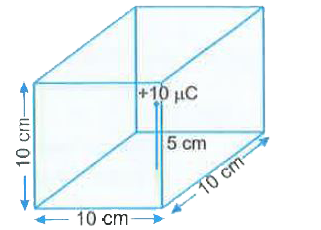
|
|
| 28. |
In an orbit of radius 0.5 A^(0) an electron revolves with a frequency of 6.25 xx 10^(15) Hz. The magnetic induction field at its centre is |
| Answer» Answer :A | |
| 29. |
When N pole of a bar magnet points towards the south and S pole toward the north, then the neutral points are at the : |
|
Answer» MAGNETIC axis |
|
| 30. |
Two particle X and Y having equal charges, after being accelerated through the same potential differences, enter a region of uniform magnetic field B and describe circular paths of radii R_1 and R_2 respectively . The ratio of mass of X to that of Y is |
|
Answer» `SQRT((R_1)/(R_1))` |
|
| 31. |
In a thermodynamic process on an ideal monatomic gas, the infinitesimal heat absorbed by the gas is given by T Delta X,where T is temperature of the system andDelta Tis the infinitesimal change in a thermodynamic quantity X of the system. For a mole of monatomic ideal gas x = 3/2 "R h" (T/T_A)"+Rh)(V/V_A).Here, R is gas constant, V is volume of gas, T_Aand T_A are constants. The List-I below gives some quantities involved in a process and List-II gives some possible values of these quantities. If the process on one mole of monatomic ideal gas is as shown in the TV-diagram with P_0 V_0 = 1/3 RT_0,the correct match is, |
|
Answer» `I to P , II toT, III toQ , IV to T` `2 to 3`Isochoric process `W_(1to2) =" nRT In"V_2/V_1 = 1xxR xxT_0/3 "In"(2V_0)/V_0 = (RT_0)/3 "In 2"` `U_(1 to 2to3) = U_(2 to 3) = 3/2 "nR"Delta T = 3/2 (1) xxR xx (2T_0)/3 = RT_0` `Q_(1 to 2 to 3) = W_(1 to 2) +U_(2to3) =(RT_0)/3 (3 + "In 2")` `Q_(1 to 2 to 3) = W_(1 to 2) =(RT_0)/3 "In 2"` |
|
| 32. |
A dog while barking delivers about t mW of power. If this power is uniformly distributed over a hemispherical area, what is the sound level at a distance of 5 m? What would the sound level be if instead of 1 dog, 5 dogs start barking at the same time each delivering 1 mW of power |
| Answer» Answer :A | |
| 33. |
An empty thick conducting shell of inner radius a and outer radius b is shown in figure. If it is obseved that the inner face of the carries a uniform charge density -sigma and the surface carries a uniform charge density .sigma. If another charge q_(0) is also placed at a distance c (gt b) the center of shell, then choose the correct statements |
|
Answer» force experienced by CHARGE A is `(sigmaq_(A)b^(3))/(epsilon_(0)c^(2))` |
|
| 34. |
An empty thick conducting shell of inner radius a and outer radius b is shown in figure. If it is obseved that the inner face of the carries a uniform charge density -sigma and the surface carries a uniform charge density .sigma. If a point charge q_(A) is placed at the center of the shell, then choose the correct statement(s) |
|
Answer» The charge MUST be positive |
|
| 35. |
Electrons with de Broglie wavelength a fall on the target in an X-ray tube. Find the cutoff wavelength of the emitted X-rays. |
|
Answer» Solution :If `lamda`=de Broglie wavelength, then momentum `p=(h)/(lamda)` K.E of the STRIKING electrons `K=(p^(2))/(2m)=(h^(2))/(2mlamda^(2))` This is equal to MAXIMUM energy of X - ray photons. `(hc)/(lamda_(0))=(h^(2))/(2mlamda^(2))implieslamda_(0)=(2mlamda^(2)C)/(h)` |
|
| 36. |
In a thermodynamic process on an ideal monatomic gas, the infinitesimal heat absorbed by the gas is given by T Delta X,where T is temperature of the system andDelta Tis the infinitesimal change in a thermodynamic quantity X of the system. For a mole of monatomic ideal gas x = 3/2 "R h" (T/T_A)"+Rh)(V/V_A).Here, R is gas constant, V is volume of gas, T_Aand T_A are constants. The List-I below gives some quantities involved in a process and List-II gives some possible values of these quantities. If the process carried out on one mole of monatomic ideal gas is as shown in figure in the PV-diagram with P_0 V_0 = 1/3, RT_0 , the correct match is : |
|
Answer» `I to Q, II toR, III toS , IV to U` `2 to 3`Isochoric process `W_(1 to 2 to 3) = W_(1to2) =P_0 (2V_0 -V_0) = P_0 V_0 =(RT_0)/3` `U_(1 to 2 to 3) = U_(1 to 2 ) +U_(2 to 3)` ` = 3/2 [P_2 V_2 - P_1 V_1 ] +3/2[P_3 V_3- P_2 V_2] =3/2 P_0 [2 V_0 - V_0]+3/2 [(3p_0)/2 xx2V_0 -p_0(2 V_0)]` `=3/2 P_0 V_0 + 3/2 P_0 V_0 = 3 P_0 V_0 = 3xx(RT_0)/3 = RT_0` `Q_(1 to 2 to 3) = Q_(1to 2)+ Q_(2 to 3)` `W_(1 to 2) + Delta u_(1 to2 ) + Delta u_(2 to 3) P_0 V_0 +3/2 P_0 V_0 + 3/2 P_0 V_0 = 4 P_0 V_0 = (4 RT_0)/3` `Q_(1 to 2)= 5/2 P_0 V_0 = 5/6 RT_0` Correct option is (B) |
|
| 37. |
Draw a labelled ray diagram showing the image formation in an astronomical telescope. Define its magnifying power and write expression for it. |
|
Answer» Solution :Telescope. A telescope is an optical instrument used for observing distant objects very clearly. Astronomical telescope. It produces virtual and inverted image and is used to see heavenly bodies like sun, stars, planets etc. so the inverted image does not affect the observation. Principle. It is based on the principle that when RAYS of light are made to incident on an objective from a distant object, the objective forms the real and inverted image at its focal plane. The eye lens is so adjusted that the final image is formed at least distance of distinct vision. Construction. The refracting type astronomical telescope consists of two convex lenses one of which is called the objective and the other eye piece. The objective is a convex lens of large focal length and large aperture, It is generally a combination of two lenses in contact so as to reduce spherical and chromatic aberrations. The eye piece is also a convex lens but of short focal length and small aperture. The objective is mounted at one end of a brass tube and the eye piece at the other end in a smaller tube which can SLIDE inside the bigger tube carrying the objective. 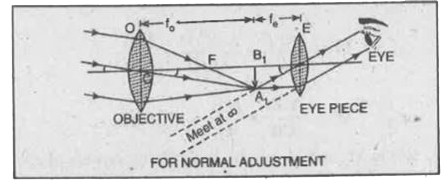 (i) When the final image is formed at infinity. The distance between the image `A_(1)B_(1)` and the eye piece is adjusted equal to the focal length of the eye piece so that the final image is formed at infinity. In this case telescope is said to be in normal adjustment or focussedto infinity. In normal adjustment, distance between two lenses = (`f_(0) + f_(e)`). The magnifying power of a telescope in normal adjustment is defined as the ratio of the angle subtended by the image at the eye as seen through the telescope to the angle subtended by the object at the unaided eye, the object and image both lying at infinity. Angle subtended by object at eye piece or at eye `/_A_(1)CB_(1) = alpha` The angle subtended by the image at the eye `/_B_(1)C_(1)A_(1)=beta` `:. "Magnifying power", M = (beta)/(alpha)` As the angles are small, therefore, they can be REPLACED by their tangents. Hence `M=(tan beta)/(tan alpha)=(A_(1)B_(1))/(B_(1)C_(1)) xx (B_(1)C)/(A_(1)B_(1))=(B_(1)C)/(B_(1)C_(1))` ...(i) When the rays emerging from the eye piece are parallel, the image `A_(2)B_(2)` lies at infinity and the distance `B_(1) C_(1)` is equal to `f_(e)` the focal length of the eye piece, as shown in Fig. Also the distance `B_(1)C=f_(0)` the focal length of the objective. `:. M=(B_(1)C)/(B_(1)C_(1))=(f_(0))/(f_(e))=("Focal length of the objective")/("Focal length of the eye piece")` (ii) When final image is formed at least distance of distinct vision. The objective O forms a real, inverted and diminished image `A_(1)B_(1)` of a far object at focal plane `B_(1)` of the objective in front of the eye piece E. The rays incident on the objective are taken in the FORM of a parallel beam as they are coming from a far off object. The distance between the eye lens and this image formed is adjusted so that it is less than the focal length of eye piece which, therefore, forms a magnified, virtual image `A_(2)B_(2)` at the least distance of distinct vision. 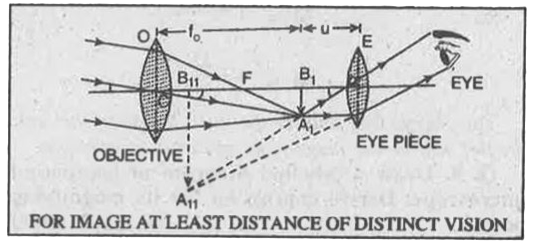 Magnifying power of a telescope is the ratio of angle subtended by the image at the eye formed at least distance of distinct vision to the angle subtended by ihe object (seen directly) at the eye lying at infinity. Angle subtended at the eye by the image formed at least distance of distinct vision `/_A_(11)C_(1)B_(11) = beta`. Angle subtended at the eye by the object seen directly lying at infinity `/_A_(1)CB_(1)=alpha` `:. "Magnifying power", M =(beta)/(alpha)` Since `alpha` and `beta` are small, so they can be replaced by their tangents. `:. M=(tan beta)/(tan alpha)=(A_(1)B_(1) // B_(1)C_(1))/(A_(1)B_(1) // B_(1)C)` `=(A_(1)B_(1))/(B_(1)C_(1)) xx (B_(1)C)/(A_(1)B_(1))` `=(B_(1)C)/(B_(1)C_(1))=(f_(0))/(u)` ...(1) For eye lens, `-(1)/(u)+(1)/(v)=(1)/(f_(e))` or `(1)/(u)=(1)/(v)-(1)/(f_(e))=(f_(e)-v)/(vf_(e))` or `u=(vf_(e))/(f_(e)-v)` USING sign conventions, we get `-u=((-D)(f_(e)))/(f_(e)-(-D))=(Df_(e))/(f_(e)+D)` or `u=(Df_(e))/(f_(e)+D)` ...(2) Putting eq. (2) in (1), we get `M=(f_(0)(D+f_(e)))/(Df_(e)=(f_(0))/(f_(e))((D+f_(e))/(D))` `M= (f_(0))/(f_(e))[1+(f_(e))/(D)]` ...(3) So, the magnification will be large, if focal length of objective (`f_(0)`) is very large as compared to focal length of eye piece (`f_(e)`). Since `1 + (f_(e))/(D) gt 1`, so we find that the amplification D produced is more when final image is formed at least distance of distinct vision than when final image is formed at infinity. In both cases, the final image is inverted hence it is not suitable for seeing terrestrial objects. |
|
| 38. |
When X-rays of wavelength 0-5Å pass through 7 mm thick aluminium sheet, then their intensity reduces to one fourth. The coefficient of absorption of aluminium for these X-rays will be : |
|
Answer» `0.198mm^(-1)` `mu=(2*303 log_(10)4)/(7)=(2*303xx0*6023)/(7)=0*198 mm` |
|
| 39. |
A ray of light strikes a material's slab at an angle of incidence 60^(@). If the reflected and refracted rays are perpendicular to each other, the refractive index of the material is |
|
Answer» `(1)/(sqrt(3))` |
|
| 40. |
A gas at N.T.P. is suddenly compressed to one fourth of its original volume. Ifgamma is supposed to be 3/2 then final pressure is : |
|
Answer» <P>4 atmospheres `V_(2)=V//4, P_(2)=?, gamma=3//2` Since `P_(1)V_(1)^(gamma) =P_(2)V_(2)^(gamma)` `therefore P_(2)=P_(1) ((V_(1))/(V_(2))^(gamma))` `P_(2) =1 ((V)/(V//4))^(3//2)` `P_(2)=8` atmosphere Thus, correct choice is (c). |
|
| 41. |
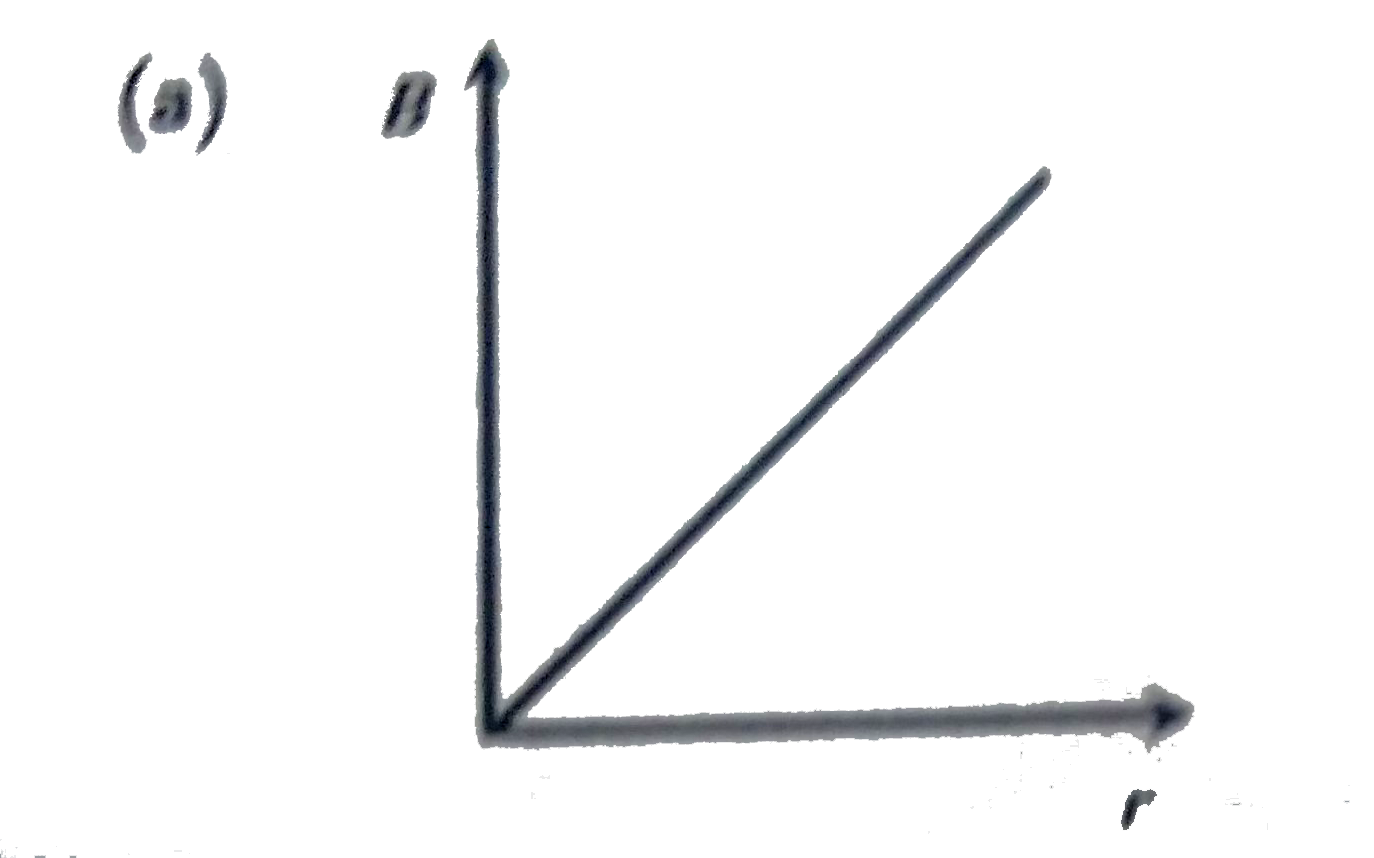
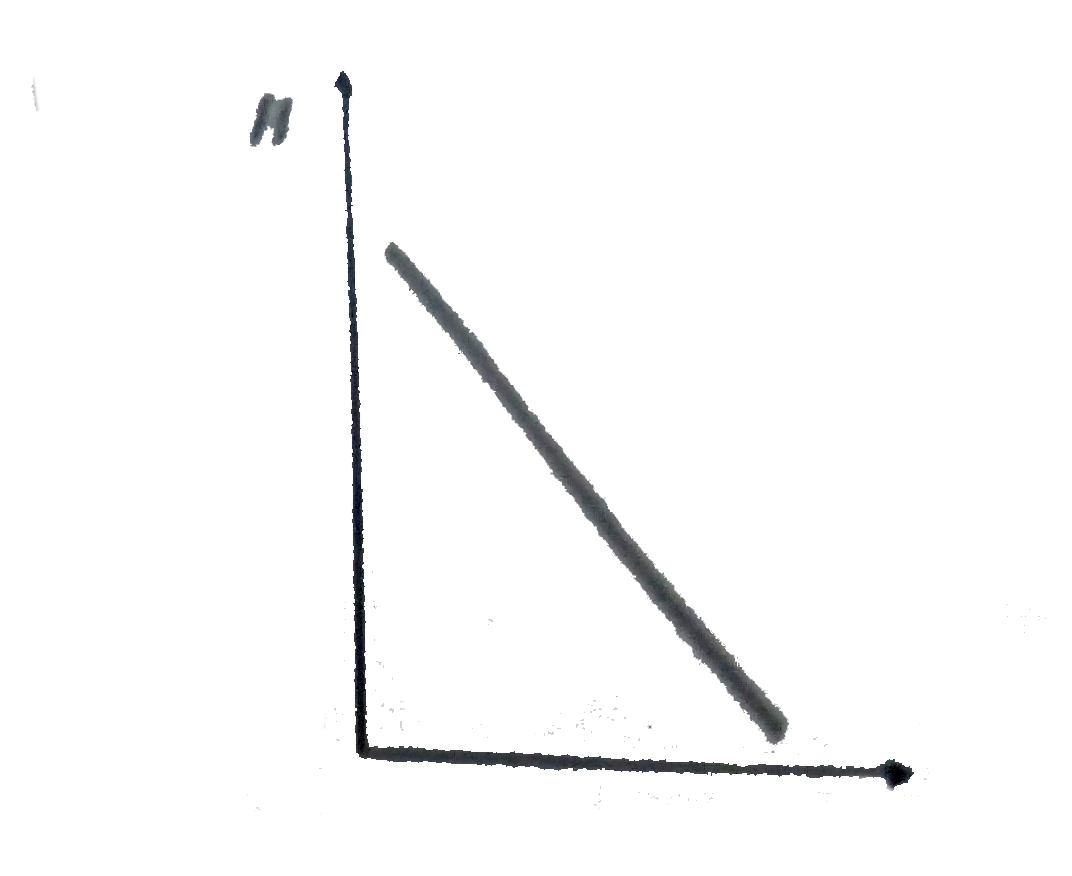
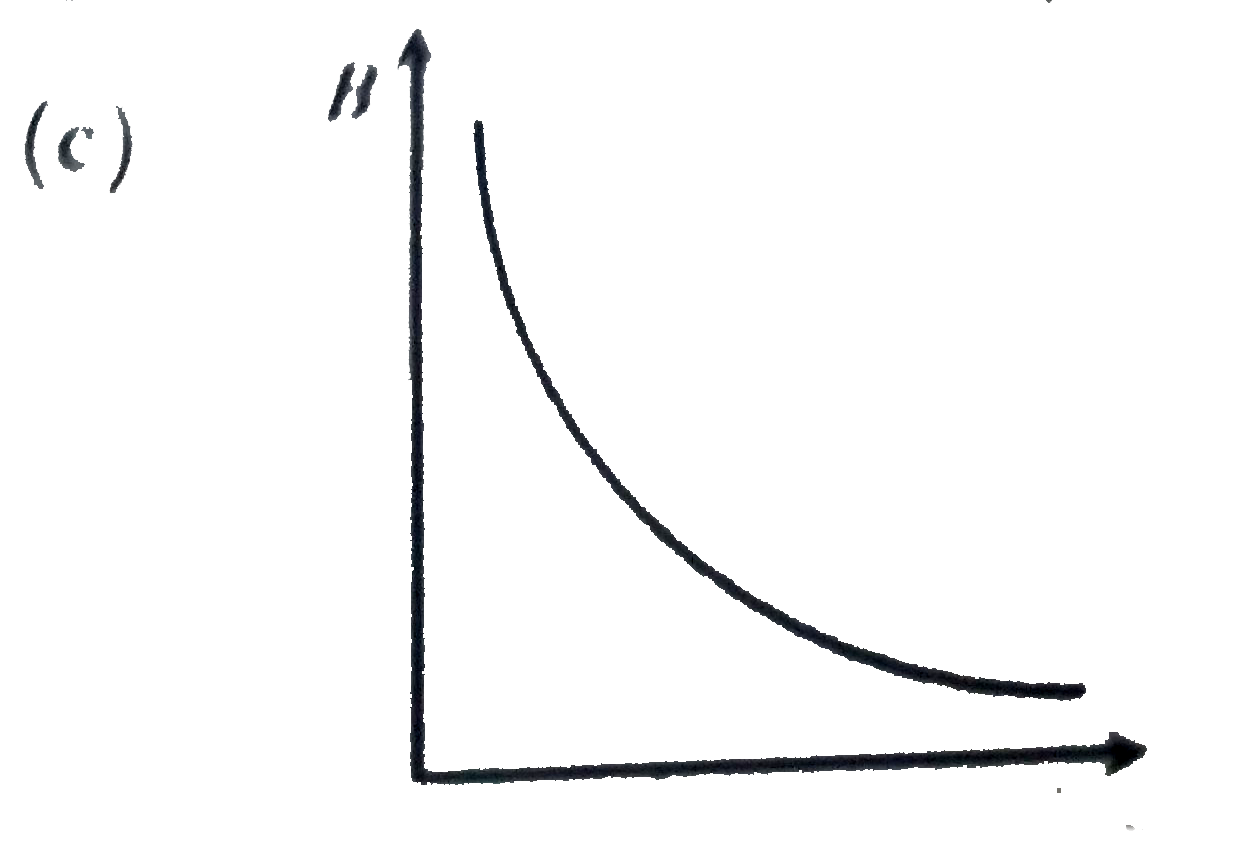
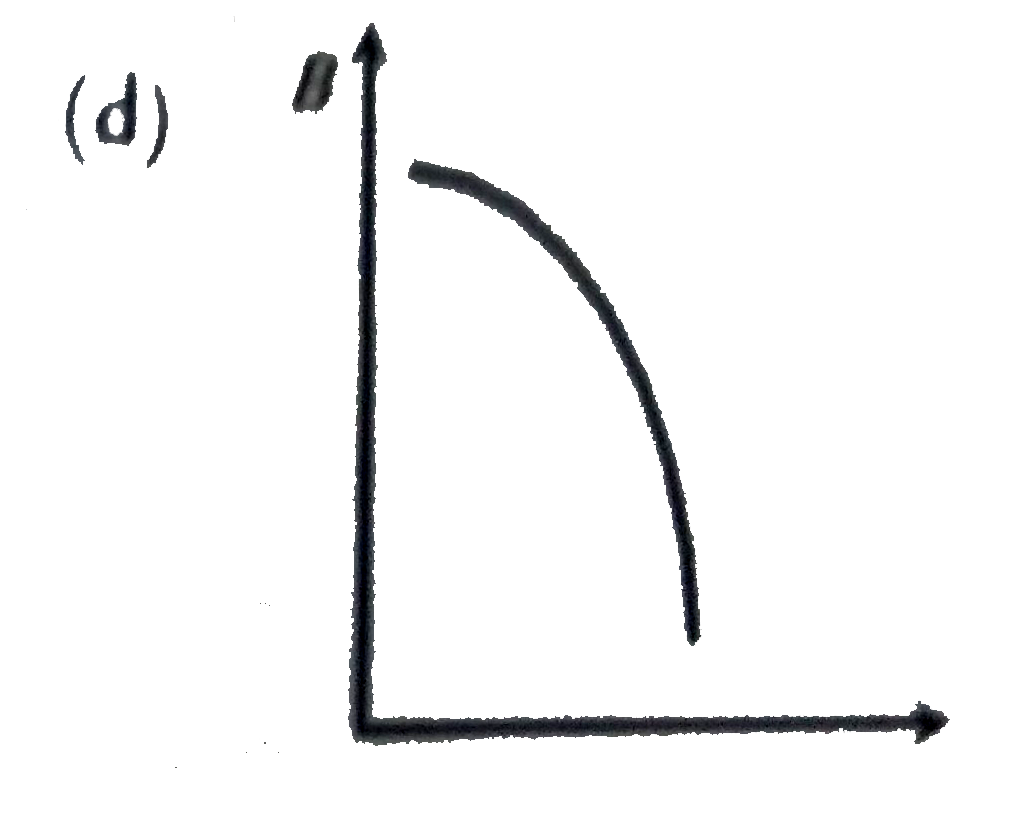
Which of the following graphs shows the variation of magnetic induction B with distance r from a long wire carrying current |
|
Answer»
|
|
| 42. |
Moving particles of matter shows wave like proper ties under suitable conditions.Who put forward this hypothesis ? |
| Answer» SOLUTION :LOUIS - DE - Brogle | |
| 43. |
In two calorimeters we poured 200 g of water each- at temperatures of +30^(@) C and +40^(@) C. From the "hot" calorimeter 50 g of water, is poured into "cold" calorimeter and stirred. Then, from "cold" calorimeter 50 g of water is poured in "hot" and again stirred. How many times do you have to pour the same portion of water back and forth so that the temperature difference between water in the calorimeters becomes less than 3^(@) C? Heat loss during the transfer and heat capacity of calorimeters is neglected. |
|
Answer» `32xxSxx50+150xxSxx40=200xxSxxT_(2)T_(2)=38^(@)` `200xxSxx32+50xxSxx38=250xxSxxT_(3) T_(3)=33.2^(@)` `33.2xxSxx50+150xxSxx38=200xxSxxT_(4) T_(4)=36.8^(@)` `36.8xxSxx50+200xxSxx33.2=250xxSxxT_(5) T_(5)=33.92^(@)` 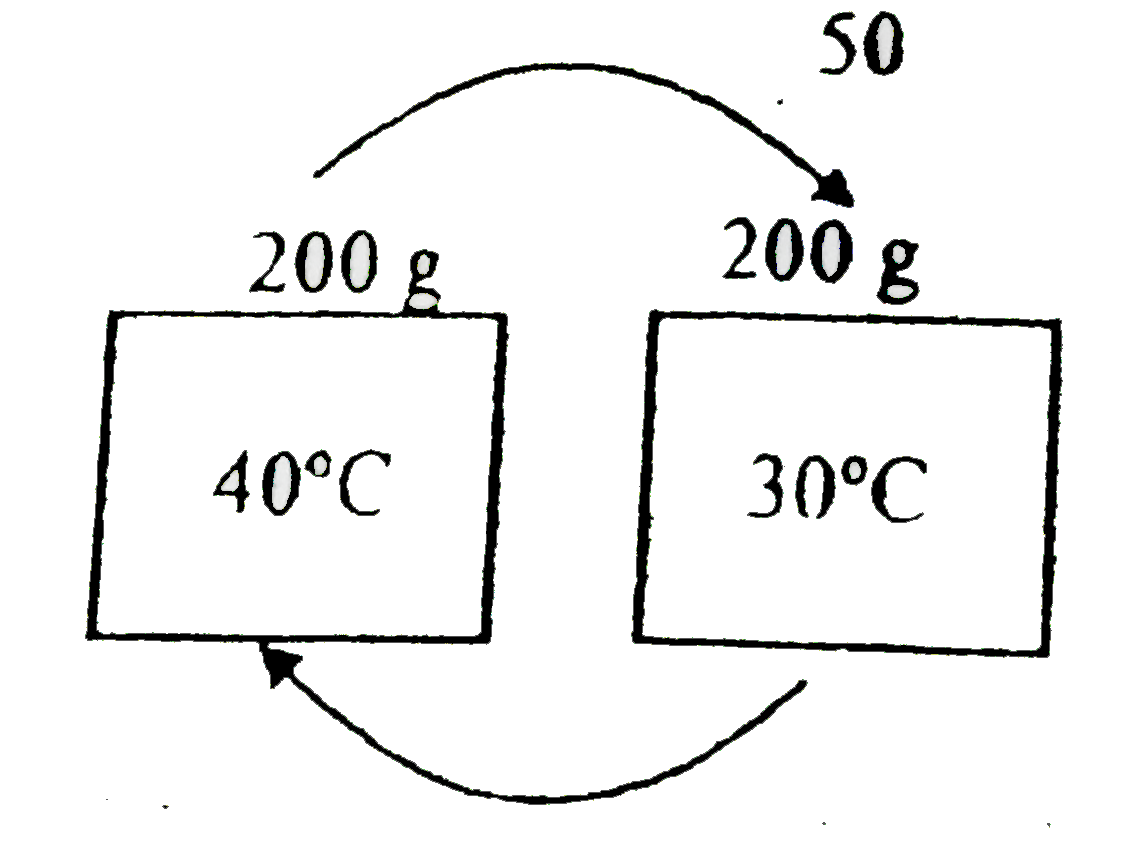
|
|
| 44. |
If 10% of a radioactive material decays in 5 days, then the amount of original material left after 20 days is approximately |
|
Answer» 0.6 `rArr t=(2.303)/(lambda) log_(10) ((100)/(90))` `and 20=(2.303)/(lamda) log_(10) ((100)/(X))` `rArr 1/4 =(log 100-log 90)/(log 100-log x)=(2-1.9542)/(2-log x)` `rArr 2-log x=8-7.8168 =0.1832` `log x=1.8168` `or x=65.58 approx 65%` |
|
| 45. |
A weight of mass m is attached to a spring hanging vertically, which causes an extension l. Subsequently the weight is pulled down a little and let go. What is the natural frequency of the vibrations? |
|
Answer» |
|
| 46. |
A convergent beam is incident on two slabs placed in contact as shown in Fig. Finally the rays are converge at a distance (from left face of slab A is) |
|
Answer» 10 cm |
|
| 47. |
A parallel beam of light of wavelength lambda is incident normally on a single slit of width d. Diffraction bands are obtained on a screen placed at a distance D from the slit. The second dark band from the central bright band will be at a distance given by .... |
|
Answer» `(2lambdaD)/(d)` But for smaller angle `sin theta_(n)=(x_(n))/(D)` `:. In (dx_(n))/(D)=n lambda, n=2` `:.x_(2)=(2lambdaD)/(d)` |
|
| 48. |
You have learnt in the text how Huygens' principle leads to the laws of reflection and refraction. Use the same principle to deduce directly that a point object placed in front of a plane mirror produces a virtual image whose distance from the mirror is equal to the object distance from the mirror. |
Answer» Solution : Consider a point object O in front of a plane mirror M, ABC is a spherical wavefront at an INSTANT of time, spread from O. had there been no mirror, this wavefront would occupy a position DEF in a time t. but points D and F on the mirror and every point lying betwen D and F acts as a source of secondary WAVELETS. these wavelets are REFLECTED back into the air. at the end of time t, DGF is the spherical wavefront which advances in air. this appears to come from I. thus, I is the VIRTUAL image of O. from Huyegen.s principle, if GB=h, then BE is ALSO equal to h. Fromm the theorem of intersection of chords `DB.BF=h(2r-h)=h(2R-h)`, where `r=OE and R=IG`. Therefore, r=R and IG=OE. Hence, we have IB=OB. Thus, the image is as far behind the mirror as the object is in front of it. |
|
| 49. |
The magnetic field B through the rectangle of Fig. 32-6 is shown at a different instant in part 1 of the figure here, B is directed in the xz plane, parallel to the z axis, and its magnitude is increasing. (a) Complete part 1 by drawing the induced electric fields, indicating both directions and relative magnitudes (as in Fig. 32-6). (b) For the same instant, complete part 2 of the figure by drawing the e lectric field of the electromagnetic wave. Also draw the induced magnetic fields, indicating both directions and relative magnitudes (as in Fig. 32-7). |
| Answer» SOLUTION :(a) USE Eq. 32 -5 . On the RIGHT side of rectangle `VECE` is in the negative y direction on the LEFT side `vecE+dvecE` is greater and in the same direction (b) `vecE` is downward . On the right side `vecB` is in negative z -direction on the left side `vecB+dvecB` is greater and in the same direction . | |