

Saved Bookmarks
This section includes 7 InterviewSolutions, each offering curated multiple-choice questions to sharpen your Current Affairs knowledge and support exam preparation. Choose a topic below to get started.
| 1. |
A ship of mass 3xx10^(7) kg at rest is pulled by a force of 5xx10^(4) N through a distance of 3m. Neglecting water resistance, the speed of ship is: |
|
Answer» 1.5 m/sec `1/2,mv^(2)=F.x.` `implies v=sqrt((2F.x)/(m))=sqrt((2xx5xx10^(4)xx3)/(3XX10^(7)))=0.1 MS^(-1)` |
|
| 2. |
An equilateral prism is made of material with refractive index 1.73. A light ray incident at an angle i on it refract and moves parallel to the base of the prism. Find the value of i. |
| Answer» SOLUTION :`59.88^(@)` | |
| 3. |
Two measure diameter of a wire a screwgauge is used The main scale division is of 1mm In a complete rotation the screw advances by 1mm and the circular scale has 100 devisions The reading of screwgauge is as shown in If there is no error is no error in mass measurement but error in length measurement is 1% then find max Possible error in density . |
|
Answer» Solution :`rho=(m)/(((pid^(2))/(4))L)` `((Deltarho)/(rho))=2(Deltad)/(d)+(Deltal)/(l)` `Deltad =" LEAST COUNT of "= (1MM)/(100) = 0.1mm` and `d = 3.07` mm from the `so((Deltarho)/(rho))_(max)=(2xx(0.01)/(3.07)+(1)/(100))xx100%` `((Deltarho)/(rho))_(max)=1.65%` . |
|
| 4. |
A triangular slave trade took place between Europe, the Americas and: |
|
Answer» Africa |
|
| 5. |
When a charged particle enters perpendicular to a magnetic field it experiences a force? : Name the force. |
| Answer» SOLUTION :MAGNETIC LORENTZ FORCE | |
| 6. |
संसाधन नियोजन के कितने स्तर होते हैं? |
|
Answer» एक |
|
| 7. |
निम्नांकित में कौन प्राकतिक संसाधन नहीं है? |
|
Answer» वन |
|
| 8. |
A convex lens is in contact with concave lens. The magnitude of the ratio of their focal length is 2/3. Their equivalent focal length is 30 cm. Their individual focal lengths are |
|
Answer» -75 cm, 50 cm. |
|
| 9. |
Radiations of intensity 0.6Wm^(-2) are incident on a non - reflecting plate. The pressure exerted on the plate by the radiation is |
|
Answer» <P>`2xx10^(-9)PA` |
|
| 10. |
(a) Find the potential difference between A and B (b) Calculate the current flowing in the circuit and the potential difference across terminals of each cell. ( c) Calculate the potential difference across terminals of each cell. (d) Calculate the potential difference between A and B ( e) Calculate the current in each resistor and terminal potential difference across each cell. (f) Calculate potential difference across each cell. (g) A battery of 6 cells each of emf 2 V and internal resistance 0.5 Omega is being changed by DC mains of emf 220 V by using an external resistance of 10 Omega. Calculate. (i) the charging current (ii) the potential difference across the battery. . |
|
Answer» Solution :(a) `i = (10)/(2 + 8) = 1 A` `V_A - V_B = i xx 8 = 1 xx 8 = 8 V` OR `V_A - V_B = E - ir` =`10 - 1 xx 2 = 8 V` (Cell is supplying current) 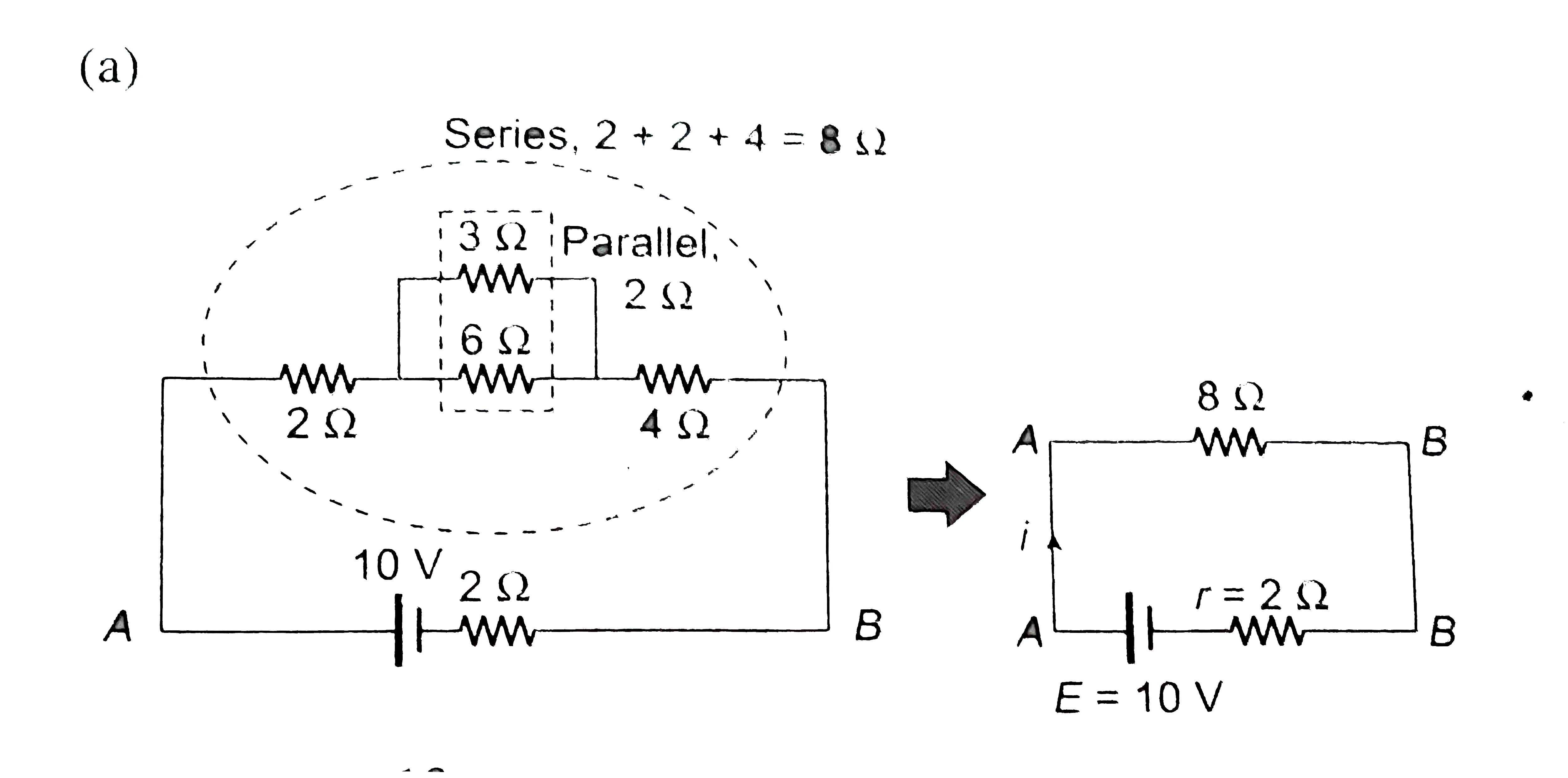 . . (b) `i = (10 + 10)/(2 +1 + 7) = 2 A` Cell `X` : `V_A - V_B = 10 - 2 xx 2 = 6 V` Cell `Y` : `V_B - V_C = 10 - 2 xx 1 = 8 V` (Cell are supplying current) 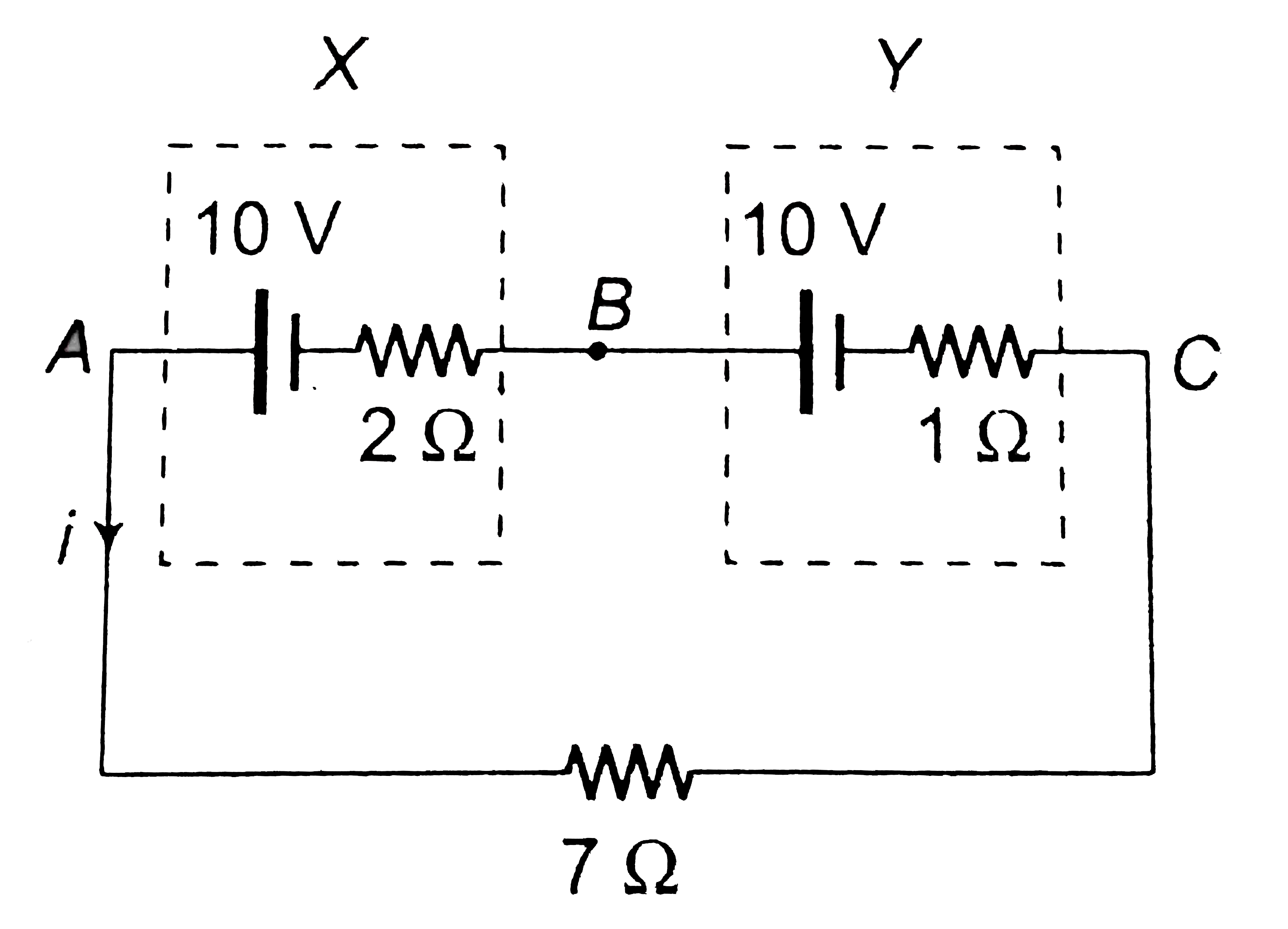 . . ( c) Net EMF `= 18 - 12 = 6 V` Net RESISTANCE `= 3 +2 + 1 = 6 Omega` `i = (6)/(6) = 1 A` Cell `X` : It is taking current `V_A - V_B = 12 + 1 xx 3 = 15 V` Cell `Y` : It is supplying current `V_C - V_B = 18 - 1 xx 2 = 16 V`. 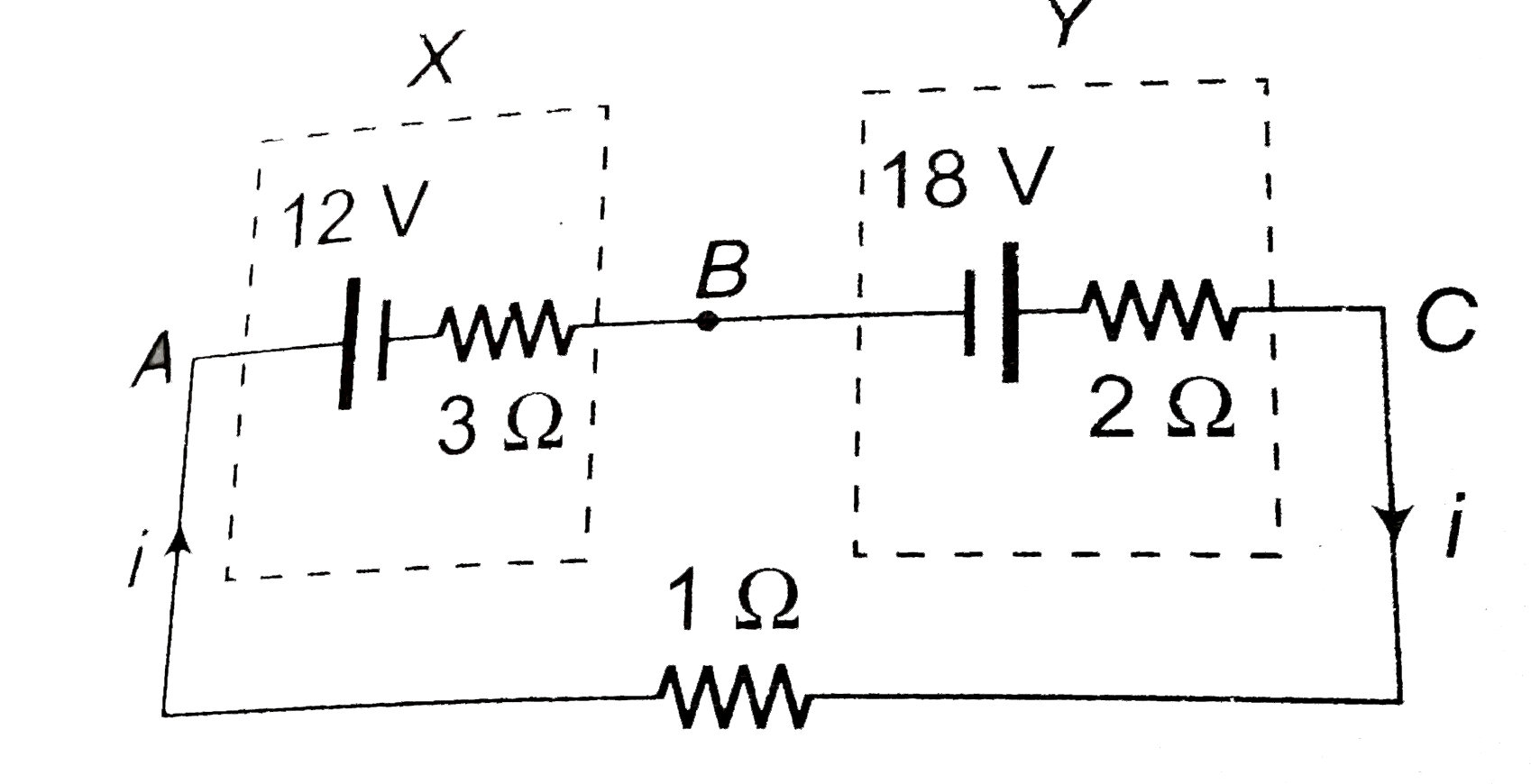 . . (d) These cells are in series because same current flows in them, cells are opposing. `i = (30 - 10)/(5 + 15) = 1 A` Cell `X` : (supplying current), `V_A - V_B = 30 - 1 xx 5 = 25 V` OR Cell `Y` : (taking current), `V_A - V_B = 10 + 1 xx 15 = 25 V`. 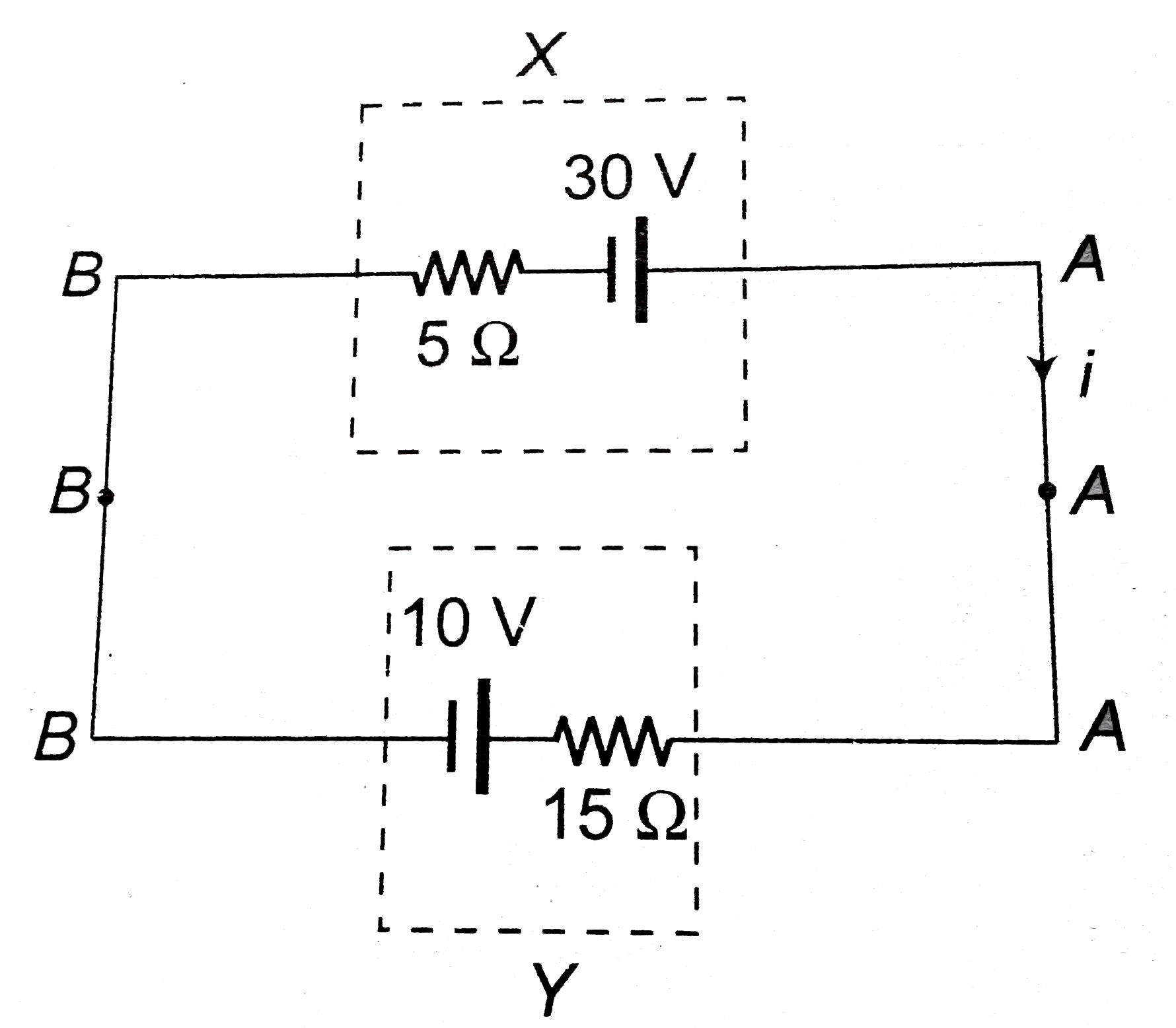 . . ( e) Net emf `= 20 - 10 = 10 V` Net resistance `= 2 + 2 + 1 + 5 = 10 Omega` `i = (10)/(10) = 1 A` `p.d`. across `AB = 1 xx 2 = 2 V` Cell `X` : (supplying current), `V_A - V_D = 20 - 1 xx 2 = 18 V` Cell `Y` : (taking current), `V_B - V_C = 10 + 1 xx 1 = 11 V` `i_1 = (2)/(4) = (1)/(2) A` `i_2 = (2)/(6) = (1)/(3) A` `i_3= (2)/(12) = (1)/(6) A` 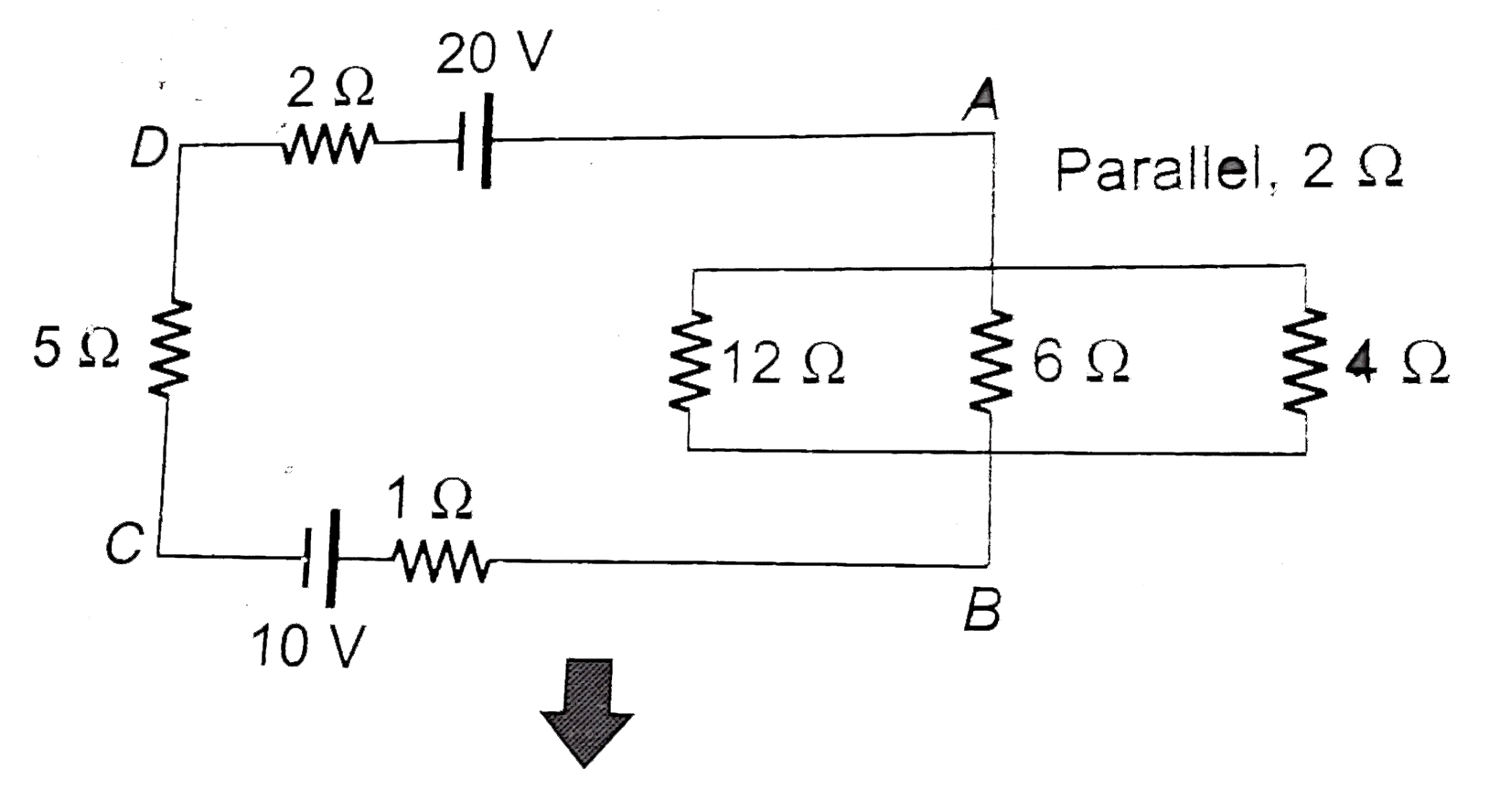 (f) Net emf `= 8 - 4 = 4 V` Net resistance `= 0.5 + 1 + 2 + 4.5 = 8 Omega` `i = (4)/(8) = (1)/(2) A` Cell `X` : (supplying current), `V_B - V_A = 8 - (1)/(2) xx 1 = 7.5 V` Cell `Y` : (taking current), `V_B - V_C = 4 + (1)/(2) xx 0.5 = 4.25 V` 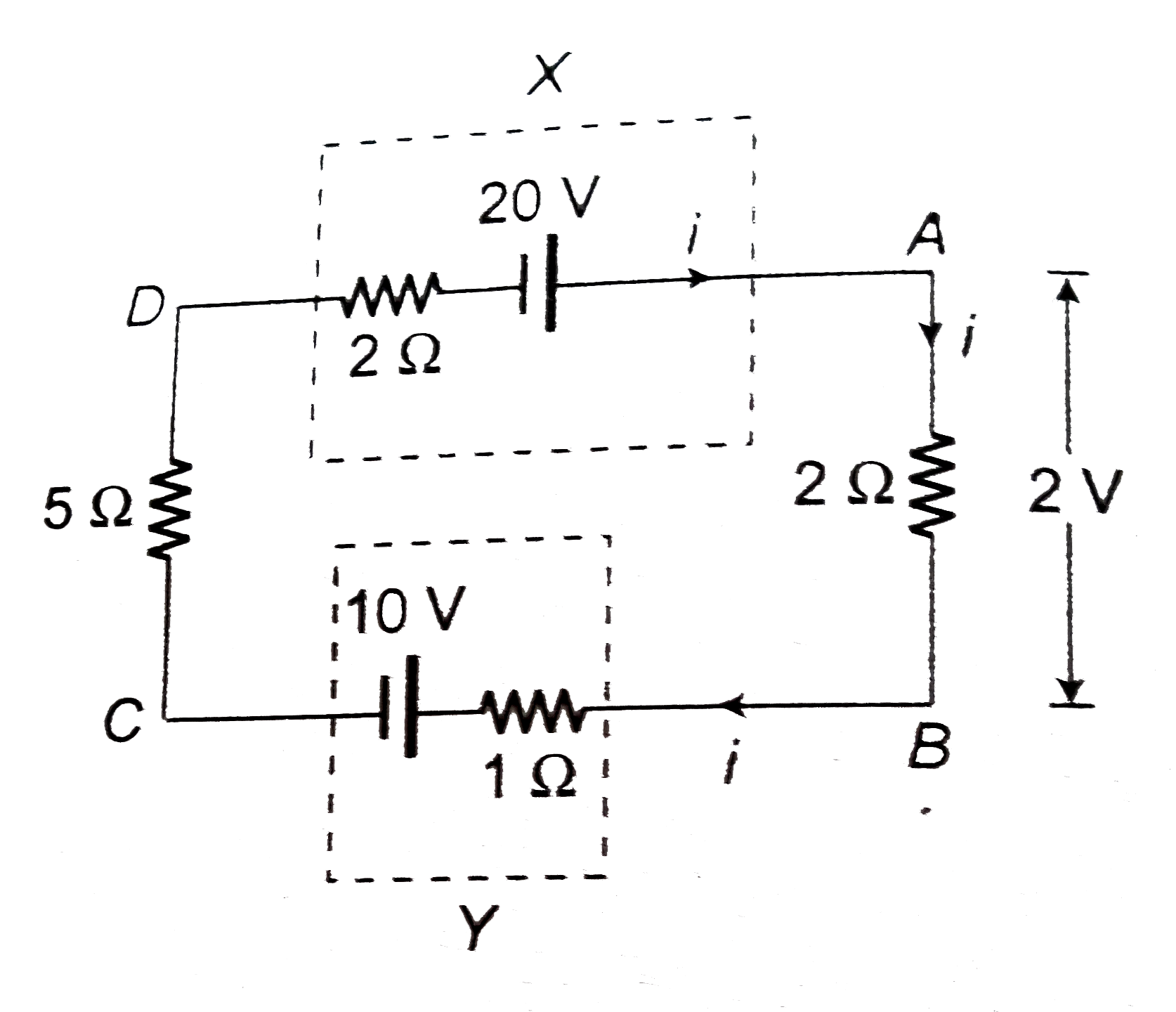 . . (g) Net emf of battery `= 6 xx 2 = 12 V` Net resistance of battery `= 6 xx 0.5 = 3 Omega` (i) `i = (220 - 12)/(3 + 10) = (208)/(13) = 16 A` (ii) Battery : (taking current) `V_A - V_B = 12 + 16 xx 3 = 60 V`. 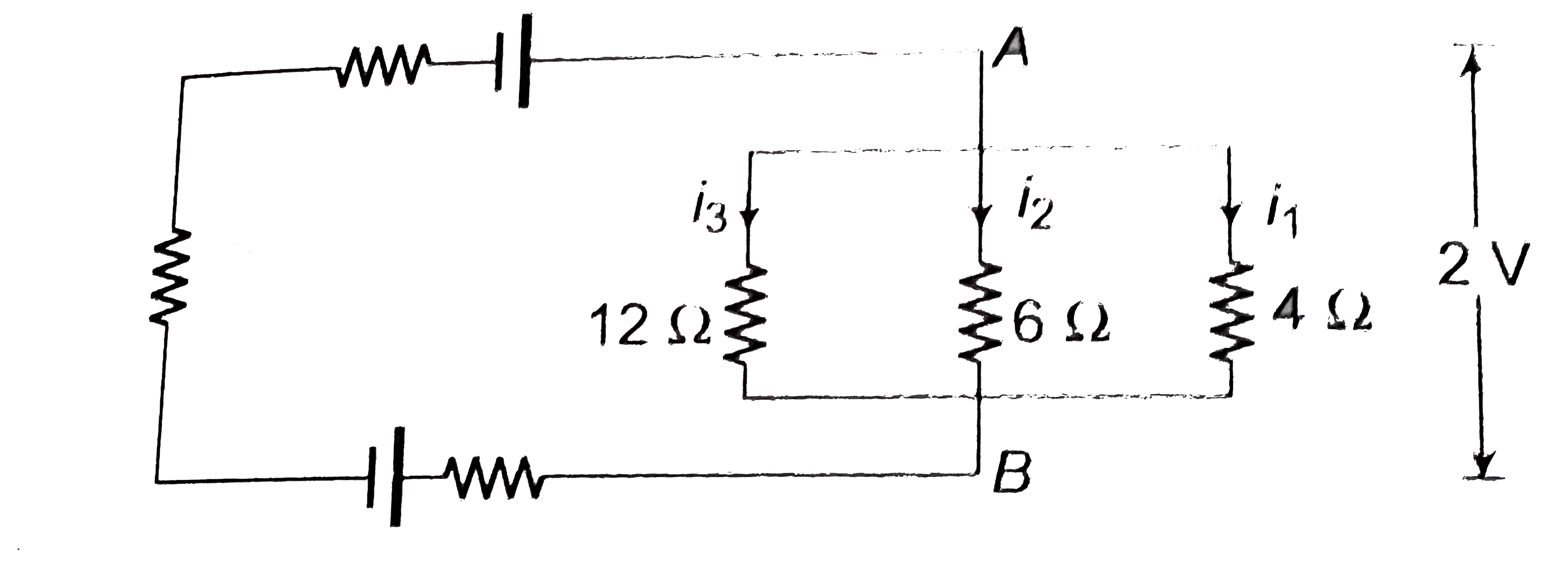 . . 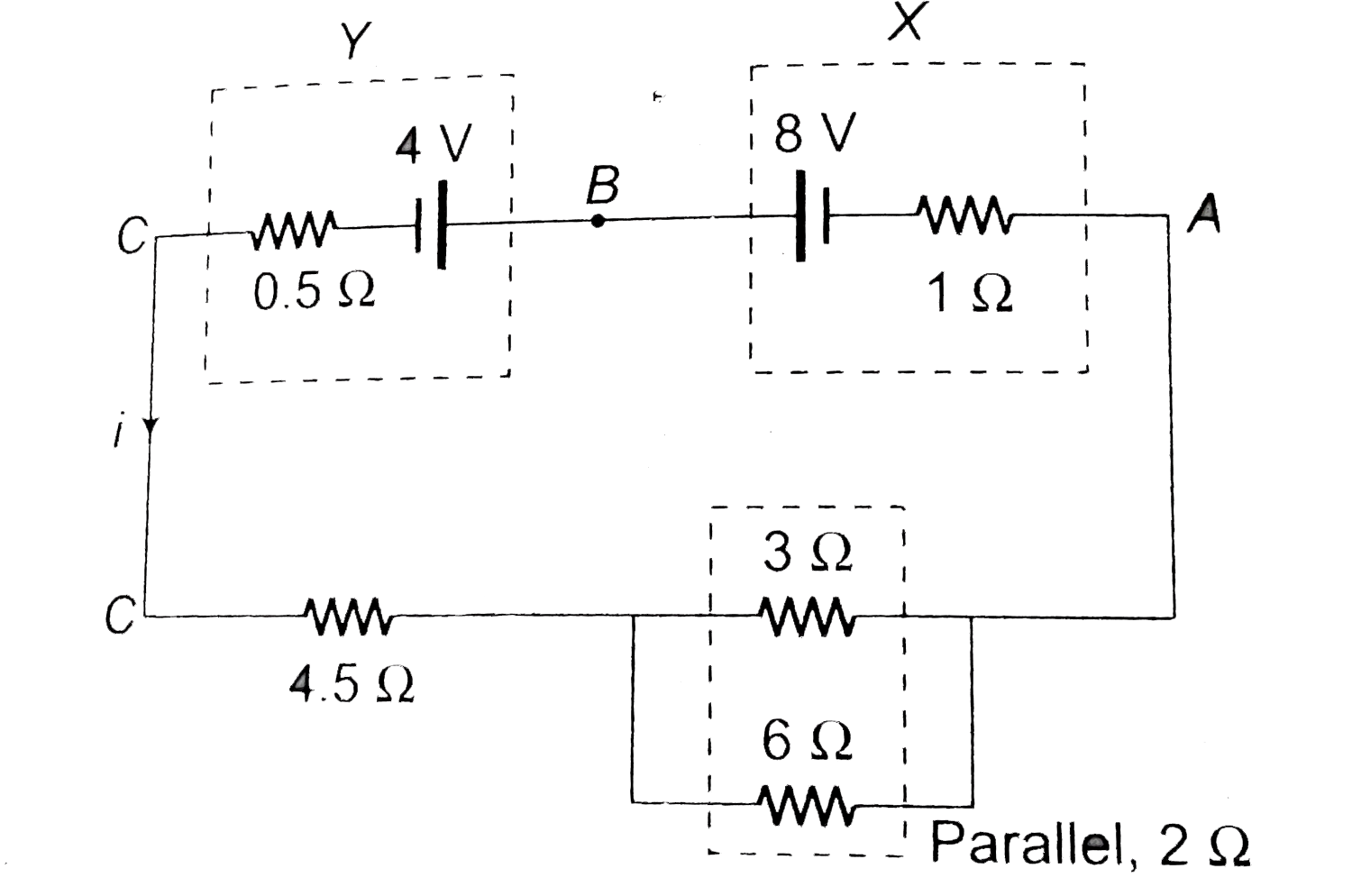 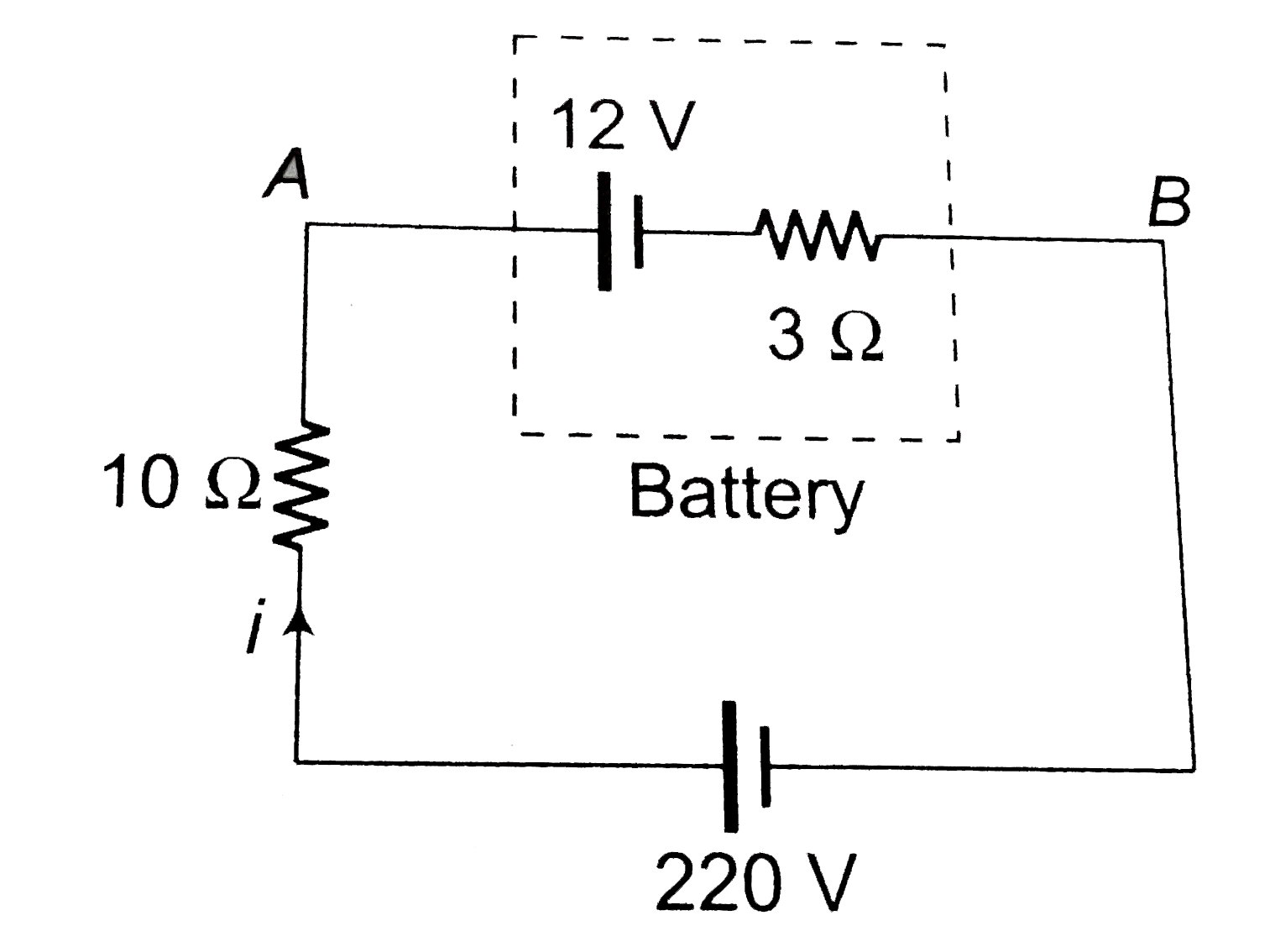
|
|
| 11. |
Two polaroids are placed in the path of unpolarised light of intensity I_(0) such that no light is emitted from the second polaroid. If a third polaroid, whose pass axis makes an angle theta with the pass axis of first polaroid, is placed between these polaroid then the intensity of the light emerging from the last polaroid will be |
|
Answer» `(I_(0))/(8)sin^(2)2theta` |
|
| 12. |
what is the angle between (overset(rarr)P+overset(rarr)Q) and (overset(rarr)P+overset(rarr)Q)? |
| Answer» Solution :before `BARA xx barB =-BAR B xx barA` | |
| 13. |
A coil of resistance 400 Omega is placed in a magnetic field. If the magnetic flux phi(Wb) linked with the coil varies with time t (s) as phi = 50t_2 + 4. The current in the coil att=2 s is |
| Answer» ANSWER :A | |
| 14. |
National phenomenan known as Aurora Boriolis is due to |
|
Answer» trapping of charged particles from SOLAR FLARE in the magnetic FIELD of earth |
|
| 15. |
Statement I: In fission the percentage of mass converted into energy is 0.1%. Statement II : In fusion the percentage of mass converted into energy is 100%. |
|
Answer» A STATEMENT I is true, statement II is false. |
|
| 16. |
The largest wavelength in the ultraviolet region of the hydrogen spectrum is 122 nm. The smallest wavelength in the infrared region of the hydrogen spectrum (to the nearest integer is) |
|
Answer» 802 nm i.e. `1/(122)=R (1/1^(2)-1/2^(2))..........(i)` SMALLEST wavelength in UR region is given by transition `noo" to "n=3` `1/lambda =R (1/3^(2)-1oo) ............(ii)` Solving equation (i) and (ii), `lambda=823.5nm` |
|
| 17. |
Obtain the equation for bandwidth in Young's double slit experimeet. Conditon for bright fringe (or) maxima |
|
Answer» Solution :Equation for path difference: (i) Let d be the distance between the double slits `S_1` and `S_2` which act as coherent sources of wavelength `lamda`. A screen is placed parallel to the double slit at a distance D from it. (ii) The mid-point of `S_1` and `S_2` is C and the i mid-point of the screen O is equidistant from `S_1` and `S_2` P is any point at a distance y from O.(iii) The waves from `S_1` and `S_2` meet at P either N-phase or out-of-phase depending uponthe path difference between the two waves. (iv) The path difference `delta` between the light waves from `S_1` and `S_2` to the point P is, ` delta= S_2P - S_1 P` (v) A perpendicular is dropped from the point `S_1` to the line `S_2P ` at M to find the path difference more precisely. ` delta = S_2 P - MP= S_2M` The angular position of the point P from C is `theta. angle OCP = theta` From the geometry, the angles `angleOCP` and `angleS_2S_1M` are equal. ` angle OCP = angle S_2 S_1 M= theta` In right angle triangle `Delta S_1 S_2 M` , the path difference, ` S_2 M = d sin theta` ` delta = d sin theta` If the angle `theta` is small, `sin theta ~~ tan theta ~~ theta` .From the right angle triangle `DeltaOCP, tan theta = y/D` The path difference,` delta= (dy)/(D)` Based on the condition on the path difference, the point P may have a bright or dark fringe. Condition for bright fringe (or) MAXIMA : (i) The condition for the constructive interference or the point P to be have a bright fringe is, Path difference, `delta= nlamda` where, n =1,2,3... ` therefore (dy)/(D) = nlamda` ` y=n (D lamda)/(d) " or "y_n =n (D lamda)/(d)` (ii) This is the condition for the point P to be a bright fringe. The distance is the distance of the nth bright fringe from the point O. Condition for dark fringe (or) minima : (i) The condition for the destructive interference or the point P to be have a dark fringe is, Path difference, ` delta= (2n - 1) lamda/2` where, n = 1, 2, 3, .. .. ` therefore (dy)/(D) = (2n -1) lamda/2` ` y = ((2n - 1))/(2) (lamda D)/(d) " or "y_n = ((2n -1) )/(2) (lamda D)/(d)` (ii) This is the condition for the point P to be a dark fringe. The distance `y_n` is the distance of the nth dark fringe from the point O. (iii) The formation of bright and dark fringes is, shown in Figure.  (iv) This shows that on the screen, alternate bright and dark bands are seen on either side of the CENTRAL bright fringe. (v) The central bright is referred as `0^(th)`bright followed by 1st dark and 1st bright and then 2nd dark and 2nd bright and so on, on either side of O successively as shown inFigure. 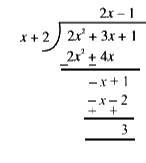 Equation for bandwidth : (i) The bandwidth (`beta`) is defined as the distance between any two consecutive bright or dark fringes. (ii) The distance between `(n+1)^(th)` and `n^(th)` consecutive bright fringes from O is given by `beta = y_((n+1)) - y_n = ((n+1) (lamdaD)/(d)) - (n (lamdaD)/(d))` `beta = (D lamda)/(d)` (iii) Similarly, the distance between `(n+1)^(th)` and nth consecutive dark fringes from O is given by, ` beta = y_((n+1)) - y_n` ` = (((2(n+1)- 1))/(2) (lamdaD)/(d) ) - (((2n -1))/(2) (lamdaD)/(d))` `beta = (Dlamda)/(d)` |
|
| 18. |
When an electron jumps from the orbit n =2 to n= 4, then wavelength of the radiations absorbed will be (R is Rydberg's constant) |
|
Answer» `(16)/(3R)` `1/lambda=R [1/((2)^(2))-(1)/((4)^(2))]` `1/lambda=R [1/4-1/(16)]` `1/lambda=R [(4-1)/(16)]` `1/lambda=(3R)/(16)` `lambda=(16)/(3R)` |
|
| 19. |
If in p-n junction diode a sinusoidal input signal is applied as shown (##AAK_P7_NEET_PHY_SP7_C29_E01_008_Q01.png" width="80%"> Then the output signal across R_(1) will bw |
|
Answer»
|
|
| 20. |
Gold nucleus (""_(79)^(198)Au) can decay into mercuyr nucleus (""_(80)^(198)Hg^(8)) by two decay schemes shown in figure below (i) it can emit a beta -particle (beta_(1)) and come to ground state by either emiting one gamma- ray ( gamma_(1)) or emitting two gamma- rays (gamma_(3) and gamma_(4)) (ii) It can emit one beta- particle (beta_(2)) and come to ground state by emitting gamma_(2) ray. Atomic masses: ""^(198)Au=197.9652 amu and ""^(198)Hg=197.9662 amu. Given that 1 amu= 930MeV//c^(2). The energy levels of the nucleus are shown in figure below Whatis the maximum kinetic energy of emitted beta_(1) parricle ? |
|
Answer» 1.28 MeV |
|
| 21. |
A heating curve has been plotted for a solid object as shown in the figure. If the mass of the object is 200g, then latent heat of vaporisation for the material of the objects, is [power supplied to the object is constant and equal to 1k W] |
|
Answer» `4.5 XX 10^(6) J- KG^(-1)` |
|
| 22. |
A circular coil of 500 turns of wire has an enclosed area of 0.1 m^2per turn. It is kept perpendicular to a magnetic field of induction 0.2T and rotated by 180^@about a diameter perpendicular to the field in 0.1 sec. How much charge will pass when the coil is connected to a galvanometer with a combined resistance of 50 ohms. |
|
Answer» 0.2C |
|
| 23. |
Plot a graph showing the variation of coulomb force (F) versus ((1)/(r^(2))) , where r is the distancebetween two charges of each pair of charges: (1mu C, 2 mu C) and (2 mu C, -3 mu C), interpret the graphs obtained. |
|
Answer» Solution :According to Coulomb'slaw, `F oo q_(1) q_(2)` and `F = oo(1)/(r^(2))` Therefore, both pairs of charges graph between Fand `(1)/(r^(2))` is a straight line.Between`(1 mu C, 2 muC)`, FORCEIS positive/ repulsive andproportionalto `1 (2) = 2`. Between `(2 muC and -3 muC)` force is negative/ attractive and proportional to `2 (3) = 6` Therefore, in Fig1(a).25, OA REPRESENTS thevariation betweenF and `l//r^(2)` for the pair `(1 mu C,2mu C)` And ,OB represents the variation betweenF and`l//r^(2)` for the secound pair `(2 muC, -3 muC)`. 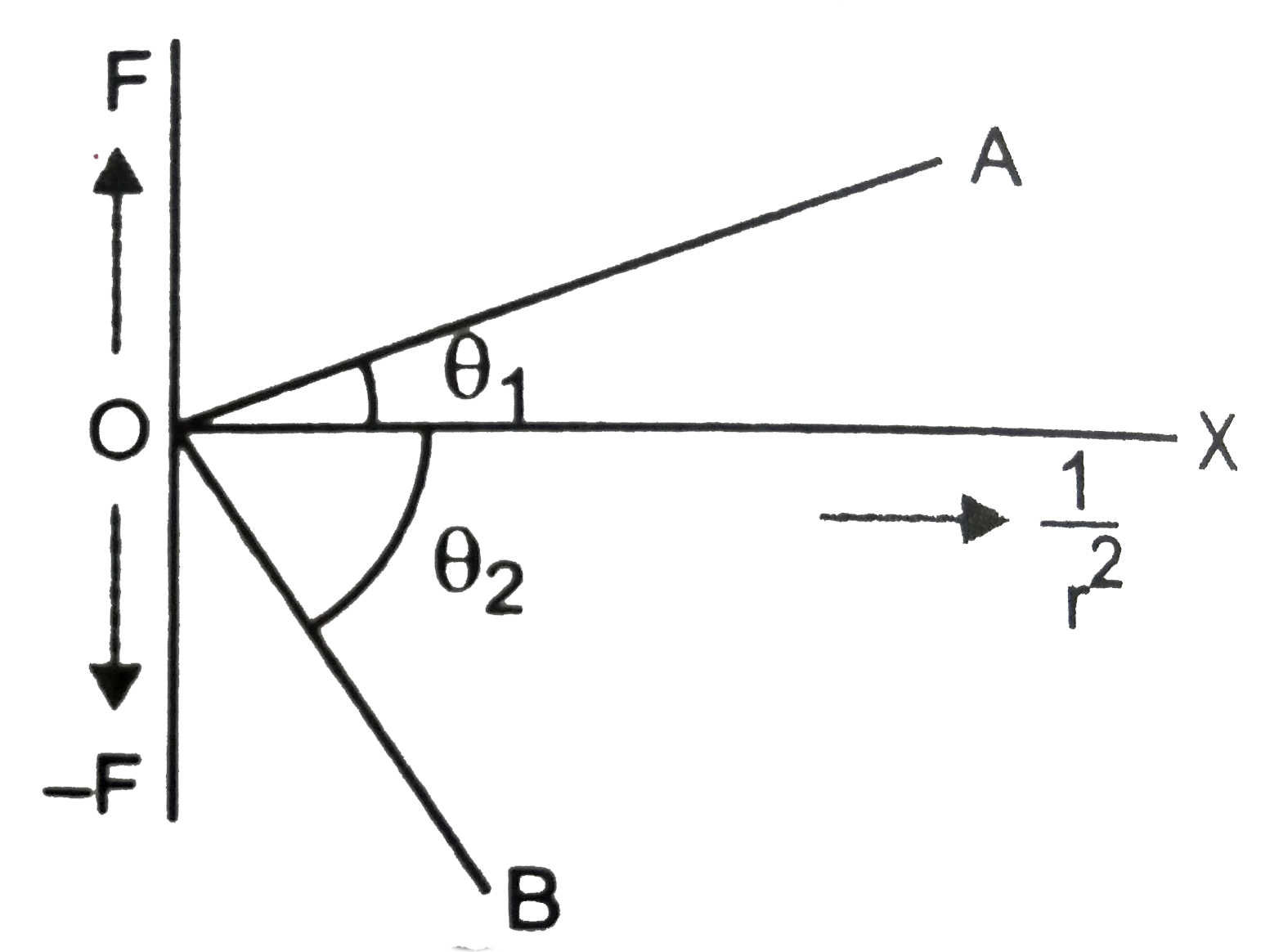
|
|
| 24. |
Gold nucleus (""_(79)^(198)Au) can decay into mercuyr nucleus (""_(80)^(198)Hg^(8)) by two decay schemes shown in figure below (i) it can emit a beta -particle (beta_(1)) and come to ground state by either emiting one gamma- ray ( gamma_(1)) or emitting two gamma- rays (gamma_(3) and gamma_(4)) (ii) It can emit one beta- particle (beta_(2)) and come to ground state by emitting gamma_(2) ray. Atomic masses: ""^(198)Au=197.9652 amu and ""^(198)Hg=197.9662 amu. Given that 1 amu= 930MeV//c^(2). The energy levels of the nucleus are shown in figure below The wavelength of emitted gamma - rays is the order |
|
Answer» `lamda_(2)gtlamda_(3)GT lamda_(1)` |
|
| 25. |
Fringes are produced by a Fresnel's biprism in focal plane of a reading microscope which is 100cm from the slit. A lens inserted between the biprism and the eyepiece gives two images of the slit in two positions of the lens. In one case the two images of the slit are 0.45 mm apart in the other case 2.90 mm apart. If sodium light of wavelength 5893Å used, find the width of the interference fringes. If the distance between the slit and biprism is 10cm and refractive index of the material of the biprism is 1.5, calculate the angle in degrees which the inclined faces of the biprism makes with its base. |
|
Answer» |
|
| 26. |
उत्तल दर्पण द्वारा बना प्रतिबिंब होता है |
|
Answer» काल्पनिक और उलटा |
|
| 27. |
A radioactive material of half-life T was produced in a nuclear reactor at different instants, the quantity produced second time was twice of that produced first time. If now their present activities are A_1 and A_2respectively then find their age difference. |
|
Answer» |
|
| 28. |
Gold nucleus (""_(79)^(198)Au) can decay into mercuyr nucleus (""_(80)^(198)Hg^(8)) by two decay schemes shown in figure below (i) it can emit a beta -particle (beta_(1)) and come to ground state by either emiting one gamma- ray ( gamma_(1)) or emitting two gamma- rays (gamma_(3) and gamma_(4)) (ii) It can emit one beta- particle (beta_(2)) and come to ground state by emitting gamma_(2) ray. Atomic masses: ""^(198)Au=197.9652 amu and ""^(198)Hg=197.9662 amu. Given that 1 amu= 930MeV//c^(2). The energy levels of the nucleus are shown in figure below Whatis the maximum kinetic energy of emitted beta_(2) particle? |
|
Answer» 1.44 MeV |
|
| 29. |
Ratio of frequencies in two Bohr's orbit of hydrogen atom is 1:27. the ratio of radius of these orbits is: |
|
Answer» 1:3 |
|
| 30. |
Itis foundexperimentallythat13.6 eVenergy is requiedto separatea hydrogenatomintoa protonand anelectron. Computetheorbitalradiusand thevelocityof theelectronin a hydrogenatom . |
|
Answer» Solution :TOTAL energyof THEELECTRON in hydrogenatom is `-13.6 EV =- 13.6 xx 1.6xx 10^(-19) J=- 2.2 xx 10^(-18) J` wehave ` E=-(e^2 )/( 8 pi epsi_0 r)=- 2.2 xx 10^(-18) J` ` thereforer= (e^2)/( 8pi epsi_0 E )= (( 9xx 10^9 )(1.6 xx 10^(-19))^2)/((2)(-2.2 xx 10^(-18))) = 5.3 xx 10^(-11) m` ` v= (e )/(sqrt(4 pi epsi_0 m r ) )= ( 1.6 xx10^(-19))/(sqrt(4xx pi xx 8.85 xx 10^(-12) xx 9.1xx 10^(-31) xx 5.3 xx 10^(-11))) = 2.2 xx 10^(6)ms^(-1)` |
|
| 31. |
Find the average drift wire with area of cross section 0.01 cm^2 ,connected across a battery of 2 V carries a current of 0.4 A. Calculate the mobility of electrons if number density of electrons in copper is 7.8 xx10^(28)m^(-3). |
| Answer» SOLUTION :`24.04 xx10^(-7) m^2V^(-1)s^(-1)` | |
| 32. |
The velocity v and displacement r of a body are related by v^2 = kr where k is a constant. What will be velocity after 1 seconds. |
|
Answer» `SQRT KR` |
|
| 33. |
Two small balls having equal positive charge Q C on each are suspended by two insulating strings of equal length L metre, from a hook fixed to a stand. The whole setup is taken into space where there is no gravity (state of weightlessness). Then the angle thetabetween the two strings is |
|
Answer» `0^@` |
|
| 34. |
A 200cm length of the wire weighs 0.6 gm. If the tension in the wire caused by a 500 gm mass hanged from it. If the approximate wavelength of a wave of frequency 400Hz sent down by it is 2^(n)xx10^(-2)m. Find the value of n (g=9.8m//s^(2)) |
|
Answer» `T=mg=0.5xx9.8=4.9Nimplies` Tension in the string `V=` speed of wave in string`=sqrt(T/(mu))` `=sqrt(4.9/(3xx10^(-4)))=128m//s` `lamdaimplies` wavelength of the wave `=v/f=128/400=32xx10^(-2)m=2^(5)xx10^(-2)m` `implies n=5` |
|
| 35. |
Find the magnetization of the substance under the conditions of the previous problem. |
|
Answer» |
|
| 36. |
At absolute zero temperature, the kinetic energy of the molecules |
|
Answer» becomes ZERO `THEREFORE K.E.` = zero |
|
| 37. |
Starting with the same initial conditions, an ideal gas expands from volume V_(1)" to "V_(2) in three different ways. The work done by the gas is W_(1) if the process is purely isothermal, W_(2) if purely isobaric and W_(3) if purely adiabatic. Then SS |
|
Answer» `W_(2) gt W_(1) gt W_(3)` Since work DONE = area under P-V diagram. 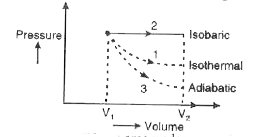 `THEREFORE W_(2) gt W_(1) gt W_(3)` as area under curve 2 is maximum and that under curve 3 is minimum. `therefore` Correct choice is (a). |
|
| 38. |
A long solenoid has 200 turns per cm and carriesa current i. The magnetic field at its centre is 6.28xx10^(-2)Wb//m^(2). Another long solenoid has 100 turns per cm and it carries a current i/3. The value of the magnetic fieldat its centre is |
|
Answer» `1.05xx10^(-4)Wb//m^(2)` |
|
| 39. |
What is the Brewster angle for air to glass transtion ?(Refractive index of glass=1.5) |
|
Answer» <P> SOLUTION :Here `n=1.5`. If Brewster angle be `i_(p)`, then `"TANI"_(p)=n``impliesi_(p)=TAN^(-1)(n)=tan^(-1)(1.5)=56.3^(@)`. |
|
| 40. |
If the magnitude of intensity of electric field at a distance x on axial line and at a distance y on equatorial line on a given dipole are equal, then x : y is |
|
Answer» `root(3)(2) :1` `E_(1) = (2krho)/x^(3)(therefore x GT gt a)` `E_(2) = (kp)/y^(3)` magnitude `(therefore y gt gt a)` But `E_(1) =E_(2)` `therefore (2kp)/x^(3) = (kp)/y^(3)` `therefore 2 = x^(3)/y^(3)` `therefore 2^(1//3) = x/y` |
|
| 41. |
Some scientists have predicted that a global nuclear war on the earth would be followed by a severe 'nuclear winter' with a devastating effect on life on earth. What might be the basis of this prediction ? |
| Answer» SOLUTION :The elouds produced by global nuclear WAR would perhaps cover substantial parts of the sky PREVENTING solar light from reaching reaching many parts of the globe.This would cause a .winter., against which life on EARTH cannot WITHSTAND. | |
| 42. |
Suppose that an electric charge moves in a magnetic field in a plane perpendicular to the lines of induction. Prove that the orbital magnetic moment of the circulating charge is directed against the field. |
Answer» Solution :The positive CHARGE circulates as shown in FIG. 28.18a, The direction of the magnetic moment 18 established with the aid of the screw driver rule (seg 40.5, 40.6). The direction of circulation of a . negative charge is the OPPOSITE (Fig. 28.15b), but the magnetic moment is, just the same, directed against the field. 
|
|
| 43. |
Give the espression for the magnetic induction due tobar magnet on the equitorial line ? |
|
Answer» Solution :MAGNETIC inductionon the equatorial LINE of a bar MAGNET is , `B= (mu_0)/(4pi) (M)/((d^(2) + l^(2))^(3//2))` In case of SHORT bar magnet the magnetic INDUCTION on the equatorail line is , `B = (mu_0)/(4pi)(M)/(d^(3))` |
|
| 44. |
Mention two properties of soft iron due to which it is preferred for making electromagnet. |
| Answer» SOLUTION :LOW RETENTIVITY and HIGH PERMEABILITY. | |
| 45. |
A condenser of capacity C_1 is charged to a potential V. The electrostatic energy stored in it is U_0 It is connected to another uncharged condenser of capacity C_2 in parallel. The energy dissipated in process is |
|
Answer» `((C_2 )/(C_1+C_2))U_0` |
|
| 46. |
In the figure shown a current I_(1) is estabilshed in the log straight wire AB. Another wire CD carrying current I_(2) is placed in the plane of the paper. The line joining the ends of this wire is perpendicular to the wire AB. The resultant force on the wire CD is: |
|
Answer» Zero |
|
| 47. |
The temperature of water in calorimeter is theta and the temperature of surrounding is theta_(c ) ( lt theta). Observation are recorded for temperature difference (theta- theta_0) and time t. The cooling curve is best represented in graph. |
|
Answer»
|
|
| 49. |
In the Q.23, the angle of projection with the horizontal is:- |
|
Answer» `TAN^(-1)((4)/(5))` `THEREFORE tan THETA=(u_(y))/(u_(x))=(25)/(40)=(5)/(8)` |
|


