

Saved Bookmarks
This section includes 7 InterviewSolutions, each offering curated multiple-choice questions to sharpen your Current Affairs knowledge and support exam preparation. Choose a topic below to get started.
| 1. |
A light beam is incident on a denser medium whose refractive index is 1.414 at an angle of incidence 45^@. Find the ratio of width of refracted beam in a medium to the width of the incident beam in air. |
|
Answer» `sqrt3:sqrt2`  Widht of incident beam = 1 `triangle`ABC is RIGHT ANGLE triangle `therefore BC=SQRT(AB^2+AC^2)` `=sqrt(1+1)` `=sqrt2` Now, `angle`D is right angle in `triangle`BDC and at B and C `N=(sini)/(sinr)` `1.414=(sin45^@)/(sinr)` `therefore sin" "r=((1)/(sqrt2))/(sqrt2)=1/2` `therefore r=30^@` `therefore angleCBD=30^@` Now,in `triangle`BDC, `cos30^@=(BD)/(BC)=(x)/(sqrt2)` `(sqrt3)/(2)=(x)/(sqrt2)implies x=(sqrt3)/(sqrt2)` |
|
| 2. |
A gun weighing 8 kg flies a bullet 40 gm wih a velocity 400 m/s. With what velocity does the gun recoil? What is the resultant momentum of the gun and the bullet before firing and after firing ? |
|
Answer» 0 |
|
| 3. |
Interference takes place due to |
|
Answer» PHASE difference |
|
| 4. |
In the figure of Checkpoint 1, we move the proton from point i to point fin a uniform electric field directed as shown. (a) Does our force do positive or negative work? (b) Does the proton move to a point of higher or lower potential? |
| Answer» SOLUTION :(a) POSITIVE, (B) HIGHER | |
| 5. |
Give any two examples for “Nano" in nature. |
|
Answer» Solution :(i) Lotus leaf surface: Scanning electron micrograph (SEM) showing the nano structures of the surface of a leaf from a lotus PLANT. This is the reason for self cleaning PROCESS in lotus leaf. (II) Peacock feathers: Get their iridescent coloration from light INTERACTING with 2 dimensional photonic crystal structures just tens of nanometers THICK. |
|
| 6. |
The electron was moves around the nucleus in circular orbit of radii r and 4r. The ratio of their respective times to complete one revolution is: |
|
Answer» `1:1` |
|
| 7. |
A nuclear reactor containing U^(235) produces 10 MW . Calculate the fission rate assuming that 200 MeVof useful energy is released in one fission ? |
|
Answer» `3.1xx 10^(17) sec^(-1)` |
|
| 8. |
A small but measurable current of 1.2 xx 10^(-10) A exists in a copper wire whose diameter is 3.0 mm. The number of charge carriers per unit volume is 8.49 xx 10^(28)m^(-3) m. Assuming the current is uniform, calculate the (a) current density and (b) electron drift speed. |
|
Answer» |
|
| 9. |
What is the de Broglie wavelength of (a) a bullet of mass 0.040 kg travelling at the speed of 1.0 km//s, (b) a ball of mass 0.060 kg moving at a speed of 1.0 m//s, and (c) a dust particle of mass 1.0 xx 10^(-9) kg drifting with a speed of 2.2 m//s? |
|
Answer» SOLUTION :(a) `1.7xx10^(-35)m` (b) `1.1xx10^(-32)m` (c) `3.0xx10^(-23)m` |
|
| 10. |
A body is projected horizontally from the top of a tower of height 10m with a velocity 10 m/s. Its velocity after 1 second is |
|
Answer» |
|
| 11. |
Rain is falling vertically with a speed of 1 ms^(-1) . A woman rides a bicycle with a speed of 1.732 ms^(-1) is in east to west direction. What is the direction in which she should hold her umbrella? |
Answer» Solution : In Fig. `V_(t)` represents the VELOCITY of rain and `v_(b)` the velocity of the BICYCLE, the woman is RIDING. Both these velocities are with respect to the ground. Since the woman is riding a bicycle, the velocity of rain as experienced by 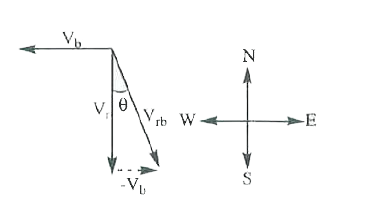 her is the velocity of rain relative to the velocity of the bicycle she is riding. That is `V_(rb)=V_(t)-V_(b)` This relative velocity vector as shown in Fig. makes an angle `theta` with the vertical. It is given by `"tan" theta=(v_(b))/(v_(r))= (sqrt(3))/(1)= sqrt(3)=60^(@)` Therefore, the woman should hold her umbrella at an angle of about `60^(@)` with the vertical towards the WEST. |
|
| 12. |
The electric field and electric potential at any point due to a point charge kept in air si 20 N C^(-1) and 10 J C^(-1) respectively. Compute the magnitude of this charge. |
|
Answer» SOLUTION :Here electric field `E = Q/(4pi epsi_0 r^2) = 20 N//C` …(i) and electric potential`V = Q/(4pi epsi_0r) = 10 J//C`…(ii) Dividing (ii) by (i), we get `r = 10/20 = 0.5 m` Substituding value of r in (ii), we get `Q = 4pi epsi_0. r XX 10 = (0.5 xx 10)/(9 xx 10^9) = 5.55 xx10^(-10) C.` |
|
| 13. |
Iodine is powerful antiseptic. It is used as a tincture of iodine which is X% iodine solution of Alcohol/water. What is (X) |
|
Answer» 3-7% |
|
| 14. |
An instrument used for sorting out and identifying positive ions and arrange them according to their masses is called ? |
| Answer» SOLUTION :MASS spectograph | |
| 15. |
An object is placed at the focus of a concave mirror. The image will be |
|
Answer» a real, inverted, same size at the FOCUS 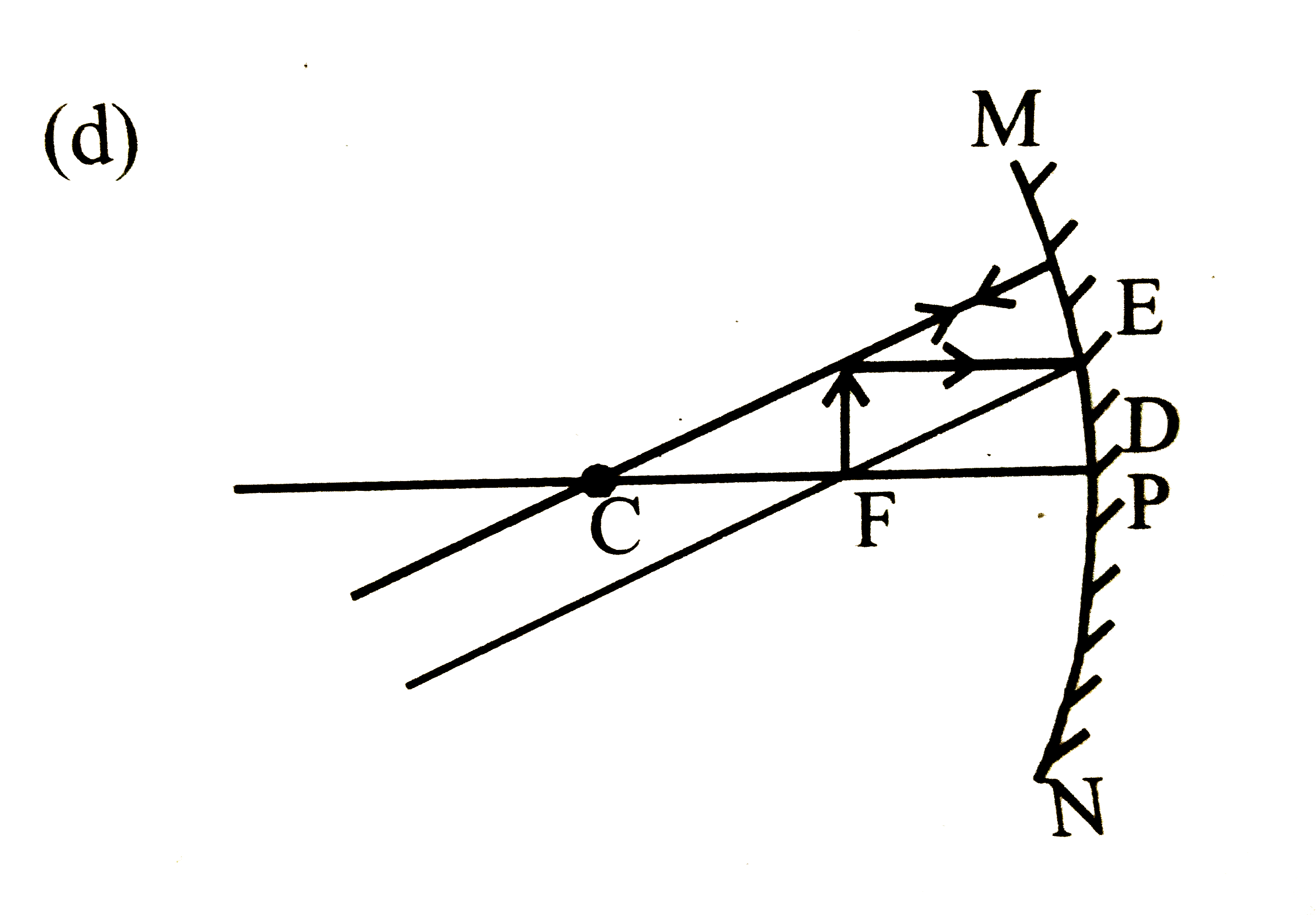
|
|
| 16. |
If the mass of a planet is 10% less than that of the earth and the radius 20% greater than that of earth, the accelerationdue to gravity on the planet will be: |
|
Answer» `(1)/(2)` TIMES that on the surface of the EARTH `g_(p)=(5)/(8)(GM)/(R^(2)) rArr g_(p)=(5)/(8)g` So the correct CHOICE is (c ). |
|
| 17. |
In a region, electric field depends on X-axis as E=E_0 x^2. There is a cube of edge a as shown. Then find the charge enclosed in that cube. |
| Answer» Answer :A | |
| 18. |
Two circular coins have masses in the ratio 1:2 and diameters in the ratio 2:1. the ratio of their moments of inertia is |
|
Answer» 0.044444444444444 |
|
| 19. |
A solid sphere of mass M and radius R is surrounded by a spherical shell of same mass M and radius 2R as shown. A small particle of mass m is released from rest from a height h(ltltR) above the shell. There is a hole in the shell. What speed will it collide at B? |
|
Answer» `SQRT((2GM)/(R ))` |
|
| 20. |
A solid sphere of mass M and radius R is surrounded by a spherical shell of same mass M and radius 2R as shown. A small particle of mass m is released from rest from a height h(ltltR) above the shell. There is a hole in the shell. What time will it take to move from A to B? |
|
Answer» `=(R ^(2))/(SQRT(GMH))` |
|
| 21. |
A solid sphere of mass M and radius R is surrounded by a spherical shell of same mass M and radius 2R as shown. A small particle of mass m is released from rest from a height h(ltltR) above the shell. There is a hole in the shell. At what time will it enter the hole at A |
|
Answer» `2 sqrt((HR^(2))/(GM))` |
|
| 22. |
In a photoelectric experiment, it was found that the stopping potential decreases from 1.85 V to 0.82 V as the wavelength of the incident light is varied from 300nm to 400nm. Calculate the value of the Planck constant from these data. |
|
Answer» Solution : The maximum kinetic energy of a photoelectron is ` (K_max = hc/lambda - varphi)` and the stopping POTENTIAL is ` V= (K_max/e)= (hc/lambda e )- (varphi/ e).` ` If V_1, V_2, are the stopping potentials at wavelengths lambda_1 and lambda_2 respectively, ` V_1 = (hc/lambda_1 e)- (varphi/e)` ` and V_2= (hc/ (lambda_2 e)-(varphi/ e)).` ` This gives, V_1- V_2 = (hc/e) ( 1/lambda_1) - (1 / lambda_2) ` or, h= (e((V_1)-(V_2))/ C(1/lambda_1)-(1/lambda_2))` ` = (e(1.85 V - 0.82V)/c(1/(300 XX (10^-9)m))-(1/400 xx (10^-9)m))` ` = (1.03e V/ ((3 xx (10^8)m (s^-1))(1/12 xx (10^7)(m^-1)))` ` = 4.12 xx (10^-15) EVS.` |
|
| 23. |
A vertical plane passing through the geographical axis of earth is called ? |
| Answer» SOLUTION :GEOGRAPHICAL MERIDIAN | |
| 24. |
A ray of light passes through four transpar ent media with refractive indicesmu_(1),mu_(2), mu_(3) and mu_(4) as shown in figure. The surfaces of all media are parallel. If the emergent ray is parallel to the incident ray, we must hav |
|
Answer» `n_1 = n_4` |
|
| 25. |
The diagram below shows a charge +Q held on an insulating support S and enclosed by a hollow spherical conductor. O represents the centre of the spherical conductor and Pisa point such that OP = x and SP = r. the electric field at the point P due to charge + Q on insulating support : |
|
Answer» `Q/(4piepsilon_0x^2)` |
|
| 26. |
Twopoint charges q_(A)=3 mu c and q_(B)=-3 mu care located20 cm apart in a vacuum (a) what is the electric field at the midpoint Oof theline AB joiningthe two charges (b) if a negativetest charge of magnitude 1.5 xx 10^(-9) cis placed at this point whatis the force experienced by the test charge |
|
Answer» SOLUTION :(a) `5.4 xx10^(6) NC^(-1)` along OB (B) `8.1 xx10^(-3) N` alongOA |
|
| 27. |
An object is placed at a distance of 20 cm from a thin plano - convex lens of focal length 15 cm. The plane surface of lens is now silvered. What is the position of image? |
|
Answer» 12 CM to the left of lens system |
|
| 28. |
At t=0, a transverse were pulse in a wire is described by the function where x and y are in metre. The function y(x, t) that describes this wave equation, if it is travelling in the positive x - direction with a speed of "4.5 m s"^(-1) is |
|
Answer» `y=(6)/((x+4.5t)^(3)-3)` |
|
| 29. |
A series LCR circuit is connected to a source of alternating emf 50 V and if the potential differences across inductor and capacitor are 90V and 60V respectively, the potential difference across resistor is : |
|
Answer» 400V |
|
| 30. |
Calculate the axial field of a finite solenoid. |
Answer» Solution :Let the solenoid of figure consists of `n` turns PER unit length.  Let its length be `2l` and radius a. We can EVALUATE the axial field at a point P, at a distance r from the centre O of the solenoid. Consider a circular element of thickness dx of the solenoid at a distance x from the centre. It consists of n dx turns. Let I be the current in the solenoid. According to formula for the magnitude of magnetic field at axis of coil of N turn, number of tum `N= n` dx and taking distance from O to P `= (r-x)`. `B= ( mu_(0) NIa^(2) )/( 2[ (r-x)^(2) + a^(2) ]^(3//2) )` `therefore B= (mu_(0) n dx Ia^(2) )/(2[ (r-x)^(2) +a^(2) ]^(3//2))` Total field is obtained by summing over all the elements that is by INTEGRATING from `x=-l` to `x=+l`. Then the denominator is approximately by, `[(r-x)^(2) +a^(2) ]^(3//2) ~~ r^(3) [ because l` means `x` and a is neglected to compare with r ] `therefore B= (mu_(0) n Ia^(2) )/( 2r^(3) ) int_(-l)^(l) dx` `= (mu_(0) nIa^(2) )/( 2r^(3) ) [l-(-l)]` `= (mu_(0) nIa^(2) )/( 2r^(3) ) [2l]` Arranging the terms appropriately, `B = (mu_(0) )/( 2r^(3) ) [ (n2l) (Ia^(2) )]` multiply and dividing by `pi` to right side term, `B= (mu_0)/( 2r^3) [( (n2l)(I pi a^(2) ))/( pi)]` Here `(n2l)` are the total turns of the solenoid. `pia^(2) = A` is the cross-section area of one side of solenoid. `B = (mu_0)/( 2r^3) [ (NIA)/( pi) ]` Here, NIA = dipole moment of solenoid, `B= (mu_0)/(2pi ) (m)/(r^3)` `therefore B=2 (mu_0)/( 4pi) (m)/( r^3)`. Is the magnetic field at the axis of solenoid. This also similar the far axial magnetic field of a bar magnet. Thus, a bar magnet and a solenoid produce similar magnetic field. |
|
| 31. |
In a photoelectric cell, current stops when a negative potential of 0.5v is given to the collector w.r.t. emitter. The maximum K.E. of emitted electron is |
|
Answer» `0.8xx10^(-19)` JOULE |
|
| 32. |
(A): A point charge is lying at the centre of a cube of each side. The electric flux emanating from each surface of the cube is (1^(th))/(6) total flux. (R ): According to Gauss theorem, total electric flux through a closed surface enclosing a charge is equal to 1//epsi_(0) times the magnitude of the charge enclosed. |
|
Answer» Both .A. and .R. are TRUE and .R. is the CORRECT explanation of .A. |
|
| 33. |
In a p - n junction diode |
|
Answer» <P>high potential at n SIDE and low potential at p side |
|
| 34. |
Panic escape . Figure 2-16 shows a general situation in which a stream of people attempt to escape through an exit door that turns out to be locked. The people move toward the door at speed v_(s)=3.50m//s, are each d=0.25m in depth, and are separated by L=1.75m. The arrangement in Fig. 2-16 occurs at time t=0. (a) At what average rate does the layer of people at the door increase ? (b) At what timedoes the layer'sdepth reach 5.0m ? (The answers reveal how quicklysuch a situation becomes dangerous. ) |
|
Answer» |
|
| 35. |
When a car moves with uniform speed on a smooth level road, neglecting air resistance. |
| Answer» SOLUTION :No, weight of the CAR and it's displacement are at RIGHT ANGLES. | |
| 36. |
An electron enters with a velocity vecv,v_(0)hati into a cubical region (faces parallel to coordinate planes) in which there are uniform electric and magnetic fields. The orbit of the electron is found to spiral down inside the cube in plane parallel to the x-y plane. Suggest a configuration of fields E and B that can lead to it. |
|
Answer» Solution :1. Due to magnetic field, electron is MOVING on circular PATH in xy-plane linear speed of electron is increase by increasing electric field in X-direction, so that radius of trajectory of path also INCREASES. Thus, electron is moving on helical path. 2. Change magnetic field as, `vecB=B_(0)hatk` Now velocity of electron, `vecv=v_(0)hati` 3. Magnetic FORCE on electron when it ENTER in magnetic field, `vecF=-e(v_(0)hatixxB_(0)hatk)` = `-ev_(0)B_(0)(hatixxhatk)` = `-ev_(0)B_(0)(-hatj)` `vecF=ev_(0)B_(0)(hatj)` Due to this force, electron is moving on circular path in xy-plane. |
|
| 37. |
A parallel plate capacitor has a parallel sheet of copper inserted between and parallel to the two plates, without touching the plates. The capacity of the capacitor after the introduction of the copper sheet is : |
|
Answer» minimum when the copper sheet TOUCHES ONE of the PLATES. |
|
| 38. |
Ice skating can be used to demonstrate that when ice is under pressure is ______ |
|
Answer» MELTING POINT is LOWERED |
|
| 39. |
A man is 180 cm tall and his eyes are 10 cmbelow the top of his head. In order to see his entire height right from toe to head, he uses a plane mirror kept at a distance of 1 m from him. The minimum length of the plane mirror required is |
|
Answer» 180cm |
|
| 40. |
An artificial satellite is moving in a circular orbit around the earth with a speed equal to 3//8 times of th emagnitude of escape velocity from the earth. If the satellite is stopped suddely in its orbit and allowed to fall freely onto the earth, then the speed with whcih it hits the surface of the earth is (take g = 10 m//sand R_(e ) = 6400 km) |
|
Answer» `SQRT((29)/(4)) Km//s` `V_(s) = (3)/(8) sqrt(2gR_(e) ) = sqrt((9gR_(e ))/(32)) = sqrt((R_(r )^(2)g)/(R_(e ) + h))` `9R_(e ) + 9h = 32 R_(e )` `h = (23)/(9) R_(e )` Now TOTAL ENERGY at heigh'h' `=` total energy at the surface of the earth `0 - (GM_(e )m)/(R_(e )) = (1)/(2)mv^(2) - (GM_(e )m)/(R_(e ))` `(1)/(2)mv^(2) = (GM_(e )m)/(R_(e )) - (GM_(e )m)/(R_(e ) +(23)/(9)R_(e ))` `(1)/(2)mv^(2) = (23)/(32) (GM_(e )m)/(R_(e ))` `v = sqrt((23)/(16)(GM_(e ))/(R_(e ))), sqrt(gR_(e) ) = 8 Km//sec` `v = sqrt((23)/(16)gR_(e) ) = sqrt((23)/(2)) Km//s` |
|
| 41. |
A uniformly charged conducting sphere of radius one metre has a surface charge density 14 mu m^(-2)?. Find the charge on the sphere and total electric flux leaving the spherical surface. |
|
Answer» Solution :`r=1m, sigma=14 XX 10^(-6) CM^(-2)` CHARGE `q=sigma xx" area "=sigma xx 4pir^(2) =14 xx 10^(-6) xx 4 xx (22)/7 xx 1^(2)=1.76 xx 10^(-4)C` Flux `=phi =q/in_0 =(1.76 xx 10^(-4))/(8.854 xx 10^(-12)) =1.98 xx 10^(7) C^(-1)m^(2)` |
|
| 42. |
Calculate the distance between two charges of 4C forming a dipole, with a dipole moment of 6 units. |
|
Answer» 1 |
|
| 43. |
If separation between an object and a screen is D, then prove that D must be greater or equal to four times of focal length of convex lens. Also prove that there are two positions of lens for which real image of object can be projected on screen. If d is separation between these two positions of lens then what will be the focal length of lens in terms of D and d. |
|
Answer» Solution :Let D be the separation between object and screen and x be the distance of lens from object. Then we can use lens formula as follows : `(1)/(f)=(1)/(v)-(1)/(u)` `RARR""(1)/(f)=((1)/(+D-x))-(1)/(-x)` `rArr""(1)/(f)=(1)/((D-x))+(1)/(x)=(x+D-x)/((D-x)x)` `rArr""(1)/(f)=(D)/(Dx-x^(2))` `rArr""Dx-x^(2)=fD` `rArr""x^(2)-Dx+fD=0"....(1)"` For real solution of above quadratic equation its discriminant must be greater or equal to zero. `rArr""D^(3)-4fD ge 0` `rArr""D(D-4f)ge0` `rArr""Dge4f` Hence we have proved that D must be greater or equal to four times of focal length of convex lens. Now from equation (i) we can see that it is a quadratic equation. Hence there are two ROOTS and hence there are two positions of lens for which we can project real image of object on screen. Two solutions of the quadratic equation can be written as follows : `x=(Dpm SQRT(D^(2)-4fD))/(2)` Let `x_(1) and x_(2)` be the zero roots then we can write as follows : `x_(1)=(D+sqrt(D^(2)-4fD))/(2)` `x_(2)=(D-sqrt(D^(2)-4fD))/(2)` Distance between these two position of lens is given to us as d. `x_(1)-d_(2)=d` `rArr""sqrt(D^(2)-4fD)=d` `rArr""D^(2)-4fD=d^(2)` `rArr""f=(D^(2)-d^(2))/(4D)` |
|
| 45. |
Water flows out of a wide vessel through a small orifice. Express the flow velocity as a function of the height of the column of liquid. |
|
Answer» |
|
| 46. |
Each of two concentric spheres of radii 5 cm and 10 cm are given a charge of 10 mu C. (iii) The electric potential at a point situated at a distance of 20 cm form the centre is |
|
Answer» `4 xx 10^(5) V` |
|
| 47. |
Define a wavefront . Using Huygens principle ,verify the laws of reflection at a plane surface. |
|
Answer» Solution :Definitionof wave frot The wave front may be defined as a surface of constant phase . (Alternatively : The wave front is the loci of all point that are in the same phase) ` (##DBT_SM_PHY_XII_DL_18_E03_013_S01.png" width="80%"> Let speed of the wave in the MEDIUM be.u. Let the time taken by the wave front , to advance from point B to point C is ` .TAU.` Let CE REPRESENT the reflected wave front Distance AE `- utau =BC ` ` Delta AEC and Delta ABD ` are congruent `ANGLE BAC = angle ECA ` `rArr angle i= angle r` |
|
| 48. |
A wire is stretched through 2mm by a certain load. What will be the extension produced in a wire of the same material with double the length and radius with the same load ? |
| Answer» Solution :L =( M G L)/(PI r^2 y)or l alpha 1/r^2` `l_2/l_1 = L_2/L_1 XX (r_1/r_2)^2 = 2/1 xx 1/4 = 1/2` | |
| 49. |
(a) A rod of length l is moved horizontal with a uniform velocity v in a direction perendicular to its length through a region in which a uniform magnetic field is acting vertically downward. Derive the expression for the emf induced across the end of the rod. (b) How does one understand this motional emf by invoking the Lorentz force acting on the free charge carriers of the conductor? Explain. |
|
Answer» Solution :(a) Suppose a rod of LENGTH `I` moves with velocity V inward in the region having uniform magnetic FIELD B. Initial magnetic flux enclosed in the rectangular space is `s=|B|lx` As the rod moves with velocity `-V=(dx)/(dt)` Using Lenz's law `e=(dphi)/(dt)=-(d)/(dt)(BLX)=Bl((-dx)/(dt))` 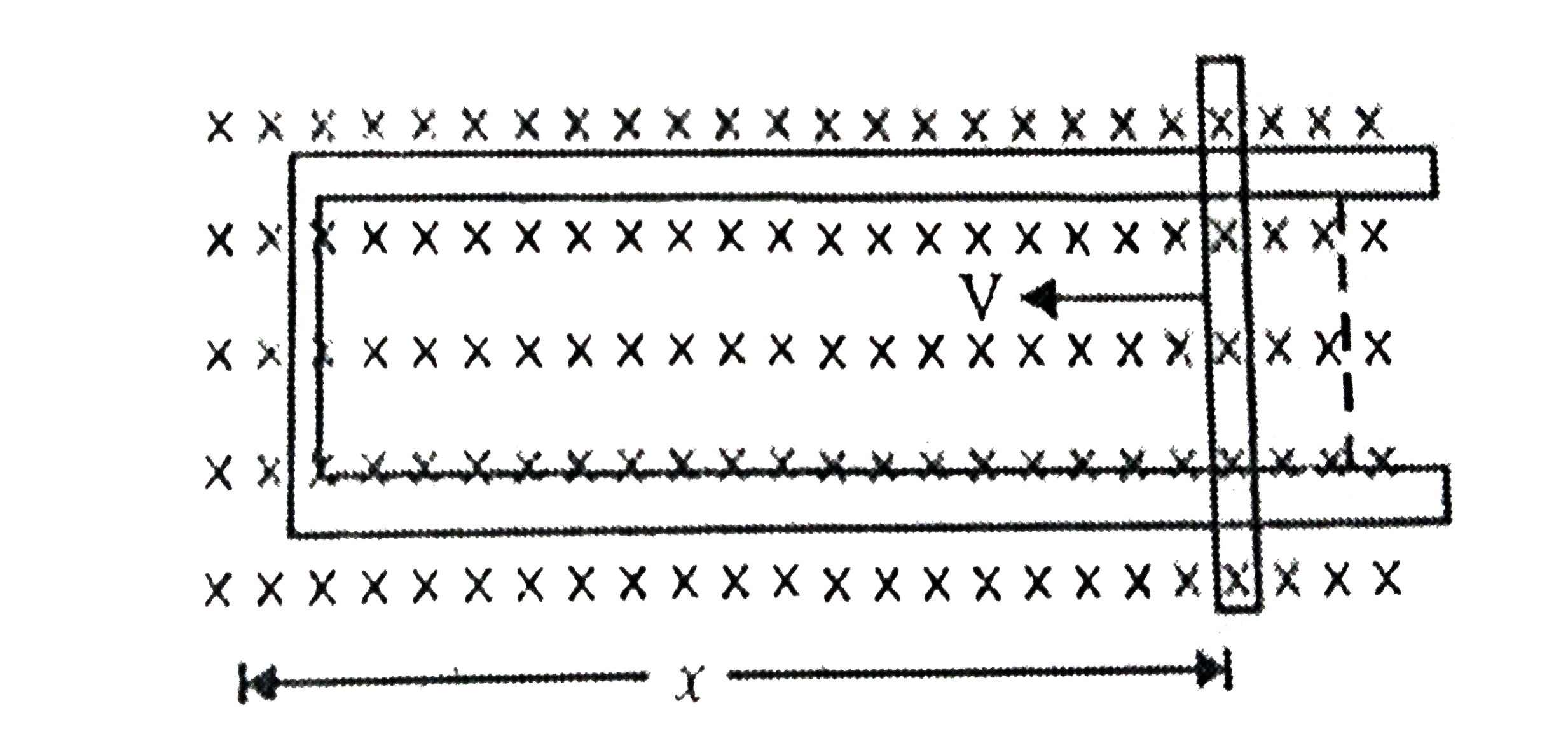 (b) the magnetic force `vecq^v(xx)vecB` component of the Lorentz force is responsible for MOTIONAL electromotive force. When a conductor is moved through a magneticfield, the magnetic force tries to push the free electrons through the wire, and this CREATES the motional EMF. |
|
| 50. |
Pick out the wrong statement from the following |
|
Answer» Lateral shift increases as the angle of INCIDENCE increases and normal shift, `L_(N) = t (1 - (1)/(mu))`. |
|