

Saved Bookmarks
This section includes 7 InterviewSolutions, each offering curated multiple-choice questions to sharpen your Current Affairs knowledge and support exam preparation. Choose a topic below to get started.
| 1. |
A piston of cross sectional area 10^-2 m^2 is used in a hydraulic press to exert a force of 100 N on water . What is the cross sectional area of the other piston which supports to carry a mass 2000kg?g = 9.8m/s^2 |
| Answer» Solution :From the principle of multiplication FORCES `(F_1)/(A_1) = (F_2)/(A_2)` in USUAL symbols `therefore A_2 = F_2 (A_1)/(F_1) = (2000 xx 9.8) xx (10^-2)/(100) = 1.98 m^2` | |
| 2. |
Calculate the work function of the metal, if the kinetic energies of the photoelectrons are E_(1) and E_(2), with wavelengths of incident light lambda_(1) and lambda_(2) |
|
Answer» `(E_(1)lambda_(1)-E_(2)lambda_(2))/(lambda_(2)-lambda_(1))` `E_(2)=(hc)/(lambda_(2))-W""......(ii)` From Eqs. (i) and (ii), we get `therefore""(E_(1)+W)/(E_(2)+W)=(lambda_(2))/(lambda_(1))" or "W=(E_(1)lambda_(1)-E_(2)lambda_(2))/((lambda_(2)-lambda_(1)))` |
|
| 3. |
The minimum number of NAND gates used to construct an OR gate is |
|
Answer» A) 4 |
|
| 4. |
In the adjacent figure ABC is a uniform isosceles triangular lamina of mass m and AB=AC=l the lamina is free to rotate about a fixed horizontal axis OAO^(') which is in the plane of the lamina. Initially the lamina is in static equilibrium with maximum gravitational potential energy. due to slight disturbance, lamina starts rotating. Now choose the correct option(s) |
|
Answer» The maximum angular SPEED acquried by lamina is `4sqrt((SQRT(2)g)/(3l))` `(2sqrt(2)mgl)/(3)=(1)/(2).(ml^(2)omega^(2))/(4)` (moment of inertial about `OAO^(')=(ml^(2))/(4))` `impliesomega=sqrt((16sqrt(2))/(3).(g)/(l))=4sqrt((sqrt(2)g)/(3l))` `becauseF-mg=momega^(2)R=mxx(16sqrt(2)g)/(3l).(sqrt(2)l)/(3)` `impliesF=mg+(32MG)/(9)=(41mg)/(9)` |
|
| 5. |
A plane mirror is placed along positive x-axis facing towards positive y-axis. If the equation of a linear object is x=y, the equation of its image is |
|
Answer» `x=y` |
|
| 6. |
What is voltage sensitivity ? write its equation. |
|
Answer» Solution :1. VOLTAGE sensitivity is define as the deflection per unit voltage. From equation, 2. `phi/I=(NAB)/k` `thereforephi=((NAB)/k)I` Divide by V on both the SIDES, `phi/V=((NAB)/k)I/V` but taking `I/V=I/R`, `thereforephi/V=((NAB)/k)I/R` which is equation for voltage sensitivity. |
|
| 7. |
m^(2)V^(-1)s^(-1) is the SI unit of which of the following? |
|
Answer» DRIFT velocity [Hint: Mobility=`mu=(v_(d))/E=(ms^(-1))/(Vm^(-1))=m^(2)s^(-1)V^(-1)`] |
|
| 8. |
How much work must be done to increase the speed of an electron from rest to (a) 0.500c, (b) 0.990c, and (c )0.99990c? |
|
Answer» |
|
| 9. |
Ultraviolet light of 200 nm wavelength is incident on polished surface of iron .Its work function is 4.71 eV what will be value of stopping potential?[h=6.626xx10^(-34)]JSc=3xx10^(8)m//s1eV=1.6xx10^(-19)J ] |
|
Answer» 0.5V `V_(0)=(hc)/(lambdae)-(phi)/(E )` `=(6.626xx10^(-34)xx3xx10^(8))/(2XX10^(-7)xx1.6xx10^(-198))-(4.71e)/(e )` |
|
| 10. |
There is a hole in the middle of a small thin circular converging lens of focal length f=4 cm. The diameter of the hole is half the aperture diameter of lens. There is a point like light source A=9 cm from a wall. Where should the lens be placed from object (in cm) in order to het a single. circular illuminated spot on the wall which also has a sharp edge? |
Answer» 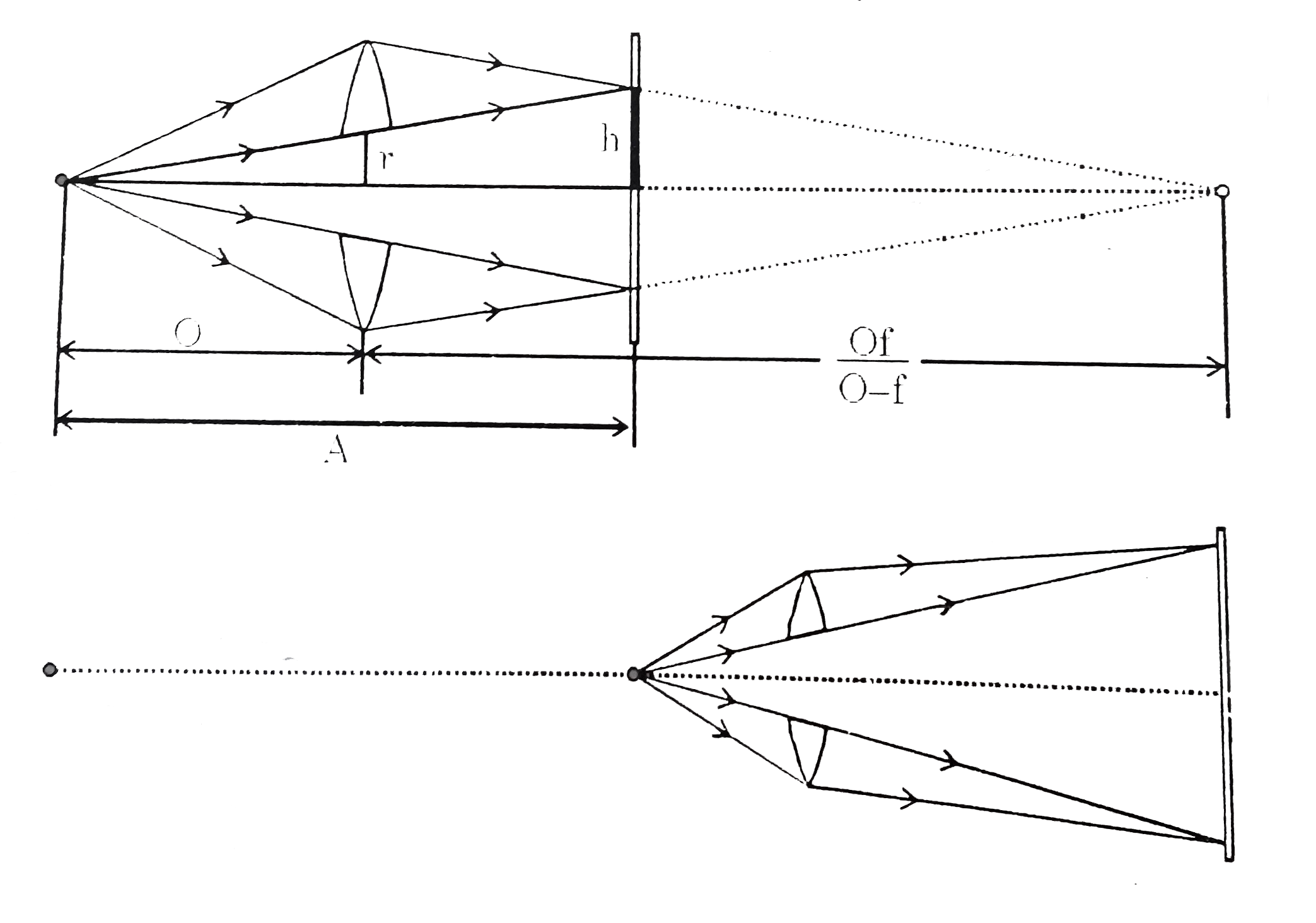 The distance between the lens and the image of the light-source is `i=(Of)/(O-f)` From the dimilar traingles : `(h)/(r)=(A)/(O)` and `(h)/(R)=(h)/(2r)=(O+i-A)/(i)=(O+(Of)/(O-f)-A)/((Of)/(O-f))` from the first equation `(h)/(r)` can be substituted and the followingquadratic equation can be gained for O: `2O^(2)-2AO+af=0` Its solution are: `O =(A)/(2)pm (1)/(2) sqrt(A(A-2f))` ltb rgt In our case the following two solution are gained for the possible of the light-gained: `O_(1)=6cm` and `O_(2)=3cm`. In the first case, the lens must be PLACED `6cm` from the light source. The second solution is also a CORRECT solution, though in this case the image is virtual `("A trivial solution is the" O=0)` The problem can only be solved if A gt 2f. |
|
| 11. |
Masses m, 2m, 3m, 4m,………,12m are kept on the peripheri of a clock having a circular dial. The masses are kept such that m is kept at 1, 2miskeptat2, 3mat3………12mat 12. vec g is the gravitational field intensity at the centre of dial. |
|
Answer» At `9 : 30` the hour hand is in the direction of `vecg` `rArr A`, `C`, `D` are correct. |
|
| 12. |
Solve Problem 35.4 assuming that the process is adiabatic. |
|
Answer» `(dgamma)/((d//x)^(gamma))=(1+(x)/(d))^(gamma)~~1-(gammax)/(d),(d^(gamma))/((d-x)^(gamma))=(1-(x)/(d))^(gamma)~~1+(gammax)/(d)` For the force we obtain `F=(p_(1)-p_(2))S=[(PD^(gamma))/((d-x)^(gamma))-(pd^(gamma))/((d+x)^(gamma))]S~~(2gammapSx)/(d)=(2gammapVx)/(d^(2))` i.e. `F_(ad)=gammaF_("isot")`. |
|
| 13. |
A pair of adjacent coils has a mutual inductance of 1.5 H. If the current in one coil changes from 0 to 20 A in 0.5 s, what is the change of flux linkage with the other coil ? |
|
Answer» Solution :EMF induced in SECOND COIL is, `epsilon_2=-(dphi_2)/(DT)=-M(dI_1)/(dt) "" (because Phi_2=MI_1)` `therefore dphi_2=M(dI_1)` `therefore Deltaphi_2=M(DeltaI_1)` `therefore Deltaphi_2=(1.5)(20)=30` Wb |
|
| 14. |
When standing waves are produced- |
|
Answer» ENERGY is TRANSPORTED from ONE PART to another |
|
| 15. |
Half-life period (T_(1/2)) and mean life period (tau) of a radioactive sample are corelated as ............. . |
| Answer» SOLUTION :`T_(1/2)=0.693 TAU` | |
| 16. |
Column I shows the optical devices on which parallel rays fall. Column II shows the shape of emergent wavefront match them. |
|
Answer» |
|
| 17. |
For two vectors A and B, |vecA+ vecB| = | vecA-vecB| is always true when (a) |vecA| =|vecB| ne 0 (b) A bot B ( c) |vecA|=|vecB| ne 0 and A and B are parallel or anti parallel (d)When either A or B is zero. |
|
Answer» i and ii are true |
|
| 18. |
A particle is acted upon by a force of constant magnitude which is always perpendicular to the velocity of the particle. The motion of the particle takes place in a plae. It follows that |
|
Answer» the kinetic ENERGY of the particle CHANGES with time |
|
| 19. |
A particle is acted upon by a force of constant magnitude which is always perpendicular to the velocity of the particle. The motion of the particle takes place in a plae. It follows |
|
Answer» its velocity is constant |
|
| 20. |
(A):lift ascending with decreasing speed means acceleration of lift is down wards. (R ):A body always moves in the direction of its acceleration . |
|
Answer» |
|
| 21. |
If oil of density higher than of water is used in place of water in a reasonable tube, how does the frequency change? |
| Answer» Solution :The FREQUENCY is independent of liquid USED and DEPENDS on the AIR column. HENCE, frequency does not change. | |
| 22. |
Which of the following produces more sever burns |
| Answer» Answer :A | |
| 23. |
Derive an expression Jor the time period (T) of a simple pendulum which may depend upon the mass (m) ofthe bob, length (l) of the pendulumand acceleration due to gravity (g) . |
|
Answer» Solution :Let T = `km^(3) l^(@) G^(c )` where k is a DIMENSIONLESS constant. Writing the equation in dimensional form, we have `[M^(@)L^(@)T^(1)]= [M]^(a)[L]^(b)[LT^(-2)]^(c )=[M^(a)L^(b+c)T^(-2c)]` Equating exponents of M, L and T on both SIDES, we GET a=0 , b+c=0 , -2c =1. Solving the eq., we get a = 0 , b=1/2 c= -1/2 Hence , T=k`SQRT((l)/(g))`, where k is constant. |
|
| 24. |
An air-cored solenoid with length 30 cm, area of cross-section 25cm^(2) and number of turns 500, carries a current of 2.5 A. The current is suddenly switched off in a brief time of 10^(-3)s. How much is the average back emf induced across the ends of the open switch in the circuit? Ignore the variation in magnetic field near the ends of the solenoid. |
|
Answer» SOLUTION :`varepsilon=|(dphi_B)/(dt)|` `B=(mu_(0)NI)/(l)=4PIXX10^(-7)xx(500)/(30xx10^(-2))xx2.5` `phi_(B)=BAN=(4pixx10^(-7)xx500xx2.5)/(30xx10^(-2))xx25xx10^(-4)xx500=65.45xx10^(-4)Wb` i.e., Initial flux linkage, `phi_(1)=65.45xx10^(-4)Wb`, Final flux linkage, `phi_(2)=0` `THEREFORE dphi_(B)=-65.45xx10^(-4)Wb` `therefore varepsilon=|(dphi_(B))/(dt)|=(65.45xx10^(-4))/(10^(-3))=6.545V` |
|
| 25. |
In an experiment for finding the focal length of a thin convex lens using two - pin method the position of the image .upsilon. is recorded for various positrons .u. of the object. Which of the following best represents object distance u versus image distance upsilon- graph. |
|
Answer»
|
|
| 26. |
A negative pion with negative energy T= 50MeV disintergrated during its flight into a moun and a neutrino. Find the energy of the neutrino outgoing at right angles to the pion's motion derection. |
Answer» Solution : See the DIAGRAM. By CONSERVATION of ENERGY `sqrt(m_(pi)^(2)c^(4)+c^(2)p_(pi)^(2))=cp_(V)+sqrt(m_(mu)^(2)+p_(pi)^(2)c^(2)+c^(2)P_(v)^(2))` or `(sqrt(m_(pi)^(2)c^(4)+c^(2)p_(pi)^(2))-cp_(v))^(2)=m mu^(2)c^(4)+c^(2)p_(pi)^(2)+c^(2)P_(v)^(2)` or `m_(pi)^(2)c^(4)-2cp_(v)sqrt(m_(pi)^(2)c^(4)+c^(2)p_(pi)^(2))=m_(mu)^(2)c^(4)` Hence the energy of the neutrino is `E_(v)=cPv=(m_(pi)^(2)c^(4)-m_(mu)^(2)c^(4))/(2(m_(pi)c^(2)+T))` on writing `sqrt(m_(pi)^(2)c^(4)+c^(2)p_(pi)^(2))=m_(pi)c^(2)T` Substitution gives `E_(v)= 21.93MeV` |
|
| 27. |
Consider a ray of light incident from air onto a slab of glass (refractive index n) of width d, at an angle theta. The phase difference between the ray reflected by the top surface of the glass and the bottom surface is |
|
Answer» `(2pind)/(lamda)(1-(sin^(2)theta)/(n^(2)))^(-1//2)+pi`  Situation given in the statement is depicted in above figure. Suppose light ray `vecPQ` is made incident at point Q on surface t=0. Here refracted ray `vecQS` gets reflected from point S after sometime, say after time t. Now, if SPEED of light in glass is v then, `v=(QS)/(t)` `:.t=(QS)/(v)` `:.t=(((d)/(cosr)))/((c)/(n))""(":.cosr=(d)/(QS)andn=(c)/(v))` `:.t=(nd)/(cxxcosr)""....(1)` Now, APPLYING Snell.s law at point Q, `sintheta=(n)sinr` `:.n=(sintheta)/(sinr)` `:.sinr=(sintheta)/(n)` `:.sin^(2)r=(sin^(2)theta)/(n^(2))` `:.1-cos^(2)r=(sin^(2)theta)/(n^(2))` `:.cosr=(1-(sin^(2)theta)/(n^(2)))^(1/2)""....(2)` From equation (1) and (2), `t=(nd)/(cxx(1-(sin^(2)theta)/(n^(2)))^(1/2))` `:.t=(nd)/(c)xx(1-(sin^(2)theta)/(n^(2)))^(-1/(2))""......(3)` Now, at the end of time t, if phase of ray `vecST` is `phi_(1)` and phase of ray `vecQR` is `phi_(2)` then phase difference between them is `Deltaphi=phi_(2)-phi_(1)=omegat` `:.Deltaphi=(kc)t""("":.c=(omega)/(k)=("angular frequency")/("wave vector"))` But since ray `vecQR` gets reflected from the surface of denser MEDIUM, net path difference would be `Deltaphi.=Deltaphi+pi` `:.Deltaphi.=(kc)t+pi` `:.Deltaphi.=((2pi)/(lamda)c)((nd)/(c))(1-(sin^(2)theta)/(n^(2)))^(-1/2)+pi` ( `:.k=(2pi)/(lamda)` and from equation (3)) `:.Deltaphi.=(2pind)/(lamda)(1-(sin^(2)theta)/(n^(2)))^(-1/2)+pi` |
|
| 28. |
The current I drawn from the 5 volt source will be |
|
Answer» 0.5A |
|
| 29. |
The dimensional formula for velocity gradient is identical to that of |
|
Answer» TIME PERIOD |
|
| 30. |
Each of the two long parallel threads carries a uniform lambda per unit length. The threads are separated by a distance l. Find the maximum magnitude of the electric field strenght in the symmetry plane of this system located between the threads. |
|
Answer» `E_(MAX)=lambda//2piepsilon_(0)L` |
|
| 31. |
firstlawof thermodynamics (##MST_AG_JEE_MA_PHY_V01_C21_E03_075_Q01.png" width="80%"> whichcombinationhas -93.15 Kas the changein temperature? |
| Answer» Answer :A | |
| 32. |
100 छात्रों की संख्या में ,गणित में उत्तीर्ण छात्रों की संख्या है 55 तथा भौतिक विज्ञान में उत्तीर्ण छात्रों की संख्या 67 है, तो केवल भौतिक विज्ञान में उत्तीर्ण होने वाले छात्रों की संख्याहै- |
|
Answer» 33 |
|
| 33. |
Heat radiation have wavelengths in the region of |
|
Answer» VISIBLE light |
|
| 34. |
A series LCR circuit with R=20Omega, L = 1.5 H and C = 35 muFis connected to a variable frequency 200 V ac supply. When the frequency of the supply equals the natural frequency of the circuit, what is the average power transferred to the circuit in one completecycle? |
|
Answer» <P> SOLUTION :When `X_L = X_C , Z = R``P = (V^2)/( R) = (200 XX 200)/(20) = 2KW` |
|
| 35. |
A leftis ascending with an acceleration equal to g/3. What will be the time period of the simple pendulum suspended from its ceiling if its time period in stationary lift is T ? |
|
Answer» `T//2` `implies""T.=2pi sqrt((l)/(g+(g)/(3)))` `:.""T.=2pi sqrt((3L)/(4g))` `implies""T.=sqrt((3)/(4)).T.` Correct CHOICE is (B)`. |
|
| 36. |
Two rods of the same length L but cross-section in the ratio S_B//S_A=4 are joined at a heater H and a heat sink S as shown. The rate of heat flow to s is found to be R_o If points of A and B at distance L/3 each from H are now joined by a conductor C of length L and the cross-section of C is such that 3c=2S/A, the new rate of heat flow to S will be (See figure) |
|
Answer» `6/5R_o` |
|
| 37. |
An electromagnetic wave is travelling in x-direction with electric field vector given by, vecE_(y) = E_(0) sin (kx – omegat) hatj. The correct expression for magnetic field vector is |
|
Answer» `vecB_(y) = (E_(0))/(C) sin(kx - omegat)hatj` 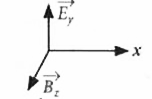 The DIRECTION of magnetic FIELD must be TOWARDS z-axis. |
|
| 38. |
A voltage V= V_(m) sin omegatis applied to a series L-C-R circuit. Derive the expression for the average power dissipated over a cycle. Under what condition (i) no power is dissipated even though the current flows through the circuit, (ii) maximum power is dissipated in the circuit ? |
|
Answer» SOLUTION :Let, in general APPLIED voltage and current flowing in a LCR series a.c. circuit be given by `V = V_(m) sin omega t` and `I = I_(m) sin (omega t-phi)` `therefore` INSTANTANEOUS power `P = VI = V_(m) sin omegat. I_(m) sin (omega t-phi)` `=V_(m)I_(m)[sin^(2)omegat cos phi - 1/2 sin 2 omegat sin phi]` `therefore` Average power for one complete cycle of a.c. `VECP = V_(m)I_(m) [vec(sin^(2)omega) cos phi -1/2 vec(sin2 omegat) sin phi]` But we know that average VALUE of `sin^(2)omegat`for a complete cycle is `1/2`, whereas average value of `sin 2omega t` for one complete cycle is zero. Hence, `vecP` or `P_(av) = V_(m)I_(m) [1/2 cos phi] = 1/2 V_(m) I_(m) cos phi = V_(rms) I_(rms) cos phi` (i) If phase difference `phi` between V and I be `pi/2`or a pure inductor or a pure capacitor or a series LC circuit) then `cos phi = cos pi/2 =0`and hence average power dissipated is zero even though the current flows through the circuit. (ii) If phase difference `phi = 0^(@)`(as for a pure resistor or for a resonant circuit) then `cos phi = cos 0^(@)=1`and hence average power `P_(av) = V_(rms) I_(rms)`which is maximum power dissipated in the circuit. |
|
| 40. |
Figure shows a semicircular ring of radius R with linear charge distribution lambda given by lambda=lambda_(0)sin theta. Find the electric field intensity at the centre of the ring. |
|
Answer» |
|
| 41. |
If lambda is decay constant of a nucleus, find the probability that a nucleus will decay in time t and further will not decay in time t: |
|
Answer» `(1-e^(lambdat))^(-1), e^(-lambdat)` `=N_(0) (1-e^(-lambda t)` Probability that ATOM decays in time `t=("Number of atoms decayed")/("Total number of the atoms")` `=(N_(0) (1-e^(-lambda t)))/(N_(0))` `=1-e^(-lambda t) ..........(1)` Probability that an atom will not decay in time `t=1-(1-e^(-lambdat))` `=e^(-lambda t) ..........(2)` |
|
| 42. |
A car leaves station A for station B every 10 minutes. Simultaneously a car leaves station B for station A every 10 minutes. The cars move at constant speed and go from A to B or vice versa in 1 hour. How many cars coming from other side will meet each car on rate from A to B : |
|
Answer» 12 |
|
| 43. |
What is the phase relationship between current & voltage in an inductive? Draw (i) phasor diagram and (ii) wave diagram. |
Answer» Solution :Current lags behind the applied voltage by `(pi)/(2)` in an inductive circuit. This FACT is DEPICTED in the phasor DIAGRAM. In the wave diagram also, it is seen that current lags the voltage by `90^(@).` 
|
|
| 44. |
Can a body have a charge 0.8 xx 10^(-19)C ? |
| Answer» Solution :No, The SMALLEST possible charge is = 1.6 xx `10^(-19)C. | |
| 45. |
An object is placed 30.0 cm from a convex spherical mirror with radius of curvature 40.0 cm.Which one of the following phrases best describes the image? |
|
Answer» VIRTUAL and LOCATED at infinity |
|
| 46. |
If the vectors vec(P)=ahat(i) + ahat(j) + 3hat(k) and vec(Q)=ahat(i) -2hat(j) - hat(k) are perpendicular to each other, then positive value of a is : |
|
Answer» 3 Dot PRODUCT of `bot` rvector is zero i.e., `vec(P).vec(Q)=0` `(ahati + ahatj +3hatk)-(ahati-2hatj-hatk)=0` `a^(2)-2a-3=0` a(a-2)=3 when a = 3 only then a - 2 is positive. |
|
| 47. |
The heat of fusion for water is 334 kJ/kg. how much thermal energy is required to completely melt a 100-gram ice cube? |
| Answer» SOLUTION :The CHANGE in PHASE from solid to liquid REQUIRES the input of heat, in this case, `Q=mL=(0.1kg)(334kg//kg)=33.4kJ`. | |
| 48. |
Predict the polarity of the capacitor in the situation described by adjoining Fig. 6.27. Explain the reason too. |
Answer» Solution :In the situation shown in Fig. 6.27, in accordance with Lenz.s LAW, when seen from left hand side the induced current appears to be FLOWING anticlockwise in the CIRCULAR LOOP and when seen from right hand side, the induced current appears to be flowing clockwise. Thus, it is clear that plate A of capacitor will be at a higher potential than the plate B. In other words, the polarity of plate A will be positive with RESPECT to plate B in the capacitor. 
|
|
| 49. |
Which one will be diffracted maximum ? |
|
Answer» `lambda` rays |
|
| 50. |
संख्या 5.232323....एक - |
|
Answer» परिमेय संख्या है |
|


