Saved Bookmarks
This section includes 7 InterviewSolutions, each offering curated multiple-choice questions to sharpen your Current Affairs knowledge and support exam preparation. Choose a topic below to get started.
| 1. |
A souree contains two phosphorus radio nuclides ._(15)^(33)P (T_(1//2)=14.3d) and ._(15)^(32)P (T_(1//2)=25.3d). Initially, 10% of the decays come from ._(15)^(33)P. How long must one wait unit 90% do so ? |
|
Answer» Solution :Initially the source has `90%` of `._(15)^(33)P` nuclides. After (say) t days, the source has `10%` of `.(15)^(33)P` nuclides and `90% ._(15)^(32)P` nuclides. `therefore` Initial NUMBER of `._(15)^(32)P` nuclides `=9X and ^(33)P=x` Final number of `.^(32)P` nuclides `=y and of ^(33)P=9y` Now,`(N)/(N_(0))=((1)/(2))^(n)=((1)/(2))^(1//T)=2^(-1//T)` For the `.^(32)P` isotope,`N_(0)=9x, N=y, T=14.3` days `y=9x(2)^(-1//14.3)`..........(1) For the `.^(33)P` isotope, `N_(0)=x,N=9y,T=25.3` days `9y=x(2)^(-1//25.3)`..........(2) `{:((1)+(2)"",(1)/(9)=(2^(-t//14.3))/(2^(-t//25.3))):}` `2^(-t//25.3)=81xx2^(-t//14.3` taking log on both sides, `(-t)/(25.3)log2=log81-(t)/(14.3) log 2` `-t((0.3010)/(25.3))=1.9085-t((0.3010)/(14.3))` `-0.01190t=1.9085-0.02105t` `0.00915t=1.9085` `t=(1.9085)/(0.00915)=208.5d` |
|
| 2. |
Which gate will be obtained by joining the two inputs of the NAND gate? |
|
Answer» Solution :When othe TWO inputs are JOINED both the inputs will ber identical. i.e. A = B. As per the characteristics of the NAND gate. Y = 1 when A = 0 and B = 0 and Y = 0 when A = 1 and B = 1 Herem the output Y will be opposite to that of the inputs A or B. Hence, we have a relation `Y=barA`. Hence the above logic CIRCUIT will behave asa NOT gate. 
|
|
| 3. |
When red glass is heated in a dark room it seems |
|
Answer» green |
|
| 4. |
Draw a neat labelled diagram of a transistor amplifier in a CE mode. |
Answer» SOLUTION :
|
|
| 5. |
In a metre bridge , the gaps are enclosed by resistances of 2omega and 3Omega . The value of shunt to be added to 3Omega resister to shift the balancing point by 22.5cm is |
| Answer» Answer :D | |
| 6. |
Radio frequency is generated with: |
|
Answer» Filter |
|
| 7. |
A voltage of 30 V is applied across a carbon resistor with first, second and third rings of blue, black and yellow colours respectively. Calculate the value of current in milliampere through the resistor. |
|
Answer» Solution : As the coloured rings are of BLUE, black and YELLOW colours respectively, hence resistance of given carbon resistor will be `R = 60 XX 10^4 Omega` ` THEREFORE ` Current flowing through the resistor`I = V/R = (30V)/(60 xx 10^4 Omega)= 5 xx 10^(-5) A = 0.05 mA` |
|
| 8. |
The transverse nature of light is shown by : |
|
Answer» REFLECTION of light |
|
| 9. |
A glass lens of refractive index 1.45 disappears when immersed in a liquid. What is the value of refractive index of the liquid ? |
| Answer» Solution :As the glass LENS of REFRACTIVE index n = 1.45 disappears when IMMERSED in a LIQUID, hence refractive index of liquid MUST be same as that of lens.Refractive index of liquid = 1.45. | |
| 10. |
The frequency condition in Bohr model of atom is given by v = ? |
| Answer» SOLUTION :`(E_2 - E_1)/H` | |
| 11. |
Ozone layer absorbs all such radiation whose wavelengths are |
|
Answer» `LT 3000 A^(@)` |
|
| 12. |
Which of the following statements is not correct according to Rutherford model ? |
|
Answer» Most of the space inside an atom is empty. |
|
| 13. |
A convex lens is held in water. What change, if any, do you expect in its focal length ? |
|
Answer» Solution : Focal length of the GIVEN lens INCREASES in ACCORDANCE with lens maker.s formula: `1/f = (n-1) (1/R_(1) - 1/R_(2))` because `n_(gw) lt n_(ga)` |
|
| 14. |
Calculate the first Bohr radius of a singly ionized helium atom. Compare with the first Bohr radius ao of the hydrogen atom. Write down the generalized Balmer formula for this ion. Find the first lines of the series corresponding to the Lyman and the Balmer series. |
|
Answer» `1/lamda=Z^(2)R(1/m^(2)-1/n^(2))` For helium (Z = 2) we obtain `1/lamda=4R(1/m^(2)-1/n^(2))` The principal line of the Lyman series is the RESULT of the transition from the second to the first level (m = 1, n = 2) and of the Balmer series `(H_(alpha))` the result of the transition from the third to the second level (m = 2, n = 3). |
|
| 15. |
साम्यावस्था में द्रव के वाष्पन की दर संघनन की दर के .........होती है- |
|
Answer» समान |
|
| 16. |
The colour coded resistance of corbon resistance is (Initial three bands are red and fourth band is silcer) |
|
Answer» `222 . OMEGA+-10 % ` |
|
| 17. |
A doubly ionised lithium atom is H_2 -like with atomic no. 3. It is excited to produce radiations, Wavelength of radiations required to excite the electron in Li^(++) from the Ist to Illrd Bohr orbit is |
|
Answer» 101.21Å `W_(1)=(-13.6)/(12) xx 9=-122.4eV` `=-195.84 xx 10^(-10)J` Energy NEEDED for exciting an electron from Ist to IIIrd orbit is `W_(3)-W_(1)=HV` then `hv=174.08 xx 10^(-19)J=(hc)/(lambda)` `lambda=(hc)/(174.08 xx 10^(-19) )m=113.74Å` |
|
| 18. |
A convec lens of focal length 0.24 m and of refractive index 1.5 is completelyimmeresed in water of refractive index 1.33, Find the change in the focal length of the lens. |
|
Answer» SOLUTION :Given : - `n_g=1.5 , n_w =1.33` f=0.24 m When the lens is in air , `1/(f_g)=(n_g-1)[1/R_1-1/R_2]` `1/0.24=[1.5-1][1/R_1-1/R_2]` ….(1) When the lens is in water , `1/(f_(gw))=[n_g/n_w-1][1/R_1- 1/R_2] =[1.5/1.33-1] [1/R_1-1/R_2]` `1/(f_(gw))=[1.1278-1][1/R_1 - 1/R_2]` ...(2) DIVIDING eqn. (1) by eqn. (2) 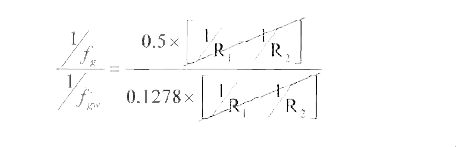 `(f_(gw))/f_g=0.5/0.1278` `(f_(gw))/0.24=0.5/0.1278` `f_(gw)` = 0.94 m CHANGE in focal length = 0.94-0.24=0.70 m |
|
| 19. |
What will be the path of a charged particle moving along the direction of a uniform magnetic field? |
| Answer» Solution :It will be moving along a STRAIGHT LINE path because the magnetic FORCE on the CHARGED PARTICLE is zero. | |
| 20. |
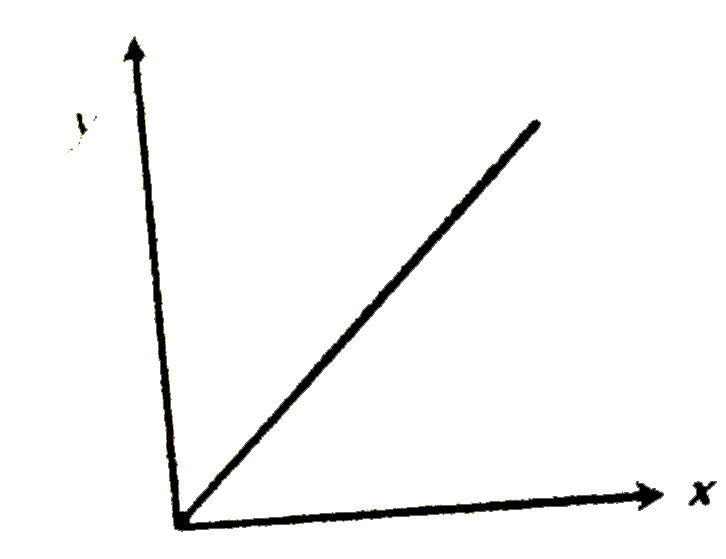
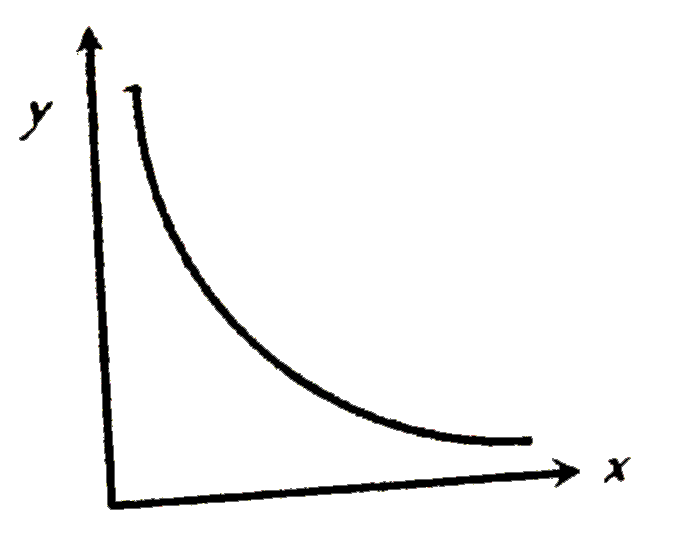
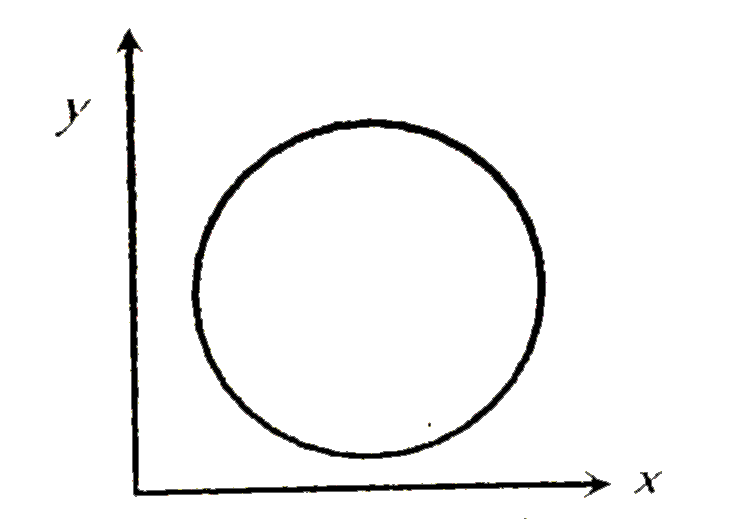
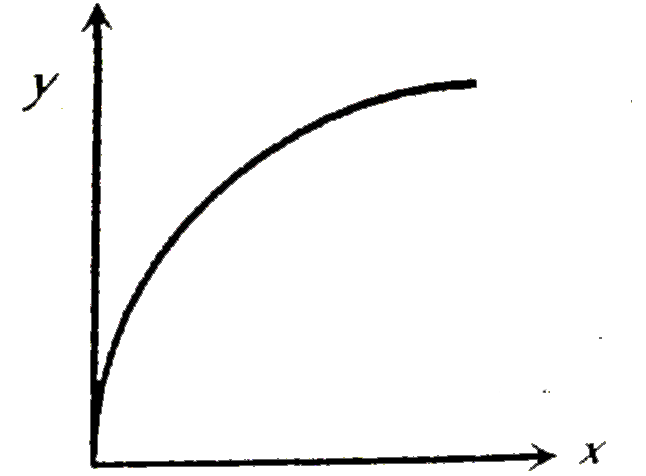
If x is the distance of an object from the focus of a concave mirror and y is the distance of image from the focus, then which of the following graphs is correct between x and y |
|
Answer»
|
|
| 21. |
The working of which of the following is similar to that of a slide projector ? |
|
Answer» electron microscope |
|
| 22. |
The answer to each of the following questions is a single-digit integer ranging from 0 to 9. Darken the correct digit. There is one charged metallic sphere of radius R. The charge is uniformly distributed over its surface. Let U_(1) be the energy stored in the region from radius R (surface) up to the radius 2R and U_(2) be the total energystored outside this sphere. Calculate U_(2)//U_(1). |
|
Answer» `U_(2)=(Q^(2))/(8pi epsilon_(0)R)"" …(i)` Using the same formula we can write energy stored outside the metallic sophere of radius 2R as follows: `U.=(Q^(2))/(8pi epsilon_(0)(2R))=(Q^(2))/(16pi epsilon_(0)R)"" ...(ii)` Hence energystored in between radius R and 2R can be written as follows: `U_(1)=U_(2)-U.=(Q^(2))/(8pi epsilon_(0)R)-(Q^(2))/(16pi epsilon_(0)R)=(Q^(2))/(16pi epsilon_(0)R)"" ...(iii)` Now dividing equation (iii) and (i) We get `U_(2)//U_(1)=2`. |
|
| 23. |
The answer to each of the following questions is a single-digit integer ranging from 0 to 9. Darken the correct digit. A uniform electric field exists in between the plates of a capacitor and potential difference between the plates is found to be V_(1). Now a dielectric slab of dielectric constant 2 is inserted in between the paltes. Thickness of the salb is half of the separationbetween the plates. The potential difference between the plates is V_(2) now. Calculate 3V_(1)//V_(2). |
|
Answer» `V_(1)=Ed` Now when dielectric slab is introduced in between the plates then potential difference can be written as follows: `V_(2)=E(d-t)+(E//K)(t)` Here t is `d//2` and K = 2. On substituting we GET the following: `V_(2)=3V_(1)//4` hence `3V_(1)//V_(2)=4`. |
|
| 24. |
Figure showna two slit arrangement with a source which emits unpolarised light. P is a polariser with axis whose directionis not given. If I_0 is the intensity of the principal maxima when no polariser is present, calculte in the present case, the intensity of the principal maxima as well as the first minima. |
|
Answer» <P>`(I_(0))/(8)` `A=A_(bot)+A_(||)` `A_(bot)=A_(bot)^(1)+A_(bot)^(2)=A_(bot)^(0)"sin"(kx-wt)+A_(bot)^(0)"sin"(kx-wt+phi)` `A_(||)=A_(||)^(1)+A_(||)^(2)=A_(||)^(0)["sin"(kx-wt)+"sin"(kx-wt+phi)]` where `A_(bot)^(0),A_(||)^(0)` are the amplitudes fo either of the beam in `bot` and `||` polarizations. ` :. ` intensity `={|A_(bot)^(0)|^(2)+|A_(||)^(0)|^(2)}[sin^(2)(kx-wt)` `(1+cos^(2)phi+2sin phi)+"sin"^(2)(kx-wt)"sin"^(2)phi]_("average")` `={|A_(bot)^(0)|^(2)+|A_(||)^(0)|^(2)}((1)/(2)).2(1+cosphi)` `= 2|A_(bot)^(0)|^(2)(1+cos phi),"since"|A_(bot)^(0)|_("average")=|A_(||)^(0)|_("average")` With P: Assume `A_(bot)^(2)` is blocked: Intensity`=(A_(||)^(1)+A_(||)^(2))^(2)+(A_(bot)^(1))^(2)` `=|A_(bot)^(0)|^(2)(1+cos phi)+|A_(bot)^(0)|^(2).(1)/(2)` `(I_(0)=4|A_(bot)^(0)|^(2)=` Intensity without polariser at principal maxima). Intensity at first maxima with polariser `=|A_(bot)^(0)|^(2)(2+(1)/(2))=(5)/(8)I_(0)` Intensity at first minima with polariser, `|A_(bot)^(0)|^(2)(1-1)+(|A_(bot)^(0)|^(2))/(2)=(I_(0))/(8).` |
|
| 25. |
The answer to each of the following questions is a single-digit integer ranging from 0 to 9. Darken the correct digit. A parallel plate capacitor is connected to a battery and when it is fully charged, the energy stored in the capacitor is U_(1). Now it is disconnected from the battery and then reconnected to the same battery but with the polarity reversed. During the time capacitor is again charged, heat H is found to get dissipated from the capacitor. Calculate H//U_(1). |
|
Answer» `U_(1)=(1)/(2)CV^(2)` When the capacitor is connected to the battery with reversed polarity then additional charge that the battery needs to supply to the capacitor is 2CV in order to REVERSE the polarity of the capacitor, as CV is the magnitude of the charge on each plate. But note that due to REVERSAL of only the polarity, energy stored in the capacitor is not going to change. Hence, whatever work is done by the battery gets dissipated in the form of heat. `H=W_(b)=QV=(2CV)V=2CV^(2)` Hence, we can get `H//U_(1)=4` |
|
| 26. |
The distance of a geo-stationary satellite from the centre of the earth is nearest to (where R=6400 km) |
|
Answer» 5R |
|
| 28. |
During each cycle, a heat engine with an efficiency of 25% takes in 800 J of energy. How much waste heat is expelled during each cycle? |
|
Answer» 100J |
|
| 29. |
What is magnetic dip ? |
| Answer» SOLUTION :It is defined as the ANGLE between total intensity of EARTH magnetic FIELD and the horizontal line in the magnetic MERIDIAN ar a place. | |
| 30. |
The focallengths of the objective and the eyepiece of a compound microscope are 2.0cm and 2.0cm, respectively. The distance between the objective and the eyepiece is 15.0cm. Th final image formed by the eyepiece is at infinity. The two lenses are thin. The distance, in cm, of the object and the image produced by the objective, mesured from the objective lens, are respectively. |
|
Answer» 2.4 and 12.0 Using lens FORMULS for eyepiece, `-(1)/(u)+(1)/(v_(1))=(1)/(f_(e))` `RARR (-1)/(u)+(1)/(prop)=(1)/(3)rArr u_(1)=-3cm[:'I=0]` But the distance between objective and eyepiece is 15cm (given). Therefore, distance of image formed by the objective, `v=15-3=12cm` . LET u be the object distance from the objective, then for objective lens `-(1)/(u)+(1)/(v)=(1)/(f_(0))or (-1)/(u)+(1)/(12)=(1)/(2)` `rArr (-1)/(u)=(1)/(2)-(1)/(12)=(5)/(12)u=-(12)/(4)=2.4cm` (a) is the CORRECT OPTION. |
|
| 31. |
Figures of merit of two galvanometers of resistance 100Omega and 50Omega, are 10^(-8)A//"div and "2xx10^(-5)A/div respectively. In which case the voltage sensitivity is more ? |
|
Answer» more in CASE I |
|
| 32. |
Three identical barmagnets each of magnetic moment M are placed in the form of an equilateral triangle with north lole of one touching the south poleof the other the net magnetic momentof the system is |
| Answer» ANSWER :A | |
| 33. |
Consider a spherical shell of radius R at temperature T. The black body radiation inside it can be considered as an ideal gas of photons with internal energy per unit colume u=(U)/(V)propT^(4) and pressure P=1/3((U)/(V)). If the shell now undergoes an adiabatic expansion the relation between T and R is : |
|
Answer» `Tprope^(-3R)` `PV=muRT`. . . (ii) `(muRT)/(V)=(1)/(3)kT^(4)` `rArrVpropT^(-3)` `RPROP(1)/(T)`. So correct is (b) |
|
| 34. |
The ratio of the number of free electrons to holes n_(e)//n_(h) for two different materials A and B are 1 and lt 1 respectively. Name the type of semiconductors to which A and B belong. |
|
Answer» SOLUTION :`n_(E)/n_(h) = 1 rArr n_(e) = n_(h) THEREFORE` Intrinsic SEMICONDUCTOR `n_(e)/n_(h) lt 1 rArr n_(e) lt n_(h) therefore` p type extrinsic semiconductor. |
|
| 35. |
A lamp is connected in series with a capacitor. Predict your observations for dc and ac connections. What happens in each case if the capacitance of the capacitor is reduced? |
| Answer» Solution :When a dc source is CONNECTED to a capacitor, the capacitor GETS charged and after charging no current flows in the circuit and the lamp will not glow. There will be no change EVEN if C is reduced. With ac source, the capacitor offers capacitative REACTANCE (`1//omegaC)` and the current flows in the circuit. Consequently, the lamp will SHINE. Reducing C will increase reactance and the lamp will shine less brightly than before. | |
| 36. |
At the same instant that a 0.50-kg ball is dropped from a high building, a second ball, with a mass of 0.25 kg, is thrown straight upward from Earth’s surface with an initial velocity of 19.6 m/s. They move along nearby lines and pass without colliding. When the second ball is at its highest point the velocity of the center of mass of the two-ball system is : |
|
Answer» 0 Acceleration of C.M.,`a_(cm) = (0.5 (-9.8) + 0.25(-9.8))/(0.5 + 0.25) = - 9.8 m//s^2` Time after which second BALL is at HIGHEST point`t = U/g= (19.6)/(9.8) = 2 "sec"` . After 2sec,`v_(cm) = u_(cm) + a_(cm) t = (19.6)/(3) + (-9.8) 2 = - 9.8 XX 4/3 = -13 m//s`. |
|
| 37. |
A truck is travelling in a straight line on level ground, and is accelerating uniformly with an acceleration of magnitude a. A rope (which of course is massless and inextensible) is tied to the back of the truck. The other end of the rope is tied to a bucket of mass M. The bucket tosses widly when the truck starts to accelerate, but due to friction it soon settles into a position at a fixed distance behind the truck, with the rope hanging straight at a fixed angle, as shown in the diagram. Although friction is needed to cause the rope to settle to an equillibrium position, we will assume that is can otherwise be neglected. Now suppose that the truck comes to a downhill section of road, at an angle alpha relative to the horizontal, as shown in the diagram. Suppose that the truck continues to accelerate with an acceleration of magnitude a. Once again the rope settles to a fixed angle theta relative to the truck and the new tension in the rope is T' |
|
Answer» The value of `theta` is `tan^(-1).(g)/(a)` 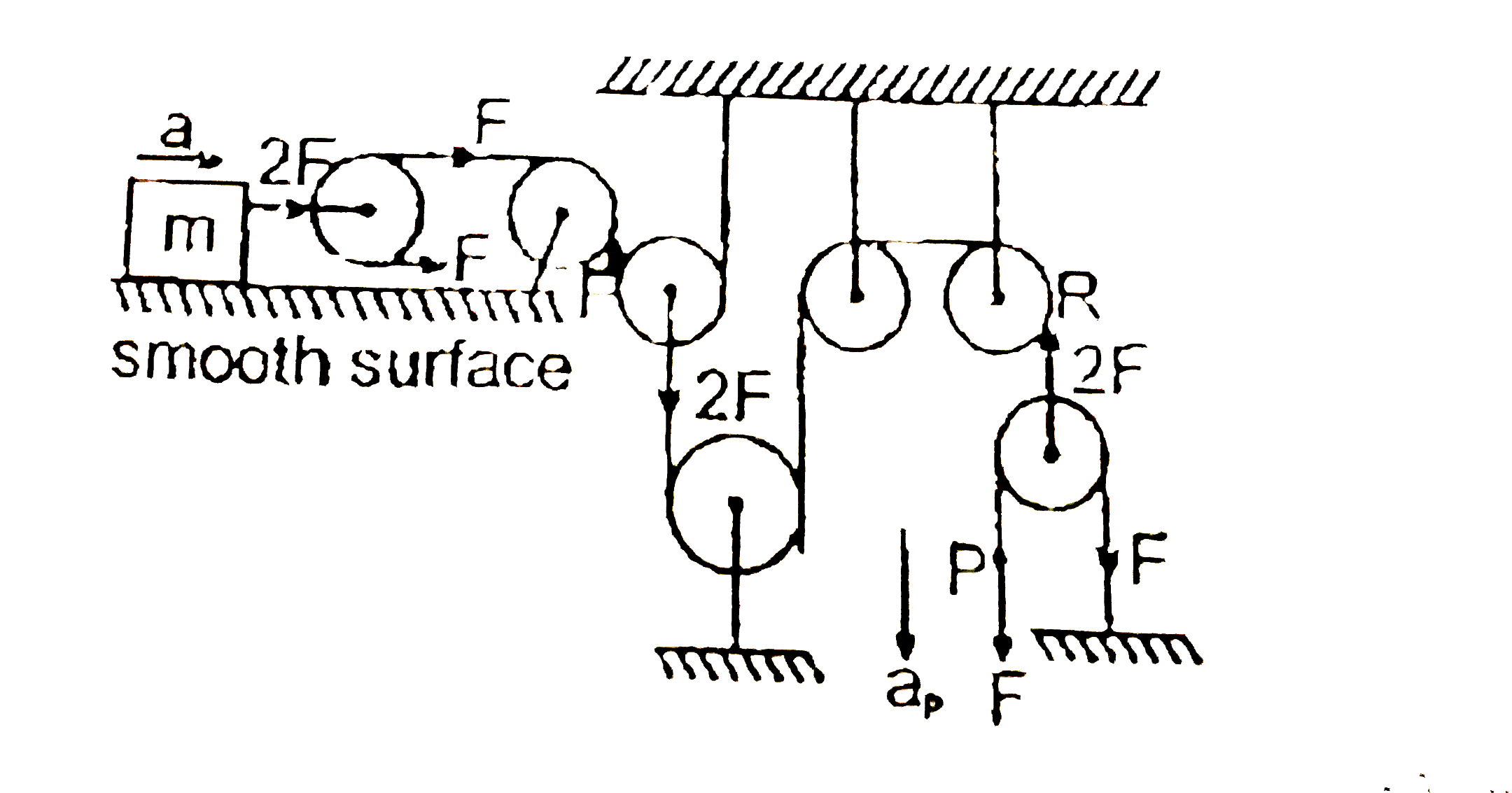 a of BLOCK = `(2F)/(m)`, acceleration of pulley at EXTREME right (pulley of point P) is = `(2F)/(m),a_(P)=2A=(4F)/(m)` |
|
| 38. |
What is the magnitude of magnetic force per unit length on a wire carrying a current of 8A and making an angle of 30^@ with the direction of a uniform magnetic field of 0.15 T ? |
|
Answer» Solution :Here `I = 8 A, theta = 30^@ and B = 0.15 T` `:.` Force per unit LENGTH of the wire `= F/l = B I SIN theta = 0.15 xx 8 xx sin 30^@ = 0.15 xx 8 xx 1/2 = 0.6 N m^(-1)`. |
|
| 39. |
The magnetic induction in betatron on an equlibrium orbit of radiusr variesduring the acceleration time at paractically constant rate fromzero to B. Assumingthe initial velocity of theelectron to be equalto zero, find: (a) the energyacquired by the electron during the acceleration time, (b) the correspondingdistance covered by theelectronif the accelearation time is equalto Delta t. |
|
Answer» Solution :(a) Even in therelativistic CASE, we know that `: p = BER` Thus, `W = sqrt(c^(2) p^(2) + m_(0)^(2) c^(4)) - m_(0) c^(2) (sqrt(1 + (B er//m_(0)c)^(2)) - 1)` (b) The DISTANCE traversed is, `2pi r = (W)/(e Phi) = 2pi r = (W)/(2pi r^(2) eB//Delta t) = (W Delta t)/(Ber)`, on using the result of the previous PROBLEM. |
|
| 40. |
The isothermal bulk modulus of an ideal gas at a pressure P is : |
|
Answer» P `PdV+VdP=0` PdV=-VdP. `RARRP=-(VdP)/(dV)` or `P=-(dP)/((dV//V)` `thereforeK=P` HENCE the CORRECT choice is (a). |
|
| 41. |
A copper coin has a mass of 63.0g. Calculate the nuclear energy that would be required to separate all the neutrons and protons form each other. The coin is entirely made of ""_(29)^(63)Cu atoms. Mass of ""_(29)^(63)Cu atom = 62.92960u mass of proton = 1.00727u Mass of neutron = 1.00866u Avogadro's number = 6.022 xx 10^(23) |
|
Answer» Solution :`N= (6.023 XX 10^(23))/(63) xx 63 = 6.023 xx 10^(23)` atoms Mass defect, `Delta m= Zm_(p) + (A-Z)m_(n)-M` `=29 xx 1.00727 + 34 xx 1.00866-62.92960` `Delta m= 0.5759` amu Binding energy `= Delta m xx 931 MeV` `=0.5759 xx 931= 536.1629 MeV` TOTAL energy REQUIRED to separate the NUCLEONS from each other `E xx N= 536.1629 xx 6.023 xx 10^(23)` `=3229.309 xx 10^(23)MeV` |
|
| 42. |
A ray of monochormatic light is incident on one refracting face of a prism of angle 75^(@). It passes through the prism an is incident on the other at the critical angle. If the refractive index of the material of the prism is sqrt(2), the angle of the first face of the prism is |
|
Answer» `30^(@)` |
|
| 43. |
Find heat loss in the above circuitDelta H = Energy [initially -finally ]on capacitor |
|
Answer» SOLUTION :` = [{(1)/(2) XX 5XX ( 20) ^(2) +(1)/(2) xx 2xx (5)^(2) }-` ` {(1)/(2) xx ( (525)/( 6))^(2) xx(1)/(5) +(1)/(2) ((75)/( 6))^(2) xx(1)/(2) +(1)/(2) ((135)/( 6))^(2) xx (1)/(2) }]xx10 ^(-6) J` |
|
| 44. |
There are two plane mirrors. They are mutually inclined as shown in figure. S is a source of monochromatic light of wavelength lamda. The reflected beam interfere and fringe pattern is obtained on the screen. If theta is small, the fringe width will be : |
|
Answer» `lamda//theta` |
|
| 45. |
Which one of the following can not emit radiation and why? Excited nucleus, excited electron. |
| Answer» Solution :EXCITED nucleus can emit radiation, but excited electron cannot. This is because energy of electronic energy levels is in the range of electron VOLT (eV) and not MeV (MILLION electronic volt). `GAMMA` -RADIATIONS have energy of the order of MeV. | |
| 46. |
A projectile of mass 100 g is fired with a velocity of 20 ms^(-1) making an angle of 30^(@) with the horizontal. As it rises to the highest point of its path, its momentum changes by: |
|
Answer» `1/2` KG m`s^(-1)` |
|
| 47. |
In the figure shown, a conducting wire PQ of length l=1m, is moved in auniform magnetic field B=4T with constant velocity v=2m/stowards right. Given R=2Omega, C=1F and L=4H. Currents through resistor, capacitor and inductor at any time t are l_(1) ,I_(2) and I_(3) respectively. Current through wire PQ is I. At l=2s, the value of I_(3) is |
| Answer» ANSWER :C | |
| 48. |
In the figure shown, a conducting wire PQ of length l=1m, is moved in auniform magnetic field B=4T with constant velocity v=2m/stowards right. Given R=2Omega, C=1F and L=4H. Currents through resistor, capacitor and inductor at any time t are l_(1) ,I_(2) and I_(3) respectively. Current through wire PQ is I. Find the force required to move the wire with the given constant velocity of 2m/s at t=2s |
| Answer» Answer :D | |
| 49. |
If two inputs of a NAND gate are shorted, then it is equivalent to |
|
Answer» an OR gate |
|
| 50. |
In the figure shown, a conducting wire PQ of length l=1m, is moved in auniform magnetic field B=4T with constant velocity v=2m/stowards right. Given R=2Omega, C=1F and L=4H. Currents through resistor, capacitor and inductor at any time t are l_(1) ,I_(2) and I_(3) respectively. Current through wire PQ is I. At t=2s, suppose P is the initial power generated by the applied force. P_(1) the power generated by the applied for, P_(1) the power stored in magnetic field of inductor and P_(2) the power dissipated in resistance. The |
|
Answer» <P>`P = 72 J//s` |
|