

Saved Bookmarks
This section includes 7 InterviewSolutions, each offering curated multiple-choice questions to sharpen your Current Affairs knowledge and support exam preparation. Choose a topic below to get started.
| 1. |
A uniform magnetic field exists in vertical direction in a region of space. A long current carrying wire (having current I) is placed horizontally in the region perpendicular to the figure. The resultant field due to superposition of the uniform field and that due to the current is represented by the field lines shown in the figure. In which direction does the current carrying wire experience the magnetic force? |
|
Answer» |
|
| 2. |
In Figure ., L is a converging lens of focal length 10cm and M Iis a concave mirror of radius of curvature 20cm. A point object O is placed in frontof the lens at a distance of 15cm. Ab and CD are optical axes of the lens andmirror, respectively. Find the distance of the final image formed by this system from the optical center of the lens. The distance between CD and AB is 1cm. |
|
Answer» `(1)/(v_(1))-(1)/(u_(1))=(1)/(f) ` `u_(1)=-15` and `f_(1)=10` Solving, we get `v_(1)=30cm` `I_(1)` acts as source for the mirror `:. u_(2)=-(45-v_(1))=-15cm` `I_(2)` is the image formed by the mirror `:.(1)/(v_(1))=(1)/(f_(m))-(1)/(u_(2))=-(1)/(10)-(1)/(15)` `:. v_(2)=-30cm` The height of `I_(2)` above principal axis fo lens ` =(v_(2))/(u_(2))xx1+1=3cm` `I_(2)` acts as a COURCE for the lens `:. u_(3)=-(45-v_(2))=-15cm` HENCE, the lens forms ANIMAGE `I_(3)` at a distance `v_(3)=30cm` to the left of the lens and at a distance The height of `I_(2)` above principal axis of lens `=(v_(2))/(u_(2))xx1+1=3cm` `:. ` Required distance `=sqrt(30^(2)+6^(2))=6sqrt(26)CM` 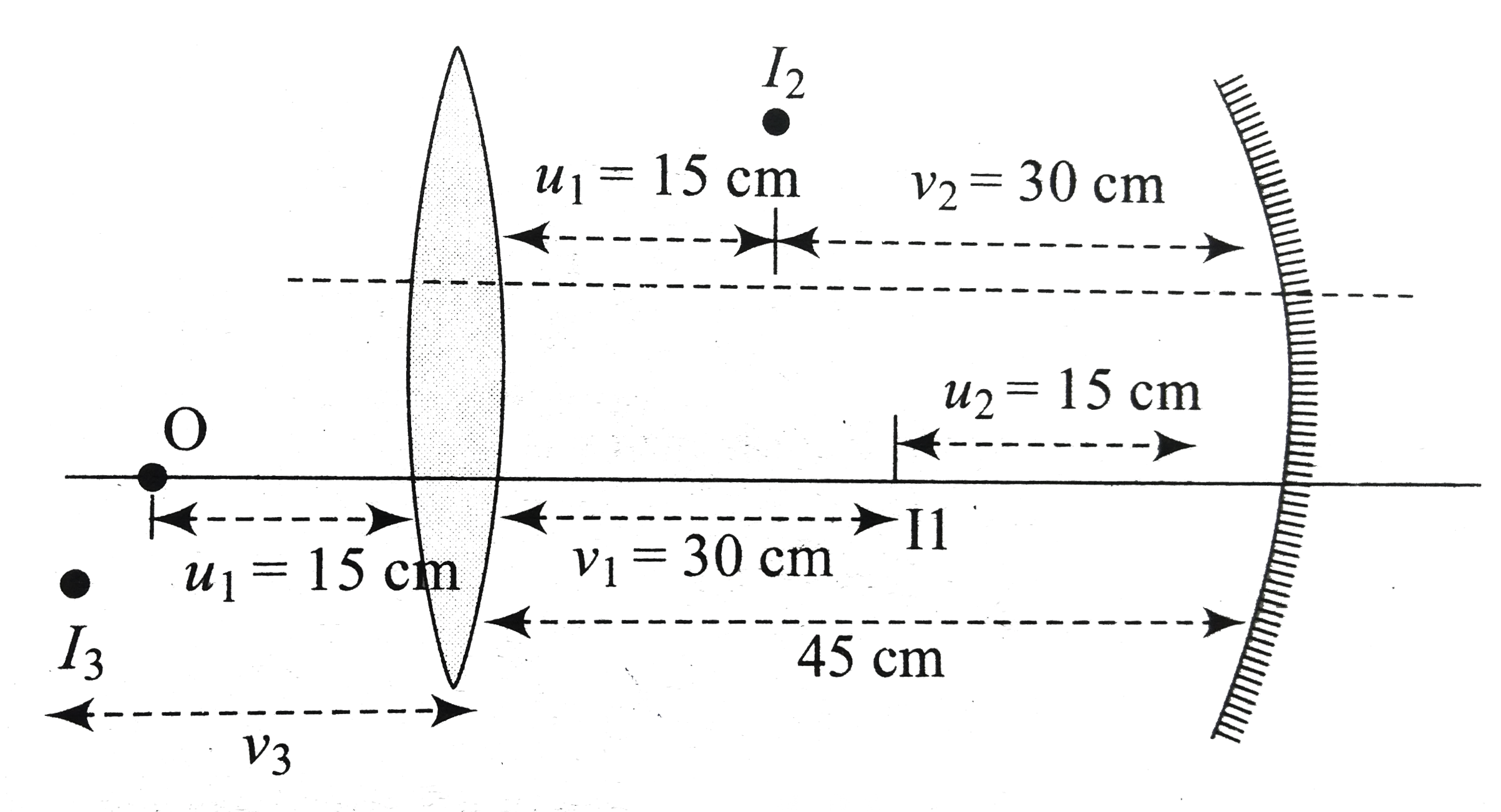
|
|
| 3. |
In an accelerator experiment on high-energy collisions of electrons with positrons, a certain event is interpreted as annihilation of an electron-positron pair of total energy 10.2 Bev into two gamma-rays of equal energy. What is the wavelength associated with each gamma-ray? ("1Bev = "10^(9) eV) |
| Answer» Solution :USE `LAMBDA=(hc//E)" with " E=5.1xx1.602xx10^(-10)J" to get "lambda=2.43xx10^(-16)m`. | |
| 4. |
In the chemical analysis of a rock, the mass ratio of two radioactive isotopes (A and B) is 100:1 and the ratio of their atomic weights is 1.02:1. If tau_(A)=4xx10^(9) year & tau_(B)=2xx10^(9) year and the two isotopes are in equal proportion at formation, the age of the rock is nearly nxx(10)^(10) year where n= _______ (take log_(10)((100)/(1.02))=1.9914 ) |
|
Answer» 2 |
|
| 5. |
Consider the D-T reaction (fusion of deuterium - tritium) ._(1)^(2)H+_(1)^(3)H rarr _(2)^(4)He+n (a) Calculate the energy released in MeV in this reaction from the data: m(._(1)^(2)H)=2.014102 u, m (._(2)^(4)He)=4.002604u m(._(1)^(3)H)=3.0016040u, m(n)=1.00867u (b) Consider the radius of both deuterium and tritiumto be approximately 2.0fm. What is the kinetic energy needed to overcome the coulomb repulsion between that twonuclie? To what temperature must the gas be heated to initate the reaction ? |
|
Answer» Solution :(b) Potential nenergy of `._(1)^(2)H and _(1)^(3)H` during head- on collision is `PE=((1)/(4 PI epsi_(0)))((e^(2))/(r))"where",r=2R=2xx2.0xx10^(-15)=4xx10^(15)` `=(9xx10^(9)xx(1.6xx10^(-9))^(2))/((4xx10^(-15)))` `PE=5.76xx10^(-14)J` `"But"_(1)""2((3k_(B)T)/(2))=3k_(B)T=5.76xx10^(-14)` Where, `K_(B)="Boltzmann constant"=1.38xx10^(-23)JK^(-)` `"i.e.,"T=(5.76xx10^(-14))/(3xx1.38xx10^(-23))=1.39xx10^(9)K` |
|
| 6. |
The effective resistance between A and B is the given circuit is |
|
Answer» `2 OMEGA ` |
|
| 7. |
The graph gives the magnitude B(t) ofa uniform magnetic field that exists throughout a conductig loop, perpendicular to the plane of the loop. Rank the five regions of the graph according to the magnitude fo the emf induced in the loop, greater first |
|
Answer» `BGT(d=e)LT(a=c)` |
|
| 8. |
The current gain fortransistor working as a commonbase amplifier is 0.96.If the emitter current is 7.2mA, then the base current is, In Question 26, for V_CE=0 the above graph lines will be |
|
Answer» Straight ALONG `I_(B)` |
|
| 9. |
A uniform horizontal disc fixed at its centre to an elastic vertical rod performs forced torsional oscillations dur to the moment of forces N_(z)=N_(m)cos omegat. The oscialltions obey the law varphi=varphi_(m) cos ( omega t- alpha). (a) the work performed by friction forces acting on the disc during one oscillation period ,(b) the quality factor of the given oscillator if th emoment of inertia of the disc relative to the axis is equal to I. |
|
Answer» Solution :The equation of the disc is `ddot(varphi)+ 2 beta dot (varphi)+ omega_(0)^(2) varphi=(N_(m) cos omegat)/( I)` Then as before `varphi=varphi_(m) cos ( omegat- ALPHA)` where `varphi(m)=(N_(m))/(I[( omega_(0)^(2)-OMEGA^(2))^(2)+ 4 beta^(2)omega^(2)] ^(1//2)), tan alpha=(2 beta omega)/( omega_(0)^(2)- omega^(2))` `(a)` Work performed by frictional forces `=-int N_(R) d varphi` where`N_(r)=-2 I beta dot(varphi)=- int_(0)^(T) 2 betaI dot(varphi^(2))dt=-2 pi beta omega I varphi_(m)^(2)` `=- pi I varphi_(m)^(2)[( omega_(0)^(2)- omega^(2))^(2)+4 beta^(2)omega^(2)]^(1//2)SIN alpha=- pi N_(m) varphi_(m) sin alpha` `(b)` The quality factor `Q=(pi)/(lambda)=(pi)/(betaT)=(sqrt(omega_(0)^(2)-beta^(2)))/( 2 beta)=( omegasqrt(omega_(0)^(2)-beta^(2)))/( ( omega_(0)^(2)- omega^(2) ) tan alpha) =(1)/(tan alpha){( 4 omega^(2) omega_(0)^(2))/((omega_(0)^(2)-omega^(2))^(2))-(4 beta^(2)omega^(2))/((omega_(0)^(2)-omega^(2))^(2))}` `=(1)/(2 tan alpha) { ( 4 omega^(2) omega_(0)^(2) I^(2) varphi_(m)^(2))/( N_(m)^(2)cos^(2) alpha)- tan ^(2) alpha}`since`omega_(0)^(2)= omega^(2)+(N)/( Ivarphi_(m))cos alpha` `=(1)/(2 sin alpha){(4 omega^(2) omega_(0)^(2) I^(2) varphi_(m)^(2))/( N_(m)^(2)) - sin ^(2) alpha}^(1//2)` `=(1)/(2 sin alpha){ ( 4 omega^(2) I^(2) varphi_(m)^(2))/( N_(m)^(2))(omega^(2)+(N_(m) cos alpha)/( I varphi_(m)))+ 1- cos^(2) alpha}^(1//2)` `=(1)/( 2sin alpha){( 4 I^(2) varphi_(m)^(2))/( N_(m)^(2))omega^(4)+ ( 4Ivarphi_(m))/( N_(m))omega ^(2) cos alpha+ cos ^(2) alpha-1}^(1//2)=(1)/( 2sin alpha ){((2Ivarphi_(m)omega^(2))/( N_(m))+ cos alpha)^(2)-1}^(1//2)` |
|
| 10. |
Two small spheres with mass m_(1) and m_(2) hang from massless insulating threads of length l_(1) and l_(2). The two spheres carry charges q_(1) and q_(2) respectively. The spheres are hung such that they are on the same horizontal level and the threads are inclined to the vertical at angles theta_(1) and theta_(1). Which of the condition is required if theta_(1)=theta_(2)? |
|
Answer» If `m_(1)=m_(2)` |
|
| 11. |
In an experiment on photo- electric effect, stopping potential is 1.0 V when light of wavelenght 6520 Å is incident on the emitting surface. The stopping potential is 2.9 V for light of wavelenght 3260 Å. The function of the metal is |
|
Answer» 0.9 eV |
|
| 12. |
What is the magnitude p of the electron's momentum, in the unit MeV/c? (Note that c is the symbol for the speed of light and not itself a unit.) |
|
Answer» <P> Solution :KEY IDEAWe can find p from the total energy E and the mass energy `mc^(2)` , `E^(2)=(pc)^(2)+(mc^(2))^(2)`. CALCULATIONS: Solving for pc gives US `pc=sqrt(E^(2)-(mc^(2))^(2))` `=sqrt((3.04MeV)^(2)-(0.511MeV)^(2))=3.00MeV`. Finally, dividing both sides by c we find `p=3.00MeV//c`. |
|
| 13. |
A disc 'A' of mass M is placed at rest on the smooth incline surface of inclination theta. A ball B of mass m is suspended vertically from the centre of the disc. A by a light inextersible string of length l as shown in the figure. If the acceleration of the disc B immediately after the system is released from rest is ((M+km)gsin^(2)theta)/(M+msin^(2)theta). Find k. |
|
Answer» SOLUTION :`Mgsintheta+Tsintheta=Ma` `mg-T=ma SINTHETA` solving, we GET `a=((M+m)G sin^(2)theta)/(M+msin^(2)theta)` 
|
|
| 14. |
According to Cartesian sign convention, in ray optics |
|
Answer» all distances are TAKEN POSITIVE |
|
| 15. |
Assertion: In Hertz experiment, the electric vector of radiation produced by the source gap is parallel to the gap. Reason: Production of sparks between the detector gap is maximum when it is placed perpendicular to the source gap. |
|
Answer» If both assertion and REASON are true and the reason is the correct explanation of the assertion. |
|
| 16. |
When a low flying aircraft passes over head, we sometimes notice a slight shaking of the picture on our TV screen. Identify the optical phenom enon behind it. |
| Answer» SOLUTION :INTERFERENCE or SUPERPOSITION of WAVES. | |
| 17. |
Which of the following is not the unit of energy? |
|
Answer» ELECTRON volt |
|
| 18. |
Boiling water is changing into steam, under this condition the specific heat of water in "cals/g/"^(@)C is: |
|
Answer» Solution :Since there is zero CHANGE in TEMPERATURE but HEAT is being absorbed `therefore (Q)/(0)=prop` `therefore` Correct choice is (c ). |
|
| 19. |
There are two types of spectra_____and_____ |
| Answer» SOLUTION :EMISSION, ABSORPTION | |
| 20. |
When radio waves pass through ionosphere phase difference between space current and capacitive displacement current is |
|
Answer» 0 rad |
|
| 21. |
Which of the following gates can be served as a building block for any digital circuit |
|
Answer» OR |
|
| 22. |
The space between the plates of a parallel plate air capacitor is filled with a material of dielectric constant k, keeping the plates connected to a certain external battery. The energy stored in this capacitor will change by a factor of |
| Answer» ANSWER :B | |
| 23. |
As a rejult of change in the magnetic flux linked to the closed loop shown in the figure, an emf V volt is induced in the loop. The work done (joules) in taking a charge Q coulomb once along the loop is |
|
Answer» `QV` `(Q "once along the LOOP")/("charge"Q)` i.e., is `V=(W)/(Q)` `impliesW=VQ` |
|
| 24. |
An unknown resistance r si determined in terms of a standared resistance R = 100 Omega by using potentiometer. The potential difference across r is balanced againt 45 cm length of the wire and that (r + R) is obtained at 70 cm of the wire. Find the value of the unknown resistance. |
|
Answer» `200 Omega` `R = 100 Omega` `r = R ((l_(1))/(l_(2) - l_(1))) = 100 ((45)/(75 - 45)) = 180 Omega` |
|
| 25. |
The ratio of intensity at maxima and minima is 25:16 . What will be the ratio of the width of the two slits in Young's double slit experiment ? |
|
Answer» |
|
| 26. |
What alpha-particle experiment of Rutherford established ? |
| Answer» SOLUTION :It SHOWED the +ve charge of an ATOM is CONCENTRATED at the centre. | |
| 27. |
The maximum kinetic energy of a photoelectron is 3eV . What is its stopping potential ? |
|
Answer» Solution :Free energy`U = 1/2 . (q^2)/(C ) "" q = 150 mu C , U = 6 mu J` ` therefore C = (q^2)/(2U) = ( (150 xx 10^(-6) )^2)/(2 xx 6 xx 10^(-6) ) = 1.875 xx 10^(-3) F` For a spring , energy ` = 1//2 kx^2` For a capacitor energy ` = 1//2 =(q^2)/( C)` Hence x corresponds to q and spring CONSTANT k corresponds to `1/C` `k = (1)/(1.875 xx 10^(-3) ) = 533 N//m` `K.E = 1//2 mv^2` and energy of inductor` = 1//2 LI^2` Hence m corresponds to L and v corresponds to L` therefore m= 1kg ` since L = 1 henry Maximum displacement corresponds tomaximum charge ` = 150 xx 10^(-6) m` Maximum VELOCITY corresponds to maximum current ` therefore v_m iff I` `I= Q OMEGA = (Q)/(sqrt(LC) ) = (150 xx 10^(-6) )/(sqrt(1 xx 1.875 xx 10^(-3) ) ) = 3.46 xx 10^(-5) A` ` therefore v_m = 3.46 xx 10^(-3) m//s ` |
|
| 28. |
A strip of wood of length l is placed on a smooth horizontal surface. An insect starts from one end of the strip, walks with constant velocity and reaches the other end in time t_(1). It then flies off vertically. The strip moves a further distance l in time t_(2). |
|
Answer» `t_(2) = t_(1)` |
|
| 29. |
A sphere of mass m moving with a velocity u hits another sphere of same mass at rest. If e is the coefficient of restitution then the ratio of velocities of two spheres after collision will be : |
|
Answer» `(1-e )/(1+e)` |
|
| 30. |
Aspringofforce constant k is cut into three equal parts, which are joined in parallel to each other. The force constant of the combination will be : |
|
Answer» <P>k `:.` Spring constant of each part becomes 3k. `:.` In PARALLEL `k_(p)=k_(1)+k_(2)+k_(3)=3k+3k+3k=9k`. Hence correct CHOICE is ( C ). |
|
| 31. |
A parallel plate capacitor has the space between the plates filled with a medium whose dielectric constant increases linearly with distance, If d is the distance between the plates and K_1 and K_2are the dielectric constant of the medium at the two plates (square each of area A) respectively, then the capacity of the capacitor. |
|
Answer» `(epsilon_0A(K_2-K_1))/(d " LN"(K_2//K_1))` |
|
| 32. |
(a) At what distance should the lens be held from the figure in Exercise 9.23 in order to view the squares distinctly with the maximum possible magnifying power ? (b) What is the magnification in this case ? (c) Is the magnification equal to the magnifying power in this case ? Explain |
|
Answer» Solution :(a) For maximum magnifying power `v=-D =-25 cm` and `F= + 9 cm` Hence, `1/u =1/v -1/f -1/(-25) -1/9 rArr MU = -6.6 cm` (b) Magnification `m =(-25)/(-6.6) = 3.8` (c) YES, in this CASE the magnification is equal to the magnifying power because now the image is being formed at NEAR point of eye. |
|
| 33. |
3 moles of a mono-atomic gas (gamma=5//3) is mixed with 1 mole of a diatomic gas (gamma=7//3). The value of gamma for the mixture will be |
|
Answer» `9//11` Here, `n_(1)=3,gamma_(1)=(5)/(3),n_(2)=1,gamma_(2)=(7)/(3)` `therefore gamma_("mixture")=(=(3xx5//3)/([5//3-1])+(1xx7//3)/([7//3-1]))/((3)/([5//3-1])+(1)/([7//3-1]))=((15)/(2)+(7)/(4))/((9)/(2)+(3)/(4))=(37)/(21)` Note : If we TAKE `gamma_(2)=7//5` `gamma_("mixture")=(=(3xx5//3)/([5//3-1])+(1xx7//5)/([7//5-1]))/((3)/([5//3-1])+(1)/([7//5-1]))=((15)/(2)+(7)/(2))/((9)/(2)+(5)/(2))=(22)/(14)=(11)/(7)` |
|
| 34. |
According to kinetic theory of gases, which one of the following statement (s) is/are not true? |
|
Answer» REAL gas BEHAVE as ideal gas at high temperature and low pressure |
|
| 35. |
Define 'quality factor of resonance in series LCR circuit. What is its SI unit? |
|
Answer» Solution :In SERIES LCR circuit the quality factor (Q) of resonance is defined as the ratio of resonant ANGULAR frequency (to the band width 21 `Omega`of the circuit from (60 - 10) to (m + Ao) at which power is half the maximum power. Mathematically, `Q = omega_(omega_(0))/(2Deltaomega) = (omega_(0)L)/R = 1/R sqrt(L/C)` Quality factor is a unit less quantity. |
|
| 36. |
A road runs midway between two parallel rows of buildings. A motorist moving with a speed of 36 Km/h sounds the horn. He hears the echo one second after he has sounded the horn. Find the distance between the two rows of buildings. (velocity of sound in air is 330 m/s) |
|
Answer» SOLUTION :`80 sqrt17m` `485 HZ and 515 Hz` |
|
| 37. |
A wire of cross-section A is stretched horizontally between two clamps located 21 metre apart. A weight W kg is suspended from the mid point of the wire. If the mid point sags vertically through a distance x < l the strain produced is : |
|
Answer» `(2x^(2))/(l^(2))` `DELTAL=[AC+BC]-2l` `=2(l^(2)+x^(2))^(1//2)-2l`  `=2l(1+(x^(2))/(l^(2)))^(1//2)-2l` `=2l[1+1/2(x^(2))/(l^(2))]-2l=(x^(2))/l` `therefore` STRAIN`=(Deltal)/(2l)=(x^(2))/(2l^(2))`. Correct choice is (c). |
|
| 38. |
Making use of the solution of the foregoing problem, determine the probability of the particle with energy E=U_(0)//2 to be located in the region xgtl, if l^(2)U_(0)=((3)/(4)pi)^(2)( ħ^(2))/(m). |
|
Answer» Solution :`U_(0)l^(2)=((3)/(4)PI)U_(0)l^(2)=((3)/(4)pi)^(2)( ħ^(2))/(m)` and `El^(2)=((3)/(4)pi)^(2)( ħ^(2))/(2m)` or `kl=(3)/(4)pi` It is easy to check that the condition of the bound state is SATISFIED. Also `alphal=sqrt((2m)/ħ^(2)(U_(0-E))l^(2))= sqrt((mU_(0))/ħ^(2)l^(2))=(3)/(4)pi` Then from the previous problem `D=Ae^(alphal)sin kl=A(e^(3//4))/(sqrt(2))` By normalization `I=A^(2)[ int_(0)^(l)sin^(2)kxdx+int_(l)^(oo)(3^(3pi//2))/(2)e^(-(3pi//2)x//l)dx]` `A^(2)[(1)/(2)int_(0)^(1)(1-cos 2kx)dx+1int_(0)^(oo)(1)/(2)e^(-3x)/(2)ydy]` `=A^(2)[(1)/(2)[-(sin 2KL)/(2k)]+(1)/(2).((l)/(3pi))/(2)]=A^(2)l[(1)/(2)[1+((1)/(3pi))/(2)]+(1)/(2)((1)/(3pi))/(2)]` `A^(2)l[(1)/(2)+(2)/(3pi)]=A^(2)(l)/(2)(1+(4)/(3pi))` or `A =sqrt((2)/(l))(1+(4)/(3pi))^(-1//2)` The probability of the particle to be LOCATED in the region `x gt l` is `P=int_(l)^(oo)Psi^(2)dx=(2)/(l)(1+(4)/(3pi))^(-1)int_(l)^(oo)(e^(3)pi//2)/(2) e^(-(3 x)/(2)(x)/(l))dx` `=(1+(4)/(3pi))^(-1)int_(l)^(oo)e^(3pi//2)e^(-(3pi//2)y)dy=(2)/(3pi)xx(3pi)/(3pixx4)=14.9%`. |
|
| 39. |
Read the following statements and choose the correct answer. (a) For a freely falling body the average velocity is proportional to square root of height of fall. (b) For a freely falling body the displacements in successive equal time intervals are in the ratio 1:4:9:.... (c) For a vertically projected body the displacement during last second of time of flight changes with velocity of projection. (d) For a body projected from the top of the tower the displacement of the body is negative when the body crosses the point of projection |
|
Answer» a,C,d are TRUE |
|
| 40. |
If mass-energy equivalemce is taken into account, when water is cooled to form ice, the mass of water should |
|
Answer» FIRST INCREASE then DECREASE |
|
| 41. |
Two charges 2 nano coulombs and -6 nano coulombs are separated by 16 cm in air. The resultant electric intensity at the zero polential point which lies in between them and on the line joining them is |
| Answer» Answer :A | |
| 42. |
(A) : When a bicycle is in motion, the force of friction exerted by the ground on the two wheels is always in forward direction. (R ) : The frictional force only when the bodies are in contact. |
|
Answer» Both (A) and (R ) are TRUE and (R ) is the CORRECT EXPLANATION of (A) |
|
| 43. |
Choose the correct statement of the following (A): In P-type semiconductor holes are majority carriers (B) : In n-type semi conductor free electrons are majority carriers |
|
Answer» A is true, B is FALSE |
|
| 44. |
A rectangular glass slab ABCD of refractive index n_(1) is immersed in water of refractive index n_(2)(n_(1) lt n_(2)). A ray of light is incident at the surface AB of the slab as shwon. The maximum value of the angle of incidence alpha_(max) such that the ray comes out from the other surface CD is given by |
|
Answer» `sin^(-1)[(n_(1))/(n_(2))COS(sin^(-1)((n_(2))/(n_(1))))]` P `, n_(1)sinC=n_(2)or sinC=(n_(2))/(n_(1))` Applying Snell's law at Q, `n_(2)SINALPHA=n_(1)cosC,` `sinalpha=(n_(1))/(n_(2))cos{sin^(-1)((n_(2))/(n_(1)))}` or `alpha=sin^(-1)[(n_(1))/(n_(2))cos{sin^(-1)((n_(2))/(n_(1)))}]` `:.` (a) is the correct option. 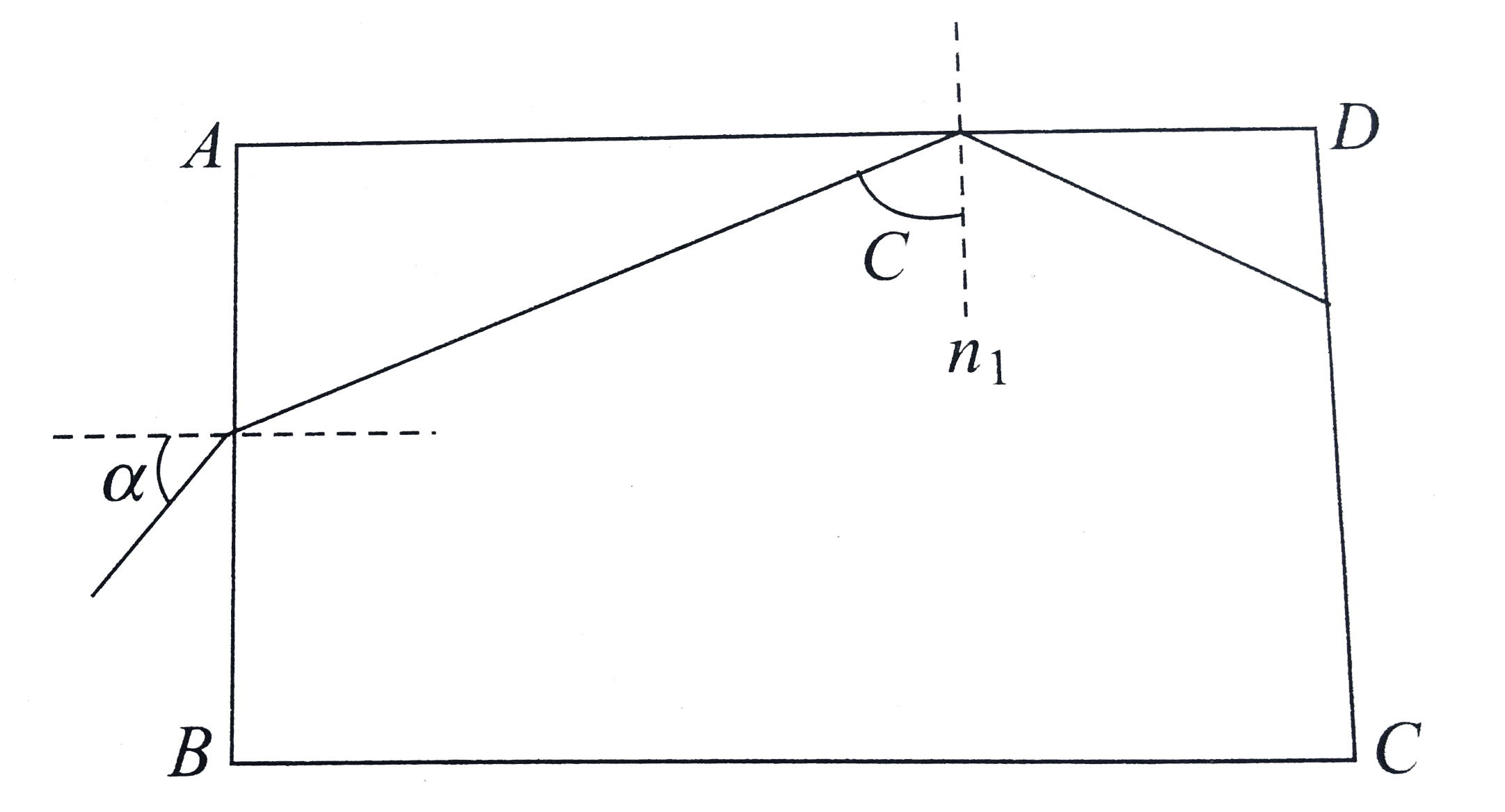
|
|
| 45. |
How we express relative permittivity what is : |
| Answer» SOLUTION :`mu_r = B/B_0` | |
| 46. |
You are given several identical resisters each of value 5Omega and each capable of carrying a maximum current of 2A. It is required to make a suitable combination of these resistance to produce a resistance of 2.5Omega which can carry current of 4A. The minimum number of resistances required for this job is |
|
Answer» 2 |
|
| 47. |
Draw equipotential surfaces for an electric dipole. |
Answer» Solution :EQUIPOTENTIAL surfaces are closed loops around the TWO charges as SHOWN in FIG. 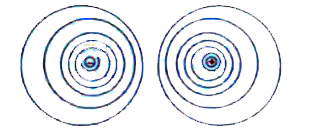
|
|
| 48. |
Calculate the resolving power of a telescope whose objective lens has a diameter of 732 cm and lamda = 6000Å |
| Answer» SOLUTION :`10^ RAD^(-1)` | |
| 49. |
An electron (e,m) is projected into a uniform electric field E vertically downward between parallel plates at separation d, with velocity v_(0). The electron enters the electric field at a point midway between the plates. Find (a) the magnitude of electric field if electron emerges from the electric field just at the edge of upper plate. (b) the direction of the velocity of electron as it emerges from the electric field. (c ) the equation of trajectory followed by electron. The length of plates is L and consider only electric force. |
|
Answer» <P> Solution :This problem is SIMILAR to when a ball is thrown from the top of a tower horizontally in UNIFORM gravational field , this is a case of two - dimensional motion.Let the particle reaches to POINT `P` after time `t`. `x`-direction (uniform motion): `v_(x) = v_(0)`...(i) `x = u_(x) t = v_(0) t`....(ii) `y`-direction (acceleration motion) : `v_(y) = u_(y) + a_(y) t = (e E)/(m) t`....(iii) `y = u_(y) t + (1)/(2) a_(y) t^(2) = (1)/(2) (eE)/(m) t^(2)`....(iv) (a) When the paticle reaches to point `A` `x = v_(0) t rArr L = v_(0) t rArr t = (L)/(v_(0))` `y = (1)/(2) (eE)/(m) t^(2) rArr (d)/(2) = (eE)/(2m) ((L)/(v_(0)))^(2) rArr E = (mv_(0)^(2) d)/(eL^(2))` (b) At `A` : `tan theta = (v_(y))/(v_(x)) = (e Et //m)/(v_(0)) = (eEL)/(mv_(0)^(2))` `theta = tan^(-1) ((e EL)/(mv_(0)^(2)))` where `theta` : angle made by the velocity of electron with initial direction of velocity. (c ) To find trajectory, eleiminating `t` from `(ii)` and `(iv)` `y = (1)/(2) (eE)/(m) ((x^(2))/(v_(0)))^(2) = (eEx^(2))/(2 mv_(0))` This is the equation of parabola , hence trajectory of electron is parabolic. 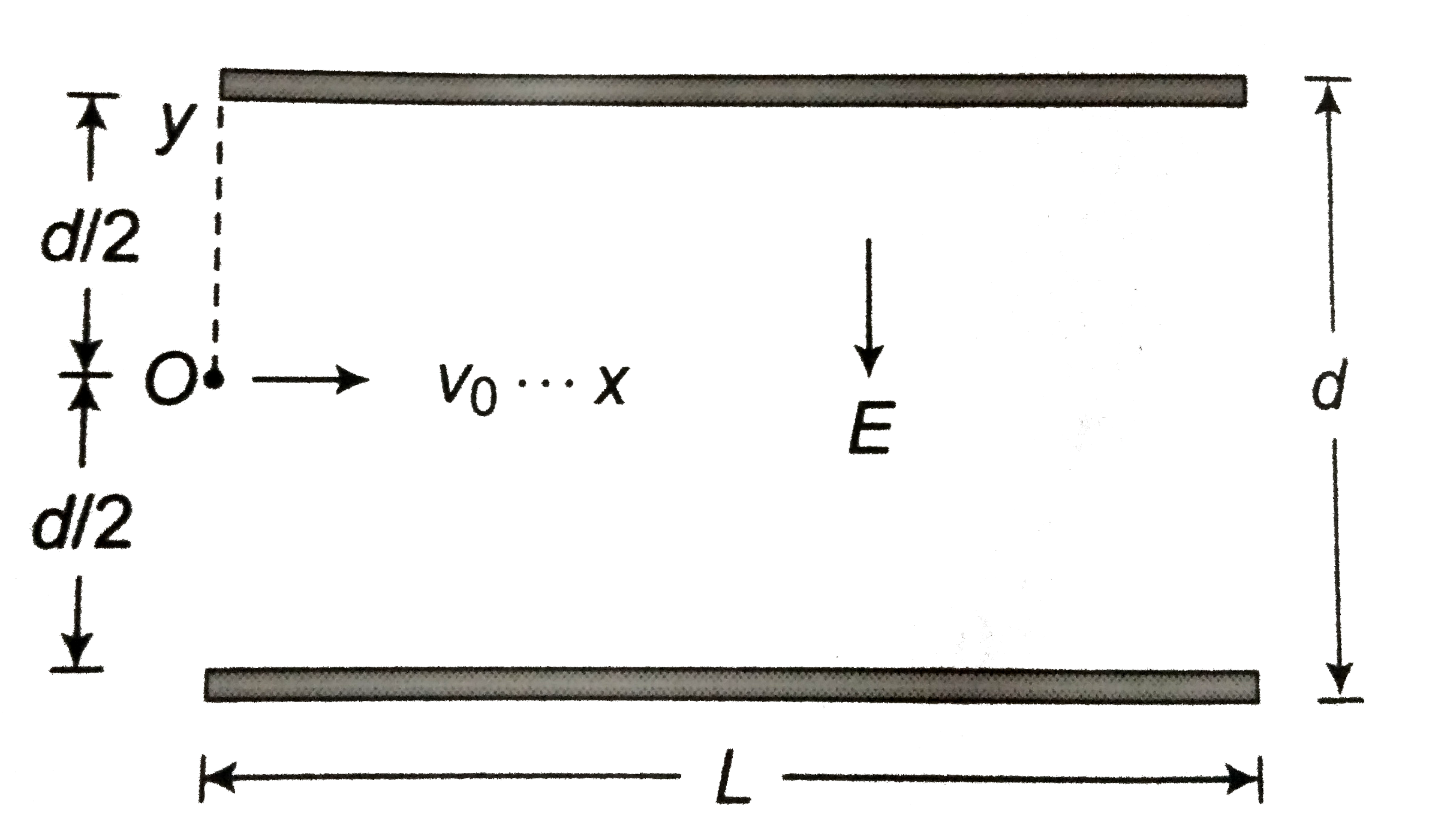 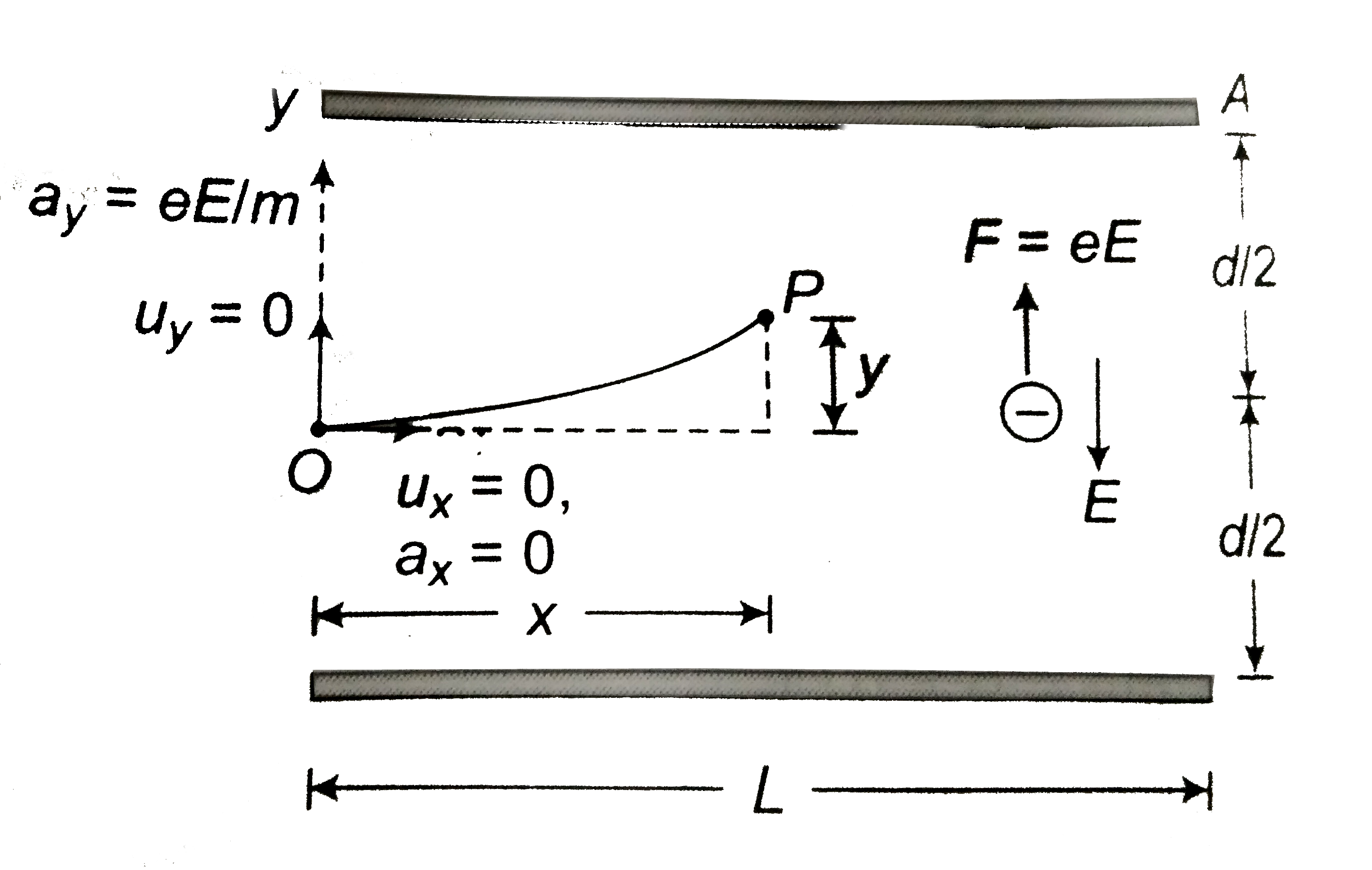 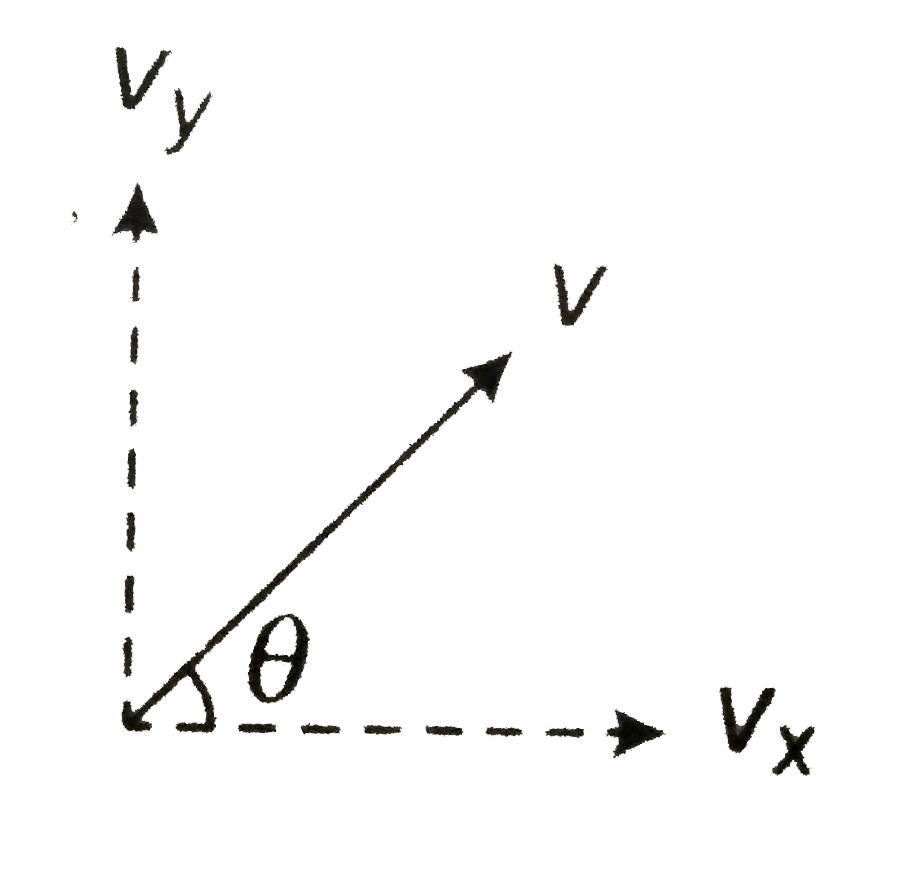
|
|
| 50. |
For a given mass of a gas in an adiabatic change the temperature and pressure are related according to the law: |
|
Answer» `(P)/(T)=` constant Since `V=(RT)/(P)` `THEREFORE P cdot (P^(gamma)cdot T^(gamma))/(P^(gamma))=" const. "rArr P^(1-gamma) cdot T^(gamma)=` constant Thus, correct CHOICE is (c ). |
|