

Saved Bookmarks
This section includes 7 InterviewSolutions, each offering curated multiple-choice questions to sharpen your Current Affairs knowledge and support exam preparation. Choose a topic below to get started.
| 1. |
One fourth chain is hanging down from a table work done to bring the hanging part of the chain on the table is ( mass of chain =M and length = L) |
|
Answer» `(MGL)/(32)` |
|
| 2. |
Two wires of different densities are soldered together end to end then stretched under tension T. The wave speed in the first wire is twice that in the second wire. Asssuming no energy loss in the wire, find the fraction of the incident power that is reflected at the junction and fraction of the same that is transmitted. |
| Answer» SOLUTION :`1/9,8/9` | |
| 3. |
A weightless thread can bear tension upto 3.7 kgwt. A stone of mass 500 gm is tied to it and rotated in a circular path of radius 4m, in a vertical circle. If g=10m/s^2 then what is maximum angular velocity of the dtone. |
|
Answer» Solution :`T_(MAX)mg + mrw^2` `thereforew^2=(T_max-mg)/(MR)=(3.7xx10-5xx10^(-1)xx10)/(5xx10^(-1)xx4` `W^2=16` and w = 4 rad/s. |
|
| 4. |
When a coil is connected to a Leclanche cell, its resistance is found to be R . What is the effect on its resistance , if it is connected to an a.c. source ? |
|
Answer» it will decrease |
|
| 5. |
Quarks iinside protons and neutrons are thought to carry fractional charges [(+2//3)e,(-1//3)e]. Why do they not show up in Millikan's oil-drop experiment ? |
| Answer» Solution :Quarks are thought to be CONFINED within a PROTON or neutron by means of FORCES which grow stronger if one tries to pull them apart. Therefore, fractional, charges `+(2)/(3)e and -(1)/(3)e` exist in nature, but OBSERVABLE charges are still `pme` or their INTEGER multiples. so, charges of quarks do not show up in Millikan.s oil drop experiment. | |
| 6. |
The force of friction is doubled. Then coefficient of friction mu |
|
Answer» INCREASES |
|
| 7. |
How does the forbidden energy gap of an intrinsic semiconductor vary with the increase in temperature ? |
| Answer» SOLUTION :On increasing the TEMPERATURE of the SEMICONDUCTOR more and more electrons are raised to conduction band, hence width of energy GAP decreases. | |
| 8. |
A metal crystallizes in FCC lattice and edge of unit cell is 620 pm. The radius of metal atom is |
|
Answer» 265.5 pm |
|
| 9. |
Calculate the current drawn from the battery in the given network . |
|
Answer» SOLUTION :The circuit can be redrawn as given in Fig. It is a Wheatstone bridge arrangement in which `R_1/R_5 = R_4/R_3` i.e., the bridge is balanced one. Hence resistance `R_2 = 5Omega`is superfluous and may be ignored. ` THEREFORE`VALUE of resistance` R_15`of series combination of `R_1` and `R_5 = 1 + 2 =3Omega` Value of resistance `R_43` of series combination of `R_4` and `R_3 = 2 +4=6Omega` ` therefore ` Net resistance of network R = resistance of parallel grouping of `R_15` and `R_43` `R = (R_15 xx R_43)/(R_15 xx R_43) = (3 xx 6)/(3+6) = 2 Omega` ` therefore ` Current drawn from the battery in the given network `I = epsi/R = (4V)/(2Omega) = 2A` |
|
| 10. |
Figure shows distance-time graphs of two objects A and B.Which objeect is moving with a greater speed when both are moving? |
Answer» SOLUTION :A linecorresponding to the object B MAKES a larger with the time-axis.Its slope is, THEREFORE,larger tha the slope of the line CORRESPONDING to the object A.Thusm the SPEED of B is greater than that of A.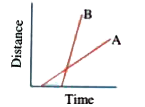
|
|
| 11. |
A sphere carries a uniformly distributed electric charge. Prove that the field inside the sphere is zero |
| Answer» Solution :Suppose that there is a field inside the SPHERE. It is obvious from considerations of symmetry that in this case equipotential surfaces must be SPHERICAL sursaces CONCENTRIC with the charged sphere. Accordingly, the lines of force coincide with the radii, i.e. they must either begin or end at the centre of the sphere. This would have been POSSIBLE, if there were a POSITIVE or a negative charge at the centre of the sphere. But since there is no charge inside the sphere, the lines of force cannot begin or end there. Consequently there is no field inside the sphore. | |
| 12. |
What is demodulation? |
| Answer» SOLUTION :The PROCESS of SEPARATING out the audio signal from the modualated signal is knownas demodulation. The process is INVERSE of process of modulation. | |
| 13. |
How old was Mini |
|
Answer» 13 |
|
| 15. |
If the electric lines of force are as shown in the figure and electric intensity at A and B are E_(A) and E_(B) respectively then |
|
Answer» `E_(A) lt E_(B)` |
|
| 16. |
Displacement current is |
|
Answer» DUE to flow of free electrons |
|
| 17. |
A 0.100 m long solenoid has a radius of 0.050 m and 1.50 xx 10^(4) turns. The current in the solenoid changes at a rate of 6.0 A/s. A conducting loop of radius 0.0200 m is placed at the center of the solenoid with its axis the same as that of the solenoid as shown. What is the magnetic flux through the small loop when the current through the solenoid is 2.50 A? |
|
Answer» `2.95 XX 10^(-2)` WB |
|
| 18. |
What is modulation and why it is needed ? |
|
Answer» Solution :Modulation is the process by which some characteristics of a relatively high frequency wave is varied in accordance with the INSTANTANEOUS value of a LOW frequency. Need for modulation For transmission of SIGNAL, the HEIGHT of antenna should be comparable to the wavelength of signal. For audio signal, the height of antenna should be from `15 km` to `15000km`, which is not possible, hence modulation of signal is required. |
|
| 19. |
What is an intrinsic semiconductor? |
| Answer» Solution :A pure semiconductor is called as INTRINSIC semiconductor. EX. Germanium (Ge), Silicon (SI). | |
| 20. |
Capacitance of capacitor is 2pE. Electric field inside capacitor is changing with the rate of 10^(12)Vs^(-1). Then displacement current is …….. A. |
|
Answer» 2 `=(d)/(dt)[CV]=C.(DV)/(dt)` `=2xx10^(-12)xx10^(12)` `THEREFORE I=2A` |
|
| 21. |
The masses of neutron, proton and deuteron in amu are 1.00893, 1.00813 and 2.01473 respectively. The packing fraction of the deuteron in amu is |
|
Answer» `11.65 XX 10^(-4)` |
|
| 22. |
Torque acting on a coil is maximum when the coil is __________ . |
|
Answer» PARALLEL to the magnetic field |
|
| 23. |
How did the grandmother look? |
|
Answer» Old, Fat, Long |
|
| 24. |
The latitude at which the acceleration due to gravity is 25% of that at the surface of the earth is (radius of earth is 6400 km) |
|
Answer» a)8.5m//sec^2` |
|
| 25. |
Draw a diagram showing the propagation of a plane wavefront from denser to a rarer medium and verify Snell's law of refraction. |
Answer» Solution : Let t be thetime taken bythewavefront to TRAVEL the distance BC. Thus BC = `v_(1)` t Let t be thetime taken bythewavefront to TRAVEL the distance BC. Thus BC = `v_(1)` t Similarly AE = `v_(2)`t For triangles ABC and AEC sin I = `(BC)/(AC)=(v_(1)t)/(AC) "and sin "r= (AE)/(AC)=(v_(2)t)/(AC)` where I and r are theangles of INCIDENCE and refraction respectively. `:. ("sin i")/("sin r")=(v_(1))/(v_(2))` If c is the speed of light in vacuum then `mu_(1)=(c)/(v_(1))orv_(1)=(c)/(v_(1))"and" " "mu_(2)=(c)/(nu_(2))` or `v_(2)= (c)/(mu_(2))` Here `mu_(1)` and `mu_(2)` are known as the refractive INDICES of medium 1 and medium 2 respectively. From equation (1) `("sin i")/("sin r")= (c)/(mu_(1))xxmu_(2)/(c)=mu_(2)/mu_(2) or mu_(1) " " "sin i" =mu_(2)` sin r This is the Snell's law of refration. |
|
| 26. |
a) At what distance should the lens be held from the figure in Exercise 2.29 in order to view the sequares distinctly with the maximum possible magnifying power? |
|
Answer» SOLUTION :i) Here. `upsilon=-25c, f=10cm, U=?` As `(1)/(upsilon)-(1)/(u)=(1)/(f)` `(1)/(UU)=(1)/(v)-(1)/(f)=-(1)/(25)-(1)/(10)=(-2-5)/(50)` `u=(-50)/(7)=-7.14cm` |
|
| 27. |
A changing electric field in space leads to a _________current. |
| Answer» SOLUTION :DISPLACEMENT | |
| 28. |
Explain any three recent advancements in medical technology. |
|
Answer» Solution :Recent advancements in medical technology: (i) DRUG delivery systems (ii) Active agents (III) Contrast medium (iv) Medical rapid tests (v), Prostheses and implantsts (vi) Antimicrobial agents and COATINGS (vii) Agents in cancer THERAPY. |
|
| 29. |
The count rate from 100cm^(3) of a radioactive liquid is c. Some of this liquid is now discarded. The count rate of the remaining liquid is found to be c//10 after three half-lives. The volume of the remaining liquid, in cm^(3), is |
|
Answer» 20 After 3 half-lives , CR for `1 cm^3` of liquid =`1/8xxc/100` Let the VOLUME of the remaining liquid=`V cm^3` `therefore` CR of this liquid , `Vxxc/800 =c/10`. Or V=80. |
|
| 30. |
Consider, a car moving along a straight horizontal road with a speed of 72 km/h. If the coefficient of static friction between the distance in which the car can be stopped is (Take g=10 //s^(2)) |
|
Answer» 30m |
|
| 31. |
The process of recovering the audio signal from the modulated wave is known as |
|
Answer» AMPLIFICATION |
|
| 32. |
A hemisphere of radius 4 cm is placed centrally oncross mark. When it is viewed directly from above what will be the position of the image for the two following cases: (i) when the plane surface of the hemisphere is in contact with the cross mark, (ii) when the curved surface is in contact with the cross mark? |
|
Answer» |
|
| 33. |
In the satellite communication, the uplinking frequency range is |
|
Answer» `0.896` to `0.901 GHZ` |
|
| 34. |
Which circuit diagram shows voltmeter V and ammeter A correctly positioned to measure the total potential difference of the circuit and the current through each resistor? |
|
Answer»
|
|
| 35. |
It is known that a spectral line lambda= 612nm of an atom is caused by a transition between singlet terms. Calculate the interval Delta lambda between the extreme components of that line in the magnetic field with induction B=10.0KG. |
|
Answer» SOLUTION :As the spectral line is caused by transition between singlet terms, the `Z` eeman effect willl be normal (since `g=1` for both terms). The energy DIFFERENCE between extreme COMPONENTS of the line will be `2mu_(B)B`. This MUST equal `-Delta((2piħc)/(lambda))=(2piħc Delta lambda)/(lambda^(2))` Thus `Delta lambda=(mu_(B)Blambda^(2))/(piħc)=35 p m`. |
|
| 36. |
A pointcharge + 10mu c is a distance 5 cm directly above the centre of a square of side 10 cm aswhat is the magnitudeof the electricflux throughthe square |
|
Answer» Solution :(a) 0.07 `MUC` (b) no only thatthe net CHARGES INSIDE is ZERO |
|
| 37. |
A parallel plate air capacitor is connected to a battery. Its charge, potential difference, electric field and the stored energy between the plates are Q_0,V_0,E_0" and "U_0 respectively. Keeping the battery connection uncharged, the capacitor is completely filled with a dielectric material. The charge, potential difference, electric field and energy stored become Q,V,E and U respectively. Which of the following is correct? Q gt Q_0. |
|
Answer» Solution :When the dielectric material is inserted in the capacitor, its CAPACITANCE INCREASES. As the capacitor is still CONNECTED to the BATTERY, so its voltage will remain CONSTANT. Since, charge = capacitance `xx` voltage, so `Qgt Q_0`. |
|
| 38. |
Dotor saclar product of the vectors vecA=2hati-3hatj+hatk and vecB=3hatj+hatk |
|
Answer» -8 |
|
| 39. |
A parallel plate air capacitor is connected to a battery. Its charge, potential difference, electric field and the stored energy between the plates are Q_0,V_0,E_0" and "U_0 respectively. Keeping the battery connection uncharged, the capacitor is completely filled with a dielectric material. The charge, potential difference, electric field and energy stored become Q,V,E and U respectively. Which of the following is correct? V gt V_0. |
|
Answer» SOLUTION :Since the capacitor remains CONNECTED to the battery its voltage remins CONSTANT. HENCE, `V gt V_0` is not CORRECT. |
|
| 40. |
A man can swim at the rate of 5 km h^-1 in still water. A 1 - km wide river flows at the rate of 3 km h^-1 The man wishes to swim across the river directly opposite to the starting point. (a) Along what direction must the man swim ? (b) What should be his resultant velocity ? ( c) How much time will he take to cross the river ? |
| Answer» SOLUTION :DIRECTION from Down STREAM `= 120^(@)` | |
| 41. |
The ratio of width of incident wavefront in air and refracted wavefront in medium is 0.8. If angle of incidence is 45^@, the angle of refraction will be: |
|
Answer» `24^@54'` |
|
| 42. |
2 km wide river flowing with a rate of 5 km/hr. A man can swim in the still water with10 km/hr. He wants to cross the river along shortest path find Crossing time |
| Answer» Solution :`(2)/(ROOT(5)(3))HR` | |
| 43. |
A parallel plate air capacitor is connected to a battery. Its charge, potential difference, electric field and the stored energy between the plates are Q_0,V_0,E_0" and "U_0 respectively. Keeping the battery connection uncharged, the capacitor is completely filled with a dielectric material. The charge, potential difference, electric field and energy stored become Q,V,E and U respectively. Which of the following is correct? E gt E_0. |
|
Answer» Solution :Since voltage and DISTANCE between the plates REMAIN CONSTANT, so electric field remains constant. HENCE, `E GT E_0` is not correct. |
|
| 44. |
A parallel plate air capacitor is connected to a battery. Its charge, potential difference, electric field and the stored energy between the plates are Q_0,V_0,E_0" and "U_0 respectively. Keeping the battery connection uncharged, the capacitor is completely filled with a dielectric material. The charge, potential difference, electric field and energy stored become Q,V,E and U respectively. Which of the following is correct? U gt U_0. |
|
Answer» Solution :Energy stored in a capacitor `= (1)/(2)xx " capacitance " xx (" VOLTAGE ")^2` Since the voltage of the capacitor REMAINS constant but its capacitance incrases, so the energy stored in the capacitor will increase. Hence, `U gt U_0` is CORRECT. |
|
| 45. |
The dimensional formula for magnetic flux is : |
|
Answer» `[ML^(2)T^(-2)A^(-1)]` `:.phi=[L^(2)xxML^(0)T^(-2)A^(-1)]` `=[ML^(2)T^(-2)A^(-1)]` `:.(a)`is CORRECT CHOICE. |
|
| 46. |
In the above problem the displacement after |
|
Answer» `30sqrt(3) hati+30 hatj` |
|
| 47. |
To throw an 80 kg opponent with a basic judo hip throw, you intend to pull his uniform with a force vecF and a moment arm d_(1) = 0.30 m from a pivot point on your right hip. You wish to rotate him about the pivot point with an angular acceleration alpha" of "-6.0rad//s^(2) - that is, with an angular acceleration that is clockwise in the figure. Assume that his rotational inertia I relative to the pivot point is 15kg*m^(2). (a) What must the magnitude of vecF be if, before you throw him, you benf your opponent forward to bring his center of mass to your hip? (b) What must the magnitude of vecF be if your opponent remains upright before you throw him, so that vecF_(g) has a moment arm d_(2)=0.12m? |
|
Answer» Solution :(a) We can relate your pull `vecF` on your opponent to the given angular acceleration `alpha` via Newton.s second law for rotation `(tau_("net")=Ialpha)`. Calculations: As his feet leave the floor, we can assume that only three forces act on him: your pull `vecF`, a force `vecN` on him from you at the pivot point, and the gravitational force `vecF_(G)`. To USE `tau_("net")=Ialpha`, we need the corresponding three torques, each about the pivot point. From Eq. `(tau=r_(bot)F)`, the torque due to your pull `vecF` is equal to `-d_(1)F`, where `d_(1)` is the moment arm `r_(bot)` and the sign indicates the clockwise rotation this torque TENDS to cause. The torque due to `vecN` is zero, because `vecN` acts at the pivot point and thus has moment arm `r_(bot)=0`. To evaluate the torque dur `vecF_(g)`, we can assume that `vecF_(g)` acts at your opponent.s center of mass. With the center of mass at the pivot point, `vecF_(g)` has moment arm `r_(bot)=0` and thus the torque dur to `vecF_(g)` is zero. So, the only torque on your opponent is due to your pull `vecF`, and we can write `tau_("net")=Ialpha` as `-d_(1)F=Ialpha` We then find `F=(-Ialpha)/d_(1)=(-(15kg*m^(2))(-6.0rad//s^(2)))/(0.30m)` = 300 N. (b) Because the moment arm for `vecF_(g)` is no LONGER zero, the torque due to `vecF_(g)` is now equal to `d_(2)mg` and is positive because the torque attempts counterclockwise rotation. Calculations: Now we write `tau_("net")=Ialpha` as `-d_(1)F+d_(2)mg=Ialpha` `F=-(Ialpha)/d_(1)+(d_(2)mg)/d_(1)`. From (a), we KNOW that the first term on the right is equal to 300 N. Substituting this and the given data, we have `F=300N+((0.12m)(80kg)(9.8m//s^(2)))/(0.30m)` = `613.6N~~610N`. |
|
| 48. |
A point object is placed in front of a silvered plano convex lens of refractive index n radius of curvature R, so that its image is formed on itself. Then the object distance is equal to |
|
Answer» `R//2n` `(1)/(F)=(1)/(f_(t))+(1)/(f_(l))+(1)/(f_(m))` where `f_(m)=R//2` & `(1)/(f_(l))=(n-1)((1)/(OO)-(1)/(-R ))=(n-1)/(R )` `rArr (1)/(f)=(2(n-1))/(R )+(2)/(R )=(2n)/(R )rArr f=(R )/(2n)` `rArr 2f=(R )/(n)` 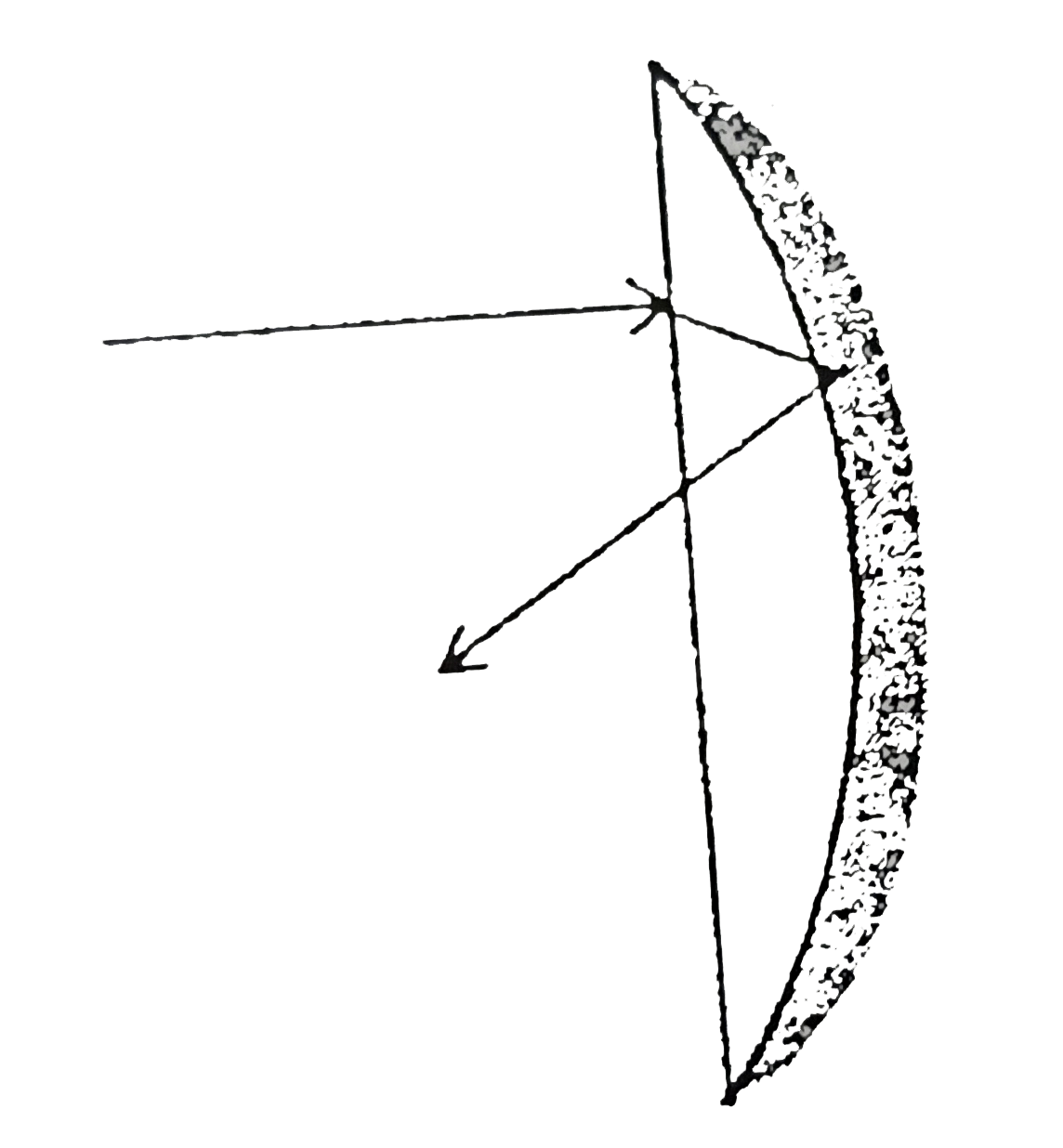
|
|
| 49. |
A uniformly charged solid (non-conducting) sphere of radius R carrying positive charge, has a volume charge density equal to rho. A tunnel of very small radius is made along the diameter of the sphere. A particle of mass m and charge -q is released from rest near the opening of tunnel described above. Calculate the speed of particle as it passes through the center of the sphere. |
|
Answer» Solution :ELECTRIC potential at a point lying inside a charged solid non-conducting sphere of radius R is given by the following relation: `V+(rho)/(6epsilon_(0))[3R^(2)-x^(2)]" for " x LE R` here x is the distance of point from the centre of sphere 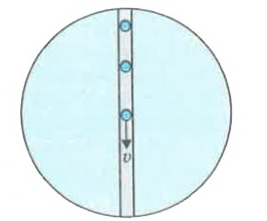 Initial location of particle is at the surface of the sphere. Let the potential at this point be `V_(1)`. Using x = R, in above relation, we have, `V_(1)=(rhoR^(2))/(3epsilon_(0))` The final location is centre where we NEED to calculate the speed. Let electric potential at the centre be `V_(2)`. Then we can use x = 0 in the formula of electric potential: `V_(2)=(rho R^(2))/(2epsilon_(0))` By definition we have: `V_(2)-V_(1)=(-W_(el))/(q) rArr W_(el)=q(V_(1)-V_(2))` `rArr W_(el)=(-q) ((rhoR^(2))/(3epsilon_(0))-(rhoR^(2))/(2epsilon_(0)))`, (NOTE that we have used negative sign of charge in this step). `rArr W_(el)=(rho q R^(2))/(6epsilon_(0))` For a negatively charged particle `W_(el)=K_(2)-K_(1)` `rArr (pqR^(2))/(6epsilon_(0)) =(1)/(2)mv^(2)-0` `rArr v= sqrt((rho QR^(2))/(3mepsilon_(0)))` |
|
| 50. |
There are two black bodies A and B with temperatures 1500 k and 3600 k respectively . Photons having wavelength equal to the wavelength corresponding to maximum spectral radiancy of A & B (say lambda_A and lambda_B respectively) are incident on a metal sphere of radius 12 cm having work-function 1.2 eV. The maximum kinetic energies of the electrons emitted by these photons are in the ratio 1:3 . Find the wavelengths lambda_A and lambda_B. if 10^(12) photons of wavelength lambda_B are incident per second and photo electric efficiency is one electron per 10^6 photons , find the time after which emission of photo-electrons will stop. in this case assume that lambda_A is not present. |
| Answer» SOLUTION :`lambda_b=(12375)/(9.6)A=1289A,lambda_a=3093.75a,t=700 "SEC"` | |


