

Saved Bookmarks
This section includes 7 InterviewSolutions, each offering curated multiple-choice questions to sharpen your Current Affairs knowledge and support exam preparation. Choose a topic below to get started.
| 1. |
In the adjacent figure ABC is a uniform isosceles triangular lamina of mass m and AB=AC=l. The lamina is free to rotate about a fixed horizontal axis OAO' which is in the plane of the lamina. Initially the lamina is in static equilibrium with maximum gravitational potential energy. Due to slight disturbance, lamina starts rotating. Now choose the correct option (s) |
|
Answer» The maximum angular speed acquired by lamina is `4sqrt((sqrt(2)g)/(3l))` `(2sqrt(2)mgl)/3=1/2.(ml^(2)omega^(2))/4` `( "moment of inertia about" OAO'=(ml^(2))/4)` `impliesomega=sqrt(16sqrt(2))/3.g/l=4sqrt((sqrt(2)g)/(3l))` `F-mg=momega^(2)R=mxx(16sqrt(2)g)/(3l).(sqrt(2)l)/3` `impliesF+mg+(32mg)/9-(41mg)/9` |
|
| 2. |
The half-life of polonium is 140 days. How long will it take to reduce to 1g polonium out of its initial mass of 16g ? |
| Answer» Solution :16 G of POLONIUM will be REDUCED to 1 g in 4 half LIVES `=4xx140=560` DAYS | |
| 3. |
A meter stick in frame S' makes an angle of 30^(@) with the x' axis. If that frame moves parallel to the x axis of frame S with speed 0.95c relative to frame S, what is the length of the stick as measured from S? |
|
Answer» |
|
| 4. |
In a semiconductors the separation between conduction band and valence band is of the order of |
| Answer» ANSWER :C | |
| 5. |
A linear object of size 1.5cm placed at 10cm from a lens of focal length 20cm. The optic centre of lens and the object are displaced a distance Delta. The magnification of the image formed is m (Take optic centre as origin). The coordinates of image of A and B are (x_(1),y_(1)) and (x_(2),y_(2)) respectively. Then |
|
Answer» `(x_(1),y_(1))=(-20cm, -1cm)` `(1)/(u)-(1)/(V)=(1)/(f)` `(1)/(v)=(1)/(20)-(1)/(20)=(1-2)/(20)=(-1)/(20)rArrv=-20cm` Magnification `m=(v)/(u)=(-20)/(-10)=2` Height of IMAGE `=1.5xx2=3cm` The `y_(1)` coordinate of a point A on the image will be `y_(1)=(0.5)xx2=-1cm` The `y_(2)` coordinate of a ppoint B on the image will be `y_(2)=1xx2=2cm` 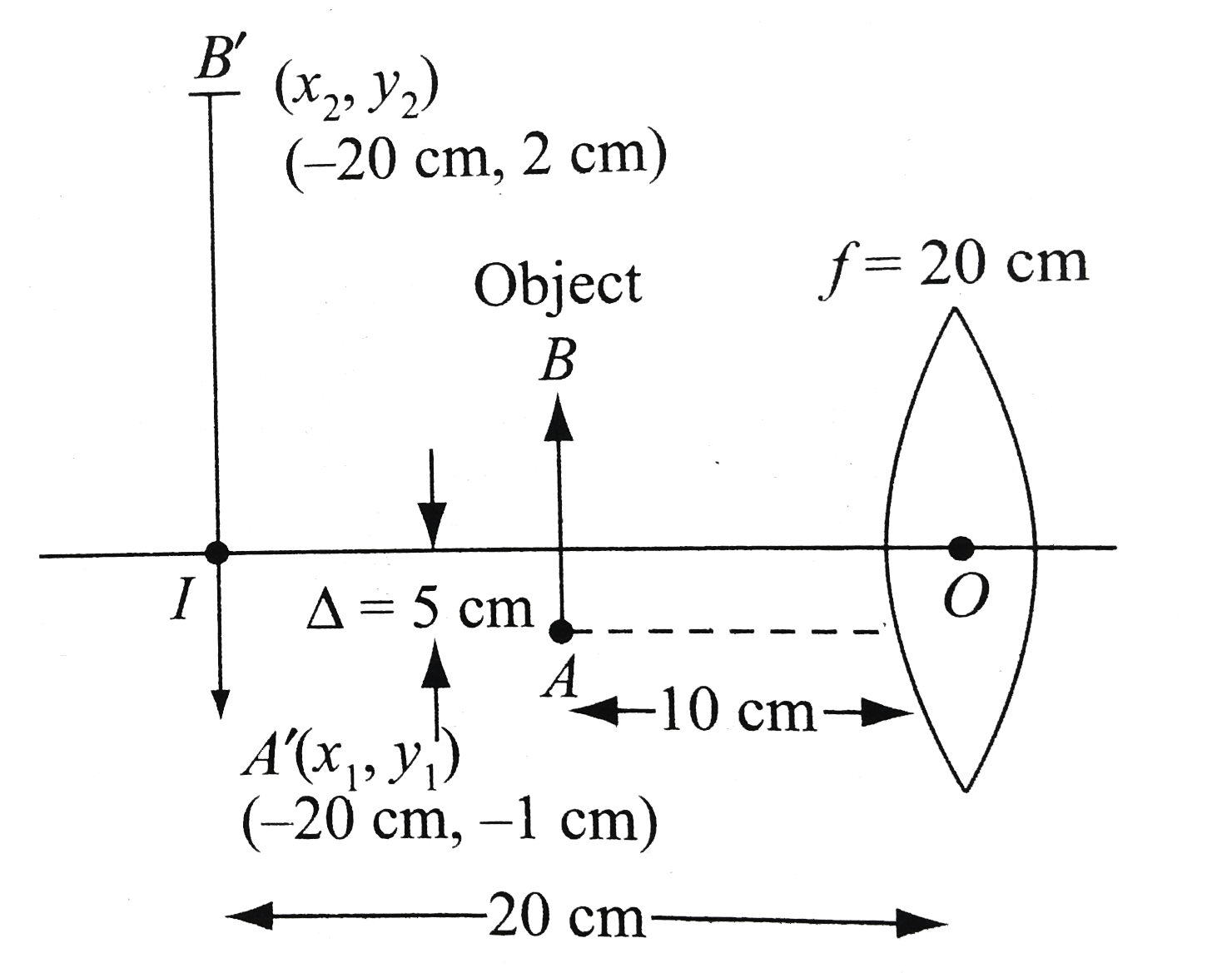
|
|
| 6. |
Two particles, each having a mass m are placed at a separation d in a uniform magnetic field B as shown in they have opposite charges of equal magnitude q. at time t =0, the particles are projectd towards each other,each with a speed v. suppose the coulomb force between the charges is switched off. (a)Find the maximum value v_m ofthe projection speed so that the two particles do not collide. (b)What would be the minimum and maximum separation between the particles if v =v_m /2? (c) At whatinstant will a collision occur betweenthe particles if v = 2v_m ? (d) Suppose v =2v_m and the collision between the particles is completely inelastic. Describe the motion after the collision. |
|
Answer» Solution :The particles will not collide if `d = r_(1) + r_(2)` `rArr d = ((mV)/(qB) + (mV)/(qB) + (2mV)/(qB))` `v= (qBd)/(2m)` `d_(1) = r_(1)+r_(2) = 2r` `rArr = (d)/(2)`(minimum distance) Max distance , `d_(2) = + d + 2r = d + (d)/(2)= (3d)/(2)` `( c ) V= 2V _(2) m` `r_(1) = r_(2) = d `The are is `(1)/(6)` `(d )V = 2V_(m)` The particle will collide at point P . At point P , both the particle will have motion `m` in upward direction . Since the particle collide inelastically they stick together distance`i` between centers `= d`, `sinsintheta = (i)/(2r)`velocity upward `= v cos (90 - sin theta ) = (vi)/(2r)` `(mv^(2) )/(r)= QVB` ` rArr r = (mV)/(qB)` Using `(mu^(2) )/(r)= (qvB)/(2m)= V_(m)` HENCE the COMBINE mass will movewith the velocity `V_(m)` |
|
| 7. |
The principle in which a solar cell operates |
|
Answer» Diffusion |
|
| 8. |
A thin convex lens of focal length 25 cm is cut into towpieces 0.5 cm above the principal axis. The top part is placed at (0,0) and an object placed at (-50 cm , 0) Find the coordinates of the image. |
Answer» SOLUTION :If lens is cut as pwer the statement then its focal length wil not change.  If lens is not cut, then object WOULD be at HEIGHT 0.5 cm from prinicpal axis OO. . From lens equation, `1/f = 1/v - 1/u` `therefore 1/v = 1/f + 1/u =1/25+ (1)/(-50) = (2-1)/(50)` `therefore 1/v = 1/50` `therefore v = 50 cm ` `therefore` Magnification `m = v/u = - (50)/(50) = -1` Thus , image will be formed at 50 cm from optical CENTRE of lens , but 0.5 cm below the edge passing through base of lens which is cut. If optical centre of the lens is TAKEN at origin and X - axis is passing through cut lens then coordinates of image are (50,-1) cm . |
|
| 10. |
A body at temperature theta_(0) having Newton's cooling constant K is placed in a surrounding having temperature T_(0) at time t = 0. The graph of temperature of the body as a function of timet is shown in the adjacent figure.A tangent on the curve is drawn at t = 0 as shown in the figure. Find the value of tau. |
|
Answer» K `(f_(s))R=((2)/(5)MR^(2))alpha` `impliesf_(s)=(2)/(5)ma_(C.M)` `implies mgsintheta=(7)/(5)ma_(C.M)implies a_(C.M)=(5)/(7)gsintheta` For time of descent `(1)/(2)a_(C.M)t^(2)=hcosectheta` `t^(2)=(2H)/(a_(C.M))cosectheta` `t^(2)=(2hxx7)/(5gsin theta)cosectheta` `t^(2)=(14H)/(5g)(1)/(sin^(2)theta)implies t=sqrt((14h)/(5g))(1)/(sin theta)&V_(F)=(a_(C.M))t=((5)/(7)gsina)(sqrt((14h)/(5g)))(1)/(sin theta)` `V_(F)=sqrt((5xx2gh)/(7))=sqrt((10gh)/(7))`implies VELOCITY does not depend or `'theta'` but time depend on `'theta'` 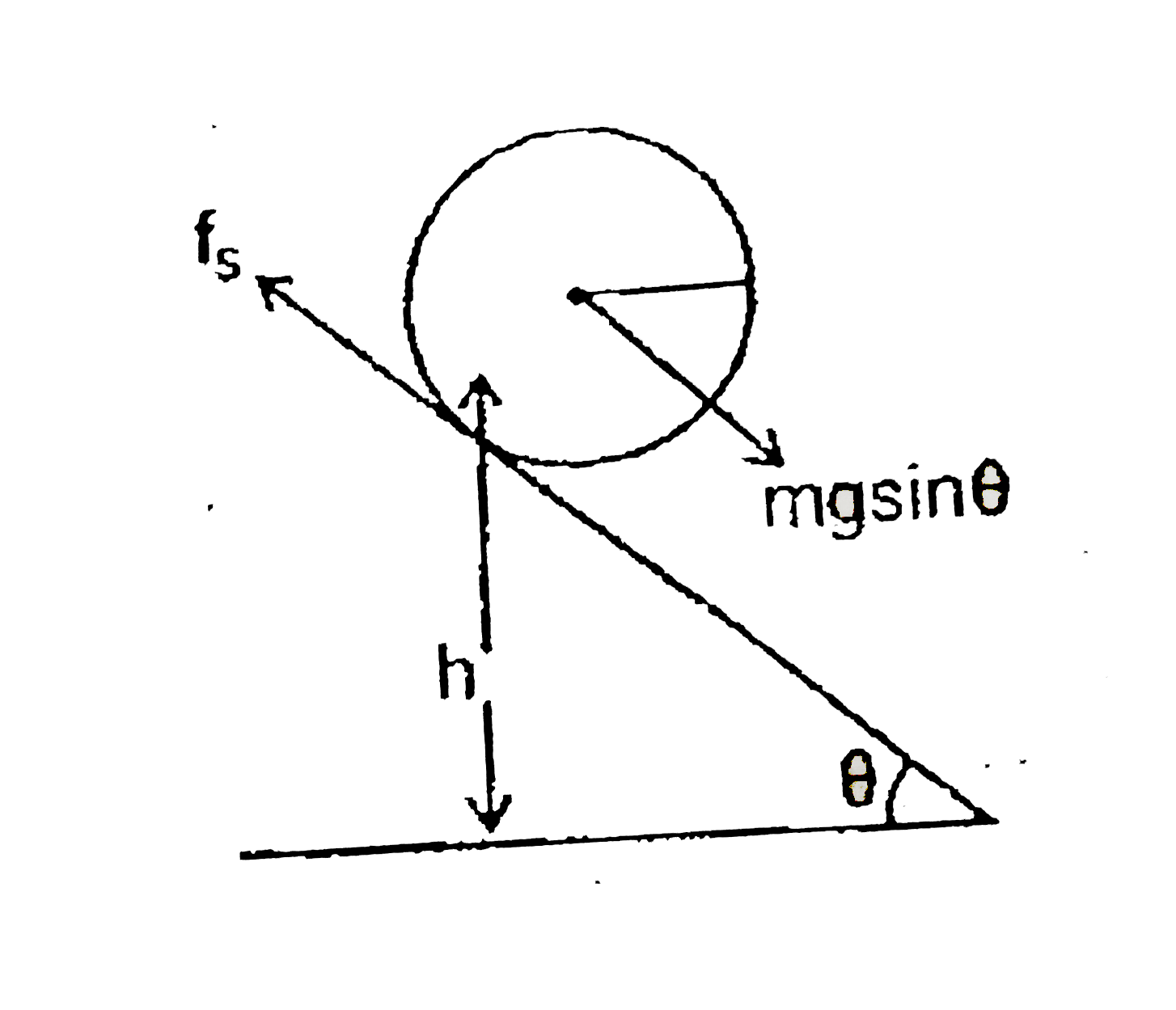
|
|
| 11. |
A conductor at very high temperature becomes : |
|
Answer» insulator |
|
| 12. |
A parallel -plate air capacitor has capacity C. A dielectric slab of dielectric constant K, whose thickness is half of the air gap between the plates, is now inserted between the plates. The capacity of the capacitor will now be |
|
Answer» `KC//2` |
|
| 13. |
In the given figure switch is open initially and capacitor C_2 is unchanged Charge on C2 just after closing the switch is |
|
Answer» `(CV)/(2)` |
|
| 14. |
If n drops of a liquid , each with surface energy E , join to form a single drop , then |
|
Answer» Some energy will be absorbed in the PROCESS. |
|
| 15. |
Two electrons are moving in opposite directions with speeds 0.8c and 0.4c where c is the speed of lights in vacuum. Then the relative speed is about |
|
Answer» 0.4c |
|
| 16. |
The fission properties of ""_(94)^(239)Pu are very similar to those of ""_(92)^(235)U. The average energy released per fission is 180 MeV. How much energy , in MeV, is released if all the atoms in 1kg of pure ""_(94)^(239)Pu undergo fission? |
|
Answer» Solution :Number of atoms in `239 g` of `""_(94)^(239)PU` is Avagadro number. Number of atoms in `1G = N/(239) = (6.023 xx 10^(23))/(239)` Number of atoms in 1KG = `(6.023 xx 10^(23))/(239) xx 10^(3) = 2.52 xx 10^(24) "atoms of " ""_(94)^(239)Pu` Energy released during 1 kg of `""_(94)^(239)Pu` = Energy released by `2.52 xx 10^(24)` atoms of `""_(94)^(239)Pu` = Energy released per FISSION `xx` Total number of atoms in 1kg `= 180 xx 2.52 xx 10^(24) = 4.536 xx 10^(26) MeV`. |
|
| 17. |
There are two oscillating circuits (figure) with capacitors of equal capacitances. How must inductances and active resistances of the coils be interrelated forthe frequencies and damping of free oscillations in both circuits to be equal ? The mutual inductance of coils in the left circuit is negligible. |
|
Answer» Solution :We have `L_(1)dot(I_(1))+R_(1)I_(1)=L_(2)dot(I_(2))+R_(2)I_(2)` `=-(int Idt)/(C)` `I=I_(1)+I_(2)` Then differentiating we have the equations `L_(1)C ddot(I_(1))+R_(1)Cdot(I_(1))+(I_(1)+I_(2))=0` ` L_(2)Cddot(I_(2))+ R_(2)Cdot(I_(2)+(I_(1)+I_(2))=0` Look for a solution `I_(1)=A_(1)e^(alphat), I_(2)=A_(2)e^(alphat)` Then ` (1+ alpha^(2)L_(1)C+ alpha R_(1)C)A_(1)+A_(2)=0` `A_(1)=(1+alpha^(2)L_(2)C+alpha R_(2)C)_(2)=0` This SET of simultaneous equation has a nontrivial solution only if `(a+alpha^(2)L_(1)C+alphaR_(1)underset.C)(1+alpha^(2)L_(2)C+alphaR_(2)C)=1` or `alpha^(3)+ alpha^(2)(L_(1)R_(2)+ L_(2)R_(1))/( L_(1)L_(2))+alpha(L_(1)+L_(2)+R_(1)R_(2)C)/(L_(1)L_(2)C)+(R_(1)+R_(2))/( L_(1)L_(2)C)=0` This cubic equation has one real root which we ignore and two complex conjugate roots. We require the condition that this pair of complex conjugate roots is identical with roots of the equation `alpha^(2) LC=alphaRC + 1 =0` The general solution of this problem is not easy . We look for special cases. If `R_(1)=R_(2)=0`, then `R=0`, and `L=(L_(1)L_(2))/(L_(1)+L_(2)).` If `L_(1)=L_(2)=0, `then `L=0` and `R=R_(1)R_(2)//(R_(1)+R_(2))`. These are the quoted solution but they are MISLEADING. We shall give the solution for small `R_(1), R_(2)`. Thenwe put `alpha=-beta+iomega` when `beta` is small We get `(1- omega^(2)L_(1)C-2ibetaomegaL_(1)C-betacancel(R_(1))C+iomegaR_(1)C)` `(1- omega^(2)L_(2)C-2ibetaomegaL_(2)C-betacancel(R_(2))C+iomegaR_(2)C)=1` `(` we neglect `beta^(2)& beta R_(1), betaR_(2))`. Then `(1-omega^(2)L_(1)C)(1-omega^(2)L_(2)C)=1implies omega^(2)=(L_(1)+L_(2))/(L_(1)L_(1)C)` This is identical with `omega^(2)=(1)/(LC)` if `L=(L_(1)L_(2))/(L_(1)+L_(2))`. ALSO`(2 beta L_(1)-R_(2))(1- omega^(2)L_(2)C)+(2 betaL_(2)-R_(2))(1-omega^(2)L_(2)C)=0` This gives `beta=(R)/(2L)=(R_(1)L_(2)^(2)+R_(2)L_(1)^(2))/(2L_(1)L_(2)(L_(1)+L_(2)))implies R=(R_(1)L_(2)^(2)+R_(2)L_(1)^(2))/((L_(1)+L_(2))^(2))` 
|
|
| 18. |
1/(sqrt25-sqrt8) निम्न में से किस के बराबर है : |
|
Answer» `(5+2sqrt2)/17` |
|
| 19. |
Ratio of intensities in consecutive maxima in a diffraction pattern due to a singleslit is |
|
Answer» `1:2:3` |
|
| 21. |
Find out the wrong statement : i)As frequency increases photo current increases ii)As frequency increase KE increases iii)As frequency increase velocity of electrons increases iv)As frequency increase stopping potential increases v)As frequency is below a certain value photo electrons are not emitted. |
| Answer» SOLUTION :As FREQUENCY INCREASES PHOTO CURRENT increases | |
| 22. |
A carbon filament has resistance of 120 Omegaat 0^@ C what must be the resistance of a copper filament connected in series with carbon so that combination has same resistance at all temperatures (alphacarbon = 5 xx 10^(-4)//0C, alpha ".copper "= 4 xx 10^(-3//0) C) |
|
Answer» `120 Omega ` |
|
| 23. |
The frequency (n)of vibration of a string is given as n=(1)/(2l)sqrt(T/(m)), where T is tension and l is the length of vibrating string, then the dimensional formula for m is : |
|
Answer» `[M^(0)L^(1)T^(1)]` `m=(T)/(4l^(2).n^(2))=(MLT^(-2))/(L^(2)xxT^(-2))=[ML^(-1)]` Hence correct choice is `(C )`. |
|
| 24. |
What is the meaning of "thrushes"? |
|
Answer» A TYPE of bird |
|
| 25. |
A string of length l is stretched by 1/30 and transverse waves in the string are found to travel at a speed v_0. Speed of transverse waves when the string is stretched by 1/15 will be : |
|
Answer» `(v_0)/(2)` |
|
| 26. |
A loop with current l Is in the field of a long straight wire with current l_(0).The plane of the loop is perpendicular to the straight wire.Find torque acting on the loop. |
|
Answer» Solution :`dvecs=(rd0dr)` , (INWARDS) `dM=(rId0dr)` , (inwards) `vecB=(mu_(0)l_(0))/(2pir)` , (tangential clockwise) `dpi=|dvecMxxvecB|=(mu_(0)II_(0)d0dr)/(2PI)` , (TOWARDS centre) `:.tau=underset(-alpha)overset(alpha)intunderset(a)overset(b)intdrcos theta` `=(mu_(0)ll_(0))/(2pi)underset(-alpha)overset(alpha)intunderset(a)overset(b)intcos theta d theta dr` `(mu_(0)II_(0)(b-a)sin alpha)/pi ` , (to the left) 
|
|
| 27. |
When a metallic surface is illuminated with radiation of wavelength lambda, the stopping potential is V. If the same surface is illuminated with radiation of wavelength 2 lambda, the stopping potential is (V)/(4). The threshold wavelength for the metallic surface is..................... |
|
Answer» `4 lambda` `E((V)/(4)) = (hc)/(2 lambda) - (hc)/(lambda_(0))""…(2)` `(1) DIV (2)` `(4 (eV))/(eV) = ((1)/(lambda) - (1)/(lambda_(0)))/((1)/(2 lambda) - (1)/(lambda_(0))) = (((lambda_(0)-lambda)/(lambda lambda_(0))))/(((lambda_(0) - 2 lambda)/(2 lambda lambda_(0))))` On solving we get, `lambda_(0) = 3 lambda` |
|
| 28. |
A rectangular closed loop moves horizontally in a uniform magnetic field. i. Will there be any induced current in the loop if the loop is completely in the magnetic field? ii. Will there be any induced current in the loop if the loop is partially out of the magnetic field? iii. Will the induced current in the loop remain if the loop is stationary and the magnetic field changes with time? |
|
Answer» Solution :i. No. There is no CHANGE of flux and hence no induced e.m.f II. Yes. Because there is no change of magnetic flux iii. Yes. The TIME VARYING flux will induce an e.m.f. or current in the LOOP. |
|
| 29. |
Two forces of magnitude F and sqrt(3) F act at right angles to each other. Their resultant makes an angle theta with F. The value of theta is : |
|
Answer» `30^(@)` |
|
| 30. |
Which of the following is forward biased? |
|
Answer»
|
|
| 31. |
At resonance , in an LCR circuit , the emf and current are |
|
Answer» in PHASE |
|
| 32. |
Human eye |
|
Answer» Can detect polarised light |
|
| 33. |
In the circuit shown, current flowing through 25V cell is |
|
Answer» 7.2 A |
|
| 34. |
Every liquid surface tends to contract to a minimum surface area. This tendency is exhibited as - |
|
Answer» SURFACE tension |
|
| 35. |
If the unit of force were 10 N, that of power were 1MW and that of time were 1 millisecond then the unit of length would be |
| Answer» Answer :B | |
| 36. |
Output characteristics of an NPN , transistor in CE mode is drawn between ……. . |
|
Answer» `I_(C) and V_(BE)` |
|
| 37. |
When a wire loop is rotated in a magnetic field the direction of induced emf changes once in each ..... |
|
Answer» `1/4` revolution `THEREFORE (dphi)/(dt)=NABomega sin omegat` In half revolution `omegat` becomes, `omega(t+T/2)=omegat+(omegaT)/2` `=omegat+(2pi)/T. T/2` `=omegat+pi` |
|
| 38. |
A stationary vessel contains a mixture of equal moles of Nitrogen and Helium gas. The percentage of the total kinetic energy of the mixture that is possessed by the molecules of Nitrogen is ___________ |
|
Answer» Total KE of Nitrogen MOLECULES, `K_(1) = (5)/(2) nRT` Total KE of Helium molecules, `K_(2)= (3)/(2) nRT` Therefore, the required PERCENTAGE `=(K_(1))/(K_(1) + K_(2))xx 100= 62.5` |
|
| 39. |
A point P is situated 90.50 cm and 90.58 cm away from two coherent source. The nature of illumination of the point P if the wavelength is of 4000overset@A is |
|
Answer» BRIGHT |
|
| 40. |
What is the aperture of the objective of a telescope that can be used to just resolve stars separated by 6 xx 10^(-6) rad. Given lambda = 5.8 xx 10^(-5) cm. |
|
Answer» |
|
| 41. |
In the Column I, a system is described in each option and corresponding time period is given in the column – II, Suitably match them. |
|
Answer» (B) `KI=mg therefore=(k)/(m)=(g)/(L)` Constant acceleration of lift has no effect in time period of oscillation. `therefore T=2pisqrt((m)/(k))=2pisqrt((I)/(g))` (C)`T=2pisqrt((I)/(mgd))=2pisqrt((((mI)^(2))/(3))/(mg(I)/(2)))=2pisqrt((2I)/(3g))` `T=2pisqrt((m)/(PAG))=2pisqrt((p//2AI)/(pAg))=2pisqrt((I)/(2g))` |
|
| 42. |
A swimmer is inside a tank. Supposing that the surface is calm, the swimmer when looking up sees the outside in an angular separation of |
|
Answer» `40^(@)` |
|
| 43. |
What is the symbol of the standard of Hollywood's films? |
|
Answer» HIGH TECHNICAL polish |
|
| 44. |
A rectangular conductor of length and area of cross section and electron density .n, is shown below. . When the face Y is given positive potential and X negative potential what will happen to the electrons inside the block |
| Answer» SOLUTION :ELECTRONS will be ACCELERATED TOWARDS the SIDE Y. | |
| 45. |
The total electric flux for the following closed surface which is kept inside water ………. . |
|
Answer» `(80q)/(epsi_0)` |
|
| 46. |
For a concave mirror and object is placed at a distanced x_1 from the focus. The focal length of mirror is : |
|
Answer» `x_1x_2` |
|
| 47. |
A uniform semicircular ring of radius R is in yz plane with its centre at the origin. The half ring carries a uniform linear charge density of lamda. (a) Find the x, y and z component of Electric field at a point P(x, 0, 0) on the axis of the ring. (b) Prove that the field at P is directed along a line joining the centre of mass of the half ring to the point P. |
|
Answer» (b). `E_y=0` (c). `E_(z)=-(2KlamdaR^(2))/((R^(2)+x^(2))^(3//2))` |
|
| 48. |
The wavelength of light from the spectral emission line of sodium is 589nm. Find the kinetic energy at which (a) an electron, and (b) a neutron, would have the same de-broglie wavelength. |
|
Answer» Solution :Here `lamda=589nm=5.89xx10^(-7)m` From the relation `lamda=(h)/(sqrt(mK))`, we have `K=(h^(2))/(2mlamda^(2))` (a) For an electron `m=9.11xx10^(-31)KM` `THEREFORE K_(c)=((6.63xx10^(-34))^(2))/(2xx1.675xx10^(-27)xx(5.89xx10^(-7))^(2))=3.78xx10^(-28)J=(3.78xx10^(-28))/(1.6xx10^(-19))eV=2.36xx10^(-9)eV` `=2.36` neV. |
|
| 49. |
In the given diagram, the energy levels of hydrogen atom have been shown along with some transitions marked A, B, C, D and E. The transition A, B and C respectively represent : |
|
Answer» The first member of the Lyman series, third member of Balmer series and the SECOND member of Paschen series `2E-E=(hc)/(lambda)` Also, `(4E)/(3)-E=(hc)/(lambda)` or `E=(hc)/(lambda) or E/3=(hc)/(lambda.)` Dividing we get 3 `=(lambda.)/(lambda) , lambda.=3lambda` |
|


