

Saved Bookmarks
This section includes 7 InterviewSolutions, each offering curated multiple-choice questions to sharpen your Current Affairs knowledge and support exam preparation. Choose a topic below to get started.
| 1. |
Half life period of ""^(215)At is 100 mu s. If a sample initially constains 6 mg of the element, calculate its activity, (i) initially, (ii) after 200 mu s. |
|
Answer» Solution :Data supplied, i. No. of atoms initially present, `""_(92)^(235)U N_0 = (6 xx 10^(-3) "gram")/(215//6.023 xx 10^(23))` `N_0 = (6 xx 6.023 xx 10^(20))/(215) = 1.683 xx 10^(19)` `T_(1//2) = 100 xx 10^(-6) "sec"` Decay constant, `lambda = (0.6931)/(T_(1//2)) = (0.6931)/(100 xx 10^(-6)) = 6931 "sec"^(-1)` `:.` Initial activity `A_0 = lambda N_0 = 6931 xx 1.683 xx 10^(19) = 1.166 xx 10^(23) BQ` ii. `t = 200 mu s` ALSO `t "sec. Activity ", A_t = A_0 e^(-lambda t) = A_0 (1/2)^n = 1.166 xx 10^(23) xx (1/2)^2` `=1.66 xx 10^(23) xx 1/4 = 0.2915 xx 10^(23)Bq` In terms of Curies (Ci) `A_0 (1.166 xx 10^(23))/(3.7 xx 10^(10)) = 3.151 xx 10^(12) Ci` `A_t = (0.2915 xx 10^(23))/(3.7 xx 10^10) =0.788 xx 10^12 Ci` . |
|
| 2. |
A Carnot's engine operates with a source at 500 K & sink at 375 K. The engine consumes 600 k cal of heat in one cycle, the heat rejected to sink per cycle is: |
|
Answer» 250 K cal `Q_(1)=600 K cal Q_(2)=?` SINCE `(T_(1))/(T_(2))=(Q_(1))/(Q_(2)) rArr Q_(2)=(T_(2)Q_(1))/(T_(1))` `Q_(2)=(375xx600)/(500)=450 K cal` THUS, correct CHOICE is (c ). |
|
| 3. |
A polaroid examines two adjacent plane polarise beams A and B whose planes of polarisation are mutually perpendicular. In the first positionof the analyser beam B shows zero intensity. From this position a rotation of 30^(@) shows that the two beams have same intensity. The ratio of intensities of the two beams I_(A) and I_(B) will be |
|
Answer» `1:3` |
|
| 4. |
Two identical circuit coils A and B are placed parallel to each other with their centres on the same axis . The coil B carries a current I in the clock wise direction as seen from A. What would be the direction of the induced current in A seen from B when :- (a) The current in B is increased ? (b) The coil B is moved towards A keeping the current in B constant ? |
|
Answer» CLOCKWISE, clockwise |
|
| 5. |
यदि द्विघात बहुपद p(x) = 2x^2 + 3x -4 के शून्यक alpha,beta हो तो alpha+beta-alpha^2 beta^2 का मान होगा- |
|
Answer» `-11/2` |
|
| 6. |
The output of a dunamo using a splitting commutator is |
|
Answer» dc |
|
| 7. |
In an induction coil with resistance, the induced emf will be maximum when |
|
Answer» The SWITCH is put on DUE to high resistance |
|
| 8. |
Statement A: A proton has spin and magnetic moment just like an electron. But its effect is neglected in magnetism of materia. Statement B: The order of magnitude of difference between the diamagnetic susceptibility of N_(2)(~5xx10^(-9))(STP) and Cu(~10^(-5)) is 1.6xx10^(-4) Statement C: Suppose we want to verfty the analogy between electrostatic and magnetostatic by an explicit experiment. Consider the motion of (i) electric dipole P in an electrostatic field E and (ii) magnetic dipole M in a magnetic field B . Set of conditons on E,B,p,M so that two motions are verified to be identical. (Assume identical initial contiditions) are (i) P=(M)/(C ) ,(ii) PE=MB |
|
Answer» `A` correct `B` correct `C` correct `M=(EH)/(4pim)` or `M prop(1)/(m)` `(therefore (eH)/(4pi)="constant")` `therefore (M_(p))/(M_(e))=(m_(e))/(m_(p))` `therefore =(M_(e))/(1837M_(e))` `(thereforeM_(p)=1837 m_(e))` `rArr(M_(p))/(M_(e))=(1)/(1837)ltlt1` `rArr (M_(p)ltltM_(e))` Thus,effect of magnetic moment of proton is neglected as COMPARED to that of electron. B) We know that Density of nitrogen`rho_(N_(2))=(28g)/(22.4L)=(28g)/(22400c c)` Also, density of copper `rho_(Cu)=(8g)/(22.4L)=(8g)/(22400 c c)` Now, comparing both densities `(rho_(N_(2)))/(rho_(Cu))=(28)/(22400)xx(1)/(8)=1.6xx10^(-4)` Also given `(X_(N2))/(X_(cu))=(5xx10^(-9))/(10^(-5))=5xx10^(-4)` We known that, `X=("Magnetisation"(M))/("Magnetic int ensity (H)")` `=(M)/(HV)=(M)/(H("mass"//"density"))=(M_(p))/(HM)` `therefore X prop raho` Hence, `(X_(N_(2)))/(X_(Cu))=(rhoN_(2))/(rho_(cu))=1.6xx10^(-4)` Thus, the order of magnitude difference or MAJOR difference between the diamagnetic susceptibility of `N_(2)` and `Cu` is accounted for by the ratio of densities . C) Now, suppose that the angle between `M` and `B` is `theta` Torque on magnetic dipole moment `M` in magnetic field `B`. `tau'=MB sin theta` Two motions will be identical, if `pE sin theta=MB sin theta` `rArr pE=MB` But, `E=cB` `therefore` Putting this value in `Eq.(i), pcB=MB` `rArr p=(M)/(c)` |
|
| 9. |
Ina specially designed vernier calipers, 10 divisions of the vernier scale are equal to 4 divisions of the main scale. In the following figure, the zero error and a measurement are shown. In the zero error, the 5^(th) and the 10^(th) divisions of the vernier coincides with 1 mm and 3 mm mark on the main scale respectively and in the measurement, the 2^(nd) and the 7^(th) divisions of the vernier scale coincidewith the 23 mm and 25 mm mark on the main scale respectively as shown in the figure. Report the length measured with due regards to the error. |
|
Answer» `(21.2pm0.2)MM` |
|
| 10. |
The force of attraction between two molecules of the same substance is called |
|
Answer» ADHESIVE force |
|
| 11. |
We showed that a particle of charge q and mass m will move in a circle of radius r = mv/|q|B when its velocity vecv is perpendicular to a uniform magnetic field vecB. We also found that the period T of the motion is independent of speed v. These two results are approximately correct it v |
|
Answer» |
|
| 12. |
In a thin film between two points A and B, eight fringes are observed with light of wavelength 5461 Å. How many fringes will be observed between the same two points A and B if the wavelength of the light used is 6500 Å. |
|
Answer» |
|
| 13. |
A spherical drop of water bas 3 xx 10^(10)C amount of charge residing on it. 500 V electric potential exists on its surface. Calculate the radius of this drop. If eight such drops (having identical charge and radii) combine to form a single drop, calculate the electric potential on the surface of the new drop. (k = 9 xx 10^(9) SI) |
|
Answer» SOLUTION :Suppose R is the radius. The CHARGE and potential on the surface are `3 xx 10^(10)` C and 500 V. `:. V=(kQ)/(R)` `:.R=(kQ)/(V)` `= (9xx10^(9)xx3xx10^(-10))/(500)` `= 5.4 xx10^(-3)` m `= 0.54 xx10^(-2)` m `:. R = 0.54 ` cm The big drop is formed from combined 8 drops. The radius and volume of the big drop are R. and V.. `:. V = 8 V` `:. (4)/(3) pi (R)^(3) = 8XX(4)/(3) pi (R)^(3)` `:. (R)^(3) = 8(R)^(3) :. R = 2R` `:. R . = 2xx0.54= 1.08 cm = 1.08 xx10^(-2)`m The total charge on big drop `Q=8xx3xx10^(-10)= 24 xx10^(10)` C `:.` The electric potential of big drop `V = (kQ)/(R)= (9xx10^(9)xx24xx10^(10))/(1.08xx10^(-2))` `:. V = 2000 V ` Second Method : Suppose radius of drop is R . Charge on its surface is `3xx10^(10)` C. Hence potential on its surface is 500 V. `:. V = (kQ)/(R)` `:. R = (kQ)/(V) = (9xx10^(9)xx3xx10^(-10))/(500)` `:. R = (2.7)/(500) = 0.0054 ` m `:. R = 0.54 ` cm Potential on surface of new drop in given condition `V.=n^(2/(3))V` `= (8)^((2)/(3))xx500` `=4xx500` `:. V = 2000V` |
|
| 14. |
The refractive index of the material of an equillateral prism is sqrt 3. What is the angle of minimum deviation? |
| Answer» ANSWER :B | |
| 15. |
A magnetic dipole is under the effect of two magnetic fieldinclined at 75^(@)to each other one of the fieldshas a magnitude of 1.5xx10^(-2)t the magnets come to stable at an angle of 30 degrees with the direction of the field.the magnitude of othe field is |
|
Answer» `(15)/(2sqrt(2)) XX 10^(-2)T` |
|
| 16. |
A line charge lambda per unit length is lodged uniformly onto the rim of a wheel of mass M and radius R. The wheel has light nonconducting spokes and is free to rotate without friction about its axis as per figure. A uniform magnetic field extends over a circular region within the rim. It is given by, B=-B_0 k ( r le a , a lt R) =0 (otherwise) What is the angular velocity of the wheel after the field is suddenly switched off ? |
| Answer» SOLUTION :`-(BPI a^2 LAMBDA)/(MR) HATK` | |
| 17. |
The volume of a liquid (v) flowing per second through a cylindrical tube depends upon the pressure gradient (p/l) radius of the tube (r) coefficient of viscosity (eta) of the liquid by dimensional method the correct formula is |
|
Answer» ` V ALPHA(Pr^(4))/(etal)` |
|
| 18. |
An object moving with a speed of 6.25m s^(-1) , isdeceleratedat a rate given by(dv)/(dt)= - 2.5 sqrt(v), where v isthe instantaneousspeed.The time takenby the object to come to rest,would be |
|
Answer» 2s INTEGRATING both SIDES within the given conditions, we GET `int_(6.25)^(0) (dv)/sqrtv=int_(0)^(t)-2.5 dt ` ` 2[sqrtv]_(6.25)^(0)=-2.5t or -2sqrt(6.25) = -2.5t or t =2s ` |
|
| 19. |
When light of a certain wavelength is incident on a plane surface of a material at a glancing angle 30^@ , the reflected light is found to be completely plane polarized Determine a) refractive index of given material and b) angle of refraction. |
|
Answer» Solution :a) Angle of incident LIGHT with the surface is `30^@` . The angle of INCIDENCE = `90^@-30^@ = 60^@`. Since reflected light is completely polarized, incidence takes PLACE at polarizing angle of incidence `theta_p` ` therefore theta_p = 60^@ ` USING Brewster.s law `MU tan theta_p = tan 60^@ rArr mu = sqrt3` b) From snell.s law `mu = (sin i)/(sin r) , therefore sqrt3 = (sin 60^@)/(sin r)` orsin ` = (sqrt3)/(2) xx (1)/(sqrt3) = 1/2 , r = 30^@` |
|
| 20. |
What is the answer if there is no outer covering of the pipe? |
|
Answer» SOLUTION :If there is no covering, then `i. = sin^(-1) ((1)/(1.68)) approx 36.5^(@),r_(max) = 90^(@) - 36.5^(@) = 53.5^(@)` `"We know" , (sini)/(sinr) = mu` `THEREFORE " " sini = sin53.5^(@) xx 1.65 = 80.3 xx 1.65 = 1.33` `"which is absurd as" sini_(max) = sin90^(@) = 1` `therefore " " r_(max) "MUST be less than" " "53.5^(@) " " "which means" " " 0^(@) le 90^(@)` Thus total internal reflection will taken place for any angle of incidence ranging from `0^(@)` to `90^(@)`. |
|
| 21. |
How long did they take for the ship's testing and fitting? |
|
Answer» months |
|
| 22. |
A metallic rod of length l & resistance R is free to rotate about one of its ends over a smooth rigid circular metallic frame of radius i in an inward magnetic field of induction B. What torque should be applied by an external angent to rotate the rod with constant angular velocity omega ? |
|
Answer» |
|
| 23. |
The acceleration a of a body, starting from rest varies with time t following the cquation a= 3t + 4. The velocity of the body at timet =2 s will be |
|
Answer» `10 m s^(-1)` or `nu=(3)/(2)t^(2)+4t=(3)/(2)xx2^(2)+4xx2"" `[At t=2s ] =6+8 =14m/s. |
|
| 24. |
An illuminated object is placed on the principal axis of a converging lens so thatreal image is formed on the other side of the lens. If the object is shifted a little, |
|
Answer» the IMAGE will be SHIFTED simultaneously with the object |
|
| 25. |
In the region between the plane z=0 and z=a (a gt 0), the uniform electric and magnetic fields are given by vecE=E_(0)(hatk-hatj), vecB=B_(0)hati. The region defined by a le z le b contains only magnetic field vecB= -B_(0)hati. Beyond z gt b no field exits. A positive point charge q is projected from the origin with velocity v_(0)hatk. Assuming the mass of the particle to be (2)/(3)(qE_(0)a)/(v_(0)^(2)). The value of E_(0) such that the particle moves undeviated upto the plane z=a is |
|
Answer» `(v_(0)B_(0))/(SQRT(2))` |
|
| 26. |
Which specific problem of the Rutherford model a was attempted to be solved by Bohr model ? |
| Answer» SOLUTION :STABILITY of ATOM | |
| 27. |
A 600pF capacitor is charged by a 200V supply. It is then disconnected from the supply and is connected to another uncharged 600 pF capacitor. How much electrostatic energy is lost in the process? |
| Answer» SOLUTION :`6 XX 10^(-6)` J | |
| 28. |
In the region between the plane z=0 and z=a (a gt 0), the uniform electric and magnetic fields are given by vecE=E_(0)(hatk-hatj), vecB=B_(0)hati. The region defined by a le z le b contains only magnetic field vecB= -B_(0)hati. Beyond z gt b no field exits. A positive point charge q is projected from the origin with velocity v_(0)hatk. Assuming the mass of the particle to be (2)/(3)(qE_(0)a)/(v_(0)^(2)). The minimum value of b such that the particle reverses its direction completely is |
|
Answer» `(4E_(0)a)/(3v_(0)B_(0))` |
|
| 29. |
If potential difference V applied across a conductor increased to 3V, how will the drift velocity of the electrons change? |
|
Answer» Solution :DRIFT velocity `V_(d) = (E V tau)/(m l)` `rArr V_(d) PROP V` If V becomes 3V, `V_(d)` will also become THRICE. |
|
| 30. |
In the region between the plane z=0 and z=a (a gt 0), the uniform electric and magnetic fields are given by vecE=E_(0)(hatk-hatj), vecB=B_(0)hati. The region defined by a le z le b contains only magnetic field vecB= -B_(0)hati. Beyond z gt b no field exits. A positive point charge q is projected from the origin with velocity v_(0)hatk. Assuming the mass of the particle to be (2)/(3)(qE_(0)a)/(v_(0)^(2)). When the particle just reverse its direction, all the fields are switched off. Time taken by the particle to touch the plane z=0 from that instant is |
|
Answer» `a//v_(0)` |
|
| 31. |
The wavelength of microwaves is: |
|
Answer» SMALLER than the wavelength of VIOLET light |
|
| 32. |
Define electric flux. Write its SI units. A spherical rubber ballon carries a charge that is uniformly distrubuted over its surface. As the balloon is blown up and increases its size, how does the total electric flux coming out of the surface change? Give reason. |
|
Answer» Solution :For electric flux and its SI unit , SEE Point Numbers 42-44 under the HEADING "Chapter At A Glance" Even on blowing up of the balloon total electric flux coming out of its surface remains uncharged. Total flux ` phi_in =(1)/(in_0) (Q) ` , where Q = charge ENCLOSED WITHIN the closed surface. As charge enclosed remain uncharged, hence electric flux remians uncharged. |
|
| 33. |
In a cyclotron, a charged particle |
|
Answer» UNDERGOES ACCELERATION all the time |
|
| 34. |
A shell of mass 20 kg moving horizontal at 4 m/s explodes into two parts. The part of mass 12 kg moves in the same direction as the shell with a velocity of 25 m/s. Find magnitude and direction of the other part. |
|
Answer» SOLUTION :From principle conservation of mementum `20xx4 = 12xx25+.08v` Where is the velocity of the other part 8v=80-300=-220 or v = -22.5 m/s -Ve SIGN indicates that 8 KG part is moving opposite to the parent shell. |
|
| 35. |
In the above question what would be the loss in K.E. of system in the process? |
|
Answer» `(I_(1)I_(2)(omega_(1)-omega_(2))^(2))/(2(I_(1)+I_(2)))` `K_(i)=(1)/(2)I_(1)omega_(1)^(2)+(1)/(2)I_(2)omega_(2)^(2)` `=(1)/(2)[I_(1)omega_(1)^(2)+I_(2)omega_(2)^(2)]` Also `K_(f)=(1)/(2)(I_(1)+I_(2))((I_(1)omega_(1)+I_(2)omega_(2))^(2))/((I_(1)+I_(2))^(2))` `=(1)/(2)((I_(1)omega_(1)+I_(2)omega_(2))^(2))/((I_(1)+I_(2)))` and `K_(f)-K_(i)=(1)/(2)((I_(1)^(2)omega_(1)^(2)+I_(2)^(2)omega_(2)^(2)+2I_(1)I_(2)omega_(1)omega_(2)))/(I_(1)+I_(2))-[(1)/(2)I_(1)omega_(1)^(2)+(1)/(2)I_(2)omega_(2)^(2)]` = `(1)/(2){(I_(1)^(2)omega_(1)^(2)+I_(2)^(2)omega_(2)^(2)-I_(1)^(2)omega_(1)^(2)-I_(2)^(2)omega_(2)^(2)-I_(1)I_(2)(omega_(1)^(2)+omega_(2)^(2))+2I_(1)I_(2)omega_(1)omega_(2))/(I_(1)+I_(2))}` `=-(1)/(2){(I_(1)I_(2)(omega_(1)^(2)+omega_(2)^(2)-2omega_(1)-omega_(2)))/(I_(1)+I_(2))}` `=-(1)/(2){(I_(1)I_(2))/(I_(1)+I_(2))(omega_(1)+omega_(2))^(2)}` Now `(I_(1)I_(2))/(I_(1)+I_(2))` cannot be - ve. Also `(omega_(1)-omega_(2))^(2)` cannot be - ve being SQUARE. Thus over all difference `(K_(f)-K_(i))` is - ve. There is a LOSS in K.E which is due to the work done against the friction between two DISC on CONTACT. |
|
| 36. |
A potential barrier of 0.50 V exists across a p-n junction.If the depletion region is 5.0 xx 10^(-7)m wide, what is the intensity of the electric field in this region ? |
|
Answer» SOLUTION :The electric FIELD is E = V/d `=( 0.50 V )/(5.0 xx 10^(-7)m )= 1.0 xx 10^6 V//m` |
|
| 37. |
The couple acting on a bar magnet kept in a magnetic field is maximum when the inclination with the field is |
| Answer» ANSWER :A | |
| 38. |
A boy sitting on a swing which is moving to an angle of 30° from the vertical is blowing a whistle which has a frequency of 100 Hz. The whistle is at 2.0 m from the pointof support of the swing. A girl stands in front of the swing. The maximum frequency she will hear is nearly 10^x Hz (velocity of sound 330 m/s,g= 9.8 m//s^2). Find x |
|
Answer» |
|
| 39. |
An ideal black body at room temperature is thrown into a furnace. It is observed that : |
|
Answer» initially, it is the darkest body and at LATER times, the brightest So correct choice is (a). |
|
| 40. |
In polar molecules, the centres of positive and negative charges of the molecule do not coincide. The statement is always |
|
Answer» 1NA |
|
| 41. |
List-IList-II a) interferencee) transverse nature of light b) diffractionf) unequal absorption of ordinary and extraordinary ray c) polarizationg) bands of equal width d) dichroismh) bands of unequal width |
|
Answer» `A-F, B-G, C-H, D-E` |
|
| 42. |
when a gas expands adiabatically. |
|
Answer» no energyexpands adiabatically |
|
| 43. |
A bar magnet of pole strengthin divided in to four equalparts so that the length as well as breadth of eath part is half of its original magnet The polestrenght of each is |
| Answer» ANSWER :C | |
| 44. |
Two point charges, q_1 = 10 xx 10^(-8) C and q_2= -2 xx 10^(-8) C, are separated by a distance of 60 cm in air. Find at what distance from the 1st charge q_1, would the electric potential be zero. |
|
Answer» Solution :Here `q_1= + 10 xx 10^(-8)C and q_2 = - 2 xx 10^(-8) C` and distance between them r = 60 CM = 0.6m Do it exactly like SHORT Answer QUESTION Number 23 given above. Distance x = 50 cm and 75 cm from `q_1` or 10 cm and 15 cm from `q_2`. |
|
| 45. |
The number density of electron is 4.5xx10^(22)m^(-3)and number density of holes is 4.5xx10^(9)m^(-3). This semiconductor is ……….. |
|
Answer» p-type Here `n_( E)=4.5xx10^(22)m^(-3) and n_(h)=4.5xx10^(9)m^(-3)` `therefore n_(e ) gt n_(h)` therefore n-type semiconductor. |
|
| 46. |
A bar magnet of pole strengthin divided in to four equalparts so that the length as well as breadth of eath part is half of its original magnet The dipole moment of each is |
| Answer» ANSWER :C | |
| 47. |
From Fig, calculate approximately the energy different E_(L)-E_(M) for molybdenum. Compare it with the value that may be obtained from Fig. |
| Answer» SOLUTION :2.2 KEV | |
| 48. |
A current I enters a uniform circular loop of radius R at point M and flows out at N as shown in the Fig. Obtain the net magnetic field at the centre O of the loop. |
|
Answer» Solution :The net magnet field at centreO of the loop is vector sum of fields due to TWO current segments 1 and 2 carrying currents `I_1 and I_2` and having resistance `R_1 and R_2` respectively. If V be the potential difference between M and N , then `V = I_1 R_1 = I_2 R_2` If `R_0` be the total resistance of entire loop than `R_1 = (90^@)/(360^(@)) R_0 = (R_0)/(4) and R_2 = R_0 - R_1` and `R_0 - (R_0)/(4) = (3 R_0)/(4)` `implies I_2 = (I_1 R_1)/(R_2) = (l_1 (R_0//4))/((3 R_0//4)) = (l_1)/3` `:.` Field `vec(B_1)` due to current SEGMENT (1), `vec(B_1) = (mu_0 I_1)/(2 R) cdot 1/4 OX` and field `vec(B_2)` due to current segment (2), `vec(B_2) = (mu_0 I_2)/(2 R)cdot 3/4 o. = (mu_0)/(2R)cdot (l_i)/(3)cdot 3/4 o.` `implies vec(B_2) = (mu_0 I_1)/(2R) cdot 1/4 o.` `:.` Net magnetic field at 0, `vecB = vec(B_1) + vec(B_2) = (mu_0 I_1)/(8 R) ox + (mu_0 I_1)/(8R) o. = vec0` 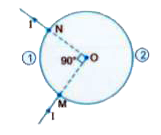
|
|
| 49. |
You slowly lift a book of mass 2 kg at constant velocity a distance of 3m. How much work did you do on the book? |
| Answer» Solution :In this CASE, the force you exert must BALANCE the WEIGHT of the BOOK (otherwise the velocity of the book wouldn't be constant), so F=mg=(2kg)`(10m//s^(2))=20N`. Since this force is straight upward and the displacement of the book is also straight upward, F and d are parallel, so the work DONE by your lifting force is `W=Fd=(20N)(3m)=60N*m`. the work done is 60 J. | |
| 50. |
If the kinetic energy of a particle is increased by 16 times, the percentage change in the de-Broglie wavelength of the particle is |
|
Answer» 25 % change in de-Broglie wavelength, `(lambda - lambda.)/(lambda) = (1 - (lambda.)/(lambda)) xx 100 = (1-(1)/(4)) xx 100 = 75%` |
|