

Saved Bookmarks
This section includes 7 InterviewSolutions, each offering curated multiple-choice questions to sharpen your Current Affairs knowledge and support exam preparation. Choose a topic below to get started.
| 1. |
When 10 observations are taken the random error isx when 100 observations are taken the random error becomes |
|
Answer» `X//10` |
|
| 2. |
(a) There is an infinitely long thread uniformly charged with linear charge density lamda C//m. Using Gauss’ law, calculate the electric field (E_0) at a distance x from the thread. (b) Now consider a semi-infinite uniformly charged thread (linear charge density = lamda) as shown in figure. Find the y component of electric field at point P in terms of E_0. Use simple qualitative argument. (c) For the situation described in (b) calculate the x component of electric field at point P using the method of integration. (d) Find the angle that the electric field at P makes with x direction. |
|
Answer» (B). `E_(y)=(E_(0))/(2)` (C). `E_(x)=(E_(0))/(2)=(lamda)/(4pi epsilon_(0)x)` (d). `45^(@)` |
|
| 3. |
Figure shows a long wire bent at the middle to from a right angle |
|
Answer» The magnitude of MAGNETIC FIELD at the points P, Q, R and S are same. |
|
| 4. |
In a Zener regulated power supply , a Zener diode with V_(Z) = 6.0 V is used for regulation . The load current is to be 4.0 mA and the unregulated input is 10.0 V . What should be the value of series resistor R_(S) ? |
| Answer» Solution :The value of `R_(S)` should be such that current through the Zener DIODE is much larger than the load current . This is to have good load regulation . Choose Zener currentas five TIMES the load current , i.e., `I_(Z) = 20 mA` . The total current through `R_(S)` is , therefore , 24 mA . The voltage drop across `R_(S)` is `10.0 - 6.0 = 4.0 V` . This gives `R_(S) = (4.0 V)/((24 xx 10^(-3)) A) = 167 Omega` . The NEAREST value of carbon resistor is `150 Omega` . So , a series resistor of `150 Omega` is appropriate . Note that slight variation in the value of resistor does not matter , what is important is that the current `I_(Z)` should be sufficiently larger than `I_(I) = ` | |
| 5. |
Someequipotential surface of the magnetic scalar potential aremagnetic field at a pointin the region is |
|
Answer» `10^(-4) T` |
|
| 6. |
A convex lens of focal length 25 cm is placed coaxially in contact with a concave lens of focal length 20 cm. Determine the power of the combination. Will the system be converging or diverging in nature ? |
|
Answer» Solution :As `f_(1) = +25 cm` and `f_(2) = -20 cm` `RARR P_(1) = 100/(f_(1) cm) = +100/25 = +4D` and `P_(2) = 100/(f_(2)cm) = -100/20 = - 5D` `therefore` Power of the combination `P = P_(1) + P_(2) =+4D - 5D =-1D` The -ve sign of power SHOWS that the combination is behaving like a diverging lens. |
|
| 7. |
(A):A body may be accelerated even when it is moving at uniform speed. (R ):When direction of motion of the body is changing then body may have acceleration. |
|
Answer» |
|
| 8. |
According to Bohr's postulate, the angular momentum of an electron , mvr=(nh)/(2pi) Using this formula show that magnetic moment of the atom is M=nmu_B Here what is mu_B and and what is its value ? |
|
Answer» Solution :According to Bohr.s postulate , the ANGULAR MOMENTUM of an electron, `mvr=(nh)/(2pi)` where m - MASS of the electron , v - velocity of the electron , h - Planck.s constant and n - 1 , 2 etc, the no of orbits . Since `v=romega,` we have `r^2=(nh)/(2pi) "":.M=1/2e.(nh)/(2pim)=n.(EH)/(4pim)` ie, `M=nmu_B` where `(eh)/(4pim)=mu_B` , called Bohr Magneton. Bohr magneton is the UNIT of atomic magnetic dipole moment. |
|
| 9. |
As shown in figure a ray of light in air is incident at 30^@ on a medium and proceeds ahead in the medium. The refractive index of this medium varied with distance y as given by n(y) = 1.6 + (0.2)/(y +1)^(2) where y is in cm. What is the angle formed by the ray with the normal at a very large depth ? |
|
Answer» Solution :`rArr` Suppose the angle is `theta` at distance in the MEDIUM. Appyling Snell.s law at this point, `N(y) SIN theta= C,` where C = constant....... (1) This formula is ture for all the pionts, Applying it to poin O, `n(0) sin 30^@ = C` But, `n(0) = 1.6 + (0.2)/((0+1))^2` `thereforen(0) = 1.8 ` From equation (2), `therefore n(0) = 1.8 xx 1/2 =C` `therefore 0.9 = C` Puting this value in (1), n(y) sin `theta` = 0.9 `therefore{1.6 + (0.2)/((y+1)^2)} sin theta =0.9` `therefore sin theta= (0.9)/(1.6 + (0.2)/(y+1)^2)` When y is very large, taking `y rarr oo`, we get sin `theta = (0.9)/(1.6)` `thereforetheta = 34^@ 14.` |
|
| 10. |
The time. period of a simple pendulum oscillating in a laboratory at north pole is 4s. Accounting for earth's rotation only, what will be the time period of this pendulum oscillating in a laboratory at equator? |
|
Answer» LESS then 4S |
|
| 11. |
The wavelength of the light used in Young's double slit experiment is lamda. The intensity at a point on the screen where the path difference is (lamda)/(6)is I. I_(0) mdenotes the maximum intensity then the ration of I and I_(0) is |
|
Answer» very few coloured fringes can be SEEN with first order red fringes being closer to the CENTRAL white FRINGE |
|
| 12. |
A wire of resistance R is cut into 'n' equal parts. These parts are then connected in parallel. The equivalent resistance of the combination will be: |
|
Answer» nR |
|
| 13. |
Potential is a scalar quantity. Potential gradient is a vector quantity Negative of potential gradient is another vector quantity. It is |
|
Answer» ELECTRIC field |
|
| 14. |
The capacity of four given condensers are C_1,C_2,C_3 and C_4 respectively. The maximum capacity can be obtained by connecting them : |
|
Answer» In SERIES |
|
| 15. |
A nucleus ruptures into nuclear parts which have their velocity ratio equal to 2:1 . What will be the ratio of their nuclear radius ? |
|
Answer» `1:2^(1//3)` |
|
| 16. |
D_(2)O(Heavy water)" and "H_(2)O differ in following except - |
|
Answer» Freczing point |
|
| 17. |
Resistance P, Q, R, S in the four sides of Whearstone bridge have respective values 10 Omega, 30 Omega, 20 Omega and 60 Omega. A cell connected across one diagonal has emf 5 V and internal resistance 2 Omega. If resistance ofgalvanometer is 60 Omega then current passing the cell is ..... |
|
Answer» 0.2 A Resistance of Wheatstone BRIDGE in the balanced condition, `R = ((10+ 30)(20 + 60))/((10 + 30) + (20+ 60)) = (40 xx 80)/(120) = (80)/(3) OMEGA` `therefore ` CURRENT through the battery. `I = (5)/(R + 2) = (5)/((80)/(3)+2) ` `therefore I = (5 xx 3)/(86) = 0.17446 A ` `therefore I = 0.17 A ` |
|
| 18. |
An electron and proton are moving in the same direction and possess same K.E. Find the ratio of de-Broglie wavelength associated with these particles. |
|
Answer» Solution :For photon `K.E., E_(p) =1/2m_(p).v_(p)^(2)` so `m_(p)v_(p) =sqrt(2m_(p)E)`…..(i) For ELECTRON K.E. `E_(e) =1/2m_(e)v_(e)^(2)`, So `m_(e)v_(e)=sqrt(2m_(e)E)`……(ii) So the ratio of de-Broglie wavelength of PROTONS and ELECTRONS is `lambda_(p)/lambda_(e) =h/(m_(p)v_(p)) xx (m_(e) v_(e))/h = (m_(e) v_(e))/(m_(p)v_(p))` Using Eq. (i) & (ii), we get `lambda_(p)/lambda_(e) =sqrt((2m_(e)E)/(2m_(p)E)) = sqrt(m_(e)/m_(p)) lt 1` `lambda_(p) lt lambda_(e)` or `lambda_(e) gt lambda_(p)` .e. de-Broglie wavelength associated with electron is more than that of proton. |
|
| 19. |
A beam of monochromatic light is refracted from vacuum into a medium of refractive index 1.33. The wavelength of refracted light will be: |
|
Answer» DEPEND UPON INTENSITY of REFRACTED light |
|
| 20. |
Answer the following questions: (a) Are the equations of nuclear reactions (such as those given in Section 13.7) 'balanced' in the sense a chemical equation (e.g., 2H_2 + O_2 to 2H_2 O) is? If not, in what sense are they balanced on both sides? (b) If both the number of protons and the number of neutrons are conserved in each nuclear reaction, in what way is mass converted into energy (or vice-versa) in a nuclear reaction? (c) A general impression exists that mass-energy interconversion takes place only in nuclear reaction and never in chemical reaction. This is strictly speaking, incorrect. Explain. |
|
Answer» Solution : (a) A CHEMICAL equation is balanced in the sense that the NUMBER of atoms of each element is the same on both sides of the equation. A chemical reaction merely alters the original combinations of atoms. In a nuclear reaction, elements may be transmuted. Thus, the number of atoms of each element is not necessarily conserved in a nuclear reaction. However, the number of protons and the number of neutrons are both separately conserved in a nuclear reaction. [Actually, even this is not strictly true in the realm of very high energies - what is strictly conserved is the total charge and total .baryon number.. We need not pursue this MATTER here.] In nuclear reactions (e.g., Eq. 13.26), the number of protons and the number of neutrons are the same on the two sides of the equation, (b) We know that the binding energy of a nucleus gives a negative contribution to the mass of the nucleus (mass defect). Now, since proton number and neutron number are conserved in a nuclear reaction, the total rest mass of neutrons and protons is the same on either side of a reaction. But the total binding energy of nudel on the left side need not be the same as that on the right hand side. The difference in these binding energies appears as energy released or absorbed in a nuclear reaction. Since binding energy contributes to mass, we say that the difference in the total mass of nudel on the two sides get converted into energy or vice-versa. It is in these sense that a nuclear reaction is an example of mass energy interconversion. (c) From the point of view of mass-energy interconversion, a chemical reaction is similar to a nuclear reaction in principle. The energy released or absorbed in a chemical reaction can be traced to the difference in chemical (not nuclear) binding energies of atoms and molecules on the two sides of a reaction. Since, strictly speaking, chemical binding energy also gives a negative contribution (mass defect) to the total mass of an atom or molecule, we can equally well say that the difference in the total mass of atoms or molecules, on the two sides of the chemical reaction GETS converted into energy or vice-versa. However, the mass defects involved in a chemical reaction are almost a million times smaller than those in a nuclear reaction. This is the reason for the general IMPRESSION, (which is incorrect) that mass-energy interconversion does not take place in a chemical reaction. |
|
| 21. |
a.Figure shows a cross-section of a 'light pipe' made of glass fibre of refractive index1.68 The outer converting of the pipe is made of a material of refractive index 1.44. What is the range of the angles of the incident rays with the axis of the pipe for which total reflections insides the pipe take place as shown in the figure. b.What is the answer if there is no outer converting of the pipe ? |
|
Answer» B. `90^(@)` |
|
| 22. |
The wavelength of de-Broglie wave is 3 mu m, then its momentum (h = 6.63 xx 10^(-34) Js) is |
|
Answer» `3.315 XX 10^(-28) "kg ms"^(-1)` |
|
| 23. |
What is the unit of k in the relation U=(ky)/(y^(2)+a^(2)) where U represents the potential energy, y represents the displacement and a represents the maximum displacement i.e., amplitude ? |
|
Answer» `ms^(-1)` Hence correct CHOICE is `(C )`. |
|
| 24. |
A graph is drawn taking frequency of incident radiation ( v) along the X-axis and its stopping potential ( V_(0)) along the Y-axis. The nature of the graph |
|
Answer» STRAIGHT line |
|
| 25. |
If the earth were to tripple its present distance from the sun then number of days in one year will be : |
|
Answer» `365xx3` `T_(2)" 365 " 3sqrt(3)" DAYS"` |
|
| 26. |
Radiation of 4f_(0) frequency is incident on metal surface with f_(0) threshold frequency maximum kinetic energy of photo-electric emitted will be …. |
|
Answer» `3hf_(0)` `=4hf_(0)-hf_(0)=3hf_(0)` |
|
| 27. |
यदि बहुपद p(x) = x^2 - 8x + 10 के शून्यक alpha,beta हो तो alpha^2 beta+alpha.beta^2 का मान होगा- |
|
Answer» -40 |
|
| 28. |
Spherical balls of radius R are falling in a viscous fluid of viscosity h with a velocity v. The retarding viscous force acting on the spherical ball is : |
|
Answer» directly PROPORTIONAL to R but inversely proportional to velocity v `F=6etaRv` `thereforeFpropR` and `Fpropv` So the correct CHOICE is (d). |
|
| 29. |
A rectangular coil of area 'A', having number of turns N, is rotated at 'f' revolutions per second in a uniform magnetic field B, the field being perpendicular to the coil. Prove that the maximum emf induced in the coil is 2 pi fNBA. |
|
Answer» Solution :Consider a rectangular coil PQRS of N turns, each of area A, held in a uniform magnetic field `vecB`. Let the coil be rotated at a steady angular velocity w about its own axis. Let at any instant t, normal to the area (i.e., the area vector `vecA`) subtends an ANGLE `THETA = omega t` from direction of magnetic field `vecB`. Then, at that MOMENT, the magnetic flux linked with the coil is ` phi_(B) = NvecB.vecA = NB Acos theta = NB Acos omegat` `therefore` Induced emf `varepsilon = - (dphi_(B))DT = - d/dt (N B A cos omegat)` ` =-N B A d/dt(cos omegat) = N B A omegat` where `varepsilon_(0) = N B A omega` = maximum value of induced emf. If the coil be ROTATING at .f. revolutions per second, then `omega = 2pif` and the maximum induced emf `varepsilon_(0) = NBAomega = 2pifNBA` 
|
|
| 30. |
When a diatomic gas undergoes adiabatic change its pressure (P) and temperature (T) are related by the relation PalphaT^cWhat is the value of C ? |
|
Answer» `2.5` |
|
| 31. |
If alpha, beta are the zeros of polynomials x^2 - 6x + 2 then 1/alpha +1/beta =? |
|
Answer» 3 |
|
| 32. |
The arm PQ of the rectangular conductor is moved from x=0, outwards. The uniform magnetic field is perpendicular to the plane and extends from x=0 to x=b and is zero for xgtb. Only the arm. PQ possesses substantial resistance r. Consider the situation when the arm PQ is pulled outwards from x=0 to x=2b, and is then moved back to x=0 with constant speed v. Obtain expressions for the flux, the induced emf, the force necessary to pull the arm and the power dissipated as Joule heat. Sketch the variation of these quantities with distance. |
|
Answer» Solution :Let us first consider the forward motion from `x=0` to `x=2b`. The flux `phi_(B)` linked with the circuit SPQR is, `phi_(B)=B//x""0lexltb` `=B//b""blexlt2b` The induced emf is, `epsilon=-(dphi_(B))/(dt)` `=-B//upsilon""0lexltb` `=0""blexlt2b` When the induced emf is non-zero, the current I is (in magnitude) `I=(B//v)/(r )` 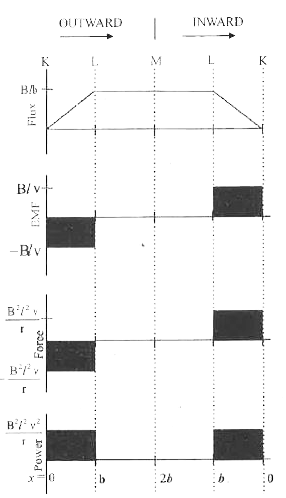 The force required to keep the arm PQ in constant motion is I/B. Its DIRECTION is to the left. In magnitude `F=(B^(2)l^(2)v)/(r)""0lexltb` `=0""blexlt2b` (constant) The Joule heating LOSS is `P_(J)=I^(2)r=(B^(2)l^(2)v^(2))/(r)0lexltb` `=0""blexlt2b` One obtains similar EXPRESSIONS for the INWARD motion from `x=2b` to `x=0`. The sketch of various quantities is displayed in the above figure. |
|
| 33. |
During each hour of flight, a large jet airplane consumes 3330 gallons of fuel via combustion. Combustion releases 1.25xx10^(6) joules/gallon. One gallon of fuel has a mass of 2.84kg. Calculate the energy equivalent of 3330 gallons of fuel and determine the ratio (in xx10^(-10) percent) of this energy equivalent to the amount of energy released by combustionin one hour of flight. |
|
Answer» |
|
| 34. |
Binding energy per nucleon is more for |
|
Answer» INTERMEDIATE nuclei |
|
| 35. |
A solid sphere of mass 2 kg is resting insidea cube as shown in the figure . The cube is moving with a velocity v=5ti + 2tj . Here t is in second . All surface are smooth . The sphere is at rest with respect to thecube . What is the totalforceexerted by the sphere on the cube . |
|
Answer» Solution :`v=5ti + 2tj , bar(a) = (DV)/(DT) = 5I + 2j` ` F = ma_x hati + m(g +a_y) hatj , F=2(5i) + 2[10+2]hatj` , `F=10i + 25 j , F= SQRT(100 + 567) = sqrt(676) = 26N` |
|
| 36. |
यदि (26, 169) का महत्तम समापवर्तक (HCF)=13, तो (26, 169) का लघुत्तम समापवर्तक (LCM) = |
|
Answer» 26 |
|
| 37. |
In the carnot engine, heat Q_1 is absorbed from the source at temperature T_1. What is the effect on the’temperature of the source ? |
|
Answer» it increases |
|
| 38. |
Find the condition under which the charged particles moving with different speeds in the presence of electric and magnetic field vectors can be used to select charged particles of a particular speed. |
|
Answer» SOLUTION :As the charged particle finally moves undeviated along the x-axis only, it means that force due to ELECTRIC field and force due to magnetic field are just equal and OPPOSITE and are nullifying each other i.e., `q vecE + q vecv xx vecB = vec0 "or" qE = qvB implies B = E/v` It is possible only when `vecB` is along the z-axis. thus, PARTICLES, POSSESSING a particular speed .v. only will move undeviated under the influence of a pair of crossed electric and magnetic fields. |
|
| 39. |
How can the power of the combination expressed, if two lenses are equibiconcave and separated by a distance? |
|
Answer» SOLUTION :`(1)/(F)= (1)/(-f_(1))+(1)/(-f_(2))-(d)/((f_(1))(f_(2)))` i.e.,`(1)/(-f)= (1)/(f_(1))+(1)/(f_(2))+(d)/(f_(1)f_(2))` |
|
| 40. |
The photon energy in the frame K is equal to epsilon. Making use of the transformation formulas cited in the foregoing problem, find the energy epsilon^' of this photon in the frame K^' moving with a velocity V relative to the frame K in the photon's motion direction. At what value of V is the energy of the photon equal to epsilon^'=epsilon//2? |
|
Answer» Solution :For a PHOTON moving in the x direction `EPSILON=cp_x`, `p_y=p_z=0`, In the moving frame, `epsilon^'=(1)/(SQRT(1-beta^2))(epsilon-V(epsilon)/(c))=epsilonsqrt((1-V//c)/(1+V//c))` Note that `epsilon^'=epsilon/2` if, `1/4=(1-beta)/(1+beta)` or `beta=3/5`, `V=(3C)/(5)`. |
|
| 41. |
Define mobility of a charge carrier. Write the relation expressing mobility in terms of relaxation time. Give its SI unit. |
|
Answer» Solution :MOBILITY of electrons (or other CHARGE carriers) in a conductor means DRIFT speed of conduction electrons per unit electric field. Mobility`mu = (v_d)/(E )` We know that drift speed of electrons `v_d = (eE)/(m) tau`, where `tau`= RELAXATION time `therefore mu = ( (eE tau)/(m) )/(E )= e/m tau` SI unit of mobility is `m^2 V^(-1) s^(-1)` |
|
| 42. |
The pressure exerted by an electromagnetic wave of intensity I(W/m^2) on a reflecting surface is |
| Answer» ANSWER :C | |
| 43. |
The height of a cloud above the earth is 100 m. If an observer hears the sound of thunder 0.3 s after the lightening is seen what is the velocity of sound on that day? |
| Answer» SOLUTION :`333.3 MS^(-1)` | |
| 44. |
The time constant of a certain inductive coil was found to be 2.5 ms. With a resistance of 80Omega added in series, a new time constant of 0.5 ms was obtained. Find the inductance and resistance of the coil. |
|
Answer» Solution :Time CONSTANT, `tau_(L)= (L)/(R)` For the first case, `(L)/(R)= 2.5 XX 10^(-3) sec to (1)` For the second case, `(L)/(R+80)=0.5xx10^(-3) rarr (2)` Divide (1) by (2) `(R +80)/(R) =(2.5)/(0.5)=5` SOLVING we get: `R=20 Omega` Now, `(L)/(R) = 2.5 xx 10^(-3)` `L=2.5 xx10^(-3)xx20 = 50`mH |
|
| 45. |
The space between two concentric conducting spherical shells of radii b=1.70 cm and a=1.20 cm is filled with a substance of dielectric constant k=6.91 A. A potential difference V=73.0 V is applied across the inner and outer shells Determine (a) the capacitance of the device (b) the free charge q on the inner shell, and (c) the charge q induced along the surface of the inner shell? |
| Answer» SOLUTION :`a) 31.4 PF B) 2.29 NC C)1.96 nC` | |
| 46. |
The wavelength of de Broglie wave associated with a thermal neutron of mass m at absolute temperature T is given by : (K = Boltzmann constant) |
|
Answer» `H/sqrt(2mKT)` |
|
| 47. |
A steel wire has a lengh of 90 cm which is under a constant tension of 100 N. The speed of the transverse waves that can be produced in the wire will be (take the mass of the steel wire be 6 xx 10^(-3) kg) , |
|
Answer» 50 m/s. m = `(M)/(L) = (6xx10^(-3))/(0.9) = (2)/(3) xx 10^(-2) `KG/`m^(-1)` Now v = `sqrt(T//m)= sqrt((100)/((2)/(3) xx 10^(-2)))` = ` 100 sqrt((3)/(2)) = 50 sqrt(6)` s . correct choice is d. |
|
| 48. |
Find the magnitude of emf induced in a 200 turn coil with cross-sectional area of 0.16m^(2) if the magnetic field through the coil changes from 0.10 Weber/m^(2) to 0.50 Weber/m^(2) at a uniform rate over a period of 0.02 second |
|
Answer» |
|
| 49. |
Which of the following is not oxidised by Aqueouis Br_(2) ? |
|
Answer» D-Fructose & D-Ribulose |
|
| 50. |
Do individual atoms of a paramagnetic material have permanent dipole moment? |
| Answer» Solution :Yes, ATOMS of PARAMAGNETIC materials have a finite, though SMALL, VALUE of MAGNETIC dipole moment | |