Saved Bookmarks
This section includes 7 InterviewSolutions, each offering curated multiple-choice questions to sharpen your Current Affairs knowledge and support exam preparation. Choose a topic below to get started.
| 1. |
Define ‘quality factor’ of resonance in series LCR circuit. What is its SI unit? |
| Answer» Solution :MICROWAVES are CONSIDERED suitable for RADAR systems used in aircraftnavigation due to their short WAVELENGTH or resonant curve. | |
| 2. |
Correct exposure for a photographic print is 10 s at a distance of one metre from a point source of 20 cd. For an equal fogging of the print placed at a distance of 2 m from a 16 cd source, the necessary time for exposure is |
|
Answer» 100 s `I_(2)xxt_(2)=I_(1)xxt_(1)` or`L_(2)/r_(2)^(2)xxt_(2)=L_(1)/r_(1)^(2)xxt_(1)` or`16/4xxt_(2)=20/1xx10` `therefore``t_(2)=50 s` |
|
| 3. |
A point object O is placed at a distance of 20 cm from a convex lens of focal length 10 cm as shown in figure. At what distance x from the lens should a mirror of focal length 60 cm, be placed so that final image coincides with the object? |
| Answer» SOLUTION :`20CM` | |
| 4. |
If the system is in equilibrium, the magnitude of friction acting on block B shown in the figure is |
|
Answer» 10N |
|
| 5. |
In Fig 27.37, epsi_(1)=1.00V, epsi_(2)=3.00 V, R_(1)=4.00 Omega, R_(2)=2.00 Omega, R_(3)=5.00 Omega, both batteries are deal. What is the latest which energy is dissipated in (a) R_1, (b) R_2 and (c) R_3? What is the power of (d) battery 1 and(e) ballery 2? Is energy being absorbed or provided in (f) battery and (g) battery 2? |
|
Answer» |
|
| 6. |
Two slits are made one millimeter apart and the screen is placed one meter away. What should the width of each slit be to obtain 10 maxima of the double slit pattern within the central maximum of the single slit pattern : |
|
Answer» SOLUTION :We WANT `a theta = lambda` (or) `theta= (lambda)/(a)` (a= width of each slit) `10(lambda)/(d)= 2(lambda)/(a)` `THEREFORE a= (d)/(5)= (1)/(5)=0.2mm`. |
|
| 7. |
A cylinder rollsup an inclinedpalne , reaches some heightand then rollsdown(without slippingthrough out thesemotions ) Thedirections of frictional forceacting on the cylinderare |
|
Answer» up the inclinewhileascending as WELL as DESCENDING |
|
| 8. |
A body weighing 10 kg rests on a horizontalsurface, the co-efficient of static friction between the surfaces being 0.364. Findthe horizontal force needed just to pull the block |
|
Answer» 35.67 N |
|
| 9. |
(a) Figure 24-10a shows two points i and fin a uniform electric field overset(to)(E ). The points lie on the same electric field line (not shown) and are separated by a distanced. Find the potential difference V_(f)- V_(i) by moving a positive test charge q_(0) from i to f along the path shown, which is parallel to the field direction. (b) Now find the potential difference V_(f)- V_(i) by moving the positive test charge q_0 from i to f along the path icf shown in Fig. 24-10b. |
|
Answer» Solution :We can find the potential difference between any two points in an electric field by INTEGRATING `overset(to)( E) .d overset(to) (s)` along a path connecting those two points ACCORDING to Eq. 24-20. Calculations: We have actually already DONE the calculation for such a path in the direction of an electric field line in a uniform field when we derived Eq. 24-23. With slight changes in NOTATION, Eq. 24-23 gives us `V_(f)- V_(i)= - Ed.`(Answer) Calculations: The Key Idea of (a) applies here too, except now we move the test charge along a path that consists of two lines: is and cf. .At all points along line is, the displacement `d overset(to)s` of the test charge is perpendicular to `overset(to) (E)`. Thus, the angle `theta` between `overset(to)(E) and d overset(to)(s)` is 90°, and the dot product `overset(to)(E). d overset(to)(s)` is 0. Equation 24-20 then tells us that points i and c are at the same potential: `V_(c ) - V_(i)= 0`. Ah, we should have seen this COMING. The points are on the same equipotential surface, which is perpendicular to the electric field lines. For lines `cf` we have `theta=45^@` and, from Eq `24-20`, `V_(f)- V_(i)-int_(c)^(f) overset(to)( E).doverset(to)(s)=-int_(c)^(f) E ( cos 45^@) ds` `=- E ( cos 45^@) int_(c )^(f) ds`. |
|
| 10. |
What is the ratio of the angular speed of the hour hand of a clock to that of the Earth due to its spin (rotational motion)? |
|
Answer» Solution :If `omega_1 " and " omega_2` are the RESPECTIVE angular speeds of the hour hand and the EARTH about its axis. `omega_1/omega_2=(2pi//T_1)/(2pi//T_2)=T_2/T_1=24/12=2` |
|
| 11. |
Maximum magnetic force on electron moving with velocity 4xx10^(4)m//s is _____ when it moves in magnetic field having intensity 5xx10^(-5)T. |
|
Answer» `1.6xx10^(-19)N` F = evB `=1.6xx10^(-19)xx4xx10^(4)xx5xx10^(-5)` = `3.2xx10^(-19)N` |
|
| 12. |
A jeep is moving on a straight road due north with a uniform speed of 60 km h^(-1) . When it turns left through 90°. If the speed remains unchanged after turning, the change in the velocity of the jeep in the turning process is : |
|
Answer» 50 KM `h^(-1)` the WEST `vec(V_(2))`=60km/h due west. `:. Deltavec(V) = vec(V_(2))-vec(V_(1))=vec(V_(2)) + (-vec(V_(1)))`…(i) `|Deltavec(V)|=sqrt(V_(2)^(2)-V_(1)^(2))=sqrt((60)^(2) + (60)^(2))` |
|
| 13. |
We don't get any stock even though the electric field near the surface of earth is about 10Vm^(-1). Why ? |
| Answer» Solution :SINCE our BODY and earth.s surface are SITUATED on an equipotential surface, there is no p.d between them, hence no SHOCK. | |
| 14. |
Newton Kg^-1 is the unit of |
|
Answer» force |
|
| 15. |
A sphere rolls on the surface with velocity v. It encounters a smooth frictionless incline of height h which it needs to climb. What will be the minimum velocity for which it will climb the incline? |
| Answer» Answer :D | |
| 16. |
In a region where the electric field having magnitude 10^(4)NC^(-1), parallel to Y-axis exists. Calculate the potential difference between two points in that region, A (0, 2m) and B (0, 9m). |
| Answer» SOLUTION :`-7XX10^(4)V` | |
| 17. |
Angular width of central maximum in the Fraunhofer diffraction pattern of a slit is measured. The slit is illuminated by another wavelengths, the angular width decreases by 30%. Calculate the wavelength of this light. The same decreases in angular width of central maximum is obtained when the original appertus is immersed in a liquid. find the refractive index of the liquid. |
| Answer» SOLUTION :`4200 Å, mu=1.43` | |
| 18. |
Find the radius of curvature of the convex surface of a plano-convex lens, whose focal length is 0.3 m and the refractive index of the material of the lens is 1.5. |
|
Answer» Solution :Here FOCAL length of a plano-convex lens f= +0.3 m and refractive index of lens n = 1.5 For a plano-convex lens let `R_(1) = +R`and `R_2 = - infty`. Applying lens maker.s formula: `1/f = (n-1)(1/R_(1) - 1/R_(2))`, we get `1/0.3 = (1.5-1) (1/R -1/(-infty)) = 0.5/R` `rArr R = 0.3 XX 0.5 = 0.15 m` or 15 CM |
|
| 19. |
For a given slit, ratio of diffraction angle of fringes of first maxima and first minima is...... |
|
Answer» `(1)/(2)` `d sin theta_(N)=(2m+1)(lambda)/(2)` `sin theta_(1)=(3lambda)/(2D) "" [ :. m=1]` Condition for `m^(th)` order minimum `d sin theta_(m)=(lambda)/(d)` `(sin theta_(1))/(sin theta_(1))=(3lambda)/(2d)xx(d)/(lambda)=(3)/(2)` `:. (theta_(1))/(theta_(2))=(3)/(2)` |
|
| 20. |
Consider the following statement A and B and identify the correct answer A) The refractive index of the extra-ordinary ray depends on the angle of incidence in double refraction B) The vibrations of light waves acquire one sidedness fro both ordinary and extraordinary rays in double refraction |
|
Answer» A is FALSE but B is TRUE |
|
| 21. |
A body of mass m hits a wall with speed v at an angle of 30^o with normal and reflects at same angle from normal on other side of normal. The magnitude of change in linearmomentum of the body is (Consider elastic collision) |
|
Answer» `FRAC{8sqrt3mv}{2}` |
|
| 22. |
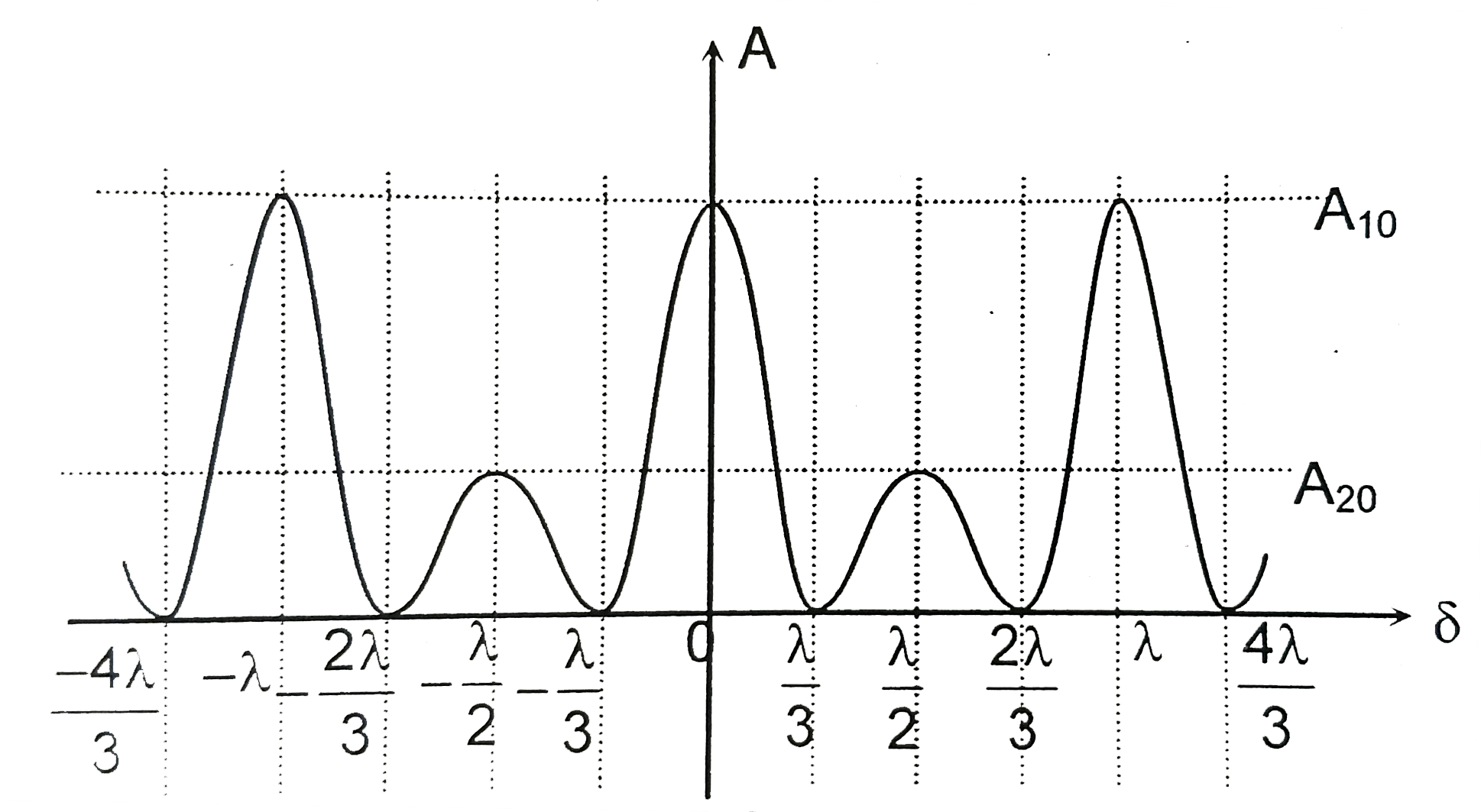
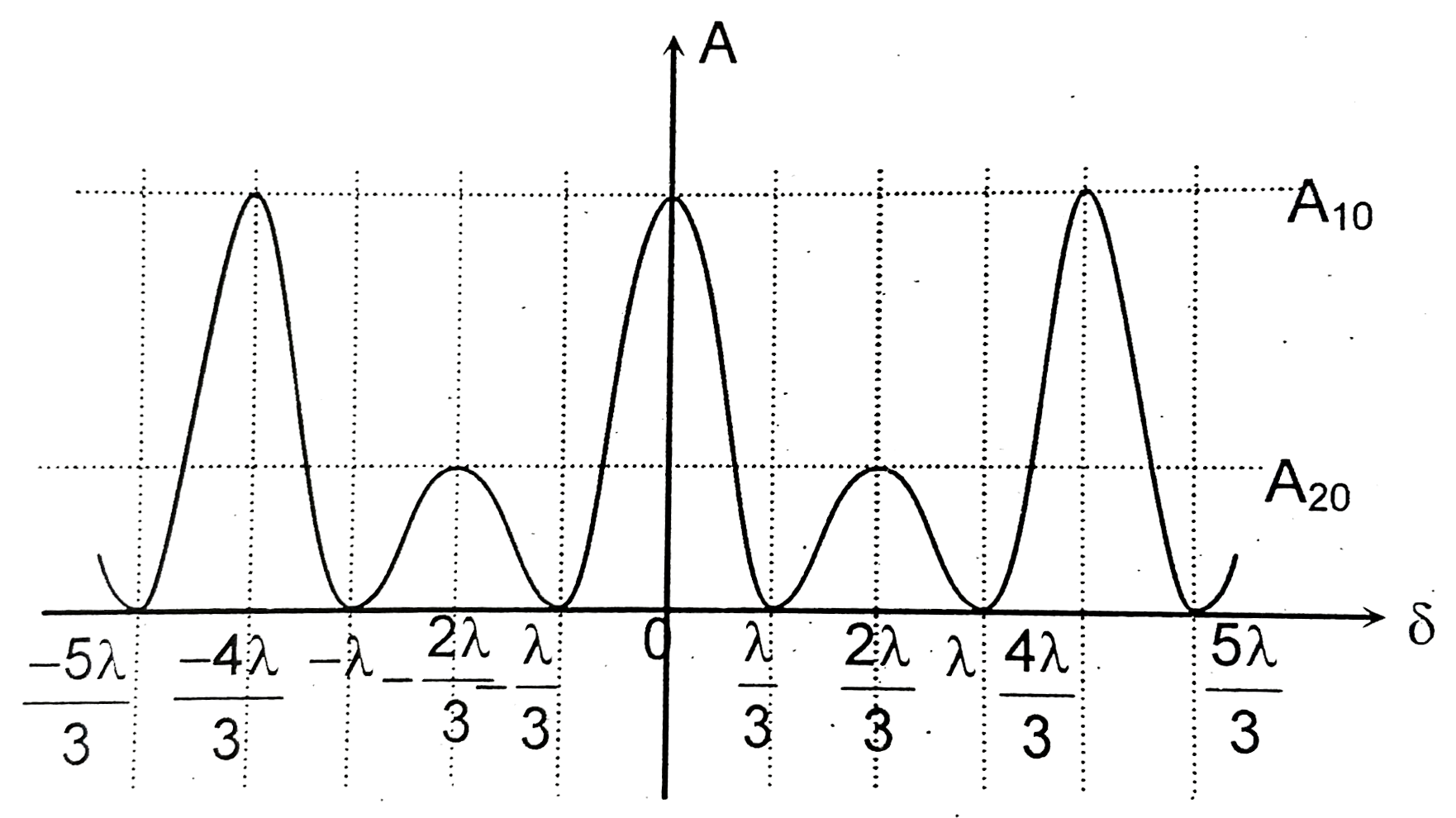
A triple slit experiment is performed as shown in the figure with monochromaric light of amplitude a_(0).S_(3)M~~S_(2)M=delta. The graph between resultant amplitude (A) versus delta is plotted. Choose the correct option (s). |
|
Answer»
`y_(2)=a_(0)sin (omega t-kx)` `impliesy_(1)=a_(0)sin(omegat-kx-phi)` and `y_(3)=a_(0)sin(omegat-kx+phi))` `A=|a_(0)+2a_(0)cosphi|=a_(0)|(1+2cosphi)|` `IMPLIES A=a_(0)|(1+2cos((2pixd)/(lamdaD))|` `=a_(0)|(1+2cos((2pidelta)/(lamda))|` 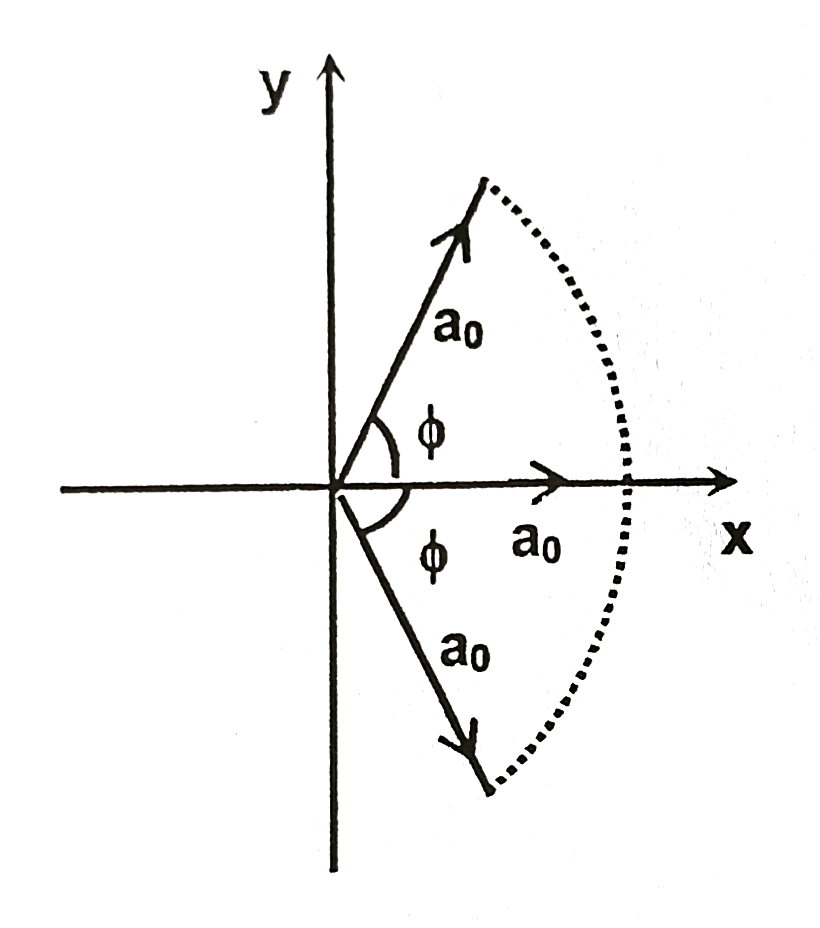 Second Method: Suppose `phi` and `delta` repesent the phase difference and PATH difference between TWO connective waves so 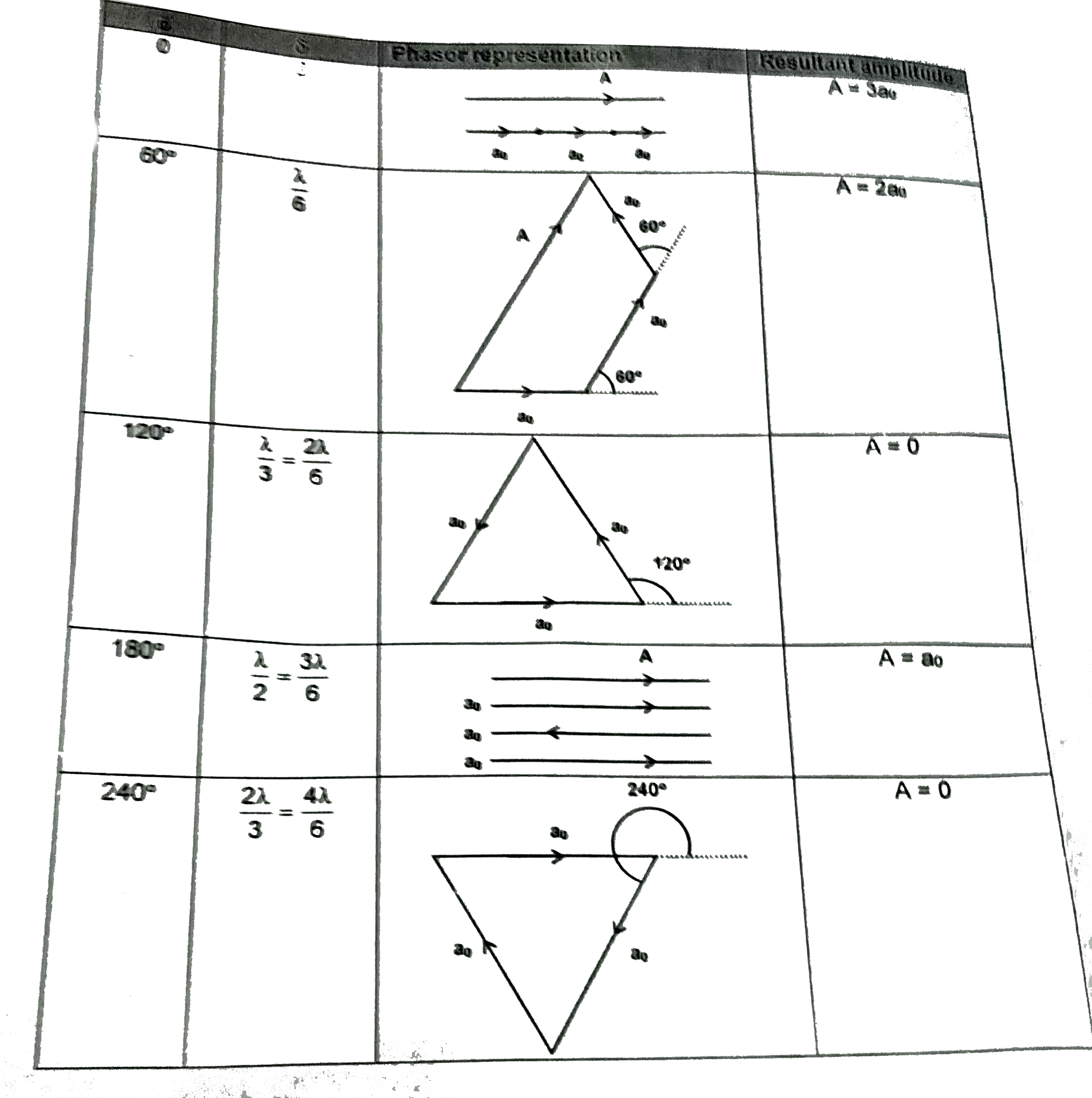 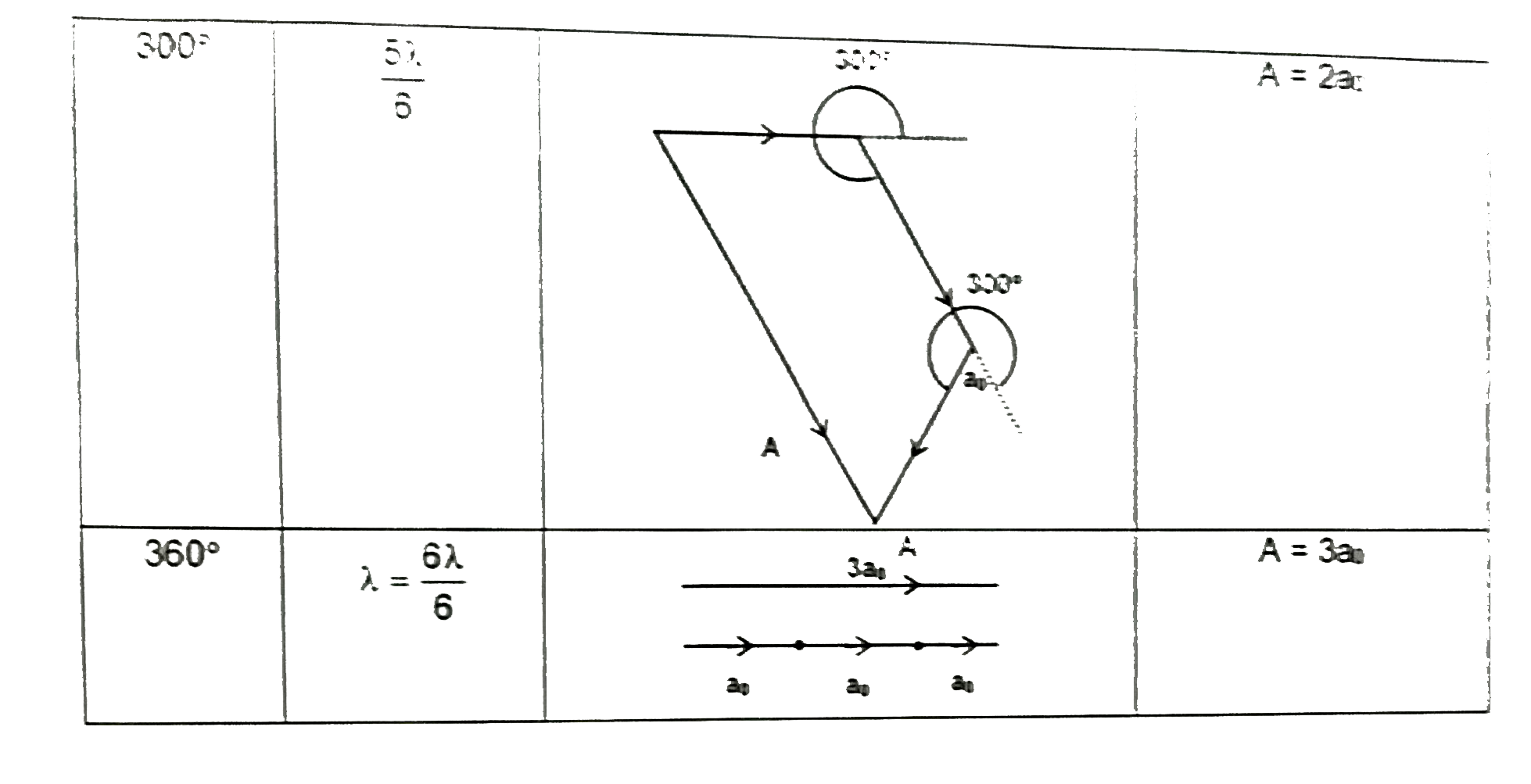
|
|
| 23. |
A piece of copper and another of germanium are cooled from room temeprature to 80 K. The resistance of |
|
Answer» each of themincreases |
|
| 24. |
A wire loop consists of a stright segment AB and a circular are ACB of radius r The segment AB subtends an angle of 60^(@) at the centre O of the circular are The wire loop carries a current I in the clockwise direction The net magnetic filed B at O due to the whole wire loop is . |
|
Answer» `B=B_(1)+B_(2)` |
|
| 25. |
In the graph variation of magnetic field with time 't' applied perpendicular to the plane of the ring is shown: |
|
Answer» at t=2 sec and CURRENT flowing in ring is equal to zero |
|
| 26. |
We have a very sensitive electronic instrument and we want to protect it from external electric fields. How ? |
| Answer» Solution :We can surround that INSTRUMENT with a conducting box or we can keept that inside the cavity of a conductor. By doing so the charge on the box or conductor with cavity distributes such that NET ELECTRIC field inside the box or cavity is zero.In this WAY instrument can be protected from the external fields. Do you know? This is called shielding. | |
| 27. |
Sn, C, and Si, Ge are all group XIV elements. Yet, Sn is a conductor, C is an insulator while Si and Ge are semiconductors. Why? |
| Answer» Solution :Because (i) in the structure of Sn, energy bands are superposed on each other, so energy gap between them is zero and hence Sn is a good conductor of electricity. (ii) In the structure of C, energy gap is 5.4 eV which is comparatively quite LARGE and so it BECOMES non-conductor of electricity. (III) Energygaps in Si and Ge are respectively 1.1 eV and 0.7 eV which are moderate and so their conductivity is LESS than good CONDUCTORS but more than non-conductors. Hence, Si and Ge become semiconductors. | |
| 28. |
A current of 1 ampere is passed through a straight wire of length 2.0 meters. What value of magnetic field at a point in air at a distance of 3 meters from either end of wire and on the axis of wire ? |
|
Answer» `(mu_(0))/(2PI)` For a GIVEN situation `theta_(1)=theta_(2)=0" "thereforeB=0` |
|
| 29. |
(a) Draw the plot of binding energy per nucleon (BE/A) as a function of mass number A. Write two important conclusions that can be drawn regarding the nature of nuclear force. (b) Use this graph to explain the relase of energy in both the processes of nuclear fusion and fission. (c) Write the basic nuclear process of neutron undergoing beta-decay. Why is the detection of neutrinos found very difficult? |
|
Answer» Solution :(a) Plot of binding energy per nucleon as the function of mass number A is given as below : Following are the two conclusion that can be drawn regarding the nature of the nuclear FORCE : (i) The force is attractive and strong enough to produce a binding energy of few MeV per nucleon. (ii) The constancy of the binding energy in the range `30 lt A lt 170` is a consequence of the fact that the nuclear force is short range force. 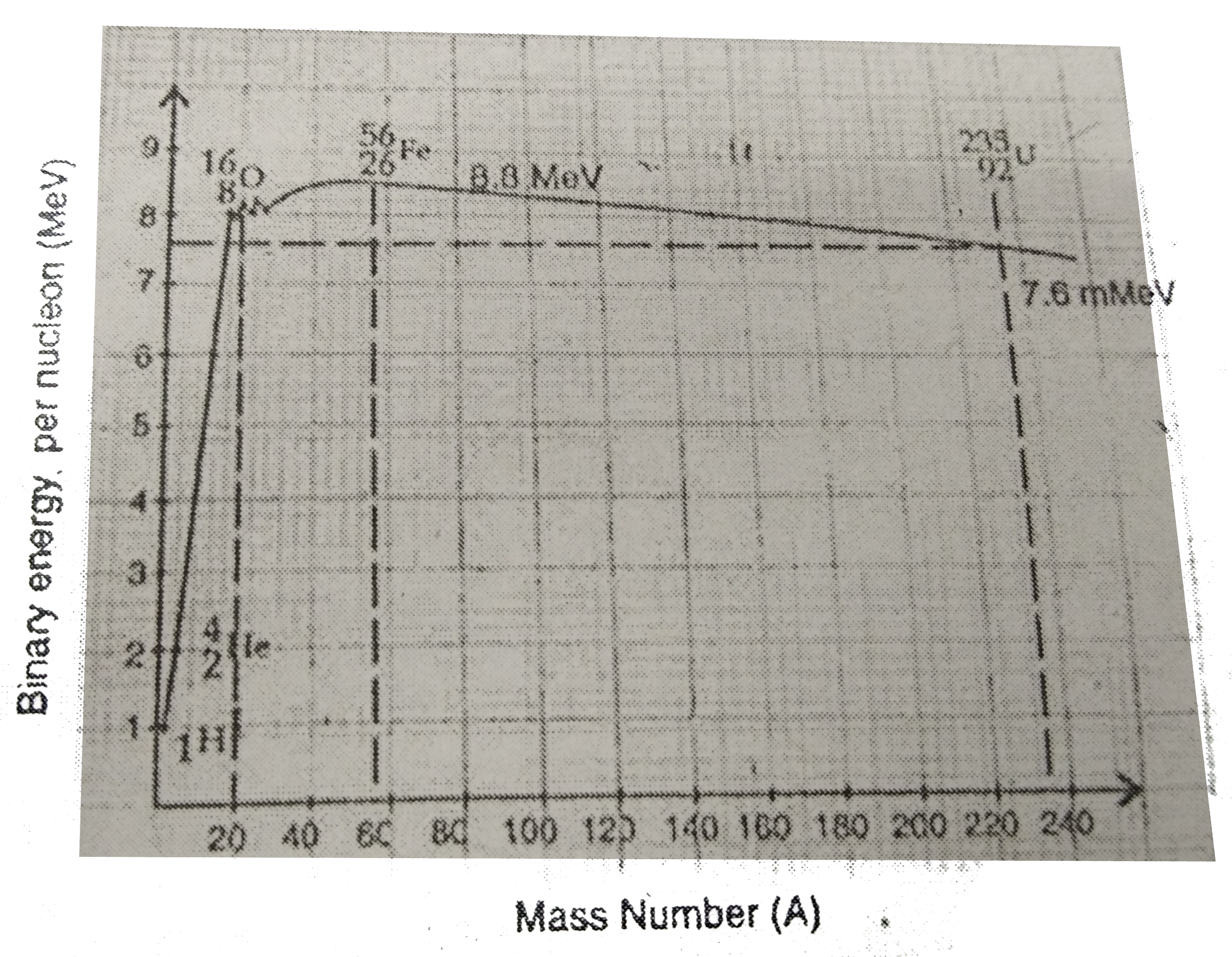 (b) Nuclear fission : A very HEAVY nucleas (say A = 240) has lower binding energy per nucleon as compared to the nucleus with A = 120. Thus, if the heavier nucleus breaks to the higher nucleus with high binding energy per nucleon, nucleons are tightly bound. This IMPLIES that energy will be RELEASED in the process which justifies the energy relase in fission reaction. Nuclear fusion : When two light nuclei `(A lt 10)` are combined to FORM a heavier nuclei, the binding energy of the fused heavier nuclei is mor than the binding energy per nucleon of the lighter nuclei. Thus, the final system is more tightly bound than the initial system. Again the energy will be relased in fusion reaction. (c) The basic nuclear process of neutronundergoing `beta` - decay is given as - `n rarr p + bar(e) + vec(v)` Neutrinos interact very weakly with matter so, they have a very high penetrating power. That's why the delection of neutrinos is found very difficult. |
|
| 30. |
A body moving along astraight line uniform acceleration 'a' covers a distance S_1 in the first t seconds and a distance S_2 in the next t second, a is then given by |
|
Answer» `(S_1 + S_2)/t^2` |
|
| 31. |
For the given two blocks system shown in figure (g=10m//s^(2)) |
|
Answer» Acceleration of `2kg` block is `1m//s^(2)` |
|
| 32. |
In Millikan's experiment for the determination of the charge on the electron, the reason for using the oil is |
|
Answer» It is a lubricant |
|
| 33. |
When 0.005A current flows through a moving coil galvanometer, it gives fullscale deflection. It is converted into a voltmeter to read 5 Volt, using an external resistance of 975Omega. The resistance of galvanometer in ohms is |
|
Answer» 5 |
|
| 34. |
If the ciritical angle for the medium of a prism isC and the angle of prism is A. then there will be no emergent ray when : |
|
Answer» `A LT 2C` |
|
| 35. |
A motor cycle starts from rest and accelerates along a straight path at 2 m//s^(2). At the straight point of the motor cycle there is a stationary electric siren. How far has the motor cycle gone when the driver hears the frequency of the siren at 94% of its value when the motor cycle was al rest? (Speed of sound = 330 ms^(-1)) |
|
Answer» 98m |
|
| 36. |
Unpolarized light falls on two polarizing sheets placed one on top of the other. What must be the angle between the characteristic directions of the sheets if the intensity of the transmitted light is one third intensity of the incident beam? |
|
Answer» SOLUTION :Intensity of the light transmitted through the first polarizer `I_1 = I_0 // 2`, where `I_0`is the intensity of the incident unpolarized light. Intensity of the light transmitted through the second polarizer is `I_2 = I_1 cos^2theta `where is the angle between the CHARACTERISTIC directions of the polarizer sheets. But `I_2 = I_0 // 3` (GIVEN) ` therefore I_2 = I_1 cos^2 theta = (I_0)/(2) cos^2 theta = (I_0)/(3)` `therefore cos^2 theta = 2//3 , theta = cos^(-1) sqrt(2/3)` |
|
| 37. |
If a 16Omegaresistance and 12 Omega inductive reactance are present in an a.c series circuit. Then the impedance of the circuit will be |
|
Answer» `28Omega` |
|
| 38. |
Name the quantity represented by the dimensional formula[M^1L^-3T^0] |
| Answer» Answer :D | |
| 39. |
The force between two parallel current carrying wires is independent of |
|
Answer» a. their distance of separation |
|
| 40. |
A solid ball of radius 6.0 cm is initially rolling smoothly at 10 m//s along a horizontal floor. It then rolls smoothly up a ramp until it momentarily stops. What maximum height above the floor does it reach? |
| Answer» SOLUTION :`~~7.1m` | |
| 41. |
The optical path difference between the two light waves arriving at a point on the screen is : |
|
Answer» `(XD)/D` |
|
| 42. |
1 कुलाम वह आवेश है जो शून्य में 1 मीटर की दुरी पर स्थित समान आवेश पर बल लगाता है |
|
Answer» `1N` |
|
| 43. |
An unknown resistance r is determined in terms of a standard resistance R=100 Omega by using potentiometer. The potentialdifference across r is balanced against 45 cm lengthof the wire and that (r+R) is obtained at 70 cmof the wire . Find the value of the unknownresistance in Omega. |
|
Answer» |
|
| 44. |
The force of repulsion between two charges +1 and 6C is 12N. A third charge -4C add between them, now the force between them will be … |
|
Answer» 4 N repulsive `F_(1) = (K(2)(6))/gamma^(2)` and `F_(2) = (k(-2)(2))/r^(2)` `therefore F_(1) = (12k)/gamma^(2)`…….(i), `therefore F_(2) = (-4K)/r^(2)`……….(ii) `therefore F_(2)/F_(1) = -4/12 = -1/3 F_(2)` is a FORCE between t after addint `-4C` charge. `therefore q_(1)^(.) = -2C` and `q_(2)^(.) = 2C` `therefore F_(2) = -1/3 xx F_(1) =-1/3 xx 12 = -4 N` Negative sign indicates attractive force. |
|
| 45. |
A 10muF capacitor is in series with a 50Omega resistance and the combination is connected to a 220 V, 50 Hz line. Calculate (i) the capacitive reactance, (ii) the impedance of the circuit and (iii) the current in the circuit. |
|
Answer» Solution :Here, `C=10muF=10xx10^(-6)=10^(-5)F` `R=50ohm, E_("rms")=220V, v=50Hz`, (i) Capacitive reactance, `X_(C)=(1)/(omegaC)=(1)/(2pivC)=(1)/(2xx3.14xx50xx10^(-5))=318.5Omega` (II) Impedance of CR circuit. `Z_(CR)=sqrt(R^(2)+X_(C)^(2))=sqrt((50)^(2)+(318.5)^(2))=322.4Omega` (iii) Current, `I_("rms")=(E_("rms"))/(Z_(CR))=(220)/(322.4)=0.68A` |
|
| 46. |
The graph between angle of deviation (delta) for a triangular prism is represented by : |
|
Answer»
|
|
| 47. |
What we call the arrangement of different types of e.m. waves according to their wavelengths or frequency ? |
| Answer» SOLUTION :ELECTROMAGNETIC SPECTRUM | |
| 48. |
The phenomenon of bouncing back of the light energy from the surface of the mirror is : |
|
Answer» reflection |
|
| 49. |
Eddy currents do not cause: |
|
Answer» Damping |
|
| 50. |
If an alpha- particle collides head on with a nucleus, what is impact parameter? |
|
Answer» zero |
|