

Saved Bookmarks
This section includes 7 InterviewSolutions, each offering curated multiple-choice questions to sharpen your Current Affairs knowledge and support exam preparation. Choose a topic below to get started.
| 1. |
To a man walking at the rate of 3 kmlh the rain appears to fall vertically. When he increases his speed to 6 kmlh it appears to meet him at an angle of 45° with vertical. Find the angle made by the velocity of rain with the vertical and its value. |
Answer» Solution :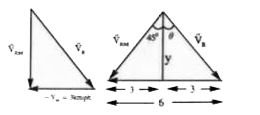 From the diagram `tan45^(@) =3/y`………..(i) and `tan THETA =3/y`……(2) From (1) and (2) `theta =45^(@)` and `THEREFORE sin 45^(@) =3/V_(R), 1/sqrt(2) =3/V_(R)` `V_(R) =3sqrt(2)` kmph |
|
| 2. |
Under suitable conditions two a-particles can combine to produce a proton and a nuclide of Li^(7). What minimum K.E. must the alpha -particle have in order that the reaction, may proceed. The range of nuclear interaction is 10^(-14)m: |
|
Answer» 2.2MeV Then, the `alpha`- particle must have sufficient velocity to come WITHIN the range of nuclear interaction which is `=10^(-14)m` . `1/(4pi epsi_(0)) . q^(2)/d=E("K.E. of INFINITY")` `rArr E=9 xx 10^(9) (4 xx (1.6 xx 10^(-9))^(2))/(10^(-14))` `=5.76 xx 10^(5)eV =0.576 MeV` |
|
| 3. |
The wavelength of light from the spectral emission line of sodium is 589 nm. Find the kinetic energyat which a. an electron, and b. a neutron, would have the same de Broglie wavelength. |
|
Answer» <P> Solution :a. DE Broglie WAVELENGTH, `lambda=(h)/(p) therefore p=(h)/(lambda)``K.E_("electron")=(p^(2))/(2m_(E ))=(h^(2))/(2m_(e )lambda^(2))` B. `K.E_("neutron")=(h^(2))/(2m_(n)lambda^(2))` |
|
| 4. |
The force between two electrons when placed in air is equal to 0.5 times the weight of an electron. Find the distance between two electrons (mass of electron = 9.1 xx 10^(-31)kg) |
|
Answer» 7.2m |
|
| 5. |
If current in diode is five times that in R_(1). Breakdown voltage of diode is 6 volt. Find R= ? |
|
Answer» Solution :Current in zero diode is 5 times. So total current DRAWN from battery `=6 mA+30 mA=36 mA` POTENTIAL difference Across `R=24` volt So V= IR `24=36xx10^(-3)R,R=2000//3 Omega` |
|
| 6. |
Equipotential surface through a point is ...... to the electric field at that point. |
|
Answer» PARALLEL |
|
| 7. |
Dimensional formula of the product of the two physical quantities P and Q is ML^(2)T^(-2), the dimensional formula of P/Q is MT^(-2), P and Q respectively are |
|
Answer» FORCE, velocity |
|
| 8. |
Three solid spheres each of mass m and radius R are released from the position shown in figure. The speed of any one sphere at the time of collision would be |
|
Answer» `SQRT(GM(1/d-3/R))` `3{1/2mv^2}=3{(Gm^2)/(2R)-(Gm^2)/d}` `rArr v^2=Gm{1/R-2/d} rArr v=sqrt(Gm{1/R-2/d})` 
|
|
| 9. |
Calculate the heat abosrbed by a system in going through the cyclic process show in Fig. |
|
Answer» 31.7 J |
|
| 10. |
What are the units of M (coefficient of mutual induction). |
| Answer» SOLUTION :SI. HENRY, CGS. EMU of INDUCTANCE. | |
| 11. |
The electrostatic force on a small sphere of charge 0.4muC due to another small sphere of charge0.8muCin air is 0.2 N. a. What is the distance between the two spheres? b. What is the force on the second sphere due to the first? |
|
Answer» Solution :`q_(1)=0.4 muC=0.4 xx 10^(-6)C, q_(2)=-0.8 MU C=-0.8 xx 10^(-6)C, F=0.2N` a. `F=9 xx 10^(6) (q_(1)q_(2))/(r^(2))` `r^(2)=9 xx 10^(9) xx (q_(1)q_(2))/(F)=(9 xx 10^(9) xx 0.4 xx 10^(-6) xx 0.8 xx 10^(-6))/(0.2) =14.4 xx 10^(-3) =144xx 10^(-4) m^(2) r=12 xx 10^(-2)m` b. 0.2N, attractive. |
|
| 12. |
The temperature coefficient of resistivity of material is 0.0004/k. When the temperature of the material is increased by 50^(@)C, its resistivity increases by 2xx10^(-8) ohm-m. The initial resistivity of the material in olm-m is |
|
Answer» `50xx10^(-8)` |
|
| 13. |
This question has Statement-I and Statement-II. Of thefour choices given after the Statements, choose the one that best describes the two Statements. Statement-I: A point particle of mass in moving with speed v collides with stationary point particle of mass M. If the maximum energy loss possible is given asf(1/2mv^2) then f=(m/(M+m))Statement-II : Maximum enegy loss occurs when the particles get stuck together as a result of the collision. |
|
Answer» Statement-I is true, Statement-II is true, Statement-II is not a CORRECT explanation of Statement KE in COM frame is `1/2((Mm)/(M+m))V_(rel)^2` `KE_i=1/2((Mm)/(M+m))V^2``KE-f=0(because V_(rel)=0)` Hence loss in energy is `1/2((Mm)/(M+m))V^2` `:. implies f=(M)/(M+m)` and not `((m)/(M+m))` as given in statement_I`. |
|
| 14. |
A spherical balll of mass m is the highest point in the space between two fixed , concentic sphere A and B the smaller the two sphere A has a radius R and the space between the two spheres has a width d . The bell has a disneter very dightly less then d . All surface are frictionless . The bell is a given a gentle push (owards the right in the figure ) The upward vertical is denoted by theta (shown ijn the figure) (a)Express the total normal reaction force exerted by the sphore on the as a finction of angle theta (b) Let N_(A) and N_(B)denote in the magnitubes of the normal reaction force on the bell evered by the sphare A and B repectively Skech the variation of N_(A) andN_(B) as functions of cos thetain the range 0 le theta le piby drawing two separate graph in your answer booktaking cos thetaan the horizental axas. |
|
Answer» `mg(3 COS theta-2)` |
|
| 15. |
Two identical coils, one of copper and the other of iron, are rotated with the same angular velocity omega in a uniform magnetic field. In which case the induced e.m.f. is more and why? |
| Answer» SOLUTION :The INDUCED emf does not depend UPON the NATURE of material of the coil. | |
| 16. |
The magnetic field in a plane electromagnetic wave is given by B_(y)=2xx10^(-7)sin(0.5xx10^(3)x+1.5xx10^(11)t). This electromagnetic wave is |
|
Answer» a visible light. |
|
| 17. |
Find the energy equivalent of one atomic mass unit, first in Joules and then in MeV. Using this, express the mass defect of ""_(8)^(16)O in MeV//c^2. |
|
Answer» Solution :`1 U = 1.6605 xx 10^(-27) KG` To convert it into energy UNITS, we multiply it by `c^2` and find that energy equivalent `= 1.6605 xx 10^(-27) xx (2.9979 xx 10^8)^2 kg m^2//s^2` `= 1.4924 xx 10^(-10) J` `= (1.4924 xx 10^(-10))/(1.602 xx 10^(-19)) eV` `= 0.9315 xx 10^(9) eV` `= 931.5 MeV` or, `1 u = 931.5 MeV//c^2` For `""_(8)^(16)O , "" Delta M = 0.13691 u = 0.13691 xx 931.5 MeV//c^2` `= 127.5 MeV//c^2` The energy needed to separate `""_(8)^(16)O` into its constituents is thus `127.5 MeV//c^2`. |
|
| 18. |
Let A and B be two sets such that A is a subset of B.then AnnB is equal to? |
|
Answer» `varphi` |
|
| 19. |
A mercury lamp is a convenient source for studying frequency dependence of photoelectric emission, since it gives a number of spectral lines ranging from the Uv to the red end of the visible spectrum. In our experiment with rubidium photo-cell, the following lines from a mercury source were used: lambda_(1) = 3650 Å, lambda_(2) = 4047 Å, lambda_(3) = 4358 Å, lambda_(4) = 5461 Å, lambda_(5) = 6907 Å, The stopping voltages, respectively, were measured to be: V_(01) = 1.28 V, V_(02) = 0.95 V, V_(03) = 0.74 V, V_(04) = 0.16 V, V_(05) = 0 V Determine the value of Planck’s constant h, the threshold frequency and work function for the material. [Note: You will notice that to get h from the data, you will need to know e (which you can take to be 1.6 xx 10^(-19) C). Experiments of this kind on Na, Li, K, etc. were performed by Millikan, who, using his own value of e (from the oil-drop experiment) confirmed Einstein’s photoelectric equation and at the same time gave an independent estimate of the value of h.] |
| Answer» Solution :Obtain `V_(0)` versus ν plot. The SLOPE of the plot is (h/e) and its intercept on the ν-axis is `ν_(0)` . The first four points lie nearly on a straight line which intercepts the ν-axis at `ν_(0) = 5.0 xx 10^(14) Hz` (threshold frequency). The fifth point corresponds to `v lt v_(0)` , there is no photoelectric emission and therefore no STOPPING voltage is required to stop the current. Slope of the plot is found to be `4.15 xx10^(-15) v s`. Using `e=1.6xx10^(-19)C, h=6.64xx10^(-34)Js("Standard value h "=6.626xx10^(-34)Js), phi_(0)=hv_(0)=2.11V.` | |
| 20. |
Unit of CR^(2) is/are (C = capacitance and R = resistance) |
|
Answer» Henry |
|
| 21. |
Two persons of the same height are standing one inside a shop and another outside the shop, on either side of a glass window. The second man sees his image behind the glass window due to reflection in the glass and his own image appears larger than the other person. What is the type of glass on the windows? |
| Answer» Solution :The outside of the glass window ACTS as a concave mirror. We KNOW that if an OBJECT is PLACED WITHIN the focus of a concave mirror, a virtual, erect and magnified image is formed behind the mirror. In case of a convex mirror, The image is diminished in size and in case of a plane mirror the image is of the same size as the object, So, for the man standing outside, the glass window behaves like a concave mirror. | |
| 22. |
A network of resistors is connected to a battery of negligible internal resistance, as shown in figure. Calculate the equivalent resistance between the point A and D, and the value of the current I_(3). |
|
Answer» |
|
| 23. |
The maximum kinetic energy of photoelectrons emitted from a metalic surface is 30 eV when monochromatic radiation of wavelength falls on it. When the same surface is illuminated with light of wavelength 2lambdathe maximum kinetic energy photo electrons is observed to be 10 eV Calculate the wavelength lambda and determine the maximum wavelength of incident radiation for which photoelectrons can be emitted by this surface, (h = 6.62 xx 10^(-34) JS =4.14 xx 10^(-15) eV-s. c = 3 xx 10^(8) m//s) |
|
Answer» |
|
| 24. |
What does the Gauss theorem in magnetism establish ? |
| Answer» SOLUTION :Magnetic monopoles do not EXIST and only magnetic DIPOLES exist in NATURE. | |
| 25. |
Observe the following statements regarding isotones (i).^39K_19 and .^40Ca_20 are isotopes. ( ii) Nuclides having different atomic number (z) and mass number (A) but same number of neutrons (n) are called isotones (iii) .^19F_9 and .^23Na_11 are isotones |
|
Answer» i,II and III are CORRECT |
|
| 26. |
A particle moves along a straight line such that its displacement at any time t is given by S=(t^(3)-6t^(2)+3t+4) metres.The velocity when the acceleration is zero is |
| Answer» ANSWER :C | |
| 27. |
The ionization energy of a hydrogen like Bohr atom is 4 Rydbergs. If, lamda_1is the wavelength of the radiation emitted when the electron jumps from the first excited state to the ground state then |
|
Answer» `lamda_1 = 300 Å` |
|
| 28. |
How does the random motion of free electrons in a conductor get affected when a potential difference is applied across its ends? |
| Answer» Solution :Free electrons in a conductor acquire a CONSTANT DRIFT VELOCITY in a direction opposite to that of POTENTIAL DIFFERENCE applied. | |
| 29. |
Define mutual inductance between a pair of coils. Deriveexpression for the mutuel inductanceof two long coaial solenoids of same length wound one over the other. |
|
Answer» Solution : MutualInductanceof two coils or circutits is defind as magnetic flux linked with the SECONDARY COIL due to the FLOW of unit current in the primary coil. 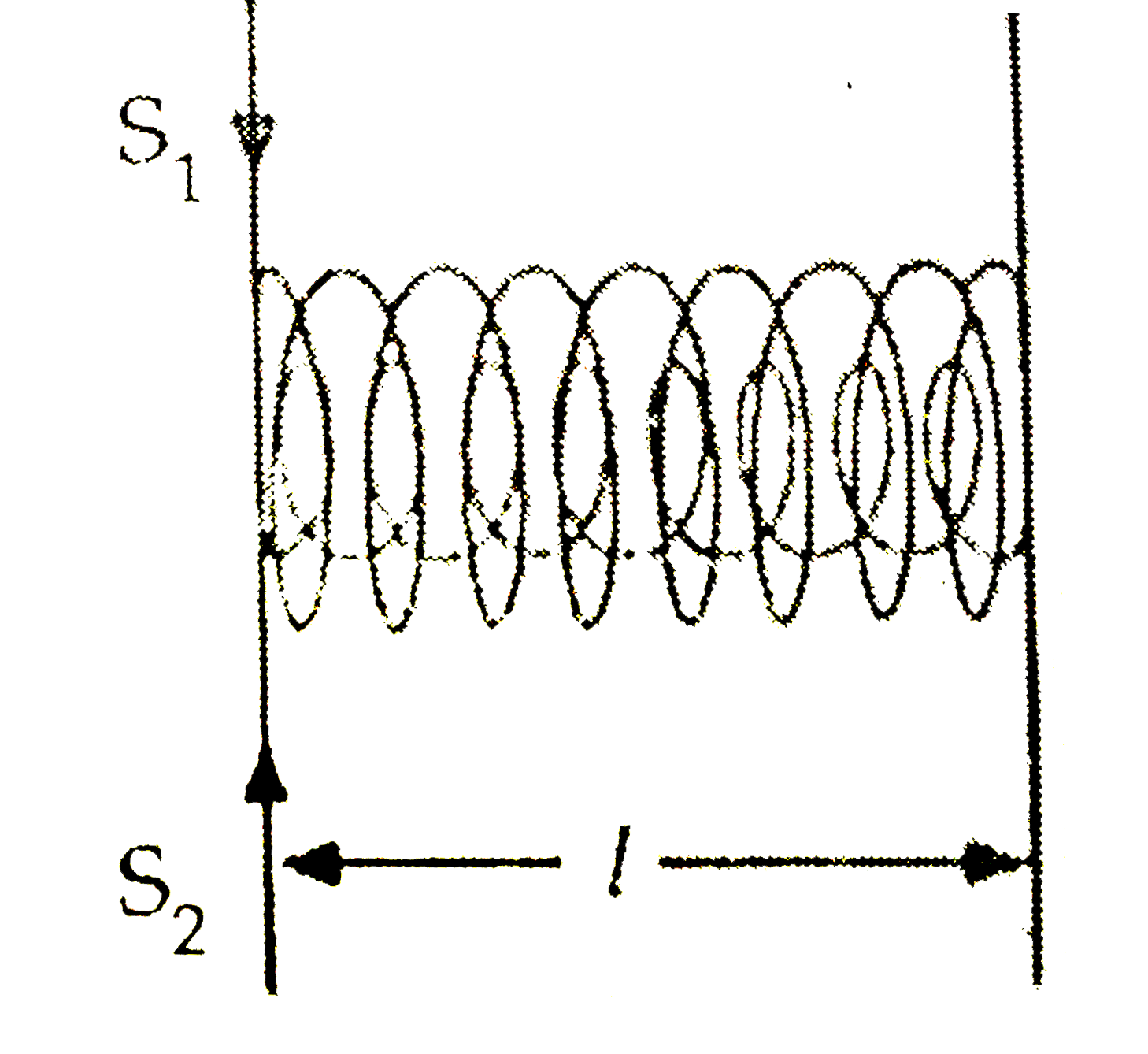 Let,I = length of each solenoid . `r_(1) , r_(2)` = radii of two solenoids A ` = pi r _(1)^(2)` = area of cross-section of inner solenoid `S_(1) ` `N_(1) , N_(2)`number of turns in the two solenoids, First , we pass a time varyingcurrent `I_(1)`through `S_(2)` . The magnetic flux is `mu_(0) n_(2) I_(2)`, where `n_(2)= N_(2)//I` = the number of turns per unit length of `S_(2)`. Total magnetic flux linked with the inner solenoid `S_(1)` is `Phi_(1) mu_(0) n_(2) I_(2) AN_(1)` `therefore` Mutual inductance of coil 1 w.r.t. coil 2 is `M_(12) (Phi_(1))/(I_(2)) =mu_(0) n_(2) I_(2) AN_(1)= (mu_(0) N_(1) N_(2) A)/(I)` Now, consider the flux linked with outer solenoid `S_(2)` due to the current `I_(1)`in the inner solenoid `S_(1) ` . The field `B_(1)`due to `I_(1)` inside `S_(1) = B_(1) mu_(0)n_(1) I_(1)` Total flux linked with the outer solenoid is ` Phi_(2) =B_(1) AN_(2) =mu_(0) n_(1) I_(1) AN_(2)= (mu_(0) n_(1) N_(2)AI_(1))/(I)` `therefore ` Mutual inductanceof coil 2 w. r . t coil 1 is `M_(21) = (phi_(2))/(I_(2)) = (mu_(0) N_(1) N_(2) A)/(I)` `thereforeM = (phi_(2))/(I_(2)) = (mu_(0) N_(1) N_(2) A)/(I)= mu_(0) n_(1)n_(2) AI = mu_(0) n_(1) n_(2) pir^(2) I`. If a medium of relative PERMEABILITY ` mu_(r)`is present within the solenoids , then ` M = mu_(r) mu_(0) n_(1) n_(2) pi r^(2) I` . |
|
| 30. |
A converging beam of light forms a sharp image on a screen. A lens is placed in the path of the beam, the lens being 10 cm from the screen. It is found that the screen has to be moved 8 cm further away from the lens to obtain a sharp image. Find the focal length and nature of lens. |
|
Answer» 22.5 CM, convex |
|
| 31. |
Minimum size of the plane mirror required to see full size image of one self is _____ |
| Answer» SOLUTION :HALF the OBSERVER | |
| 32. |
A circular coil of radius R carries a current in it. The magnetic field along its axis decreases as we move away from its centre. The space rate of fall of this field is constant at distance equal to |
|
Answer» 2 R |
|
| 33. |
A 12.5 eV electron beam is used to bombard gaseous hydrogen at room temperature. What series of wavelengths will be emitted? |
|
Answer» Solution : Ground state energy of hydrogen gas at room TEMPERATURE = - 13.6 eV. When the energy BEAM used to bombard gaseous hydrogen then its energy becomes = - 13.6 + 12.5 eV = -1.1 eV. Now energy in nth orbit `E_(n)=-(13.6)/(n^(2))eV` `:.-1.1eV=(13.6)/(n^(2))eV` `:. n^(2)=(13.6)/(1.1)=12.36` `:. n=3.51` but possibel orbits n=3  `:.` Spectral line of emiision spectra `=(n(n-1))/(2)` `=(3(-1))/(2)` =3 Hence in transition from n = 3 to n = 1 an n = 2 to n = 1 two lines of Lyman series and i transition n = 3 to n = 2, one line of Balme series are obtained. `RARR` In transition from n = 3 to n = 1 th wavelength of `beta`-line emitted in Lyman series. `lambda_(31)=(HC)/(E_(1)-E_(3))=(6.62xx10^(-34)xx3xx10^(8))/((-13.6-(-1.51))` `:. lambda_(31)=(19.875xx10^(-26))/(12.09xx1.6xx10^(-19))` `=1.0274xx10^(-7)m` `~~103xx10^(-9)m=103 m` In transition from n = 2 to n = 1, the wavelength of c-line emitted in Lyman series, `lambda_(21)=(hc)/(E_(1)-E_(2))=(6.625xx10^(-34)xx3xx10^(8))/([-13.6-(3.4)]eV)` `=(19.875xx10^(-26))/(10.2xx1.6xx10^(-19))` `=1.2178xx10^(-7)m` `~~122xx10^(-9)m=122 mm` `rArr` In transition from n = 3 to n = 2. wavelength of a-line emitted in Balmer series, `lambda_(32)=(hc)/(E_(2)-E_(3))=(6.625xx10^(-34)xx3xx10^(8))/([-3.4-(-1.51)]eV)` `:. lambda_(32)=(19.875xx10^(-26))/(1.89xx1.6xx10^(-19))` `6.5724xx10^(-7)m` `=657xx10^(-9)m` `657nm` |
|
| 34. |
In the above problem, compute the current density if the potential drop along the cylinder is V_(0). Also find the electric field at each point in the cylinder in the case described? |
|
Answer» `(3)/(2)(sigma_(0)V_(0))/(L), (3)/(2)(V_(0)x)/(l^(3//2))` |
|
| 35. |
A magnetised needle in a uniform magnetic field experiences a torque but no net force. An iron nail near a bar magnet, however, experiences a force of attraction in addition to a torque. Why ? |
|
Answer» SOLUTION :(a) In either case, one GETS two magnets, each with a north and south pole. (b) No force if the field is UNIFORM. The iron nail experiences a non-uniform field due to the bar magnet. There is induced magnetic moment in the nail, therefore, it experiences both forcy and torque. The net force is ATTRACTIVE because the induced south pole (say) in the nail is closer to the north pole of magnet than induced north pole. (c) Not necessarily. True only if the source of the field has a net non-zero magnetic moment. This is not so for a toroid or een for a straight infinite conductor. (d) Try to bring DIFFERENT ends of the bars closer. A repulsive force in some situation establishes that both are magnetised. If it is always attractive, them one of them is not magnetised. In a bar magnetic the intensity of the magnetic field is the strongest at the two ends (poles) and weakest at the central region. This fact may be used to determine whether A or B is the magnet. In this case, to see which one of the two bars is a magnet, pick up one, (say A) and lower one of its ends, first on one of the ends of the other (say B), and then on the middle of B. If you notice that in the middle of B, A experience no force, then B is magnetised. If you do not notice any change from the end to the middle of B, then A is magnetised. |
|
| 36. |
The K.E. of photo electron ejected from a metal surface by light of wave length 2000A^(@) range from zero to 3.2xx10^(-19)J . The stopping potential will be equal to |
|
Answer» 2V |
|
| 37. |
Define Bandwidth. |
| Answer» Solution :The FREQUENCY range over which the baseband SIGNALS or the information signals such as Voice, music, PICTURE, etc. is transmitted is KNOWN as BANDWIDTH. | |
| 38. |
The uniform rod AB of mass 1 kg is supported on a horizontal smooth surface by a small roller of negligible mass and dimension. If the coefficient of kinetic friction between ends and vertical wall is 1/3. The rod is released from rest in the shown position. (Given lengthof rod = 2m, g=10m//s^(2)). Match list-I with List-II and select the correct answer using the codes given below the lists: |
|
Answer» <P>`{:(P, Q,R,S),(3,1,2,4):}` |
|
| 39. |
Young's modulus is defined as the ratio of |
|
Answer» tensile STRESS and LONGITUDINAL strain |
|
| 40. |
A thin biconvex lens of focal length 6.25cm is made of material of refractive index 1.5. It is cut into two identical pieces perpendicular to its principal axis. One of the pieces is placed in water of refractive index 4/3. The focal power of the piece immersed in water, in diopter, is |
|
Answer» |
|
| 41. |
Using the graph as in figure for stopping potential vs the incident frequency of photons. Calculate plank's constant. |
|
Answer» SOLUTION :Einstein.s photoelectric EQUATION is `eV_0 = hv-W_0` on differentiation, we GET `eDeltaV_0 = h DELTA v` `therefore=(DeltaV_0)/(DELTAV)=(1.23-0)/((8-5)xx10^14)xx1.6 xx10^-19Js = 6.56xx10^-34Js` |
|
| 42. |
If a charge is moving towards the centre of an earthed conducting sphere of radius b with uniform velocity v. Distance of two points A and B from centre of sphere are 3a & 2a. Conducting sphere is earthed with an ammeter and resistance in series (as shown) reading of ammeter of this instant |
| Answer» Answer :C | |
| 43. |
If a charge is moving towards the centre of an earthed conducting sphere of radius b with uniform velocity v. Distance of two points A and B from centre of sphere are 3a & 2a. Conducting sphere is earthed with an ammeter and resistance in series (as shown) Potential of the sphere will be |
|
Answer» ZERO at any instant |
|
| 44. |
If a charge is moving towards the centre of an earthed conducting sphere of radius b with uniform velocity v. Distance of two points A and B from centre of sphere are 3a & 2a. Conducting sphere is earthed with an ammeter and resistance in series (as shown) Net charge on surface of conductor at this instant |
|
Answer» `+Q` |
|
| 45. |
Sketch a graph showing the variation of reactance of an inductor with frequency of the applied voltage |
Answer» SOLUTION :
|
|
| 46. |
Consider the potentiometer circuit arranged as in figure.The petentiometer wire is 600cm long.(a) At wht distance from the point A should the jockey touch the wire to get zero deflection in the galvanometer?(b) If the jockey touches the wire at a distance of 560cm from A, What will be the current in the galvanometer? |
|
Answer» Solution :Resistance per unit LENGTH = 15r/6 For length x, rx = 15rx/6 For the loop PASQ ` (i_1 +i_1) 15/6 rx+ 15/6 r(6-x) i_1 + i_1 r = epsilon ………….(i) ` for the loop awtm, ` i_2r- 15/6 rx (i_1 + i_1) = epsilon /2 ` ` rArri_2 + 15/6 rx (i_1 + i_1) = epsilon /2 ...........(ii) ` For zero DEFLECTION in galvanometer, `i_2 =0` . ` 15/6 rx. i_1 = epsilon /2 ` ` rArr i_1 = epsilon/5.r ` ` Putting i_1 = epsilon/5.r ` ` and i_2 = 0 in eqn. (i) ` ` we get, x = 320 cm. ` `(B) Putting x = 5.6 and solving equation` ` (i) & (ii) ` ` we get,i_2 = 2epsilon/ 22r ` . |
|
| 47. |
Assertion: In the absence of an external electric field, the dipole moment per unit volume of a polar dielectric is zero. Reason : The dipoles of a polar dielectric are randomly oriented. |
|
Answer» Assertionis CORRECT, REASON is correct, reason is a correct EXPLANATION for ASSERTION. |
|
| 48. |
Does diffraction take place at the Young's double slit? |
| Answer» SOLUTION :Both diffraction and interference in the DOUBLE SLIT EXPERIMENT. The wavefront is diffracted as it passes through each of the slits. The diffraction causes the wavefronts to SPREAD out as if they were coming from light sources located at the slits. These two wavefronts overlap, and interference occurs. | |
| 49. |
There are three concentric thin spherical shells A, B and C of radii R, 2R and 3R. Shells A and C are given charges q and 2q and shell B is earthed. Then which of the given is not correct ? |
|
Answer» charge on inner SURFACE of shell is `(4)/(3) q` |
|