

Saved Bookmarks
This section includes 7 InterviewSolutions, each offering curated multiple-choice questions to sharpen your Current Affairs knowledge and support exam preparation. Choose a topic below to get started.
| 1. |
The central maximum in the diffraction pattern of a circular aperture is known as |
|
Answer» the ABBE DISC |
|
| 2. |
A pile 4 m high driven into th bottom of a lake is 1 m above the water. Determine the length of the shadow of the pile on the bottom of the lake if the sun rays make an angle 45^@ with the water surface. The refractive index of water is 4/3. |
| Answer» SOLUTION :`2.88m` | |
| 3. |
(a) Briefly describe the Young's double-slit experiment of interference of light. Derive the expression for fringe width in the pattern. (b) Monochromatic light of wavelength 588 nm is incident from air to water interface. Find the wavelength and speed of the refracted light. The refractive index of water is 4/3. |
Answer» 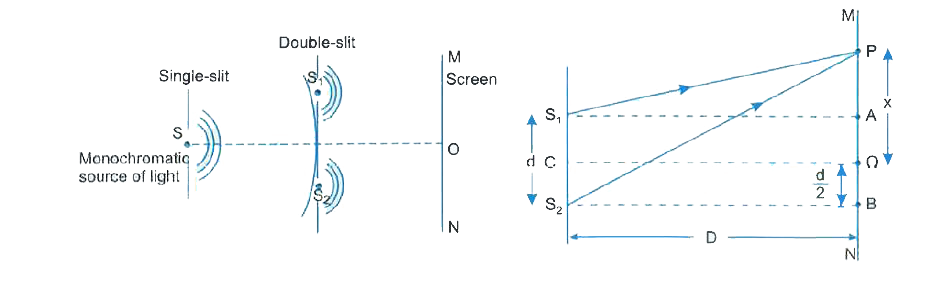 light waves reaching point P from two slit sources is `S_(2)P-S_(1)P`, where `(S_(2)P)^(2)=D^(2)+(x+d/2)^(2)` and `(S_(1)P)^(2)=D^(2)+(x-d/2)^(2)` `therefore(S_(2)P)^(2)-(S_(1)P)^(2)=[D^(2)+(x+d/2)^(2)]-[D^(2)+(x-d/2)^(2)]=2xd` `rArr(S_(2)P-S_(1)P)(S_(2)p+S_(1)P)=2xd` or `(S_(2)P-S_(1)P)=(2xd)/((S_(2)P+S_(1)P))` If x and dare very very small as compared to D, then `(S_(2)P+S_(1)P)` may be considered as 2D. Hence, `[S_(2)P-S_(1)P]=(2xd)/(2D)=(xd)/D` For constructive interference, path difference must be an integer multiple of `lamda` i.e., `(xd)/D=nlamda` where n = 0, 1, 2, 3, ... etc. `thereforex=(nDlamda)/d` i.e., positions of various maxima (bright bands) will be given by : `x_(0)=0,x_(1)=(Dlamda)/d,x_(2)=(2Dlamda)/d,x_(3)=(3Dlamda)/d` ........ For destructive interference, path difference must be an odd multiple of `lamda/2` i.e., `(xd)/D=(2n-1)lamda/2`, where n ::= 1, 2, 3, ... etc. `rArrx=((2n-1)Dlamda)/(2d)` i.e., positions of various minima (dark bands) will be given by : `x_(1).=(Dlamda)/(2d),x_(2).=(3Dlamda)/(2d),x_(3).=(5Dlamda)/(2d)` ...... Fringe width of the fringe pattern is defined as the distance between two successive maxima or successive minima. Therefore, considering two successive maxima, we have Fringe width `beta=x_(n+1)-x_(n)=((n+1)Dlamda)/d-(nDlamda)/d=(Dlamda)/d` (b) Here wavelength`lamda`= 588 nm and refractive index of water w.r.t. air `n =4/3` We know that speed of light in air =`c=3xx10^(8)ms^(-1)` `therefore` Speed of light in water v =`c/n=(3xx10^(8))/((4//3))=2.25xx10^(8)ms^(-1)` and wavelength of given light in water, `lamda_(w)=lamda/n=(588nm)/((4//3))=441nm` |
|
| 4. |
Describe the simple filter circuit for obtaining smooth rectified voltage from junction diode rectifier. |
|
Answer» Solution :The rectified voltage is in the form of pulses of the shape of half sinusoids. Thought it is unidirectional it does not have steady value. To get steady dc OUTPUT from the pulsating voltage normally a capacitor is connected across the output terminals parallel to the load `R_(L)` or one can also use an INDUCTOR in series will `R_(L)` for the same purpose. SINCE these additional circuit appear to filter out the ac RIPPLE and give a pure dc voltage, so they are called filters. When the voltage across the capacitor is rising it gets charged. If there is no external load, it remains charged to the peak voltage of the rectified output. When there is a load, it gets discharged through the load and the voltage across it begins to fall. In the next half cycle of rectified output it again gets charged to the peak value. This is shown in figure.  The rate offall of the voltage across the capacitor depends INVERSELY upon the product of capacitance C and the effective resistance `R_(L)` used in the circuit and is called the time constant `[t=RC]`. To make the time constant large value of C should be large. So capacitor input filters use large capacitors. The output voltage obtained by using capacitor input filter is nearer to the peak voltage of the rectified voltage. This type of filter is most widely used in power supplies. |
|
| 5. |
A laser used to weld detached retains emits light with a wavelength 652 nm in pulses that are of 20ms duration. The average power during each pulse is 0.6W. The energy in each pulse and in a single photon are |
|
Answer» `7.5xx10^(15)eV,2.7eV` |
|
| 6. |
A rod of length 10 cm is made up of conducting and non-conducting material (shaded part id non conducting), the rod is rotated with constant magnetic field of 10 rad/s about point o, in a constant magnetic field of 2T as shown in the figure. Find induced emf between the points A and B? |
| Answer» SOLUTION :`e_(AB) int_(0.07)^(0.1) (2) (10r) dr = 0.051 V` | |
| 7. |
A charge Q is distributed over the surfaces of two concentric hollow spheres of radii r and R ( R gt gt r) , such that their surface charge densities are equal . Derive the expression for the potential at the common centre. |
|
Answer» Solution :As shown let charges on inner and outer spheres be `Q_(1)` and `Q_(2)` respectively , where `Q_(1) + Q_(2) = Q` Let COMMON surface CHARGE density be `sigma` , then ` Q_(1) = 4 pi r^(2) sigma` and `Q_(2) = 4 pi R^(2) sigma` `implies Q = Q_(1) + Q_(2) = [4 pi r^(2) + 4 pi R^(2)] sigma = 4 pi sigma [r^2 + R^2] implies sigma = (Q)/(4pi [r^(2) + R^(2)])` THUS , `Q_1 = (4pi r^(2) * Q)/(4pi [r^(2) + R^(2)]) = (Qr^(2))/((r^(2) + R^(2)))` and `Q_(2) = (4pi R^(2) * Q)/(4pi [r^(2) + R^(2)]) = (Q R^(2))/((r^(2) + R^(2)))` Now potential at centre point O due to charge`Q_(1)` on the HOLLOW sphere of radius r is , `V_(1) = (Q_(1))/(4pi in_(0) r) = (Q r^(2))/(4 pi in_(0) r ( r^(2) + R^(2))) = (Qr)/(4pi in_(0) (r^(2) + R^(2)))` and potential at centre point O due to charge `Q_2` on the hollow sphere of radius R is , `V_(2) = (Q_(2))/(4pi in_(0) R) = (Q R^(2))/(4 pi in_(0) R (r^(2) + R^(2))) = (Q . R)/(4 pi in_(0) (r^(2) + R^(2)))` `therefore` Total potential at centrepoint O `V = V_(1) + V_(2) = (Q r)/(4 pi in_(0) (r^(2) + R^(2))) + (Q. R)/(4 pi in_(0) (r^(2) + R^(2))) = (Q)/(4pi in_(0)) * ((r + R))/((r^(2) + R^(2)))` 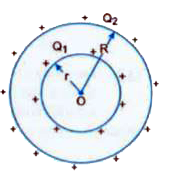
|
|
| 8. |
A constant torque of 1500 N-m turns a wheel of Ml 300 kg-m^2 about an axis passing throughit's centre, What will be the angular velocity of the wheel after 3 seconds ? |
|
Answer» SOLUTION :`tou=I alpha=1500/300 = 5 rad/s^2` `THEREFORE omega=omega_0+alphat` but `omega_0=0` ` therefore omega=5xx3=15` rad/s |
|
| 9. |
Distinguish between a pure and an impure spectrum. |
|
Answer» Solution :A pure SPECTRUM is that spectrum in which there is no OVERLAPPING of COLOURS. Different colours fall on the SCREEN at different points distinctly. An impure sepctrum is that spectrum in which there is an overlapping of colours. There will be INTERMIXING of colours so that different colours do not fall on the screen in a regular sequence. |
|
| 10. |
Angle between equipotential surface and electric field is ...... |
| Answer» Answer :B | |
| 12. |
If accidentally the calorimeter remained open to atmosphere was for some time during the experiment, due to which the steady state temperature comes out to be 30^(@)c, then total heat lost to surrounding during the experiment, is (Use the specific heat capacity of the liquid from previous question). |
|
Answer» `20 kcal` `=(1000)(1//2)(80-30)=25,000 cal` Heat absorted by the water CALORIMETER SYSTEM `=(900)(1)(40-30)+(200)(1//2)(40-30)` `=10,000 cal` So heat LOSS to surrounding `=15,000 cal` |
|
| 13. |
The magnetic moment of a current carrying circular coil of radius r varies as |
|
Answer» `(1)/(r^(2))` |
|
| 14. |
A standing wave is maintained in a homogeneous string of corss-sectional area 'S' and density phe. It is formed by the superposition of two waves travelling in opposite directions given by the equation y_(1)=asin(omegat=kx)andy_(2)=2asin(omegat+kx). The total mechanical energy confined between the sections corresponding to the abjacent antinodes is: |
|
Answer» `(3pispomega^(2)a^(2))/(2K)` |
|
| 15. |
If a physical quantity X is represented by X=M^(a)L^(b)T^(-c) and the % error in M,L and T are alpha%, beta% and gamma% resperctively, then total % error in X is : |
|
Answer» `(alphaa+betab-gammac)%` `:. (DeltaX)/(X)xx100` `=a((DeltaM)/(M)xx100)+b((DeltaL)/(L)xx100)+c((DeltaT)/(T)xx100)` `=(alphaa+betab+gammac)%` So the correct CHOICE is `(b)`. |
|
| 16. |
The size of the atom in Thomson's model is .......... the atomic size in Rutherford's model. (much greater than/no different from/much less than |
| Answer» SOLUTION :no DIFFERENT from | |
| 17. |
How does the surface of water appear to the eye of an observe inside water? |
|
Answer» MIRROR with a CIRCULAR hole |
|
| 18. |
Find the typical de Broglie wavelength associated with a He atom in helium gas at room temperature (27^(@)C) and 1 atm pressure, and compare it with the mean separation between two atoms under these conditions. |
|
Answer» Solution :Atomic weight of He `=4g=4xx10^(-3)Kg` Pressure P=1 atm.=`1.01xx10^(5) N//m^(2)` Boltzmaan.s constant, `k_(B)=1.38xx10^(-23)Jmol^(-1)K^(-1)` T=27+273 =300 K,`N_(0)=6xx10^(23)` `implies` Mass of given atom, `m=("atomic weight of He")/("No. of Avogardro")` `therefore m=(4xx10^(-3))/(6xx10^((23))` `=(2)/(3)xx10^(-26) kg` `implies` At standard temperature average kinetic energy of He atom, `(1)/(2)mv^(2)=(3)/(2)K_(B)T` `therefore m^(2)v^(2)=3mk_(B)T` `therefore p^(2)=3mk_(B)T`. `therefore p=sqrt(3mmk_(B)T)` Now ,de-Broglie wavelength, `lambda=(h)/(p)=(h)/(sqrt(3mk_(B)T))` `therefore lambda=(6,63xx10^(-34))/(sqrt(3xx(2)/(3)xx10^(-26)xx1.38xx10^(-23)xx300))` `therefore lambda=(6.63xx10^(-34))/(sqrt(828xx10^(-49)))` `=(6.63xx10^(-34))/(90.99xx10^(-25))` `therefore lambda=0.0728xx10^(-9)` `lambda ~~0.73xx10^(-10)m` `implies` Equation of state of 1 mole gas, PV=RT `therefore PV=N_(A)k_(B)T` `[because k_(B)=(R)/(N_(A))impliesR=N_(A)k_(B)]` `therefore (V)/(N_(A))=(k_(B)T)/(P)` `"Average distance "r=[("Molar volume")/("Avogardo number")]^((1)/(3))` `(V)/(N_(A))` `[(k_(B)T)/(P)]^((1)/(3))` `[(1.38xx10^(-23)xx300)/(1.01xx10^(5))]^((1)/(3))` `r=[(138xx30)/(101)xx10^(-27)]^((1)/(3))` log r=`[40.99]^((1)/(3))xx10^(-9)` `logr=(1)/(3)log[40.99]xx10^(-9)` `log=(1)/(3)[1.6127]xx10^(-9)` `logr=0.5378xx10^(-9)` Antilog`r=3.449xx10^(-9)` `therefore r~~3.4xx10^(-9)m` Here `gt lambda` hence average distance between two atom is very large compared to de-Broglie wavelength. |
|
| 19. |
Ring of mass M and radius 1m placed on smooth horizontal surface at rest. A particle of same mass M moving horizontally with speed 6 m//s strike the ring and stick to it as shown in figure. Find angular speed of system after collision in rad/sec. |
|
Answer» `M(6)((R)/(2))=[(MR^(2))/(2)+M((R)/(2))^(2)+M((R)/(2))^(2)]OMEGA` `3MR = [MR^(2)]omega` `omega=(3)/(R)=3"rad"//"sec"` 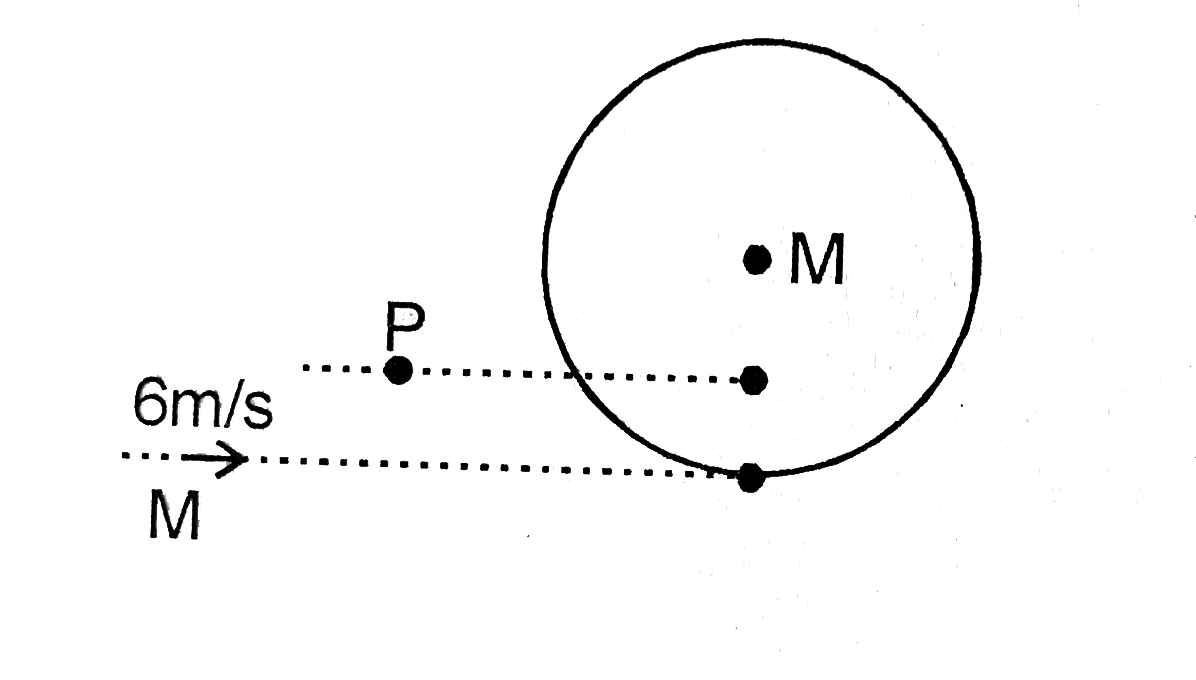
|
|
| 20. |
What is dispersion of light? |
| Answer» Solution :The PHENOMENON of SPLITTING of ligth into its component COLOURS is KNOWN as dispersion. | |
| 21. |
In a thermos flask, attempt is made to reduce losses of heat by |
|
Answer» CONDUCTION only |
|
| 22. |
Two identical capacitors of 12 pF each are connected in series across a battery of 50 V . How much electrostatic energy is stored in the combination ? If these were connected in parallel across the same battery , how much energy will be stored in the combination now ? Also find the charge drawn from the battery in each case. |
|
Answer» Solution :Here `C_1 = C_2 = 12 pF` and battery voltage V = 50 V . When the capacitors are CONNECTED in series , the equivalent capacitance `C_s` is given as : `(1)/(C_(s)) = (1)/(C_(1)) + (1)/(C_(2)) = (1)/(12) + (1)/(12) = (1)/(6) implies C_(s) = 6 pF = 6 xx 10^(-12) F` `therefore` ENERGY STORED in the combination `U_(s) = (1)/(2) C_(s) V^(2) = (1)/(2) xx (6 xx 10^(-12)) xx (50)^(2) = 7.5 xx 10^(-9) J = 7.5 NJ` and charge drawn from the battery `Q_(s) = C_(s) V = 6 xx 10^(-12) xx 50 = 300 xx 10^(-12) C = 0.3 nC` If the capacitors are connected in parallel across the same battery , then the equivalent capacitance `C_(p) = C_(1)+ C_(2) = 12 + 12 = 24 pF = 24 xx 10^(-12) F` `therefore` Energy stored in the combination `U_(p) = (1)/(2) C_p V^(2) = (1)/(2) xx (24 xx 10^(-12)) xx (50)^(2) = 30 xx 10^(-9) J = 30 nJ` and charge drawn from the battery `Q_(p) = C_(p) V = (24 xx 10^(-12)) xx 50 = 1.2 xx 10^(-9) C = 1.2n C ` |
|
| 23. |
A point object 'O' is at the center of curvature of a concave mirror. The mirror starts to move at a speed u, iin a direction perpendicular to the principal axis. Then, the initial velocity of the image is |
|
Answer» 2u, in the direction OPPOSITE to theat of MIRROR's velocity Here `m=1` |
|
| 24. |
An ideal coil of 10 henry is joined in series with a resistance of 5 ohm and a battery of 5 volt. 2 second after joining, the current flowing in ampere in the circuit will be |
|
Answer» `E^(-1)` |
|
| 25. |
A T.V. tower has a height 100m. What is the population density around the tower if total population covered is 50 lakh ? Given radius of earth =6.3xx10^(6)m. |
|
Answer» Solution :Given `h=100m,R=6.3xx10^(6)m,` Population COVERED `=50` lakh `50xx10^(5)` Radius of circle WITHIN which transmission is OBSERVED `d=sqrt(2hR)=sqrt(2xx100xx6.3xx10^(6))`m Area in which transmission can be VIEWED `A=pid^(2)=3.142xx2xx100xx6.3xx10^(6)` `=3.9589xx10^(9)m^(2)` `A=3.9589xx10^(3)km^(2)` `:.` Average population density `sigma=(50xx10^(5))/(3.9589xx10^(3))=1263xx10^(2)` `=1263km^(-2)` |
|
| 26. |
It can be seen that no rainbow is seen during the middle of the day. Give reason. |
| Answer» Solution :For VIEWING RAINBOW, The observer MUST STAND with his BACK towards the sun and look at the sky, this is not possible during the middle of the day and hence the reason. | |
| 27. |
When you have learned to integrate exponential functions, try to derive formulas (18.6), (18.10), and (18.12). |
|
Answer» Solution :(a) `F= -kx, A= int_(x_(1))^(x_(2))F dx=-kint_(x_(1))^(x_(2))xdx= -(kx^(2))/(2)int_(x_(1))^(x_(2))=(kx_(1)^(2))/(2)-(kx_(2)^(2))/(2)`, (B) `F= (qQ)/(4piepsilon_(1)r^(2)), A= int_(r_(1))^(r_(2))Fdr= (qQ)/(4piepsilon_(1))int_(r_(1))^(r_(2))(dr)/(r^2)= -(qQ)/(4piepsilon_(0)r)|_(r_(1))^(r_(2))= (qQ)/(4piepsilon_(1)r_(1))-(qQ)/((4piepsilon_(1)r_(2)))` (C) `F= (-gammamM)/(r^(2))= ,A= int_(r_(1))^(r_(2))Fdr= -gammamMint_(r_(1))^(r_(2))(dr)/(r^(2))= (gammamM)/(r)|_(r_(1))^(r_(2))=(gammamM)/(r_(2))-(gammamM)/(r_(1))` |
|
| 29. |
Laser light of wavelength 640mm incident on a pair of slits produces an interference pattern in which the bright fringes are separated by 7.2mm. Calculate the wavelength of another source of light which produces interference fringes separated by 8.1mm using same arrangement. Also find the minimum value of the order (n) of bright fringe of shorter wavelength which coincides with that of longer wavelength. |
|
Answer» Solution :As , FRINGE width, `beta=(Dlambda)/(2d)` `:.7.2mm=(Dxx660nm)/(2d)`….`(i)` and `8.1mm=(Dxxlambda.)/(2d)`…….`(ii)` Diving (i) by (ii) `:.(7.2mm)/(8.1mm)=(640nm)/(LAMBDA.)` or `lambda.=640xx(8.1)/(7.2)nm=720nm` Also `y_(N)=n_(1)(Dlambda)/(2d)=n_(2)(Dlambda.)/(2d)` or `n_(1)lambda=n_(2)lambda.` `impliesn_(1)xx640=n_(2)xx720` `:.(n_(1))/(n_(2))=(720)/(640)=(9)/(8)` |
|
| 30. |
A mass of 12 Kg at rest explodes into two pieces of masses 4 Kg and 8 Kg which move in opposite directions. If the velocity of 8 Kg peice is 6 ms^(-1), then the kinetic energy of the other piece in joules is |
|
Answer» 64 |
|
| 31. |
The magnitude of drift velocity per unit electric field is known as ____ |
| Answer» SOLUTION :MOBILITY | |
| 32. |
In a silicon transistor, the base current is changed by 20 change of 0.02 V in base to emitter voltage and a change of 2 mA in the collector current (i) Find the input resistance beta_(ac) and transconductance of the transistor (ii) if this transistor is used as an- amplifier. Find the voltage gain of the- amplifier with theload resistance 5 k amplifier |
| Answer» Solution :(i) `r_(i)=(Delta V_(BE))/(Delta I_(B) )=(0.02)/(20xx10^(-6)) = 1k Omega`, `beta_(ac)=(Delta I_(C))/(Delta I_(B) )= (2xx10^(-3))/(20xx10^(-6))=100` (II) Voltage gain, `A_(V) =-g_(m)R_(L)=-(0.1)(5XX10^(3))=-500`.(since, `g_(m)=(beta _(ac))/(r_(i)))` | |
| 33. |
A : Magnetic field lines are continuous and posses closed loop. R : Magnet do not exist with single pole. |
|
Answer» both are TRUE and the REASON is the CORRECT EXPLANATION of the ASSERTION. |
|
| 34. |
A particle moves along a circle of radius [20/pi] metre with constant tengential acceleration. If the velocity of the particle is 40 m/s at the end of second revolution, Find the tangential acceleration. |
|
Answer» SOLUTION :`v^2 =u^2 + 2as=2 AR THETA` ` [thereforeS=rtheta]` `THEREFORE a=v^2/(2rtheta)` `therefore a= (40xx40)/(2xx20/pi xx4pi)=10 m/s^2` |
|
| 35. |
On applying a stress of 20 xx 10^8 N/m^2, the length of a perfectly elastic wire is doubled. Its Young's modulus will be |
|
Answer» a)`5 xx 10^8 N/m^2` |
|
| 36. |
एक बिन्दु आवेश Q से r दूरी पर विद्युत क्षेत्र की तीव्रता का परिमाण होगा - |
|
Answer» `1/4pi.epsilon_0 Q/r` |
|
| 37. |
(i) In figure (a) calulate the electric flux through the closed areas A_(1) and A_(2) (ii) In figure (b) calculate the electric flux through the cube |
|
Answer» Solution :(i) In figure (a) the area `A_(1)` encloses the charge Q. So ELECTRIC flux through this closed surface `A_(1)` is `(Q)/(epsilon_(0))` . But the closed surface `A_(2)` contains no charges inside so electric flux through `A_(2)` is zero . (ii) In figure (b) the net charge inside the cube is 3p and the TOTAL electric flux in the cube is therefore `Phi_(E)=(3q)/(epsilon_(0))` NOTE that the charge `-10q` lies outside the cube and it will not contribute the total flux through the surface of the cube. |
|
| 38. |
A : The clouds in sky generally appear to be whitish. R : Diffraction due to clouds is efficient in equal measure at all wavelengths. |
|
Answer» Both A and R are TRUE and R is the CORRECT explanation of A |
|
| 39. |
The resultant of two forces, one double the other in magnitude, is perpendicular to the smaller of the two forces, the angle between the two forces is |
|
Answer» `60^(@)` |
|
| 40. |
In p-type semiconductor , the acceptor level lies |
|
Answer» NEAR the CONDUCTION BAND |
|
| 41. |
What are isobars ? |
| Answer» Solution :The atom having the same mass NUMBER but different atomic number are CALLED isobars. Such ATOMS CONTAIN different number of protons and electrons. So, they differ in the chemical properties and occupy different positions in the PERIODICAL table. | |
| 42. |
A cylindrical steel component machined on an engine lathe is heated to temeprature of 80^(@)C.The diameter of the component should be 5 cm at temperature of 10^(@)C and the permissible error should not exceed 10 microns from the specified dimension. Do we need correctionis for the thermal expansioni component be introduced during the process of machining ? If so what diameter should be prepared? Take alpha_("steel")=12xx10^(-6).^(@)C^(-1). |
|
Answer» |
|
| 43. |
In Rutherford's scattering experiment if impact parameter is zero then the angle of scattering will be. |
|
Answer» `0^(@)` |
|
| 44. |
A planoconvex lens is made of refractive index 1.6. The radius of curvature of curved surface is 60 cm. The focal length of the lens is |
|
Answer» 50 cm `(1)/(f)=(n-1)((1)/(R_(1))-(1)/(R_(2)))=(1.6-1)[(1)/(60)-(1)/(oo)]=(0.6)/(60)=(1)/(100)=f=+100cm` |
|
| 45. |
What is the ratio of the wavelengths of a photon and that of an electron of the same energy ? |
|
Answer» `csqrt((2m)/(E))` |
|
| 46. |
A 44 mH inductor is connected to 220 V, 50 Hz ac supply. Determine the rms value of current in the circuit. |
|
Answer» Solution :Here `L = 44mH = 44 xx 10^(-3)H`. `v = 50 Hz` `E_(RMS) = 220 V` Reactance of inductor. `X_(L) = L OMEGA = L xx 2pi v` `= 44 xx 10^(-3) xx 2 xx 3.14 xx 50` `= 13.82 Omega` Current (rms) through the CIRCUIT `I_(rms) = (E_(rms))/(X_(L)) = (220)/(13.82) = 15.9A` |
|
| 47. |
Electric field lines are always parallel to Equi potential surfaces. Correct the statement if there is any mistake. |
| Answer» SOLUTION :Electric FIELD lines are ALWAYS perpendicular to Equipotential SURFACES. | |
| 48. |
A circular beam of light of diameter (width) falls on a plane surface of glass. The angle of incidence is 'i', angle of refraction is 'r' and refractive index of glass is mu . Then the diameter of the refracted beam d' is |
Answer» SOLUTION : Let d be the DIAMETER of incident beam and d. be the diameter of refracted beam. Then from figure `COS i= (d)/(PQ) , d = PQ cos i ` From figure` cos r = (d.)/(PQ) ` and `d. = PQ cos r ` `i.e., (d.)/(d)= (cos r)/(cos i)` |
|
| 49. |
It is possible to project a particle with a given velocity in two possible ways so as to make them pass through a point P at a horizontal distancc r from the point of projection. If t_(1) and t_(2) are times taken to reach this point in two possible ways, then the product t_(1)t_(2) is proportional to |
|
Answer» `(1)/(R)` |
|
| 50. |
Metal ring of radius R is placed perpendicular to uniform magnetic field B. Magnetic field starts changing at a rate alpha |
|
Answer» Electric field at any POINT on the ring is zero. `phi= piR^(2)B` Magnitude of emf induced in the loop can be written as follows: `e = dphi//dt = pi R^(2) (dB//dt)=pi R^(2) alpha` We can see that OPTION (d) is correct. Due to SYMMETRY electric field at any point on the ring is same. If E is electric field intensity, then we can multiply electric field, with length of the circle (`2piR`) to calculate induced emf. We can equate it to the calculated value of emf as follows: `E xx 2piR= pi R^(2)alpha` `E= alpha R//2` Option (b) is correct. Hence, options (b) and (d) are correct. |
|