

Saved Bookmarks
This section includes 7 InterviewSolutions, each offering curated multiple-choice questions to sharpen your Current Affairs knowledge and support exam preparation. Choose a topic below to get started.
| 1. |
Two capacitors of capacities 100muF and 200muF are connected in sereis. A.p.d. of 90 V is applied across them. Calculate the p..d across each capacitor. |
|
Answer» Solution :DATA supplied, `C_(1) =100muF","C_(2)=200muF, ""V=90V` Effective capacity `C_(s)=(C_(1)C_(2))/(C_(1)+C_(2))=(100 xx 200)/(300)=(200)/(3) muF` Total charge `Q=C_(s).V=(200)/(3) xx 90=6000muC` Hence p.d. acorss `C_(1)" is "V_(1)=Q/C_(1)=(6000muC)/(100muF)=60"volts"` p.d. across `C_(2)" is "V_(2)=Q/C_(2)=(6000muC)/(200muF)="30 volts"` |
|
| 2. |
For a resistance R and capacitance C in series the impedance is twice that of a parallel combination of the same elements What is the frequency of applied emf . . |
|
Answer» Solution :Series: `Z_(1) = sqrt(R^(2) + X_(C)^(2)) , X_(C) =1//OMEGAC` PARALLEL `(i_(r))_(0) = V_(0) //R,( i_(C))_(0) = (V_(0))/(X_(C)) ` ` i_(0) = sqrt((i_(R))_(0)^(2) + (i_(C))_(0)) = sqrt(((V_(0))/(R))^(2) + ((V)/(X_(C)))^(2))` `(V_(0))/(Z^(2)) = V_(0) sqrt((1)/(2^(2)) + (1)/X_(C)^(2))` `Z_(1) = 2Z_(2) implies sqrt(R^(2) + X_(C)^(2)) = (2RX_(C))/(sqrt(R^(2) + X_(C)^(2)` `R^(2) + X_(C)^(2) = 2RX_(C) implies (X_(C) -R)^(2) =0` `X_(C) =R implies (1)/(omegaC) =R` `omega = (1)/(RC) implies 2pi f = (1)/(RC)` `f = (1)/(2 pi RC)` 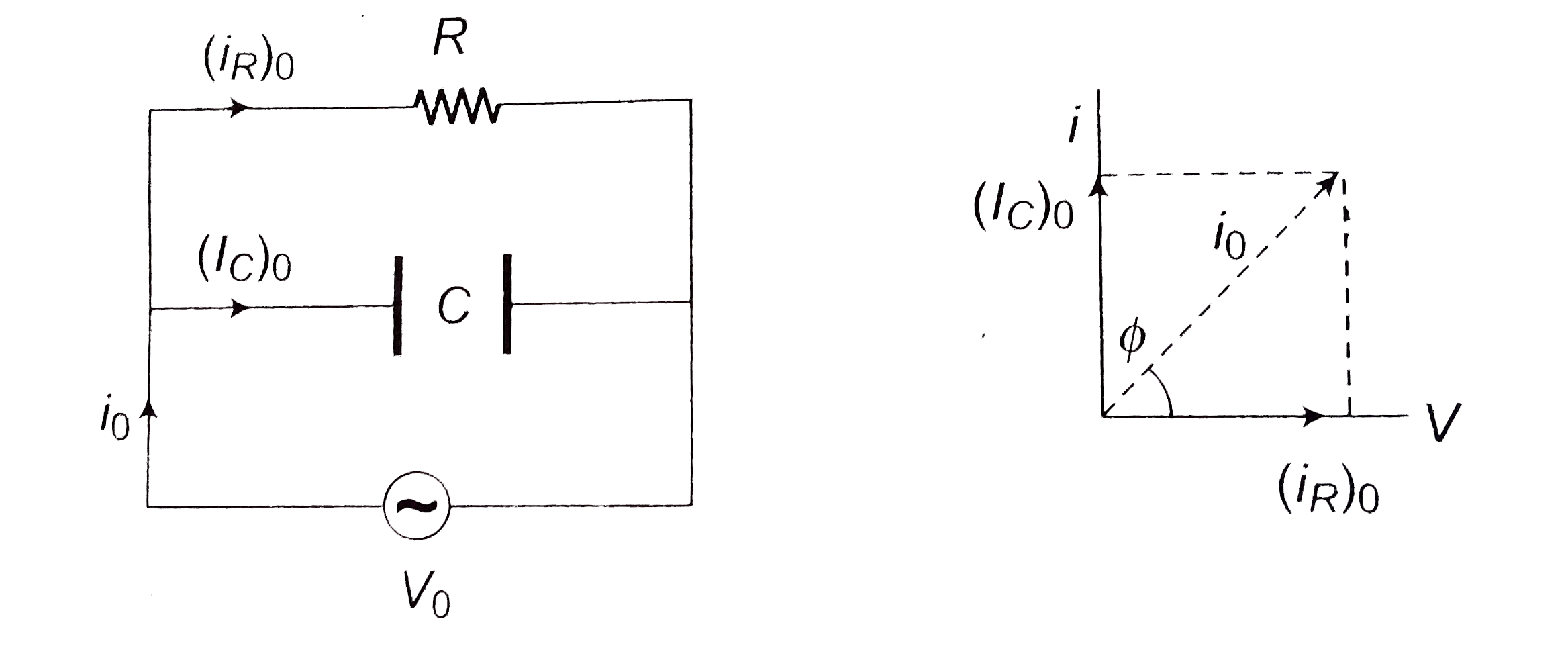 . .
|
|
| 3. |
In Question obtain the frequency of revolution of the electron in its circular orbit. Does the answer depend on the speed of the electron ? Explain . |
|
Answer» Solution :Frequency`v = (e B)/(2 pi m_e) = (1.6 xx 10^(-19) xx 6.5 xx 10^(-4))/(2 xx 3.14 xx 9.1 xx 10^(-31)) = 18 xx 10^(6) Hz or 18 MHz` This frequency is independent of the SPEED of the electron, We know that RADIUS of path ` r = (m_e . v)/(e B)` i.e., `r PROP v`. Consequently, the ratio `v/r` and hence `v/(2 pi r)`, which is equal to the time of one revolution (T), remains constant and independent of the speed. Consequenty frequency `v = 1/T` is independent of speed. |
|
| 4. |
A certain prism is that to produce minimum deviation of38^(@). If produces a deviation of 44^(@) when the angle of incidence is either 42^(@) or 62^(@). What is refractive index of material of prism? |
|
Answer» 1.51 I + e = A + D 42 + 62 = A + 44 or A = `60^(@)` When deviation is min. I = e `therefore I + I = 60 + 38 = 49^(@)` Now `MU = (A)/(2) = sin ((A + D_(m))/(2))` `or "" mu=(sin((60+38)/(2)))/(sin30^(@))=1.51` |
|
| 5. |
A mass M is suspended from a light spring. An additional mass m added displaces the spring further by a distance x. Now the combined mass will oscillate on the spring with a period : |
|
Answer» `T=2pi sqrt((mg)/(x(M+m)))` `T=2pi sqrt(((M+m))/(K))impliesT=2pi sqrt(((M+m)x)/(mg))`. So correct choice is (B). |
|
| 6. |
Relation between Neopentane and n- pentane is ? |
|
Answer» HOMOLOGUES |
|
| 7. |
In the given Boolean expression, Y=A.bar(B)+B.barA, if A=1, B=1 then Y will be |
|
Answer» 0 |
|
| 8. |
The ground state and first excited state energies of hydrogen atom are -13.6 eV and -3.4 eV, respectively. If potential energy in ground state is taken to be zero, then |
|
Answer» |
|
| 9. |
A particle of charge q, mass m is moving in an electric field vecE= EhatiNC^(-1) andmagnetic field vecB =BhatkT . It follows a trajectory from P to Q as shown Velocity at P is Vhati & that at Q is - 2Vhatj, find a) electric field strength b) power developed at P by electric field c) rate of work done at by both fields at Q |
|
Answer» <P> Solution :(a) Work done by magnetic FIELD is zero `becausevecFbotvecV` only `vecE` does work on charged particleFrom work energy theorem `DeltaKE=WD` by `vecE` `1/2m(v^(2)-u^(2))=vecEq.vecS` `1/2m(4v^(2)-v^(2))=q(Ehati.2ahati)` `1/2m3v^(2)=2Eq.a`  b) power developed by `vecE` at P is `vecE.vecV=q(Ehati.vhati)=q(vE)=QV((3MV^(2))/(4aq))rArrP=(3mv^(3))/(4a)` c) Power developed by both fields is equal to power developed by `vecE` alone (`because` Work done by `vecB` is 0) `vecP_(0)=vecF.vecV_(0)=q[(vecEhati.(-2Vhatj)]=0` |
|
| 10. |
A convex lens of refractive index 1.5 is immersed in a liquid of refractive index (i) 1.6 (ii) 1.3 and (iii) 1.5. what changes happens to the focal length of the lens in the three cases ? |
|
Answer» |
|
| 11. |
Use Gauss s law to derive the expression for the electric field between two uniformly charged large parallel sheets with surface charge densities sigma and -sigma respectively . |
|
Answer» Solution :Electric field due to two infinite parallel sheets of a charge : Suppose two infinite , plane NON - conducting POSITIVELY charged sheets 1 and 2 are placed parallel to each other in vacuum or air (as shown in fig.). Let `sigma_(1)andsigma_(2)` be the surface densities ofcharge on sheets 1 and 2 respectively . As the magnitude of electric intensity `vecE` on either side CLOSE to a plane sheet ofcharge of density `sigma` is : `E=(sigma)/(2epsilon_(0))` `vecE` acts perpendicular to the sheet , directed away from the sheets (if charge is positive) or towards the sheet (if charge is negative). Let `vecE_(1)andvecE_(2)`be the electric intensities at any point due to sheets 1 and 2 respectively . Then , for points outside the sheets , like P. , we have `E_(1)=(sigma_(1))/(2epsilon_(0))` and `E_(2)=(sigma_(2))/(2epsilon_(0))`  Since `E_(1) and E_(2)` are in the same direction the magnitude of the resultant intesity at point P . is given by `E=E_(1)+E_(2)` `=(sigma_(1))/(2epsilon_(0))+(sigma_(2))/(2epsilon_(0))` `=(1)/(2epsilon_(0))(sigma_(1)+sigma_(2))`, At a point in between the sheets , like P we have `E_(1)=(sigma_(1))/(2epsilon_(0))` (away from sheet 1) and `E_(2)=(sigma_(2))/(2epsilon_(0))` (away from sheet 2) Now `E_(1)andE_(2)` are oppositely - directed , so `E=E_(1)-E_(2)` `=(sigma_(1))/(2epsilon_(0))-(sigma_(2))/(2epsilon_(0))` `=(1)/(2epsilon_(0))XX(sigma_(1)-sigma_(2))`. |
|
| 12. |
If you sling a thin wire loop around a block of ice and attach to it a weight of several kilograms then after some time the wire will pass through the block of ice, but the block remains intact (Fig. 23.2). Explain this phenomenon. |
| Answer» Solution :ICE melts under the PRESSURE of the WIRE, and the wire SINKS: the WATER formed above the wire immediately freozes again. | |
| 13. |
(A) : The orbital magnetic moment and angular momentum of orbiting electron are always in opposite directions. (R) : Conventional direction of current flow is opposite to the direction of electron motion. |
|
Answer» Both 'A' and 'R' are TRUE and 'R' is the correct EXPLANATION of 'A'. |
|
| 14. |
Figure 5.5 shows a small magnetised needle P placed at a point O. The arrow shows the direction of its magnetic moment. The other arrows show different positions (and orientations of the magnetic moment) of another identical magnetised needle Q. (a) In which configuration the system is not in equilibrium? (b) In which configuration is the system in (i) stable, and (ii) unstable equilibrium? (c) Which configuration corresponds to the lowest potential energy among all the configurations shown? |
|
Answer» Solution :POTENTIAL ENERGY of the configuration arises due to the potential energy of one dipole (say, Q) in the magnetic field due to other (P). Use the result that the field due to P is given by the expression [Eqs. (5.7) and (5,8)] `B_(P)=-(mu_(0)m_(p))/(4pi r^(3))` (on the normal bisector) `B_(p)=(mu_(0)2)/(4pi) (m_(p))/(r^(3))` (on the axis) where `m_(p)` is the magnetic moment of the dipole P. Equilibrium is stable when `m_Q` is parallel to `B_p` and UNSTABLE when it is anti parallel to `B_P`. For instance for the configuration `Q_(3)`, for which Q is along the perpendicular bisector of the dipole P, the magnetic moment of Q is parallel to the magnetic field at the position 3. Hence Q, is stable. Thus (a) `PQ_(1) and PQ_(2)` (b) (i) `PQ_(3), PQ_(6) ("stable") (ii) PQ_(5), PQ_(4) ("unstable")` (c) `PQ_(6)` |
|
| 15. |
a. Are heavy nuclei stable or unstable ? b. Give reason. |
|
Answer» SOLUTION :a. Unstable B. BINDING energy per nucleon per nucleon is small for heavy NUCLEI. |
|
| 16. |
If a charge q is placed at each vertex of a regular polygon, the net electric field at its centre is zero. Show it. |
Answer» Solution : The distance of the centre of a regualr polygon from each vertex will be same. Therefore, `|vec(E_(1))|=|vec(E_(2))|=|vec(E_(3))|` in (a) `|vec(E_(1))|=|vec(E_(2))|=|vec(E_(3))|=|vec(E_(4))|` in (b) and `|vec(E_(1))|=|vec(E_(2))|=|vec(E_(3))|=|vec(E_(4))|=|vec(E_(5))|` in ( c ) The angle between any two consecutive field vectors for each of a polygon is also same. Hence, `vec(E_(1))+vec(E_(2))+vec(E_(3))+......+vec(E_(n))=vec(0)` where n = 3, 4, 5, 6.............. Note : `vec(E)_(1)+vec(E)_(2)+............+vec(E)_(n)iff vec(E)_(1)+vec(E)_(2)+............+vec(E)_(n-1)=-vec(E)_(n)` Hence, if a charge q is PLACED at each vertex EXCEPT one vertex of regular polygon, then the net electric field at its centre, distant r from each vertex is `(1)/(4pi epsilon_(0))(q)/(r^(2))`, directed TOWARDS or away from the empty vertex depending on whether q is positive or negative. |
|
| 17. |
A block of mass m is attached to a cart of mass 4m through spring of spring constant k as shown in the figure. Friction is absent everywhere. The time period of oscillations of the system, when spring is compressed and then released, is |
|
Answer» `pi SQRT((m)/(K))` |
|
| 18. |
A 15.0mu F capacitor is connected to a 220 V , 50 z source. Find the capacitive reactance and the current ( rms and peak ) in the circuit. If the frequency is doubled, what happens to the capacitive reactance and the current ? |
|
Answer» Solution :`X_(C ) = (1)/( omega C )` `= (1)/( 2 pi f C )` `= (1)/( 2 xx 3.14 xx 50 xx 10^(-6)) = 212 .3 Omega` `I_(rms) = (V_(rms))/(X_(C ))` `=(220)/( 212.3)` `= 1.0363A` We know, `I_(rms) = ( I_(m))/( sqrt(2))` `:. I_(m) = sqrt( 2) I_(rms)` `= ( 1.414) ( 1.063)` = 1.465 A Here, CURRENT through the capacitor oscillates between `+1` 1.465A and - 1.465A, keeping itself ahead of voltage by amount `( pi )/(2)` rad. After the frequency is MADE double , `X_(C ) = ( 1)/( 2pi f C )` , would become half and so current`I_(rms)` would become doubled . |
|
| 19. |
In the cycle ABCD shown in the figure, the volume increases by times while the absolute temperature increases threefold. The processes AB and CD are isothermal. If the working substance is a monatomic gas, then efficiency of the cycle is |
| Answer» ANSWER :C | |
| 20. |
Out of following pairs which one does NOT have identical dimensions ? |
|
Answer» angular momentum and Planck's CONSTANT Moment of force`=`Force `xx` distance`=[MLT^(-2)]xx[L]` `=[ML^(2)T^(-2)]` Hence correct CHOICE is `(C )`. |
|
| 21. |
In figure, three isothermal processes are shown for the same gas and for same change in volume (V_(i) - V_(f)) but at different temperature. If Delta Q_(1), Delta Q_(2) , " and " Delta Q_(3)are the heat transferred in the respective process, then |
|
Answer» `Delta Q_(1) = DeltaQ_(2) = DeltaQ_(3)` ` :. Q = 0 + W` (from FIRST law of thermodynamics) Area of `P - V` is GREATER for process 1, so W and HENCE `Q_(1) ` is GREATEST. |
|
| 22. |
Four point charges are respectively placed at the corners A, B, C and D of a square of side a. If F is the mid-point of side CD, the work done in carrying an electron of chargefrom O [the centre of the square] to F fill be: |
|
Answer» `(qe)/(PI epsi_(0)a)(1-(1)/sqrt(5))` |
|
| 23. |
Show that the magnitude of the polarisation of dielectric medium is equal to the surface density of bound charges induced on its surface? |
|
Answer» <P> Solution :LET A be the area of cross section of dielectric slab and its thickness be d. Assume `pm sigma_(p)` to be the induced surface charge densities at the front faces of dielectric slab. Equal and opposite CHARGES appears on the front faces of dielectric slab, given by `Q=sigma_(p)A`. Electric dipole moment is charge multiplied with distance between the charges. Hence, the electric dipole moment developed can be WRITTEN as `sigma_(p)Ad`. Polarisation is electric dipole moment developed per UNIT volume. Hence, polarisation of dielectric medium is equal to the surface charge density of bound charges induced on its surface. `P=(sigma_(p)Ad)/(Ad)=sigma_(p)`. |
|
| 24. |
A particle of mass m and charge q is located midway between two fixed charged particles each having a charge q and at a distance 2L apart so that distance of this charge from each charge located at end is L. Assuming that the middle charge moves along the line joining the fixed charges. The frequency of oscillation when it is displaced slightly is |
|
Answer» `Q/(pisqrt(mpiepsilon_0L^3))` |
|
| 25. |
What is total internal reflection? Mention two applications of optical fibres. |
|
Answer» Solution :When a ray of light travelling from denser medium to rares medium and is INCIDENT at an angle greater than critical angle the ray does not undergo REFRACTION. It undergoes only reflection. This phenomenon is called total INTERNAL reflection. 2 APPLICATIONS : (i) Used in endoscopy. (ii) Used in the field of communication. |
|
| 26. |
A bead of mass m is atached to a spring of natural length (3R)/(4) with other end of it fixed at O.The bead moves in a track of which part ABC is semicircular of radius R and part CDA varies from R to (R)/(2) and then again to R. The bead is in equilibrium at position D and starts moving downward. Find the ratio of normal reaction on the bead to the cetrifugal force at the bottom most position. |
|
Answer» 2 in bottom most position. `N+f-mg=(MV^(2))/(2)`. . . .(2) [since spring is ELONGATED] where F=kx and `x=(3R)/(4)-(R)/(2)=(R)/(4)`in position D and `x=R-(3R)/(4)=(R)/(4)` in bottom position From 1 and 2 `N+(N+mg)-mg=(mv^(2))/(r)` `2N=(mv^(2))/(r)` `(N)/(mv^(2)//r)=(1)/(2)` |
|
| 27. |
A person in lift which ascents up with acceleration 10 ms^(-2) drops a stone from a height 10 m.The time of decent is [g=10 ms^(-2)] |
|
Answer» 1s |
|
| 28. |
A test charge q_(0) is movedwithoutacceleration from P to Q in a uniform electric field over the path shown in figure. The points P and Q are seperated by a distance d. Find the potential difference between P and Q. |
|
Answer» <P> Solution :The test charge `q_(0)` FOLLOWING the path PRQ. For path PR.`V_(R ) -V_(P)= -int_(P)^(R ) barE.dbarl` `=-int_(P)^(R ) E.dlcost135^(0) = int_(P)^(R ) E.dl cos45^(0)` `=E cos45^(0) int_(P)^(R ) dl=E(PR) cos45^(0)` `=E(PQ)=Ed ( :. PQ=PR cos45^(0))` For path RQ `V_(Q)-V_(R ) = - int_(R )^(Q) barE. d barl= - int_(R )^(Q) E.dl cos90^(0) =0` `V_(Q)=V_(R )` No work is done in moving the charge at right angleto the electric field. So potential DIFFERENCE between P and Q is Ed. |
|
| 29. |
Van der Waal's forces between atoms and between molecules arise from : |
|
Answer» symmetric charge distributions |
|
| 30. |
For a circular coil of radias R and N turns carrying current I, the magnitude of the magnetic field at a point on its at a distance x from its centre is given by B=(mu_0 IR^2 N)/(2(x^2+R^2)^(1/2)) a. Show that this reduces to the familar result for field the centre of the coil . ] |
|
Answer» SOLUTION :` THEREFORE B = (mu_0. IR^2N)/(2(x^2 + R^2)^2)` At the CETRE , x=0 `thereforeB = (mu_0. IR^3 N)/(2R^3) = (mu_0 IN)/(2R)`. This is the expression for field at the centre of a CIRCULAR coil. b. AXIAL field , `B=(mu_0 NI R^2)/(2(R^2+x^2)^(1/3))` Here `x=R/2` `therefore B = (mu_0 NI)/(2) xx (R^2)/((R^2 +R^2/4))=(mu_0NI)/(2) xx (R^2)/(R^3(5/4)^(1/2)) = (mu_0NI)/(2R(5/4)^(1//2))` `therefore` For two coils , `B=(mu_0 NI)/(R) (4/5)^(1/2) = (0.72 mu_0NI)/(R)` |
|
| 31. |
The angular acceleration of the toppling pole shown in fig is given by a= k sin theta, where thetais the angle between the of the pole and the vertical, and k is aconstant. The pole starts from rest at theta=0. Find (a) the tan gential and (b) the centripetal acceleration ofthe upper end of the pole in terms of k, theta, and (the length of the pole.) |
|
Answer» |
|
| 32. |
A parallel plate capacitor is charged by a current of 2xx10^(-7)A displaced between the plates of capacitor. When discharge of the capacitor takes place through a resistance, the rate of change of electric flux (in Wb/s) will be |
|
Answer» `2.26xx10^(4)` |
|
| 33. |
A round uniform body of radius R, mass M and moment of inertia 'I', rolls down (without slipping) an inclined plane making an angle theta with the horizontal. Then its acceleration is : |
|
Answer» `(gsintheta)/(1+MR^(2)//I)` `a=(gsintheta)/(1+(I)/(MR^(2)))` |
|
| 34. |
Which of the following methods can be used to measure the speed of light in water? |
|
Answer» Roemer method |
|
| 35. |
A light ray parallel to the x-axis strikes the outer reflecting surface of a sphere at a point (2,2,0). Its center is at the point (0,0,-1). The unit vector along the direction of the reflected is xhat(i)+yhat(j)+zhat(k) Find the value of yz/x^(2) |
Answer» 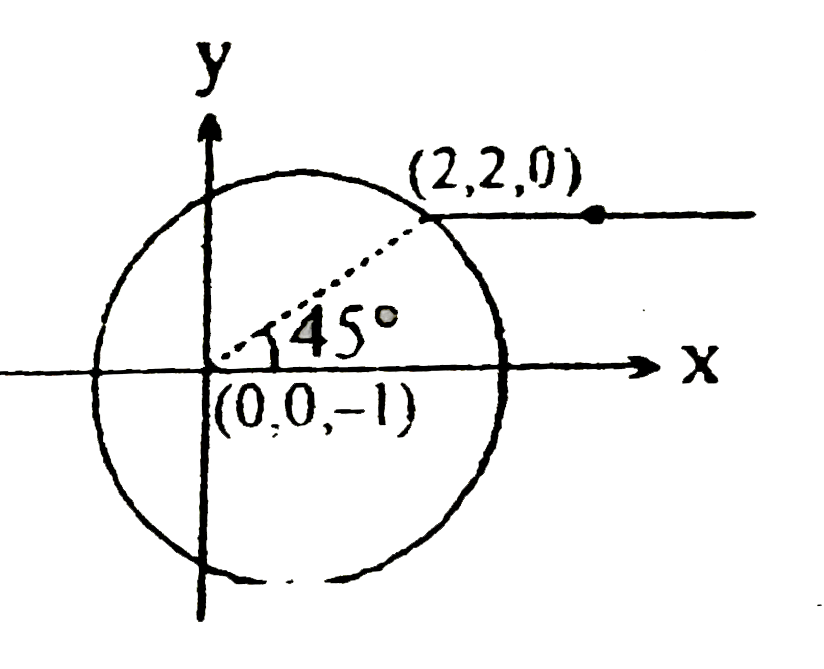 `hat(N)=(2HAT(i)+2hat(j)+hat(K))/3` `hat(e)=-hat(i)` USING `hat(r)=hat(e)-2(hat(e).hat(n))hat(n)` `hat(r)=-hat(i)-(2(-2))/3 ((2hat(i)+2hat(j)+hat(k)))/3=-hat(i)+4/9(2hat(i)+2hat(j)+hat(k))=(-hat(i)+8hat(j)+4hat(k))/9` |
|
| 36. |
When a body of mass M loses heat, the rate of fall of temperature is proportional to |
|
Answer» `M^(1//2)` |
|
| 37. |
When a projectile is moving at 60 m s^(-1) at the highest point of its trajectory, it explodes into two equal parts. One part moves vertically up with a velocity of 50 ms^(-1) . The magnitude of velocity of other part is: |
|
Answer» `50ms^(-1)` Applying momentum conservation along X-axis, we get `mv_(x)=(2m)60` or `v_(x)=120ms^(-1)` Applying momentum conservation along Y-axis, we get `mv_(y)=m(50)` or `v_(y)=50ms^(-1)` Velocity of the other part, v `sqrt(120^(2)+50^(2))MS^(-1)` |
|
| 38. |
An infinite non-conducting plane with uniform charge density sigma is kept parallel to yz plane and at a distance 'd' from a dipole vecp which itself is located at the origin. An equipotential surface for this system is spherical, centred at origin, having radius R(ltd). Given that R=(p/(npisigma))^(1//3), find the integer n |
|
Answer» `implies(sigma)/(2epsilon_(0))=1/(4piepsilon_(0)) (p sin theta)/(R^(3))` `impliesR^(3)=p/(2pi sigma)` `implies n=2` 
|
|
| 39. |
A sliding conducting bar of mass m resistance R is released from rest . It starts sliding due to the current drawn from a battery of emf epsilon in a steady inward magnetic field . Find the variation of its speed with time. Also find the terminal speed of the bar. |
|
Answer» |
|
| 40. |
The equation of a transverse travelling wave on a string is y = 2 cos pi (0.5xx - 200t), where x and y are in cm and t in sec. Then the velocity of propagation of the wave is |
|
Answer» 200 cm/sec |
|
| 41. |
Draw circuit diagram for n-p-n transistor to draw input and output characteristics in common base configuration. Draw the input and ouput curves and explain them. |
Answer» Solution :`(i)` Common base characteristics. The circuit diagram for common base n-p-n transistor is shown in fig. (a). The input is APPLIED across the emitter and base and OUTPUT is taken across collector and base. Here base is common to both the input and output circuits. The most important characteristics of common base connections are input characteristic and output characteristic.  Input characteristics (or emitter characteristics) A graph showing the relationship between the emitter base voltage `(V_(eb))` and the emitter current `(I_(e))` at constant collector base voltage is called input characteristics of emitter characteristics of the transistor. To OBTAIN input characteristics, the emitter base circuit is forward baised by emitter to base voltage `V_(eb)` and collector base circuit is reverse biased by collector to base voltage `V_(eb)`. The collector voltage `V_(cb)` is kept constant at a suitable value. The emitter voltage `V_(eb)` is varied in small steps and the emitter current `I_(e)` is noted corresponding to each value of the emitter voltage. A curve is then plotted between `V_(eb)` and `I_(e)` for a GIVEN value of `V`. This is one characterisitic. Similar characteristic curves can be drawn for different fixed values of `V_(cb)` as shown in fig. (b).  `(ii)` Output characteristic (or collector characteristics). A graph showing the relationship between the collector base voltage `(V_(cb)` and collector current at constant emitter current `(I_(e))` is called the collector characteristic or the output characteristic of the transistor. To obtain ouput characteristics the emitter current `I_(e)` is kept constant at a suitable value. The collector voltage `V_(cb)` is varied in small steps and the collector current `I_(c)` is noted corresponding to each value of the emitter current. A curve is then plotted between `V_(cb)` and `I_(c)` for a given value `I_(e)`. This is one characteristic. Similar characteristic curves can be drawn for different fixed values of `I_(c)` as shown in fig (c) . 
|
|
| 42. |
Two circular coils 1 and 2 are made from same wire but radius of first coil is twice that of second coil .What potential difference should be applied across them so that so that the magnetic field at their center is the same ? |
|
Answer» 2 |
|
| 43. |
Consider the diagram, A parallel plate capacitor has the plate width t and length L while the separation between the plates is d. The capacitor is connected to a battery of voltage rating V. A dielectric which carefully occupy, the space between the plates of the capacitor is slowly inserted between the plates. when length x of the dielectric slab is introduced into the capacitor, then energy stored in the system is |
|
Answer» `(epsi_(0) t V^(2))/(2d) L` |
|
| 44. |
A wire suspended vertically from one of its ends is stretched by attaching a weight of 200 N to the lower end. The weight stretches the wire by 1 mm. Then the elastic energy stored in the wire is : |
|
Answer» 0.2 J `=1/2` Force `xx` EXTENSION `=1/2xx200xx1xx10^(-3)=0.1J` Thus correct choice is (d). |
|
| 45. |
A parallel plate capacitoris charged by a battery which is then disconnected. A dielectric slab is then inserted to fill the space between the plates. Match the changes that could occur with Column II. |
|
Answer» <P> |
|
| 46. |
epsilon_0 iscalled of free space and it's magnitude is _____ . |
| Answer» Solution :PERMITTIVITY,`8.854 XX 10^(-12) C^2N^(-1)m^(-2)`` | |
| 47. |
The numerical ratio of average velocity to average speed is |
|
Answer» UNITY Now displacement is always the SHORTEST distance `:.("displacement")/("distance")le 1` Hence `v_(av)le("speed")_(av)` `:. (v_(av))/(("speed")_(av))LE1` |
|
| 48. |
Out of the following the correct order of dimensions of mass increases is (A) Velocity(b) Power (c) Gravitational constant |
|
Answer» A, B, C |
|
| 49. |
P - V plots for two gases during P4 adiabatic process are shown in the figure. Plots 1 and 2 should correspond respectively to |
|
Answer» `He " and " O_(2)` `(dP)/(dV) = - gamma P/V` slope is `gamma` with negative sign. From the given graph `("slope")_(2) GT ("slope")_(1)` ` :. gamma_(2) gt gamma_(1)` Therefore , CURVE 1 should correspond to `O_(2) (gamma = 1.4) ` and curve 2 should correspond to He `(gamma = 1.67)`. |
|
| 50. |
Three different slabs consisting of different media are placed in front of a concave mirror of radius of curvature 150 cm. The whole arrangement is placed in water (mu = 4//3). An object O is placed at a distance 153 cm from the mirror. The refractive index of different media are given in the diagram. Find the position of final image formed by the system. |
| Answer» SOLUTION :IMAGE COINCIDE with the OBJECT | |