

Saved Bookmarks
This section includes 7 InterviewSolutions, each offering curated multiple-choice questions to sharpen your Current Affairs knowledge and support exam preparation. Choose a topic below to get started.
| 1. |
Three charges are placed on the circumference of a circle of radius d as shown in the figure. Find the electric field along x-axis at the centre of the circle : Electric field due to -4q vecE_(1) =(4kq)/d^(2) electric field due to +2q and -2q vecE_(23) = (4kq)/d^(2) |
|
Answer» `q/(4piepsilon_(0)d^(2))` `E==(4kq)/d^(2)cos30^(@) + (4kq)/d^(2) cos(-30^(@))` `=q/(piepsilon_(0)d^(2)) xx (2 xx SQRT(3))/2 =(qsqrt(3))/(piepsilon_(0)d^(2))` |
|
| 2. |
(A) : Short wave communication over long distance is not possible via ground waves. (R) : The ground waves can bend round the corners of the objects on earth. |
|
Answer» Both 'A' and 'R' are true and 'R' is the correct explanation of 'A'. |
|
| 3. |
A ray of light passes through an isosceles triangle such that the angle of incidence is equal to the angle of emergence. If the angle of emergence and angle of incidence are both 45^(@) then angle of deviation will be |
|
Answer» `15^(@)` |
|
| 4. |
Statement (A): According to wave nature of light the radiant energy spreads out continuously in the form of wave. Statement (B): According to particle nature it behaves as a particle and is localized at a point in space. |
|
Answer» Only A is correct |
|
| 5. |
After time t, the height y of a projectile is Y = 8t -5t^2 and horizontal distance x = 6 t ifg = 10m//s^2 the velocity of the projectile at the instant is |
|
Answer» 8 m `s^-1` |
|
| 6. |
Pure Si at 300 K has equal electron (n_(e)) and hole (n_(h)) concentration of 1.5xx10^(16) m^(-3) . Doping by indium increases n_(h) to 4.5xx10^(22)m^(-3) . Calculate n_(e) in the doped silicon. |
|
Answer» Solution :Here `n_(i)=1.5xx10^(16)m^(-3),n_(H)=4.5xx10^(22)m^(-3)` But `n_(E)n_(h)=n_(1)^(2)` `therefore n_(e)=(n_(1)^(2))/(n_(h))=((1.5xx10^(16))^(2))/(4.5xx10^(22))=5xx10^(9)m^(-3)` |
|
| 7. |
I-IV characteristics of four devices are shown. Identify devices that can be used for modulation |
|
Answer» (i) and (III) |
|
| 8. |
If Mis mass of a planetand Ris its radiusthen in order to becomeblack hole[ c is speed of light ] |
|
Answer» `sqrt((GM)/(R)) le c ` |
|
| 9. |
A stone hanging from a massless string of length 15 m is projected horizontally with speed 12ms^(-1). The speed of the particle at the point where the tension in the string is equal to the weight of the particle, is close to |
| Answer» Answer :B | |
| 10. |
Explain colour code to determine value of carbon film resistors, |
Answer» Solution :`RARR` colour code to determine value of carbon film resistor is SHOWN in table below.  `rArr` To remember this colour code : B B ROY Goes to Bombay Via Gate Way `rArr` First and second colour band represent tenth PLACE and unit place of resistance respectively. `rArr` Third band represent is denoted by n then it represent `10^(n)` power to number OBTAINED by first two band. `rArr` Fourth band represent tolerance value 5% or 10%. If there are only three band then tolerance value of 20% . For example , carbon resister have orange, blue, yellow and golden band. Form table forOrange = 3 Blue = 6 Yellow = 4 = n `therefore` Resistance value = `36 xx 10^(4) Omega` `rArr` Fourth band is of golden colour which indicate 5% tolerance. |
|
| 11. |
The flat bottom of cylinder tank is silvered and water (mu=4/3) is filled in the tank upto a height h. A small bird is hovering at a height 3h from the bottom of the tank. When a small hole is opened near the bottom of the tank, the water level falls at the rate of 1 cm/s. The bird will perceive that his velocity of image is 1/x cm/sec (in downward directions) where x is |
|
Answer» |
|
| 12. |
A coil area 100 cm^(2) having 500 tums carries a current of 1 mA . It is suspended in a uniform magnetic field of induction 10^(-3) Wb//m^(2). Its plane makes an angle of 60° with the lines of induction. Find the torque acting on the coil. |
|
Answer» SOLUTION :Given `i = 1 mA=10^(-3) A, N=500, B=10^(-3)Wb//m^(2)` `theta=60^(@),tau=?A=100cm^(2)=100xx10^(-4)m^(2)` COUPLE acting on the coil is given by `tau=BiANsinphi,` Where `phi` is angle made by NORMAL to the PLANE of coil with B. `phi =90 - 60 = 30°` `thereforeC=10^(-3)xx10^(-3)xx100xx10^(-4)xx500xxsin30` `=250xx10^(-8)Nm` |
|
| 13. |
A small object loops a vertical loop in which a symmetrical section of angle 2alphahas been removed (Fig.) Find the maximum and the minimum heights from which the object, after loosing contact with the loop at point A and flying through the air, will reach point B. Find the corresponding angles of the section removed for which this is possible. |
|
Answer» `L=(2v_0^2sinalphacosalpha)/g` So `v_0^2=(gR)/(COSALPHA)` To find the speed `v_0` apply the law of conservation of energy `mgH = mgH (1+ cos alpha)+1/2 mv_0^2` for which `k=H/R=1+cos alpha+1/(2 cosalpha)`. For the computation of `cos alpha ` we obtain an equation `2 cos^2alpha-2(k-1) cos alpha+1=0` `cosalpha=1/2(k-1pmsqrt((k-1)^2-2))` Since the number under the root sign must be non - negative , we obtain `k-1gesqrt2` i.e. `kge1+sqrt2`. On the other hand `0 lt cos alpha le 1`, i.e. `k-1 +sqrt((k-1)^(2)-2) le le 2 and k le 2.5`. Thus `1+sqrt2 le k le 2.5 `, i.e. `(1+sqrt2)R le H le 2.5R` For the limiting VALUES of the cosines we have `cosalpha=sqrt2/2,e. alpha_1=45^@` `cos alpha=(1.5pm0.5)//2,cosalpha_(2)=0.5, cosalpha_3=1` Obviously the solution `cos alpha_(3) =1` does not satisfy the condition of the problem since for `alpha_3=0` there will be no cut. So the remaining solution is `cos alpha_(2)=0.5 , alpha_(2) = 60^@` Accordingly for the heights in the range `(1+sqrt2)R le H le le 2.5R` corresponding suitable cuts are those with angles of`45^@ le le alpha le 60^@` chosen so as to satisfy the condition `cosalpha=1/2(k-1-sqrt(k^2-2k-1))` |
|
| 14. |
Find the Q-value and the kinetic energy of the emitted alpha-particle in the alpha-decya of(a) ""_(88)^(226)Ra and (b) ""_(86)^(220)Rn. Given m (""_(88)^(226)Ra) = 226.02540 u, "" m(""_(86)^(222)Rn) = 222.01750 u. m(""_(86)^(220)Rn) = 220.01137 u, "" m (""_(84)^(216)Po) = 216.00189u. |
| Answer» SOLUTION :(a) `Q = 4.93 MEV, E_a = 4.85 MeV (B) Q = 6.41 MeV, E_a = 6.29 MeV` | |
| 15. |
A prism shaped network of resistors has been shown in the figure. Each arm (like AB, AC, CD, DF ...) has resistance R. Find the equivalent resistance of the network between (a) A and B (b) C and D |
|
Answer» (B) `(3R)/(5)` |
|
| 16. |
The maximum energy emitted per unit time per unit area by a body for a particular wavelength depend directly on |
|
Answer» temperature |
|
| 17. |
A ball is thrown upward with an initial velocity of 100ms^(-1).After how much time will it return?Draw velocity-time graph for the ball and find from the graph (i) the maximum height attained by the ball and (ii) height of the ball after 15 s.Take g=10 ms^(-2) |
Answer» Solution :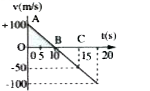 Here,U =`100ms^(-1)` ,g=`-10 ms^(-2)` At highest point ,v=0 As v=u+gt `therefore=100-10xxt` `therefore` Time taken to reah highest point ,`t=(100)/(10)=10s` The ball will return to the ground at t =20 S Corresponding velocity-time graph of the ball is SHOWN in (i)Maximum height attained the ball =Area of `DeltaAOB=(1)/(2)xx10xx10=500 m` (ii)HEight attained after 15s= Area of `DeltaAOB`+Area of `DeltaBCD` `500+(1)/(2)(15-10)xx(-50)=500-125=375m` |
|
| 18. |
Obtain an expression for the kinetic energy of a particle performing linear SHM. State how it depends upon the amplitude, frequency and period of SHM. |
|
Answer» Solution :Consider a particle of MASS m performing linear SHM with amilitude A. The restoring force acting on the particle is `F=-kx`, where k is the force constant and X is the displacement of the particle from its mean position. As `omega=2pif=(2pi)/(T)`, where f and T are respectively the frequency and PERIOD of SHM, `KE=(1)/(2)momega^(2)(A^(2)-x^(2))=(1)/(2)m(4pi^(2)f^(2))(A^(2)-x^(2))` `=2 m pi^(2)f^(2)(A^(2)-x^(2))=(2mpi^(2)(A^(2)-x^(2)))/(T^(2))` Thus, `KE prop A^(2) prop f^(2)` and `KE prop (1)/(T^(2))` [Note : Total energy : The total energy of a particle performing linear SHM is `E=PE+KE=(1)/(2)kx^(2)+(1)/(2)k(A^(2)-x^(2))=(1)/(2)kx^(2)+(1)/(2)kA^(2)-(1)/(2)kA^(2)` `=(1)/(2)momega^(2)=2mpi^(2)f^(2)A^(2)=(2mpi^(2))/(T^(2))A^(2)` `:. E prop A^(2), E prop f^(2), E prop (1)/(T^(2))`] |
|
| 19. |
Calculate the wavelength of radiation emitted when He^(+) makes a transition from the state n =3 to the state n=2. |
|
Answer» 164.0nm |
|
| 20. |
A 1 mu C charge is uniformly distributed on a spherical shell given by the equation x^(2)+y^(2)+z^(2)=25 . What will be the intensity of electric field at a point (1,1,2) ? |
|
Answer» 5 N/C Zero because point (1,1,2) will be inside the spherical SHELL. ' |
|
| 21. |
An alpha -particle moving with initial kinetic energy 'K' towards a nucleus of atomic number Z approaches a distance 'r_(0)' at which it reverses its direction. Obtain the expression for the distance of closest approach 'r_(0)' in terms of kinetic energy of a particle. |
|
Answer» Solution :Consider an o-particle of mass m, charge + 2e and an initial speed v (or initial KINETIC energy K) moving straight along the central LINE of a nucleus of atomic number Z. As `alpha`particle approaches the nucleus, on account of electrostatic repulsion, its speed goes on DECREASING and at a point SITUATED at a distance `r_(0)`, the `alpha`-particle momentarily comes to REST. Obviously in this position the initial kinetic energy of `alpha`-particle has been completely converted into electrostatic potential energy i.e., `K.E ` at`A =P.E` at B `therefore "" k = (1)/(2) mv^(2)= (1)/(4 pi in_(0)) .((+2e)(+Ze))/(r_(0))` `rArr "" r_(0) = (1)/(4 pi in_(0)) = (2Ze^(2))/(((1)/(2) mv^(2))) =(1)/(4pi in_(0)) .(2Ze^(2))/(K)` 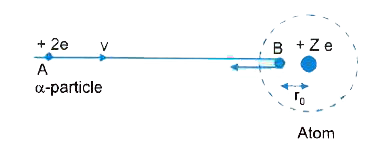
|
|
| 22. |
Name three nuclei which lie on maxima in Binding energy curve. |
| Answer» Solution :Three nuclei which LIE on maxima are `._2He^4,._6C^(12),._8O^(16)`. | |
| 23. |
H,He^(+), Li^(2+) are examples of atoms or ionswith one electron each . The energy of such atoms when in the n-th energy state (according to Bohr,s theory , n=1,2,3…. =principal quantum number ) is E_n =(13.6 Z^2)/(n^2) eV (1 eV =1.6xx10^(-19)J). For the ground state ,n=1 . in order to raise theatom from the ground state to n=f , the suitable incidentlight should have a wavelength given by lambda=(hc)/(E_f-E_1). But the atom cannotstay permanently in thef-energy state, ultimately , it comes to the ground state by radiating the extra energy ,E_f-E_1 as electromagnetic radiation .The electron of the atom comes from n=f to n=1 in one or more steps using the permitted energy levels . As a resultthere is a possibilityof emission of radiation with more than one wavelength from the atom. Planck's constant=6.63 xx10^(-34)J*s and velocity of light c=3xx10^(8)m*s^(-1). (iii) What is the value of the maximum wavelength inexample (ii) ? |
|
Answer» 952 Å |
|
| 24. |
H,He^(+), Li^(2+) are examples of atoms or ionswith one electron each . The energy of such atoms when in the n-th energy state (according to Bohr,s theory , n=1,2,3…. =principal quantum number ) is E_n =(13.6 Z^2)/(n^2) eV (1 eV =1.6xx10^(-19)J). For the ground state ,n=1 . in order to raise theatom from the ground state to n=f , the suitable incidentlight should have a wavelength given by lambda=(hc)/(E_f-E_1). But the atom cannotstay permanently in thef-energy state, ultimately , it comes to the ground state by radiating the extra energy ,E_f-E_1 as electromagnetic radiation .The electron of the atom comes from n=f to n=1 in one or more steps using the permitted energy levels . As a resultthere is a possibilityof emission of radiation with more than one wavelength from the atom. Planck's constant=6.63 xx10^(-34)J*s and velocity of light c=3xx10^(8)m*s^(-1). (iv) What is the value of the minimum wavelength in example (ii)? |
|
Answer» 952 Å |
|
| 25. |
H,He^(+), Li^(2+) are examples of atoms or ionswith one electron each . The energy of such atoms when in the n-th energy state (according to Bohr,s theory , n=1,2,3…. =principal quantum number ) is E_n =(13.6 Z^2)/(n^2) eV (1 eV =1.6xx10^(-19)J). For the ground state ,n=1 . in order to raise theatom from the ground state to n=f , the suitable incidentlight should have a wavelength given by lambda=(hc)/(E_f-E_1). But the atom cannotstay permanently in thef-energy state, ultimately , it comes to the ground state by radiating the extra energy ,E_f-E_1 as electromagnetic radiation .The electron of the atom comes from n=f to n=1 in one or more steps using the permitted energy levels . As a resultthere is a possibilityof emission of radiation with more than one wavelength from the atom. Planck's constant=6.63 xx10^(-34)J*s and velocity of light c=3xx10^(8)m*s^(-1). (ii) Radiations of how manywavelengths are possible in case of the excited atom in theexample I to come to ground state? |
|
Answer» 2 |
|
| 26. |
Why are high frequency carrier waves used for transmission ? |
| Answer» Solution :The high carrier WAVES are used for transmission because these high frequency carrier waves TRAVEL through SPACE or medium with the speed of light and they are not obstructed by EARTH's ATMOSPHERE. | |
| 27. |
The distance between the object and its real image formed by a convex lens |
|
Answer» cannot be GREATER than 2f |
|
| 28. |
A: The phase difference between the two particles shown below is pi. (Assuming both particles have same time periods and same amplitudes). R: If the particles cross each other while they move in the opposite direction, they have a phase difference of pi radian. |
|
Answer» If both ASSERTION & Reason are true and the reason is the correct explanation of the assertion, then MARK (1) |
|
| 29. |
In the circuit shown below, the switch is kept in position 'a' for a long time and is then thrown to position 'b'. The amplitude of the resulting oscillating current is given by |
|
Answer» `E sqrt(L//C)`  Charge on capacitor, q = CE. ENERGY stored in capacitor, `U=(q^(2))/(2C)` When switch is thrown to position b, there is an LC oscillating circuit. Suppose amplitude of current in LC circuit is `I_(0)`. Using energy conservation principle, Maximum electrical energy = Maximum magnetic energy `(q^(2))/(2C)=(1)/(2)LI_(0)^(2)RARR (C^(2)E^(2))/(C )=LI_(0)^(2), therefore I_(0)=E sqrt((C )/(L))` |
|
| 30. |
(a)Describe briefly, with the help of suitable diagram, how the transverse nature of light can be demonstrated by the phenomenon of polarization. (b)When unpolarized light passes from air to a transparent medium, under what condition does the reflected light get polarized? |
|
Answer» Solution :(a)Polarization :The dots and arrow indicates that both polarization are present in the incident and refracted waves. Only TRANSVERSE wave can be POLARIZED. And the transverse nature of light can be DEMONSTRATED by the polarization. Light can be polarized by reflecting it from a transparent medium. The extend of polarization by reflecting it from a transparent medium. The extend of polarization depend on the ANGLE of incient, at a particular angle of incidence, called Brewster 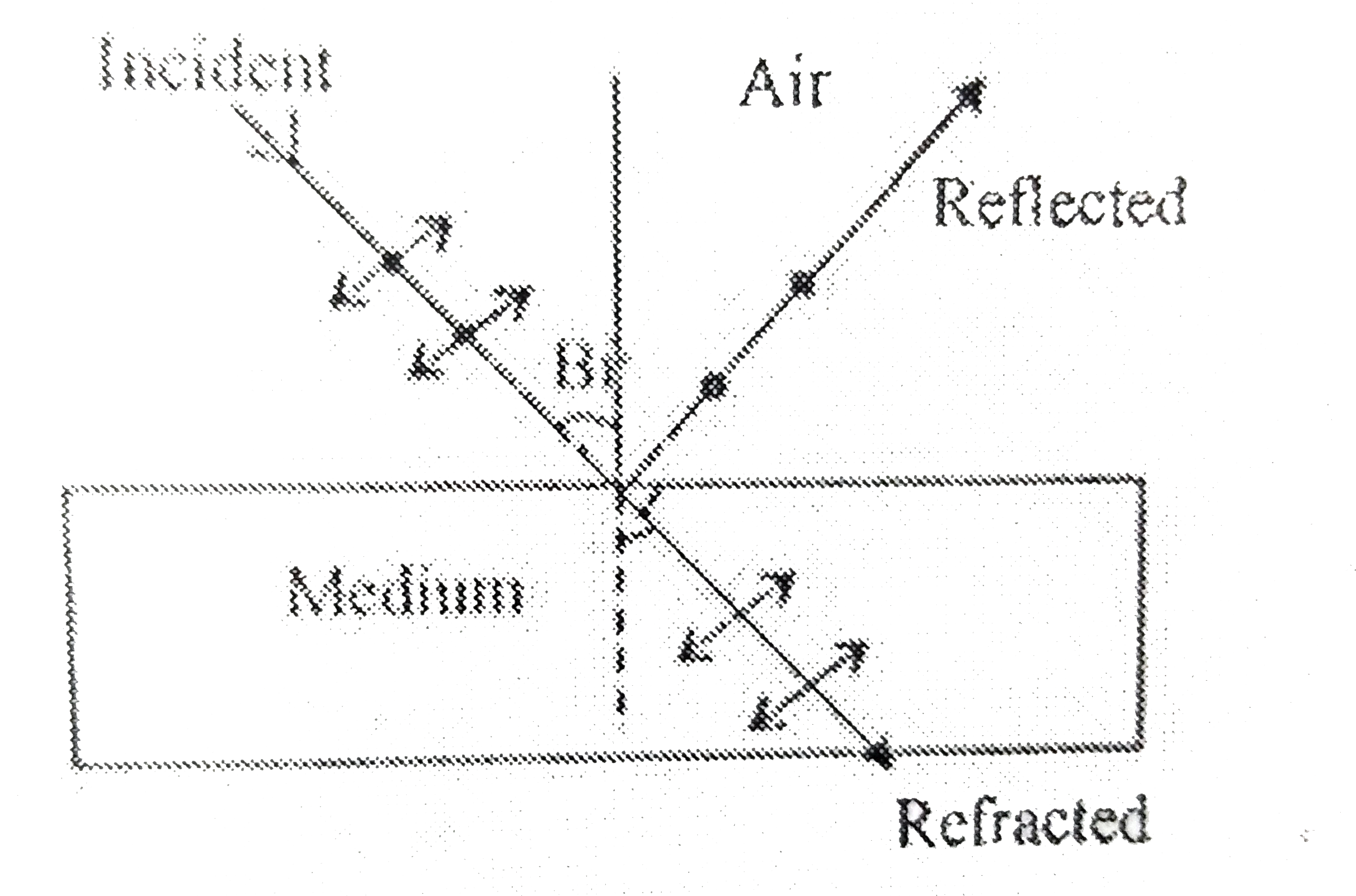 (b)Unpolarized light : The independent light waves whose planes of vibrations are randomly oriented about the direction of propagation are said to be unpolarized light. When unpolarized light is incident on the boundary between two transparent media, the reflected light i polarized with electric vector perpendicular to the PLANE of incidence when the refracted and reflected rays make a right angle with each other. |
|
| 31. |
A : The gravitational fieldintensityis zeroeverywhereinsidea uniformspherical shell R: The netforceon a pointmass insidea uniformsphericalshellis zeroeverywhere . |
|
Answer» If both Assertion & Reasonare true . Andthe REASONIS the correct explanationof theassertion , then mark (1) |
|
| 32. |
Assertion (A) : Nuclear density has same value for all nuclei irrespective of their atomic numbers and mass numbers. Reason (R) : Radius of a nucleus is directly proportional to the cube root of its mass number. |
|
Answer» SOLUTION :As `R prop [A]^(1//3)` , Volume of nucleus `V prop R^(3)` or ` V prop A` `THEREFORE` Nuclear density `RHO = (A)/(V)` is a constant . |
|
| 33. |
A long horizontal plank of mass m is lying on a smooth surface. A solid sphere of same mass m and radius 'r' is spinned about its own axis with angular velocity omega_(0) and gently placed on the plank. The coefficient of friction between the plank and the sphere is mu. After some time the pure rolling of the sphere on the plank will start. Find the displacement of the plank till the sphere starts pure rolling |
|
Answer» `(omega_(0)^(2)r^(2))/(81mug)` `V_(2)^(2)=V_(1)^(2)-2g(R+Rsintheta)=2gR-2gRsintheta` N + `mgsintheta=(mV_(2)^(2))/(R )` Putting N = 0 implies `mgsintheta = m2g(1-sintheta)` ` implies theta=sin^(-1)((2)/(3))` `V^(2)=V_(1)^(2)-2gRimpliesV^(2)=4gR-2gR` `V=sqrt(2gR)` `a_(c )=(V^(2))/(R )=2gimpliesa_(t)=g` `TAN alpha=(a_(t))/(a_(c ))impliesalpha=tan^(-1)((1)/(2))` Maximum contact force is at A. 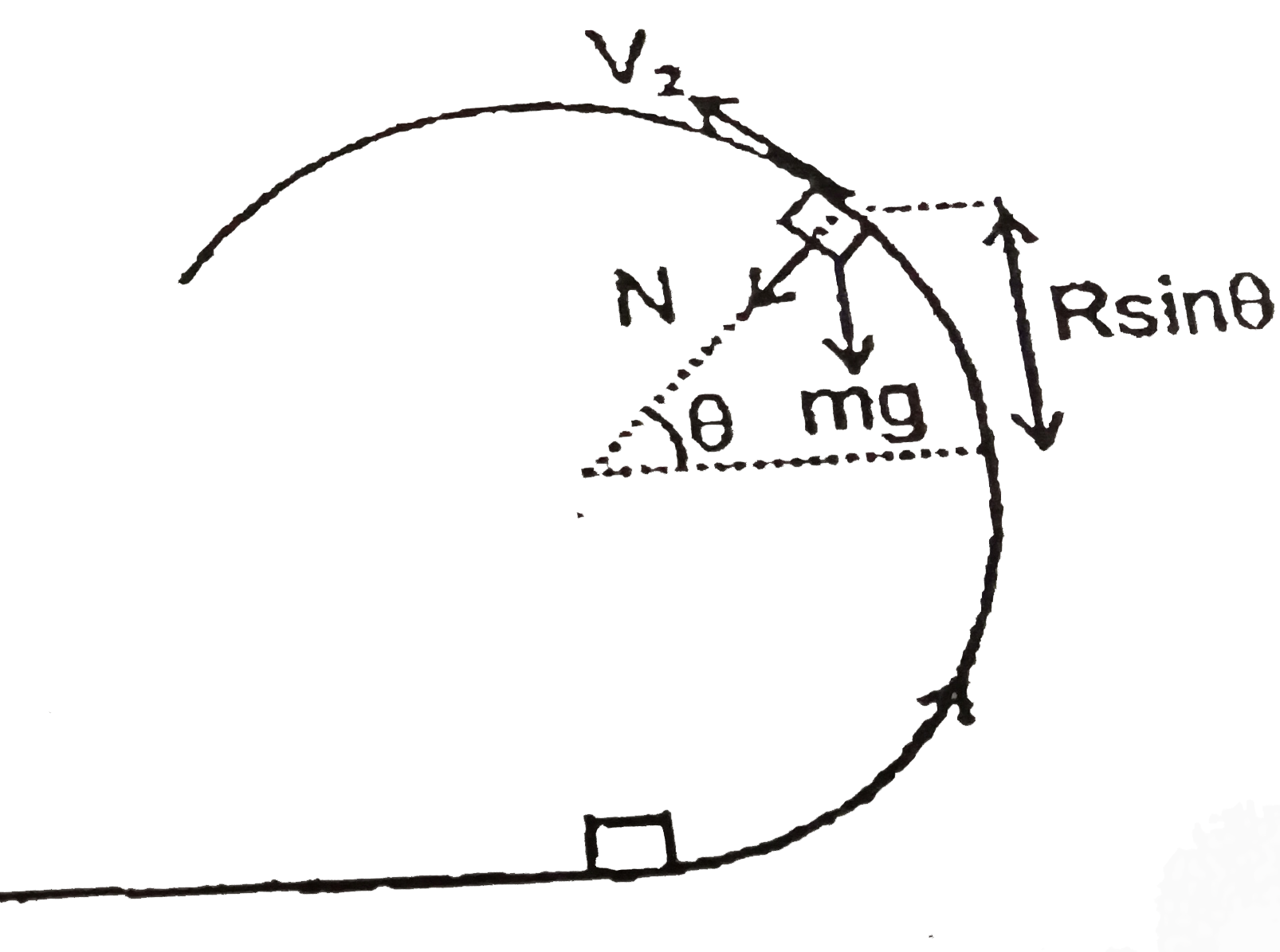
|
|
| 34. |
A long horizontal plank of mass m is lying on a smooth surface. A solid sphere of same mass m and radius 'r' is spinned about its own axis with angular velocity omega_(0) and gently placed on the plank. The coefficient of friction between the plank and the sphere is mu. After some time the pure rolling of the sphere on the plank will start. Velocity of sphere after pure rolling starts |
|
Answer» `(2omega_(0)r)/(9)` `V_(2)^(2)=V_(1)^(2)-2g(R+Rsintheta)=2gR-2gRsintheta` N + `mgsintheta=(mV_(2)^(2))/(R )` PUTTING N = 0 implies `mgsintheta = m2g(1-sintheta)` `implies theta=sin^(-1)((2)/(3))` `V^(2)=V_(1)^(2)-2gRimpliesV^(2)=4gR-2gR` `V=sqrt(2gR)` `a_(c )=(V^(2))/(R )=2gimpliesa_(t)=G` `tan alpha=(a_(t))/(a_(c ))impliesalpha=tan^(-1)((1)/(2))` Maximum contact force is at A. 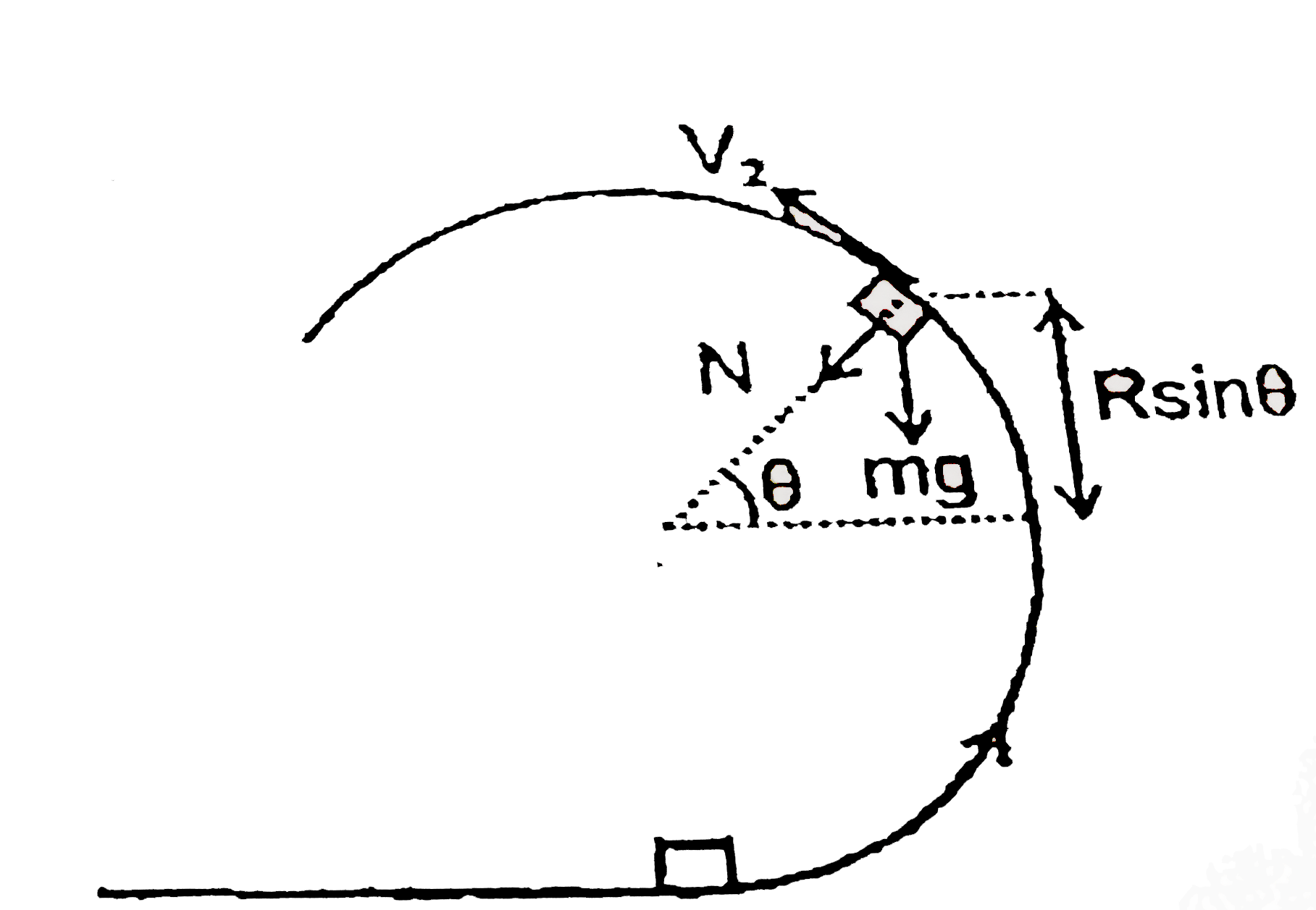
|
|
| 35. |
A projectile is thrown with initial velocity ahat(i) + bhat(j) m/s. If range of projection is twice the maximum height reached by it then : |
|
Answer» `b=a/2` Velocity in Y= direction `u_(y) = u sin theta = b` Now `R=(u^(2)ssin2theta)/g=(2u^(2)SINTHETACOSTHETA)/g` `=(2(usintheta)(ucostheta))/g=(2ab)/g` Also `H_(max)=(usintheta)^(2)/(2g)=b^(2)/(2g)` `(2ab)/g=(2b^(2))/(2g)` Thus b=2a |
|
| 36. |
The wavelength of X-rays is of the order of: |
|
Answer» `10^(-3) m` |
|
| 37. |
A hydrogen atom and Li^(++) ion are both in the second excited state. If l_(H) and l_(Li) are the respective electronic moments, and En and EL their respective energies then |
|
Answer» `l_(H) gt l_(Li) and |E_(H)| gt |E_(L)|` `l =n (h)/(2PI)` For both, n=2, `therefore l_(H)=l_(Li)=2 XX (h)/(2pi)=(h)/(pi)` Energy of electron in nth orbit of hydrogen atom. `E_H=-(13.6)/(n^(2)) eV` For n=2, we get `E_(H)=-(13.6)/(4)-3.4eV` Energy of electron in nth orbit of hydrogen like atom `("say "Li^(++) ion). E_(Li)=-(Z^(2) xx 13.6)/(2)eV` Here n=2 and for Li, Z=3 `therefore E_(Li)=-(9 xx 13.6)/(2) -30.6eV` i..e `|E_(H)| lt |E_(Li)|` |
|
| 38. |
A potentiometer has a uniform wire of length 10m andresistance 5 Omega. The potentiometer is connected to anacross a cellof e.m.f. 2 V and internal resistanc 10 Omega. The reading of voltmeter is |
|
Answer» 1mV/m `Irho=((E)/(R+R_(h)+r))(R)/(L)=((10)/(5+995+0))=(5)/(10)` `=5XX10^(-3)V//m = 5 m V//m` |
|
| 39. |
A long straight conductor carrying a current lies along the axis of a ring. The conductor will exert a force on the ring, if the ring |
|
Answer» CARRIES a current |
|
| 40. |
(A): When a donor electron is excited to the conduction band no hole is created (R): Donor energy level does not exist in the valence band. |
|
Answer» Both 'A' and 'R' are TRUE and 'R' is the CORRECT EXPLANATION of 'A' |
|
| 41. |
A rectangular coil ABCD is rotated in uniform magnetic field with constant angular velocity about its one of the diameter as shown in figure. The induced emf will be maximum, when the plane of the coil is :- |
|
Answer» PREPENDICULAR to the magnetic field |
|
| 42. |
A 30 kg box has to move up an inclined slope of 30^@ to the horizontal at a uniform velocity of 5 ms^(-1). If the frictional force retarding the motion is 150N, the horizontal force required to move up is (g=10 ms^(-2)) |
|
Answer» `300 XX (2)/(sqrt3) N` |
|
| 43. |
Two masses m_(1), and m_(2) are connected by a string of length L. They are held in horizontal plane at a height H above two fixed heavy plates A and B made of different material placed on the floor. Initially distance between two masses is altL. When the masses are released under gravity they make collision with A and B with co-efficient of resitution 0.8 and 0.4 respectively. The time after collision when the string becomes tight is |
|
Answer» `t = 5/2 SQRT((l^2 - a^2)/(2gh))` |
|
| 44. |
Four light sources produce the following waves y_(1)=a sin (omegat +phi_(1)) (ii) y_(2)=a sin (2 omegat) (iii) y_(3) =a^(1)sin (omegat+phi_(2)) (iv) y_(4)=a^(1)sin(3omegat+phi) |
|
Answer» (i) and (II) |
|
| 45. |
Each side of a cube is measured to be 7.023m. What are the total surface area and volume of the cube to appropriate significant figures. |
|
Answer» Solution :Here l=7.203m Surface area of the cube=`6l^2 A=6(7.203)^2=311.299m^2` As l has four SIGNIFICANT FIGURES as per rule surface area and VOLUME both should have four significant figures. Rounding off`A=311.3mm^2` volume of the cube `=l^3=(7.203)^3=373.714m^3=373.7m^3` |
|
| 46. |
A point source of 100 candela is held 5 m above a sheet of blotting paper which reflects 75% of light incident upon it. The illuminance of blotting paper is |
|
Answer» 4 phot |
|
| 47. |
A long straight wire carrying current of 30 A is placed in an external uniform magnetic field of induction 4 xx 10^(-4) T. The magnetic field is acting parallel to the direction of current. The magnitude of the resultant magnetic induction in tesla at a point 2.0 cm away form the wire is |
|
Answer» `10^(-4)` |
|
| 48. |
What are the dimensions of chi, the magnetic susceptibility? Consider an H-atom. Guess an expression for chi, upto a constant by constructing a quantity of dimensions of chi, out of parameters of the atom: e, m, v, R and mu_0. Here, m is the electronic mass, v is electronic velocity, R is Bohr radius. Estimate the number so obtained and compare with the value of |chi|10^(-5) for many solid materials. |
|
Answer» Solution :Magnetic susceptibility of substance `chi_(m) = (M)/( H)` `chi_(m) = (I)/( I) [ because` Units of M and H are same dimension FORMULA of `chi_(m) [M^(0) L^(0) T^(0) ]`. From Biot-Savart.s law, `dB= (mu_0)/( 4pi )( I dl sin theta )/( R^2)` `therefore mu_0 = (4pir^2dB)/( Idl sin theta)` `= (4pi r^2)/( I dl sin theta ) xx (F)/( qv sin theta) [ because dB= (F)/( dv sin theta)]` The dimensional formula of `mu_0` `therefore` Dimension of `mu_0 = (L^(2) xx [M^(1) L^(1) T^(-2) ] )/( (QT^(-1) ) (L) (Q) (L^(-1) T^(-1) ) )` `= M^(1) L^(1) Q^(-2)""` [Where Q is the dimension of charge] An `chi` is dimensionless, it should have no involvement of charge Q in its dimension formula. It will be so if `mu_0 and e^(2)` together should have the value `mu_(0) e^(2)` as e has the dimension of charge. LET `chi= mu_(0) e^(2) m^(a) V^(b) R^(c ) ""...(1)` where a, b, c are the power of m, v and R respectively, such that relation (1) is satisfied Dimension equation of (1) is, `[ M^(0) L^(0) T^(0) Q^(0) ] = [ M^(1) L^(1) Q^(-2) ] [Q^(2) ] [Q^(2) ] [M]^(a) [LT^(-1) ]^(b) [L]^(c )` `= [M^(1+a)] [L^(1+ b+ c)] [T^(-b) ] [Q^(0)]` Equating the power of M, L, T Equating the power of M, `a+1 =0 therefore a= -1 ""...(2)` Equating the power of T, `-b=0 therefore b=0""...(3)` Equating the power of Q, `1+b + c =0` `therefore c=-1""...(4)` PUTTING value of a, b, c in equation (1) `chi= mu_(0)e^(2) m^(-1) v^(0) R^(-1)` `chi= (mu_(0) e^(2) ) /( mR) [ because v^(0) =1]""...(5)` Here `mu_0= 4pi xx 10^(-7) Tm//A` `e= 1.6 xx 10^(-19) C` `m=9.1 xx 10^(-31) Kg` `R= 10^(-10) m` `therefore chi = ((4pi xx 10^(-7) ) (1.6 xx 10^(-19) )^(2) )/( (9.1 xx 10^(-3) ) (10^(-10) )) ~~ 10^(-4)` `(chi )/( chi_(+) ) = (10^(-4) ) /( 10^(-5)) = 10` |
|
| 49. |
A triode value has mutual conductance of 2 xx10^(-3) mho . If the grid voltage is changed from -2 V to -4 , the plate current : |
|
Answer» INCREASES by 0.5 mA |
|
| 50. |
A block P of mass m is placed on a horizontal frictionless plane. A second block of same mass m is placed on it and is connected to a spring of spring constant K, the two blocks are pulled by distance A. Block Q oscillates without slipping. The maximum value of frictional force between blocks is |
| Answer» Answer :A | |