

Saved Bookmarks
This section includes 7 InterviewSolutions, each offering curated multiple-choice questions to sharpen your Current Affairs knowledge and support exam preparation. Choose a topic below to get started.
| 1. |
If the whole earth is to be connected by LOS communication usinf space waves (no restrication of antenna size or tower height), what is the minimum number of antennas required ? Calculate the tower height of these antennas in terms of earth's radius. |
|
Answer» 1 |
|
| 2. |
The current in the forward bias is known to be more (mA) than the current in the reverse bias (~ muA). What is the reason, then why photo diodes is to operate in reverse bias. |
| Answer» SOLUTION : Even though the current in forward BIAS has a larger magnitude, the CHANGE, due to changes in light intensity, in the MINORITY carrier dominated reverse bias current, is more and is, therefore, more easily DETECTABLE. | |
| 3. |
When a beam of white light illuminates a narrow list,what is the width of the slit so that the second minimum for light of wavelength 600 nm falls at theta=12^(@). |
|
Answer» |
|
| 4. |
A 0.05 A ammeter having resistance of 20 ohm is to be converted into a voltmeter with a range of 0-10 volt.it can be done by connecting a resistance of approximately : |
|
Answer» 1 OHM in parallel |
|
| 5. |
30 coulomb electric charge passes through conducting wire in 10 minutes so ...... A electric current will pass through it. |
|
Answer» 3 `I= (Q)/(t) = (30)/(10 XX 60) = (1)/(20) = 0.05` A |
|
| 6. |
In a series LCR circuit the frequency of a 10V, AC voltage source is adjusted in such a fashion that the reactance of the inductor measures 15 Omega and that of the capacitor 11Omega. If R= 3Omega, the potential difference across the series combination of L and C will be: |
| Answer» Answer :A | |
| 7. |
One milligram of matter converted into energy will give |
|
Answer» `9xx10^10` J |
|
| 8. |
The total area of cross section is 0.25m^2 . If the blood is flowing at the rate of 100 cm^3 / sec , then the average velocity of flow of blood through the capillaries is |
| Answer» Answer :A | |
| 9. |
Find out the product of following reaction : X and Y are : |
|
Answer» `Ph-OVERSET(O)overset(||)(C)-overset(ɵ)(O)` and `CH_(3)OH` |
|
| 10. |
The distance of mth minima from the centre of interference pattern is : |
|
Answer» `X_m=mlamda(D)/d` |
|
| 11. |
What are thermal generators? Mention the value of frequency of ac used in India. |
| Answer» Solution :THERMAL GENERATORS : It is a solid state device that converts heat FLUX directly into electrical energy. The FREQUENCY of AC used in India is 50 Hz. | |
| 12. |
In Young's double-slit experiment, how many maxima can be obtained on a screen (including the central maximum) on both sides of the central fringe (lambda = 2000 Å)? |
|
Answer» 12 `d sin THETA = n lambda` or `sin theta = (n lambda)/(d)` `= ((n)(2000))/((7000)) = (n)/(35)` `sin thetage 12 IMPLIES n = 0, 1, 2, 3` only Thus, only seven maxima can be obtained on both sides of the screen. |
|
| 13. |
A network of four capacitors each of 12 mu Fcapacitance is connected to a 500 V supply as shown in the Fig . Determine equivalent capacitance of the network . |
|
Answer» Solution :GIVEN that `C_1 = C_2 = C_3 = C_4 = 12 mu F ` and supply voltage V = 500 V Since capacitors `C_1 , C_2` and `C_3`are connected in series , their combined capacitance `C_(123)` is given by `(1)/(C_(123)) = (1)/(C_(1)) + (1)/(C_(2)) + (1)/(C_(3)) = (1)/(12) + (1)/(12) + (1)/(12) = (3)/(12) = (1)/(4) implies C_(123) = 4 mu F ` As `C_(123)` has been connected in parallel to `C_(4)` , hence equivalent capacity of the network `C_(EQ) = C_(123) + C_(4) = (4 + 12) mu F = 16 mu F ` |
|
| 14. |
Laminated iron sheets are used to minimise currents in the core of a transformer. |
|
Answer» |
|
| 15. |
A network of four capacitors each of 12 mu Fcapacitance is connected to a 500 V supply as shown in the Fig . Determine charge on each capacitor . |
|
Answer» Solution :Given that `C_1 = C_2 = C_3 = C_4 = 12 mu F ` and supply VOLTAGE V = 500 V Charge on capacitors `C_1 , C_2 , C_3` , being connected in SERIES is exactly same having a value `Q_1 = Q_2 = Q_3 = C_(123) xx V = 4 mu F xx 500 V = 2000 mu C = 2 mC ` Charge on capacitor `C_4` is `Q_(4) = C_(4) V = 12 mu F xx 500 V = 6000 mu C = 6 mC ` |
|
| 16. |
If the critical angle for total internal reflection from a medium to vacuum is 30^@, then velocity of light in the medium is .......... ms^(-1). (c = 3.8 xx 10^8 ms^(-1)) |
|
Answer» `3.0xx10^8` `n=(1)/(sinC)impliessinC=1/n`…........(1) but `n=c/v` (where v is the velocity in medium) `therefore 1/n=v/C` …........(2) From equation (1) and (2), `sinC=v/C` `thereforev=sinCxxc` `(c=3xx10^8,` critical angle C=`30^@`) `=sin(30^@)xx3xx10^8=1.5xx10^8" "m//s` |
|
| 17. |
Derive an expression for the current sensitivity of a moving-coil galvanometer. A solenoid, 1.5 m long and 4 cm in diameter, has 10 turns/cm and carries a current of 5 A. Calculate the magnetic induction at its centre. |
|
Answer» |
|
| 18. |
A ray of monochromatic light is incident on the plane surface of separation between two media x andy with angle of incidence i in the medium x and angle of refraction r in the medium y . The graph shove the relation between sin i and sin r |
|
Answer» The speed of light in the MEDIUM y is `sqrt3`TIMES than in medium x |
|
| 19. |
How is it convenient to obtain image by lens practically? |
Answer» SOLUTION :To find the image of an object by a lens, we cai in PRINCIPLE, take any two RAYS emanating fron a point on an object, TRACE their paths using thi laws of refraction and find the point where the refracted rays meet or appear to meet). Ir practice, however it is convenient to choose any two of the following rays. (i) A ray emanating from the object parallel to the principal axis of the lens after refraction PASSES through the second principal focus F. (in a convex lens) or appears to diverge (in a concave lens) from the first principal focus F. (ii) A ray of light, passing through the optical centre of the lens, emerges without any deviation after refraction. (iii) A ray of light passing through the first principal focus (for a convex lens) or appearing to meet at it (for a concave lens) emerges parallel to the principal axis after refraction. It must be remembered that each point on an object gives out infinite number of rays. All these rays will pass through the same image point after refraction at the lens. |
|
| 20. |
Find the flux due to the electric field through the curved surface (R is radius of curvature) |
|
Answer» `a-0, B-0, c-2pi R^(2)E` |
|
| 21. |
The angular displacement of the minute hand in 20 minutes is, |
|
Answer» `2 PI` rad/sec |
|
| 22. |
Prove that the current density of a metallic conductor is directly proportional to the drift speed of electrons. |
| Answer» Solution :CURRENT DENSITY `J = I/A = (nAe v_d)/(A) `= ne `v_d` . Thus `J PROP v_d` | |
| 23. |
The arc of cross-section of a metallic conductor is halved. The drift vclocity of electron ....... |
|
Answer» is not AFFECTED. `v_(d) = (Ee)/(m) .tau` Hence DRIFT velocity do not DEPEND on area. |
|
| 24. |
Psi(x) is the wave function for a particle moving along the x axis. The probability that the particle is in the interval from x = a to x = b is given by |
|
Answer» `Psi(B)-Psi(a)` |
|
| 25. |
C_(p)-C_(v)=R//J for one mole of the gas. If we consider n moles of the gas, the formula becomes: |
|
Answer» <P>`C_(p)-C_(v)=(R )/(J)` For n moles of the gas each terms on L.H.S and the term on R.H.S. is MULTIPLIED by n and HENCE even for n moles of gas the relation remains the same. Thus, correct choice is (a). |
|
| 26. |
Highest energy level of an electron corresponds to n= infty and it has an energy of…….eV. |
|
Answer» Solution :Because `E_n=-(mZ^2e^4)/(8 epsi_0^2 N^2 h^2) implies E_n PROP (-1/n^2)` `implies For n= infty, E_n=0` |
|
| 27. |
In a meter bridge as shown in figure, the balance point is found to be at 39.5 cm from the end A, when the Y resistor is of 12.5Omega. Determlne the resistance of X. Why are the connections between resistors in a Wheatstone or meter bridge made of thick copper strips ? |
|
Answer» Solution :For equilibrium condition `(x)/(y) = (l_(1))/(100 - l_(1))` `therefore (x)/(12.5) = (39.5)/(100 - 39.5)` `therefore x = (39.5)/(60.5) XX 12.5 ` `therefore x = 8.16 OMEGA` Reason for using thick metallic strips in Wheatstone bridge and meter bridge is that their resistances are extremely small which can be easily neglected as compared to those CONNECTED in the two GAPS. |
|
| 28. |
Given vec(A)=2 hat(i) - hat(j) + 2 hat(k). The unit vector of vec(A) - vec(B) is: |
|
Answer» `vec(K)/sqrt(10)` `=3hati + hatj` `hat(N)=(vec(A) - vec(B))/(|vec(A)-vec(B)|)=(3hati + hatj)/sqrt(9+1)=(3hati + hatj)/sqrt(10)` |
|
| 29. |
A uniformly charged andinfinitely long line having a linear charge density lambda. is placed at a normal distance y from a point O. Consider a sphere of radius R with with O as centre and R gt y. Electric flux through the surface of the sphere is |
|
Answer» zero |
|
| 30. |
What do you mean by cladding ? |
| Answer» SOLUTION :Cladding is a coating of GLASS AROUND the glass CORE in an OPTICAL fibre having refractive index slightly less than that of glass core. | |
| 31. |
Statement I. Escape velocity of body is sqrt(2) times the orbital velocity of the body revolving very close toe surface of the earth. Statement II. Moon would depart for ever if its velocity is increased by 42%. |
|
Answer» STATEMENT-I is TRUE, Statement-II is true and Statement-II is correct EXPLANATION for Statement-I. So correct CHOICE is a. |
|
| 32. |
A long straight wire of a circular cross-section (radius r) carries a steady current I. The current is distributed uniformly across the cross-section. Calculare the magnetic field at a point (a) outside the wire , (b) inside the wire. Draw a graph showing variation of magnetic field. |
|
Answer» Solution :(a) Consider a long straight thick wire of a circular cross-section of radius r carrying a steady current I which is distributed UNIFORMLY across the cross-section. For a point `P_1` situated at a normal distance R from central line of wire (where R > r) , consider a circular loop, as SHOWN in fig. as the amperian loop. Then , we have `oint vecB . vecdi= ont B dl - B oint dl - B. 2pi R = mu_0 I` `implies B = (mu_0 I)/(2 pi R)` 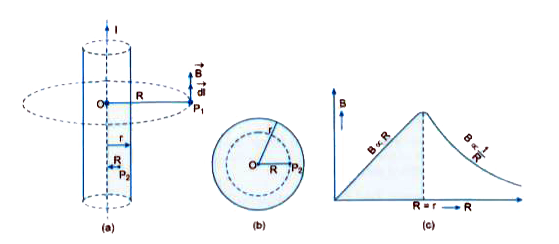 (b) For a point `P_2` situated at a distance R, where R < r, consider a circular amperian loop as shown in fig. Then `oint vecB . vecd l = oint B dl = B oint dl = B . 2 pi R` But now the current enclosed is only `I_e = I ((pi R^2)/(pi r^2))= (I R^2)/(r^2)`. Hence, as PER Ampere.s circuital LAW : `B . 2 pi r = mu_0 I_e = mu_0 (I R^2)/(r^2) implies B = (mu_0 I R)/(2 pi r^2)` Moreover field at the surface of wire `(R = r)` will be `B = (mu_0 I)/(2 pi r)`, which is maximum, Variation of magnetic field B with distance R from the axis of thick wire is shown in fig. |
|
| 33. |
For what value of the principal quantum number n would the effective radius, as shown in a probability density dot plot for the hydrogen atom, be 1.0 mm? Assume that has its maximum value of n-1. (Hint: See Fig. 38-19.) |
| Answer» SOLUTION :`4.3xx10^(3)` | |
| 34. |
A straight wire of mass 200g and length 1.5m carries a current of 2A. To suspend it in a air by a uniform horizontal magnetic field, value of required magnetic field is…. T |
|
Answer» 6.5 |
|
| 35. |
Find the degree of compression of air if its temperature rises from 15^@C to 700^@C upon compression. Assume the compression process to be adiabatic. |
|
Answer» |
|
| 36. |
Which of the following has negative temperature coefficient of resistance ? |
|
Answer» COPPER |
|
| 37. |
200 g of water and equal volume of another liquid of masss 250 g areplaced in turn in the same calorimeter of mass 100 g and specific heat capacity 420 J/kg K. The liquids which are constantly stirred are found to cool from 60^(@)C to 20^(@0C in 3 minutes and 2 minutes 20 seconds, respectively. Find the specific heat capacity of the liqudi. The temperature of the surrounding is 20^(@)C. |
|
Answer» |
|
| 38. |
Let the x-y plane to be boundary between two transparent media. Medium 1 in Z ge0 has a refractive index of sqrt(2) and medium 2 with z lt 0 has a refractive of sqrt(3). A ray of light in medium 1 given by the vector vecA=6sqrt(3)hati+8sqrt(3)hatj-10hatk is incident onthe plane of separation. The angle of refracted ray in medium 2 is |
|
Answer» SOLUTION :Unit vector representing the normal to the plane `hate_a=hatk`. Component of the INCIDENT ray along the normal is `-10 hatk` The unit vector that represents the plane of the incident ray and the normal. ` hate_p= ((6 sqrt(3) HATI + 8 sqrt(3)hatj))/( sqrt((6 sqrt(3))^2 +(8 sqrt(3))^2))=0.6hati + 0.8hatj` ANGLE between the incident ray and the normal is given by ` cos theta= ( 6 sqrt(3) hati + 8 sqrt(3) hatj - 10 hatk ) . hatk // sqrt((6 sqrt(3))^2 +(8 sqrt(3))^2 + 10^2)` (or)` cos theta=- 0.5 ` thereforetheangle` theta = 120^@` The angleofincidenceis ` theta= 180^@ - 120^@=60^@` theangleof therefractedbeamis givenby ` sqrt(2) sin ( theta) = sqrt(3) sin (r)orr= 45^@ ` The equationof theemergentrayis ` cos(45)(- hatk ) + sin(45)[0.6hati+ 0.8hatj]` `= 1// sqrt(2)( 0.6hati+ 0.8hatj - hatk)` |
|
| 39. |
An observer measures speed of light to be C, when he is stationary with respect to the source. If theobserver moves with velocity V towards the source then the velocity of light observed will be |
| Answer» Answer :D | |
| 40. |
An inductor of 10mH is connected to a 18V battery through a resistor of 10 kOmega and a switch. After a long time, when the maximum current is set up in the circuit, the battery is disconnected from the circuit. Calculate the current in the circuit after 15mu s |
| Answer» SOLUTION :`5.5 XX 10^(-10)A` | |
| 41. |
A potentiometer is being used to determine the internal resistance of a primary cell. The balance point for the cell in an open circuit is at 76.3 cm. when the cell sends a current in a resistor of 9.5Omega, the balance point shifts to 64.8cm. Find the internal resistance of the cell. |
|
Answer» |
|
| 42. |
An electron and a proton are allowed to fall through the separation the plates of a parallel plate capacitor of voltage 5 V and separation distance h = 1 mm as shown in the figure . (a) Calculate the time of flight for both electron and proton (b) Suppose if a neutron is allowed to fall what is the time of flight ? (c ) Among the three which one will reach the bottom first? ( Take m_(p) = 1.6xx10^(-27)kg , m_(c) = 9.1 xx10^(-31) " kg and g " = 10 ms^(-2)) |
|
Answer» Solution :Potential difference between the parallel plates V = 5 V Separation distance h= 1 mm `= 1xx10^(-3)` m MASS of proton `m_(p)= 1.6xx10^(-27) `kg Mass of proton `m_(c) = 9.1 xx10^(-31) `kg Charge of an a proton ( or ) electron E = `1.6xx10^(-19)` C From equation of motion S = `vt+ (1)/(2) at^(2)"" [ u =0 ,s =h]` From equation of motion `h = (1)/(2) at^(2)` `t = sqrt((2h)/(a))` Acceleration of an electron due to electric field ` a= (F)/(m ) = (eF)/(m)"" [ E= (V)/(d)]` (a) Time of flight for both electron and proton `t_(e)=sqrt((2hm_(e))/(eE))=sqrt((2xx1xx10^(-13)xx9.1xx10^(-31)xx10^(-3))/(1.6xx10^(-19)xx5))` `=sqrt((18.2xx10^(-34)xx10^(-3))/(8xx10^(-19)))=sqrt(2.275xx10^(-15)xx10^(-3))` `t_(e)= 1.5 xx10^(-9)s` `t_(e)= 1.5xxns ` `t_(p)= sqrt((2hm_(e))/(eE))=sqrt((2hm_(p).d)/(eV))=sqrt((2xx1xx10^(-3)xx1.6xx10^(-27)xx10^(-3))/(1.6xx10^(-19)xx5))` `=sqrt((2xx10^(-33))/(5xx10^(-19)))=sqrt(0.4xx10^(-14))= 6x32xx10^(-8)` `t_(p)=63xx10^(-9)` `t_(p)= 63 ns ` (b) time of flight of neutron `t_(N)= sqrt((2h)/(g)) = sqrt((2xx1xx10)/(10))= sqrt(0.2xx10^(-3))` `t_(n)= 0.0141 s = 14.1 xx10^(-3)s ` `t_(n) = 14.1 xx10^(-3) ms ` (c) Comparision of VALUES 1,2 and 3 The electron will reach the bottom first |
|
| 43. |
Sketch the change in flux, emf and force when a conducting rod PQ of resistance R and length L moves freely to and fro between A and C will speed v on a rectangular conductor placed in uniform magnetic field as shown in the figure. |
|
Answer» SOLUTION :The flux enclosed by the rod is, `phi=BLx" for "0lexleb=BLb" for "blexle2b` Now, the magnitude of induced EMF is, `e=-(dphi)/(dt)=-BL(dx)/(dt)=-BLv" for "0lexleb` `=-BL(db)/(dt)=0" for "blexle2b` Now, the magnitude of induced current when induced emf is non-zero is, `I=(e)/(R)=(BLv)/(R)` The force required to keep the CONDUCTOR in motion is, `F=BIL=B(BLv)/(R)L=(B^(2)L^(2)v)/(R)` `THEREFORE F=(B^(2)L^(2)v)/(R)" for "0lexleb=0" for "blexle2b`. Therefore, the variation of flux, emf and force are shown in fig 
|
|
| 44. |
Ata particular point, electric field depends upon |
|
Answer» source CHARGE Q only |
|
| 45. |
A charge + Q at A as shown in fig. produces electric field E and electric potential V at D. ifwe now put charges -2 Q and + Q at B and C respectively , then the electric field and potential at D will be : |
|
Answer» E and 0 |
|
| 46. |
If the binding energy per nucleon of deuterium is 1.115 MeV, its mass defect in atomic mass unit is |
|
Answer» 0.0048 For DEUTERIUM , A=2 `therefore ` 1.115 MeV=`E_b/2` or `E_b=2xx1.115` MeV or `E_b=DeltaMc^2` Mass defect, `DeltaM=(2xx1.115 )/931.5 U "" [because 1 u = 931.5 MeV//c^2]` =0.0024 u |
|
| 47. |
Figure shows planar loops of different shapes moving out of or into a region of a magnetic field which is directed normal to the plane of the loop away from the reader. Determine the direction of induced current in each loop using Lenz's law. |
|
Answer» SOLUTION :(i) Here, as the given loop enters given magnetic field, inward magnetic flux increases and so induced current should cause outward magnetic flux to oppose the increase in flux, according to Lenz.s LAW. For this induced current should flow in anticlockwise direction. i.e. along the path `atobtocto d to a`. (ii) Here, as the given loop exits given magnetic field, inward magnetic flux DECREASES and so induced current should cause inward magnetic flux (to oppose the decrease in flux, according to Lenz.s law). For this, induced current should flow in CLOCKWISE direction, i.e. along the path `atoctobtoa`. (III) Here, as the given loop exits given magnetic field, inward magnetic flux decreases and so induced current should cause inward magnetic flux (to oppose the decrease in flux, according to Lenz.s law). For this, induced current should flow in clockwise direction. i.e. along the path `a to b to c to d to a`. |
|
| 48. |
IfanelectronisacceleratedbyaPotential difference of1 Volt, Calculatethe gainin energyin Jouleandelectron volt. |
|
Answer» Solution :GAIN in ENERGY`=eV= 1.6 XX 10 ^(-19)xx 1=1.6 xx 10 ^(-19)J ` or` Delta KE = 1e xx 1"volt"= 1.6 xx 10 ^( -19) Cxx 1"volt" =1.6 xx 10 ^(-19)J ` |
|
| 49. |
Which of the following represents an infrared wavelength |
| Answer» Answer :A | |
| 50. |
A 44 mH inductor is connected to 220 V, 50 Hz a.c. supply. Determine the rms value of the current in the circuit. |
|
Answer» Solution :Here, L = 44 mH `=44 xx 10^(-3) H, V_(rms) = 220V` and frequency V= 50 HZ `therefore I_(rms) = V_(rms)/(L OMEGA) = (V_(rms))/(L.2pi v) = (220)/(44 xx 10^(-3) xx 2 xx 3.14 xx 50) = 15.9` A |
|