

Saved Bookmarks
This section includes 7 InterviewSolutions, each offering curated multiple-choice questions to sharpen your Current Affairs knowledge and support exam preparation. Choose a topic below to get started.
| 1. |
A spectral line is obtained from a gas discharge tube at 5000Å. If the rms velocity of gas moleculesis 10^5 ms^(-1) , then the width of spectral line will be |
|
Answer» 1.66Å |
|
| 2. |
Eye is more sensitive to yellow colour. Why are then the danger signals red? |
| Answer» Solution :The intensity of SCATTERED light is inveresly proportional to the fourth power of the wavelength of light. So the scattering of RED light is much less than YELLOW light and the signals of red light can be seen upto a longer DISTANCE. That is why the danger signals are red in COLOUR. | |
| 3. |
A charge Q is placed at the centre of the line joining two charges q and q. For the system of three charges to be in equilibrium, what should be the value of Q? |
|
Answer» Solution :Here Q is in EQUILIBRIUM as it is at the centre and net force on it is zero. For equilibrium of q, net force on it is zero `(1)/(4PI in_(0))(Qq)/((r//2)^(2)) + (1)/(4pi in_(0)) (q^(2))/(r^(2)) = 0` where r is separation between q and q `rArr Q = (-q)/(4)` |
|
| 4. |
In a single state transistor amplifier,When the signal changes by 0.02 V,the base current change by 10 muA and collector current by 1mA.If collector load R_(C)=2 kOmega and R_(L)=10kOmega ,Calculate ,(i)Current Gain (ii)Input impedance ,(iii)Effective a.c load (iv)Voltage gain and (v)Power gain. |
|
Answer» Solution :(i)CURRENT GAIN `BETA=(deltai_(c))/(deltai_(h))=(1MA)/(10muA)=100` (ii)Input impedance `R_(i)=(deltaV_(BE))/(deltai_(b))=(0.02)/(10muA)=2000Omega=2kOmega` (iii)Effctive (a.c)load `R_(AC)=R_(C)||R_(L)=(2xx10)/(2+10)=1.66 kOmega` (iv)Voltage gain `A_(v)=betaxx(R_(AC))/(R_(in))=(100xx1.66)/(2)=83` (v)Power gain ,Ap=Current gain `xx` Voltage gain `=100x83=8300` |
|
| 5. |
A stone is thrown horizontally from a height with a velocity v_(x)=15m/s. Determine the normal and tangential acceleration of the stone in 1 second after it begins to move. |
|
Answer» Solution :The horizontal component of acceleration is zero. The net acceleration of the stone is directed vertically downward and is equal to the acceleration DUE to gravity g. Thus, `a=g = sqrt(a_(1)^(2) + a_(n)^(2))` from figure we can see that `COS theta =v_(x)/V =a_(c )/a =a_( c)/g` and `SIN theta =v_(y)/v =a_(t)/a =a_(t)/g` HENCE, `a_(t) =gv_(y)/v =(g^(2)t)/sqrt(v_(x)^(2) +g^(2)t^(2))` and `a_( c) gv_(s)/v =(gv_(x))/sqrt(v_(x)^(2) + g^(2)t^(2))` on substituting numerical values, `v_(x) =15 m//s, g=9.8 m//s^(2)` we get, `a_( t)=5.4 m//s^(2)` and `a_(n) =8.2 m//s^(2)` |
|
| 6. |
There are two bodies of masses 10^(3) kg and 10^(5) kg separated by a distance of 1 km. At what distance from the smaller body, the inensity of gravitational field willbe zero |
|
Answer» 1/9 km `(1)/(r^(2)) = (10^(2))/((1 - r)^(2))` `(1)/(r) = (10)/(1 - r) rArr 10r = 1 - r ` `THEREFORE r = (1)/(11) ` km |
|
| 7. |
When we apply a horizontal force on a body kept on horizontal floor, a horizontal force startsopposing the net applied force. This force is called frictional force and is always tangential to the contact surface. Frictional force on a moving body is called kinetic friction which is directly proportional to the normal force (f_(k)=mu_(k)N) where mu_(k) is a constant depending upon the surfaces and is called the coefficient of kinetic friction. Frictional force on a static body is called static friction. Maximum value of static friction force is (f_(s) le mu_(s)N), where mu_(s) is coefficient of static friction. Now a man wants to slide down a block of mass m which is kept on a fixed inclined plane of inclination 30^(@) as shown in figure initially, the block is not sliding. To just start sliding the man pushes the block down the inclined with a force F. Now the block starts accelerating. To move it downwards with constant speed, the man starts pulling the block with same force. Surfaces are such that ratio of maximum static friction to kineticfriction is 2. Now, answer the following questions. If man continues pushing the block by force F, its acceleration would be |
|
Answer» `g//6` |
|
| 8. |
Two conducting spheres of radii 3 cm and 1 cm are separated by a distance of 10 cm in free space. If the spheres are charged to same potential of 10 V each, the force of repulsion between them is density |
|
Answer» `(1/3) XX 10^(-9)N` |
|
| 9. |
Two cells of emf E_1 and E_2 and internal resistance r_1 and r_2 are connected in parallel such that they send current in same direction. Derive an expression for equivalent resistance and equivalent emf of the combination. |
|
Answer» <P> SOLUTION :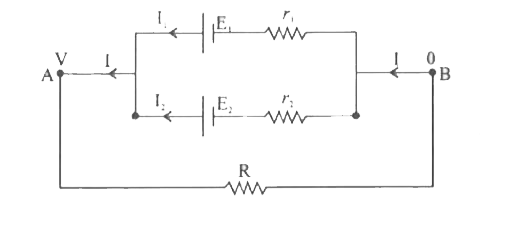 Let `I_1,I_2` representbranchcurrents . Let V be the commonpotential , so that , `I_1=(E_1-V)/r_1 , I_2=(E_2-V)/r_2` hence, `I=(E_1-V)/r_1 + (E_2-V)/r_2` i.E. `I=(E_1/r_1 + E_2/r_2) -V (1/r_1 +1/r_2)` Comparingthis with theterminalpotentialdifference, `V=E_(eq)-Ir_(eq)` i.e.,`V=E_(eq)-I/((I/r_(eq)))` For TWO cells in parallel combination, `(E_(eq))_p=(E_1/r_1 + E_2/r_2)/(1/r_1 + 1/r_2)=(E_1r_2 +E_2r_1)/(r_1+r_2)` `1/(r_(eq))_p=1/r_1 +1/r_2` , and main current= `I=E_(eq)/(R+r_(eq))` Note : (i) For n cells in parallel `V=[(sum_(i=1)^n E_i/r_i)/(sum_(i=1)^n 1/r_1)]-[I/(sum_(i=1)^n 1/r_i)]` `(E_(eq))_"parallel"=[(sum_(i=1)^n E_i/r_i)/(sum_(i=1)^n 1/r_i)]` `(1/r_(eq))_p = sum_(i-1)^n (1/r_i)` (ii) For .n. number of identical cells E-emf of each CELL r-internalresistance of each cell. `(E_(eq))_p=(n(E/r))/(n(1/r))` i.e., `(E_(eq))_p=E` and `(1/r_(eq))_p=n(1/r)` i.e. `(r_(eq))_p=r/n` Main current , `I=(nE)/(R+n/r)` and terminal potentialdifference across cells V=IR. |
|
| 10. |
A glass slab (n= 1.5) of thickness 6 cm is placed over a paper. What is the shift in the letters? |
|
Answer» 4 cm |
|
| 11. |
A car moving with a velocity of 20 ms^(-1) is stopped in a distance of 40 m. If the same car is travelling at double the velocity, the distance travelled by it for same retardation is |
|
Answer» 640 m From NEWTON third equation, `v^(2)-u^(2)=2as` `(0)^(2)-(20)^(2)=2(a)xx40` `400=2xx40xxa` `a=(400)/(2xx40)` `a=5 ms^(-2)` In the SECOND condition, the velocity becomes twive i.e., `u^(1)=2u` Again from Newton.s third equation, we get `(0)^(2)-(2u)^(2)=2xx(5)xx s` `s=((2u)^(2))/(2xx5)` `s=(4u^(2))/(2xx5)` `s=(4xx20xx20)/(2xx5)` `s=(4xx20xx20)/(2xx5)` s = 160 m. |
|
| 12. |
When we apply a horizontal force on a body kept on horizontal floor, a horizontal force startsopposing the net applied force. This force is called frictional force and is always tangential to the contact surface. Frictional force on a moving body is called kinetic friction which is directly proportional to the normal force (f_(k)=mu_(k)N) where mu_(k) is a constant depending upon the surfaces and is called the coefficient of kinetic friction. Frictional force on a static body is called static friction. Maximum value of static friction force is (f_(s) le mu_(s)N), where mu_(s) is coefficient of static friction. Now a man wants to slide down a block of mass m which is kept on a fixed inclined plane of inclination 30^(@) as shown in figure initially, the block is not sliding. To just start sliding the man pushes the block down the inclined with a force F. Now the block starts accelerating. To move it downwards with constant speed, the man starts pulling the block with same force. Surfaces are such that ratio of maximum static friction to kineticfriction is 2. Now, answer the following questions. What is the value of mu_(s) ? |
|
Answer» `(4)/(3sqrt(3))` |
|
| 13. |
Mention the types of transmission media. |
| Answer» Solution :Types of TRANSMISSION media are WIRES, free space or vacuum and FIBRE optic CABLE. | |
| 14. |
A small mass m attached to one end of a spring with a negligible mass and an unstretched length L, executes vertical oscillations with angular frequency omega_(0)When the mass is rotated with an angular speed omegaby holding the other end of the spring at a fixed point, the mass moves uniformly in a circular path in a horizontal plane. Then the increase in length of the spring during this rotation is |
|
Answer» `(OMEGA^(2)L)/(omega_(0)^(2)-omega^(2))` |
|
| 15. |
When we apply a horizontal force on a body kept on horizontal floor, a horizontal force startsopposing the net applied force. This force is called frictional force and is always tangential to the contact surface. Frictional force on a moving body is called kinetic friction which is directly proportional to the normal force (f_(k)=mu_(k)N) where mu_(k) is a constant depending upon the surfaces and is called the coefficient of kinetic friction. Frictional force on a static body is called static friction. Maximum value of static friction force is (f_(s) le mu_(s)N), where mu_(s) is coefficient of static friction. Now a man wants to slide down a block of mass m which is kept on a fixed inclined plane of inclination 30^(@) as shown in figure initially, the block is not sliding. To just start sliding the man pushes the block down the inclined with a force F. Now the block starts accelerating. To move it downwards with constant speed, the man starts pulling the block with same force. Surfaces are such that ratio of maximum static friction to kineticfriction is 2. Now, answer the following questions. What is the value of F? |
|
Answer» `(MG)/(4)` |
|
| 16. |
A wave is travelling along a string. At an instant shape of the string is as shown figure. At this instant A is moving upwards. Which of the following statements are correct: |
|
Answer» The WAVE is travelling to the right |
|
| 17. |
(A) A laser beam of 0.2W can drill holes through a metal sheet whereas a 1000W torch light cannot. (R): The frequency of laser light in much higher than that of torch light. |
|
Answer» Both .A. and .R. are true and .R. is the correct explanation of .A. |
|
| 18. |
State Gauss's theorem in magnetism. How this differs from Gauss's electrostatics ? why is the difference in two cases ? |
| Answer» Solution :The reason for the difference is ISOLATED electric CHARGE exist but magnetic monopoles does not exist. | |
| 19. |
A block of mass m is attached to a massless spring of force constant k, the other end of which is fixed from the wall of a truck as shown in the figure. The block is placed over a smooth surface and initially the spring is unstretched. Suddenly the truj starts moving towards right with a constant acceleration a_(0). If the block is observed from the truck |
|
Answer» the block will execute SHM |
|
| 20. |
____law states line integral of magnetic (oversettoB) around a closed path or a circuit is equal to mu_@ (absolute permeability) of free space times the total current (I) threading the circuit. |
| Answer» SOLUTION :Ampere.s | |
| 21. |
If mu_(0) be the permeability and ko the dielectric constant of a medium , its refractive index is given by : |
|
Answer» `(1)/(sqrt(mu_(0)k_(0)))` Now `c=(1)/(sqrt(mu_(0) epsilon k_(0)))` & `v=(1)/(sqrt(mu_(0)k_(0) mu_(r) k_(r)))` `:. mu=sqrt(mu_(r)k_(r))` But `mu_(r)=mu_(0)` & `k_(r)=k_(0)` `:. mu=sqrt(mu_(0)k_(0))` |
|
| 22. |
In Davisson and Germer experiment, if the angle of diffraction is 50^(@), then tha angle of glancing will be |
|
Answer» `65^(@)` |
|
| 23. |
The two headlights of an approaching automobile are 1.4 m apart. At what (a) angular separation and (b) maximum distance will the eye resolve them? Assume that the pupil diameter is 4.5 mm, and use a wavelength of 550 nm for the light. Also assume that diffraction effects alone limit the resolution so that Rayleigh's criterion can be applied. |
| Answer» SOLUTION :(a) `1.5 xx 10^(4)` RAD, (B) `9.39 xx 10^(4) m ~~ 9.4 km` | |
| 24. |
Find the voltage applied to an X-rays tube with nickel anticathode if the wavelength difference between the k_(alpha) line and the short-wave cut-off of the continuous X-rays spectrum is equal to 84 p m. |
|
Answer» Solution :From Mosley's LAW `lambda k_(alpha)(Ni)=(8 pi c)/(3R) (1)/((Ƶ-1)^(2))` where `Ƶ= 28` for `Ni`. SUBSTITUTION gives `lambda k_(alpha) (Ni)=166.5 p m` Now the short WAVE cut of off the continuous spectrum MUST be more energetic (smaller wavelength) otherwise `k_(alpha)` lines will not emerge. Then since `Delta lambda= lambda k_(alpha)-lambda_(0)=84 p m` we get `lambda_(0)=82.5 p m` This corresponds to voltage of `V=(2piħ c)/(e lambda_(0))` Substitution gives `V=15.0 kV`. |
|
| 25. |
According to the quantum mechanical picture of the atom, which one of the following statements is true concerning the magnitude of the angular momentum L of an electron in the n=3 level of the hydrogen atom? |
|
Answer» L is 0.318h |
|
| 26. |
If the maximum and minimum voltage of an AM wave V_("max") and V_("min") respectively then modulation factor |
|
Answer» `m = (V_("MAX"))/(V_("max") + V_("MIN"))` |
|
| 27. |
Three capacitances, each of 3 mu F , are provided. These cannot be combined to provide the resultant capacitance of: |
|
Answer» `1 mu F` |
|
| 28. |
A solid body rotates with a constant angular velocity omega_0=0.50 rad//s about a horizontal axis AB. At the moment t=0 the axis AB starts turning about the vertical with a constant angular acceleration beta_0=0.10 rad//s^2. Find the angular velocity and angular acceleration of the body after t=3.5s. |
|
Answer» Solution :The AXIS AB acquired the angular velocity `vecomega=vecbeta_0t` (1) Using the FACTS of the solution of `1.57`, the angular velocity of the BODY `omega=sqrt(omega_o^2+omega^('^2))` `=sqrt(omega_0^2+beta_0^2t^2)=0*6rad//s` And the angular acceleration. `vecbeta=(dvecomega)/(dt)=(d(vecomega+vecomega_0))/(dt)=(dvecomega)/(dt)+(dvecomega_0)/(dt)` But `(dvecomega_0)/(dt)=vecomegaxxvecomega_0`, and `(dvecomega)/(dt)=vecbeta_0t` So, `vecbeta=(vecbeta_0txxvecomega_0)+vecbeta_0` As, `vecbeta_0_|_vecomega_0` so, `=sqrt((omega_0beta_0t)^2+beta_0^2)=beta_0sqrt(1+(omega_0t^2))=0*2rad//s^2` 
|
|
| 29. |
A cat is chasinga mouseas shown in the figure . The mouse runs horizontally with speed 19m/s. The catruns with a constnatspeed of 20m/s. At whichangleto thehorizontal should the cat run in orderto catch the mouse ? |
|
Answer» Solution :Method -I [Analysis of velocitycomponents] Assumethat the cat and the mousedo meet at POINT D as shown. Let D be the horizontal pointaboveD. Thecat has velcoity.v. which carries it to point D in time t. Sincethe velocityis inclined , we can .D.. The cat hasa velcoities `v_(x),v_(y),v_(A)` carries cat from POINTC to Din timet and `v_(y)` carries cat from Cto Dint . Wethussee that the X-component of velocity`v_(x)` is responsiblefor keepingcat directly above mouse . 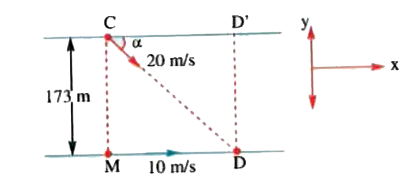 Y -component of velocitybrings cat nearnearrer tomouse . Hencethe catshould run such that `v_(x) = 10` . `therefore20 cos alpha = 10` . `cos alpha =1//2, alpha = 60^(@)`. Only when cat runsat this angleit will reamin at thesame level as themouseat all time . To FIND the timeat whichthey meet , we analyze motion alongY - axis . The cat has a Y - component ofvelocityof 20 sin `60 =10 sqrt(13) = 17.32 m//s.` It HASTO travel a distanceof173 m in -ve Y direction. Hence time taken ` t = ("vertical distance ")/("vertical component velcoity") = (173)/(17.3) = 10 sec`. |
|
| 30. |
The ratio of contributions made by the electric field and magnetic field components to the intensity of an electromagnetic wave is |
|
Answer» `c:1` Intensity due to MAGNETIC field `I_B=(cB^2)/(2mu_0)` `I_E/I_B=(1/2cepsilon_0E^2)/(cB^2//2mu_0)=(epsilon_0mu_0)(E//B)^2=(1/c^2)(c^2)=1` (as `c=1/sqrt(epsilon_0mu_0` and E/B=c ) |
|
| 31. |
Two wires of equal lengths one of copper and other of manganin have the same resistance which wire is thicker ? |
|
Answer» COPPER `R_(Mn) GT R_(CU)` LENGTH of both the wires are equal. If we want RESISTANCE equal, so have to reduce the resistance of manganin wire, we have to take manganin wire thicker. |
|
| 32. |
In an LCR circuit, at resonance |
|
Answer» the current LEADS the VOLTAGE by `pi//2` |
|
| 33. |
Domain formation is the necessary feature for |
|
Answer» diamagnetism |
|
| 34. |
In Young's two slit experiment d=2xx20^(-4)m, lambda=6000overset@A and D = 80 cm. The distance of 7th dark band from the centre is : |
|
Answer» 1.56 cm |
|
| 35. |
a)Are the equations of nuclear reactions .balanced. in the sense a chemical reaction ? b) If both the number of protons and the number of neutrons are conserved in each nuclear reaction, in what way is mass converted into energy (or vice- versa) in a nuclear reaction? |
|
Answer» Solution :(a) : A chemical equation is balanced in the sence that the number of atoms of each element is the same on both sides of the equation. In nuclear reactions the number of PROTONS and the number of NEUTRONS are the same on the two sides of the equation. (b) : The total binding energy of nuclei on the left side need be the same binding energy of nuclei on the left side need not be the same as that on the right hand side. The difference in these binding ENERGIES appears as energy RELEASED or absorbed in a nuclear REACTION. |
|
| 36. |
A sphere, a cube, a cone and a thin disc all made up of the same material and all have the same mass. If they are heated to the same temperature theta and allowed to cool in identical surrounding then the initial rate of cooling is maximum for |
|
Answer» sphere |
|
| 37. |
A 75 kg man stands in a lift. What force does the floor exert on him when the elevator starts moving upward with an acceleration of 2 ms^(-2) Given : g = 0 ms^(-2). |
|
Answer» Solution :R - mg = ma, `R=mg+ma=m(g+a)` `=75(10+2)N=900N` `=(900)/(10)KG wt. = 90 kg. wt` |
|
| 38. |
What can be said from graph below? |
|
Answer» `(I_(1)+I_(4))/(2)=(I_(2)+I_(3))/(2)` |
|
| 39. |
Calculate the most probable de Broglie wavelength of hydrogen molecules being in thermodynamics equilibrium at room temperature. |
|
Answer» SOLUTION :To FIND the most proabable de Broglie wavelength of a gas in the THERMODYNAMICS equilibrium we determine the distribution is `lambda` corresponding to Maxellian velocity distribution. It is given by `Psi(lambda)d lambda=-Phi(v)dV` (where-sign takes ACCOUNT of the fact that `lambda` decreases as `v` increases). Now `lambda=(2pi ħ)/(mv) or v=(2pi ħ)/(m lambda)` `dv=(2pi ħ)/(m lambda^(2))d lambda` Thus `Psi(lambda)= +AV^(2)E^(-mv^(2)//2kT)(-(dv)/(d lambda))` `A((2pi ħ)/(m lambda))^(2)((2pi ħ)/(m lambda^(2)))e^(-(m)/(2kT).((2pi ħ)/(m lambda))^(2))` `=Const. lambda^(-4)e^(-a//lambda^(2))` where `a=(2pi^(2)ħ^(2))/(mkT)` This is maximum when `Psi(lambda)=0 =Psi(lambda)[(-4)/(lambda)+(2a)/(lambda^(3))]` or `lambda_(pr)=(126)/(sqrt(2))p m= 89.1p m` |
|
| 40. |
A source of sound is moving with a uniform speed along a circle. The frequency of sound as heard by listener stationed all the centre of the path |
|
Answer» increases |
|
| 41. |
In a p-n junction, depletion region contains |
|
Answer» No CHARGES at all |
|
| 42. |
Give one application of infrared. |
| Answer» Solution :For TAKING PHOTOGRAPHS during CONDITIONS of fog,smoke ETC. | |
| 43. |
Modulation is required to (a) distinguish different transmissions (b) ensure that the information may be trans mitted over long distances © allow the information accessible for different people |
|
Answer» a & b are true |
|
| 44. |
A wheel has angular acceleration of 3.0 rad/sec^(2) and an initial angular speed of 2.00 rad/sec. In a time of 2 sec it has rotated through an angle (in radian) of |
|
Answer» 10 Using, `theta=omega_(1)t+1/2alphat^(2)` `thereforetheta=2xx2+1/2xx3xx4=4+6=10` RADIAN |
|
| 45. |
In Fig., S is a small loud speaker driven by an audio oscillator with a frequency that is varied from 1000 Hz to 2000 Hz, and D is a cylindrical pipe with two open ends and a length of 48.9 cm. The speed of sound in theair-filled pipe is 344 m/s. (a) At how many frequencies does the sound from the loudspeaker set up resonance in the pipe? What are the (b) lowest and (c) second lowest frequencies at which resonance occurs? |
| Answer» SOLUTION :(a) 3 FREQUENCY, (B)1055 HZ, (c ) 1407 Hz | |
| 46. |
Three resistor 2 Omega , 4 Omega and 6 Omega are combined In parallel. What is the total resistance of the combination ? |
|
Answer» Solution :If EQUIVALENT resistance of parallel CONNECTION of given resistances is `R_(p)`, then according to law, `(1)/(R_(p)) = (1)/(R_(1)) + (1)/(R_(2)) + (1)/(R_(3))` = `(1)/(2) + (1)/(4) + (1)/(5)` `= (10 + 5 + 4)/(20)` `THEREFORE (1)/(R_(p)) = (19)/(20)` `therefore R_(p) = (20)/(19) Omega` |
|
| 47. |
A train of mass m=2000 tons moves in the latitude varphi=60^@ North. Find: (a) the magnitude and direction of the lateral force that the train exerts on the rails if it moves along a meridian with a velocity v=54km per hour, (b) in what direction and with what velocity the train should move for the resultant of the inertial forces acting on the train in the reference frame fixed to the Earth to be equal to zero. |
|
Answer» Solution :(a) When the train is moving along a meridian only the Coriolis force has a LATERAL component and its magnitude (see the previous problem) is, `2momegavcostheta=2momegasinlambda` (Here we have put `Roverset(.)thetararrv`) So, `F_(lateral)=2xx2000xx10^3xx(2pi)/(86400)xx(54000)/(3600)xxsqrt3/2` `=3*77kN`, (we write `lambda` for the latitude) (b) The resultant of the inertial FORCES acting on the train is, `vecF_(i n)=-2momegaRoverset(.)thetacosthetavece_varphi` `+(momega^2Rsinthetacostheta+2momegaRsinthetacosthetaoverset(.)varphi)vece_theta` `+(momega^2Rsin^2theta+2momegaRsin^2thetaoverset(.)varphi)vece_r` This vanishes if `underset(.)theta=0`, `overset(.)varphi=1/2omega` Thus `vecv=v_(varphi)vece_(varphi)`, `v_(varphi)=-1/2omegaRsintheta=-1/2omegaRcoslambda` (We write `lambda` for the latitude here) Thus the train must move from the east to west along the `60^(TH)` parallel with a speed, `1/2omegaRcoslambda=1/4xx(2pi)/(8*64)xx10^-4xx6*37xx10^6=115*8m//s~~417km//hr` 
|
|
| 48. |
A body falls from a heighth = 200 m. The ratio of distance travelled in each 2, during != 0 to 6 second of the journey is: |
|
Answer» `1:4:9` Since body starts from rest u=0 After 2 s the distance TRAVELLED is `s_(2)=(1)/(2)xxgxx(2)^(2)=2g` After 4s, `s_(4)=(1)/(2)xxgxx(4)^(2)=8g` After 6s ,`s_6=(1)/(2)xxgxx(6)^(2)=18g` Distance travellled in FIRST 2 `s=d_1=2g` Distance travelled in next `2s=d_2=(8-2)g=6g` Distance travellled in last `2s=d_3(18-8)g=10g` `:. d_1 :d_2 : d_3 : : 2g :6 g: 10 g` `therefore1 : 3: 5`. |
|
| 49. |
A simple pendulum is carrying a bob of mass 'M'. It is pulled through an angle 45^(@) from its mean position. The horizontal force required to keep it under equilibrium at this new position is |
|
Answer» Mg |
|
| 50. |
An n-p-n transistor has three leads A,B and C connecting B and C by moist fingers A to the positive lead of an ammeterand c to the negative lead of the ammeter one finds large deflection then a,b and c referrespectively to |
|
Answer» emitter base and COLLECTOR `B to`collector `C to ` Emitter 
|
|