Saved Bookmarks
This section includes 7 InterviewSolutions, each offering curated multiple-choice questions to sharpen your Current Affairs knowledge and support exam preparation. Choose a topic below to get started.
| 1. |
Critical angle for diamond (refractive index = 2.42) is _____________ |
| Answer» SOLUTION :Hint : `sin i_(C)=(1)/(n)=(1)/(2.42) RARR i_(c)=sin^(-1)((1)/(2.42))=24.5^(@)` | |
| 2. |
A body moving with the constant retardation d loses 2/3of its initial velocity w What is the distance covered by the body in the time during which it occurs ? |
|
Answer» `((2v_0)/(3A))^(2)` |
|
| 3. |
Name the semiconductor device that can be used to regulate an unregulated d.c. powersupply. With the help of I-V characteristics of this device, explain its working principle. |
| Answer» SOLUTION :Nameofdevice: ZENERDIODE. | |
| 4. |
Burial ground is a: |
|
Answer» COMMUNITY OWNED resource |
|
| 5. |
Mention two communication systems that use space wave propagation. |
| Answer» SOLUTION :SATELLITE COMMUNICATION, microwave, TV BROADCAST, etc. | |
| 6. |
The average translational kinetic energy of nitrogen gas molecules is 0.02 eV(1 eV = 1.6xx10^(-19)J). Calculate the temperature of the gas. Boltzmann constant k=1.38xx10^(-28)J//K. |
|
Answer» 193.1 K `(3)/(2)kT=0.02eV=0.02xx1.6xx10^(-19)J` `T=(0.02xx1.6xx10^(-19))/(1.38xx10^(-23))xx(2)/(3)orT=154.5K` |
|
| 7. |
Draw a ray diagram to show the formation of image by an astronomical telescope when the final image is formed at the near point. Answer the following giving reasons : (i) Why the objective has a larger focal length and a larger aperture than the eyepiece ? (ii) What would be the effect on the resolving power of the telescope if its objective lens is |
|
Answer» Solution :(i) Magnifying POWER of a telescope in normal adjustment is `m=-f_(0)/f_(e)`. Therefore, we prefer an objective lens of higher focal length to have higher magnification. We take the objective lens of large aperture so as to have higher RESOLVING power because resolving power of telescope `=A/(1.22 lambda)`, where A = aperture of objective lens. (II) If the objective lens of telescope is immersed in a transparent medium then effectively the wavelength of light decreases and consequently resolving power of telescope increases. |
|
| 8. |
A thin prism of angle 15^(@) made of glass of refractive index mu_(1) = 1.5 is combined with another prism of glass of refractive index mu_(2) = 1.75 . The combination of the prism produces dispersion without deviation, The angle of the second prism should be |
|
Answer» `5^(@)` |
|
| 9. |
There is a cylindrical vessel of radius 10 cm and a cylindrical glass piece of radius 5 cm and height 10 cm is kept inside it. Volume of water 950 pi cm^(3) is poured into it. Bottom of the glass piece is seen with paraxial rays. What will be the apparent depth of bottom of glass cylinder? Index of refraction of glass is 3//2 and that of water is 4//3. |
Answer» Solution :Let h be the total height of the water from bottom as shown in figure. 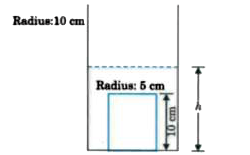 `"Total VOLUME of water"=950 pi cm^(3)` `pi(10)^(2)h-pi(5)^(2)xx10=950pi` `rArr""100pih-250pi=950pi` `rArr""h=12cm` Height of layer of water above the cylindrical glass piece is `=12-10=2cm`. We can use the following relation to CALCULATE apparent DEPTH : `"apparent depth"=("REAL depth")/(MU)` Apparent depth of the bottom of glass piece `=(2)/(4//3)+(10)/(3//2)=(3)/(2)+(20)/(3)=(9+40)/(6)=(49)/(6)cm`. |
|
| 10. |
How x-rays are produced ? |
| Answer» SOLUTION :When a BEAM of HIGH energy ELECTRONS are incident a SUBSTANCE. | |
| 11. |
A Kerr cell is positioned between two crossed Nicol prisms so that the direction of electric field E in the capacitor forms an angle of 45^(@) with the principle directions of the prisms. The capacitor has the length l = 10 cm and is falled up with nitrobenzence. Light of wavelength lambda = 0.50 mu m passes through the system. Taking into account that in this case the kerr constant is equal to B = 2.2.10^(-10)cm//V^(2), find: (a) the minimum strength of electric field E in the capacitor at which the intensity of light that passes through this syetm is independent of rotation of the rear prism, (b) how many times per second light will be interrupted when a sinusoidal voltage of frequecny v = 10 MHz and strength amplitude E_(m) = 50kV//cm is applied to the capacitor. Note. The Kerr constant is the coefficient B in the equation n_(e) = n_(0) = Blambda E^(2). |
|
Answer» SOLUTION :In passing through the Kerr cell the two perpendicualr components of the electirc field will acquire a phase difference. When its phase difference quals `90^(@)` the emergent light will be circularly polarized because the two perpendicualr components `O & E` have the same magnitude since it is given that the direction of ELECTRIC field `E` in the capacitor forms an angle of `45^(@)` with the principle directions of then icols. In this case the intensity of light that emerges from this system will be independent of the rotation of the analyser prism. Now the phase difference INTRODUCED is given by `delta = (2pi)/(lambda) (n_(e) - n_(0)) l` In the present case `delta = (pi)/(2)` (for minimum electric field) `n_(e) - n_(0) = (lambda)/(4l)` Now `n_(e) - n_(0) = B lambda E^(2)` so `E_(min) sqrt((1)/(4Bl)). = 10^(5)// sqrt(88) = 10.66 kV// cm`. (b) If the APPLIED electric fiel is `E = E_(m) sin omegat, omega = 2pi v` then the Kerr cell introduces a time varying phase difference `delta = 2pi B|E_(m)^(2) sin^(2) omegat` `= 2pi xx 2.2 xx 10^(-10) xx 10 xx (50 xx 10^(3))^(2) sin^(2)omegat` `= 11pi sin^(2) omega t` In one half-cycle (i.e. in time `(pi)/(omega) = T//2 = (1)/(2v)`) this reaches the value `2kpi` when `sin^(2) omegat = 0, (2)/(11), (4)/(11), (6)/(11), (8)/(11), (10)/(11)` `(2)/(11), (4)/(11), (6)/(11), (8)/(11), (10)/(11)` i.e. `11` times. On each be interrupted when the Kerr cell (placed between crossed Nicols) introduced a phase difference of `2 k pi` and in no other case.) |
|
| 12. |
Ina transistor in CE configuration, the ratio of power gain to voltage gain is: |
|
Answer» `ALPHA` |
|
| 13. |
CH_(3)-underset(OH)underset(|)overset(CH_(3))overset(|)(C)-underset(NH_(2))underset(|)overset(CH_(3))overset(|)(C)-CH_(3)overset(HNO_(2))underset(Delta)rarr? |
|
Answer»
|
|
| 14. |
A mark at the bottom of a liquid beaker appears to rise by 0.1 m. If the depth of the liquid is 1.0 m, then refractive index of the liquid is ...... |
|
Answer» 1.1 (h=1 m, h.=1-0.1=0.9 m,`n_("air")`=1) `THEREFORE n_w=(hxxn_("air"))/(h.)=(1xx1)/(0.9)=1.1` |
|
| 15. |
Explain the J.J. Thomson experiment to determine the specific charge of electron. |
Answer» Solution :In 1887, J.J.Thomsonmade remarkable improvement in the scope of study of gases in discharge tubes. In the presence of electric and magnetic FIELDS, the cathode rays are deflected. By the variation of electric and magnetic fields, mass normalized charge or the specific charge(charge PER unit mass) of the cathode rays is MEASURED.  A highly evacuated discharge tube is used and cathode rays (electron beam) produced at cathode are attracted towards anode disc A. Anode disc is made with pin hole in order to allow only a narrow beam of cathode rays. These cathode rays are now allowed to pass through the parallel metal plates, maintained at high voltage.Further this gas discharge tube is kept in between pole pieces of magnet such that both electric and magnetic fields are perpendicular to each other.When the cathode rays strike the screen, they produce scintillation and hence bright spot is observed. This is achieved by coating the screen with zinc sulphide. (i) Determination of velocity of cathode rays For a fixed electric field between the plates, the magnetic field is adjusted such that the cathode rays(electron beam) strike at the original position O.Thismeans that the magnitude of electric force is balanced by the magnitude of force due to magnetic field. Lete be the charge of the cathode rays, then `eE = eBv` `Rightarrow v = (E)/(B)` .....(1)  (ii) Determination of specific charge Since the cathode rays (electron beam) are accelerated from cathode to anode , the potential energy of the electron beam at the cathode is converted into kinetic energy of the electron beam at the anode. Let V be the potential difference between anode and cathode, then the potential energy is eV. Then from law of conservation of energy. `eV = (1)/(2)mv^(2) Rightarrow (e)/(m) = (v^(2))/(2V)` Substituting the value of velocity from equation (1), we get `(e)/(m) = (1)/(2V) (E^(2))/(B^(2))` .....(2) Substituting the values of E,B and V, the specific charge can be determined as `e/m = 1.7 xx 10^(11) Ckg ^(-1)` . (iii)Determination of charge only due to uniform electric field When the magnetic field is turned off, the deflection is only due to electric field. The deflection in vertical direction is due to the electric force. `F_(e) = eE`......(3) Let m be the mass of the electron and by applying Newton.s second law of motion,acceleration of the electron is `a_(e) = (1)/(m)F_(e)` .....(4) Substituting equation (4) in equation (3), `a_(e) = (1)/(m)eF = (e)/(m) E` Let y be the deviation produced from original position on the screen. Let the initial UPWARD velocity on the screen.Let the initial upward velocity of cathode ray be `u = 0` before entering the parallel electric plates. Let t be the time taken by the cathode rays to travel in electric field. Let l be the length of one of the plates, then the time taken is `t = l/v`.....(5)  Hence, the deflection y. of cathode rays is (note: u = 0 and `a_(e) = (e)/(m) E`) `y. = ut + (1)/(2) at^(2) Rightarrow y. = ut +(1)/(2)a_(e)(t)^(2) = 1/2((e)/(m)E)((1)/(v))^(2)` `y. = (1)/(2) (e)/(m) (l^(2)B^(2))/(E)`.....(6) Therefore, the deflection y on the screen is `y infty y. Rightarrow y = Cy.` where C is proportionality constant which depends on the geometry of the discharge tubeand substituting y. value in equation (6), we get `y = C(1)/(2)(e)/(m)(l^(2)B^(2))/(E)`.....(7)Rearranging equation (7) as `(e)/(m) = (2yE)/(Cl^(2)B^(2))`.... (8) Substituting the values on RHS, the value of specific charge is calculated as `(e)/(m) = 1.7 xx 10^(11) Ckg^(-1)` (iv) Determination of charge only due to uniform magnetic field. Suppose that the electric field is switched off and only the magnetic field is switched on. Now the deflection occurs only due to magnetic field. The force experienced by the electron in uniform magnetic field applied perpendicular to its path is `F_(m) = evB` ..... (in magnitude) Since this force provides the centripetal force, the electron beam undergoes a semicircular path. Therefore, we can equate `F_(m)` to centripetal force`(mv^(2))/(R)` `F_(m) = evB = m(v^(2))/(R)` where v is the velocity of electron beam at the point where itenters the magnetic field and R is the radius of the circular path traversed by the electron beam. `eB = m (v)/(R) Rightarrow (e)/(m) = (v)/(BR) ` .....(9) Further, substituting equation (1) in equation (9), we get `(e)/(m) = (E)/(B^(2)R)`....(10) By knowing the values of electric field, magnetic field and the radius of circular path, the value of specific charge `((e)/(m))` can be calculated. |
|
| 16. |
A ray of white light is normally incident on one face of an equational prism. Trace the course of the ray through the prism and emerging from it. |
| Answer» SOLUTION :The light disperses into DIFFERENT colors on entering a glass SLAB i.e., dispersion TAKES place inside a glass also. | |
| 17. |
What would you do to increase the magnification? |
| Answer» SOLUTION :The magnifying POWER of a telescope s given by M = `f_0/f_e` (in normal ADJUSTMENT). In ORDER to increase magnifying power of the telescope, we should either increase `f_0` or decrease `f_e`. The brightness of the IMAGE depends upon the amount of the light entering the objective should be large for brightness of the image. | |
| 18. |
The dimensional formula of the physical quantity whose S.J. unit is Hm^(-1) is |
|
Answer» `ML^(2) T^(-2) I^(-2)` |
|
| 19. |
The power of a lens is defined as the tangent of the angle by which it converges or diverges a beam of light falling at unit distant from the optical centre. |
|
Answer» |
|
| 20. |
In the circuit shown in figure the maximum output voltage |
|
Answer» 0 V 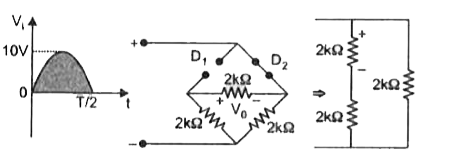 `IMPLIES (V_0)_(max)=1/2(V_i)_(max)=1/2xx10=5V` |
|
| 21. |
Coherent sources are necessary for producing sus tained interference. Write the condition of coherence. |
| Answer» SOLUTION :Two light sources are SALD to be coherant, if they emit light waves of same FREQUENCY, same AMPLITUDE and same phase | |
| 22. |
A man of mass m climbs a rope of length L suspended below a balloon of mass M. The balloon is stationary with respect to ground. If the man begins to climb up the rope at a speed v_("rel"). (relative to rope) in what direction and with what speed (relative to gound) with the balloon move ? |
|
Answer» <P> Solution :The change in momentum `Delta p` of the ball during `Delta = 0.01` sec is known as the impulse `(F Delta t)` of the force of impact`rArr F Delta t = Delta p` `|Delta VEC(p)|=|m vec(v)_(2)-m vec(v)_(1)|= m (v_(1)+v_(2))` `because m vec(v)_(1)& m vec(v)_(2)` are ANTIPARALLEL `rArr F delta t = m (v_(1)+v_(2)) ""`...(1) 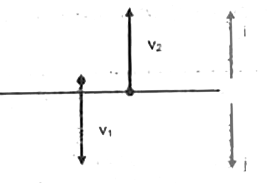 Since, the ball falls through a HEIGHT h, and its velocity just before STRIKING the surface is `sqrt(2gh)`. As the ball losses 75percent of its total mechanical energy that is knetic energy. `rArr 1//2 mv_(2)^(2)=1//2 m v_(1)^(2)(1-75//100)` `rArr v_(2)=(v_(1))/(2)=(sqrt(2gh))/(2)=sqrt((gh)/(2))` Substitution of the values of `v_(1)` and `v_(2)` in (1) yields `F Delta t = 50xx10^(-3)xx3 sqrt((gh)/(2))=50xx10^(-3)xx 3 sqrt(((9.8)(10))/(2))=1.05` N - sec. |
|
| 23. |
Statement - I : If a charge enters in electric field then it moves in the direction of vec(E) Statement - II : Force on charge is in the direction of field. |
|
Answer» If both Statement-I and Statement-II are TRUE, and Statement-II is the correct EXPLANATION of Statement -I. |
|
| 24. |
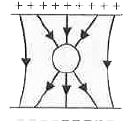
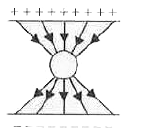
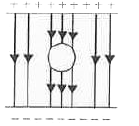
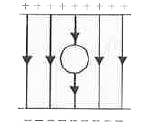
An uncharged sphere of metal is placed inside a charged parallel plate capacitor. The lines of force will look like |
|
Answer»
|
|
| 25. |
The refractive index of the material of a converging lens is 1.5. If air is replaced by a medium of refractive index 1.6, then the lens will now behave as a ___ lens. |
|
Answer» Solution :diverging . [Hint: When a LENS is immersed into a medium, whose REFRACTIVE INDEX is GREATER than that of lens material, nature of lens GETS reversed] |
|
| 26. |
Suppose while sitting in a parked car, you notice a jogger approaching towards you in the side view mirror of R = 2m. If the jogger is running at a speed of 5 ms^(-1) , how fast the image of the jogger appears to move when the jogger is (a) 39 m (b) 29 m (c) 19m (d) 9 m aways. |
|
Answer» Solution :From the mirror equation, we get v = `(fu)/(u - f)` For cunvec mirror, SINCE R = 2m, f = 1m. Then for u = -39 m , v = `((-39)xx 1)/( - 39 - 1) = (30)/(40) `m since the jogger moves at a constant speed of 5 `ms^(-1)`, after 1s the position of the IMAGE v (for u= 39 + 5= - 34 ) is `((34)/(35))` m. The shift in the position of image in 1s is`(39)/(40) - (34)/(35)= (1365 - 1360)/(1400) = (5)/(1400) = (1)/(280) m ` therefore, the average speed of the image when the jogger is between 39m and 34 m from the mirror, is `((1)/(280) ) ms^(-1)` similarly, it can be seen that the for you u =- 29m, - 19m and -9m, the speed with which the image apprears to MOVE is `(1)/(150) ms^(-1), (1)/(60) ms^(-1) and (1)/(10) ms^(-1)` , respectively. The analysis shown that the speed of image is not same as that of object, but increases for closer positions. |
|
| 27. |
As shown in fig an amplifier of no load gain 400 and input resistance 100Omega is connected to external signal via a series resistance of 300Omega. What is the apparent voltage gain? |
|
Answer» |
|
| 28. |
By applying electric field of the order of………..Vm^-1 to a metal, electrons can be pulled out of the metal. |
|
Answer» `10^(5)` |
|
| 29. |
A two particles P and Q are separated by distance d apart. P and Q move with velocity v and u making an angle 60^(@) and theta with line PQ the graph between their relative separation (s) when time t is shown in figure (2). The velocity v in terms of u |
| Answer» Answer :B | |
| 30. |
A body of length 1m having cross sectional area 0.75m^(2) conducts heat 6000J//s. Then find the temperature difference if K=200" Jm"^(-1)"K"^(-1). |
|
Answer» `20^(@)C` `rArrDeltaT=(6000)/(200xx0.75)=40^(@)C` So CORRECT CHOICE is (b). |
|
| 31. |
In the circuit shown, when a voltmeter is connected across any one of the three resistances, it shows a reading of 24 V. (a) Find the reading of the voltmeter when it is connected between A and C (b) The same voltmeter is used to measure potential difference across resistances shown in figure below. Will the voltmeter be more accurate this time ? |
|
Answer» (B) YES |
|
| 32. |
In the circuit shown in Fig. 7.41, calculate (a) the capacitance of the capacitor if the power factor of the circuit is unity, and (b) the Q-factor of the circuit. Given that the angular frequency of the a.c. source is 100s^(-1) . (C) Also calculate the average power dissipated in the circuit. |
|
Answer» <P> SOLUTION :Here, R `=10 OMEGA, L = 200 mH = 0.2 H, V_(rms) = 50 V`, power factor `cos phi =1 ` and `omega = 100 s^(-1)`(a) For power factor to be one, `X_(L) = X_( C) rArr L omega = 1/(C omega)` `rArr` Capacitance `C = 1/(L omega^(2)) = 1/(0.2 xx (100)^(2)) = 5 xx 10^(-4)F` or `500 muF`  (b) The Q-factor `=X_(L)/R = (L omega)/R = (0.2 xx 100)/10 =2` ( c) Average power dissipation `P_(av) = V_(rms)^(2)/R = (50)^(2)/10 = 250 W` |
|
| 33. |
An electric dipole made up of a positive and negative charge, each of 1mu C separated by a distance of 2cm is placed in an electric field of 10^(5)N//C, then the work done in rotating the dipole from the position of stable equilibrium through an angle of 180^(@) is |
|
Answer» `2 xx 10^(-3)` JOULE |
|
| 34. |
What is a NAND gate? Write its circuit symbol and truth table for two inputs. |
|
Answer» SOLUTION : NAND gate :- A logic gate whose output is 0 (or LOW) only when all the inputs are 1(or HIGH) is called NAND gate. CIRCUIT symbol : 
|
|
| 35. |
A parallel plate capacitor of capacitance 100 mu F Is charged to 500 V. The plate separation is then reduce to half its original value. Then the potential on the capacitor becomes |
|
Answer» 250 V `q = C.V. = CV RARR V. = (CV)/(2C) = (500)/(2) = 250 `C |
|
| 36. |
Explain giving necessary reactions, how energy is released during (i) fission, and (ii) fusion. |
|
Answer» SOLUTION :(i) In a fission process Uranium-235 nucleus BREAKS into two nearly equal fragments releasing great amount of ENERGY when bombarded by a slow moving (thermal) neutron. The representative reaction is `" "_(0)^(1)n + " "_(92)^(235)U to (" "_(92)^(236)U) to " "_(56)^(144)Ba + " "_(36)^(89)kr + 3" "_(0)^(1)n + Q` The energy released (the Q-value) in the fission reaction is of the order of 200 MeV per fissioning nucleus. This is estimated as follows : Let us take a nucleus with mass number A = 240 breaking into two fragments each of A = 120. Then binding energy per nucleon for A = 240 is about 7.6 MeV but that for the two A = 120 fragments is about 8.5 MeV. `therefore` Gain in binding energy per nucleon is about 0.9 MeV and hence the total gain in binding energy is `240 xx 0.9` or 216 MeV. (ii) In fusion reaction four hydrogen nuclei fuse together to form a helium nucleus along with release of about 26.7 MeV of energy. The actual reactions is quite complex and takes place in four STAGES but the combined effect of all these stages may be written in the form of following reaction : `4" "_(1)^(1)H +2e^(-) =" "_(2)^(4)He + 2nu + 6gamma + 26.7 MeV` The binding energy curve again helps in explaining the cause of energy generation in fusion reaction. Binding energy per nucleon of `" "_(2)^(4)He` is about 6.7 MeV but binding energy of hydrogen is zero. As a result, gain in binding energy on fusion is `4xx6.7=26.8MeV`. |
|
| 37. |
In the diagram shown ray of light is incident on the first medium boundary at angle 30^@ the medium has refractive index 2The second layer has refraction index mu/2 . A graph is given between deviation and refractive index 'mu'. The deviation is measured by considering the final emergent ray and the incident ray.Answer the following questions.Value of theta_1 will be |
| Answer» Answer :B | |
| 38. |
(a) Write an expression of magnetic moment associated with a current (l) carrying circular coil of radius R having N turns. (b) Consider the above mentioned coil placed in YZ plane with its centre at the origin. Derive expression for the value of magnetic field due to it at point (x, 0, 0). |
|
Answer» Solution :(a) Magnetic MOMENT of a coil carrying current is given as m= NIA, where A is the area bounded by the loop, If R be radius of coil then `A=piR^(2)` and so magnetic moment `M=NI.pi R^(2)`. (b) Let the said coil be placed in Y- Z plane with its CENTRE at the origin and let P be a point along x-axis at a DISTANCE from origin [i.e, having coordinates (x, 0, 0)). A turn of coil may be 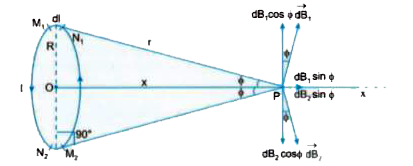 divided into large NUMBER of current elements `I.vecdl`. Two such elements `N_(1) M_(1) and N_(2) M_2`, diametrically opposite to each other, produce the magnetic fields `dvecB_(1) and dvecB_(2)` perpendicular to both `vecr and vecdl` and given by right hand rule as, `|vecdB_(1)|=|dvecB_(2)|=mu_(0)/(4pi) (Idl sin 90^(@))/(4pi) . (Idl sin 90^@)/(r^(2))=(mu_(0))/(4pi) (Idl)/((R^(2)+x^(2))` These fields may be resolved into components along x-axis and y-axis. Obviously components along y-axis balance each other but components along x-axis are all summed up. Hence, magnetic FIELD due to whole current loop will be : `B=oint dB sin phi= oint mu_(0)/(4pi) (Idl)/((R^(2)+x^(2)) . (R)/sqrt((R^(2)+x^(2))) =(mu_(0)IR)/(4pi (R^(2)+x^(2))^(3//2)) oint dl` `=(mu_(0)IR)/(4pi (R^(2)+x^(2))^(3//2)) .2piR=(mu_(0)IR^(2))/(2(R^(2)+x^(2))^(3//2)` As the coil consists of N turns, all carrying same current 1 in same direction so their magnetic up and the field due to entire coil will be. `B=(mu_(0) NIR^(2))/(2(R^(2)+x^(2))^(3//2)` |
|
| 39. |
In the diagram shown ray of light is incident on the first medium boundary at angle 30^@ the medium has refractive index 2The second layer has refraction index mu/2 . A graph is given between deviation and refractive index 'mu'. The deviation is measured by considering the final emergent ray and the incident ray.Answer the following questions.Value of theta_2 will be |
| Answer» ANSWER :A | |
| 40. |
A revolving ring in a siren revolves 420 times per minute and it produces 2 beats per second with a tuning fork of frequency 348 Hz. Choose the correct statement from the following. |
|
Answer» No. of HOLE in ring `=49`. |
|
| 41. |
In the diagram shown ray of light is incident on the first medium boundary at angle 30^@ the medium has refractive index 2The second layer has refraction index mu/2 . A graph is given between deviation and refractive index 'mu'. The deviation is measured by considering the final emergent ray and the incident ray.Answer the following questions.Value mu_1 will be |
|
Answer» 1 |
|
| 42. |
How much money does Aunt Jane gives the couple as their wedding present? |
|
Answer» 200 pounds |
|
| 43. |
A toaster operating at 240 V has a resistance of 120 Omega. The power is |
| Answer» SOLUTION :480 W | |
| 44. |
Is it possible to measure high current using a galvanometer? |
| Answer» SOLUTION : No. (It is SENSITIVE to EVEN SMALL CURRENT) | |
| 45. |
The specific heat of an ideal gas varies with temperature T as |
|
Answer» `T^1` |
|
| 46. |
Under what condition is the force acting on a charge moving through a uniform magnetic field minimum? |
| Answer» Solution :When a CHARGE is moving in the same/opposite direction (i.e. PARALLEL or ANTIPARALLEL) of the magnetic field, the foce acting on the charge is zero (MINIMUM or no force). | |
| 47. |
An equibiconvex lens has a focal length of 20 cm. A ball pin of length5 cm is placed on one side of the lens, such that the mid point of the pin is at a distance of 30 cm from the centre of the lens. Calculate the size of the image of the pin and its magnificationf = 20 cm l = 5 cm. |
Answer» Solution :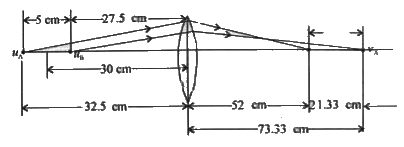 `(1)/(F)=(1)/(-u)+(1)/(V)` Given : `-u_(A)=27.5 cm` `(1)/(f)=(1)/(-u_(A))+(1)/(v_(A))` `(1)/(20)=(1)/(27.5)+(1)/(v_(A))` `(1)/(20)-(1)/(27.5)=(1)/(v_(A))` `v_(A)= 73.33 cm` `(1)/(f) = (1)/(-u_(B))+(1)/(v_(B))` `-u_(B)=32.5 cm` `(1)/(20)-(1)/(32.5)=(1)/(v_(B))` `(1)/(v_(B))=(12.5)/(650)` `v_(B)=52 cm` `v_(A)-v_(B)=21.33cm` magnification`m=(v_(1))/(v_(0))=(21.33)/(5)=4.266` |
|
| 48. |
A block of mass M=4kg is moving with velocity V=6m/s toward a target block of mass=2kg, which is stationary (v=0). The object collide heat-on, and immediately after the collision, the speed of block m is 4 times the speed of block M. Q. What is the speed of block M after the collision? |
|
Answer» Solution :If we let V' be the SPEED of block M immediately after the COLLISION, then the speed of block m will be 4V'. By applying conservation of linear momentum, we FIND that TOTAL `p_("before")=`total`p_("after")` `MV=MV'+m(4V')` `(4)(6)=(4)(V')+(2)(4V')` `V'=2m//s` Therefore, the speed of block M immediately after the collision is 2m/s (and the speed of block m immediately after the collision is 8 m/s). |
|
| 49. |
A device (figure) consists of a smooth L-shaped rod located in a horizontal plane and a sleeve A of mass m attached by a weight less spring to a point B. The spring stiffness is equal to x. The whole system rotates with a constant angular velocity omega about a vertical axis passing through the point O. Find the elongation of the spring. How is the result affected by the rotation direction? |
|
Answer» SOLUTION :At FIRST draw the free body diagram of the device as, SHOWN. The forces, acting on the sleeve are it's weight, acting vertically downward, spring forces, along the length of the spring and normal reaction by the rod, perpendicular to its length. Let F be the spring force, and `Deltal` be the elongation. From, `F_n=mw_n`: `Nsin theta+Fcos theta=momega^2r` (1) where `r cos theta=(l_0+Deltal)`. Similarly from `F_t=mw_t` `Ncos theta-Fsin theta=0` or, `N=Fsin theta//cos theta` (2) From (1) and (2) `F(sin theta//costheta)*sin theta+F cos theta=momega^2r` `=momega^2(l_0+Deltal)//cos theta` On putting `F=kappa Deltal`, `kappa DELTA l sin^2 theta+kappa Deltal cos^2 theta=momega^2(l_0+Deltal)` on solving, we get, `Deltal=momega^2(l_0)/(kappa-momega^2)=(l_0)/((kappa//momega^2-1))` and it is independent of the DIRECTION of rotation. 
|
|