

Saved Bookmarks
This section includes 7 InterviewSolutions, each offering curated multiple-choice questions to sharpen your Current Affairs knowledge and support exam preparation. Choose a topic below to get started.
| 1. |
A block of mass M=4kg is moving with velocity V=6m/s toward a target block of mass=2kg, which is stationary (v=0). The object collide heat-on, and immediately after the collision, the speed of block m is 4 times the speed of block M. Q. Is the collision elastic? |
|
Answer» SOLUTION :A collision is ELASTIC if the TOTAL KINETIC energy is conserved. Since `K_("before")=(1)/(2)MV^(2)+(1)?(2)mv^(2)=(1)/(2)MV^(2)=(1)/(2)(4kg)(6m//s)^(2)=72J` and `K_(after)=(1)/(2)MV^(+2)+(1)/(2)mv^(+2)=(1)/(2)(4kg)(2m//s)^(2)+(1)/(2)(2kg)(8m//s)^(2)=72J` `K_("before")=K_("after")`, so the collision is elastic. |
|
| 2. |
The object distance 'u' and the image distance v from a convex lens vary as shown in figure. Find (a) The nature and focal length of the lens. (b) The minimum distance between an object and its real image. |
| Answer» Solution : (a) CONVEX, 25 cm, (B) 1 m) | |
| 3. |
A 12.5 eV electron beam is used to bombard gaseous hydrogen at room temperature. What series of wavelengths will be emitted ? |
|
Answer» Solution :We know that energy of an electron in nth orbit of hydrogen is `E_(n)= -(13.6)/(n^(2))` and energy in ground STATE of hydrogen is -13.6 eV. Whenan electron beam of 12.5 eVis used , hydrogen atom cannot be ionised but atthe mostexcitedto n= 3state where energy of theelectron will be ` - (13.6)/((3)^(2)) = - 1.51 eV`(as maximum energy of electron can be`- 13.6 + 12.5 = - 1.1eV` andelectron cannot be excited to n = 4state having energy - 0.85 eV) So only THREE transitions are possible So only three transitions are possibleasshwonin Fig. 12.01. Here transtionsNo.1 and3 represent lins of Lyman series . andtransition No.2 represents lineof Balmer series . Wavelength of lightemiited in a transition will be . `lambda = (c)/(v) = (ch)/((E_(i) -E_(f))` ` therefore""lambda_(1) = (3 xx10^(8) xx 6.63 xx 10^(-34))/([(-1.51 - (- 13.6)] xx 1.6 xx 10^(-19)))= (3 xx 10^(8) xx 6.63 xx 10^(-34))/(12.09 xx 1.60 xx 10^(-19)) = 1.03 xx 10^(-7) m = 103 nm` `lambda_(2) = (3 xx 10 xx 6.63 xx 10^(-34))/([(-1.51 - (-3.4)] xx1.6 xx 10)^(-19)) = (3 xx10^(8) xx 6.63 xx 10^(-34))/(1.89 xx 1.6 xx 10^(-19)) = 6.56 xx 10^(-7) m = 656 nm` and`lambda _(3) =(3 xx 10^(8) xx 6.63 xx 10^(-34))/([(-3.4- (-13.6)]xx1.6 xx 10^(-19)))= (3 xx 10^(8) xx 6.63 xx 10^(-34))/(10.2 xx 1.6 xx 10^(-19)) = 1.22 xx 10^(-7) m =122 nm` 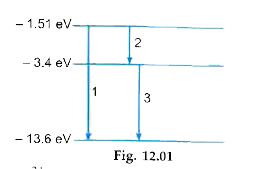
|
|
| 4. |
If the earth is moving towards a stationary star at a speed of 30 kilometres per second, find the apparent wavelength oflight emitted from thestar. Therealwavelength hasthevalue 5875 A. |
|
Answer» Solution :Here earth (observer) is approaching the star and hence, the mutual distance is decreasing. So, the observer will notice an increase in frequency or decrease in WAVELENGTH. If V be the relative velocity ofthe SOURCE and c, the velocity of light, then the change in wavelength is GIVEN by `Deltalambda = (v)/(c) xx lambda` Substituting the given values, we have `Deltalambda = (30xx10^(3))/(3 xx10^(8)) xx 5875 A` =` 5875 xx 10^(-4) A` Altered wavelength `lambda' = lambda - Deltalambda` ` = 5875 A - (5875 xx 10^(-4) A)` `lambda' = 0.9999 xx 5875 A` = 5874.4125 A |
|
| 5. |
Calculate the zero-point energy per one gram of copper whose Debye temperature is Theta= 330K. |
| Answer» SOLUTION :Molar zero point ENRGY is `(9)/(8) R Theta`. The zero point energy per GM of copper is `(9R Theta)/(8M_(cu)), M_(cu)` is the atomic WEIGHT of the copper. Substitution gives `48.6J//gm`. | |
| 6. |
If electric field in electromagnetic wave propagating along north is verically upward then magnetic field will be towards ……. |
|
Answer» north 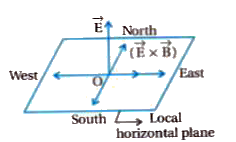
|
|
| 7. |
IN S.I. system the value of universal gravitational constant is , |
|
Answer» `Nm^2//kg^2` |
|
| 8. |
What do you know about the following terms ? a. Isogonic line and Agonic line b. Isolinic line and Aclinic line c. Isodynamic line |
|
Answer» SOLUTION :a. Isogonic lines - the lines joining the place of same magnetic DECLINATION . Agonic lines - the lines passing through places of zero declination. B. Isoclinic lines - the lines joining the places of same dip. ACLINIC lines - the lienes passing through places of zero dip. c. Isodynamic - the lines of same HORIZONTAL intensity. |
|
| 9. |
Statement-1 : As a simple pendulum oscillates, its bob has a non-zero acceleration at the mean position which is directed towards the point of suspension. bacause Statement -2 : Speed of an object in SHM is maximum at the mean position. |
|
Answer» STATEMENT -1 is TRUE, statement -2 is True, Statement -2 is a CORRECT explanation for Statement -1. |
|
| 10. |
In an ammeter 5% of the main current is passingthrough a galvanometer .If the galvanometer is G,then the resistance of shunt S will be: |
|
Answer» 19G |
|
| 11. |
State two applications of x-rays |
| Answer» Solution :(i) In medical to DIAGNOSE fractures in bones.(ii) In ENGINEERING for DETECTING cracks, flaws & holes in METAL parts of a MACHINE | |
| 12. |
If the equation in x given by (2(1/(cos^(-1)x)))^(2pi)-(a+1/2)(2(1/(cos^(-1)x)))^pi-a^2=0has only one real solution then exhaustive set of values of 'a' is |
|
Answer» `(-3,-1)` EQUATION becomes `t^2-(a+1/2)t-a^2=0` has ONE roots 2 or greater than 2 and other root LESS than 2, f(2) `le` 0. `rArr 4-(a+1/2)2-a^2 le 0` `a^2+2a-3 le 0` `(a+3)(a-1) le 0` `a ge -3` or `a le 1` |
|
| 13. |
In this essay, Nehru also tells about the...... .in Prison |
|
Answer» Experience |
|
| 14. |
Obtain the condition for bridge balance in Wheatstone's bridge. |
Answer» Solution :An important application of Kirchhoff.s rules is the Wheatstone.s bridge. It is used to compare resistances and also helps in determining the unknown resistance in electrical network. The bridge consists of four resistances P, Q, R and S connected. A galvanometer G is connected between the points B and D. The battery is connected between the points A and C. The current through the galvanometer is `I_(G)` and its resistance is G. Applying Kirchhoff.s current RULE to junction B, `I_(1)-I_(G)-I_(3)=0 ""...(1)` Applying Kirchhoff.s current rule to junction D, `I_(2)+I_(G)-I_(4)=0 "" ...(2)` Applying Kirchhoff.s VOLTAGE rule to loop ABDA, `I_(1)P+I_(G)G-I_(2)R=0""...(3)` Applying Kirchhoff.s voltage rule to loop ABCDA, `I_(1)P+I_(3)Q-I_(4)S-I_(2)R=0""...(4)` When the points B and D are at the same potential, the bridge is said to be balanced. As there is no potential difference between B and D, no current flows through galvanometer `(I_(G)=0)`. Substituting `I_(G)=0` in equation, (1), (2) and (3), we get `I_(1)=I_(3)"" ...(5)` `I_(2)=I_(4)""...(6)` `I_(1)P=I_(2)R ""...(7)` Substituting the equation (5) and (6) in equation (4) `I_(1)P+I_(1)Q-I_(2)S-I_(2)R=0` `I_(1)(P+Q)=I_(2)(R+S)""...(8)` Dividing equation (8) by equation (7) , we get `(P+Q)/(P)=(R+S)/(R )` `1+(Q)/(P)=1+(S)/(R ) RARR (Q)/(P)=(S)/(R )` `(P)/(Q)=(R )/(S)""...(9)` This is the bridge BALANCE condition. Only under this condition, galvanometer shows null deflection. Suppose we know the values of two adjacent resistances, the other two resistances can be compared. If three of the resistances are known, the value of unknown resistance (fourth one) can be determined. |
|
| 15. |
A particle having no charge and almost no rest mass |
|
Answer» NEUTRINO |
|
| 16. |
The total energy of an electron in the first excited state of the hydrogen atom is about -3.4 eV. Which of the answers above would change if the choice of the zero of potential energy is changed? |
|
Answer» Solution :We KNOW kinetic energy of electron `=(Kze^(2))/(2r)` and P.E of electron `=(-Kze^(2))/(r)` P.E.=-2 (kinetic energy) In this calculation electric potential and HENCE potential energy is zero at infinity. Total energy = PE + KE = -2KE + KE = -KE If zero of potential energy is changed, KE does not change and continues to be + 3.4 EV. However, the P.E. and total energy of the state would change with the choice of zero of potential energy. |
|
| 17. |
In the study of Geiger-Marsden experiment on scattering of alpha particles by a thin foil of gold, draw the trajectory of alpha-particles in the coulomb field of target nucleus, Explain briefly how one gets the information on the size of the nucleus from this study. |
|
Answer» SOLUTION :Thetrajectoryof alpha - PARTICLEIN the Coulombain fieldof tragestnucleus is show in fig. 12.05 By experimental study of large angle scattering of HIGH energy c-particles, value of distance of closest approach .`r_(0)`. was determined. The distance of closest approach can be either equal to or greater than the nuclear radius .r. i.e.`r_(0)ge r`, P2r Thus, by knowing the value of distance of closest approach we can estimate the size of the nucleus. The estimated size COMES out to be about 10 times the size of an ATOM. |
|
| 18. |
In the given decay equation A and B indicate _8O^19 to _9F^19+A+B, A and B indicate |
|
Answer» ELECTRON and positron |
|
| 19. |
Consider a thin square plate floating on a viscous liquid in a large tank. The height h of the liquid in the tank is much less than the width of the tank. The floating plate is pulled horizontally with a constant velocityu_0. Which of the following statement is (are) true ? |
|
Answer» The resistive force of liquid on the PLATE is inversely proportional to h |
|
| 20. |
An infinitely long thin straight wire has uniform linear charge density of 1/3 coul m^(-1). Then the magnitude of the electric intensity at a point 18cm away is |
|
Answer» `0.33 XX 10^(11)NC^(-1)` |
|
| 21. |
SI unit of work function is…… |
|
Answer» N |
|
| 22. |
A telegraph wire of length 2500m, is kept in E-W direction, at a height of 10 m from the ground. If it falls freely on the ground, then what is the current induced in the wire? [Given: resistance of the wire = 25sqrt2Omega, g= 10ml/s^2 and B_H = 2xx10^-5T] |
|
Answer» SOLUTION :`E = B_mulv = B_mulsqrt2gh` The velocity V is GIVEN by `V^2 = 2gh` We get, `e = 50sqrt2xx10^-2V` `therefore i = e/R = (50xx1.414xx10^-2)/35= 0.02A` |
|
| 23. |
At a certain place the horizontl component of earth's magnetic field is sqrt(3) times vertical component. The angle of dip at that place is |
|
Answer» `75^(@)` |
|
| 24. |
A permanent magnet should shoud have ______. |
|
Answer» HIGHT RETENTIVITY and LOW COERCIVITY |
|
| 25. |
Plane polarised light is passed through a polaroid. On viewing through the polaroid we find that when the polaroid is given one complete rotation about the direction of light |
|
Answer» The INTENSITY of TRANSMITTED light GRADUALLY decreases to zero and remains zero |
|
| 26. |
The magnetic flux linked with a coil given by phi = 5t^2+3t+2 What is the e.m.f. induced in the coil in the third second? |
|
Answer» Solution :`e = (dphi)/dt = d/dt(5t^2+3t+2) = 10t+3` When t = 2 SEC, `e_1` = 20+3 = 23V When t = 3 sec, `e_2` = 10+3 = 33 `THEREFORE` e.m.f. induced in the THIRD SECOND = 33-23 = 10V |
|
| 27. |
In the Example 16, with what energy does the alpha-particle emerge out of the cycloton? |
|
Answer» |
|
| 28. |
A block of wood is kept on the floor of a stationary lift.The lift begins to descend with an acceleration of 12 ms^(-2). The displacement of the block duringthe first 0.2 second after the start is (g = 10 ms^(-2)): |
|
Answer» 0.02 |
|
| 29. |
In a series L–C–R circuit, voltages across inductor, capacitor, and resistor are V_(L), V_(C ) and V_(R ) respectively. What is the phase difference between (i) V_(L) and V_(R ) (ii) V_(L) and V_(C ) ? |
| Answer» SOLUTION :(i) `PI/2` (II) `pi` | |
| 30. |
Consider the following conclusiond regarding the components of an electric field at a certain point in space given by E_x = -Ky, E_y = Kx, E_z = 0 . |
|
Answer» The field is conservative. Let us find potential difference between any two points: `V_(2)-V_(1)=-underset(x_(1))overset(x_(2))intE_(x)DX-underset(y_(1))overset(y_(2))intE_(y)dy` `RARR V_(1)-V_(1)=+underset(x_(1))overset(x_(2))intK_(y)dx-underset(y_(1))overset(y_(2))intK_(x)dy` This can further be evaluated only if we know the dependance of `x` and `y` on each other or the PATH of intergration. Hence field is nonconservative. To find the shape of lines of force: `tantheta=(E_(y))/(E_(x))` or `(dy)/(dx)=(E_(y))/(E_(x))` or `(dy)/(dx)=(K_(x))/(-K_(y))` or `xds+ydy=0` or `(x^(2))/(2)+(Y^(2))/(2)=C` or `x^(2)+y^(2)=2C` This is the equation of circle. 
|
|
| 31. |
Ecology is the science for the |
|
Answer» PRESERVATION of NATURAL atmosphere |
|
| 32. |
Find the heat conductivity of silver and of mercury at room temperature (20^(@)C). |
|
Answer» |
|
| 33. |
An LCR series circuit with L = 80 mH, C = 60 muFand R= 100Omegais connected to a 230 V, 50 Hz AC source. Calculate the p.d. across L,C and R |
| Answer» SOLUTION :`V_L = 55.6 V, V_C = 117.3V, V_R = 221 V` | |
| 34. |
A proton is 1836 times heavier than an electron. If the repulsive force between two protons is F for given distance, then the electric force between two electrons at same distance will be.........N. |
|
Answer» F |
|
| 35. |
In the steady state of the below given circuit, find the charge on the capacitor of capacity 0.2muF. |
|
Answer» Solution :In steady state, there is no flow of current through C. So, `4Omega` resistance is INEFFECTIVE. `"so"R_("eff")=(2xx3)/(2+3)+2.8=4Omega, i=(V)/(R_("eff"))=(6)/(4)=(3)/(2)A` But potential difference across C = potential difference across the combination of 2 OHMS and 3 ohms. i.e, `(q)/(C)=(3)/(2)xx(6)/(5)""therefore" "q=(9)/(5)xx0.2 RARR q=0.36 muC` |
|
| 36. |
Uniform magnetic field B, exists in the vertical downward direction. A rod whose length is kept horizontal and is moved with velocity v perpendicular to its length. Motional emf developed across the length of the rod is |
|
Answer» When ROD is moved vertical then velocity becomes parallel to magnetic field and hence no EMF is induced across the length. Hence, option (a) is wrong hut (c) is correct. When rod is moved horizontally then B, v and I are mutually perpendicular and hence emf Bul is induced across the length. Hence, option (b) is correct but (d) is wrong Options (b) and (c) are correct. |
|
| 37. |
A transmitting antenna at the top of a tower has a height of 32 m and the height of the receiving antenna is 50 m. What is the maximum distance between them for satisfactory communication in LOS mode? Given radius of earth 6.4 xx 10^(6) m. |
|
Answer» SOLUTION :`d_m= sqrt( 2 xx 64 xx 10^(5) xx 32 ) xx ( 2 xx 64 xx 10^(5) xx 50)` `= 64 xx 10^(2) xx sqrt( 10)+ 8 x 10^(3) xx sqrt(10) m ` ` = 144 xx 10^(2) xx sqrt(10) m = 45.5 km` |
|
| 38. |
Compare the intensities of two points located at respectivedistance (beta)/(4)" and "(beta)/(3) fromthe central maixma in a interference pattern of YDSE (beta is the fringe width). |
|
Answer» Solution :`(beta)/(4) IMPLIES triangle theta= (2PI)/(4)= (pi)/(2) implies I= 4I_(0) COS^(2) (pi/4)` `(beta)/(3) implies triangle theta = (2pi)/(3) implies I= 4I_(0) cos^(2) ((2pi)/(2xx3))= I_(0)` required ratio `= 2 : 1`. |
|
| 39. |
A cyclist rolls down a ''devil's loop'' track from a height H. Find the pressure of the cyclist on the track as afunction of the angle the radius vector makes with the vertical. Do the calculations also for the case when the cyclist rolls down from the minimum height. |
|
Answer» `N - mgcos alpha - mv^2//R` To find speed apply the law of conservation of energy . `mgH = mgR(1 cos alpha) + mv^2//2` Hence `N=mg(3cosalpha-2+(2H)/R)` In the highest point of the loop `alpha = pi` , so `N_("top") =mg (-5+(2H)/R)` The MINIMUM height is FOUND form the condition `N_("top")=0` , there FORE `H_(min) = 5/2 R`. In this case `N=3mg(1+cosalpha)=6mgcos^2""(alpha)/2` 
|
|
| 40. |
A solid substance of mass 10 g at -10^(@)C was heated to -2^(@)C (still in the solid state). The heat required was 64 calories. Another 880 calories was required to raise the temperature of the substance (now in the liquid state) to 1^(@)C, while 900 calories was required to raise the temperature from -2^(@)C to 3^(@)C. Calculate the specific heat capacities of the substance in the solid and liquid state in calories per kilogram per kelvin. |
|
Answer» |
|
| 41. |
Two coils – 1 and 2 – are mounted co axially as shown in the figure. The resistance of the two coils are R_(1) and R_(2) and their self inductances are L_(1) and L_(2) respectively. Switch S is closed at time t = 0 to connect the coil 1 to an ideal cell of emf V. It is observed that by the time current reaches its steady value in coil 1, the quantity of charge that flows in coil 2 is Q_(0). Calculate the mutual inductance (M) between the two coils. |
|
Answer» |
|
| 42. |
How long does it take a brick to reach the ground if dropped from a height of 65 m?What will be its velocity just before it reaches the ground? |
|
Answer» 2s,10 m/s |
|
| 43. |
If the electric flux entering and leaving an enclosed surface respectively is phi_1 and phi_2, the electric charge inside the surface will be |
|
Answer» `(phi_2 - phi_1) epsilon_0` |
|
| 44. |
The diagram below shows two coils A and B placed parallel to each other at a very small distance. Coil A is connected to an ac supply. G is a very sensitive galvanometer. When the key is closed |
|
Answer» Constant deflection will be observed in the galvanometer for 50 HZ supply |
|
| 45. |
The difference between the deviation in the angular dispersion between two colors to the deviation caused by the mean color ? |
| Answer» SOLUTION :ANGULAR DISPERSION | |
| 46. |
Who took Kailash Satyarthi's Interview? |
|
Answer» ADAM Smith |
|
| 47. |
Consider a thin conducting shell of radius R carrying total charge Q. Two point charges Q and 2Q are placed on points A and B, which are at a distances of R/2 and 2R from the center of the cell respectively as shown in the figure. If the cell is earthed how much charge will flow to the eart? |
|
Answer» `3Q` `(KQ^(1))/R+(K(2Q))/(2R)=0` `:. Q^(1)=-Q` Hence `3Q` will flow to the earth 
|
|
| 48. |
If the input frequency is 50 Hz in fullwave rectification, what is the output frequency? |
|
Answer» Solution :100 Hz In the fullwave rectification, the OUTPUT frequency is TWICE the frequency of the INPUT. |
|
| 49. |
A dipole is placed in a uniform electric field with its axis parallel to the field. It experiences |
|
Answer» |
|
| 50. |
A ball dropped from a height of 2.43 m attains a height of 3 cm after second rebound. What is the value of coefficient of restitution ? |
|
Answer» 0.5 |
|