

Saved Bookmarks
This section includes 7 InterviewSolutions, each offering curated multiple-choice questions to sharpen your Current Affairs knowledge and support exam preparation. Choose a topic below to get started.
| 1. |
The intensity of magnetic field at a point X on the axis of a small magnet is equal to the field intensity at another point Y on its equatorial axis. The ratio of distances of X and Y from the centre of the magnet will be |
|
Answer» `(2)^(-3)` `B_1=mu_0/(4pi) (2M)/d_1^3 , B_2=mu_0/(4pi) M/d_2^3` As `B_1=B_2` `therefore mu_0/(4pi) M/d_1^3 = mu_0/(4pi) M/d_2^3 RARR d_1^3 = 2d_2^3 rArr d_1/d_2=2^(1//3)` |
|
| 2. |
An electron and photon have same wave length. If E is the energy of photon and P is the momentum of electron, the magnitude of E/P in SI in unit is : |
|
Answer» `3.33 xx 10^(-8)` |
|
| 3. |
A block of mass m is at rest on a frictionless, horizontal table placed in a laboratory on the surface of Earth. An identical block is at rest on a frictionless, horizontal table placed on the surface of the moon. Let F be the net force necessary to give the earthbound block an acceleration of a across the table. Given that g_("moon") is one sixth of g_("Earth"), the force necessary to give the moon-bound block the same acceleration a across the table is |
|
Answer» `(F)/(12)` |
|
| 4. |
A car moves on a plane road,induced emf produced across its axis connecting wheels is maximum when it |
|
Answer» MOVES at the pole |
|
| 5. |
Which of the following is a buffer solution ? |
|
Answer» `NH_(4)OH+NH_(4)CL` |
|
| 6. |
A truck crosses a stationary motorcycle at a speed of 54 km/h. At the same instant, the motor cyclist follows the truck by accelerating his motorcycle at the rate of 1 ms. The motor cyclist catches the truck after a time interval of: |
|
Answer» 45 s `s_2` for motor cyclist =`0+1//2 xx1xxt^(2)` But `s_1=s_2` `54xx(5)/(18)xxt=(t^(2))/(2)` or t=30s |
|
| 7. |
If a car covers (2)/(3) of the total distance with speed nu_(1)and (3)/(5) distance with speed v, then average speed is |
|
Answer» `(1)/(2)sqrt(nu_(1)nu_(2))` `nu_(a)=(s)/(((2s)/5)/nu_(1)+((3s)/5)/nu_(2))IMPLIES nu_(a)=(5nu_(1)nu_(2))/(3nu_(1)+2nu_(2))` |
|
| 8. |
This story revolves around whom? |
|
Answer» AROUND CROFTER and his daughter |
|
| 9. |
A particle having charge q=10muC and mass m = 3 mg has a velocity vecv = (10 cm) (hati+2hatj) at t =0 at origin. There exists a uniform magnetic fieldvecB=0.6 piT hati. Another uncharged particle is moving with a constant velocity along negative x-axis. At t =0 its x coordinate is +50 cm. The two particles collide and stick together and the combined mass goes in a circular path. Find the possible values of the mass of the uncharged particle . |
|
Answer» |
|
| 10. |
In a Van-De Graaff type generator a spherical metal shell is to be a 15 xx 10^(6) V electrode. The dielectric strength of the gas surrounding the electrode is 5xx10^(7) Vm^(-1). What is the minimum radius of the spherical shell required ? |
|
Answer» Solution :Maximum acceptable potential `V=1.5xx10^(6)` V For SAFETY E = 10 % of dielectric strength `= 5 xx10^(7)` `= 5xx10^(7)xx(10)/(100)` `= 5xx10^(6) Vm^(-1)` Potential for spherial shell `V = (kq)/(r)` and electric field `E = (kq)/(r^(2))` `:. (V)/(E) =r ` `:.` Required MINIMUM RADIUS `r = (V)/(E) = (1.5xx10^(6))/(5xx10^(6))` `:. r = 3xx10^(-1) `m = 30 CM |
|
| 11. |
Express velocity of electromagnetic wave in a material medium in terms of mu and epsi. |
|
Answer» Solution :An electromagnetic wave CONSISTS of oscillating electric and magnetic field vectors produced by an accelerating charged PARTICLE. `C=(1)/sqrt(mu_(0)epsilon_(0))` where c= velocity of light in vacumm `epsilon_(0)`= electrical permittivity for free space `mu_(0)` = magneticpermeability for free space |
|
| 12. |
A wave travelling along the x-axis is described by the equation y(x,t) = 0.005cos (alpha x -beta t) . If the 1wavelength and the time period of the wave are 0.08m and 2.0s, respectively, then alpha/beta = n xx 5, thenthe value of n is____(where alpha, beta are in appropriate units). |
|
Answer» |
|
| 13. |
For what purposes Fax is used ? |
| Answer» Solution :Fax is USED for electronic transmission of a document at a DISTANT place VIA phone LINES. | |
| 14. |
What is Hysteresis loop ? Explain with the help of terms related to it. |
Answer» SOLUTION :Consider a piece of magnetic material placed in variable magnetic field. When the applied field varies from O to A, the magnetic intensity follows a path OA. As the field is decreased from A to O, the magnetic intensity does not follow BACK the path AO but AB. As the field is gradually varied back from O to K, I follows path BD. Thus we find that I always lacks behind H and we get a graph like ABCDEFA. 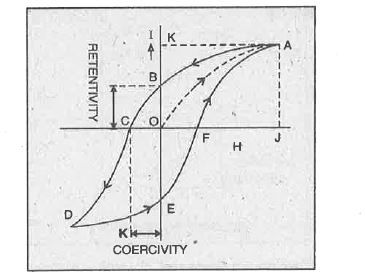 Value of intensity of magnetisation of material when the magnetising field is reduced to zero is called RETENTIVITY or residual magnetism. To reduce the residual magnetism to zero, we have to apply a magnetising field OC in opposite direction. This magnetising field is called coercivity. The PHENOMENON of lagging of I or B behind H when a specimen of magnetic material is subjected to a cycle of magnetisation is called hysteresis and the loop ABCDEFA is called hysteresis loop. |
|
| 15. |
Two identical conducting spheres carry charges of +5.0 mu C and -10 mu C, respectively. The centers of the spheres are initially separated by a distance L. The two spheres are brought together so that they are in contact. The spheres are then returned to their original separation L. What is the ratio of the magnitude of the electric force on either sphere after the spheres are touched to that before they were touched ? |
|
Answer» `(1)/(1)` |
|
| 16. |
A capacitor of capacitance C is charged to a voltage V_(0) and subsequently discharged through a combination of a resistor R and another identical capacitor C in series. Find the current at time t and heat generated in the same time. |
|
Answer» |
|
| 17. |
A parallel beam of light is incident on a face of a prism of refracting angle 60^@.Find the refractive index of the prism if the angle of minimum deviation is 40. What is the new angle of minimum deviation if the prism is immersed in water of refractive index 1.33? |
|
Answer» Solution : Given, `A = 60^@ , N = ? , D = 40^@ , D^1 = ? , D_w = 1.33` The REFRACTIVE index of the material of a prism is given by CASE (i) `n = (sin ((A+D)/(2)) )/(sin (A/2) ) = (sin ( (60+40)/(2)) )/(sin (60/2))` `n = (sin (50))/(sin (30)) = (0.766)/(0.5)` Case (ii) `(n_g)/(n_w) = (sin ((A+D^1)/(2)) )/(sin(A/2))` `(1.532)/(1.33) = (sin ((60+D^1)/(2)))/(sin (60/2))` `1.151 = (sin ((60+D^1)/(2)))/(0.5)` `1.151 xx 0.5 =sin ((60+D^1)/(2)) ` `0.5755 = sin ((60 + D^1)/(2))` `(60+D^1)/(2) = sin^(-1) (0.5755)` `60+D^1 = 2 xx sin^(-1)(0.5755)` `60+D^1 = 2 xx 35^@ g^1` ` = 70^@ 16^1` `D^1 = 70^@ 16^1- 60^@` `D^1 = 10^@ 16^1` |
|
| 18. |
In a certain region of space, electric field is along the Z-direction throught. The magnitude of electric field is, however, not constant but increases uniformly along the positive Z-direction, at the rate of 10^(5) NC^(-1) per metre. Whay are the force and torque experienced by a system having a total dipolemoment equal to 10^(7) Cm in the negative Z-direction? |
| Answer» Solution :Only (c ) is right the rest cannot represent electrostaicfield lines (a) is wrong becausefield lines must be normal to a conlductor (B) is wrong because FIELD lines cannot startwrong becauseelectrostaticfield lines cannotform CLOSED LOOPS | |
| 19. |
A conducting ring of mass 2kg, radius 0.5m carries a current of 4A. It is placed on a smooth horizontal surface. When a horizontal magnetic field of 10 T parallel to the diameter of the ring is applied, the initial acceleration is (in rad/sec^2) |
| Answer» ANSWER :C | |
| 20. |
A closed organ pipe of length Lis in resonance with a tuningfork. If a hole is made in the pipe at a distance L/4 from closed - end, it will be in resonance again, when: |
|
Answer» TUNING FORK is replaced by another of high frequency |
|
| 21. |
A bullet of mass m, moving with a velocity u stikes a suspended wooden block of mass M. If the block rises to a height h , the initial velocity will be given by . |
|
Answer» `SQRT(2gh)` |
|
| 22. |
Mention any three properties of an electric charge. |
|
Answer» Solution :(i) Additivity of CHARGES : Charges can be ADDED algebraically. (ii) CHARGE is CONSERVED : The total charge of the isolated system is always conserved. (iii) QUANTISATION of charge : All free charges are integral multiples of a basic unit of charge. .e.. |
|
| 23. |
The maximum force, in addition to the weight required to pull a wire frame 5cm long from the surface of water at temperature 20^@C is 728 dyne. The surface tension of water is, |
|
Answer» 7.28 dyne/cm |
|
| 24. |
Consider the arrangement shownin figure. By some mechanism,the separation between the slits S_3 and S_4 can be changed. The intensity in measured at the point P which is at the common perpendicular bisector of S_1S_2 and S_3S_4. When z=(Dlamda)/(2d) the intensity measured at P is I. Find this intensity when z is equal to a. (Dlamda)/d, b. (3Dlamda)/(2d), c. (2Dlamda)/d |
|
Answer» <P> So, `OS_3=OS_4=(lamdaD)/d` `rarr Dark fringe at `S_3 and S_4` `rarr At S_3` intensity at `S_3=0` `rarrl_1=0` At `S_4 Intensity at S_4=0` `rarr `l_2=0` `rarr At P PATH DIFFERENCE =0 `rarr PHASE difference =0` `rarr l=l_1+l_2+2sqrt(l_1l_2)COSTHETA^@=0+0+0=0` `rarr intensilty at P=0` |
|
| 25. |
If there is an increase in length by 0.1% due to stretching the percentage increase in its resistance will be |
|
Answer» 0.001 |
|
| 26. |
In the given circuit, if point C is connected to the earth and a potential of +2000 V is given to the point A, the potential at B is |
|
Answer» 1500 V |
|
| 27. |
Let N be the set of natural numbers and the functionsf: Nrarr N be defined by f (n) = 2n+3 AAn in N,Then f is- |
|
Answer» surjective |
|
| 28. |
A bus is moving along a straight road with a uniform acceleration. It passes through two points A and B separated by a distance with velocity 30 km/h and 40 kmh respectively. The velocity of the bus midway between A and B is: |
| Answer» Answer :D | |
| 29. |
We know that the light ray bends toward the normal when it goes from a denser medium. This adjacent photograph seems to be wrong ! The straw dipped in water seems to be bent away from the normal . Explain. |
|
Answer» |
|
| 30. |
Atom consists of three fundamental particles _____, _____ an _____. |
| Answer» SOLUTION :ELECTRONS, PROTONS, NEUTRONS | |
| 31. |
A wire loop ABCDE carrying a current I is placed in the x-y plane as shown in the figure. A particle of mass m and charge q is projected from origin with velocity vec(V) = (V_(0))/(sqrt(2))(hat(i) + hat(j)) m//sec. (a) Find the instaneous acceleration (b) If an external magnetic field vec(B) = B_(0) hat(i) is applied, find the force and torque acting on the loop due to this field. |
Answer» Solution :(a) 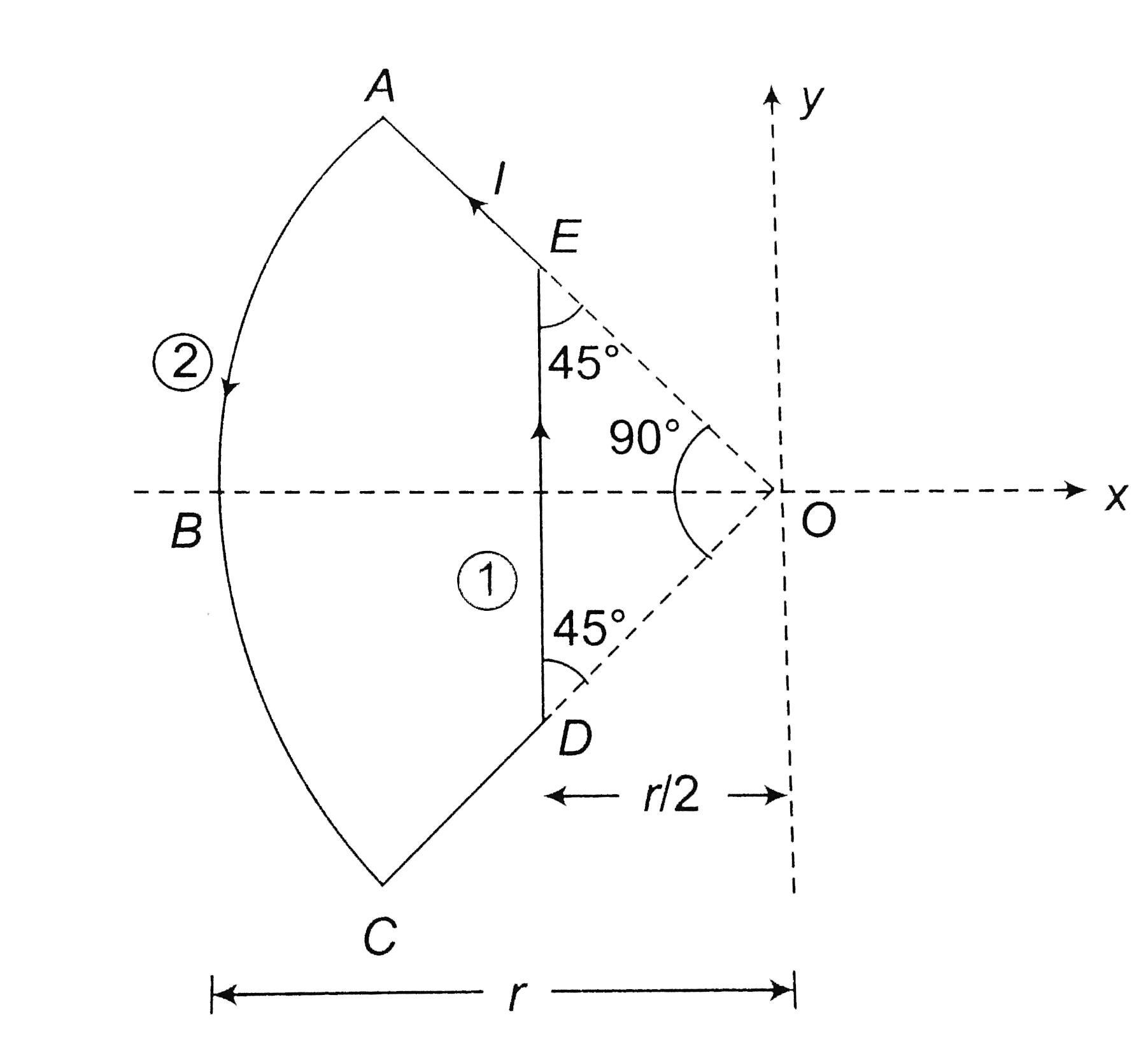 Magnetic field at `O` due to loop `ABCDE` `vec(B)_(1) = (mu_(0)I)/(4pi(r )/(2))(cos 45^(@) + cos 45^(@))(- hat(k))` `= -(mu_(0)I)/(2pi r).2.(1)/(sqrt(2))hat(k)` `= -(mu_(0)I)/(sqrt(2)pi r) hat(k)` `vec(B)_(2) = (mu_(0)I)/(2 r).(90^(@))/(360^(@))hat(k) = (mu_(0)I)/(8 r)hat(k)` `B_(0) = vec(B)_(1) + vec(B)_(2) = (mu_(0)I)/(r )((1)/(8) - (1)/(sqrt(2)pi)) hat(k)` Magnetic force on charged particle at `O` `vec(F) = q vec(V) xx vec(B)` `= q[(V_(0))/(sqrt(2))(hat(i) + hat(j))] xx [(mu_(0)I)/(r )((1)/(8) - (1)/(sqrt(2)pi))hat(k)]` `= (MU q V_(0) I)/(sqrt(2) r)((1)/(8) - (1)/(sqrt(2)pi))[(hat(i) + hat(j)) xx hat(k)]` `= (mu q V_(0) I)/(sqrt(2) r)((1)/(8) - (1)/(sqrt(2)pi))(-hat(j) + hat(i))` Acceleration `vec(a) = (vec(F))/(m)` `= (mu q V_(0) I)/(sqrt(2)m)((pi - 4sqrt(2))/(8 pi)) (hat(i) - hat(j))` `= (mu q V_(0)I)/(8sqrt(2) pi mr)(pi - 4sqrt(2))(hat(i) - hat(j))` (b) Now external magnetic field `vec(B) = B_(0) hat(i)` is applied. Net magnetic force on loop `= 0` (when a closed loop CARRYING single current is placed in uniform magnetic field, net magnetic force on loop is ZERO, whatever the shape of loop) AREA of loop `= (pi r^(2))/(4) - (1)/(2)r.(1)/(2) = r^(2)((pi)/(4) - (1)/(4))` Magnetic moment of loop `vec(M) = IA = (I r^(2))/(4)(pi - 1) hat(k)` Torque acting on loop `vec(tau) = vec(M) xx vec(B) = (B_(0)Ir^(2))/(4)(pi - 1)[hat(k) xx hat(i)]` `= (B_(0) I r^(2)(pi - 1))/(4) hat(j)` |
|
| 32. |
In the figure shown when the massless spring is in released state its free end is at point B. A very small block is ressed against the spring by a distance delta and the released from rest. Except the portion BC where coefficient of kinetic friction is mu_(k), track is smooth everywhere. Determine the spring compression delta so that the block enters a small hole at E. Consider all values shown in the figure. |
|
Answer» Solution :We determine the speed REQUIRED at `D` so that the block falls into the HOLE at `E` by following a parbolic trajectory. `v_(d)=`speed at `D` `v_(d)=sqrt(8gd)` APPLYING conservation of energy for motion from `A` to `D` `(1)/(2)kdelta^(2)=mu_(k)mgd+mgd+(1)/(2)m(8gd) rArr delta=sqrt((2mgd)/(k)(mu_(K)+5))` |
|
| 33. |
Statement - 1 : Two longitudinal waves given by equations: y_(1)(x,t) = 2 a sin(omega t- kx) and y_(2) (x,t) = a sin (2 omega t - 2kx) will have equal intensity . Statement -2 : Intensity of waves of given frequency in same medium is proportional to square of amplitude only . |
|
Answer» Satement-I is true, statement -II is false. `I_(1) prop (2a)^(2) omega^(2) ` `I_(2) prop a^(2) (2omega)^(2) ` `I_(1) = I_(2) ` Intensity depends on FREQUENCY ALSO. so , correct choice is a. |
|
| 34. |
A particle is trapped in an infinite potential energy well. It is in the state with quantum number n = 14. How many nodes does the probability density have (counting the nodes at the ends of the well)? |
|
Answer» None |
|
| 35. |
BlockA of mass 2 kg is placed over block B of mass8 kg .The combination is placed over a rough horizonatal surface .Cofficient of friction between B and the floor is 0.5 .Coefficient of friction berween A and B is 0.4 .A horizontal force of 10 N is applied on block B .The force of friction between A and B is (g=10 ms^(-2)) |
|
Answer» 100N `F_(f)=muR = 0.5 xx 10 xx 10 = 50 N.` Since force applied on B is less than frictional force so block B will not MOVE w.r.t. ground. So there is no relative motion between block B and block A. So frictional force between A and B is zero. :. Correct choice is (d). |
|
| 36. |
Assertion : If momentum of a body increases by 50%, its kinetic energy will increase by 125%. Reason: Kinetic energy is proportional to square of velocity. |
|
Answer» `therefore v_(2)=(3//2)v_(1)` As, kinetic energy `k ALPHA v^2` `therefore K_(2)=9/4 k_(1)` Increase in K.E. `=((K_(2)-K_(1))xx100)/(K_(1))=125%` |
|
| 37. |
Pick out a vector quantity from the following |
|
Answer» ELECTRIC POTENTIAL |
|
| 38. |
What are the other forces acting on the disc? |
| Answer» SOLUTION :HINGE REACTION at the CENTRE of DISC. | |
| 39. |
(A) : An electron moving with uniform velocity enters uniform magnetic field perpendicularly and then a uniform electric field in the same direction. Nature of paths followed by electron in both the fields will be same. (R) : The force applied by magnetic and electric field on electron are in the same direction. |
|
Answer» Both 'A' and 'R' are TRUE and 'R' is the CORRECT explanation of 'A'. |
|
| 40. |
The number density of free electrons in a copper conductor is estimated at 8.5 xx 10^(28) m^(-3). How long does an electron take to drift from one end of a wire 3.0 m long to its other end? The area of cross-section of the wire is 2.0 xx 10^(-6)m^(2) and it is carrying a current of 3.0A. |
|
Answer» SOLUTION :` I= enAV_d = (L)/(t) ` `t = (ENAL)/(1)=2.7 xx10 ^4S ` |
|
| 41. |
A blockA of mass 2 kg is connected with two springs, as shown . The spring constant of lower spring is system is thrice thespring costant ofupper spring. The system is released from rest with both the springs unstreched. The maximum displacement of bloack is 0.1 m. Find the acceleration of the block is its lowest position- |
|
Answer» `6.5 m//s^(2)` `x = (10)/(k) = 0.1` so `k = 100 N//m` `A = ((k + 3k)x - mg)/(m) = 10 m//s^(2)` |
|
| 42. |
A 4muF capacitor is charged by a 200 V battery. It is then disconnected from the supply and is connected to another uncharged 2muFcapacitor. During the process loss of energy (inJ) s |
|
Answer» ZERO |
|
| 43. |
(i) State the principle of working of a potentiometer.(ii) In the following potentiometer circuit AB is a uniform wire of length 1 m and resistance 10 Omega. Calculate the potential gradient along the wire and balance length AO (= l). |
|
Answer» Solution : (ii) Emf of battery `E_1 = 2 V`, resistance of potentiometer `r =10 Omega` , resistance joined in series R= 15`Omega` and LENGTH of potentiometer wire L = 1 m = 100 cm (a) Potential gradient k = `(E_1 r)/((R+r).L) = (2 xx 10)/((15 + 10) xx 100) = 0.008 Vcm^(-1)` (b) Current through 0.3`Omega`resistance due to cell `E_2, I = (1.5)/(1.2 + 0.3) = 1A` ` therefore `Potential difference across 0.3 12 resistor `V=IR=1 xx 0.3 =0.3 V ` If balancing length AO of wire bel then USING RELATION V=kl, we have `l = V/k = (0.3)/(0.008) = 37.5 cm ` |
|
| 44. |
A standing wave given by the equation y=2A sin ((pix)/L) sin omegat is formed between the points x=- L and x = L The separation between two such particles, which have their maximum velocity half the maximum velocity of the antinodes and which are closest to the particle present f x=0, is L/k thon find the value of k. |
|
Answer» Solution :`(deltay)/(deltat)=2A omegasin ((pix)/L) COS omegat` from THEGIVEN CONDITION `rArr 2A omegasin ((pix)/L)=A omega` `rArr sin (pix)/L =1/2` `rArr x= pm L/6` HENCE separation =`L/3` |
|
| 45. |
Tetrahedral void is formed by......... Atoms |
|
Answer» 8 |
|
| 46. |
The intemal connections of a moving coil galvanom eter is given in the fig( ## EXP_SPS_PHY_XII_C04_E04_002_Q01 .png" width="80%"> |
| Answer» Solution :The instrument SHOWN in FIGURE (2) is used to MEASURE VOLTAGE. | |
| 47. |
A projectile is fired with a velocity v at angle theta with the horizontal. The magnitude of the change in momentum between the starting point and the point at which it strikes is given by : |
| Answer» Answer :B | |
| 48. |
An alpha-particle moves in a uniform magnetic field with an induction of 1.2 tesla (T) in a circle of 49 cm radius in the plane perpendicular to the lines of force. Find the speed and the kinetic energy of the particle. |
|
Answer» `u=2e BR//m and K=2e^2 B^2 R^2//m` |
|
| 49. |
A point object is kept at a distance of 2 m from a parabolic reflecting surface y^(2) = 2x . An equiconvex lens is kept at a distance of 1.80 m from the parabolic surface. The focal length of the lens is 20 cm . Find the position from origin of the image in cm, after reflection from the surface. |
Answer» SOLUTION :_S01_032_S01.png) Comparing with `y^(2) = 4"ax" implies a = 0.5` `PC` is a normal so `"tan"(pi-theta) = (-1)/((dy//dx)_(x_(1)y_(1))) = -y_(1) implies ` final position of image = `0.5"m" = 50 "CM"` But `"tan"2THETA = (y_(1)-0)/(x_(2)-x_(1))` & `"tan"2theta = (2"tan"theta)/(1-tan^(2)theta) implies (xy_(1))/(x_(2) - x_(1)) = (2(y_(1)))/(1-y_(1)^(2))x_(2) = (1)/(2)"m"` |
|
| 50. |
_____ is used to see heavenly objects. |
| Answer» SOLUTION :ASTRONOMICAL TELESCOPE | |
