

Saved Bookmarks
This section includes 7 InterviewSolutions, each offering curated multiple-choice questions to sharpen your Current Affairs knowledge and support exam preparation. Choose a topic below to get started.
| 1. |
The velocity of sound in gas is 206 m/s. at N.T.P. The increase in velocity per ""^(@)C rise in temp. in this gas is : |
|
Answer» 0.61 m/s `K^(-1)` Now `(v_(t))/(v_(0)) - 1 = (t)/(546)` `rArr (v_(t) - v_(0))/(t) = (v_(0))/(546)` `rArr "" alpha = (v_(0))/(546) = (206)/(546) = 0.38 ms^(-1) k^(-1)` Hence the CORRECT CHOICE is (b) . |
|
| 2. |
The diagram shows a modified meter bridge, which is used for measuring two unknown resistances at the same time. When only the first galvanometer is used, for obtaining the balance point, it is found at point C. Now the first galvanometer is used, which gives balance point at D. Usingthe details given in the diagram, find out the value of R_1 and R_2 . |
|
Answer» `R_1 = 5R//3` `R/(R_1+R_2) = (L//4)/(3L//4)` `3R = (R_1 + R_2)` `(R_1+R_2)/R = (2//3)/(1//3)` `3R = R_2 + R_1` `R = 2R_2 - R_1 ` `4R = 3R_2` `R_1 = (5R)/3` `R_2 = (4R)/3` . |
|
| 3. |
At what rate a single conductor should cut the magnetic flux so that a current of 1.5mA flows through it when a resistance of 5 ohm is connected across it ends? |
|
Answer» SOLUTION :`E = (dphi)/DT` `THEREFORE (dphi)/dt` = IR = `1.5xx10^-3xx5` `therefore (dphi)/dt= 7.5xx10^-3Wb/seconnd` |
|
| 4. |
Assume that Rayleigh's criterion gives the limit of resolution of an astronaut's eye looking down on Earth's surface from a typical space shuttle altitude of 420 km. (a) Under that idealized assumption, estimate the smallest linear width on Earth's surface that the astronaut can resolve. Take the astronaut's pupil diameter to be 5 mm and the wavelength of visible light to be 550 nm. (b) Can the astronaut resolve the Great Wall of China, which is more than 3000 km long, 5 to 10 m thick at its base, 4 m thick at its top, and 8 min height? (c) Would the astronaut be able to resolve any unmistakable sign of intelligent life on Earth's surface? |
| Answer» SOLUTION :(a) `~~ 56 m`, (B) no, (C) no | |
| 5. |
Which of the following is true about liquid ? |
|
Answer» They are not compressible |
|
| 6. |
Mention the types of optically active crystalswith example. |
|
Answer» Solution :UNIAXIAL crystals: Crystals like calcite, quartz, TOURMALINE and ice having only one optic AXIS are called uniaxial crystals. BIAXIAL crystals: Crystals like mica, TOPAZ, selentie and aragonite having two optic axes are called biaxial crystals. |
|
| 7. |
Calculate the moment of couple required to keep a bar magnet of magnetic moment 2 xx10^(2) Am^(2) a uniform field of induction 0.36 T at an angle of 30^(@) with the direction of the field. |
| Answer» SOLUTION :`36N-m` | |
| 8. |
In a single - slit diffraction pattern , the position of first secondary maximum is at 30^@ , then what will be the angular position of second minima ? |
|
Answer» `SIN ^(-1) (2//3)` |
|
| 9. |
In the circuit shown in figure, the potentials of B, C and D are: |
|
Answer» `V_B = 6V ,V_C= 9V , V_D= 11V ` |
|
| 10. |
In the figure shown |
|
Answer» the ratio of ENERGY DENSITY in `I^(st)` dielectric to second dielectric is `(5)/(3)` (ii) `sigma_(B)=sigma(1-(1)/(k_(1)))-sigma(1-(1)/(k_(2)))=sigma((1)/(k_(2))-(1)/(k_(2)))=-(2sigma)/(15)` 
|
|
| 11. |
What has civilization taught us......... |
|
Answer» To be inhuman |
|
| 12. |
Which of the following logic gates considered as universal? |
|
Answer»

|
|
| 13. |
Four equal charges each 16 muC are placed on four corners of a squareof side 0.4m. Calculateforce on q is zero, how are Q and q related ? |
Answer» 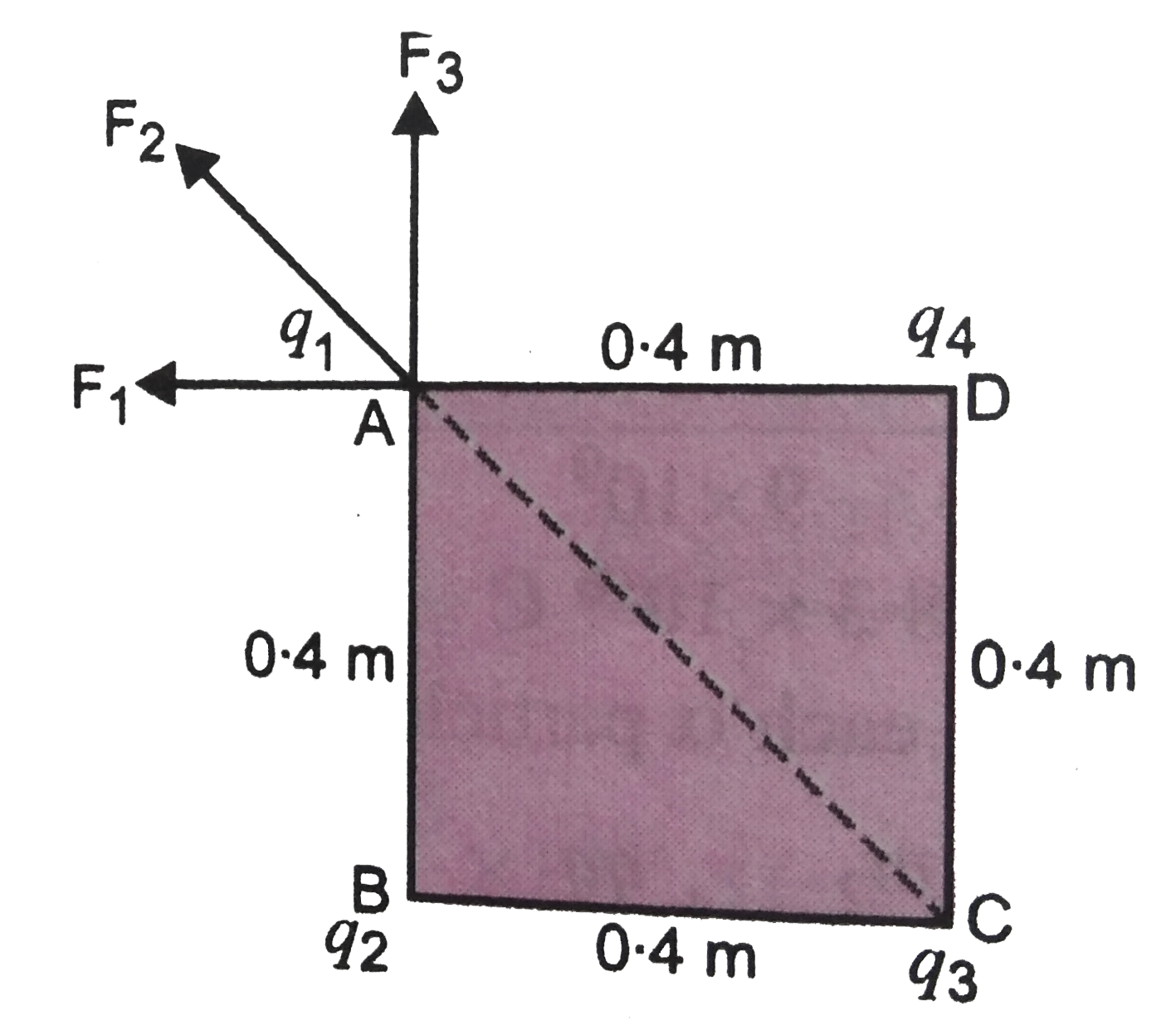 Refer to Fig. `AB = BC = CD = AD = 0.4m`. Force exerted by `q_(4) on q_(1)` = force exerted by `q_(2)` on `q_(1)` `F_(1) = F_(3) = (9XX10^(9)xx16xx10^(-6)xx16xx10^(-6))/((0.4)^(2)) = 14.4 N` Force EXERTEDBY `q_(3)` on `q_(1)` `F_(2) = (9xx10^(9)xx16xx10^(-6)xx16xx10^(-6))/((0.4)^(2) + (0.4)^(2)) = 7.2 N` `F_(1) and F_(3)` are perpendicular to each other, resultant force `F = sqrt( F_(1)^(2) + F_(3)^(2)) = sqrt((14.4)^(2) + (14.4)^(2)) = 20.36 N` Total force on `q_(1) = F + F_(2) = 20.36 + 7.2` `=27.56N` |
|
| 14. |
Figure shows lines of force for a system of two point charges. The possible choice for the charges is |
|
Answer» `q_1 = 4 mu C, q_2 = -1.0 muC` |
|
| 15. |
In a ferromagnetic material typical domain size is _________ and the domain contains about___________atoms. |
| Answer» SOLUTION :1 MM , `10^(11)` | |
| 16. |
A thin uniform disc of radius 4cm will have radius of gyration of about its diameter as |
|
Answer» 2 CM |
|
| 17. |
The displacement y of a particle executing periodic motion is given by :y = 4cos^(2) (1/2t) sin(1000 t).This expression may be considered to be a result of the superposition of .X. Independent harmonic motions |
|
Answer» |
|
| 18. |
The length of a straight line is measured a number of times by a number of observers. The following are the results of these measurements. Decide precision and accuracy Actual length = 3.785 cm +- 0.001 cm 1st of mesurements 3.8 cm , 3.9 cm, 3.7 cm 2nd set of measurements 3.478 cm,3.479 cm, 3.478 cm,3.478 cm, 3.479 cm 3rd set of measurements 3.55 cm, 3.65 cm, 3.45 cm, 3.55 cm 4th set of measurements 3.784 cm, 3.785 cm, 3.784 cm, 3.785 cm, 3.784 cm. |
|
Answer» SOLUTION :First set of measurements are ACCURATE because it is closest to the actual value but not precise. SECOND set of measurements are not accurate but it is most precise because the readings are REPRODUCIBLE. THIRD set of measurements are neither accurate nor precise. Fourth set of measurements are accurate as well as precise. |
|
| 19. |
(A): It is advantageous to transmit electric power at high voltage. (R): High voltage implies high current during transmission |
|
Answer» Both 'A' and 'R' are true and 'R' is the correct EXPLANATION of 'A' |
|
| 20. |
The ratio of kinetic energy to the potential energy of a particle executing SHM at a distance equal to half its amplitude, the distance being measured from its equilibrium position is |
|
Answer» Solution :Potential energy `U= (1)/(2) KX^(2)= (1)/(2)k (A^(2))/(4)` Where `x = (A)/(2)` Kinetic energy `K = (1)/(2) kA^(2)- (1)/(2) k(A^(2))/(4)= (3)/(8) kA^(2)` Hence `(K)/(U)= (3//8)/(1//8)= 3: 1` |
|
| 21. |
_____ component of velocity remains same but _____ component changes with motion. |
|
Answer» |
|
| 22. |
A coherent parallel beam of microwaves of wavelength lambda = 0.5 mm falls on aYoung's double- slit apparatus. The separation between the slits is 1.0 mm. The intensity of microwaves is measured on a screen placed parallel to the plane of the slits at a distance of 1.0 m from it as shown in figure If the incient beam falls normally on the double-slit apparatus, find the order of the interference minima on the screen |
|
Answer» Only the first ORDER minima are possible `y = D tan theta = 1 tan theta` For first minima, `n = 1, sin theta_(1) = (1)/(4), tan theta_(1) = (1)/(sqrt 15)` For second minima, `n = 2, sin theta_(2) = (3)/(4), tan theta_(2) = (3)/(sqrt 7)` So, the positions of minima are `y_(1) = tan theta_(1) = (1)/(sqrt 15) = 0.258 m` `y_(2) = tan theta_(2) = (3)/(sqrt 7) = 1.13 m` The minima are symmetrically placed on either of central mixima, therefore will be 4 minima at positions `+- 0.258 m` and `+- 1.13 m` on the screen. a. When INCIDENT rays are incident normally, the waves arriving at slits are in phase, zero path difference before slit. Path difference after slits, at point P, is `d sin theta`. CONDITION for minima at y-axis is `d sin theta = (2 n - 1) (lambda)/(2)` `sin theta = ((2 n -1)lambda)/(2d) = ((2 n - 1)(0.5))/(2 XX 1) = ((2 n - 1))/(4)` As `sin theta le 1, ((2n - 1)/(4)) le` or `n le 2.5` Hence, only first-order and second-order minima are possible. 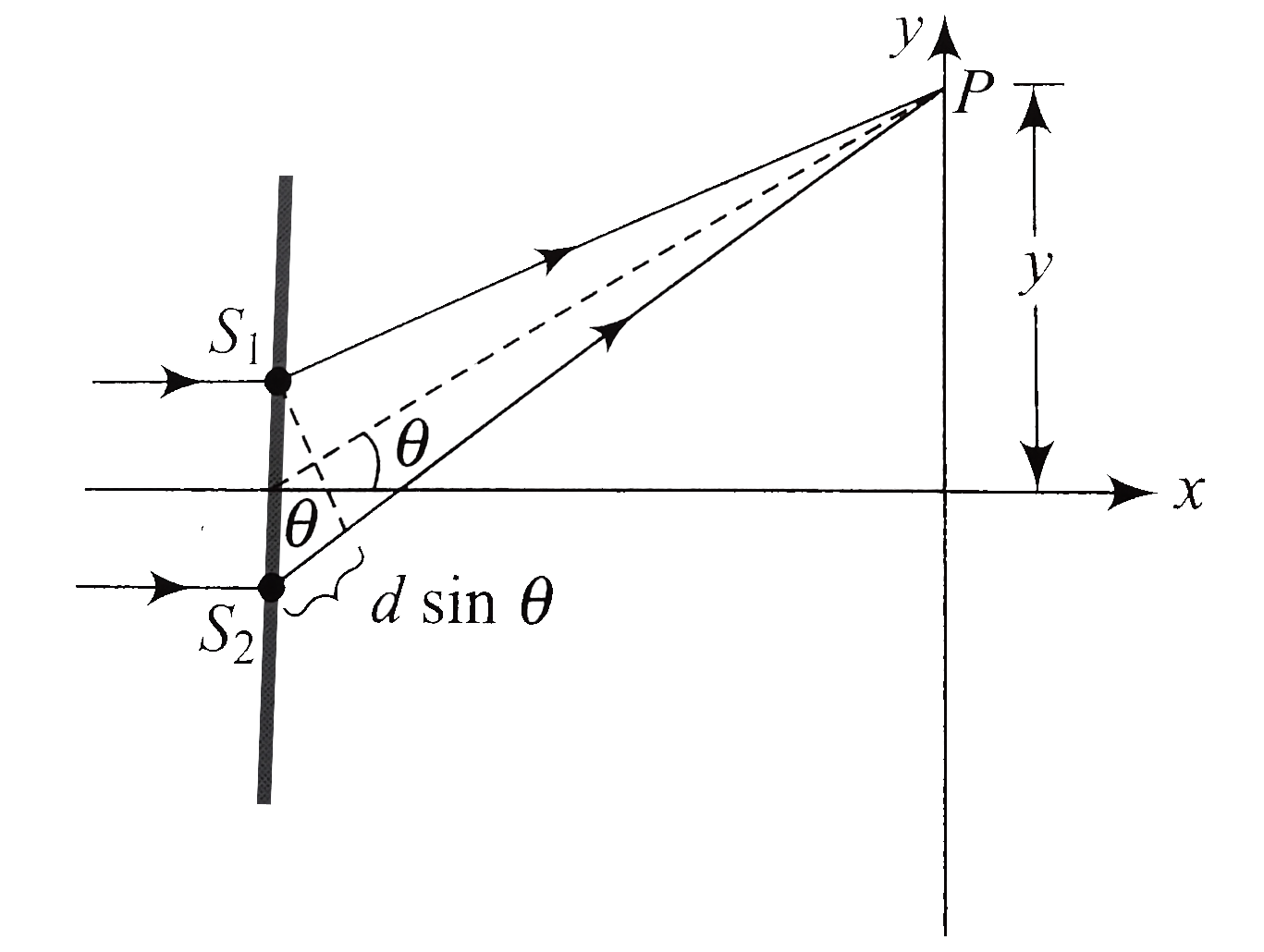 b. Path difference before slits `= d sin phi` Path difference after slits `= d sin theta` As path of rays before slits is longer at `S_(1)` and `S_(2) P gt S_(1) P` after slits, so net path difference for first minima is `d sin theta - d sin phi = +- (lambda)/(2)` `sin theta = sin phi +- (lambda)/(2)` `= sin 30^(@) +- (0.5)/(2 xx 1) = (3)/(4)` or `(1)/(4)` `tan theta = (3)/(sqrt 7)` and `(1)/(sqrt 15)` So, the position of first minima on either side of central maxima is `y = D tan theta = (3)/(sqrt 7)` and `(1)/(15) m` 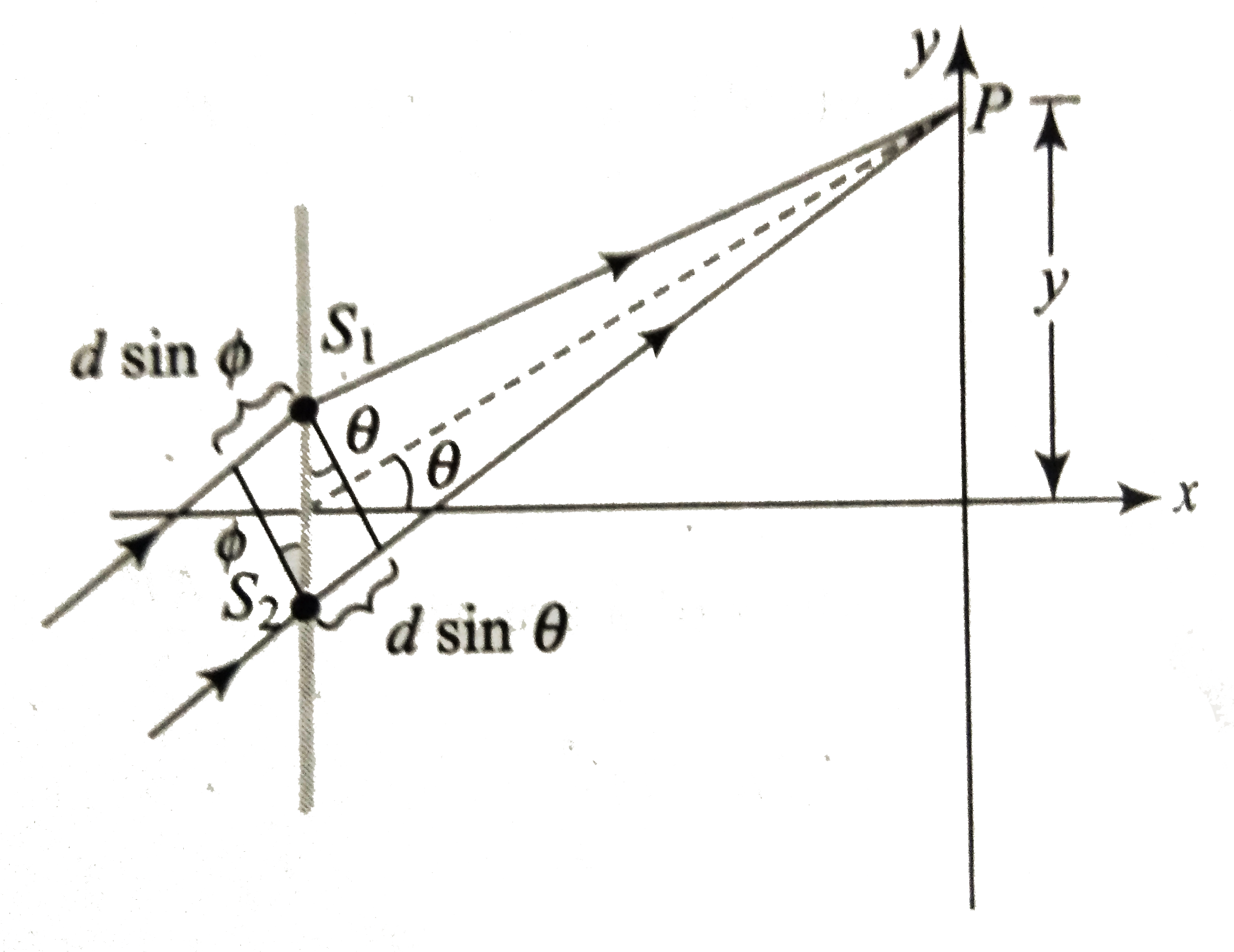
|
|
| 23. |
The dimension of sqrt((mu)/(varepsilon)where mu is permeability & varepsilon is permittivity is same as: . |
|
Answer» Resistance |
|
| 24. |
A ray of light is incident on a glass slab at grazing incidence. The refractive index of the material of the slab is given by u = sqrt((1+y)). If the thickness of the slab is d, determine the equation of the trajectory of the ray inside the slab and the coordinates of the point where the ray exits from the slab. Take the origin to be at the point of entry of the ray. |
|
Answer» Solution :From the equation, we have ` (dy)/(dx) = cot ( theta_y) = SQRT(mu_(y)^(2) - sin^2 alpha)` here ` mu= sqrt((1+y))and alpha =90^@` Therefore, `(dy)/(dx) = y^(1//2)` Integrating with the boundary condition that y = 0 at x = 0, we get `y=(x^2)/( 4)` to be the equation of the PATH of the RAY through the slab. The ray will obviously EXIT at the point `(2sqrt(2), d)`. |
|
| 25. |
Unifrom electric and magnetic fields with strengthE andinduction B respectively are directedalong they axis (Fig). A particlewith specific charge q//mleaves the origin O in the direction of the z axiswith an initialnon-realtive velocity v_(0) find: (a) the coordinatey_(n) of theparticlewhen it crossses then y axis for thenth time, (b) the angle alpha between the particle's velocityvectorand the y axis at that moment. |
|
Answer» Solution :The equaction of MOTION are, `m (dv_(X))/(DT) = -q Bv_(z), m (dy_(y))/(dt) = q E` and `m(dv_(z))/(dt) = q v_(x) B` These equactions can be solved easily. First, `v_(y) = (qE)/(m) t, y = (qE)/(2m) t'^(2)` Then, `v_(x)^(2) + v_(z)^(2)` = constant `= v_(0)^(2)` as before. Intergatingagainand using `x = z = 0`, at `t = 0` `x = (v_(0))/(OMEGA) sin omega t, z = (v_(0))/(omega) (1 - cos omega t)` Thus, `x = z = 0` for `t = t_(N) = n (2pi)/(omega)` At what instant, `y_(n) = (qE)/(2m) xx (2pi)/(qB//m) xx n^(2) xx (2pi)/(qB//m) = (2pi^(2) m E n^(2))/(qB^(2))` Also, `tan alpha_(n) = (v_(x))/(v_(y))`, (`v_(z) = 0` at this moment) `= (mv_(0))/(q E t_(n)) = (mv_(0))/(qE) xx (qB)/(m) xx (1)/(2pi n) = (B v_(0))/(2pi E n)` |
|
| 26. |
Two charged particles having masses in the ratio 2: 3 and charges in the ratio 1: 2 are released from rest in a uniform electric field. After a time 1 minute their K.E. will be in the ratio of |
| Answer» Answer :A | |
| 27. |
A wooden disc of mass M and radius R has a single loop of wire wound on its circumference. It is mounted on a massless rod of length d. The ends of the rod are supported at its ends so that the rod is horizontal and disc is vertical. A uniform magnetic field B_(0) exists in vertically upward direction. When a current I is given to the wire one end of the rod leaves the support. Find least value of I. |
|
Answer» |
|
| 28. |
In the given circuit the effective capacity between A and B is |
|
Answer» `20 MUF` |
|
| 29. |
Calculate the electric potential at the surface of a gold nucleus of diameter 13 fermi. Atomic no. of gold is 79. |
|
Answer» Solution :Data supplied Atomic no. of gold Z=79 Charge, `q=Ze=79 xx1.6 xx 10^(-19)C` RADIUS, r=6.5cm fermi `=6.5 xx 10^(-15)m` Potential, `V=(1)/(4PI epsi_(0)). q/r=(9 xx 10^(9) xx 79 xx 1.6 xx 10^(-19))/(6.5 xx 10^(-15)m)-1.75 xx 10^(7)V="17.5 Mega volt"` |
|
| 30. |
Assertion By increasing the accelerationg voltage in coolidge tube wavelength of characteristic X-rays does not change. Reason Cut-off wavelength is inversely proportional to the acceleration voltage |
|
Answer» If both ASSERTION and Reason ar true and Reason is the correct EXPLANATION of Assertion. |
|
| 31. |
(a) Obtain an expression for the mutual inductance between a long straight wire and a square loop of side a as shown in Fig. 6.06. (b) Now assume that the straight wire carries a current of 50 A and the loop is moved to the right with a constant velocity, v = 10 m/s. Calculate the induced emf in the loop at the instant when x = 0.2 m. Take a = 0.1 m and assume that the loop has a large resistance. |
|
Answer» Solution :(a) The magnetic field due to straight wire has magnitude `B_(1)=((mu_(0)I))/(2pir)`, at a distance R from the wire and according to right hand rule `B_(1)` points directly into the page within the loop. The magnetic flux `phi_(2)` linking the loop is `phi_(12) = INT vceB_(1).dvceA_(2)`, where `dA_(2)` is the area of an elementary strip as shown in Fig. 6.07 having a value `dA_(2) = a dr` and r ranges from `r_(min) = r to r_(max) = (x + a)`. Therefore, `phi_(12) = int_(x)^(x+a)((mu_(0)I)/(2pir)).adr = (mu_(0)Ia)/(2pi)int_(x)^(x+z)(dr)/r` `=(mu_(0)Ia)/(2pi) In ((x+a)/x)=(mu_(0)a)/(2pi) In (1+a/x)` Therefore, the MUTUAL inductance `M=M_(12)=phi_(12)/I=(mu_(0)a)/(2pi)In (1+a/x)` (b) The square loop is moving in a NON uniform magnetic field. The magnetic flux linked with the loop at any instant is `phi_(B)= (mu_(0)Ia)/(2pi)In (1+a/x)` `therefore` Induced emf `VAREPSILON=-(dphi_(B))/dt=-(dphi_(B))/dx.0dx/dt=-v(dphi_(B))/dx=-d/dx[(mu_(0)Ia)/(2pi).In(1+a/x)]` `=-v(mu_(0)Ia)/(2pi).((-a//x^(2)))/((1+x/a))mu_(0)/(2pi).(a^(2)v)/(x(x+4)).I` In the present problem `a = 0.1 m, x = 0.2 m, v = 10 ms^(-1), I = 50 A` `therefore |varepsilon|=(4pixx10^(-7))/(2pi).((0.1)^(2)(10))/((0.2)(0.2+0.1))xx50 =1.7xx10^(-5)V.` |
|
| 32. |
In the shown arrangement in a vertical plane, the lens forms a bright image of 'S' on the screen. The lens is suddenly released to fall freely under gravity at time t = 0. The image of source is again obtained on screen at time 'l'. Find t. |
| Answer» SOLUTION :`SQRT((2 (h_2 -h_1))/(G ))` | |
| 33. |
When vecA+ vecB=vecA-vecB, then vecB is a |
|
Answer» POSITIVE vector |
|
| 34. |
A current carrying conductor is in the shape of an arc of a circle of radius R subtending an angle q at the centre (C). A long current carrying wire is perpendicular to the plane of the arc and is at a distance 2R from the midpoint (M) of the arc on the line joining the points M and C. Current in the arc as well as straight wire is I. Find the magnetic force on the arc. |
|
Answer» |
|
| 35. |
A positively charged particle starts at rest 25 cm from a second positively charged particle, which is held stationary throughout the experiment. The first particleis released and accelerates directly away from the second particle. When the first particle has moved 25 cm, it has reached a velocity of 10(sqrt2)ms^(-1) . What is the maximum velocity (in xx 10 ms^(-1)) that the first particle will reach? |
|
Answer» SOLUTION :`kq^(2)((1)/(r)-(1)/(2r))=(1)/(2)m(v^(2))` or `(kq^(2))/(2r)=(1)/(2)MV^(2)` or `(kq^(2))/(r)=(1)/(2)m(sqrt(2v))^(2)=(1)/(2)m(V_("MAX")^(2))` or `V_("max")=Vsqrt(2)=(10sqrt(2))sqrt(2)=20ms^(-1)=2xx10ms^(-1)` |
|
| 36. |
A rod of length 10 meter has one end on smooth floor and the other end on smooth wall is released from the rest the position shown in figure. When the rod makes an angle of 37^(@) with the horizontal, answer the following: The angular velocity of rod is: |
|
Answer» `SQRT(3)` rad/sec |
|
| 37. |
A rod of length 10 meter has one end on smooth floor and the other end on smooth wall is released from the rest the position shown in figure. When the rod makes an angle of 37^(@) with the horizontal, answer the following: The velocity of centre of mass of rod is : |
|
Answer» `sqrt(5)m//s` Using `IAOR` `mg l/2 sin 53^(@)=mg l/2 sin 37^(@)+1/2Iomega^(2)` `omega=sqrt(3/5)impliesV_("cm")=5 sqrt(3/5)=sqrt(15)` |
|
| 38. |
Give the charge of an electron. |
|
Answer» Solution :Millikan.s oil drop experiment is used to determine the charge of an electron. Principle : By adjusting electric field suitably, the motion of oil drop inside the chamber can be controlled - that is, it can be made to move up or down or even kept balanced in the field of view for sufficiently long time. Construction : (i) The apparatus CONSISTS of two horizontal circular metal plates A and B each with diameter around 20 cm and are separated by a small distance 1.5 cm. (ii) These two parallel plates are enclosed in a chamber with glass walls. plates A and B are given a high potential difference around 10 kV such that electric field acts vertically downward. (iii) A small hole is made at the centre of the upper plate A and atomizer is kept exactly above the hole to spray the liquid. (iv) When a fine droplet of highly viscous liquid (LIKE glycerine) is sprayed using atomizer, it falls freely downward through the hole of the top plate under the INFLUENCE of gravity. Working : (i) Few oil drops in the chamber can acquire electric charge (negative charge) because of friction with air or passage of x-rays in between the parallel plates. (ii) The chamber is illuminated by light which is passed horizontally and oil drops can be seen clearly using microscope placed perpendicular to the light beam. These drops can move either upwards or downward. (iii) Let m be the mass of the oil drop and q be its charge. Then the forces acting on the droplet are (a) gravitational force `F_(g)=mg` (b) electric force `F_(e)=qE` ( c) buoyant force `F_(b)` (d) viscous force `F_(v)` 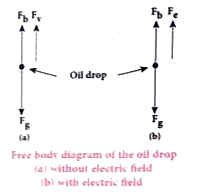 (iv) When the electric field is switched off, the oil drop accelerates downwards. Due to the presence of air drag forces, the oil drops easily attain its terminal velocity and moves with constant velocity. (v) This velocity can be carefully measured by noting down the time taken by the oil drop to fall through a predetermined distance. The free body diagram of the oil drop is shown if Figure (a), we note that viscous force and buoyant force balance the gravitational force. (vi) Let the gravitational force acting on the oil drop (downward) be `F_(g)` = mg ASSUME that oil drop to be spherical in shape. Let `rho` be the density of the oil drop, and r be the radius of the oil drop, then the mass of the oil drop can be expressed in terms of its density as (vii) `rho=m/V` `rArrm=rho(4/3pir^(3))""(therefore"volume of the sphere",V=4/3pir^(3))` The gravitational force can be written in terms of density as `F_(g)=mgrArrF_(g)=rho(4/3pir^(3))g` Let `sigma` be the density of the air, the upthrust force experienced by the oil drop due to displaced air is `F_(b)=sigma(4/3pir^(3))g` (viii) Once the oil drop attains a terminal velocity v, the net downward force acting on the oil drop is equal to the viscous force acting OPPOSITE to the direction of motion of the oil drop. From Stokes law, the viscous force on the oil drop is `F_(v)=6pirveta` (ix) From the free body diagram as shown in Figure (a), the force balancing equation is `F_(g)=F_(b)+F_(v)` `rho(4/3pir^(3))g=sigma(4/3pir^(3))g=6pirveta` `4/3pir^(3)(rho-sigma)g=6pirveta` `2/3pir^(3)(rho-sigma)g=3pirveta` `r=[(9etav)/(2(rho-sigma)g)]^(1/2)""...(1)` Thus, equation (1) gives the radius of the oil drop. (x) When the electric field is switched on, charged oil drops experience an upward electric force (qE). Among many drops, one particular drop can be chosen in the field of view of microscope and strength of the electric field is adjusted to make that particular drop to be stationary. Under these circumstances, there will be no viscous force acting on the oil drop. Then, from the free body diagram shown Figure (b), the net force acting on the oil droplet is `F_(e)+F_(b)=F_(g)` `rArrqE+4/3pir^(3)sigmag=4/3pir^(3)rhog` `rArrqE=4/3pir^(3)(rho-sigma)g` `rArrq=4/(3E)pir^(3)(rho-sigma)g""...(2)` Substituting equation (1) in equation (2), we get `q=(18E)/E((eta^(3)v^(3))/(2(rho-sigma)g))^(1/2)` |
|
| 39. |
Can a room be cooled by leaving the door of an electric refrigerator open ? |
| Answer» SOLUTION :The room can not be cooled by leaving the DOOR of an electric refrigerator OPEN. The room is SOMEWHAT heated because a refrigerator extracts heat from freezing CHAMBER and rejects heat into the surroundings air. Here some work is done on freezing chamber by electric motor | |
| 40. |
A current I flows in the network shown in a adjacent figure. Resulting magnetic induction at point P is |
|
Answer» `(mu_(0) i)/(4 PI a)` |
|
| 41. |
The critical angle of transparent crystal is 45^(0) . Then its polarizingangle is : |
|
Answer» `theta = tan^(-1) (SQRT(2))` |
|
| 42. |
A time varying magnetic field is present in a cylindrical region of radius R as shown in figure ( cross - sectionalview ). B is increasing with time, mark out the correct statement (s) for the given situation, r being the distance from centre of cylindrical region. |
|
Answer» For `rltR`, the INDUCED electric field is proportional to `r` `impliesE=(alphar)/(2)` For `rgtR,Exx2pir=(dB)/(dt)xxpiR^(2)` `impliesE=(alphaR^(2))/(2R)` For `r=(R)/(2),` the emf induced, `e=(dB)/(dt)xxpi((R)/2)^(2)=(pi alphaR^(2))/(4)` |
|
| 43. |
Which two resistors are connected in series with a cell of emf 2V and negligible internal resistance, a current of (2/5)A flows in the circuit. When the resistances are in parallel, the main current is (5/3)A. Calculate the resistances. |
|
Answer» Solution :`I=E/(R+r)` or `R=V/I` Case (1): `R_S=2/(2//5)=5Omega` Case(2): `R_S=2/(5//3)=6/3 Omega` Simplification Arriving at `R_1 =3Omega` and `R_2=2Omega` Given , E=2V , r=0 , `I_s=2/5A` `I_P=5/3A R_1=? , R_2`=? (a)Resistors in SERIES :  `I_S=E/(R_S+r)` i.e., `2/5=2/((R_1+R_2)+0)` i.e., `R_1+R_2=5` ...(i) (B) Resistors in PARALLEL :  `I_p=E/(R_p+r)` i.e., `5/3=2/((R_1R_2)/(R_1+R_2) + 0)` i.e., `(R_1R_2)/(R_1+R_2)=6/5` `therefore R_1+R_2= 5 , R_1R_2=6` and `R_1+R_2=sqrt((5)^2 -4(6))=1`...(ii) Solving `R_1+R_2=5` `R_1-R_2=1` `2R_1=6` `R_1=3Omega` and `3-R_1=1` `R_2=2W` Hence `R_1=3Omega, R_2=2W` |
|
| 44. |
Young's modulus of elasticity for a perfectly plastic body is zero. |
|
Answer» Statement-I is TRUE, Statement-II is true and Statement-II is correct EXPLANATION for Statement-I. |
|
| 45. |
State which of the two, the capacitor or an inductor, tends to become SHORT when the frequency of the applied alternating voltage has a high value. |
| Answer» SOLUTION :The CAPACITOR. | |
| 46. |
The minimum frequency v_("min") of continuous X-rays is related to the applied pot. diff. V as : |
|
Answer» `v_("MIN") prop V` |
|
| 47. |
An astronaut approaching the moon sends a radio signal of frequency 5 xx 10^(3) MHz towards moon to find the speed of his rocket . The frequency of waves reflected back from the moon to find the speed of his rocket . The frequency .Calculate the velocity of the rocket relative to the moon. |
|
Answer» |
|
| 48. |
In Young's experiment for the interference of light, the separation between the slits is d and the distance of the screen from the slits is D. if D is increased by 0.5% and d is decreased by 0.3% then for the light of a given wavelength, which one of the following is true ? "The fringe width. . . " |
|
Answer» INCREASES by 0.8% On differentiating, we get `(Deltabeta)/(beta)=(DeltaD)/(D)-(Deltad)/(d)` `implies (Deltabeta)/(beta)xx100%=(DeltaD)/(D)xx100-(Deltad)/(d)xx100` `=(0.5)-(-0.3)=0.8%` THEREFORE, fringe width increases by 0.8%. |
|
| 49. |
A steady current I is set up in a wire whose cross-sectional area decreases in the direction of the flow of the current. Then, as we examine the narrowing region |
|
Answer» the current DENSITY decreases in value. |
|
| 50. |
The equivalent inductance between points P and Q in the figure is : |
| Answer» ANSWER :A | |


