

Saved Bookmarks
This section includes 7 InterviewSolutions, each offering curated multiple-choice questions to sharpen your Current Affairs knowledge and support exam preparation. Choose a topic below to get started.
| 1. |
In the figure shown PQ is a potentiometer wire. When galvanometer is connected at A, it shows zero deflection when PJ = x. Now the galvanometer is connected to B and it shows zero deflection when PJ = 3x. find the value of unknown resistance R_(X) in term of R. |
|
Answer» |
|
| 2. |
Answer the questions : Two students are separated by a 7 m partition wall in a room 10 m high. If both light and sound waves can bend around obstacles, how is it that the students are unable so see each other even though they can converse easily. |
| Answer» SOLUTION :For diffraction the size of the OBSTACLE should be comparable to wavelength if the size of the obstacle is much too large compared to wavelength, diffraction is by a small angie. Here the size partition of wall is of the order of few metres. The wavelength of light is about `5 XX 10^(-7)m,` while sound waves of SAY 1 kHZ frequency have wavelength of about 0.3 m. Thus sound waves can bend around the partition while light waves cannot. | |
| 3. |
An infinite number of charges, each equal to q are arranged in a line at distance 1,2,4,8,16,…..from a fixed point on the line. Find the potential and field at that fixed point. What will be the potential and electric field if, in the above set up, the consecutive charges have opposite signs? |
|
Answer» |
|
| 4. |
Three forces (2 hat(i) - 3hat(j) + 4hat(k)),(8hat(i) - 7hat(j) + 6hat(k)) and m(hat(i) - hat(j) + hat(k) keep a body in equilibirium. The value of m is: |
|
Answer» 10 `:. (2hati - HATJ + 4hatk)+ (8hati - 7hatj + 6hatk) + m(hati -hatj + hatk)=0` `(10 +m)hati -(10 + m)hatj + (10+m)hatk=0` This eqn. is SATISFIED only if 10 + m = 0 `IMPLIES m = -10` |
|
| 5. |
The mutual inductance of the system of two coils is 5 mH. The current in the first coil varies according to the equation I = I_0sinomegat, where I_0 = 10 A and omega = 100pi"rad s"^(-1). The value of maximum induced emf in the second coil is ____ |
|
Answer» `2piV` `epsilon=M. d/(dt)` [ `I_0 sin omegat` ] `therefore epsilon=M. I_0 omega cos omegat` For maximum value , cos `omegat=1` `therefore epsilon_"max"=MI_0 omega` `=0.005xx10xx100pi` `therefore epsilon=5piV` |
|
| 6. |
Figure (a) and (b) show the field lines of a positive and negative point charge respectively. (a) Give the signs of the potential difference . V_(p)-V_(Q), V_(B)-V_(A) (b) Give the sign of the potential energy difference if a small negative charge is moved from points Q to P from point A to B.(c) Give the sign of the work done by the field in moving a small positive charge from Q to P. ( d) Give the sign of the work done by the external agency in moving a samall negative charge from B to A . (e ) Does the kinetic energy of a small negative charge increase or decrease in going from B to A ? |
|
Answer» Solution :A small negative charge will be attracted towards positive charge. The negative charge moves from higher potential energy to lower potential energy . Therefore the sign of potential energy difference from Q to P is negative. Similarly `(PE)_(A) gt ( PE)_(B)` and hence sign of potential energy difference is negative. ( c) In moving a small positive charge from Q to P work to be DONE by an external agency against the ELECTRIC FIELD . Therefore work done by the field is negative . (d) In moving a small negative charge from B to A work has to be done by the external agency It is positive. ( e) Due to force of repulsion on the negative charge VELOCITY decreases and hence the kinetic energy decreases in going from B to A. |
|
| 7. |
Audio signal cannot be transmitted as such because |
|
Answer» the signal has more noise |
|
| 8. |
A plane electromagnetic wave is incident on a material surface. The wave delivers momentum p and energy E, then : |
|
Answer» <P>`p != 0, E != 0` |
|
| 9. |
What would be maximum wavelength for Brackett series of hydrogen spectrum ? |
|
Answer» 74583 Å `(1)/(lambda)=R[(1)/(n_(1)^(2))-(1)/(n_(2)^(2))]` where `R=1.0967xx10^(7)m^(-1)` called Rydberg.s constant and for maximum wavelength `n_(2)=5` `(1)/(lambda_(max))=1.09687xx10^(7)[(1)/(4^(2))-(1)/(5^(2))]` `=1.09687xx(9)/(400)` `lambda_(max)=(400)/(9.87183)xx10^(-7)=40.519xxx10^(-7)` `=40519Å` |
|
| 10. |
In India electricity is supplied for domestic use at 220V. It is supplied at 110V in USA. If the resistance of a 60W bulb for use in India is R, the resistance of a 60W bulb for use in USA will be ……………………. . |
|
Answer» R |
|
| 11. |
A steel ball, of mass 10 g and specific heat 100 "cal"//kg(@)C, is pushed out after being heated inside a furnace. It is quickly caught inside a thick copper vessel of mass 200 g and relative specific heat 0.09 at 50^(@)C and the vessel is dropped into a calorimeter of water equivalent 20 g containing 180 g of water at20^(@)C. The thermometer in the calorimeter shows maximum temperature of 26^(@0C. Calculate the temperature of the furnace and find the calculation whether there was any local boiling in the calorimeter. |
|
Answer» |
|
| 12. |
Which one of the following is not made of soft iron ? |
|
Answer» electromagnet |
|
| 13. |
A cylindrical tube filled with water (mu_(w)=(4)/(3)) is closed at its both ends by two thin, silvered plano - convex lenses, as shown in the figure. Refractive index of lenses L_(1) and L_(2) and 2.0 and 1.5, while their radii of curvatures are 5 cm and 9 cm, respectively. A point O on the axis of the cylindrical tube. If it is found that all the images formed by multiple refractions and reflections coincide with the object, then the distance with the object, then the distance between both the lenses is |
|
Answer» 8 cm |
|
| 14. |
Find the values of the phase difference between the current and the voltage in the series LCR circuit shown below, which one leads in phase: current or voltage? |
|
Answer» Solution :Calculatioin of phase difference between curren and VOLTAGE Name of QUANTITY which leads. `X_(L)=omegaL=(1000xx100xx10^(-3))Omega=100Omega` `X_(C)=1/(omegaC)=(1/(1000xx2xx10^(6)))Omega=5000 Omega1` Phase angle `tan varphi=(X_(L)xxX_(C))/R` `tanvarphi=(100-500)/400=-1` `vaphi=-(pi)/4` As `X_(C)gtX_(L)` (phase angle is negative) hence current leads voltage. |
|
| 15. |
Briefly explain how you will convert a moving coil galvonometer into a voltmeter of given range. |
|
Answer» Solution :Let us have a MOVING coil galvanometer of resistance `R_G`, which gives FULL scale deflection for a current `I_g`. THUS, it can MEASURE a maximum potential difference of `I_g.R_G`. To convert the galvanometer into a voltmeter of given range V, we must join a suitable high resistance R in series to the galvonometer so that `V = I_(g) cdot (R_G + R) implies R = V/(I_g) - R_G` As in a voltmenter resistance of galvanometer `R_G` and series resistance R are joined in seires, the NET resistance of voltmeter `(R_V)` is given by 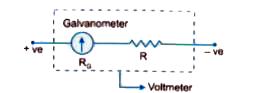
|
|
| 16. |
Where was Saalumarada Thimmakka born? |
|
Answer» HULIKAL village |
|
| 17. |
A pair of stars rotates about a common centre of mass. One of the stars has a mass Mand the other has mass m such that =2m. The distance between the centres of the stars is d ( d being large compare to the size of eithe star). The period of rotation of the stars about their common centre of mass ( in terms of d,m,G) is |
|
Answer» `sqrt((4 PI^(2))/(GM)d^(3))` |
|
| 18. |
यदि किसी बहुपद को –x^2 +x - 1 से विभाजित किया जाये तो भागफल x-2 तथा शेषफल 3 प्राप्त होता है, तो बहुपद है : |
|
Answer» `x^3 – 3X^2 + 3x – 5` |
|
| 19. |
Three vector each of magnitudeA are acting a point such that the angle between any two vector is 60^@. The magnitude of there resultant ? |
| Answer» Answer :D | |
| 20. |
If 5% of the energy supplied to an incandescent light bulb is radiated as visible light, how may visible light photons are emitted by a 100W bulb? Assume the average wavelength of all visible photons to be 5600Å. Given h=6.25xx10^(-34)Js. |
|
Answer» Solution :Here `lamda=5600Å=5600xx10^(-10)m,h=6.625xx10^(-34)JS` Energy of photon, `E=(hc)/(lamda)=(6.625xx10^(-34))/(5600xx10^(-10))=3.549xx10^(-19)J` Visible energy radiated by the bulb per second `=(5)/(100)xx100=5J` `:.` Number of visible photons EMITTED per second `=(5)/(3.549xx10^(-19))=1.41xx10^(-19)` |
|
| 21. |
In the circuit it shown in the figure, the value of Resistance X, when potential difference between the points B and D is zero will be |
| Answer» Solution :`P/Q = R/S` | |
| 22. |
The power of a transmitter 19 kW. The power of the Carrier wave is if the amplitude of modulated wave is 10 V and that of Carrier is 30 V, |
| Answer» ANSWER :B | |
| 23. |
The photoelectric work function of potassium is 2.3 eV. If light having wavelength of 2800 A^@ falls on potassium , find the kinetic energy in electron volts of the most energetic electrons ejected. |
|
Answer» SOLUTION :Given W = `2.3 E V, lambda = 2800 A^@` `therefore` E ("in" e V)= (12375)/(lambda ("in" A^@)) = (12375)/(2800) = 4.4 e V` `k_(max) = E-W = (4.4 - 2.3 ) eV = 2.1 eV` |
|
| 24. |
The photoelectric work function of potassium is 2.3 eV. If light having wavelength of 2800 A^@ falls on potassium , find the stopping potentail in volts. |
|
Answer» SOLUTION :`K _(MAX) = E V_0, THEREFORE 2.1 e V = e V_0` or `V_0 = 2.1 V`. |
|
| 25. |
The angle of a prism is A. One of its refracting surfaces is silvered. Light rays falling at an angle of incidence 2A on the first surface re turns back through the same path after suffer ing reflection at the silvered surface. The re fractive index m of the prism is |
|
Answer» 2 sin A From Snell.s law, `n_1sini=n_2sin r` (1) sin2A=nsinA `thereforen=(sin2A)/(sinA)` `=(2sinAcosA)/(sinA)=2cosA` |
|
| 26. |
26001 मे कितने सार्थक अंक है - |
|
Answer» 3 |
|
| 27. |
For a BJT , the common-base current gain alpha=0.98and the collectorbase junction reverse bias saturation I_(CO) = 0.6muA . This BJT is connected in the commone emitter mode and operated in the active region with a base drive current I_(B) =20muA . The collector current I_(C) for this of operating is . |
|
Answer» SOLUTION :`alpha=0.98` and `I_Co=0.6 muA`. Collector CURRENT `I_C=betaI_B+(1+beta)I_(Co)` `beta(alpha)/(1-alpha)=(0.98)/(1-0.98)=49` THUS, `I_C=(49xx20)+(50xx0.6)=980+30=1010muA` `I_C=1.01muA` |
|
| 28. |
A spring-block system undergoes vertical oscillations above a large horizontal metal sheet with uniform positive charge. The time period of the oscillations is T. If the block is given a charge Q, its time period of oscillation will be |
|
Answer» T |
|
| 29. |
Calculate the limit of resolution of microscope if the numerical apperture of microscopo is 0.12 and the wavelength of light used is 600cm |
|
Answer» `0.3mum` `x=(0.641lamda)/(MU SIN theta)` `x=((0.61)(6xx10^(-7)))/((0.12))` `x=3mum` |
|
| 30. |
A parallel beamof monochromatic light is used in a Young.s double slit experiment . The slits are separated by a distance d and the screen is placed parallel to the plane of the slits . If the incidentbeammakes an angle theta= sin^(-1)((lambda)/(2d))with the normalto the plane of the slitsthere will be .... at the centre P_(0) of the pattern . |
|
Answer» 1/4 the MAXIMUM INTENSITY |
|
| 31. |
Which of the following transaction statement are correct. |
|
Answer» Electric lines of FORCE are just IMAGINARY lines |
|
| 32. |
Assertion:The detection of neutrinos is extremely difficult . Reason : Neutrinos interact only very weakly with matter. |
|
Answer» If both ASSERTION and reason are true and reason is the correct explanation of assertion . |
|
| 33. |
There waves A,B and C of frequencies 1600 KHz, 5 MHz and 60 MHz respectively are to be transmitted from one place to another. Which of the following is the most appropriate mode of communication. |
|
Answer» A wave is transmitted through space wave while B and C are transmitted VIA sky wave |
|
| 35. |
Find the kinetic energy and the velocity of the photoelectrons liberated by K_(alpha) radiation of zinc from the K shell of iron whose K band absorption edge wavelength is lambda_(k)=174p m. |
|
Answer» Solution :The energy of the `K_(alpha)` radiation of Ƶn is ` ħ omega=(3)/(4) ħR(Ƶ-1)^(2)` where `Ƶ=` atomic number of Zinc`= 30`. The binding energy of the `K` electrons in iron is obtained from the wavelength of `K` absorption edge as `E_(k)= 2PI ħc//lambda_(k)` Hence by Einstein equation `T=(3)/(4) ħR(Ƶ-1)^(2)-(2pi ħc)/(lambda_(k))` SUBSTITUTION GIVES `T=1.463keV` This corresponds to a velocity of the photo electrons of `v= 2.27xx10^(6)m//s` |
|
| 36. |
What type of semiconductor is made by mixing Indium in Silicon ? |
|
Answer» <P>N-type |
|
| 37. |
An LC circuit contains a 20 mH inductor and a 50 muF capacitor with an initial charge of 10 mC. The resistance of the circuit is negligible. Let the instant the circuit is closed be t = 0. (a) What is the total energy stored initially? Is it conserved during LC oscillations? (b) What is the natural frequency of the circuit? (c) At what time is the energy stored (i) completely electrical (i.e., stored in the capacitor)? (ii) completely magnetic (i.e., stored in the inductor)? (d) At what times is the total energy shared equally between the inductor and the capacitor? (e) If a resistor is inserted in the circuit, how much energy is eventually dissipated as heat? |
|
Answer» Solution :`U_(i) = U_(E )` `= ( 1)/(2) (q_(0)^(2))/( C )` `= ((10 XX 10^(-3))^(2))/( (2) ( 50 xx 10^(-6)))` = 1J If there is no heat loss and no radiation loss, then above TOTAL energy is conserved. |
|
| 38. |
A charge is located at the center of sphere A (radius R_(A)=0.0010 m), which is in the center of sphere B (radius R_(B) = 0.0012 m ). Spheres A and B are both equipotential surfaces. What is the ratio V_(A)//V_(B) of the potentials of these surfaces? |
|
Answer» 0.42 |
|
| 39. |
If the error in the measurement of momentum of a particle is (+100%), then the error in the measurement of kinetic energy is : |
|
Answer» <P>`250%` `:.%` age increase `=(4E_(k)-E_(k))/(E_(k))XX100` `=300%` Hence `(c )` is CORRECT. |
|
| 40. |
Statement I : Mean free path of a gas molecule varies inversely as the density of gas. Statement II : Mean free path of gas molecule is defined as the average distance travelled by a molecule between two successive collisions. |
|
Answer» Statement-I is true, Statement-II is true and Statement-II is CORRECT EXPLANATION for Statement-I. |
|
| 41. |
Isolated proton does not decay into neutron but an isolated neutron can decay into proton. Explain. |
| Answer» Solution : Since the mass of the neutron is GREATER than the mass of proton, the Q value for the CONVERSION of proton into a neutron is negative. Thus, proton will NEED some energy to decay into neutron and hence an isolated proton NEVER decays into a neutron. However, in case of an isolated neutron, it can decay to proton and does not need any energy for conversion. | |
| 42. |
A bar magnet is moved between two parallel circular loop A and B with a constant velocity v as shown in figure. |
|
Answer» The current in each loop FLOWS in the same direction |
|
| 43. |
An electron which is emitted in beta decay comes out of the nucleus. It is not one of the atomic electron revolving around the nucleus. This fact led some scientists to conjecture that electrons are constituents of the nucleus. Later this conjecture proved to be incorrect. Try to collect some arguments which show that this conjecture is indeed incorrect. |
|
Answer» Solution :The conjecture that electrons are constituent of the nucleus is incorrect because of the FOLLOWING arguments: (i) According to de Broglie hypothesis and Heisenberg's uncertainity principle, if an electrons is to exist inside the nucleus, it should possess energy ranging form 20MeV to 200MeV. But energy of electrons emitted form nucleus during `beta`-decay is at the most 2-3 MeV. (ii) The observed values of NUCLEAR SPIN or angular momentum of nuclei rule out the possibility of electrons inside the nucleus. (iii) Magneticmoments of nuclie undergoing `beta` decay are MUCH smaller than the magnetic moments of electrons emitted. (iv) The PRESENCE of a few electrons inside the nucleus and others revolving in orbits around the nucleus show dual role of electrons in atomic structure, which is difficult to visualize. |
|
| 44. |
A stone is dropped freely,while another thrown vertically downward with an initial velocity of 2ms^(-1) from the same point,simultaneously.The time required by them to have a distance of separation 22 m between them is |
|
Answer» 11s |
|
| 46. |
Estimate de Broglie wavelength is nm associated with an iron ball of mass 66 g moving with a velocity of 2.5xx10^(5)ms^(-1). |
| Answer» SOLUTION :`4XX10^(-29)NM` | |
| 47. |
For the two parallel rays AB and DE shown here, BD is the wavefront. For what value of wavelength of rays destructive interference takes place between ray DE and reflected ray CD? |
|
Answer» `SQRT3X` |
|
| 48. |
In order that a body of 15 kg weighs zero at the equator, then the angular speed of earth is : (g=10ms^(-1)) |
|
Answer» `(1)/(80) " rad s"^(-1)` `rArr omega= SQRT((g)/(R ))=sqrt((1.0)/(6.4xx10^(6)))=(1)/(800)" rad SEC"^(-1)` Thus correct CHOICE is (c ). |
|
| 49. |
A force of 20 N acts on a body of mass 5kg at rest. What is the acceleration of the body ? What is its velocity after 5 seconds if the same force acts? After 5 seconds if the force ceases to act how will the body move? |
|
Answer» `4 m//s^2 , 20 m/s , ` UNIFORMLY VELOCITY |
|
| 50. |
If energy of photon of 6000 Å is 3.2xx10^(-19) J then energy of photon with 4000 Å will be……. |
|
Answer» `4.44xx10^(-19)J` `THEREFORE E prop (1)/(lambda)[because` hc same] `therefore (E_(2))/(E_(1))=(lambda_(1))/(lambda_(2))` `therefore E_(2)=E_(1)xx(lambda_(1))/(lambda_(2))=3.2xx10^(-19)xx(6000)/(4000)` `therefore E_(2)=4.80xx10^(19)J` |
|