

Saved Bookmarks
This section includes 7 InterviewSolutions, each offering curated multiple-choice questions to sharpen your Current Affairs knowledge and support exam preparation. Choose a topic below to get started.
| 1. |
Diamond is very hard because |
|
Answer» it is covalent solid |
|
| 2. |
In YDSE,D=1m, d=4mm and lamda=1/2mm in the figure shown, a parallel beam of light is incident on the plane of the slits of YDSE. Light incident on the slit s_(1), passes through a medium of variable refractive index mu=(2x+1) (where x is the distance from the plane of slits in mm) up to a distance l=1mm before falling on s_(1). Rest of the space filled with air. Then choose the correct option (s): |
|
Answer» Position of central brigh FRINGE is at a DISTANC `y=1/(sqrt(3))m` above the central line `dsintheta=2mm` `4mmsintheta=2mm` `theta=30^(@)` `TAN30^(@)=y/2` For bright fringe (`dsin theta+-2)=nlamda` where `n` is `0,1,2,3,……….` 
|
|
| 3. |
What is the nuclear fission reaction ? Give one example. |
|
Answer» `""_(92)U^(235) +""_(0)n^(1) rarr ""_(36)Kr^(92)+""_(56)Ba^(141)+3 ""_(0)n^(1)+Q` Used in nuclear reactor. |
|
| 4. |
If the current in the circuit for heating the filament is increased, the cut off wavelength |
|
Answer» INCREASES |
|
| 5. |
For light incident from air onto a slab of refractive index 2. Maximum possible angle of refraction is, |
|
Answer» `30^(@)` Now consider an ANGLE of incident is `90^(@)` `sinr=(SIN90^(@))/(2)` R=`SIN^(-1)(0.5)` `r=30^(@)` |
|
| 6. |
If the speed and radius both are trippled for a body moving on a circular path, then the new centripetal force will be: |
|
Answer» `F_(1)=2F_(1)` |
|
| 7. |
An astronaut on the Moon simultaneously drops a feather and a hammer. The fact that they land together shows that: |
|
Answer» no gravity forces ACT on a body in a vacuum |
|
| 8. |
In a n-type semiconductor each pentavalent dopant atom contributes only one electron. |
|
Answer» |
|
| 9. |
If the galvanometer in the Wheatstone's network is removed under the balanced condition, then say whether the network is still balanced or not. |
| Answer» SOLUTION :The NETWORK will be STILL BALANCED. | |
| 10. |
A man can swim with speed 5 ms^(-1) in still river while the river is also flowing speed 10ms ^(-1) If the width of the river is 100 m then minimum possible drift is |
| Answer» Answer :C | |
| 11. |
The S.I. unit of force constant is identical to that of |
|
Answer» Pressure |
|
| 12. |
Thin infinite sheet of width w contains uniform charge distribution sigma. Find out electric field intensity at following points : (a) A point which lies in the same plane at a distance d from one of its edge. (b) A point which is on the symmetry plane of sheet at a perpendicular distance d from it. |
|
Answer» Solution :(a) consider a thin strip of width dx. Linear charge DENSITY of strip : `lambda= sigma dx` So, electric field due to this strip at point P `dE= (2 k sigma d X)/x` `E_("net")= underset(d)OVERSET(d+w)(int) sigma/(2 pi epsi_(0)) (dx)/x` `= sigma/(2 pi epsi_(0)) ln ((d+w)/d)` (b) Consider a thin strip of width dx. Linear charge density of strip : `lambda=sigma dx` `:. E_(p) =int 2d E cos theta` or `E_(p)=2. int_(0)^(w//2) (sigma dx)/(2 pi epsi_(0) sqrt(d^(2)+x^(2))). d/sqrt(d^(2)+x^(2))` `=(sigma d)/(pi epsi_(0)) int_(0)^(w//2) (dx)/(d^(2)+x^(2))=sigma/(pi epsi_(0))"tan"^(-1) w/(2d)` 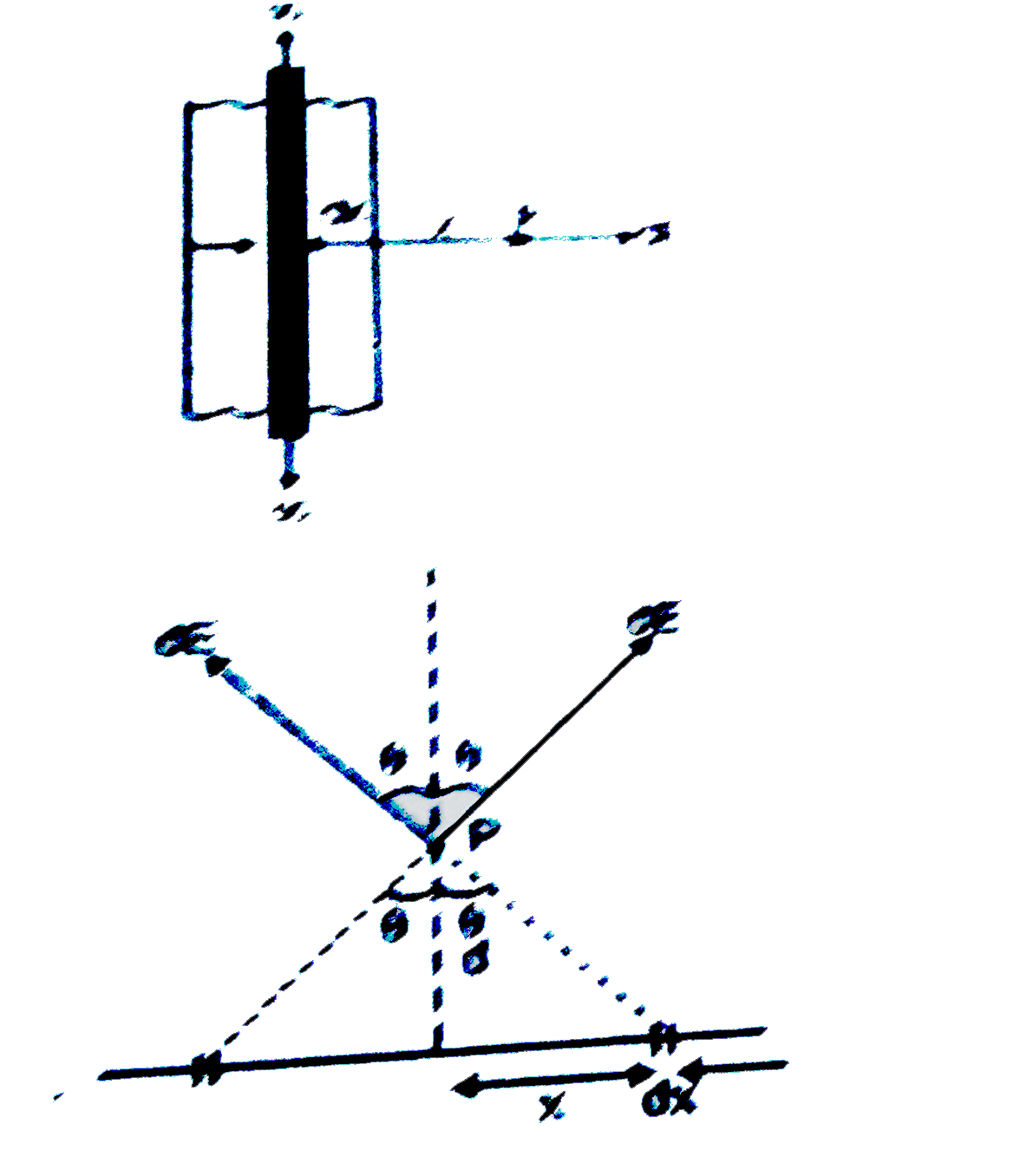
|
|
| 13. |
20 g of solute is dissolved in 100ml solution.mass by volume percentge is- |
|
Answer» 10 |
|
| 14. |
A concave mirror is used to focus the image of a flower on a nearby well 120 cm from the flower. If a lateral magnification of 16 is desired, the distance of the flower from the mirror shuld be : |
|
Answer» 8cm `therefore (120+u)/(u) = 16 rArr 15 u = 120 rArr u = 8 cm`. |
|
| 15. |
The meter bridge works on the principle of: |
|
Answer» Potentiometer |
|
| 16. |
In the circuit shown, if a conducting wire is connected between points A and B, the current in this wire will |
|
Answer» FLOW from A to B |
|
| 17. |
Consider a system composed of two metallic spheres of radii r_(1) and r_(2) conneced by a thin wire and switch S as shown in the figure. Initially S is in open position. And the spheres carry charges q_(1) and q_(2) respectively. If the switch is closed, the potential of the system is |
|
Answer» `(1)/(4pi epsilon_(0))(q_(1)q_(2))/(r_(1)r_(2))` |
|
| 18. |
You are given a solenoid of length 'l', number of turns per unit length 'n' and area of cross-section A. When a current 'I' passes through it, a. What is the total magnetic flux through the solenoid? b. What is the self inductance of the solenoid? c. How does the value of self inductance get affected if some material of high relative permeability is filled inside the solenoid? |
|
Answer» SOLUTION :a. `mu_(0)nIANor(mu_(0)N^(2)IA)/(l)` b. `L=(mu_(0)N^(2)A)/(l)` c. It INCREASES `mu_(R)` times that given in (b) |
|
| 19. |
Angle between the magnetic meridian and the geographical meridian at a given place is known as __________ . |
| Answer» SOLUTION :ANGLE of DECLINATION | |
| 20. |
Two materials have the value of alpha_(1) and alpha_(2) as 6 xx 10^(-4) (""^(@) C )^(-1)and - 5 xx 10^(-4) (""^(@) C )^(-1) respectively. The resistivity of the first materialrho_(20) = 2 xx 20^(-8) Omega.A new material is made by combining the above two materials. the resistivity does not change with temperature . The resistivity rho_(20)of the second material is .... Considering the reference temperature as 20^(@) Cassume that the resistivity of the new material is equal to the sum of the resistivity ofits component materials. |
|
Answer» Solution :Here the REFERENCE temperature is `20" "^(@)` C. Resistivity of a material at temperature `theta` is , `rho_(theta ) = rho_(20) [ 1 + alpha (theta - 20)]` `rho theta= rho 20+ rho_(20) alpha theta- rho_(20)infty 20 ` ` therefore (d rho theta)/(d theta ) = rho_(20) alpha ` For first material `((d rho theta )/(d theta ) )_(1) = (rho_(20) )_(1) alpha_(1)` For SECOND material`((d rho theta )/(d theta ) )_(2) = (rho_(20) )_(2) alpha_(2)` The resistivity of the mixture `rho_(theta)= (rho theta )_(1) + (rho theta )_(2)`does not CHANGE with temperature . Therefore , `(d rho theta )/(d theta ) = ((d rho theta )/(d theta ))_(1)+ ((d rho theta )/(d theta ))_(2) = 0 ` `therefore ((d rho theta )/(d theta ))_(1) = - ((d rho theta )/(d theta ))_(2)` `therefore (rho_(20))_(1) alpha_(1) = - (rho_(20))_(2) alpha_(2)` `therefore (rho_(20))_(2)= - ((rho_(20))_(1) alpha_(1))/(alpha_(2))` = - ` ((2 xx 10^(-8) ) ( 6 xx 10^(-4)))/(- 5 xx 10^(-4))` `therefore (rho_(20)_(2) = 2.4 xx 10^(-8) Omega` m |
|
| 21. |
The direction of viscous force in Millikan's oil drop experiment is |
|
Answer» always downwards |
|
| 22. |
The Rydberg constant for hydrogen is given by R_H ? |
| Answer» SOLUTION :`1.097xx10^7m^-1` | |
| 23. |
An object is placed at a distance of 20.0 cm from a concave mirror of focal length 15.0 cm. (a) What distance from the mirror a screen should be placed to get a sharp image? (b) What is the nature of the image? |
|
Answer» Solution :Give: f = - 15 cm, `mu = 20 cm` (a) Mirror equations, `(1)/(v) + (1)/(u) = (1)/(f)` Rewriting to find `v, (1)/(v) = (1)/(f) - (1)/(u)` Substituting for f and u, `(1)/(v) = (1)/(-15) - (1)/(-20)` `(1)/(v)=((-20)-(-15))/(300)xx(-5)/(300)=(-1)/(60)` v = - 60.0 cm As the image is formed at 60.0 cm to the left of the concave mirror, the screen is to be placed at distance 60.0 cm to the left of te concave mirror. (b) MAGNIFICATION, m = `(h.)/(h) = - (v)/(u)` `m = (h.)/(h) = ((-60))/((-20)) = - 3` As the sign of magnification is NEGATIVE, the image is inverted. As the magnitude of magnification is 3, the image is enlarged three times. As the image is formed to theleft of the concave mirror, the image is real. |
|
| 25. |
A 1000 MW fission reactor consumes half of its fuel in 5.00 y. How much ._(92)^(235)U did it contain initially ? Assume that the reacotr operates 80% of the time that all the energy generated arises from the fission of ._(92)^(235)U and that this nuclide is consumed only by the fission process. |
|
Answer» Solution :In the fission of one nucles of `._(92)U^(235)` ENERGY generated is 200 MeV `therefore` Energy generated in fission of 1 KG of `._(92)U^(235)=200xx(6XX10^(23))/(235)xx1000` MeV `= 5.106xx10^(26)MeV = 5.106xx10^(26)xx1.6xx10^(-13)J` `= 8.17xx10^(3)J` Time for which reactor operates `(80)/(100)xx5` years = 4 years. Total energy generated in 5 years. `= 1000xx10^(6)xx60xx60xx24xx365xx4J` `therefore` Amount of `U_(92)^(235)` consumed in 5 years `= (1000xx10^(6)xx60xx60xx24xx365xx4)/(8.17xx10^(13))kg` = 1544 kg `therefore` Initial amount of `._(92)U^(235)=2xx1544 kg` = 3088 kg |
|
| 26. |
The force acting on a pole of polestrength 10 A-m is 10 N. The magnetic intensity at that point is (in tesla) |
|
Answer» 1 |
|
| 27. |
A tiny electric dipole of dipole moment p is palced at a distance r from an infinitely long wire, with its vecp normal to the wire. If the linear charge density of the wire is lambda, the electrostatic force acting on the dipole is equal to |
|
Answer» `(lambdaP)/(4piepsilon_(0)R)` `F_("net")=2Fsin(theta//2)` `=Ftheta=qE(l//r)` `=(lambdap)/(2piepsilon_(0)r^(2))` 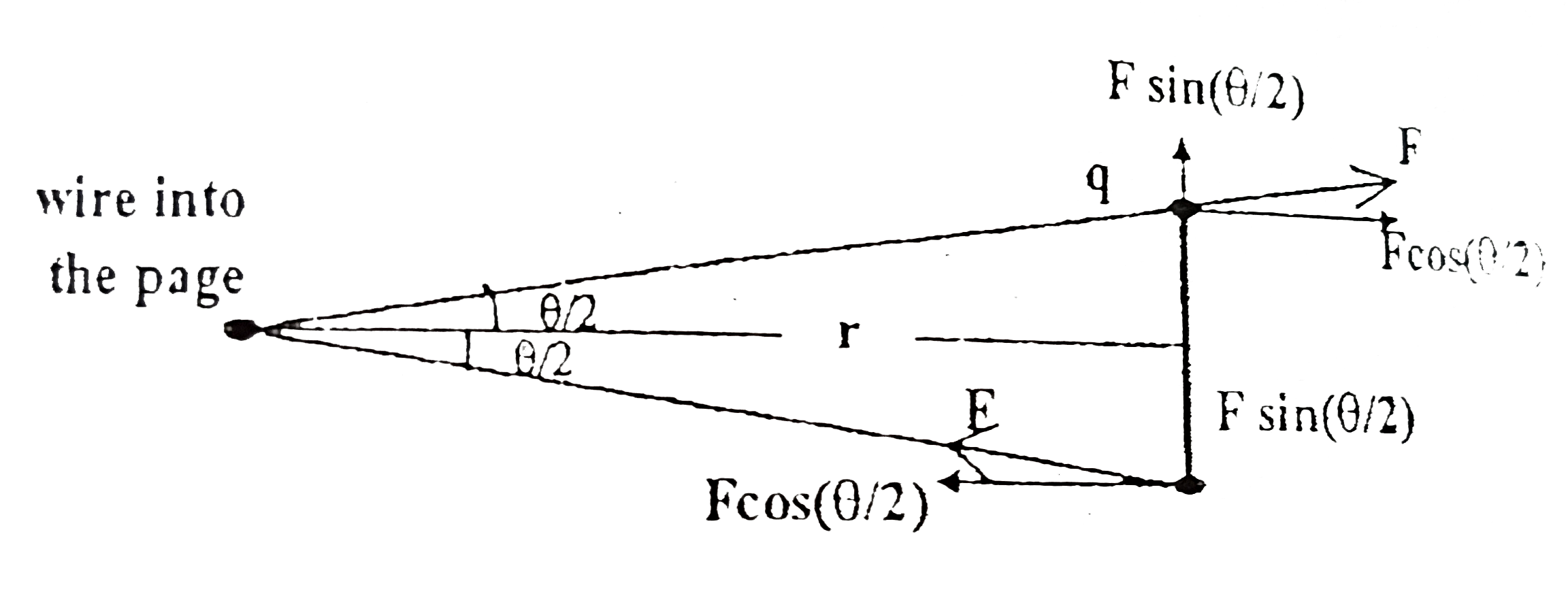
|
|
| 28. |
A proton moves with speed (c )/(10).Its de-Broglie wavelength will be…… (h=6.63xx10^(-34)Js,m_(p)=1.673xx10^(-27)Kg) |
|
Answer» 0.1321 Å `therefore lambda =(h)/(m_(p)v)` but `v=(c )/(10)=(3xx10^(8))/(10)=3xx10^(7) m//s` and `m_(p)=1.0078xx1.66xx10^(-27)`kg `-1.673xx10^(-27)kg` `therefore lambda=(6.63xx10^(-34))/(1.673xx10^(-27)xx3xx10^(7))` `=1.321xx10^(-14)m` `=1.321xx10^(-4)Å` |
|
| 29. |
Which of the following statements given below are false? a. Becquerel discovered radioactivity b. Fraunhoffer lines were first discovered by Wollaston c. Photoelectric effect was discovered by Einstein |
|
Answer» a, B & c |
|
| 30. |
Consider fraunhoffer diffraction pattern obtained with a single slit illuminated at normal indicent. At the angular position of the first diffraction minimum the phase different between the wavelets from the opposite edge of the slits is |
| Answer» Solution :At the angular position of first minimum waveles from opposite EDGES of the SLITS have a path difference of `LAMBDA` and a phase difference of `2pi` radian. | |
| 31. |
A scalar quantity is one tha |
|
Answer» is conserved in a process |
|
| 32. |
Half life of a radioactive substance A is two times the half life of another radioactive substance B. Initially, the number of nuclei of A and B are N_(A) and N_(B) respectively. After three half lives of A, number of nuclei of both are equal. Then the ratio (N_(A))/(N _(B)) is |
|
Answer» `(1)/(3)` Therefore, `N_(A)((1)/(2))^(3)=N_(B)((1)/(2))^(6)` `(N_(A))/(N_(B))=((1//2)^(6))/((1//2)^(3))=((1)/(2))^(3)=(1)/(8)` |
|
| 33. |
How does the fringe width in Yougn's double slit experiment change when the distance of separation 'D' between the slits and screenn in doubled? |
| Answer» Solution :The fringe WIDTH is DOUBLED because fringe width .`beta`. is directly proportional to the distance of SEPARATION .D. between the slits and SCREEN. | |
| 34. |
Explain effect of variation of intensity of incident radiation on photoelectric current. |
|
Answer» Solution :Collector (A=anode) is kept positive w.r.t emitter C(Cathode) hence electron emitted are attracted toward collector A. By keeping frequency of incident RADIATION and voltage on collector constant INTENSITY of incident radiation is changed and resulting photocurrent is measured. Figure SHOW graph OBTAINED for intensity-photoelectric CURRENT.  Photoelectric current is proportional to number of photoelectrons emitted in one second which shows that no. of electrons emitted in one second. |
|
| 35. |
A cockroach rides the rim of a rotating merry-go-round. If the angular speed of this system (merry-go-round + cockroach) is constant, does the cockroach have (a) radial acceleration and (b) tangential acceleration? If omega is decreasing, does the cockroach have ( c) radial acceleration and (d) tangential acceleration? |
| Answer» SOLUTION :(a) YES, (B) no, ( C) yes, (d) yes. | |
| 36. |
Two electric bulbs marked 20 W- 220 V and 100 W - 220 V are connected in series to 440 V supply. Which bulb will be fused? |
|
Answer» SOLUTION :To CHECK which bulb will be fused, the voltage drop across each bulb has to be CALCULATED. The resistance of a bulb, `R=(V^(2))/(P)=(("Rated Voltage")^(2))/("Rated Power")` For 20W-220V bulb, `R_(1)=((220)^(2))/(20)Omega=2420Omega` For 100W-220V bulb, `R_(2)=((220)^(2))/(100)Omega=484Omega` Both the bulbs are connected in series. So the current which passes through both the bulbs are same. The current that passes through the circuit, `I=(V)/(R_("tot"))`. `R_("tot")=(R_(1)+R_(2))` `R_("tot")=(484+2420)Omega=2904Omega` `I=(440V)/(2904Omega)=0.151A` The voltage drop across the 20 W bulb is `V_(1)=IR_(1)=(440)/(2904)xx2420=366.6V` The voltage drop across the 100 W bulb is `V_(2)=IR_(2)=(440)/(2904)xx484=73.3V` The 20 W bulb will be fused because its voltage rating is only 220 V and 366.6 V is dropped across it. |
|
| 37. |
Shweta's grand mother often comlains of headache. Shweta asked her to visit an eye specialist for a check up, but she refused saying that her eye sight is O.K. Some other day, her grand mother asked Shweta to thread a needle. Shweta understood her problem and took her to the eye specialist who prescribed her spectacles of suitable power. Read the above passage and answer the following questions : (i) What could Shweta make out ? Can you guess the nature of lens prescribed ? What values are displayed by Shweta ? |
|
Answer» Solution :(i) Shweta could make out that her grand MOTHER is suffering from hypermetropia having difficulty in veiwing nearby objects. (II) Yes, the eye specialist must have prescribed a convex lens suitable POWER. (iii) Shweta has displayed concern for the health of her grandmother in particular and senior citizens in general. Like kids, elderly people must be provided CARE with love. |
|
| 38. |
How long did Nehru live in his little cell? |
|
Answer» FOURTEEN and a HALF months |
|
| 39. |
If the last band on the carbon resistor is absent, then the tolerance is |
|
Answer» 0.05 |
|
| 40. |
Cathode rays and canal rays produced in a certain discharge tube are deflected in the same direction if |
|
Answer» A magnetic field is APPLIED NORMALLY |
|
| 41. |
A 100 Omega resistor is connected to a 220 V. 50 Hz ac supply. What is the rms value of current in the circuit ? |
|
Answer» SOLUTION :(a) 2.20A (B) 484W |
|
| 42. |
The motion of a particle executing simple harmonic motion is given by x=0.01sin100pi(t+0.005) Where s is in metres and t in seconds. The time period in second is : |
|
Answer» `0.01` |
|
| 43. |
Increasing forward voltage in diode, the width of depletion layer is …….. |
|
Answer» decreases |
|
| 44. |
Resistances P, Q, S and R are arranged in a cyclic order to form a balanced Wheatstone's network. The ratio of power consumed in the branches (P+Q) and (R+S) is |
|
Answer» `1:1` POWER dissipation in resistance R with voltage V is V^(2)//R` `THEREFORE (P_(P+Q))/(P_(R+S))=(R+S)/(P+Q)....(ii)` From equation (i) `(P)/(Q)+1=(R)/(S)+1 Rightarrow (P+Q)/(Q)=(R+S)/(S) or (R+S)/(P+Q)=(S)/(Q)` USING (i). we get `(R+S)/(P+Q)=(R)/(P) therefore (P_(P+Q))/(P_(R+S))=(R)/(R) |
|
| 45. |
Switch S in Fig. 27-46 is closed at time t= 0, to begin charging an initially uncharged capacitor of capacitance C= 49.0 muF through a resistor of resistance R = 32.0Omega. At what time is the potential across the capacitor equal to that across the resistor? |
|
Answer» |
|
| 46. |
The flux linked with a coil at any instant t is given by Phi_(B)=10t^(2)-50t^(2)-50t+250. The induced emf at t = 3s is |
|
Answer» `-190V` |
|
| 47. |
The formula for spectral lines in Lyman series is given by 1/lambda. |
| Answer» SOLUTION :`R(1/n_1^2 - 1/n_2^2)` | |
| 48. |
A stationary pulley carries a rope whose one end supports a ladder with a man and the other end the counterweight of mass M. The man of mass m climbs up a distance l^' with respect to the ladder and then stops. Neglecting the mass of the rope and the friction in the pulley axle, find the displacement I of the centre of inertia of this system. |
|
Answer» `(ML)/(M+m)` |
|
| 49. |
A fast moving bullet is not diffracted by a crystal surface, while an electron diffracts. Why? |
| Answer» SOLUTION :The wavelength of bullet is of the order of `10^(-31)` m while that of an electron is `10^(-10)` m. Diffraction is possible when the width of APERTURE is of the order of the same order as that of wave. Inter atomic distance of CRYSTAL is `10^(-10)`m. HENCE only electrons get diffracted. | |
| 50. |
A rocket of initial mass m, moving with a velocity of v, discharges a jet of gases of mean density rhoand effective area A. The minimum value of v of fuel gas which enables the rocket to rise vertically above is nearly : |
|
Answer» `((rhog)/(M_(0)A))^(1//2)` |
|