

Saved Bookmarks
This section includes 7 InterviewSolutions, each offering curated multiple-choice questions to sharpen your Current Affairs knowledge and support exam preparation. Choose a topic below to get started.
| 1. |
In the circuit diagram shown in Fig. 4.53, a voltmeter reads 30 V when connected across 400 Omega resistance. Calculate what the same voltmeter reads when it is connected across 300 Omega resistance. |
|
Answer» |
|
| 2. |
A cone made of insulating material has a total charge Q spread uniformly over its sloping surface. Calculate the energy required to bring up a small test charge q from infinity to the apex A of the cone. The cone has a slope length L |
|
Answer» |
|
| 3. |
A capacitor initially given a charge Q_(o) is connected across a resistor R at t = 0. The separation between the plates changes according to d=(d_(o))/(1+t)(oletlt1)A small bulb is connected across the plates of the capacitor which lights when potential difference across the plates of the capacitor reaches V_(o). Find (a) the variation of charge with time (b) till when the bulb will light |
|
Answer» SOLUTION :`Q=Q_(o)(1+t)^((1)/(RC_(o)))` (b)`t=1-((V_(o)C_(0))/Q_(o))^-(RC_(o)/(RC_(o)+1))` |
|
| 4. |
What is the function of a soft iron core in a moving coil galvanometer? |
| Answer» Solution : (i) To help in MAKING the magnetic FIELD RADIAL, (ii) To enhance the VALUE to magnetic field. | |
| 5. |
Identify the following electro magnetic radiations as per the frequencies given below. Write one application of 10^9Hz |
| Answer» SOLUTION :Radio waves in radio and TV COMMUNICATION SYSTEMS. | |
| 6. |
Figure shows a conducting rod PQ in contact with metal rails RP and SQ, which are 0.25m apart in a uniform magnetic field of flux density 0.4T acting perpendicular to the plane of the paper. Ends R and S are connected through a 5Omegaresistance. What is the emf when the rod moves to the right with a velocity of 5ms^(-1) ?What is the magnitude and direction of the current through the 5Omegaresistance? If the rod PQ moves to the left with the same speed, what will be the new current and its direction? |
|
Answer» Solution :`|e| = Blv = 0.4 xx 0.25 xx 5 = 0.5V` Current , `I = (|e|)/( R) = (0.5V)/(5Omega) = 0.1A` As the rod .PQ. moves to right as SHOWN, the free electrons in it experience a Lorentz force. According to F.L.H., the force is TOWARDS the end .Q. of rod. `therefore `They move from P to Q, hence the end of the rod P becomes deficient of electrons `rArr V_P gt V_Q` APPLYING Fleming.s right hand rule, the current in the rod shall flow from Q to P. (b): If the rod PQ moves to the left with the same speed, then the current of 0.1 A will flow in the rod PQ from P to Q |
|
| 7. |
In a biprism experiment the distance of source from biprism is 1 m and the distance of screen from biprism is 4 meters. The angle of refraction of biprism is 2xx10^(-3) radians. mu of biprism is 1.5 and the wavelength of light used is 6000 Å. How many fringes will be seen on the screen ? |
|
Answer» 4 |
|
| 8. |
In Young's double-slit experiment, the two slits 0.15 mm apart are illuminated by monochromatic light of wavefront 450 nm. The screen is 1.0 m away from the slits. (a) Find the distance of the second (i) bright fringe, (ii) dark fringe from the central maximum. (b) How will the fringe pattern change if the screen is moved away form the slits? |
|
Answer» Solution :It is given that distance between the two SLITS d=0.15mm=`1.5xx10^(-4)m`, wavelength of light used `lamda=450nm=450xx10^(-9)m` and distance of screen from double-slit `D=1.0m` (a) (i) Distance of the second bright (n=2) FRINGE from the central maximum `x=(nDlamda)/(d)=(2Dlamda)/(d)=(2xx1.0xx450xx10^(-9))/(1.5xx10^(-4))m=6xx10^(-3)m or 6mm`. (ii) Distance of the second dark (n=2) fringe from the central maximum `x=((2n-1)Dlamda)/(2d)=(3Dlamda)/(2d)=(3xx1.0xx450xx10^(-9))/(2xx1.5xx10^(-4))=4.5xx10^(-3)m or 4.5`mm (b) If the screen is moved away from the slits, the fringe WIDTH increases PROPORTIONATELY (since fringe width `beta=(lamdaD)/(d)`) and we obtain broader fringes. however, INTENSITY of fringes is reduced. |
|
| 9. |
The moment of inertia of circular disc about its diameter is 200 g cm^(2). Then its moment of inertia about an axis passing through its centre and normal to its face is : |
|
Answer» `100gcm^(2)` `I_(zz.)=I_(AB)+I_(CD)` `I_(zz.)=21_(d)=400gcm^(2)` 
|
|
| 10. |
(A) : The maximum range of coverage by the ground wave propagation is limited up to a few MHz. (R) : The attenuation of ground wave increases very rapidly with frequency. |
|
Answer» Both 'A' and 'R' are true and 'R' is the CORRECT EXPLANATION of 'A'. |
|
| 11. |
The following truth table with A and B as inputs is for ......................gate. {:(A,B,"Output"),(1,0,1),(1,1,0),(0,1,1),(0,0,0):} |
|
Answer» NOR |
|
| 12. |
Two capillaries of length L and 2L and of radii R and 2R are connected in series. The net rate of flow of fluid through them will be (given rate of flow through single capillary x=(pi PR^(4))/(8eta^(2))). |
|
Answer» `(8)/(9)x` |
|
| 13. |
A coil of 10 turns and area 10^(-2) m^2 rotates in a magnetic field of 0.25 tesla. If the maximum induced e.m.f. is 25 m V. then the angular speed of rotation of the ciol will be : |
|
Answer» `0.5 (rad)/s` |
|
| 14. |
(a) The mass of a nucleus in its ground state is always less than total mass of its constituents - neutrons and protons. Explain. (b) Plot a graph showing the variation of potential energy of a pair of nucleons as a function of their separation. |
|
Answer» Solution :(a) Protons and neutrons have to come TOGETHER within a very small space of the order of `10^(-14)` to MAKE a nucleus. The energy required to do so is provided by the nucleons at the expenses of their masses. DUE to this, the mass of the nucleus formed is always less than the sum of the masses of the constituent nucleons. (b) Graph : The graph showing potential energy of a pair of nucleons as a function of their separation is shown in given FIGURE. 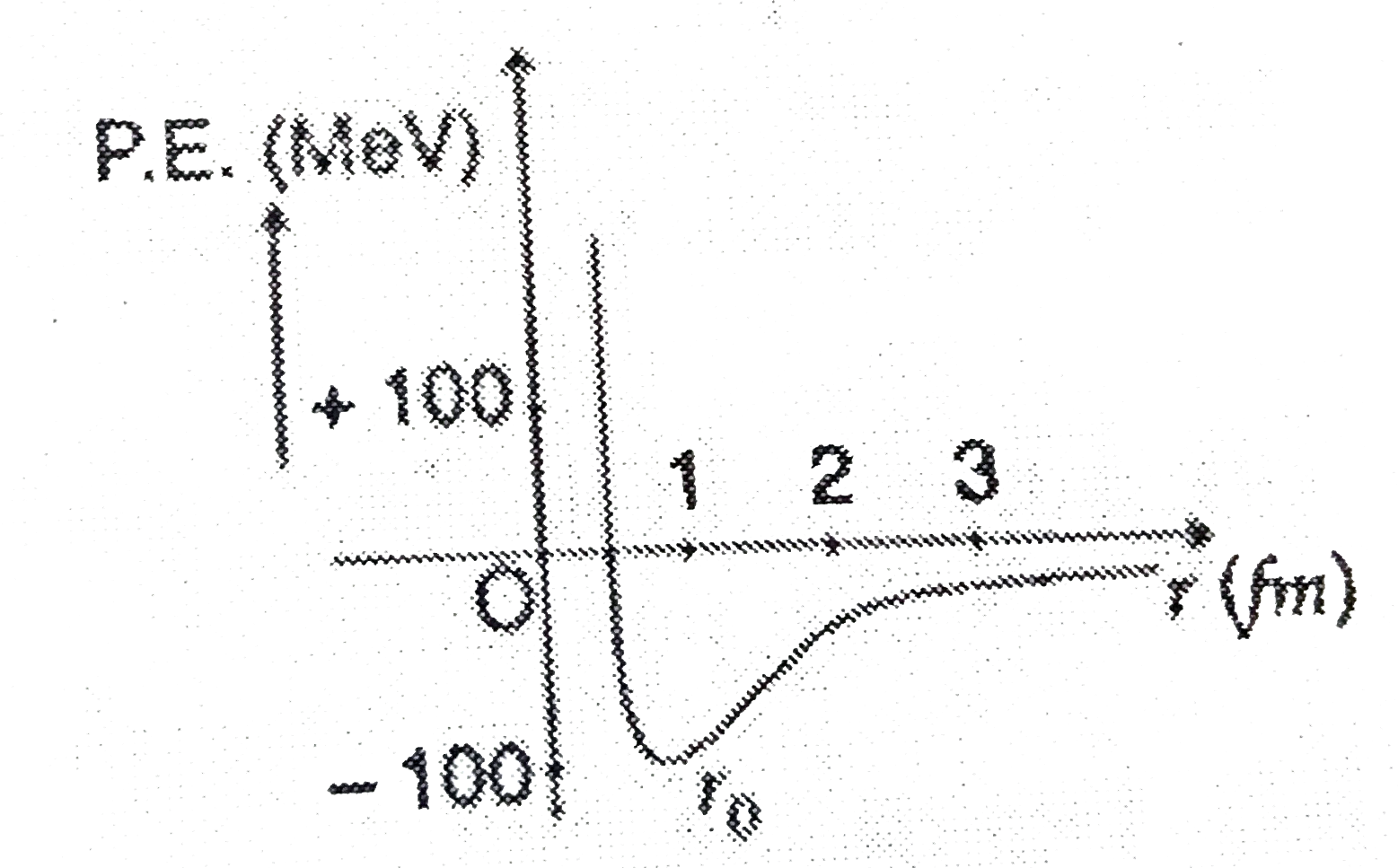
|
|
| 15. |
In biprism experiment, the distance of 20th bright band from the centre of the interference pattern is 8 mm. The distance of the 30th bright band is : |
|
Answer» 4 mm |
|
| 16. |
In the given circuit find the |V_(A) - V_(B)|where V_(A), V_(B)are electric potentials at the points A andB. |
|
Answer» `(E_1+E_(2)+E_3)/3` |
|
| 17. |
What is a photodiode ? Explain its working with a circuit diagram and draw its I-V characteristics. |
|
Answer» Solution :PHOTODIODE `:` Photodiode is an optoelectronic device in which current carriers aregenerated by photons through photo excitation. Working `:` When visible light of ENERGY greater than FORBIDDEN energy gap is incident on a reversebiased p-n junctionphotodiode,ADDITIONAL electron -hole pairs are created in the depletion layer ( near the junction). These CHARGE carrierswill be separated by the junction field and made to flow across the junction, creating a reverse current across the junction. The valeu of reverse saturation current increases with the increase in the intensity of incident light. V-I characteristics of photodiode is shown in figure. It is found that reverse saturation current through the photodiode varies almost linearly with the light flux. Uses `:` (1) It is used in switching thelight ON and OFF . (2) It is used in demodulation in optical signals.  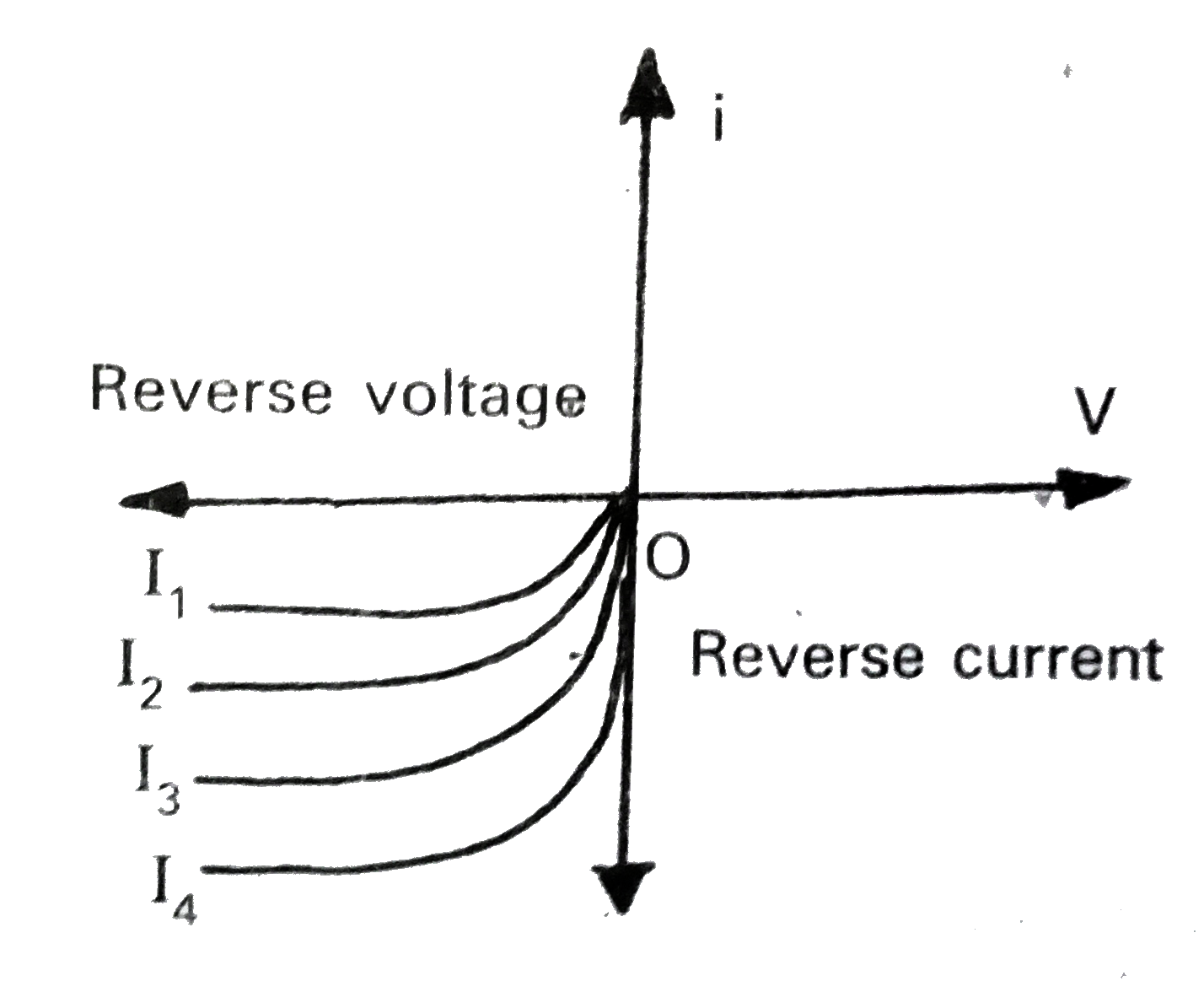
|
|
| 18. |
The bending of a light beam around the edges of small obstacles and narrow apertures is called |
|
Answer» REFLECTION of light |
|
| 19. |
A ray of mono - chromatic light is incident at the angle theta_i on refracting face of a prism of apex angle 75^@. After refraction though prism it is incident on 2nd refracting surface, such that it grazes the surface. Refractive index of material of prism is sqrt2 . If critical angle of material of prism is theta_c. Then find the ratio (theta_i)/(theta_c) |
|
Answer» |
|
| 20. |
Conduction of heat takes place due to |
|
Answer» a)FREE ELECTRONS |
|
| 21. |
On the basis of electron drift, derive an expression for resistivity of a conductor in ten density of free electrons and relaxation time. On what factors does resistivity of a conduc |
| Answer» Solution :Resistivity of the material of a conductor DEPENDS UPON the relaxation lime, i.e., temperature and the NUMBER DENSITY of electrons. | |
| 22. |
In the figure shown a thin parallel beam of light is incident on a plane mirror m_(1) at small angle 'theta' . m_(2) is a concave mirror of focal length 'f' . After three successive reflefctions of this beam the x and y coordinates of the image is |
|
Answer» `x=f-d,y=ftheta` |
|
| 23. |
How does microwave oven heats up a food item containing water molecules most efficiently? |
| Answer» SOLUTION :A MICROWAVE oven heats up a food item containing water molecules efficiently because FREQUENCY of waves produced in oven just MATCHES with the frequency of VIBRATIONS of water molecules. | |
| 24. |
An n-type silicon sample of width 4xx10^(-3)m, thickness 25xx10^(-5)m and length 6xx10^(-2)m carries a current of 4.8mA when the voltage is applied across the length of the sample. What is the current density? If the free electron density is 10^(22)m^(-3) then find how much time does it take for the electrons to travel the full length of the sample? |
|
Answer» |
|
| 25. |
(a) Define electric flux. Write its S.I. units. (b) Using Gauss's law, prove that the electric field at a point due to a uniformly charged infinite plane sheet is independent of the distance from it. (c ) How is the field directed if (i) the sheet is positively charged, (ii) negatively charged ? |
|
Answer» Solution :(a) Electric FLUX is defined as the dot product of electric field intensity vector. Its S.I. UNIT is `Nm^(2)//C`. (b) Let `sigma` be the UNIFORM surface charge density of an infinite plane sheet. Consider a GAUSSIAN surface to be a rectangular sectional area A. 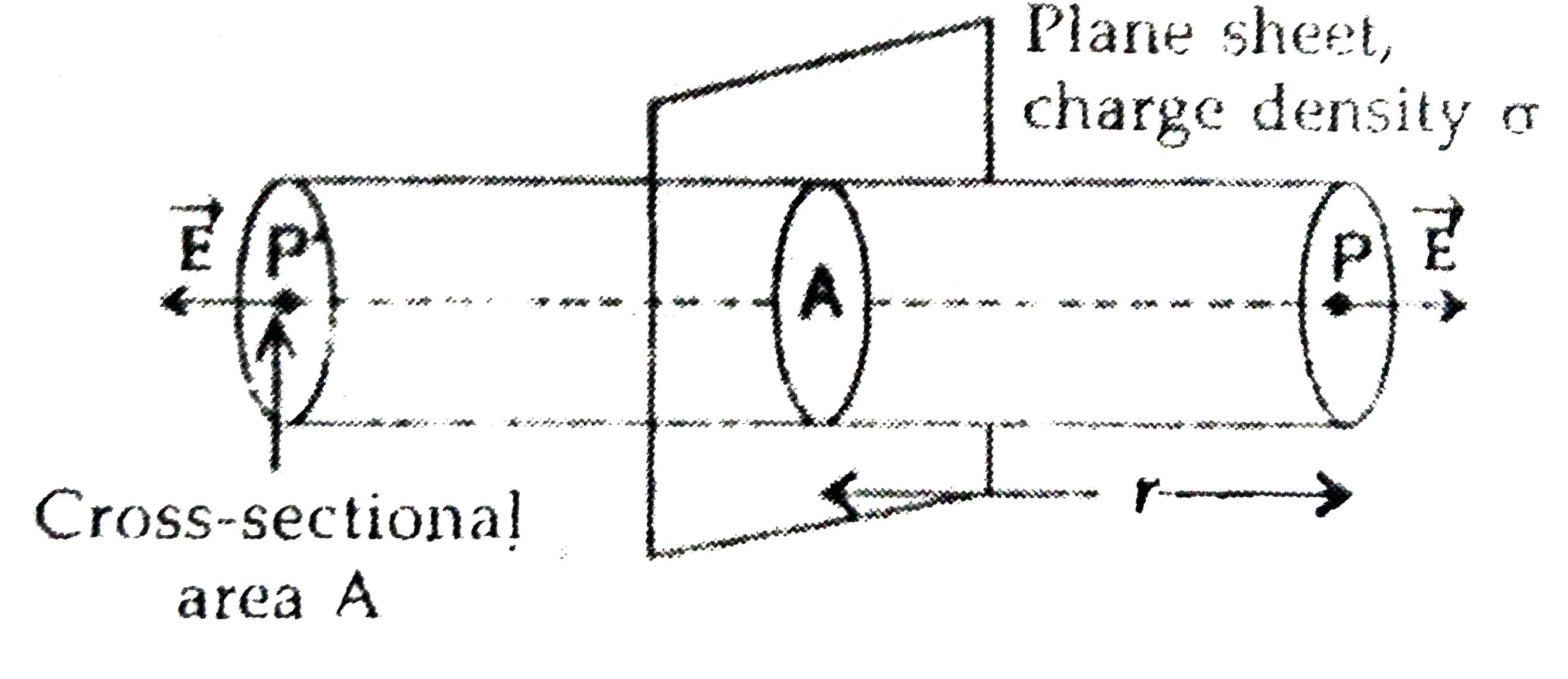 From figure, only the two faces 1 and 2 will contribute to flux. Electric field lines are parallel to the other faces and they do not contribute to the total flux. The net flux through the Gaussian surface is 2EA. The charge enclosed by the closed surface is `sigma A`. By Gauss's law, `2EA=(sigma A)/(in_(0)) "" or "" vec(E )=(sigma)/(2 in_(0))hat(n)` Since the expression does not contain x, so electric field is independent of the distance. (c ) (i) The electric field is directed perpendicularly away from the sheet. (II) The electric field is directed perpendicularly towards the sheet. 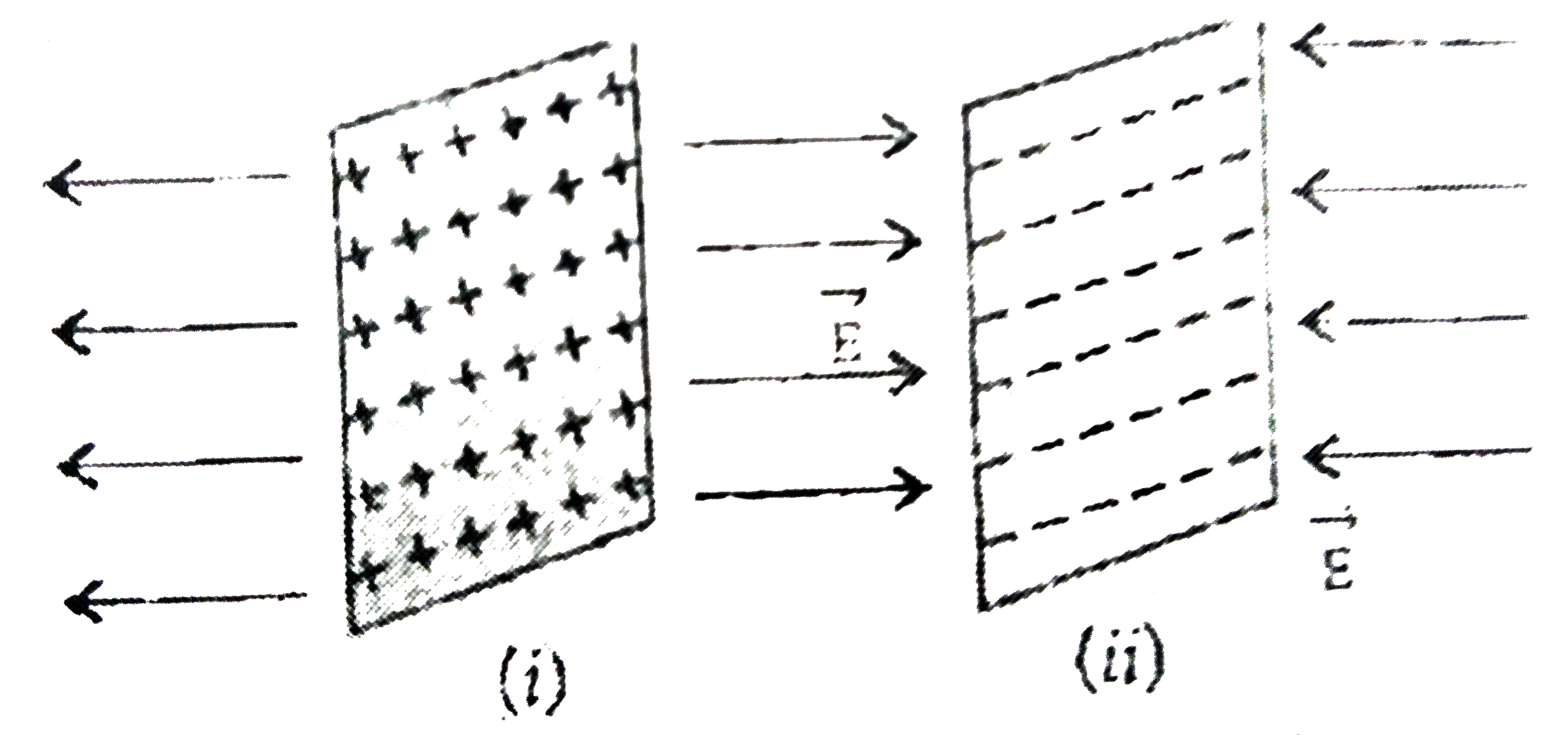
|
|
| 26. |
A magnetic needle is kept in a non-uniform magnetic field. It experiences |
|
Answer» a force and a torque. |
|
| 27. |
Obtain the magnification by lens after giving its definition. |
Answer» Solution :The ratio of the size of the image obtained by lens to that of the object is called MAGNIFICATION.  In figures (a) and (b), convex and concave lenses are SHOWN respectively. Object HEIGHT AB = h, Image height A.B. = h. Object distance BP = u, Image distance B.P = v Right angle triangles ABP and A.B.P are similar triangles. `therefore(AB)/(A.B.)=(BP)/(B.P.)` `therefore(h)/(-h.)=(v)/(u)` [`because` According to sign CONVENTION] `therefore(h.)/(h)=v/u` `therefore` Magnification m = `v/u` Magnification is negative for real image and positive for virtual image. |
|
| 28. |
An alpha- particle of energy 5 Mev is scattered through 180^(@) by a fixed uranium nucleus the distance of closest approach is of the order of |
|
Answer» `1A^(@)` |
|
| 29. |
A small electric lamp is placed at a depth of 46 cm inside a tank full of water. (i) Calculate the area on the surface of water through which light will be emitted. (ii) what is the maximum distance an emergent ray will travel before emerging from the surface of water? [mu" ""of water" = 1.3, sin 50.3^(@) = 0.7694 and tan 50.3^(@) = 1.205] |
|
Answer» |
|
| 30. |
What do we mean by dual nature of light ? |
| Answer» SOLUTION :Light TRAVELS as WAVE and ALSO as a PARTICLE. | |
| 31. |
If an intrinsic semiconductor is heated, the ratio of free electrons to holes is |
|
Answer» GREATER than ONE |
|
| 32. |
Rays of light fall on a glass slab (mugt1) as shwon in figure. If mu at A is maximum and at B it is minimum, then what will happen to these rays? |
|
Answer» They will tilt towards `A` `l=0, r=0`, so there is no deviation of ray. |
|
| 33. |
A man of mass 70 kg is standing at one end of a stationary, floating barge of mass 210 kg. he then walks to the other end of the barge, a distance of 90 meters. Ignore any frictional effect between the barge and the water. Q. If the man walks at an average velocity of 8m/s what is the average velocity of the barge? |
|
Answer» Solution :Let he time it takes the man to walk ACROSS the barge be denoted by r, then `t=(90m)/(8m//s)`. In this AMOUNT of time, the barge moves a DISTANCE of 22.5 meters in the OPPOSITE, so the velocity of the barge is `v_("barge")=(-22.5m)/(t)=(-22.5m)/((90m)/(8m//s))=-(180m^(2)//s)/(90)=-2m//s` |
|
| 34. |
In Davisson and Germer experiment, a detector with a galvanometer can be rotated on a circular scale. As the detector is rotaed the intensity of electronic beam after diffraction |
|
Answer» REMAINS constant |
|
| 35. |
Energy required to store a current line an inductor L is |
|
Answer» `1//2 (LI^2)` |
|
| 36. |
A man of mass 70 kg is standing at one end of a stationary, floating barge of mass 210 kg. he then walks to the other end of the barge, a distance of 90 meters. Ignore any frictional effect between the barge and the water. Q. How far will the barge move? |
|
Answer» Solution :Since there are not external forces acting on theman+barge system, the center of mass of the system cannot accelerate. In PARTICULAR, since the system is orginally at rest, the center of mass cannot move. Lettingx=0 denote the midpoint of the barge (which is its own center of mass, ASSUMING it is uniform), we can figure out the center of mass of the mass+barge system. `x_(cm)=(m_(1)x_(1)+m_(2)x_(2))/(m_(1)+m_(2))=((70)(-45)+(210)(0))/(70+210)=(-3,150)/(280)=-11.25`. So the center of mass is a distance of 11.25 meters from the midpoint of the barge, and since the MAN's mass is originally at the LEFT end, the center of mass is a distance of 11.25 meters to the left of the barge's midpoint.  When the man reaches the other end of the barge, the center of mass will, by symmetry, be 11.25 meters to the right of the midpoint of the barge. but, since the POSITION of the center of mass cannot move, this means the barge itself must have moved a distance of 11.25+11.25=22.5 meters to the left. |
|
| 37. |
In the above problem, now a liquid is poured into the vessel and filled up to OQ. The central bright fringe is found to be at Q. The refractive index of the liquid is |
|
Answer» `1.0016` |
|
| 38. |
Two pendulums have timeperiods T and (5T)/(4). They start swinging in S.H.M. together. What will be the phase difference between them after the longer has completed one oscillation ? |
|
Answer» `45^(@)` `:.` Diff. in vibrations `=(5)/(4)-1=(1)/(4)`. `:.` Phasedifference `=(1)/(4)xx2pi=(pi)/(2)=90^(@)`. THUS correctchoice is (b). |
|
| 39. |
(a) With the help of a labelled ray diagram, explain the construction and working of a Cassegrain reflecting telescope. (b) An amateur astronomer wishes to estimate roughly the size of the sun using his crude telescope consisting of an objective lens of focal length 200 cm and an eyepiece of focal length 10 cm. By adjusting the distance of the eyepiece from the objective, he obtains an image of the sun on a screen 40 cm behind the eyepiece. The diameter of the sun's image is measured to be 6.0 cm. Estimate the sun's Size, given that the average earth-sun distance is 1.5xx10^(11)m. |
|
Answer» Solution :(b) For the eye piece `(1)/(u_(e))=(1)/(v_(e))-(1)/(f_(e))=(1)/(40)-(1)/(10)=(3)/(40)` `u_(e)=40//3cm` Magnification PRODUCED by the eye piece is `m_(e)=(v_(e))/(u_(e))=(40)/(40//3)=3` Diameter of the IMAGE formed by the objective is `D=6//3=2cm` IF D is the diameter of the sun then the angle substended by it on the objective will be `ALPHA=(D)/(1.5xx10^(11))" rad"` Now, angle subtended by the image at the objective = angle subtended by the sun `alpha=("size of image")/(f_(0))=(2)/(200)=(1)/(100)" rad"` Therefore, `(D)/(1.5xx10^(11))=(1)/(100)` `D=1.5xx10^(9)` |
|
| 40. |
As per concept of e.m. waves, the refractive index .n. of a medium can be expressed as n = ____________. |
| Answer» SOLUTION :`n=(1)/(sqrt(mu_(R).epsilon_(r)))` | |
| 41. |
What happens to the width of depletion layer of a p-n junction when it is (i) forward biased, (ü) reverse biased ? |
| Answer» SOLUTION :(i) DECREASES (SLIGHTLY) (II) INCREASES (slightly) | |
| 42. |
According to Rayleigh scattering law, the amount of scattering is |
|
Answer» a. DIRECTLY proportional to WAVELENGTH of light |
|
| 43. |
Three resistances of 2Omega each are connected in a triangle.The resistance between two vertices is |
|
Answer» `4/3OMEGA` |
|
| 44. |
A young's double slit experiment uses a monochromatic source. The shape of the interference fringes formed on a screen is |
|
Answer» hyperbola |
|
| 45. |
Light of wavelength 4000A^(@) is incident on a potassium surface whose work function is 2.1eV. What will be the stopping potential |
|
Answer» 1 V |
|
| 46. |
Diatomaceous earth is used in |
|
Answer» polishing |
|
| 47. |
What is the equivalent capacitance between A and B in the given figure (all are in farad) ? |
|
Answer» `(13)/(18)F` |
|
| 48. |
A conductor of area of cross-section. A having charge carries, each having a charge q is subjected to a polential difference V. The number density of charge carries in the conductor is an und the charge carries (along with Their random) are moving with a velocity. If s is the conductivity of the conductor and ris the average relaxation |
|
Answer» `TAU=m/(nq^(2) sigma)` |
|
| 49. |
A conductor of length T'is rotated about one of its ends at a constant angular speed 'omega' in a plane perpendicular to a uniform magnetic field B. Plot graphs to show variations of the emf induced across the ends of the conductor with (i) angular speed o and (ii) length of the conductor i. |
|
Answer» Solution :When a conductor of length " is rotated about one of its ends at a constant angular speed .`OMEGA`. in a plane perpendicular to a uniform magnetic field "B., the induced EMF `epsilon` across its ends is given as : `epsilon = (1)/(2) B I^(2) omega` It means that (i) `epsilon PROP omega` and (II) `epsilon prop I^(2) ` . Hence `epsilon- omega` and `epsilon-l` graphs are as shown below : 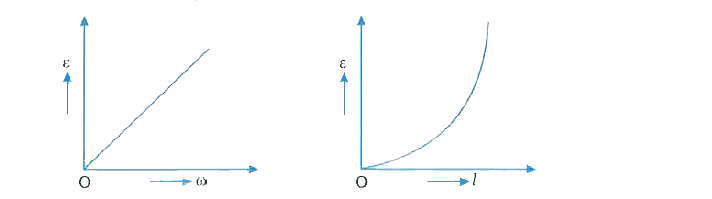
|
|
| 50. |
In a common base amplifier the phase difference between the input signal voltage to output voltage is: |
| Answer» ANSWER :A | |