

Saved Bookmarks
This section includes 7 InterviewSolutions, each offering curated multiple-choice questions to sharpen your Current Affairs knowledge and support exam preparation. Choose a topic below to get started.
| 1. |
Show that lateral shift is equal to the thickness of the slab for grazing incidence. |
Answer» Solution :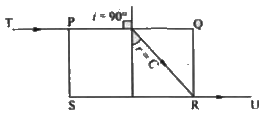 `i=90^(@)` `r=C=` critical angle `THEREFORE "Lateral shift"=(t SIN(90^(@)-C))/(cosC)` `L.S=(t cosC)/(cosC): L.S=t` `therefore` For GRAZING incidence, there will be grazing emergence. So L.S = t. |
|
| 2. |
Explain the position (orientations) of a dipole in stable equilibrium, unstable equilibrium. |
|
Answer» Solution :The potential energy of a DIPOLE place in uniform electric field, `U = -VECP.vecE=-pEcos THETA` where `theta ` is an angle between `vecp` and `vecE` . (i) If ` vecp||vecEimplies theta=0^(@)` `:.` U = -pE is the stable equilibrium STATE of a pole . (ii) If `vecp ||(-vecE)implies theta=180^(@)` `:.` U = pE is the maximum value of potential energy which indicates unstable equilibrium state ofa dipole. (III) If `vecP bot vecEimplies theta= 90^(@)` `:.` U=0 which indicates maximum unstabl equilibrium state of a dipole. |
|
| 3. |
Discussthe Millikan's oil drop experiment to determine the charge of an electron. |
Answer» Solution :Millikan.s oil drop experiment is another important experiment in modern physics which is used to determine one of the fundamental constants of nature known as charge of an ELECTRON.By adjusting electric field suitably,the motion of oil drop inside the chamber can be controlled-that is, it can be made to move up or down or even kept balanced in the field of view forsufficiently long time.  The APPARATUS consists of two horizontal circular metal plates A and B each with diameter around 20cm and are separated by a small distance 1.5 cm. These two parallel plates are enclosed in a chamber with glass walls. Further, plates A and B are given a high potential difference around 10kV such that electric acts vertically downward. A small hole is made at the centre of the upper plate A and atomizer is kept exactly above the hole to SPRAY the liquid. When a fine droplet of highly liquid (like glycerine) is sprayed using atomizer, it falls freely downward through the hole of the top plate only under the influence of gravity. Few oil drops in the chamber can acquire electric charge(negative charge) because offriction with air or passage of x-rays in between the parallel plates. Further the chamberis illuminated by light which is passed horizontally and oil drops can be seen clearly using microscope PLACED perpendicular to the light beam.These drops can move either upwards or downward. Let m be the mass of the oil drop and q be its charge. Then the forces acting on the droplet are (a) gravitational force `F_(g) = mg` (b) electric force `F_(e) = qE` (c) buoyant force `F_(b)` (d) viscous force `F_(v)` (a) Determination of radius of the droplet: When the electric field is switched off, the oil drop accelerates downwards. Due to the presence of air drag forces, the oil drops easily attain its terminal velocity and moves with constant velocity. This velocity can be carefully measured by NOTHING down the time taken by the oil drop to fall through a predetermined distance. The free body diagram of the oil drop, we note that viscous force and buoyant force balance the gravitational force. Let the gravitational force acting on the oil drop (downward) be `F_(g)= mg`. Let us assume that oil drop to be spherical in shape. Let `rho` be the density of the oil drop, and r be the radius of the oil drop, then the mass of the oil drop can be expressed in terms of its density as `rho = (m)/(V)` `Rightarrow m = rho((4)/(3) pi r ^(3))`(`because` volume of the sphere, `V = (4)/(3) pi r^(3)`) The gravitational force can be written in terms of density as `F_(g) = mg Rightarrow F_(g) = rho ((4)/(3) pi r^(3))`g Let `rho` be the density of the air, the upthrust force experienced by the oil drop due todisplaced air is `F_(b) = rho ((4)/(3) pi r^(3))`g Once the oil drop attains a terminal velocity v, the net downward force acting on the oil drop is equal to the viscous force acting opposite to the direction of motion of theoil drop. From Stokes law, the viscous force on the oil drop is `F_(r) = 6 pi r veta` From the free body diagram as shown in Figure (a), the force balancing equation is `F_(g) = F_(b) + F_(v)` `rho((4)/(3) pi r^(3))g = sigma ((4)/(3) pi r^(3))g + 6 pi rveta` `(4)/(3)pi r^(3)(rho - sigma)g = 6pirveta` `(2)/(3) pi r ^(3)(rho - sigma) = 3pirveta` `r = ((9etav)/(2(rho - sigma)g))`.....(1) Thus, equation(1) gives the radius of the oil drop. (b) Determination of electric charge : When the electric field is switched on, charged oil drops experience an upward electric force(qE). Among many drops, one particular drop can be chosen in the field of view of microscope and strength of the electric field is adjusted to make that particular drop to be stationary.Under these circumstances,there will be no viscous force acting on the oil drop. Then, from the free body diagram, the net force acting on the oil droplet is `F_(e) + F_(b) = F_(g)` `Rightarrow qE + (4)/(3)pi r^(3) sigmag = (4)/(3) pi r^(3) rho g` `Rightarrow qE = (4)/(3) pi r^(3)(rho - sigma)g` `Rightarrow q = (4)/(3E)pi r^(3) (rho -sigma)g` ....(2) Substituting equation (1) in equation(2), we get `q = (18 pi)/(E)((eta^(3)v^(3))/(2(rho - sigma)g))^(1/2)` Millikan repeated this experiment several times andcomputed the charges on oil drops. He found that the charge of any oil drop can be written as integral multiple of a basic value, `-1.6 xx 10^(-19) C`, which is nothing but the charge of an electron. 
|
|
| 4. |
What similarities do electrostatic forces have to gravitational forces? |
|
Answer» Solution :(i)Both OBEY inverse square law. (ii) Both are central forces, i.e., forces. ACT along the lines joining the centres of the bodies. (iii) Both are CONSERVATIVE forces, i.e., WORK done by them does not depend UPON the path followed. (iv)Both involve a property of the interacting particles-the mass in one case and the charge in the other. |
|
| 5. |
The apparent wavelength of light from a star moving away from earth is observed to be 0.01% more than its real wavelength. The velocity of star is |
| Answer» Answer :D | |
| 6. |
A transmitting antenna at the top of a tower has a height 32 m and that of the receiving antenna is 100 m. What is the maximum distance between them for satisfactory communication in LOS mode? Given radius of earth 6.4 xx10^(6) m |
|
Answer» Solution :`h_(T)=32m.h_(R)=100m` R=`6.4xx10^(6)m` `d_(M)=sqrt(2Rh_(T))+sqrt(2Rh_(R))` `d_(M)`=45.5km. |
|
| 7. |
A voltage of 6 V and a current of 0.3 A are required for the normal filament supply of a radio tube. Draw a diagram of a transformless filament supply of an eight-tube receiver from 220 V mains. Compare the heat dissipated per second by the tubes and by the instrument series resistor. |
Answer» 
|
|
| 8. |
Which of the following are not electromagnetic waves ? |
|
Answer» COSMIC RAYS |
|
| 9. |
A point source is at a distance35cm on theopticalaxos from a sphericalmirror having afocallength 25cm. At whatdistancemeasuredalongthe opticalaxis form the concavemirror shoulda planemirror (perpendicualrto principle axis) be placedfor the imageit forms (due to rays fallingon it afterreflectionfrom theconcave mirror) to coincidewith the pointsource? |
|
Answer» |
|
| 10. |
The components of space wave are _____, _____ and _____ wave. |
| Answer» SOLUTION :DIRECT, GROUND REFLECTED and TROPOSPHERE | |
| 11. |
Two forces each equal to F/2, act at right angles. Their effect may be neutralised by a third force acting along their bisector in the opposite direction with a magnitude of: |
|
Answer» F `:. `Hence when `F/sqrt(2)` force acts ALONG their bisector in opposite DIRECTION, then resultant of three forces will be zero |
|
| 12. |
A ball collides head-on with another at rest having 3 times the mass of first with a velocity of 1 ms^(-1). If the coefficient of restitution is 0.8, then velocities of the two after the collision will be: |
|
Answer» `- 0.35 MS^(-1)` and `0.45 ms^( 1)` |
|
| 13. |
A conducting sphere of radius r has a charge. Then |
|
Answer» The CHARGE is uniformly distributed over its SURFACE, if there is an external ELECTRIC field. |
|
| 14. |
In the ground state of hydrogenatom , itsBohr radius is given as 5.3 xx 10^(-11) m. Theatomis excitedsuch athat th radiusbecomes 21.2 xx 10^(-11) m. Find(i) thevalueof principal quantum number, and (ii) thetotal energyof theatom in thisexcited state. |
|
Answer» SOLUTION :Here `a_(0)` (or `r_(1)`) `=5.3 XX 10^(-11) m`and`r_(n)= 21.2 xx10^(-11) m` (i) `becauser_(n) = n^(2) a_(0) rArr n = sqrt((r_(n))/(a_(0)) = sqrt((21.2xx10^(-11))/(5.3 xx 10^(-11))) = 2` (ii)Total energyofatom in the excitedstate correspodingto n=2 . `E_(n) = - (13.6)/(n^(2)) eV =- (13.6)/((2)^(2)) eV = -3.4 eV` |
|
| 15. |
Two nicols prisms are so orientated that the maximum amount of light is transmitted. Two what fraction of itsmaximum value is the intensity of transmitted light reduced when the analyser is rotated through 30^(@)? |
|
Answer» |
|
| 16. |
In the given table, Column I shows masses of the objects, Column II shows the initial and final velocity of the object after force is applied on it and Column III shows the time span for which force is applied on the object. Conditions for a hammer with the force of 2500 N applied in opposite direction of motion are: |
| Answer» Answer :A::B | |
| 17. |
The density of a liquid of coefficient of cubical expansion gamma is d at 0^(@)C. When the liquid is heated to a temperature T, the change in density will be: |
|
Answer» `(-gammaTd_(0))/((1+gammaT))` |
|
| 18. |
A body of mass m =3.513 kg is moving along the X-axis with a speed of 5.00 ms^(-1)The magnitude of its momentum as recorded is : |
|
Answer» `17.57 kg ms^(-1)` `= 17.565 kg ms^(-1) = 17. 6 kg ms^(-1)` :’ answer should have three SIGNIFICANT figs Hence (B) is the correct choice. |
|
| 19. |
In the given table, Column I shows masses of the objects, Column II shows the initial and final velocity of the object after force is applied on it and Column III shows the time span for which force is applied on the object. Conditions for a dumbbell with the force of 1000 N applied in same direction of motion are : |
|
Answer» (III) (i) (L) |
|
| 20. |
A prism has refracting angle equal to pi//2. It is given that gamma is the angle of minimum deviation and beta is the deviation of the ray entering at grazing incidence. Prove that singamma=sin^(2)beta . |
|
Answer» Solution :Applying CONDITION of minimum deviation, `mu=" sin "(((A+gamma))/2)/("sin"A/2)=("sin"(A)/(2)"COS"(gamma)/(2)+"cos"(A)/(2)"sin"(gamma)/(2))/("sin"(A)/(2))` `="cos" (gamma)/(2)+"cot" (A)/(2)"sin"(gamma)/(2)` Using `A=90^(@), mu=" cos "(gamma)/(2)+cot45^@" sin "(gamma)/(2)` `rArr " cos " (gamma)/(2)+ " sin "(gamma)/(2)=mu` Squaring, `"cos"^(2)(gamma)/(2)+"sin"^(2)(gamma)/(2)+gamma=mu^(2)rArrsingamma=mu^(2)-1` Deviation at grazing incidence, `BETA= delta_(1)+delta_(2)` `beta=((pi)/(2)-C)+(E-r_(2))` `rArr beta ((pi)/(2)-C)+[e-((pi)/(2)-C)]` `rArr beta=e` (iii) or `sin beta=sin e=mu sin r_(2)=mu sin((pi)/(2)-C)` `rArr sin beta=mu cosC` Squaring Eq. (ii), `sin^(2) beta=mu^(2)cos^(2)C rArr sin^(2) beta=mu^(2)(1-sin^(2)C)` Using`sin C = (1)/(mu), sin^(2)beta=mu^(2)(1-(1)/(mu^(2)))` `rArr sin^(2)beta=mu^(2)-1` From EQS. (i) and (iii), `sin gamma=sin^(2) beta` 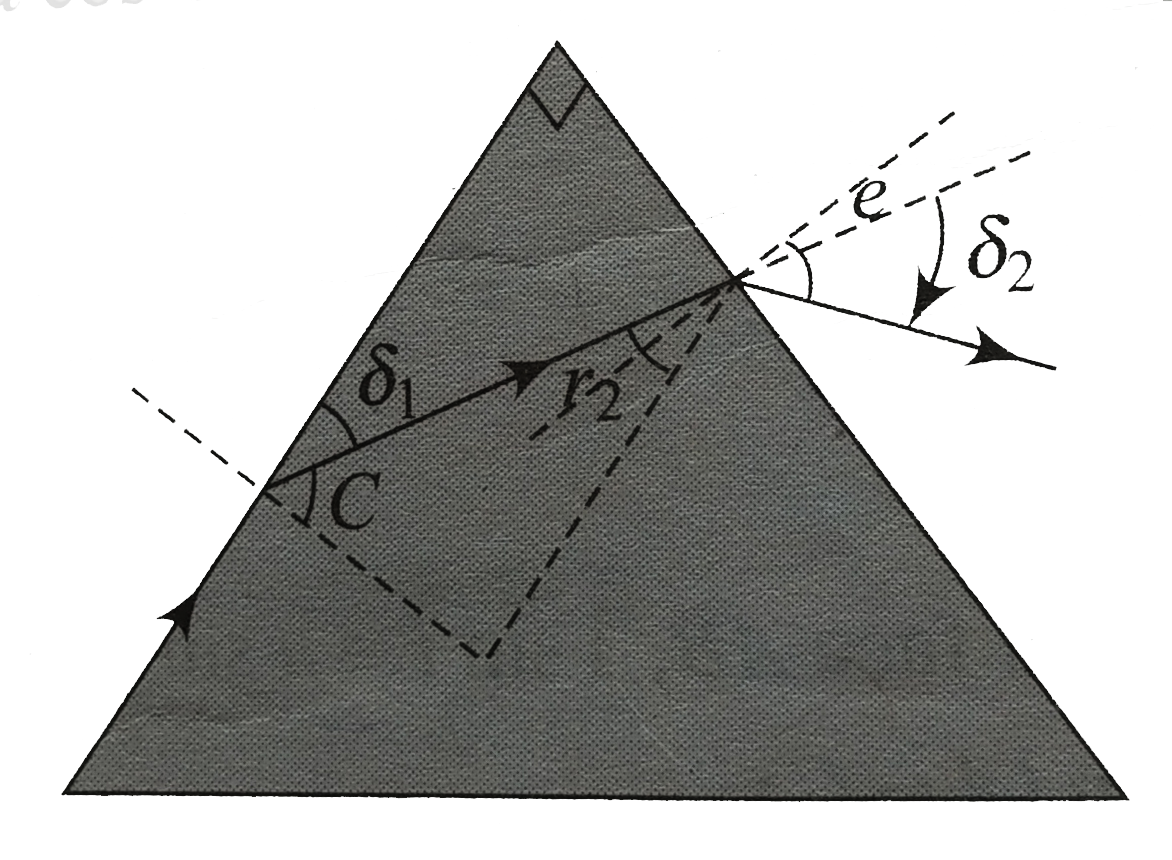
|
|
| 21. |
X and Y are large, parallel conducting plates closed to each other. Each face has an area A. X is given a charge Q. Y is without any charge. Points A. B and C are as shown in figure |
|
Answer» The FIELD at B is `(Q)/(2epsilon_(0)A)` |
|
| 22. |
Two cells A and B with same e.m.f of 2 V each and with internal resistances r_(A)=3.5Omega and r_(B)=0.5Omega are connected in series with an external resistance R=3Omega. Find the terminal voltage across the two cells. |
|
Answer» Solution :CURRENT through the circuit `i=(epsilon)/((R+r))=(2+2)/((3+3.5+0.5))=(4)/(7)` i) `R=3Omega, r_(A)=3.5Omega, E=2V,` TERMINAL voltage A, `V_(A)=E-ir =2-(4)/(7)xx3.5="0 volt"` ii) `r_(B)=0.5Omega, R=3Omega, E=2V,` Terminal voltage at B, `V_(B)=E-ir=2-(4)/(7)xx0.5="1.714 volts."` |
|
| 23. |
Write down the applications of LED's? |
|
Answer» SOLUTION :Indicator lamps on the front PANEL of the scientific and laboratory EQUIPMENTS. • Seven-segment displays. • Traffic signals, exit SIGNS, emergency VEHICLE lighting etc. .Industrial process control, position encoders, bar graph readers. |
|
| 24. |
The ratio of angular speed of minutes hand and hour hand of a watch is, |
|
Answer» 1:12 |
|
| 25. |
Four lenses of focal lengths +15 cm, +20 cm, +150 cm and +250 cm are available for making an astronomical telescope. To produce the largest magnification, the focal length of the eyepiece should be : |
| Answer» Answer :B | |
| 26. |
The resistance of the bulb filament is 100at a temperature of 100^(@)C. If its temperature coefficient of resistance be 0.005 per ^(@)C, its resistance will become200 Omegaat a temperature |
|
Answer» `200^(@)C` `200= 100 (1 + 0.005) (T_(2)-100)` `T_(2)= 300` |
|
| 27. |
Using a neat labelled diagram derive the mirror equation. Define linear magnification. |
|
Answer» Solution :Derivation of mirror equation : Consider an object AB is placed beyond centre of curvature of a concave mirror, on its principal axis. A ray AD parallel to principal axis incident on the mirror at point D and is reflected to pass through F. Another ray AE passing through centre of curvature C is reflected along the same path. Two rays of light intersect at point A'. Thus A'B' is real, inverted and diminished image of AB formed between C and F. `Delta^("le")"DPF and "Delta^("le")" A'B'F are similar "("B'A'")/("PD")=("B'F")/("FP")` (or) `("B'A'")/("BA")=("B'F")/("FP")"......................... (1)"(therefore PD = AB)` Since `ANGLEAPB= angleA'P'B'` The right ANGLE triangles A'B' P and ABP are similar. `("B'A'")/("BA")=("B'P")/("BP")".............................(2)"` From EQUATIONS (1) and (2), `("B'F")/("FP")=("B'P")/("BP")=(B'P-FP)/(FP)"............(3)"` Now APPLYING the sign convention. `B'P=-upsilon, FP=-f, BP=-u` `(-upsilon+f)/(-f)=(-upsilon)/(-u)` `(upsilon-f)/(f)=(upsilon)/(u) rArr (upsilon)/(f)-1=(upsilon)/(u)` `(1)/(f)=(1)/(v)+(1)/(u)` 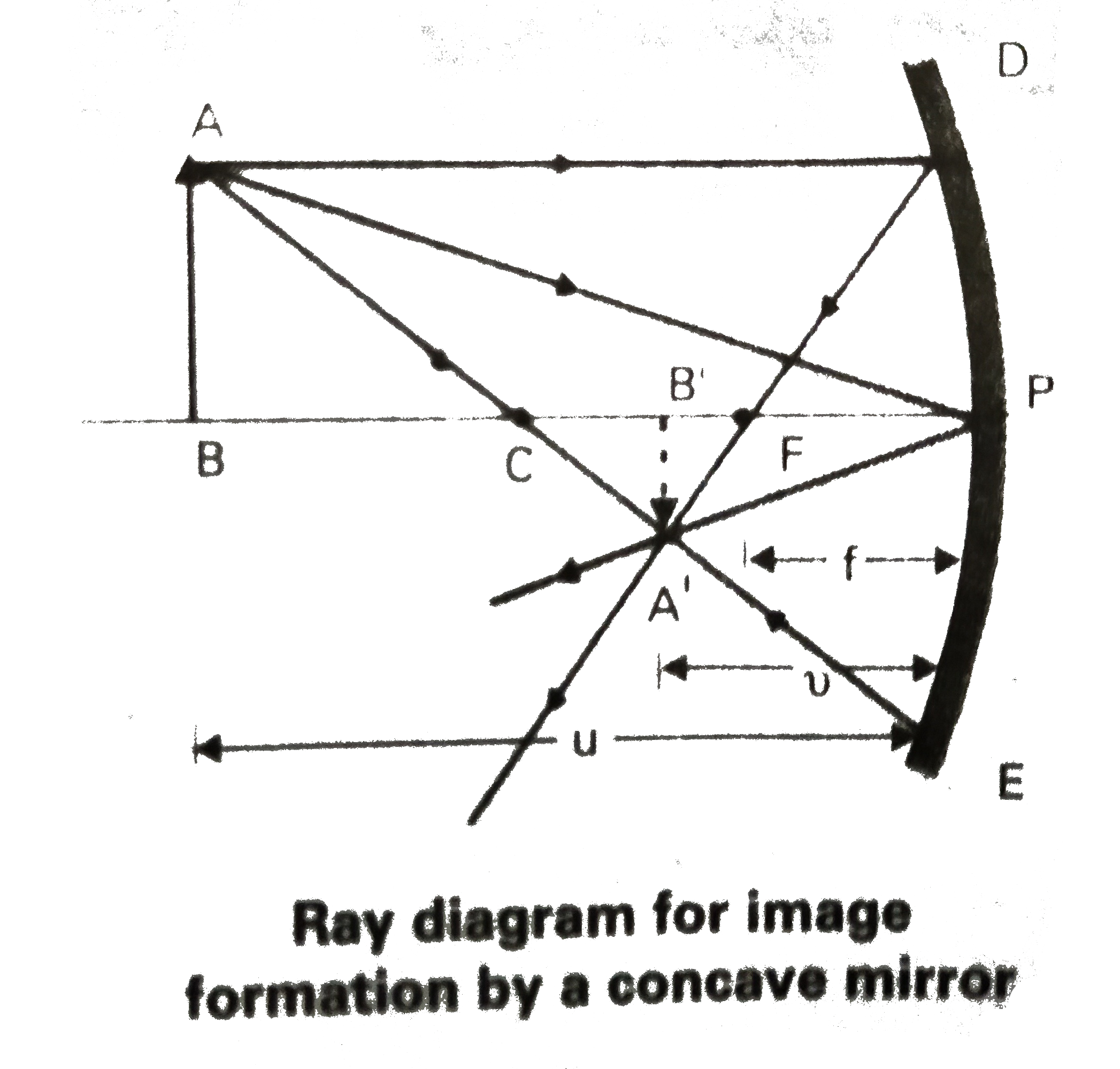 Linear magnification : Linear magnification is the ratio of the size of the image formed by the mirror to the size of the object. `m=("size of the image")/("size of the object")=(h_(2))/(h_(1))=(-upsilon)/(u)` |
|
| 29. |
What is digital signal ? What mathematical method are expressed in it? |
|
Answer» Solution :In electroniccircuits such as amplifier, oscillator, the signals is in the form of constant change with current or voltage over time. Such signals are CALLED continuous or analog signals. A typical analog signal is shown in figure (a) and (b).  If a current or voltage (signal) has only two minimum and maximum values, the signal is called digital signal. The signal in figure (c ) is in the form of waveform or pusle, which has only two values of the signals.  A BINARY system for displaying such signal is convenience. Binary only has two digits 0 and 1. The maximum value (5V) of voltage is expressed as 1 and the minimum value (0V) is expressed as 0. The input and output voltage indicated by two values (0 and 1) in the digital circuit are valid. |
|
| 30. |
Calculate the equivalent resistance between the points A and B of the network shown in figure. |
|
Answer» |
|
| 31. |
A capillary tube of diameter 0.6 mm is dipped vertically into water. It rises to a height of 6cm in the capillary tube. What is the surface tension of water. (rho_(water) = 10^3 kg//m^3, g = 9.8 m//s^2, 0 = 0^@) |
|
Answer» `8.82 XX 10^-4 N/m` |
|
| 32. |
(a) Two monochromatic waves emanating from two coherent sources have the displacements represented by y_(1)=acosomegat and y_(2)=acos(omegat+phi), where phi is the phase difference between the two displacements . Show that the resultant intensity at a point due to their superposition is given by I=4I_(0)cos^(2)phi//2, where I_(0)=a^(2). (b) Hence obtain the conditions for constructive and destructive interference. |
|
Answer» Solution :(a) The resultant displacement is GIVEN by : `y=y_(1)+y_(2)` `=acosomegat+acos(omegat+phi)` `=acosomegat(1+cosphi)-asinomegatsinphi` Put `Rcostheta=a(1+cosphi)` `Rsintheta=asinphi` `:.R^(2)=a^(2)(1+cos^(2)phi+2cosphi)+a^(2)SIN^(2)phi` `=2a^(2)(1+cosphi)=4a^(2)cos^(2).(phi)/(2)` `:.I=R^(2)4a^(2)cos^(2).(phi)/(2)=4I_(0)cos^(2).(phi)/(2)` For CONSTRUCTIVE interference, `cos.(phi)/(2)=+-1` or `(phi)/(2)=npi` or `phi=2npi` For DESTRUCTIVE interference `cos.(phi)/(2)=0` or `(phi)/(2)=(2n+1).(pi)/(2)` or `phi=(2n+1)pi` |
|
| 34. |
A hollow conducting sphere of radius 10 cm has a charge of +10 esu. What is the potential at an internal point of the sphere? |
|
Answer» |
|
| 35. |
यदि छोटे वैद्युत द्विध्रुव के कारण अक्षीय स्थिति में विद्युत क्षेत्र E_aतथा उतनी ही दूरी परनिरक्षीय स्थिति में विद्युत क्षेत्र E_e हो, तो - |
|
Answer» `E_e =2E_a` |
|
| 36. |
In a magnetic field of 0.05T, area of a coil changes from 101 cm^(2) to 100 cm^(2) without changing the resistance which is 2Omega. The amount of charge that flow during this period is |
|
Answer» `2.5 xx 10^(-6)` C |
|
| 37. |
What is the meaning of 'damp'? |
|
Answer» HARD mettle |
|
| 38. |
Prove theoretically E=-(d Phi)/(dt). |
|
Answer» Solution :Consider a rectangular wire loop PQRS of width `l`, with its plane perpendicular to a uniform magnetic FIELD of induction `vecB`. The loop is being pulled out of the magnetic field at a constant speed v, as shown. At any instant,let x be the length of the part of the loop in the magnetic field. Then, the magnetic flux through the loop is `Phi=Blx ""` ...(1) 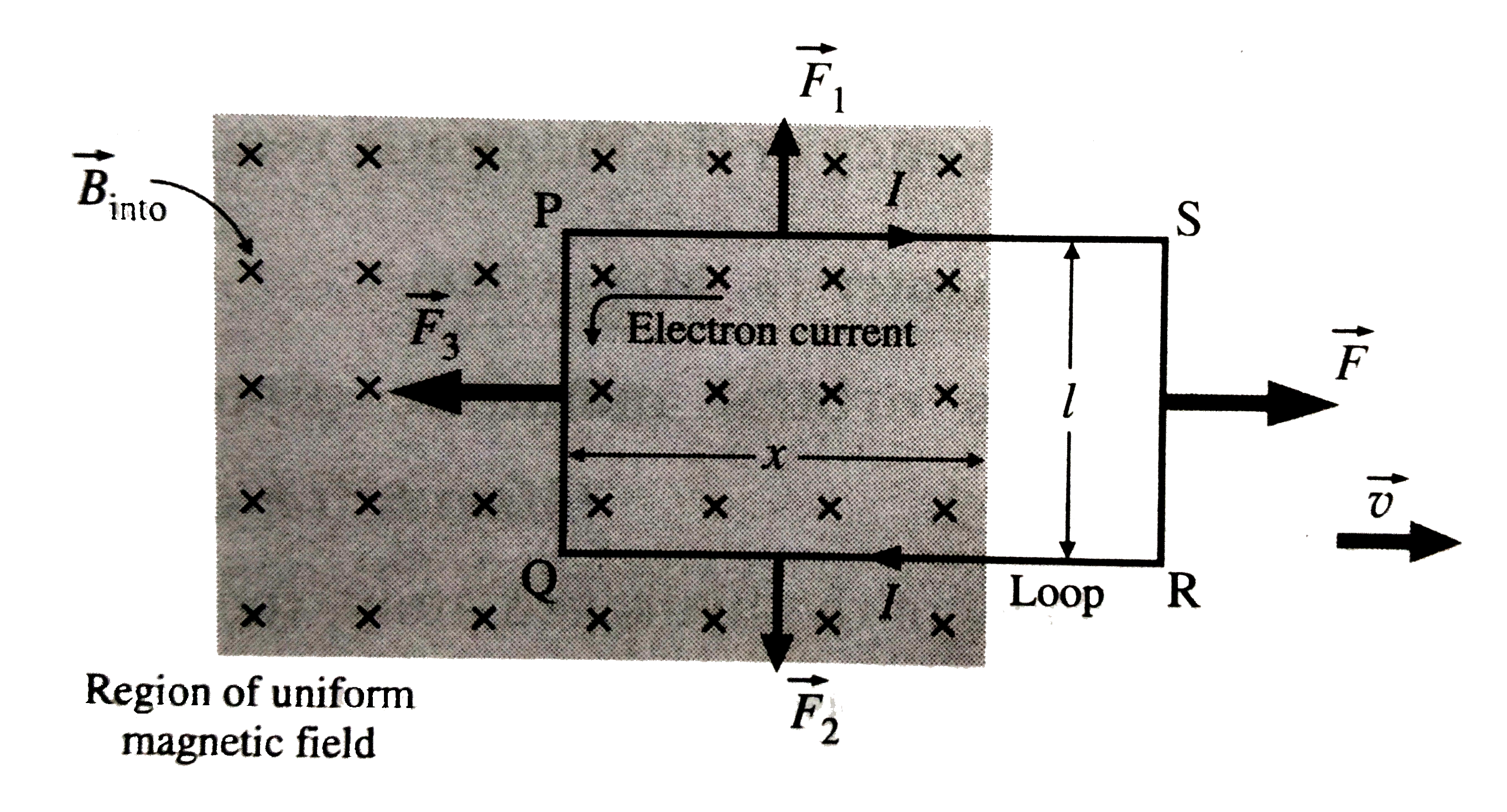 As the loop MOVES to the right through a distance dx = vdt in time dt, the area of the loop inside the field changes by `dA=ldx =lvdt. ` And, the changein the magnetic flux `dPhi` through the loop is `d Phi =Bda=Blvdt "" ` ...(2) Then, the time rate of change of magnetic flux is `(d Phi)/(dt)=(Blvdt)/(dt)=BLV "" ` ...(3) The changing magnetic flux induces a current `I` in the clockwise DIRECTION, as shown. a current-carrying conductor in a magnetic field experiences a force `vecF=I vecL XX vecB` (in the usual notation), whose direction can be found using Fleming'sleft hand rule. Accordingly, forces `vecF_(1) and vecF_(2)` on wires PS and QR, respectively, are equal in magnitude`(=IxB),` opposite in direction and have the same line of action. Hence, they balance each other. There is no force on wire RS as it lies outside the field. The force `vecF_(3)` on wire PQ has magnitude `F_(3)=IlB` and is directed towards the left. To move the loop with constant velocity `vec v`, an external force `vecF=-vecF_(3)` must be applied. The work done by the external agent is `dW=Fdx=-IlBdx=-IBdA=-Id Phi "" ` [from Eq. (2)] ...(4) Therefore, the power, i.e., the time rate of doing work, is `P=(dW)/(dt)=I(-(d Phi)/(dt)) "" ` ...(5) The electric power when an emf E drives a current through a circuit is given by `P=EI"" ` ...(6) In Eq. (4), P is the electric power when a current `I` is driven througha circuit as a consequence of a change in the magnetic flux through it. From Eqs. (5) and (6), `dW=Pdt =EIdt "" ` ...(7) Therefore, comparing Eq. (4) with Eq. (7),`E=-(dPhi)/(dt) "" ` ...(8) Thus, the emf induced in an electric circuit is equal to the negative of the time rate of change of the magnetic flux through the circuit, which is Faraday-Lenz's law. |
|
| 39. |
Which of the following pn junction is not used in reverse bias? |
| Answer» Answer :D | |
| 40. |
If the net electric flux through a closed surface is zero, then we can infer |
|
Answer» no net charge is enclosed by the surface |
|
| 41. |
If the thickness of the plate in the above problem is 2 mm, find the downward force when plate is placed vertically on water along its longest side. |
| Answer» SOLUTION :`7.59 XX 10^(-3)` N | |
| 42. |
In Young's double slit experiment the y co-ordinates of central maxima and 10th maxima are 2 cm and 5 cm respectively. When the YDSE apparatus is immersed in a liquid of refractive index 1.5. Find the corresponding y co-ordinates. |
| Answer» SOLUTION :Central MAXIMA at 2 CM and 10TH maxima at 4 cm | |
| 43. |
In the given figure switch is open initially and capacitor C_2 is unchanged Potential difference on C1just after closing the switch is |
|
Answer» `(V)/(3)` |
|
| 44. |
Suppose the spheres A and B in the above question have identical sizes. A third sphere of the same size but uncharged is brought in contact with the first, then brought in contact with the second, and finally removed from both. What is the new force of repulsion between A and B? |
|
Answer» Solution :Distance between the spheres, A and B, r = 0.5 m Initially, the CHARGE on each sphere,` q = 6.5 × 10^(−7 )C` When sphere A is touched with an uncharged sphere C, `(q)/(2)`amount ofcharge from A will transfer to sphere C. Hence, charge on each of the spheres, A and C, is.`(q)/(2)` When sphere C with charge `(q)/(2)`is BROUGHT in contact with sphere B with charge q, TOTAL charges on the system will divide into two equal halves given as, `((q)/(2)+q)/(2)=(3q)/(4)` Each sphere will SHARE each half. Hence, charge on each of the spheres, C and B, is. `(3q)/(4)` Force of repulsionbetweensphere Ahaving charge `(q)/(2)` and sphere B havingcharge`(3q)/(4) =((q)/(2) xx(3q)/(4))/(4pi epsilon_(0)r^(2))=(3q^(2))/(8 xx 4 pi epsi_(0)r^(2))` `9 xx 10^(9) xx(3xx (6.5 xx 10^(-7))^(2))/( 8xx (0.5)^(2))` `= 5.703 xx 10^(-3) N` Therefore, the force of attraction between the two spheres is `5.703 × 10^(−3) N`. |
|
| 45. |
The principal section of a glass prism is an isosceles triangle PQR with PQ = PR. The face PR is silvered. A ray incident normally on face PQ after two reflections, emerges from the base QR in a direction perpendicular to it. What is the angleQPR of the prism ? |
|
Answer» `36^(@)`  `alpha + 2beta = 180^(@)` and `"" beta = 2ALPHA` HENCE `"" alpha = 36^(@)`. |
|
| 46. |
In Young's double slit arrangement the central fringe is: |
|
Answer» ALWAYS dark |
|
| 47. |
There are infinite equipotential lines all parallel to BC in a right angled triangular region ABC as shown in the figure. All the points on a line have the same potential proportional to the length of the line. If E_(P), E_(Q) & E_(R ) denote the electric field at P, Q and R, respectively, then |
|
Answer» <P>`E_(P) GT E_(Q) gt E_(R )` |
|
| 48. |
The heat given to an ideal gas under isothermal conditions is used for |
|
Answer» INCREASE the temperature of the gas |
|
| 49. |
Professor C.V. Raman surprised his students by suspending freely a tiny light ball in a transparent vaccum chamber by shining a laser beam on it. Which property of e.m. waves was he exhibiting ? Give one more example of this property? |
| Answer» SOLUTION :Professor C.V. Raman.s DEMONSTRATION was BASED on the RADIATION pressure exerted by e.m. waves. Tails of comets are DUE to pressure exerted due to solar radiation. | |
| 50. |
What is health? |
|
Answer» Health is BEAUTIFUL STATE of mind |
|