Saved Bookmarks
This section includes 7 InterviewSolutions, each offering curated multiple-choice questions to sharpen your Current Affairs knowledge and support exam preparation. Choose a topic below to get started.
| 1. |
A rope of length 8m and linear density 0.5 kg/m is lying length wise on a horizontal smooth floor. It is pulled by a force of 12 N. The tension at the midpoint is |
|
Answer» 12 N |
|
| 2. |
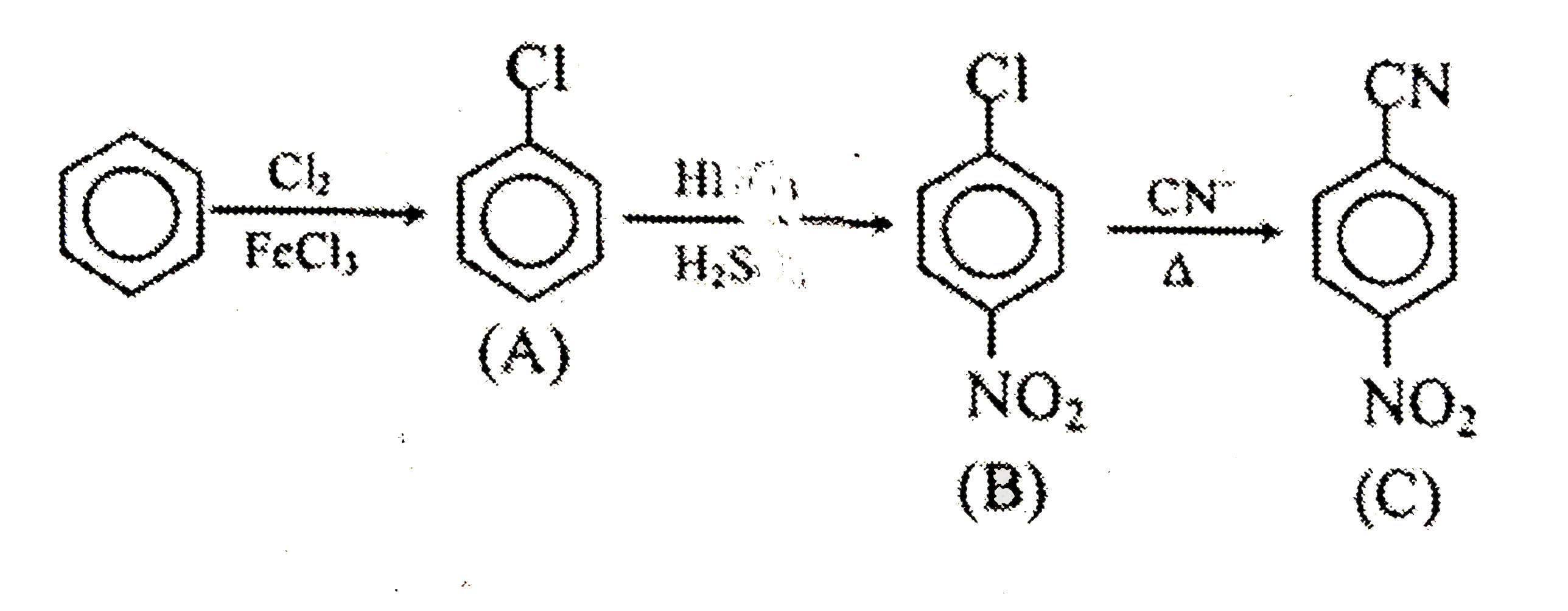
The product C is - |
|
Answer»
|
|
| 3. |
A 100 millihenray coil carries a current of 1A. Energy stored in its magnetic field is |
|
Answer» 0.5 J |
|
| 4. |
A ray of light is incident on a glass plate of refractive index 1.54. If the reflected ray is completely plane polarised, find (i) angle of incidence (ii) angle of refraction and (iii) crictical angle. Given tan 57^(@)=1.54 and sin 40.5^(@)=0.6493. |
|
Answer» |
|
| 5. |
Does a current carrying circular coil produce uniform magnetic field ? |
| Answer» SOLUTION :No, magnetic FIELD producedis notunifonn.. HOWEVER,it MAY be considered as uniform at the CENTRE of the circular coil. | |
| 6. |
What happens to the pressure of a sample of helium gas if the volume is reduced from 6 liters to 3 liters, with no change in temperature? |
| Answer» Solution :The Ideal Gas Law, `PV=nRT`, tell us that if T REMAINS CONSTANT, then P is INVERSELY proportional to V. So, if V decreases by a factor of 2, then P will increase by a factor of 2. | |
| 7. |
A body is thrown horizontally with a velocity sqrt(2gh) from the top of a tower of height h. It strikes the level ground through the foot of the tower at a distance x from the tower. The value of x is : |
|
Answer» Solution :Here `x=vt` Now `h=1/2g t^(2)` or `t=sqrt((2h)/G)` THUS `x=sqrt(2gh)xxsqrt((2h)/g)=2h` |
|
| 8. |
What changes during the polarisation of light? |
|
Answer» FREQUENCY |
|
| 9. |
Who has come to visit Jack and Jill? |
|
Answer» AUNT Jane |
|
| 10. |
A grounded conducting sphere may be |
|
Answer» positively charged |
|
| 11. |
An infinite number of capacitors having capacitances 1muF,2muF,4muF,8muF......are connected in series. The equivalent capacitance of the system is : |
|
Answer» INFINITE |
|
| 12. |
A small sphere is charged unifomly and placed at some point A(x_0,y_0) so that at point B(9m,4m) electric field strength is vec E = (54 hati + 72 hatj)NC^(-01) and potential is 1800V. Then |
|
Answer» the magnitude of chargeon the sphere is `4muC` `vecE=54hati+74hatj,E=90NC^(-1)` `90=(9xx10^(-9)Q)/(R^(2)` `V=1800=(9xx10^(9)Q)/(r)` From Eqs. (i) and(ii), we get `r=20M,q=4muC` Now, `((9-x_(0))+(4-y_(0))hatj)/(20)=(54hatj+72hatj)/(90)` or `x_(0)=3,y_(0)=-12` |
|
| 13. |
The height of transmitting antenna if the TV telecast is to cover a radius of 128 km is, |
|
Answer» 1560 m |
|
| 14. |
The conductivity of a semiconductor increases with increasein temperature because |
|
Answer» number density of free current carriers increases. As TEMPERATURE is increased, large no. of charge carriers transit from valence band to CONDUCTION band. Thus, free chargecarrier density is increased and so electrical conductivityof SEMICONDUCTOR increases considerably. This is the DOMINATING factor for increase in electrical donductivity of semiconductors. |
|
| 15. |
Determine the overall degeneracy of a 3D state of a Li atom. What is the physical meaning of that value? |
|
Answer» SOLUTION :For a `3d` state of `Li` atom, `S=(1)/(2)` because there is only one electron and `L=2`. The total degeneracy is `g=(2L+1)(2S+1)=5xx2=10`. The states are `.^(2)D_(3/2)` and `.^(2)D_(5//2)` and we CHECK that `g= 4+6=(2XX(3)/(2)+1)+(2xx(5)/(2)+1)` |
|
| 16. |
Showthat voltage in an inductor leads the current by pi//2rad for a pure inductor |
Answer» Solution :  <BR>Consider an inductor of inductance L is connected across an AC source . <BR>Consider an inductor of inductance L is connected across an AC source . Let `V= V_(0) sinomegat` …. (1) the self induced emf in the conductor is `epsilon = - L (dI)/(dt)`, ACCORDING to K irchoff loop rule `v- L (dI)/(dt) = 0` `RightarrowV_(0)sinomegat-L(dt)/(dt)=0` `RightarrowL (dt)/(dt)= V_(0)sinomegat.This INDICATES the current in an inuctor is a function of time . `dt= v_(0)/(L)sin omegat` dt To obtain the current at any tan t, we INTEGRATE above equation `I = int di = (V_(0))/(L )int sin omegat dt` `Rightarrow I = (V_(0))/(L)[-cosomegat0/(omega) + constant]` `I = (V_(0))/(L) [(cosomegat0/(omega)+ constant]` `I= (V_(0))/(L_(omega) (-COSOMEGAT)`,br> If we take `(V_(0))/(Lomega)= I_(0)`, the amplitude of the current , then `I = I_(0)(-cosomegat)` `therfore I = I_(0)sin (omegat- (pi)/(2))rightarrow (2)` From (1) and (2) we can conclude that voltage leads current by `(pi)/(2)`,br> Phasor diagram : 
|
|
| 17. |
How long would it take a car, starting from rest and accelerating uniformly in a straight line at 5 m//s^(2), to cover a distance of 200 m ? |
|
Answer» 9.0 s `Delta s = v_(0)t+(1)/(2)at^(2)=(1)/(2)at^(2) IMPLIES t = sqrt((2 Delta s)/(a))= sqrt((2(200 m))/(5 m//s^(2)))=9 s` |
|
| 18. |
A toy car with charge q moves on a frictionless horizontal plane surface under the influence of a uniform electric field vec(E). Due to the force qvec(E), its velocity increases from 0 to 6 m/s in one second duration. At that instant the direction of the field is reversed. The car continues to move for two more seconds under the influence of this field. The average velocity and the average speed of the toy car between 0 to 3 seconds are respectively |
|
Answer» `1 m//s, 3.5 m//s` 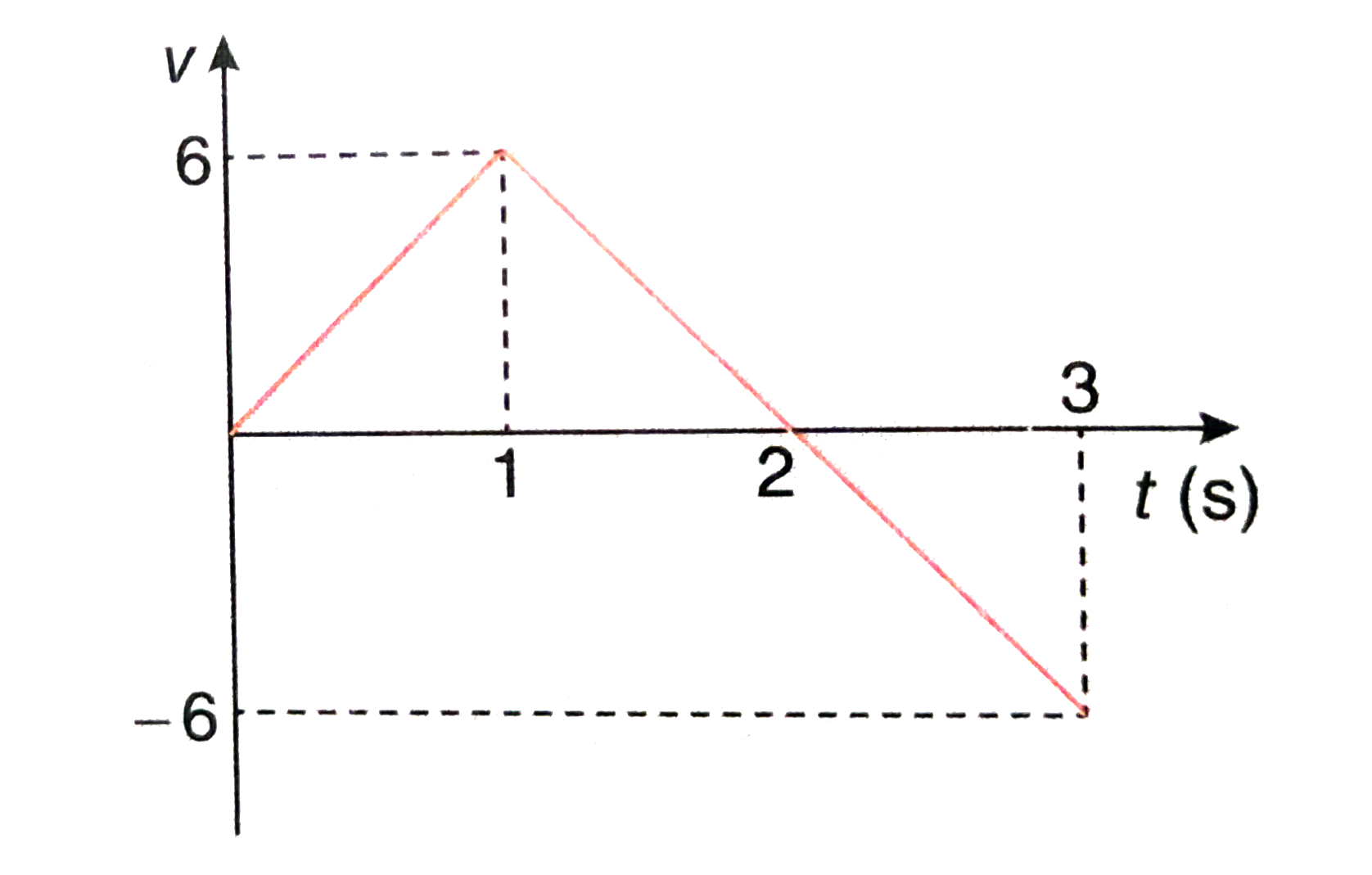 Total displacement = area under the v - t curve `=1/2 xx 2 xx 6 - 1/2 xx 1 xx 6 = 3m` `:.` Average VELOCITY = `("total displacement")/("total time") = 3/5 = 1 m//s` Total path TRAVELLED = `1/2 xx 2 xx 6 + 1/2 xx 1 xx 6 = 9 m` `:.` Average speed = `("total path travelled")/("total time") = 9/3 = 3 m//s` . |
|
| 19. |
A Ge specimen is doped with Al. The concentration of acceptor atoms is 10^(21)"atoms/m"^(3). Given that the intrinsic concentration of electronhole pairs is 10^(19)//m^(3), the concentrationof electrons in the specimen is ……. |
|
Answer» `10^(17)//m^(3)` For p-type semiconductor `n_(h)~~ N_(A)` where `N_(A)` is the concentration of acceptor atoms. Also `n_(h)n_(e )=n_(i)^(2)` where `n_(h)=` concentration of holes `=10^(21) "atom/m"^(3)` `n_(i)=` CONCENTRATIONOF electron-pair `=10^(19)"atom/m"^(3)` `n_(e )=` concentration of electron, `THEREFORE n_(e )=(n_(i)^(2))/(n_(h))=((10^(19))^(2))/(10^(21))=10^(17)"atoms/m"^(3)` |
|
| 20. |
A p-n photodiode is fabricated from a semiconductor with band gap of 2.8 eV. Can it detect a wavelength of 6000 nm? |
| Answer» SOLUTION :NO (HV has to be GREATER than `E_(G)`). | |
| 21. |
In an athletic-meet an athlete has to throw a shot put with mass 10 kg with an initial velocity 1 ms at an angle 45^(@) with the horizontal from a platform 1.5 m above the ground. What will be the kinetic energy of this shot put when it just strikes the ground. Assume the air resistance to be negligible and take the value of 'g' to be 10 ms? |
|
Answer» 5.0 J `E_k=1/2mv^2=1/2xx10xx(1)^2` `:.` K.E. of STRIKE at the same level `E_k=5J` Now P.E. at the height 1.5 m `E_P=mgh=10xx10xx1.5` =150 J Total ENERGY of FINAL strike =150+5=155 J. |
|
| 22. |
Diameter or aperture of a plano - convex lens is 6 cm and its thickness at the center is 3 mm. The image of an object formed is real and twice the size of the object. If the speed of light in the material of the lens is 2xx10^(8)ms^(-1). The distance where the object is placed from the plano - convex lens is .............. xx15cm. |
|
Answer» |
|
| 23. |
A plane monochromatic light wave of intensity I_(0) falls normally on the surfaces of the opaque screens which are shaped as shown in the figure here. The shaped as shown in the gigure here. The rounded-off edge coinicides with the boundary of the first Fresnel zone. Find the intensity of the screens at a point located behind the point P. |
| Answer» SOLUTION :`25/16 I_(0), 49/16 I_(0), 9/4 I_(0)` | |
| 24. |
(A) : Current versus time graph is as shown in figure, rms value of current is 4A. (R) : For a constant current, rms current is equal to that constant value. |
|
Answer» Both 'A' and 'R' are TRUE and 'R' is the correct EXPLANATION of 'A'. |
|
| 25. |
Li nucleus has three protons and four neutrons. Mass of Li nucleus is 7.016005 amu. Mass of proton is 1.007277 amu and mass of neutron is 1.008665 amu. Mass defect of lithium nucleus in amu is |
|
Answer» <P>0.04048 AMU `=3.021831+4.03466=7.056491" amu"` `THEREFORE"MASS DEFECT "=7.056491-7.016005=0.040486amu` |
|
| 26. |
A cylindrical tube, open at both ends, has a fundamental frequnecy ,f in air. The tube is dipped vertically in water so that half of it is in water. The fundamental frequency of the air-column is now : |
|
Answer» 2f `f_(0) = (v)/(4l.)= (v)/(4 xx (l)/(2)) = (v)/(2l ) = f ` So, correct CHOICE is B. |
|
| 27. |
A monochromatic beam of light is incided at 60^(@) in one face of an equilateral prism of refractive index n and emerges from the opposite face making an angle theta(n) with the normal (see the figure). For n=sqrt3 the value of theta is 60^(@) and (dtheta)/(dn)=m. The value of m is |
|
Answer» |
|
| 28. |
Find the equivalent resistances between the points a and c of the network shown in figure. Each resistance is equal to r. |
|
Answer» Solution :Suppose a potential difference V is applied between a and c so that a current I enters at a and the same current LEAVES at c. The current I DIVIDES in three parts at a. By symmetry, the part in ad and in AB will be equal. LET each of these currents be`i_(1).`The current through ao is `i-2i_(1).`Similarly , surrent i. Since the situation at c is equivalent to that at a, by symmetry the currents in dc and bc will be `i_(1)` and that in oc will be `i-2i_(1).` `APPLYING Kirchhoff's junction law at d, we see that the current in do in zero. Similarly,the current in ob is zero. We can remove do and ob for further analysis. It is then equivalent to three resistances, each of value 2r,in parallel.the equivalent resistance is, therefore,`2r/3`. |
|
| 29. |
Using Bohr's postulates, derive the expression for the frequency of radiation emitted when electron in hydrogen atom undergoes transition from higher energy state (quantum number n_(i)) to the lower state, (n_(f)). When electron in hydrogen atom jumps from energy state n_(i) = 4 to n_(f) = 3, 2, 1, identify the spectral series to which the emission lines belong. |
|
Answer» Solution :In the hydrogen atom, Radius of electron orbit, `r=(n^(2)h^(2))/(4 pi^(2)kme^(2))""...(i)` Kinetic energy of electron, `E_(K)=(1)/(2)nv^(2)=(ke^(2))/(2r)` Using equation (i), we get `E_(K)=(de^(2))/(2)(4 pi^(2)kme^(2))/(n^(2)h^(2))=(2pi^(2)k^(2)me^(4))/(n^(2)h^(2))` Potential energy, `E_(p)=(-k(E)xx(e))/(r)=(-ke^(2))/(r)` Using `eq^(n)` (i), we get `E_(p)=-ke^(2)xx(4pi^(2)kme^(2))/(n^(2)h^(2))=-(4pi^(2)k^(2)me^(4))/(n^(2)h^(2))` Total enery of electron, `E=(2pi^(2)k^(2)me^(2))/(n^(2)h^(2))-(4pi^(2)k^(2)me^(4))/(n^(2)h^(2))=-(2pi^(2)k^(2)me^(4))/(n^(2)h^(2))=-(2pi^(2)k^(2)me^(4))/(h^(2))xx((1)/(n^(2)))`. Now, according to BOHR's frequency condition when electron in hydrogen atom undergoes transition from higher energy STATE to the lower state `(n_(f))` is, `hv = E_(ni)-E_(nf)` `or""hv=-(2pi^(2)k^(2)me^(4))/(h^(2))xx(1)/(n_(i)^(2))-((-2pi^(2)k^(2)me^(4))/(h^(2))xx(1)/(n_(f)^(2)))` `or hv=(2pi^(2)k^(2)me^(4))/(h^(2))xx((1)/(n_(f)^(2))-(1)/(n_(i)^(2)))rArr v = (2pi^(2)k^(2)me^(4))/(h^(3))xx((1)/(n_(f)^(2))-(1)/(n_(i)^(2)))` `v = (C2 pi^(2)k^(2)me^(4))/(Ch^(3))xx((1)/(n_(f)^(2))-(1)/(n_(i)^(2)))` `(2pi^(2)k^(2)me^(4))/(Ch^(3)) = R` = Rydberg constant `R = 1.097 xx 10^(7) m^(-1)` Thus, `v = R xx ((1)/(n_(f)^(2))-(1)/(n_(i)^(2)))` `{:("Now, higher state,",,),(,n_(i)=4,),("Lower state,",,),(,n_(f)="3,2,1",):}""{:("For the transition"),(n_(i)=4 "to n"_(f)=3","rarr "Paschen Seriers"),(n_(i)=4 "to n"_(f)=2"," rarr "Balmer Series"),(n_(i)=4 "to n"_(f)=1"," rarr "Lyman Series"):}` |
|
| 30. |
"Lux" is a unit of |
|
Answer» Luminous intensity of a SOURCE |
|
| 31. |
Sound waves travel at 350 m/s through warm air and at 3,500m/s through brass. What happens to the wavelength of a 700 Hz acoustic wave as it enters brass from warm air? |
|
Answer» It decreases by a factor of 20 `lamda_("in BRASS")=(v_("in brass"))/(f)=(10v_("in air"))/(f)=10lamda_("in air")`. |
|
| 32. |
Readings of length of a pole are 2.63m, 2,56m, 2.71m and 2,80 m . Calculate the absolube errors and relative errors and percentange errors. What do you think of the actural value of the length and its limits? |
|
Answer» Solution :The mean value of length `L = ((2.63 + 2.56 + 2.42 + 2.71 + 2.80)m)/(5)` `= (13.12)/5 m = 2.624m = 2.63m` As the lengths are measured to a RESOLUTION of `0.01m`, all lengths are given to the second PLACE of DECIMAL, it is proper to ROUND off this mean length also to the second place of decimal. |
|
| 33. |
A ray of light travelling in impure water is incident on a glass plate immersed in it. Wher the angle of incidence is 51^(@), the reflected ray i totally plane polarised. Given that refractiv index of impure water is 1.4. The refractive index of glass should be ...... |
|
Answer» `1.64` `n=(n_(g))/(n_(W)) rArr n_(g)=nxxn_(w)` `=1.235xx1.4` `=1.729` `=1.73` |
|
| 34. |
Two monochromatic (wavelength = a/5) and coherent sources of electromagnetic waves are placed on the x-axis at the points (2a,0) and (-a,0). A detector moves in a circle of radius R(gtgt2a) whose centre is at the origin. The number of maxima detected during one circular revolution by the detector are |
|
Answer» 60 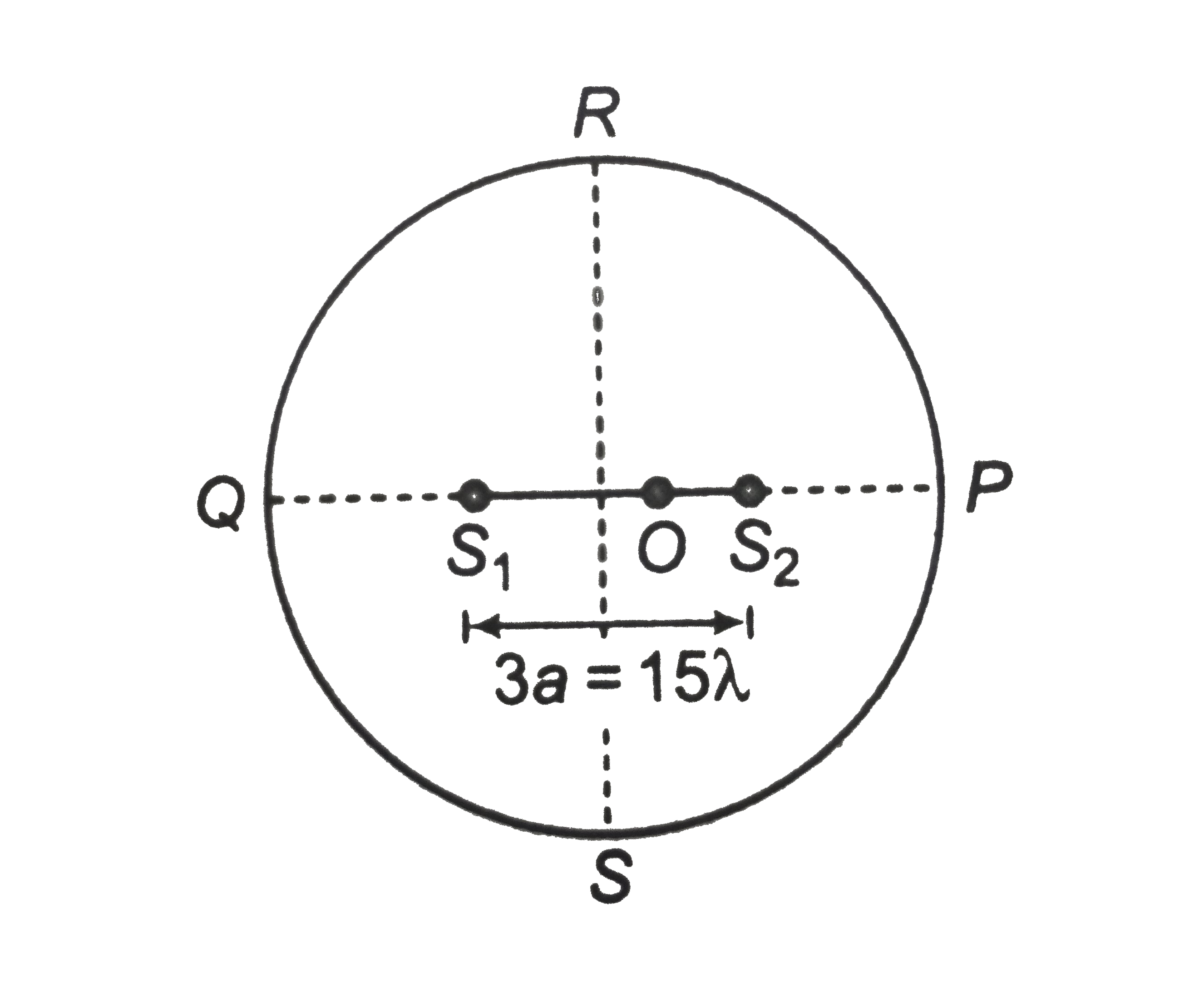 `|Deltax| = 15`, THEREFORE MAXIMA At points R and S `Deltax=0`, therefore maxima. Between P and R (and similarly in other three QUADRANTS), we will get 14 maxima corresponding to, `Deltax = lambda, 2lambda ...... 14lambda`. Therefore, total MAXIMAS are 60. |
|
| 35. |
Mention any one application of gamma- ray. |
|
Answer» Solution :`gamma `--RAYS are used 1. For detecting flaws in metal CASTINGS 2. To produce nuclear reaction 3. In RADIOTHERAPY to treat the CANCER and tumours.(Any one) |
|
| 36. |
Resistances P, Q, S and R are arranged in a cyclic order to form a balanced Wheatstone's bridge network. The ratio of power consumed in the branches (P+Q) and (R+S) is |
|
Answer» `1:1` POWER DISSIPATION in resistance R with voltage V is `V^(2)//R`. `therefore (P_(P+Q))/(P_(R+S))=(R+S)/(P+Q)""...(ii)` From equation (i) `(P)/(Q)+1=(R)/(S)+1` `(P+Q)/(Q)=(R+S)/(S)or(R+S)/(P+Q)=(S)/(Q)` Using (i), we get `(R+S)/(P+Q)=(R)/(P), therefore (P_(P+Q))/(P_(R+S))=(R)/(P)` |
|
| 37. |
Plot a graph showing the variation of stopping potential with the frequency of incident radiation for two different photosensitive materials having work functions W_(1) and W_(2)(W_(1) gt W_(2)). On what factors does the (i) slope and (ii) intercept of the lines depend ? |
Answer» Solution : A graph showing the variation of stopping potential `V_(0)` with the frequency v of incident radiation for two different photosensitive materials having work functions `W_(1) and W_(2)(W_(1) gtW_(2))` have been shown. the graphs are straight lines as shown. (i) Slope of the `V_(0)-v` lines is same both materials and has a VALUE `H/e`, where h=Planck.s CONSTANT and e=electron charge. (II) Intercept of `V_(0)-v` line along v-axis depends on the work function or the threshold frequency `v_(0)` of the photosensitive materials where `v_(0)=(W)/(h)`. |
|
| 38. |
Assertion (A): A bird perches on an electric power line but nothing happens to the bird. Reason (R) : The level of bird on the power line is quite high above the ground. |
|
Answer» If both assertion and REASON are true and the reason is the correct explanation of the assertion. |
|
| 39. |
A person peddles a stationary bicycle the pedals of the bicycle are attached to a 100 turn coil of area 0.10 m^(2). The coil rotates at half a revolution per second and it is placed in a uniform magnetic field of 0.01 T perpendicular to the axis of rotation of the coil, What is the maximum voltage generated in the coil ? |
|
Answer» Solution :Here f=0.5Hz, N=100, A=0.1 `m^(2)` and B=0.01T from the equation `epsilon=epsilon_(0) SIN omega t= NBA omega sin omega t` maximum emf `epsilon_(0)= NBA omega = NBA(2 pi f)` `epsilon_(0) = 100 xx 0.01xx0.1xx2 xx 3.14 xx 0.5 = 0.314 V` |
|
| 40. |
Hydrogen atom is excited from ground stats to swather state with principal quantum number equal to 4. Then the number of spectral lines in the emisakon spatra will be: |
|
Answer» 2 |
|
| 41. |
A particle is projected at 60° to the horizontal with a kinetic energy K. The kinetic energy at the highest point is: |
|
Answer» Zero K.E. at the TOP `=1/2mv^(2)cos^(2)theta=Kcos^(2)60^@=K/4` |
|
| 42. |
A conducting ring of radius b is placed coaxially in a long solenoid of radius a (b < a) having n turns per unit length. A current i = i_(0), cos omega t flows through the solenoid. The induced emf in the ring is |
|
Answer» ZERO |
|
| 43. |
The momentum of a photon of energy 1 MeV is kg m/s will be |
|
Answer» <P>`5 xx 10^(-22)` |
|
| 44. |
In Young's double slit experiment, carried out with light of wavelength lambda= 5000 Å the distance between the slits is 0.2 mm and the screen is at 200 cm from the slits. The central maximum is at x = 0. The third maximum (taking the central maximum as zeroth maximum) will be at x equal to ...... |
|
Answer» `1.67 cm` `=3xx5000xx10^(-10)xx(2)/(0.2xx10^(-3))` `=1.5xx10^(-2)m=1.5 cm` |
|
| 45. |
निम्न में से कौन-सा एक मात्रकों की ब्रिटिश पद्धति का मात्रक नहीं है? |
|
Answer» फुट |
|
| 47. |
Where on the surface of earth is the angle of dip 90^@ ? |
| Answer» SOLUTION :At the MAGNETIC POLES of the EARTH. | |
| 48. |
Assertion:When a nucleus is in an excited state, it can make a transition to a lower energy state by the emission of gamma rays . Reason:These are energy levels for a nucleus just like there are energy levels in atoms . |
|
Answer» If both ASSERTION and reason are TRUE and reason is the correct EXPLANATION of assertion . |
|
| 49. |
A source emitting sound of frequency f_0 is moving in a circle of radius R, having centre at the origin with a uniform speed =c/3 where c is the speed of sound.Find the maximum and minimum frequencies heard by stationary listener at the point (R/2,0) |
|
Answer» ` (6f_0)/( 5) ,( 6f_0)/( 7) ` |
|
| 50. |
An electron moving perpendicular to a uniform magnetic field 0.500 T undergoes circular motion of radius 2.80 mm. What is the speed of electron ? |
|
Answer» SOLUTION :CHARGE of an electron q = -1.60 `xx 10^(-19) C rArr |a| = 1.60 xx 10^(-19)` C Magnitude of magnetic field B = 0.500 T Mass of the electron, m = 9.11 `xx 10^(-31)` kg Radius of the orbit , r = 2.50 mm = `2.50 xx 10^(-3)` m Velocity of the electron, v = (q) `(RB)/(m) rArr v = 1.60 xx 10^(-19) xx (2.50 xx 10^(-3) xx 0.500)/(9.11 xx 10^(-11)) ` v = 2.195`xx 10^(8) ms^(-1)` |
|