Saved Bookmarks
This section includes 7 InterviewSolutions, each offering curated multiple-choice questions to sharpen your Current Affairs knowledge and support exam preparation. Choose a topic below to get started.
| 1. |
(a) In Young's double slit experiment, describe briefly how bright and dark fringes obtained on the screen kept in front of a double slit. Hence obtain the expression for the fringe with. (b) The ratio of the intensities at minima in Young's double slit experiment is 9 :25. Find the ratio of the widths of the two slits. OR (a) Describe briefly how a diffractoin pattern is obtained on a screen due to a single narrow illuminated by a monchromatic source of light. Hence obtain the condition for the angular width of secondary maxima and secondary minima. (b) Two wavelengths of sodium light of 590 nm and 596 nm are used in turn to study the diffraction taking place at a single slit of aperture 2xx10^(-6). The distance between the positions of first maxima of the difraction pattern obtained in the two cases. |
|
Answer» SOLUTION :(b) For first maxima `asintheta=(3)/(2)lambda` `y=(3lambdaD)/(2a)` for `590 NM` `y_(1)=0.66375m` for `596nm` `y_(2)=0.6705 m` `y_(2)-y_(1)=0.00675m` |
|
| 2. |
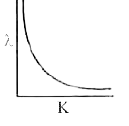
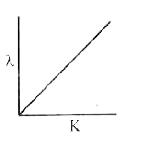
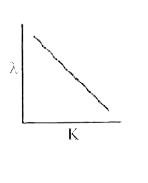
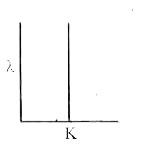
Identify the graph depicting the variation of the de Broglie wavelength lambda of an electron with its kinetic energyK. |
| Answer» ANSWER :A | |
| 3. |
The dimensional formulu fur magnetic flux is |
|
Answer» `[ML^(2)T^(-2) A^(-1)]` |
|
| 4. |
Hence ohtaln the work done in bringingcharge of 2 xx 10^(-9) C . From infinity to the point P. Does the answer depend on the path along which the charge is brought ? |
|
Answer» <P> Solution :Let V(P) = and `V(oo) =0``:. V(P)-V(oo) = DeltaV=V=4xx10^(4)V` Now the work done in bringing a charge of `2xx10^(9)` C from infinity to the point P, W= q `DeltaV=qV` `= 2xx10^(-9) xx4xx10^(4)` `:. W= 8 xx10^(-5)J` No work done will be path independent. Any ARBITRARY infinitesimal path can be resolved into two PERPENDICULAR displacements. (1) Along parallel to displacement `vecr` and (2) Along perpendicular to displacement `vecr`. But work done corresponding to perpendicular component will be zero. |
|
| 5. |
If wavelength of incident light for Rayleigh scattering is decreased from 8000 Å to 4000 Å, then intensity of scattered light will become ...... times then that of initial intensity. |
|
Answer» Solution :`I=(I)/(lambda4)` `(I_2)/(I_1)=(lambda_1)/(lambda_2)^4` `THEREFORE I_2=I_1xx((8000)/(4000))^4` `=I_1xx(2)^4` `=16I_1` |
|
| 6. |
The volume charge density inside of sphere of radius R is given by rho = rho_(0) (1 - (r )/(R )) ,where rho_(0) is constant and r distance from centre. (a) Find total charge Q inside sphere. Electric field outside sphere at distance r from centre. (b) Electric field outside sphere at distance r from centre. (c) Electric field inside sphere at distance r from centre. (d) At what distance from centre electric field is maximum and its value? (e ) Sketch E versus r graph. |
|
Answer» Solution :To take element on spherical VOLUME , we choose a spherical shell of radius `r` and thickness `dr` Volume of element `dV = (4)/(3) pi ( r + dr)^(3) - (4)/(3) pi r^(3) = 4 pi r^(2) dr` (a) Small charge in small volume `dq = rho dV = rho_(0) (1 - (r )/(R )) 4 pi r^(2) dr` `Q = 4 pi rho_(0) int_(0)^(2) (r^(2) = (r^(3))/(R )) dr` `= 4 pi rho_(0) |(r^(3))/(3) - (r^(4))/(4 R)|_(0)^(R ) = 4 pi rho_(0) ((R^(3))/(3) - (R^(4))/(4R))` ` = (4 pi rho_(0) R^(3))/(12) = (pi rho_(0) R^(3))/(3)` (B) For apoint `(r gt R)`, whole charge is assumed to be concentrated at centre `E = (1)/(4 pi in_(0)) (Q)/(r^(2)) = (1)/(4 pi in_(0)) .(pi rho_(0) R^(3))/(3r^(2)) = (rho_(0) R^(3))/(12 in_(0)r^(2))`. `E` versus `r` will be rectangular hyperbola type . At `r = R , E = (rho_(0) R)/(12 in_(0))` (c ) For a point `(r lt R)` , change inside sphere of radius `r` `q = int_(0)^(r ) rho dV = int_(0)^(r ) rho_(0) (1 - (r )/(R)) 4 pi r^(2) dr = 4 pi rho_(0) int_(0)^(2) (r^(2) - (r^(3))/(R )) dr` `= 4 pi rho_(0) |(r^(3))/(3) - (r^(4))/(4 R)|_(0)^(R ) = 4 pi rho_(0) ((r^(3))/(3) - (r^(4))/(4 R))` `E = (1)/(4 pi in_(0)) .(q)/(r^(2)) = (1)/(4 pi in_(0)) . 4 pi rho_(0) ((r)/(3) - (r^(2))/(4 R))` `= (rho_(0))/(in_(0)) ((r)/(3) - (r^(2))/(4 R))`, `E` versus `r` will be parabola open downward. At `r = R , E = (rho_(0))/(in_(0)) ((R )/(3) - (R^(2))/(4R)) = ( rho_(0) R)/(12 in_(0))` (d) If `r gt R` i.e. outside sphere , electric field is decreasing CONTINUOUSLY as `E = (rho_(0) R^(3))/(12 in_(0) r^(2))` The electric field will be maximum inside sphere `(r lt R)`, `E =(rho_(0))/(in_(0)) ((r )/(3) - (r^(2))/(4 R))` For `E` to be maximum `(dE)/(dr) = (rho_(0))/(in_(0)) ((1)/(3) - (2 r)/(4 R)) = 0rArr r = (2 R)/(3)` `E_(MAX) = (rho_(0))/(in_(0)) [(2R)/(9) - (R )/(9)] = (rho_(0) R)/(9 in_(0))` (e ) `E` versus `r` graph 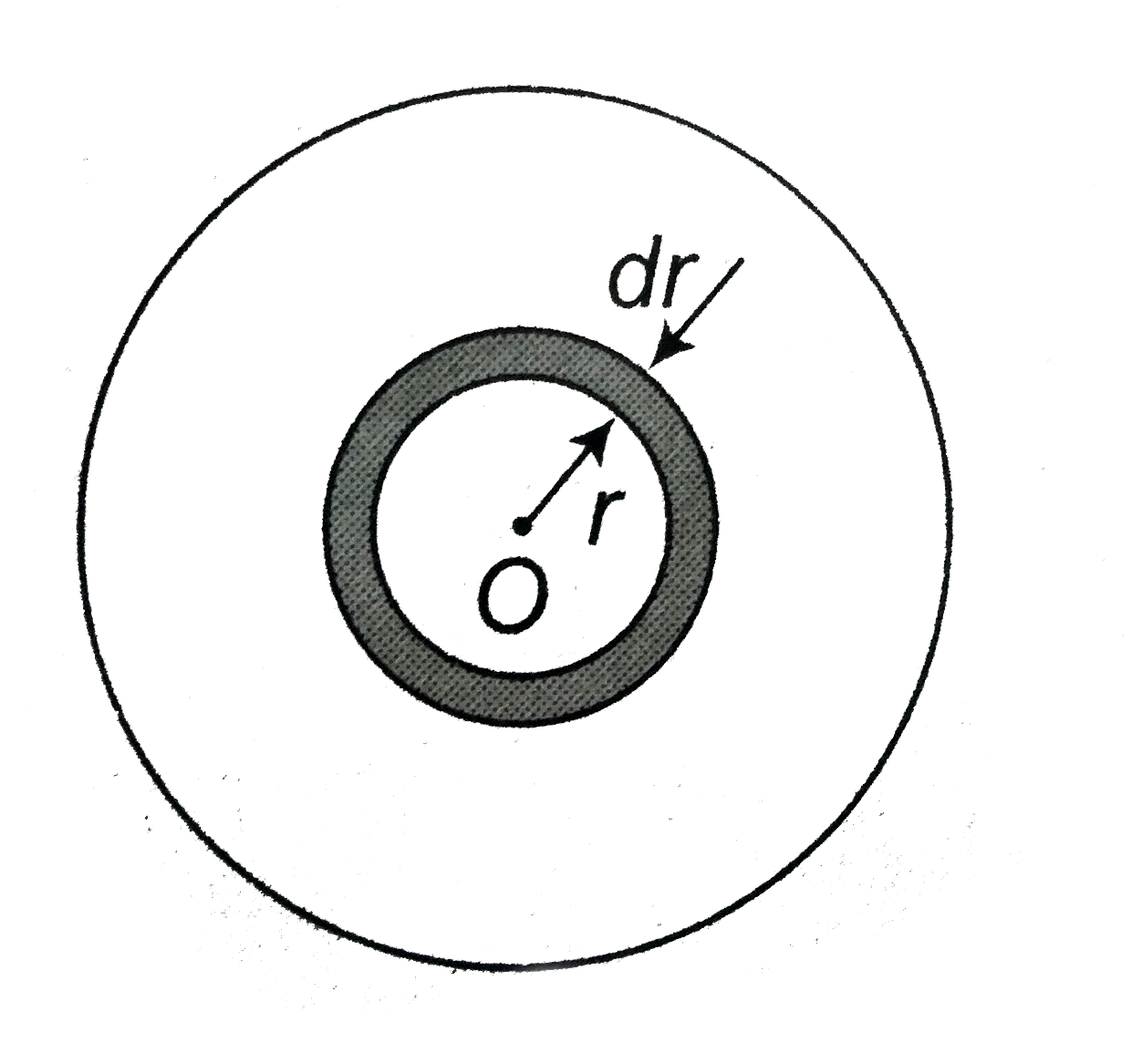 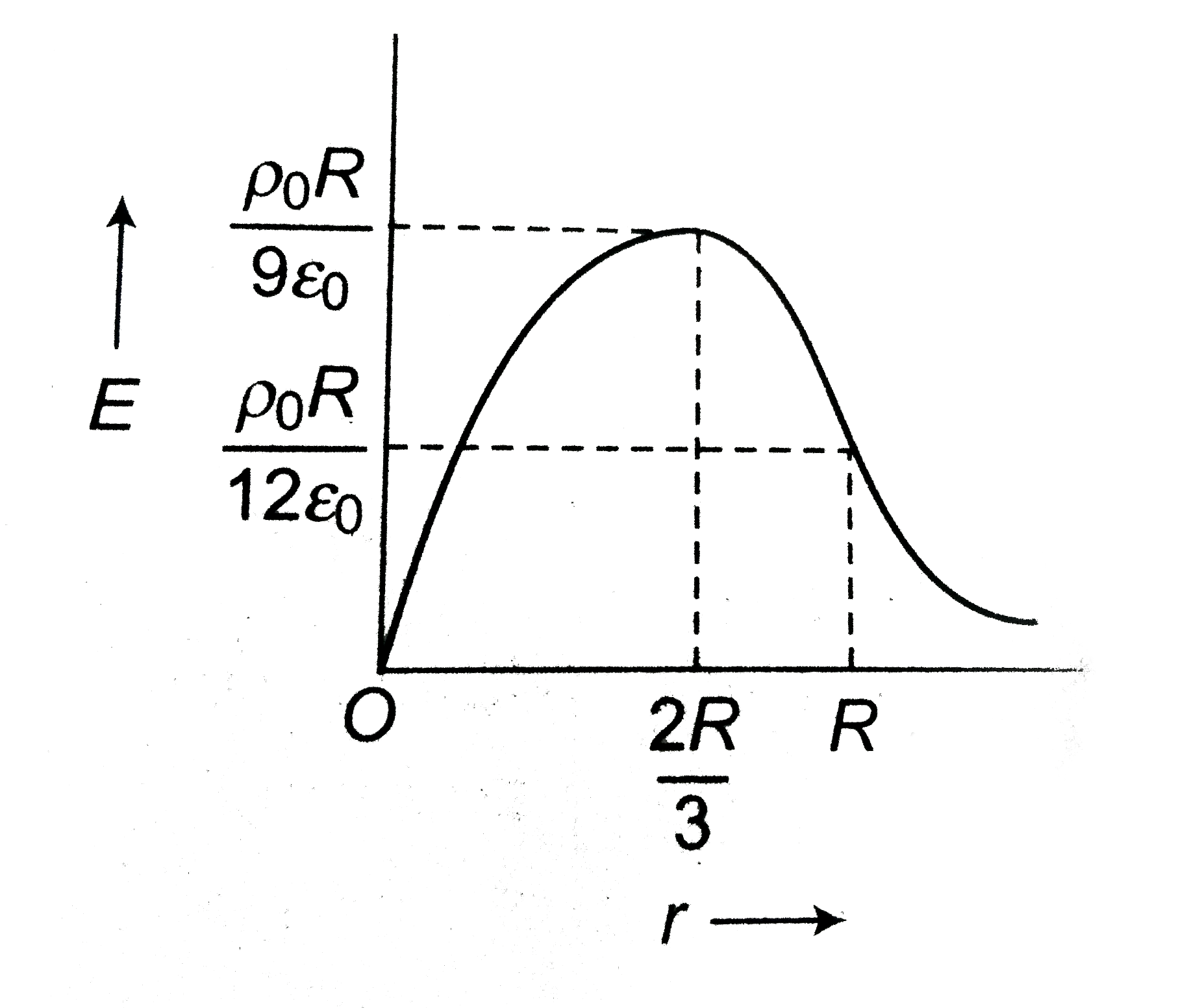
|
|
| 7. |
A concave mirror of radius 40cm lies on a horizontal table and water is filled in it up to a height of 5.00 cm. A smalll dust particles floats on the water surface at a point P vertically above the point of contact of the mirror with the table. Locate the image of the dust partical as seen from a point directly above it . The refractive index of water 1.33. |
|
Answer» Solution :The ray diagram is shown in the following FIGURE. Let us first locate the mage FORMED by the concave mirror. Let us take vertically upward as the negative axis. Then, `R=-40cm.` The OBJECT distance is `u=-5cm. ` Using the mirror equation: `(1)/(u)+(1)/(v)=(2)/(R)` `(1)/(v)=(2)/(R)-(1)/(u)=(2)/(-40cm) -(1)/(-5cm)=(6)/(40)cm` or `v=6.67cm` The positivesign shows that the image `P_(1)` is formed below the mirror and hence, it is virtual. These reflected rays are REFRACTED at the water SURFACE and go to the observer. The depth of the point `P_(1)` from the surface is `6.67 cm +5.00cm=11.67cm.` Due to refraction at the water surface, the image `P_(1)` will be shifted above by a distance (`11.67` cm) `(1-(1)/(1.33))=2.92cm` Thus, the final image is formed at a point`(11.67-2.92)cm =8.75cm` below the water surface. 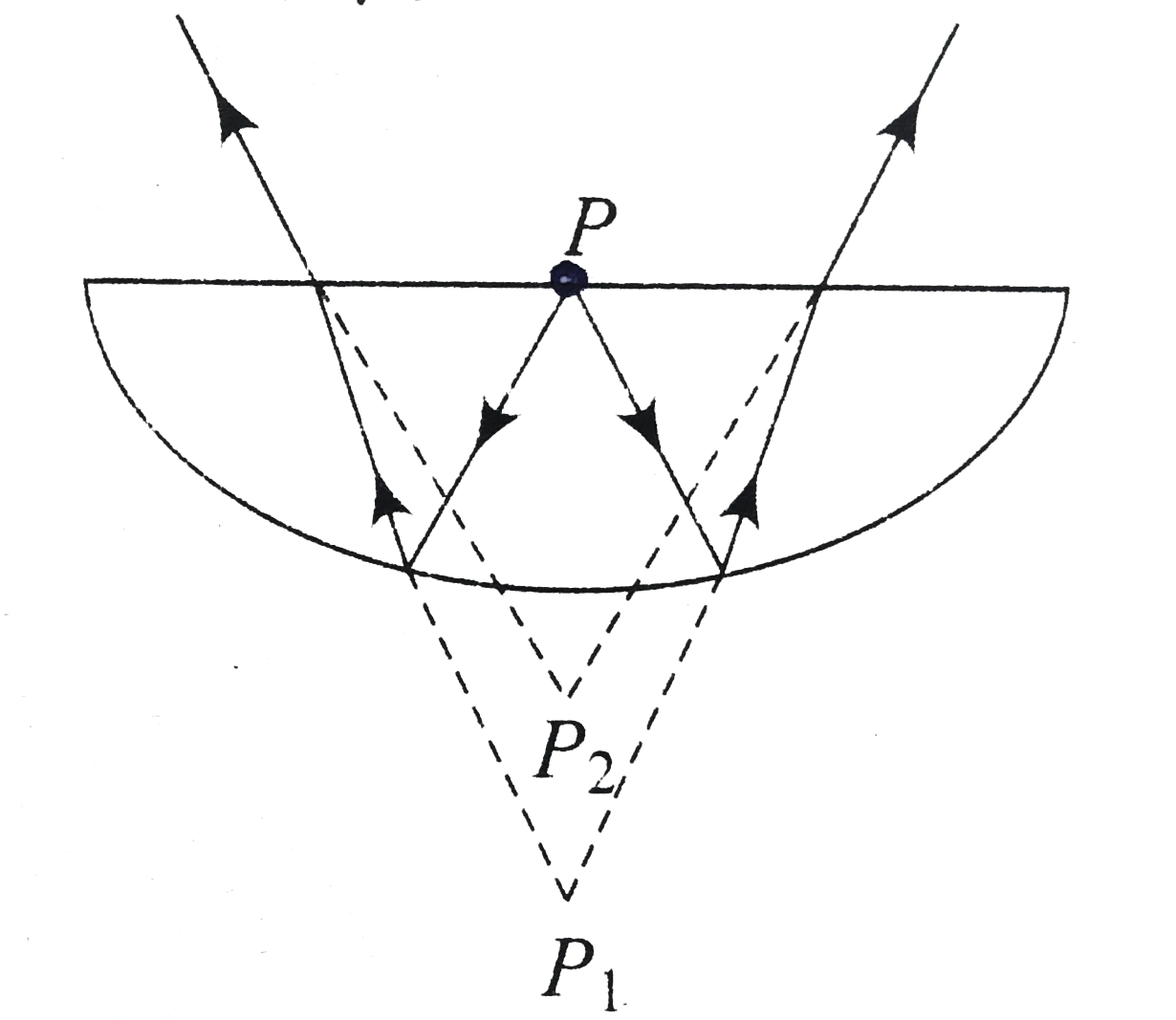
|
|
| 8. |
An adiabatic piston of mass m equally divides an insulated container of total volume v_(0) and length l. A light spring connect the piston to right wall. The container has helium gas. The pressure on both side of piston is P_(0). The container starts moving with acceleration 'a' towards right, find the stretch of the spring when acceleration of the piston equals acceleration of container. (Assume displacement of the piston lt lt l) |
|
Answer» SOLUTION :Free BODY diagram of the separator `P_(2)A+ma=P_(1)A+kx` ….(`1`) where `A` is the area of cross SECTION of separator and `x` is the stretch of the spring We can write `P_(0)((V_(0))/(2))^(gamma)=P_(1)((V_(0))/(2)-Ax)^(gamma)` …..(`2`) and `P_(0)((V_(0))/(2))^(gamma)=P_(2)((V_(0))/(2)+Ax)^(gamma)` ....(`3`) from equation `P_(1)=P_(0)((V_(0))/((V_(0)-2Ax)))^(gamma)=P_(0)((1)/(1-(2Ax//V_(0))))^(gamma)` `P_(1)=P_(0)(1-(2Ax)/(A(l//2)))^(-gamma)=P_(0)(1+(4xgamma)/(l))`.......(`4`) `(XLT lt l)` Similarly `P_(2)=P_(0)(1-(4xgamma)/(l))`.....(`5`) Substituting the values of `P_(1)` and `P_(2)` in equation (`1`) `P_(0)(1-(4xgamma)/(l))A+ma=P_(0)(1+(4xgamma)/(l))A+kx` `[k+(8gammaP_(0)A)/(l)]x=ma` `rArr x=[(ma)/(k+(8gammaP_(0)V_(0))/(l^(2)))]` 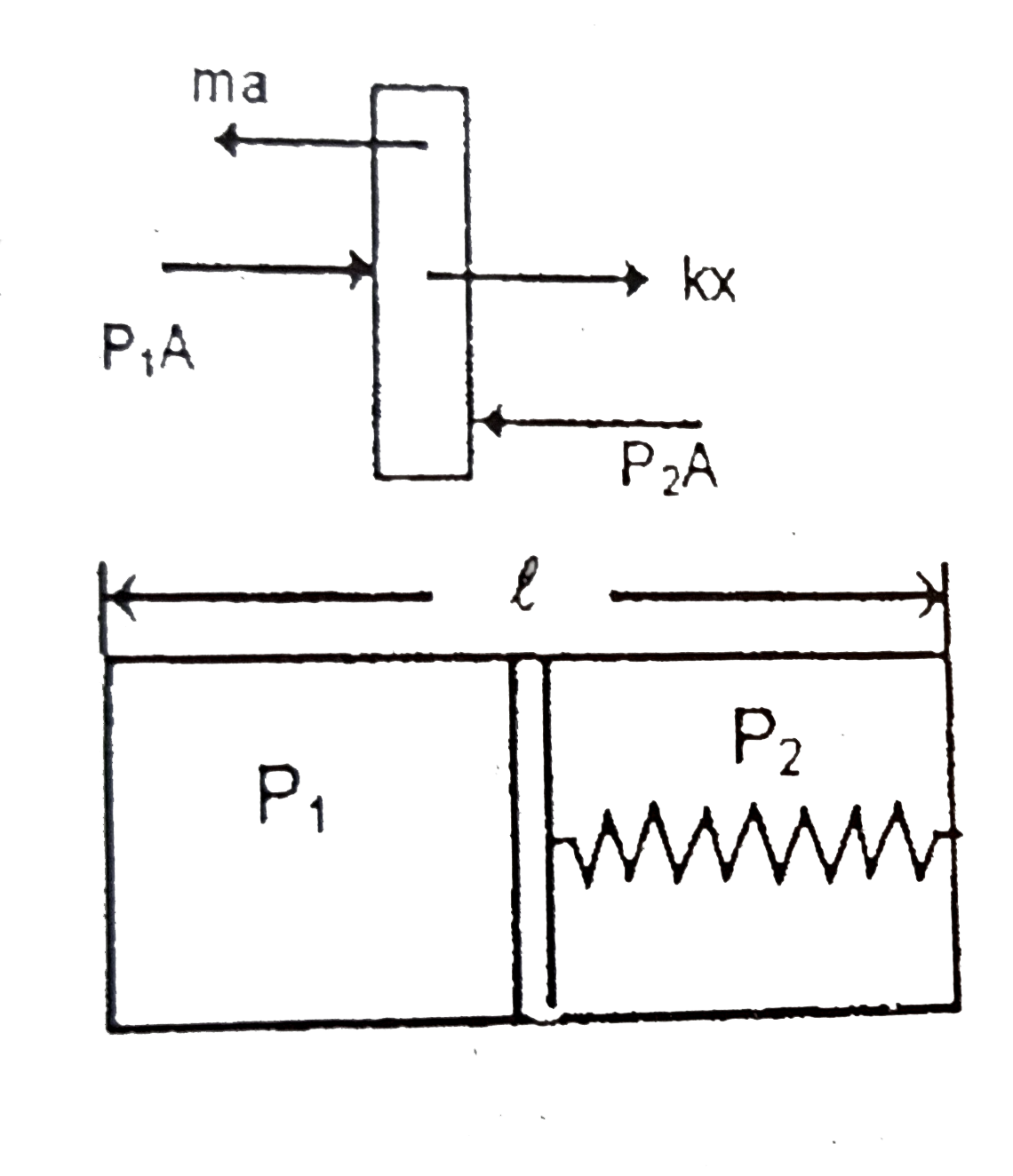
|
|
| 9. |
Find the ratio of magnetic field magnitudes at a distance 10 m along the axis and at 60^(@) from the axis, from the centre of a coil of radius 1 cm, carrying a current 1 amp. |
|
Answer» `(3)/sqrt(7)` |
|
| 10. |
An infinite ladder is constructed by connecting several sections of 2 mu F , 4 muFcapacitor combination as shown in figure . It is terminated by a capacitor of capacitance C. What value should be chosen for C such that the equivalent capacitance of the ladder between points A and B becomes independent of the number of sections in between |
|
Answer» `18 MU` F You can use hit and trial METHOD . |
|
| 11. |
Wavelength of electron obtained in Davisson-Germer experiment is.. |
|
Answer» 0.165 nm |
|
| 12. |
Half life period of lead is |
|
Answer» zero |
|
| 13. |
A nuclide can decay simultaneously by two different process A graph is plotted between activity (A) and number of nuclei (N) left at any time tas shown is figure. If the decay constant in one of the process is (1)/(3)S^(-1) then find the other decay constant. (take tan 37^(@)=3//4). |
|
Answer» |
|
| 14. |
A converging lens has a focal length of 0.12 m. To get an image of unit magnification the object should be placed at what distance from the converging lens ? |
|
Answer» 0.24 m |
|
| 15. |
Calculate the (a) Momentum, and (b) De-broglie wavelength of the electrons accelerated through a potential difference of 56 V. |
|
Answer» <P> SOLUTION :Here accelerating potential difference `V=56V`(a) `THEREFORE` Momentum of electron `p=SQRT(2mK)=sqrt(2mVe)=sqrt(2xx9.11xx10^(-31)xx56xx1.6xx10^(-19))` `=4.04xx10^(-24)KG" ms"^(-1)` (b) `therefore`de-Broglie wavelength `lamda=(h)/(p)=(6.63xx10^(-34))/(4.04xx10^(-24))=1.64xx10^(-10)m=0.164nm`. |
|
| 16. |
If galvanometer and battery are interchanged in balanced Wheatstone bridge, then |
|
Answer» the battery discharges |
|
| 17. |
What we call the region around a current a current carrying conductor (or a magnet). Where magnetic effects can be experienced ? |
| Answer» SOLUTION :MAGNETIC FIELD | |
| 18. |
A circuit consisting of a capacitor and a coil connected in seried if fed two alternating voltages of equal amplitudes but different frequencies. The frequency of one voltage is equal to the natural oscillation frequency ( omega_(0)) of the circuit, the frequency of the othervoltage is eta times highter. Find the ratio of the current amplitudes (I_(0)//I) generated by the two voltages if the quality factor of the system is equal to Q. Calculate this ratio for Q=10 and 100, if eta=1.10. |
|
Answer» Solution :At resonance ` omega= omega_(0)` `I_(m) ( omega_(0))=(V_(m))/( R)` Then `I_(m)(etaomega_(0))=(V_(m))/( sqrt(R^(2)+(eta omega_(0)L-(1)/( eta omega_(0)C))^(2)))` `=(V_(m))/( sqrt(R^(2)+(eta-(l)/( eta))^(2) (L)/(C)))=(V_(m))/sqrt(1+(Q^(2)+(l)/(4))(eta-(1)/(eta))^(2)(L)/(C))` |
|
| 19. |
What is Joule's heating effect ? |
| Answer» Solution :When CURRENT FLOWS through a resistor, some of the ELECTRICAL ENERGY delivered to the resistor is converted into HEAT energy and it is dissipated. This heating effect of current is known as Joule.s heating effect. | |
| 20. |
Current of 2A passing through a coil of 100 turns gives rise to a magnetic flux of 5 xx 10^(-3) Wb per turn. The magnetic energy associated will coil is ____ |
|
Answer» `5xx10^(-3)` J `N phi = LI` `therefore L=(N phi)/I`…(1) The energy linked the coil `U=1/2LI^2` `therefore U=1/2 xx (Nphi)/I xx I^2` [ `because` from eqn. (1)] `therefore U=1/2 xx N PHII` `=1/2xx100xx5xx10^(-3)xx2` `therefore` U=0.5 J |
|
| 21. |
The 6000Å line emitted by a gaseouselement in a star iis found to have red shift of15Å. What is the speed with which the star is receding from the earth ? (c=3 xx 10^(8) m//s ) |
|
Answer» `5xx10^(5) m//s ` ` Delta lambda=((v)/(c))lambda ` `:.""v=c((Delta lambda)/(lambda))=3 xx 10^(8) xx (15 xx 10^(-10))/(6000 xx 10^(-10))` `:. ""v=(45xx10^(8))/(6 xx 10^(3))=7.5xx10^(5) m//s ` |
|
| 22. |
In a transistor connected in a common emitter mode, R_o-4kW, R_i=1W,I_c=1muA and I_b =20muA. The voltaged gain is : |
|
Answer» 100 `=(1XX10^(-3))/(20xx10^(-6))xx4/1` `=1000/5=200`. |
|
| 23. |
In Davisson-Germer experiment, the correct relation between angle of diffraction and glancing angle is : |
|
Answer» `THETA=90^(@)-(PHI)/(2)` `:. theta=90^(@)-(phi)/(2)` 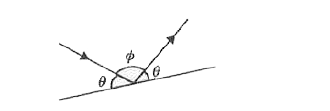
|
|
| 24. |
A pool cue striking a stationary billiard ball (mass=0.25kg) gives the ball a speed of 2 m/s. If the force of the cue on the ball was 25N, over what distance did this force act? |
|
Answer» Solution :The kinetic energy of the ball as it LEAVES the cue is `K=(1)/(2)MV^(2)=(1)/(2)(0.25kg)(2m//s)^(2)=0.5J` The WORK W done by the cue gave the ball this kinetic energy, so `W=DeltaKimpliesW=K_(i) implies Fd=Kimplies d=(K)/(F)=(0.5J)/(25N)=0.02m=2cm` Note that this could have been solved by using `F_("net")=ma` to find the acceleration, and them using Big Five +5 to find the displacement. |
|
| 25. |
An object is placed in front of a concave mirror of focal length 20 cm. The image formed is three times the size of the object. Calculate two possible distances of the object from the mirror? |
|
Answer» SOLUTION :`m= pm 3` `m=(-v)/u=+3` for virtual image `v=-3u` `1/v+1/u=1/f` `1/(-34)+1/u=-1/20` `u=-40/3 CM` `m=(-v)/u=-3` for real image `v=3u` `1/v+1/u=1/f` `1/(3u)+1/u=-1/ 20` `u=-80 /3CM` |
|
| 26. |
Name the e.m. waves in the wavelength range 10 nm " to " 10^(-3)nm. How are these waves generated ? Write their two uses. |
|
Answer» SOLUTION :X-rays: They are generated by BOMBARDING a TARGET of high atomic number Z with a beam of fast MOVING electrons. Uses : (i) radio theapy for curing skin diseases. (ii) Medical diagnosis locating FRACTURE TB etc. |
|
| 27. |
Assertion : Kilovol-ampere (kVA) and kilowatt-hour have the same dimensions. Reason : Both are the units of energy. |
|
Answer» If both ASSERTION and REASON are true and Reason is the correct EXPLANATION of Assertion. |
|
| 28. |
A moon of mass m orbits a planet of mass 100 m. Let the strength of the gravitational force exerted by the planet on the moon be denoted by F_(1), and let the strength of the gravitational forc exerted by the moon on the planet be F_(2) . Which of the following is true ? |
|
Answer» `F_(1)= 100 F_(2)` |
|
| 29. |
A metallic square loop ABCD is moving in its own plane with velocity v in a uniform magnetic field perpendicular to its plane as shown in the figure. Find a) In which sides of the loop electric field is induced. b) Net emf induced in the loop. c) If one side .BC. is outside the field with remaining loop in the field and is being pulled out with a constant velocity then induced current in the loop. |
|
Answer» Solution : a) The METALLIC SQUARE loop moves in its own plane with VELOCITY V. A uniform magnetic field is imposed perpendicular to the plane of the square loop. AD and BC are `bot`to the velocity as well as I to field applied. Hence ELECTRIC field is induced ACROSS the sides AD and BC only. b) As there is no change of flux through the entire coil net emf induced in the coil is zero. c) Induced current `i = e/R` Where R is the resistance of the coil. ` rArr i = (Blv)/( R)`(Only the side AD cuts the flux ) |
|
| 30. |
As shown in the figure two sources producing sound Sr and Sn (velocity of sound 360 m/sec) each producing sound of frequency 200 Hz. S_(1)is rotating anti clock wise where as S_n is approaching observer O each with a speed 10 m/sec. (neglect radius of circular path of S_1), then calculate If wind is blowing from right to left with a speed 10 m/sec and observer is at rest find the number of beats received by observer when S_(1)is at A. (nearly) |
|
Answer» 5.5 |
|
| 31. |
As shown in the figure two sources producing sound Sr and Sn (velocity of sound 360 m/sec) each producing sound of frequency 200 Hz. S_(1)is rotating anti clock wise where as S_n is approaching observer O each with a speed 10 m/sec. (neglect radius of circular path of S_1), then calculate If O is approaching S_(1)with a speed 10 m/sec. Number of beats received by .O. per second when S_(1)is at A, (nearly) |
|
Answer» 4 BEATS/sec |
|
| 32. |
As shown in the figure two sources producing sound Sr and Sn (velocity of sound 360 m/sec) each producing sound of frequency 200 Hz. S_(1)is rotating anti clock wise where as S_n is approaching observer O each with a speed 10 m/sec. (neglect radius of circular path of S_1), then calculate Range of number of beats received by observer O at rest is (nearly) |
|
Answer» 0 to 11.2 |
|
| 33. |
When a beam of light is used to determine the position of an object, the maximum accuracy is achieved if the light is |
|
Answer» polarised |
|
| 34. |
Particles and their antiparticles have |
|
Answer» The same masses but OPPOSITE SPINS |
|
| 35. |
Compute the intensity of magnetisation of the bar magnet whose mass, magnetic momentand density are 200 g. 2 A m^(2) and 8 g cm^(-3),respectively. |
|
Answer» Solution :Density of the magnet is Density = `("Mass")/("Volume") rArr "Volume" = ("Mass")/("Density")` Volume = `(200 XX 10^(-3) kg)/((8 xx 10^(-3) kg) xx 10^(6) m^(-3)) = 25 xx 10^(-6) m^(3)`Magnitude of magnetic moment `p_(m) = 2 Am^(2)` Intensity of magnetization. I = `("Magnetic moment")/("Volume") = (2)/(25 xx 10^(-6))` M = 0.8`xx 10^(5) Am^(-1)` |
|
| 36. |
Consider the meter bridge circuit without neglecting and corrections (alpha, beta) If the unknown Resistance calculated without using the end corraction, is R_(1) and using the end corrections is R_(2) then |
|
Answer» `R_(1)gtR_(2)` when balanced point is in first HALF If balance point is second half say `l=70` MAXIMUM permissible error in `p`: the specific resistivity of wire, from meter bridge is `p=(piD^(2)S)/(4L)(l)/(100-l)` Assume that know resistance in `RB(S)`, and total length of wire is presicely known, then lets find maximum permissible error in `p` due to error in `p` due to error in measurement of `l` (Balance length and `D`(diameter of wire). In `p=In((piS)/(4L)+2InD+Inl-In(100-l))` `(DP)/(p)=2(dD)/(D)+(dl)/(l)-(d(100-l))/((100-l))` `=2(dD)/(D)+(dl)/(l)-(dl)/(100-l)` `((dp)/(p))_(max)=2(DeltaD)/(D)+(Deltal)/(l)-(Deltal)/(100-l)` `((dp)/(p))_(max)` due to error in `l` only is `=(Deltal)/(l)+(Deltal)/(100-l)=(Deltal(100))/(l(100-l))` `((dp)/(p))_(max)` will be least when `l(100-l)` if max imum, i.e. `l=50cm` |
|
| 37. |
A boy focuses Sunlight on a paper by using biconvex lens of focal length 10 cm. Such that paper can be burnt. Diameter of Sun is 1.39 xx 10^9 m and distance of Earth from Sun is 1.5 xx 10^(11) m approximately, then the diameter of image of Sun on paper will be |
|
Answer» `9.2xx10^(-4)` m `therefore` Image height =`|v/u|XX` object height `=(10^(-1))/(1.5xx10^(11))xx(1.39xx10^9)` `=0.92xx10^(-3)` m `=9.2xx10^(-4)` m Hence, diameter of image of SUN is `9.2 xx 10^(-4)` m. |
|
| 38. |
A battery 10 V and 0.5 Omega internal resistance is connected to a battery of 12 V and 0.8 Omega internal resistance and one terminal of battery is connected to a 20 Omega resistance, then the current flow in 20 Omega resistance is |
|
Answer» 0.3023 A 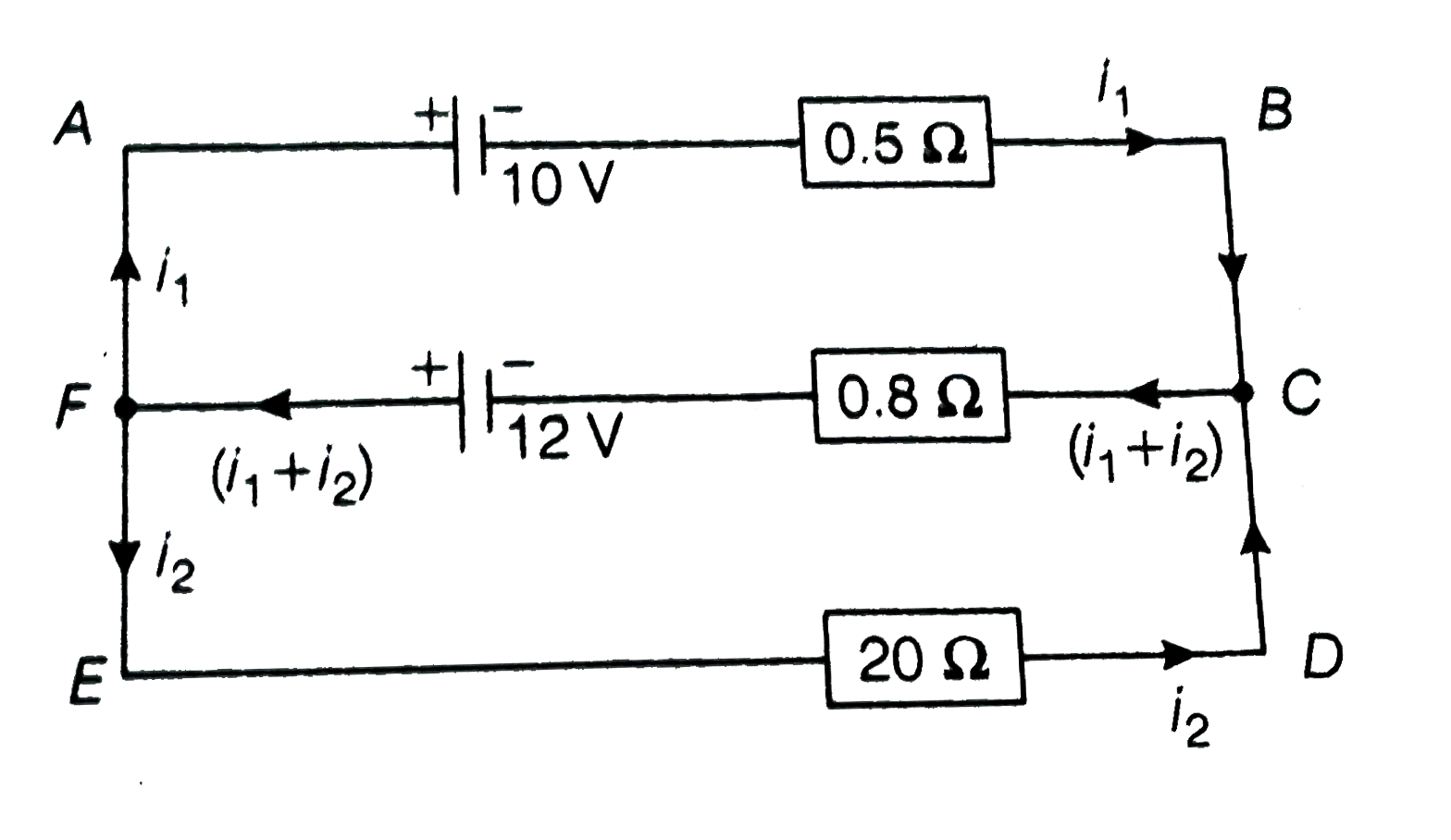 Now, in the PART FABCF of the circuit Applying KVL, `0.5i_(1)+0.8(i_(1)+i_(2))=12-10` `0.5i_(1)+0.8i_(1)+0.8 i_(2)=2` `RARR "" 1.3i_(1)+0.8i_(2)=2`.....(i) SIMILARLY, applying KVL in FCDEF `-0.8(i_(1)+i_(2))-20i_(2)=-12` `-0.8i_(1)-0.8i_(2)-20i_(2)=-12` `0.8i_(1)+20.8i_(2)=12`.....(ii) On SOLVING Eqs. (i) and (ii), `i_(1)=1.212 A` and `i_(2)=0.5303 A` |
|
| 39. |
Statement I. Time period of revolution of a satellite moving closer to earth is smaller than that revolving far away from earth. Statement II. The square of time period (T) is directlyproportional to cube of its orbital radius. |
|
Answer» Statement-I is true, Statement-II is true and Statement-II is correct EXPLANATION for Statement-I. So correct CHOICE is a. |
|
| 40. |
A Ge specimen is doped with Al. The concentration of acceptor atoms is ~10^(21) atoms/ m^3 . Given that the intrinsic concentration of electron hole Paris is ~10^(19)//m^3 , the concentration of electrons in the specimen is : |
|
Answer» `10^(17)//m^3` `:. n_e =(n_i^2)/(n_h)=(10^(19))^2/10^(21)=10^(17)//m^3` |
|
| 41. |
When a glass capillary tube of radius r is dipped in water, the water rises to height h such that |
|
Answer» Same in both the tubes |
|
| 42. |
Derive an expression for a thin double convex lens. Can you apply the same to a double concave lens too? |
|
Answer» <P> Solution :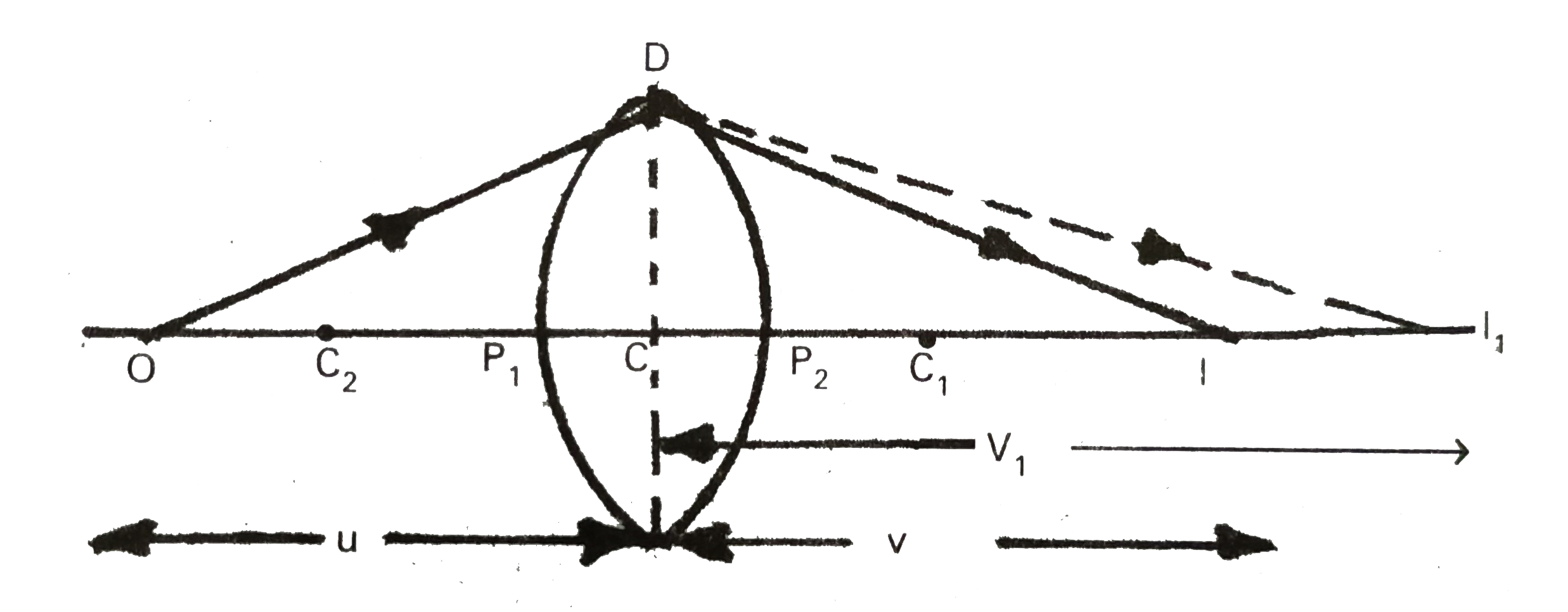 i) convex lens is made up of two spherical refracting surfaces of radii of curvatures, `R_(1) and R_(2) and mu` is the refractive index of the lens. ii) `P_(1),P_(2)` and the poles, `C_(1), C_(2)` are the centres of curvatures of two surfaces with optical centre C. iii) Consider a point object O LYING on the principal axis of the lens and `I_(1)` is the real image of the object. If `CI_(1)~~P_(1)I_(1)=v_(1)` and `"CC"_(1)~~PC_(1)=R_(1)` `CO~~P_(1)O=u` iv) As refraction is taking place from rarer to denser medium `(mu_(1))/(-u)+(mu_(2))/(v_(1))=(mu_(2)-mu_(1))/(R_(1))"..................................(1)"` V) The refracted ray suffers further refraction THEREFORE I is the final real image of O. vi) For refraction at second surface, `I_(1)` as virtual object, whose real image is formed at I, `therefore u~~CI_(1)~~P_(2)I_(1)=V_(1)` `"Let "CI~~P_(2)I=V` vii) Now refraction taking place from denser to rarer medium `(-mu_(2))/(v_(1))+(mu_(1))/(v)=(mu_(1)-mu_(2))/(R_(2))=(mu_(2)-mu_(1))/(-R_(2))"...................(2)"` Adding equations (1) and (2) `(mu_(1))/(-u)+(mu_(1))/(v)=(mu_(2)-mu_(1))((1)/(R_(1))-(1)/(R_(2)))` `mu_(1)=((1)/(v)-(1)/(u))=(mu_(2)-mu_(1))((1)/(R_(1))-(1)/(R_(2)))` `(1)/(v)-(1)/(u)""=((mu_(2))/(mu_(1))-1)((1)/(R_(1))-(1)/(R_(2)))(because mu=(mu_(2))/(mu_(1)))` `(1)/(v)-(1)/(u)""=(mu-1)((1)/(R_(1))-(1)/(R_(2)))"....................(3)"` When the object on the left of the lens is at infinity `(PROP)`, image is formed at principal focus of the lens. `therefore""u=prop, upsilon = f=" focal length of the lens."` `(1)/(f)-(1)/(prop)=(mu-1)((1)/(R_(1))-(1)/(R_(2)))` `(1)/(f)=(mu-1)((1)/(R_(1))-(1)/(R_(2)))"........................(4)"` This is the lens marker's formula. Yes, same formula applies to double concave lens too. |
|
| 43. |
We see Sunrise ...... |
|
Answer» before its ACTUAL TIME. |
|
| 44. |
A balloon starts from rest,moves vertically upwards with an acceleration g//8 ms^(-2).A Find the time taken by stone to reach the grounf (g=9.8 ms^(-1)) |
|
Answer» Solution :Step-1:To FIND the distance of the stone above the ground about which it BEGINS to fall from the balloon. `S=ut+(1)/(2)at^(2)` ,here,h u=0a=g/8 ` h=(1)/(2)((g)/(g))8^(2)=4g` Step-2:The velocity of the ballon at this height can be obtained from v=u+at `V=0+((g)/(g))8=g` This becomes the intial velocity `(u^(1))` of the stone as the stone falls from the balloon at the height h. `therefore u^(1)=g` Step-3:For the TOTAL motion of the stone `h(1)/(2)"gt"^(2)-u^(1)t` Here, h=4g,`u^(1)`=g,t=time of travel of stone. `therefore -4g="gt"-(1)/(2)"gt"^(2) ""therefore-2t-8=` Solving for .t. we get t=4 and -2s. IGNORING negative value of time,t=4s |
|
| 45. |
Define following for curved mirrors (1) Radius of curvature (2) Centre of curvature (3) Pole (4) Principle axis (5) Aperture (6) Principle focus (7) Focal plane (8) Focal length (9) Paraxial Rays |
Answer» Solution :Radius of Curvature (R) : The radius of the spherical shell from which the mirror is made is called the radius of curvature of curved mirror. Centre of Curvature (C): The centre of the spherical shell is called the centre of curvature (C) of the mirror. Pole (P): The centre of the reflecting surface of a mirror is called pole (P). PRINCIPAL Axis : The imaginary line passing through the pole and the centre of curvature (CP) is called the principal axis of the mirror. Aperture : The DIAMETER of the reflecting surface (QQ.) is called aperture of the mirror. Principal Focus (F) : The POINT where the rays parallel to the principal axis meet (CONCAVE mirror), or appear to meet (convex mirror), after reflection is called the principal focus of the mirror. Radial Aperture :  Focal Plane : A plane passing through the principal focus and normal to the principal axis is called the focal plane of the mirror. Focal Length (F) : The distance between the pole and the principal focus of a mirror is called focal length. Paraxial Rays : Rays close to the principal axis are called paraxial rays. |
|
| 47. |
A square loop of side 10 cm and resistance 0.5 Omega is placed vertically in the east-west plane. A uniform magnetic field of 0.5 T is set up across the plane in the north-east direction. The magnetic field is decreased to zero in 1.4 s at a steady rate. Determine the magnitudes of induced emf and current during this time interval . |
|
Answer» |
|
| 48. |
What will be the distance of closest approach of a 5 MeV alpha-particle as it approaches a gold nucleus ? (Given atomic no of gold =79) |
| Answer» SOLUTION :`4.55xx 10^(-14)`m | |
| 49. |
In a hydrogen atom, the electron revolves round the nucleus 6.8 xx 10^(15) times per second in an orbit of radius 0.53Å. What is equivalent magnetic moment ? (Given that e=1.6 xx 10^(-19)C). |
|
Answer» Solution :The electron revolving in an ORBIT is EQUIVALENT to a current loop. The magnitudeto current is given by , `I =(e)/(T) = e xx (1)/(T) = ef= (1.6 xx 10^(-19)) (6.8 xx 10^(15))` `=1.1 xx 10^(-3) A ` Magnetic MOMENT of equivalent current loop is M= nIA . Here `n=1 ,I = 1.1 xx 10^(-3) A` and AREA ,`A = pi ( 0.53 xx 10^(-10))^(2)` `:. M = (1)(1.1 xx 10^(-3)) [ pi (0.53 xx 10^(-10))^(2)]` `=9.7 xx 10^(-24) Am^(2)` |
|
| 50. |
The adjoining graph shows the variation of terminalpotential difference V, across a combination of three cells in series to a resistor, versus the current, I:(i) Calculate the emf of each cell. (ii) For what current I, will the power dissipation of the circuit be maximum ? |
|
Answer» Solution : (i) We KNOW that V = `epsi - Ir` . From the graph it is CLEAR that when nocurrent is being drawn from the cells (i.e., I =0), voltage is 6.0 volt. As the battery is a combination of 3 cells and in an open circuitterminal potential difference is equal to emf, hence emf of each cell `epsi = (6.0)/(3) V = 2.0 V` (ii)From graph, terminal potential difference Vis zero when current drawn is `I_s=2.0 A` . It represents the short circuit CONDITION, where `0 = epsi - I_s. r ` and r is the internal resistance of the cell combination. ` rArr r = epsi/I_s = (6.0V)/(2.0A) = 3Omega` Power DISSIPATION of the circuit will be maximum when external resistance is equal to internal resistance (R=r) i.e., current drawn is `I = (epsi)/(r + R) = (epsi)/(2r) = (6V)/(2 xx 3Omega ) = 1A` |
|