Saved Bookmarks
This section includes 7 InterviewSolutions, each offering curated multiple-choice questions to sharpen your Current Affairs knowledge and support exam preparation. Choose a topic below to get started.
| 1. |
Golden view of sea-shell is due to: |
|
Answer» diffraction |
|
| 2. |
Whenever a hydrogen atom emits a photon in the Balmer series |
|
Answer» it need not emit any more photon |
|
| 3. |
A equilateral glass prism has a refractive index sqrt(2). A light ray is incident at 45^(@) on one face. Total deviation of ray is nxx15^(@) where n is |
|
Answer» |
|
| 4. |
If power of objective lens increases, then magnifying power…...... |
|
Answer» of MICROSCOPE INCREASES and of telescope decreases. M.P. of telescope = `(f_o)/(f_e)`. In this, if `f_0` INCREASE with same `f_e`, then M.P. increases. |
|
| 5. |
Making use of the results of Problems 17.8 and 18.7 try to find the connection between the entropy and the thermodynamical probability. |
|
Answer» `Q_T = W_T = m/M RT ln (V)/(V_0)` Therefore, the change in the entropy is `DeltaS = S - S_0 = (Q_T)/(T) = m/M R ln (V)/(V_0) = Nk ln V/(V_0)` (1) Here N is the number of molecules. Since the compression of the gas took place at a CONSTANT temperature, the energy of molecular motion does not change, and the change in the entropy is due solely to the change in the volume. Estimate the probabilities of the initial and final states. The mathematical probability of a gas occupying the entire volume `V_0` is UNITY because this is a certainty, hence `w_0 = 1`. The mathematical probability of the gas occupying volume `V lt V_0` was found in Problem 18.7, it is W = `(V//V_0)^N`. The thermodynamic probabilities of macroscopic states are proportional to their mathematical probabilities: `W/(W_0) = w/(w_0) = ((V)/(V_0))^(N)` Taking logarithms, we obtain `ln W/(W_0) = N ln V/(V_0)` (2) COMPARING equalities (1) and (2), we obtain `S- S_0 = k ln W - k ln W_0` whence the relation between the entropy and the thermodynamic probability. |
|
| 6. |
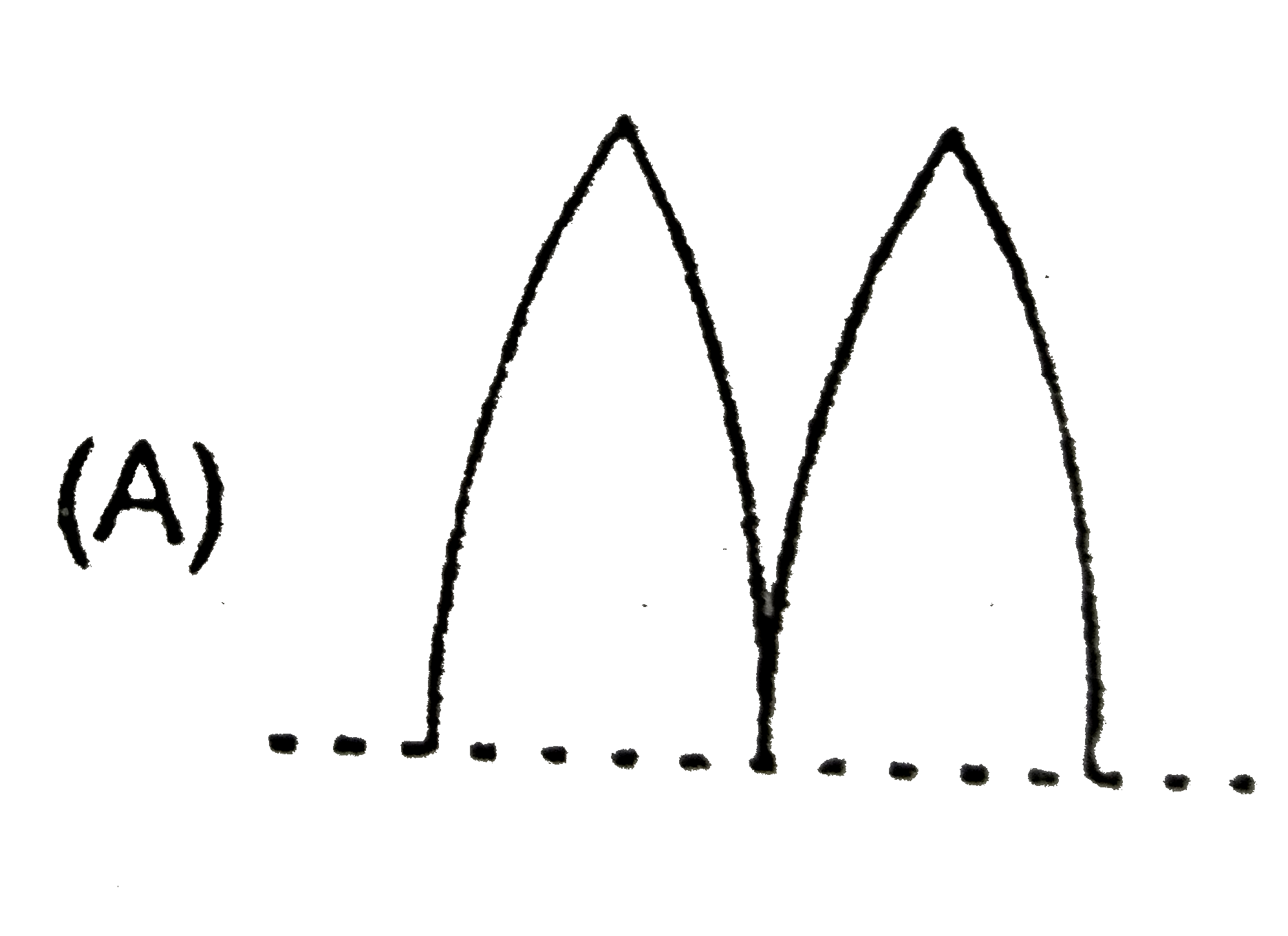
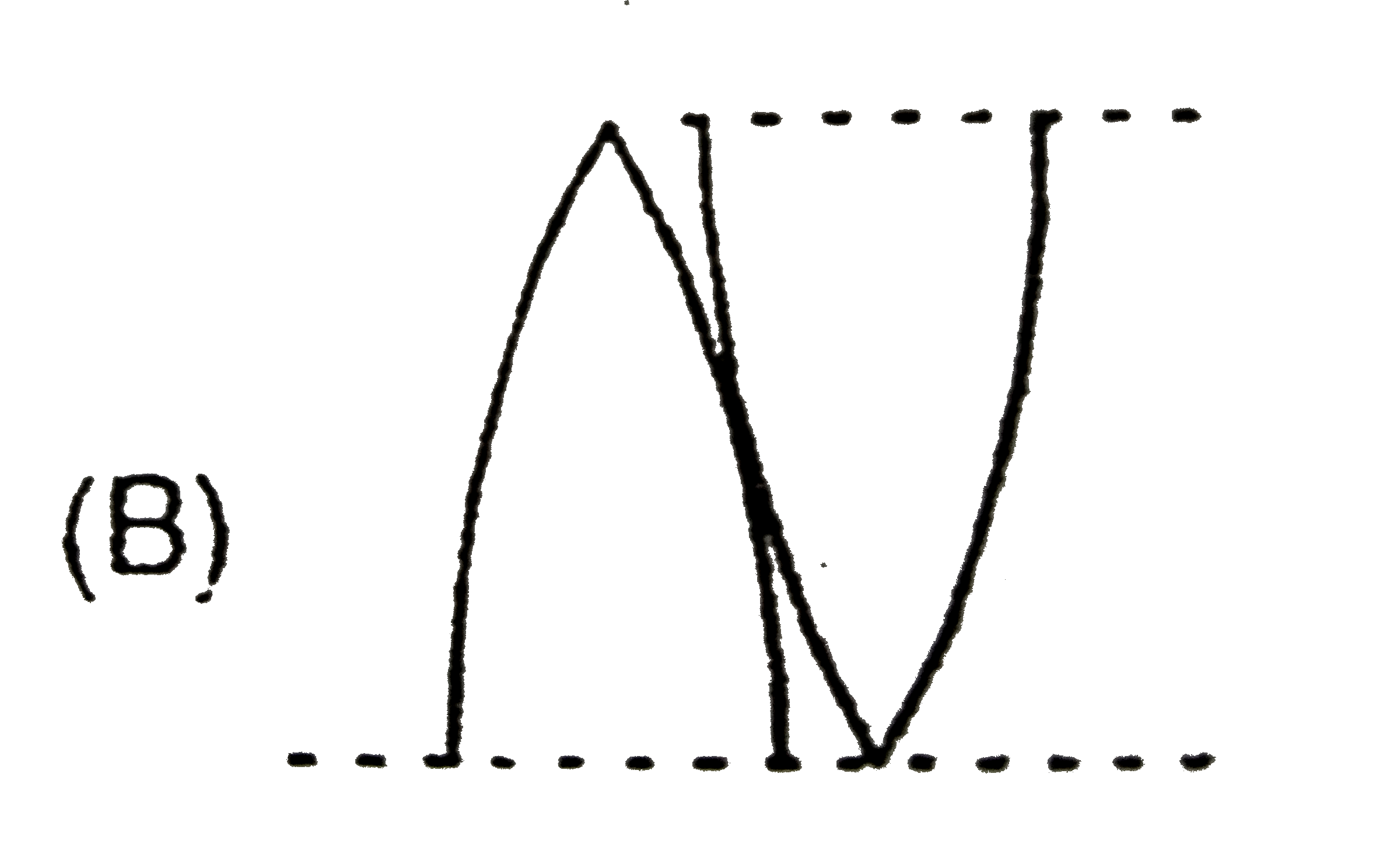
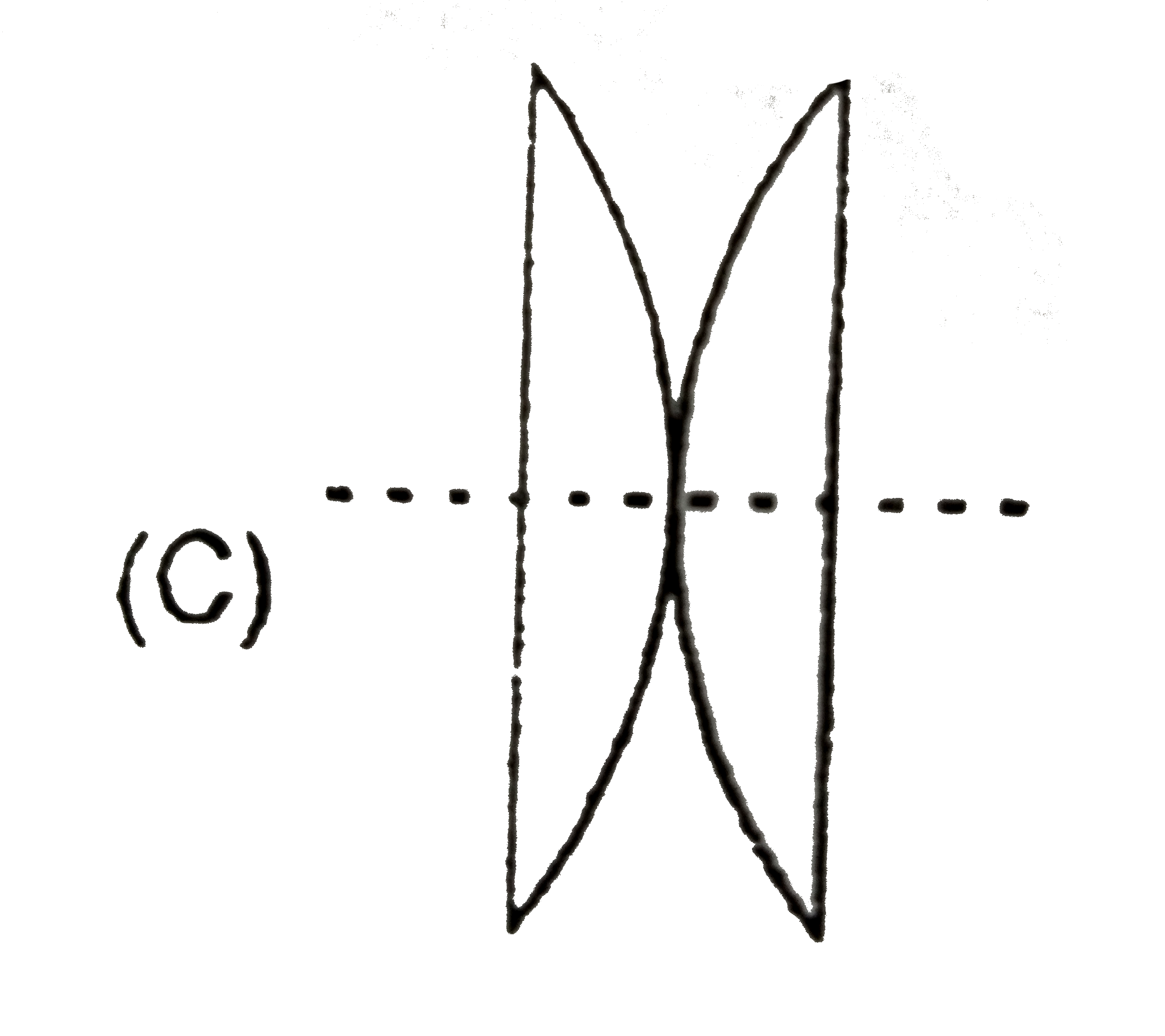
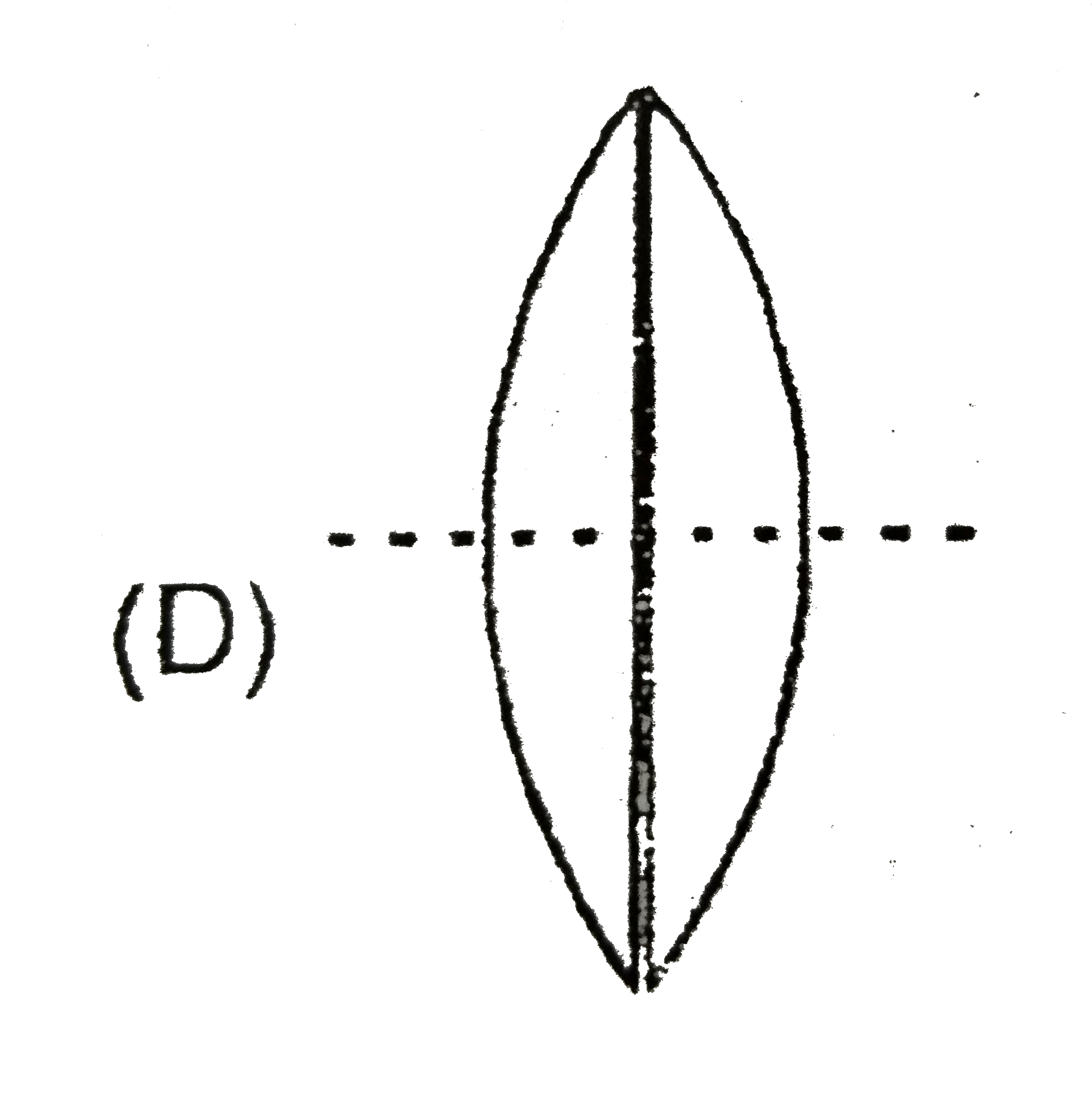
A convex lens is cut into two parts in different ways that are arranged in four manners, as shown. Which arrangement will give maximum optical power? |
|
Answer»
|
|
| 7. |
The electric field vector at point P(a, a, a) due to three uniformly charged infinite wires 1, 2 and 3 kept the x, y and z - axes, respectively as shown in the shown in figure is (Charge unit length of each wire is lambda) |
|
Answer» `(lambda)/(3pi epsilon_(0)a)(hati+hatj+hatk)` |
|
| 8. |
A source emitting sound of frequency 180 Hz is placed in front of a wall at a distance of 2m fromit. a detector is also placed in front of the wall at the same distance from it. The minimum distance between the source and the detector is x mtrs for which the detector shows a maxima of sound. Speed of sound in air = 360 m/s |
|
Answer» |
|
| 9. |
If two electric charges q and -2q are placed at distance 6a apart, find the locus of points in the plane of the charges, where the field potential is zero taking q as origin and the line joining the charges as x-axis. |
|
Answer» |
|
| 10. |
In Fig. , the particles have charges q_(1) = -q_(2) = 300 nC and q_(3) = -q_(4) = 200 n C, and distance a = 5.0 cm. What are the (a) magnitude and (b) angle (relative to the +x direction) of the net force on particle 3 ? |
| Answer» SOLUTION :(a) 0.26 N, (B) `-32^(@)` | |
| 11. |
Read the screwgaug shown bellow Main scale has (1)/(2)mm marks In complete rotation the screw advances by (1)/(2)mm Circular scale has 50 division . |
|
Answer» SOLUTION :OBJECT thickness `= 6.5 mm + 14 ((1//2mm)/(50))` Object thickness `= 4.5mm + 39 ((1//2mm)/(50))` `=4.89mm` 
|
|
| 12. |
In the core of nuclear fusion reactor, the gas becomes plasma because of |
|
Answer» STRONG NUCLEAR FORCE acting between the deuterons |
|
| 13. |
A constant voltage of 25 V is applied to a series L-R circuit at t = 0, by closing a switch. What is the potential difference across the resistor and the inductor at time t = 0? |
| Answer» Answer :A | |
| 14. |
Which of the following modulation index produces noise? |
|
Answer» 0.5 |
|
| 15. |
On the horizontal surface of a truck, a block of mass 1 kg is placed (mu = 0.6) and truck is moving with acceleration with 5 m//s then the frictional force on the block will be: |
|
Answer» 5N (C) is the choice. |
|
| 16. |
Check whether, the following equations can represent a progressive (travelling wave) (a) y=A cos(x^(3)-vt) (b) x=Ae^((vt-y))(c) y=A log((x)/(v)-t) |
|
Answer» SOLUTION :(a) Since the factor `(x^(3)-VT)`, cannot be expressed in terms of the combination of `(x+-vt)` and /or some constants, so, the equation cannot represent a wave. (b) For a finite value of .y. after a long time,`t to OO` the factore `e^(vt-y)oo,`as such the DISPLACEMENT x is undefined for `vt-y lt` ,so, the equation doesnot represent a wave. (c) Since the value of log `((x)/(v)-t)` is undefined for `(x)/(v)-t le 0`, so the equation cannot pertain toa wave |
|
| 17. |
If l_(1)and l_(2)are the lengths of air column for the first and second resonance when a tuning fork of frequency n is sounded on a resonance tube, then the distance of the displacement antinode from the top end of the resonance tube is: |
|
Answer» `2(I_(2)-I_(1))` |
|
| 18. |
The dipole moment of a dipole is 4 xx 10^(-9) Cm. The po1ential of a point away from 0.2 rn, the direction maJting an angle 60^(@) with axis of dipole is ......... |
|
Answer» Solution :`V = (kq COS theta)/(r^(2))=(9XX10^(9)xx4xx10^(-9)xxcos 60^(@))/((0.2)^(2))` `= (3.6xx1)/(0.04xx2) = 450 V` |
|
| 19. |
Match the following {:(,"Column I",,"Column II"),((A),"Escape speed at the centre of earth",(p),sqrt((2)/(3)(GM_(e))/(R_(e)))),(,("mass " M_(e) " radius "R_(e)),,),((B),"Escape speed at the centre of mass of two bodies",(q),sqrt((4)/(3)(GM_(e))/(R_(e)))),(,("earth of mass " M_(e))" separated by distance " R_(e),,),((C ),"Orbital velocity of a satellite about a planet of",(r ),sqrt((3GM_(e))/(R_(e)))),(,"mass " 2 M_(e)" and radius " (R_(e))/(2)." The height of",,),(,"the satellite about planet surface is " h = R_(e),,),((D),"The horizontal velocity imparted to a satellite",(s),sqrt((8GM_(e))/(R_(e)))),(,"at height " h(=R_(e))" above earth's surface such",,),(,"that satellite moves in elliptical path of apogee " 4R_(e),,),(,"Take "M_(e)=6xx10^(24)Kg "and " R_(e )=6400 km",(t),22.4 km/s):} |
|
Answer» |
|
| 20. |
Name the em waves which are produced during radioactive decay of a nucleus. Write their frequency range. |
| Answer» Solution :WELDERS wear special GLASS goggals to protect their eyes from large amount of harmful UV RADIATION PRODUCED by welding etc. | |
| 21. |
From study of elastic collision we understand that if two colliding particles have equal masses they interchange their velocities and energy transfer is maximum if they have equal masses and one is at rest w... other. This principle can be easily used in nuclear reactor to select a moderator. If m_(1)=m_(2)=m and m_(2) at rest then m_(1) will stop after colliding with m_(2) and m_(2) will move with velocity of m_(1). In case of nuclear reactor we used a moderator such that neutrons can be slowed down. With above reference answer the following questions Which is correct statement |
|
Answer» Soft water can be USED as moderator |
|
| 22. |
A proton and an electron have same de Broglie wavelength. Which of them moves faster and which possesses more kinetic energy ? |
|
Answer» Solution :We KNOW that `lambda = (h)/(sqrt(2 MK))` Since proton and electron have same de Broglie WAVELENGTH, we get `(h)/(sqrt(2m_(p)K_(p))) = (h)/(sqrt(2m_(e) K_(e))) (or) (K_(p))/(K_(e)) = (m_(e))/(m_(p))` Since `m_(e) lt m_(p), K_(p) lt K_(e)`, the electron has more KINETIC energy than the proton. `(K_(p))/(K_(e)) = ((1)/(2) m_(p)v_(p)^(2))/((1)/(2) m_(e)v_(e)^(2)) (or) (v_(p))/(v_(e)) = sqrt((k_(p)m_(e))/(k_(e)m_(p)))` `(v_(p))/(v_(e)) = sqrt((m_(e)^(2))/(m_(p)^(2))) = (m_(e))/(m_(p))` since `(K_(p))/(K_(e)) = (m_(e))/(m_(p))` Since `m_(e) lt m_(p), v_(p) lt v_(e)`, the electron MOVES faster than the proton. |
|
| 23. |
(a) State the law of radioactive decay. Plot a graph showing the number (N) of undecayed nuclei as a function of time (t) for a given radioactive sample having half-life T_(1/2). Depict in the plot the number of undecayed nucei at(i) t=3T_(1/2) and (ii) t=5T_(1/2). (b) The half-life, of a given radioactive nuclide, is 138.6 days. What is the mean life of this nuclide? After how much time will a given sample of this radioactive nuclide get reduced to only 12.5% of its initial value? |
| Answer» SOLUTION :(B) 200days, 415.8days | |
| 24. |
Name the different series obtained in hydrogen spectrum and give formulas for finding the wave number. |
Answer» Solution : In 1885, the first such series was observed by a Swedish SCHOOL teacher Johann Jakob Balmer in the visible region of the hydrogen spectrum which is shown in the figure.  The line with the longest wavelength 656.3 nm in the red is CALLED `H_(alpha)`. The 486.1 nm wavelength of line that appears in blue-green region is called `H_(beta)`. The 434.1 nm wavelength of line that appears in violet region is called `H_(gamma)`. As the wavelength decreases, the lines appear closer TOGETHER and are weaker in intensity. Balmer found a simple empirical FORMULA for the observed wavelengths. `(1)/(lambda)=R[(1)/(2^(2))-(1)/(n^(2))]`....(1) where `lambda`= wavelength R= Rydberg constant `=1.097xx10^(7) m^(-1)` n= Integal values3,4,5... Taking n = 3 in this equation one obtains the wavelength of the `H_(alpha)` line (maximum wavelength) `:.(1)/(lambda)=1.097xx10^(7)[(1)/(2^(2))-(1)/(3^(2))]` `=1.097xx10^(7)((5)/(36))` `:. (1)/(lambda)0.1524x10^(7)m^(-1)` `:. lambda=6.52xx10^(-7)m` or `lambda=656.2nm` `rArr` Taking n = 4, one obtain the wavelength of `H_(beta)` `(1)/(lambda)=R[(1)/(2^(2))-(1)/(4^(2))]` `(1)/(lambda=1.097xx10^(7))[(3)/(16)]` `:. (1)/(lambda)=0.2057xx10^(7)m^(-1)` `:. lambda=4.861xx10^(-7)m` `:. lambda486.1nm` `rArr` Taking `n=oo, "inifinite"^(th)` line obtained whose wavelength is the shortest (small). `(1)/(lambda)=R[(1)/(1^(2)-(1)/(oo^(2)))]=(R)/(4)` `:. lambda=(4)/(R)=(4)/(10.97xx10^(7))=3.646xx10^(-7)m` `:. lambda=364.6 nm` Beyond this limit, no further distinct lines appear, instead only a faint continuous spectrum is seen. Moreover, the other discovered spectra lines are named by their inventor and their formulas are as follows: Lyman series : Found in the ultraviolet region. `(1)/(lambda)=R[(1)/(1^(2))-(1)/(n^(2))]` where n=2,3,4,... If n=2 then the `H_(alpha)` line of the Lyman series is obtained. If n=3 then the `H_(beta)` line of the Lyman series is obtained. If n=4 then the `H_(gamma)` line of the Lyman series is obtained. Paschen series : Found in the infrared region. `(1)/(lambda)=R[(1)/(3^(2))-(1)/(n^(2))]` where n=4, 5,6,... If n=4 then the `H_(alpha)` line of the Paschen series is obtained. If n=5 then the `H_(beta)` line of the Paschen series is obtained. If n=6 then the `H_(gamma)` line of the Paschen series is obtained. Brackett series : Found in infrared region. `(1)/(lambda)=R[(1)/(4^(2))-(1)/(n^(2))]` where n=5,6,7,..... If n=5, then the `H_(alpha)`line of the Brckett series is obtained. If n=5, then the `H_(beta)`line of the Brckett series is obtained. If n=6, then the `H_(beta)`line of the Brckett series is obtained. If n=7 then the `H_(gamma)`line of the Brckett series is obtained. Pfund series : Found in infrared region. `(1)/(lambda)R[(1)/(5^(2))-(1)/(n^(2))]` where n=6,7,8,... If n=6, then the `H_(alpha)` line ofP fund series is obtained. If n=7, then the `H_(beta)` line ofP fund series is obtained. If n=8 then the `H_(gamma)` line ofP fund series is obtained. The general formula for all the above series is a follows. `(1)/(lambda)=R[(1)/(m^(2))-(1)/(n^(2))]` where m=n-1 If `m=1 rArr` Lyman sereis, m=2, Balmer series. m = 3, Paschen series, m = 4, Brackett series and m = 5, Pfund series formulas are obtain. |
|
| 25. |
The disk in Fig. 10-5a is rotating about its central axis like a merry-go-round. The angular position theta(t) of a reference line on the disk is given by theta=-1.00-0.600t+0.250t^(2), with t in seconds, theta radians, and the zero angular position as indicated in the figure. (a) Graph the angular position of the disk verus time from t = -3.0 s to t = 5.4 s. Sketch the disk and its angular position reference line at t = -2.0 s, 0 s, and 4.0 s, and when the curve crosses the t axis. (b) At what time t_(min)" does "theta(t) reach the minimum value shown in Fig. 10-5b? What is that minimum value? (c ) Graph the angular velocity omega of the disk versus time from t = -3.0 s to t = 6.0 s. Sketch the disk and indicate the direction of turning and the sign of omega at t = -2.0 s, 4.0 s, and t_(min). (d) Use the results in parts (a) through ( c) to describe the motion of the disk from t = -3.0 s to t = 6.0 s. |
|
Answer» Solution :(a) The angular position of the disk is the angular position `theta(t)` of its reference line, which is given by a function of time t. So we graph, the result is shown in Fig. Calculations: To sketch the disk and its reference line at a particular time, we need to determine `theta` for that time. To do so, we substitute the time. For t = -2.0 s, we get `theta=-1.00-(0.600)(-2.0)+(0.250)(-2.0)^(2)` = `1.2rad=1.2rad(360^(@))/(2pirad)=69^(@)`. This means that at t = -2.0 s the reference line on the disk is rotated counterclockwise from the zero position by angle 1.2 rad = `69^(@)` (counterclockwise because `theta` is positive). Sketch 1 in Fig. shows this position the reference line. Similarly, for t = 0, we find `theta=-1.00rad=-57^(@)`, which means that the reference line is rotated clockwise from the zero angular position by 1.0 rad, or `57^(@)`, as shown in sketch 3. For t = 4.0 s, we find `theta=0.60rad=34^(@)`. Drawing sketches for when the curve crosses the t axis is easy, because then `theta` = 0 and the reference line is momentarily aligned with the zero angular position. 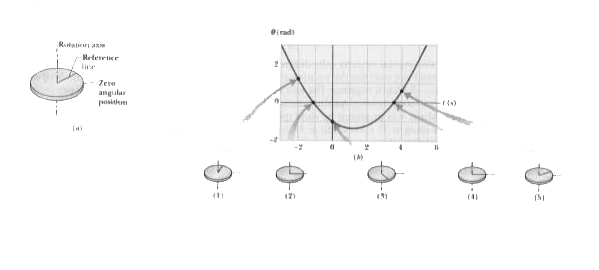 (b) To find the extreme value of a function, we take the first DERIVATIVE of the function and set the result to zero. Calculations: The first derivative of `theta(t)` is `(d theta)/(dt)=-0.600+0.500t` Setting this to zero and solving for t give US the time at which `theta(t)` is minimum: `t_(min)=1.20 s`. To get the minimum value of `theta`, we next substitute `t_(min)` into Eq. finding `theta=-1.36rad~~-77.9^(@)`. This minimum of `theta(t)` corresponds to the maximum clockwise rotation of the disk from the zero angular position, somewhat more than is shown in sketch 3. ( C) From the angular velocity `omega` is equal to `d theta//dt` as given in Eq. So, we have `omega=-0.600+0.500t`. The graph of this function `omega(t)` is shown in Fig. Because the function is linear, the plot is a straight line. The slope is 0.500 `rad//s^(2)` and the intercept with the vertical axis is -0.600 rad/s. Calculations: To sketch the disk at t = -2.0 s, we substitute that value into Eq., obtaining `omega=-1.6rad//s`. The minus sign here tells us that at t = -2.0 s, the disk is turning clockwise. Substituting t = 4.0 s into Eq. given us 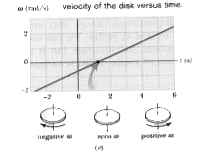 The implied plus sign tells us that now the disk is turning counterclockwise. For `t_(min)`, we already known that `d theta//dt=0`. So, we must also have `omega=0`. That is, the disk momentarily stops when the reference line reaches the minimum value of `theta` in Fig. as suggested by the center sketch in Fig. On the graph of `omega` versus t in Fig. this momentary STOP is the zero point where the plot changes from the negative clockwise motion to the positive counterclockwise motion. (d) Description: When we first observe the disk at t = -3.0s, it has a positive angular position and is turning clockwise but slowing. It stops at angular position `theta=-1.36` rad and then begins to turn counterclockwise, with its angular position eventually becoming positive again. |
|
| 26. |
Two NOT gates are connected at the two inputs of a NAND gate. This combination will behave like |
|
Answer» NAND GATE |
|
| 27. |
Two long coaxial cylindrical metal tubes (inner radius a, outer radius b) stand vertically in a tank of dielectric oil (of mass density rho , dielectric constant K). The inner one is maintained at potential V and the outer one is grounded. To what equilibrium height (h) does the oil rise in the space between the tubes? [Assume this height ( h) as an equilibrium height] |
|
Answer» `(epsilon_(0)2V^(2)(K-1))/(grho(b^(2)-a^(2))1n((b)/(a)))` |
|
| 28. |
10 A and 2A currents are passed through two parallel wires A and B respectively in the opposite directions. If the wire A is infinitely long and the length of wire B is 4 m, which is 10cm away from the wire A, calculate the force on the wire 'B' |
| Answer» SOLUTION :`1.6 XX 10^(-4)N` | |
| 29. |
Which of the following waves are diffracted by an obstacle of zise 1 cm |
|
Answer» LIGHT WAVES |
|
| 30. |
(A): The nuclear force between two nucleons falls rapidly to zero as their distance is more than a few femtometer. (R) : Sharp decrease in nuclear forces made it saturated, which causes constancy for binding energy per nucleon. |
|
Answer» Both .A. and .R. are TRUE and .R. is the correct EXPLANATION of .A. |
|
| 31. |
Obtain the equations of frequency of radiation and wave number when electron makes transits from the high energy state to the lower energy state in hydrogen atom. |
|
Answer» Solution :According to the third POSTULATE of Bohr.s model when an atom MAKES a transition from the higher ENERGY state with quantum number `n_(i)` to the lower energy state with quantum number ng`n_(f) (n_(i) gt n_(f))`. then a photon of energy is emitted equal to their energy difference. State, Energy of electron in `n_(i)` state, `E_(n_(i))=-(me^(4))/(8 epsi_(0)^(2)h^(2)n_(i)^(2)) "".....(1)` Energy of electron in `n_(f)` state, `E_(n_(f))=-(me^(4))/(8epsi_(0)^(2)h^(2)n_(k)^(2)) ""...(2)` `E_(n_(i)) gt E_(n_(f))` `:. E_(n_(f))-E_(n_(f))=-(me^(4))/(8 epsi_(0)^(2)h^(2)n_(i)^(2))-(-(me^(4))/(8 epsi_(0)^(2)h^(2)n_(f)^(2))) hv_(if)= (me^(4))/(8 epsi_(0)^(2)h^(2))[(1)/(n_(f)^(2))-(1)/(n_(i)^(2))]` this is the Rydbergy formula for the spectrum of hydrogen atom `:.v_(if)=(me^(4))/(8 epsi_(0)^(2)h^(3))[(1)/(n_(f)^(2))-(1)/(n_(i)^(2))]` But `c= lambda_(if) v_(if)` `:.v_(if)=(c)/(lambda_(if))` `:.(c)/(lambda_((if)))=(me^(4))/(8 epsi_(0)^(2)h^(2)c)[(1)/(n_(f)^(2))-(1)/(n_(i)^(2))]` `:.(1)/(lambda_(if))=(me^(4))/(8epsi_(0)^(2)h^(3)c) [(1)/(n_(f)^(2))-(1)/(n_(i)^(2))]` which is formula for the wave number of emitted photon butRydberg constant R is`(me^(4))/(8 epsi_(0)^(2)h^(3)c)` and putting the accepted values of each SIMPLIFYING gives theoretical value `R=.03xx10^(7)m^(-1)`. The value of R from Balmer experiment it is R= `1.097xx10^(7)m^(-7)` `:. (1)/(lambda_(if))=R[(1)/(n_(r)^(2))-(1)/(n_(i)^(2))]` where `n_(f)` = quantum number of lower state. `n_(i)=` quantum number of higher state. The similarity of the theoretical and experimental values of Rydberg constant supported of the Bohr.s model. |
|
| 32. |
(A): Current is passed through a metallic wire, heating it red. Half of its portion is cooled (by cold water jacket), then rest ofthe half portion become more hot. (R ) : Resistance decreases due to decrease in temperature and so current through wire increases. |
|
Answer» Both 'A' and 'R' are TRUE and 'R' is the correct explanation of 'A' |
|
| 33. |
The binary number corresponding to the decimal number 49 is : |
|
Answer» 1101 |
|
| 34. |
For nano metres whose diameters less than ................. are used as welding purposes. |
|
Answer» 10 nm |
|
| 35. |
The energy in the superposition of waves |
|
Answer» is lost |
|
| 36. |
A triangular prism of glass is shown in the figure. A ray incident normally to one face is totally reflected. If theta = 45^@ , the refractive index of glass is |
|
Answer» `LT 1.41` |
|
| 37. |
A wire of resistance 15.0(Omega)is bent to form a regular hexagon ABCDEFA.Find the equivalent resistance of the loop between the points (a)A and B, (b)A and C and (c )A and D . |
|
Answer» Solution :(a) ` R_eff= (((15 xx 5)/6) xx 15/6/((15 xx 5)/6) + 15/6) = (((15 xx 5 xx 15)/(6xx6))/75 +15 /6)` ` = ((15 xx 5 xx 15)/(6 xx 90)) = 25/12 ` ` =2.08 OMEGA `. (B)Across AC ` R_eff = (((15 xx 4)/6) xx((15 xx 2) /6)/ ((15 xx 4)/6) + ((15 xx2)/6)) =(((15 xx 4 xx 2 xx 15)/(6xx6)/((60+30)/6))` ` = ((15 xx 2 xx 4 xx 15)/ (6 xx 90 ))` ` = 10/3 = 3.33 Omega` (C) Across A&D ` R_eff = (((15 xx 3)/ 6) xx ((15 xx 3)/6)/((15 xx 3)/6) + ((15 xx 3)/6)) = ((15 xx 3 xx 3 xx 15)/(6 xx 6)/90/6)` ` = ((15 xx 3 xx 3 xx 15 )/(6 xx 90)) = 15/4 = 3.75 Omega ` . |
|
| 38. |
A small ball is kept on the top of a sphere of radius R. The sphere start accelerating with constant accelerationof 10m//s^(2) horizontally. The angle of radial line with the vertical at which small ball leaves the sphere is 1/2 sin^(-1)(K//9). Find the value of K. [take g=10m//s^(2)] |
|
Answer» |
|
| 39. |
A transparent paper (mu=1.45) of thickness 0.023 mm is pasted on one of the sdlits of a Young's double slit experiment which uses monochromatic light of wavelength 620 nm. How many fringes will cross the centre if the paper is removed ? |
|
Answer» |
|
| 40. |
A signal of 5 kHz frequency is amplitude modulated on a carrier wave of frequency 2 MHz. The frequencies of the resultant signal is/are : |
|
Answer» 2 MHZ only `:. F_m = 5 ` KHz Resultant frequencies are : `f_c,f_m,f_c,f_c-f_m` `=2005 KHz, 2000,1995 ` KHz. |
|
| 41. |
A ball is projected upwards from the top of a tower with velocity 50 ms^(-1) making an angle of 30° with the horizontal. If the height of the tower is 70 m, after what time from the instant of throwing, will the ball reach the ground (g = 10 ms^(-2) ): |
|
Answer» 2s `:.h=-70m,a=-10m//s^(2)` USING `h=ut + 1/2g t^(2)` `-70=25t - 5t^(2)` SOLVING this, we GET t=7s |
|
| 42. |
The minimum frequency of incident radiation required to eject the electrons from the photosensitive material is called. |
| Answer» SOLUTION :THRESHOLD FREQUENCY. | |
| 43. |
Two charges 6muC and 3muC are kept 9 cm apart in free space. Calculate the work done to move 3muC" by "3cm towards 9muC. |
|
Answer» |
|
| 44. |
Define isotope and isobar. |
|
Answer» Isobars. The atoms which have the same mass number A, but different atomic number Z, are called isobars. |
|
| 45. |
An aeroplane moving with a uniform speed of 200km//h takes half an hour to cover a circular path of radius 50m. Find the displacement. |
| Answer» SOLUTION :ZERO, the INITIAL and FINAL POSITION being same. | |
| 46. |
Assertion: The lightening conductor at the top of a high building has sharp ends. Reason : The surface density of charge at sharp points is very high. Resulting in setting up of electric wind. |
|
Answer» If both ASSERTION and reason are TRUE and the reason is the correct explanation of the assertion. |
|
| 47. |
A particle starts from origin goes along x-axis to point (+ 20 m, 0) and then returns along same line to (-20 m, 0) point total distance moved is: |
| Answer» ANSWER :D | |
| 48. |
A pair of adjacent coils has a mutual inductance of 1.5 H. If the current in one coil changes from 0 to 20 A in 0.5 s, what is the change of flux linkage with the other coil? |
| Answer» SOLUTION :`dphi_(B)=M.dI=1.5xx(20-0)=30Wb` | |
| 49. |
In a UDSE, the central bright -fringe can be identified : |
|
Answer» as it has greater intensity than the other bright FRINGES |
|
| 50. |
A current carrying loop free to turn is placed in a uniform magnetic field. What will be its orientation relative to the rection of magnetic field in the equilibrium state? |
| Answer» Solution :The plane of the loop is PERPENDICULAR to the DIRECTION of MAGNETIC field ecause the torque on the loop in this orientation is ZERO. | |