Saved Bookmarks
This section includes 7 InterviewSolutions, each offering curated multiple-choice questions to sharpen your Current Affairs knowledge and support exam preparation. Choose a topic below to get started.
| 1. |
The ceilings ofa concert hall are generally curved |
|
Answer» because they reflect the sound to the AUDIENCE. |
|
| 2. |
Consider the fission of " "_(92)^(238)U by fast neutrons. In one fission event, no neutrons are emitted and the final end products, after the beta decay of the primary fragments, are " "_(58)^(140)Ce and " "_(44)^(99)Ru. Calculate Q for this fission process. The relevant atomic and particle masses are m(" "_(92)^(238)U) = 238.05079 u, m(" "_(58)^(140)Ce) = 139.90543 u, m(" "_(44)^(99)Ru) = 98.90594 u. |
|
Answer» Solution :For the FISSION `" "_(92)^(238)U +N to " "_(58)^(140)Ce + " "_(44)^(99)Ru +Q` `Q = [m (" "_(92)^(238)U) + m_(n) -m (" "_(58)^(140)Ce) - m(" "_(44)^(99)Ru)]c^(2)= [238.05079 + 1.00867 - 139.90543 - 98.90594] u xx c^(2) = 0.24809 u xx 931.5 MeV = 231.1 MeV`. |
|
| 3. |
Can the thermonuclear reaction ""_(1)H^(2)+""_(1)H^(2)to""_(2)He^(4) be initiated in gaseous deuterium at a temperature of the order of 10^(8)K? |
|
Answer» |
|
| 4. |
Explain error of chromatic aberration. |
|
Answer» SOLUTION :Thick lenses could be assumed as made of many prisms. Therefore, thick lenses show CHROMATIC aberration due to DISPERSION of light. The bending of red COMPONENT of white light is least while it is most for the violet. This phenomenon is known as error of chromatic aberration. |
|
| 5. |
Photo electric current depends on the intensity of incident lightThe maximum current emitted by a photolectric material is called ______ |
| Answer» SOLUTION :SATURATION CURRENT | |
| 6. |
Define electric flux. Write its SI units. (b) The electric field components due to a charge inside the cube of side 0.1 marea as shown in E_x =alpha x ,where alpha =500 N//C m, E_Y =0 and E_Z =0. Calculate (i)the flux through the cube , and (ii)the charges inside the cube. |
|
Answer» Solution :(i) As `E_y and E_Z ` are zero and E =`E_x = ALPHA x ,` hence electric flux is linked only with TWO faces of the cube lying in y-zplane (i.e., perpendicular to `oversetto (E_x) `) At the position of left face of cube `x= 0.1 m , "hence" E_x = alpha x =500 xx 0.1 = 50 N//C ` and surface area of face `s= (0.1) ^(2)=0.001 m^(2) ` ` therefore "" ` Flux on this face ` phi_1 =E_x s= 50 xx0.01 = 0.5N m^(2) C ^(-1)`(inward ) Again on the opposite face of cube (i.e., right face ) x= 0.2 m and hence ` "" E_x. =alpha x= 500 xx 0.2 = 100 N//C ` Flux on this face `phi_2 =E_x.s =100 xx 0.01 =1 N m^(2) C^(-1) ` (outward ) ` therefore ` Net electric flux through the cube ` phi= 0.5 N m^(2)C^(-1)("inward")+ 1.0N m^(2) C^(-1) ("outward")= +0.5N m^(2)C^(-1)` (outward) (ii)From Gauss.s law ` phi= (q)/( in_0) ` `rArr "" ` Charge inside the cube ` q= phi in_0 =+ 0.5 xx 8.85 xx 10 ^(-12)=+ 4.42 xx 10 ^(-12)C ` |
|
| 7. |
The current in a circuit containing a battery connected to 2Omega resistance is 0.9A. When a resistance of 7Omega is connected to the same battery, the current observed in the circuit is 0.3A. Then the internal resistance of the battery. |
|
Answer» `0.1OMEGA` |
|
| 8. |
The effective resistance between A and B in the figure is 7/12 Omega .If each side of the cube has 1 Omegaresistance The effective resistance between the same two points, when the link AB is removed is |
|
Answer» `7/12 Omega` ` thereforeR_(AB ) = (x XX 1)/( x+1)` ` IMPLIES(7)/(12) =(x )/( x+1) implies7x +7 = 12 x impliesx =(7)/(5)Omega ` 
|
|
| 9. |
A plane light wave with wavelength lambda = 0.60mum falls normally on the face of a glass wedge with refracting angle Theta = 15^(@). The opposite face of the wedge is opaque and has a slit of width b = 10mum parallel to the edge. Final: (a) the angle Delta theta between the direction to the Fqaunhofer maximum of zeroth order and that of incident light, (b) the angular width of the frqunhofer maximum of the zeroth order. |
|
Answer» Solution :This case is analogous to the previous one except that the incident wave moves in GLASS of `R.I. n`. Thus the expression for the PATH DIFFERENCE for light diffracted at angle `theta` from the NORMAL to the hypotenuse of the wedge is `b(sin theta - n sin Theta)` we write `theta = Theta + Delta theta` Then for the direction of principle Fraunhofer maximum `b(sin(Theta + Delta theta) - n sin Theta) = 0` or `Delta theta = sin^(-1) (n sin Theta) - Theta` Using `Theta = 15^(@), n = 1.5` we get `Delta theta = 7.84^(@)` (b) The width of the central maximum is obtained from `(lambda = 0.60 MU m, b = 10mu m)` `b(sin theta_(1) - n sin Theta) = +- lambda` Thus `theta_(+1) sin^(-1) (n sin Theta +(lambda)/(b)) = 26.63^(@)` `theta_(-1) = sin^(-1) (n sin Theta(lambda)/(b)) = 19.16^(@)` `:. delta theta = theta_(+1) - theta _(-1)= 7.47^(@)` 
|
|
| 10. |
When current passing through a coil increases, direction of induced emf is |
|
Answer» in the direction of existing current. `epsilon=-L(DI)/(DT)` Here current passing through the coil, increases with time and so `((dI)/(dt)) gt 0 rArr epsilon lt 0 rArr` self induced emf will be in a direction opposite to the flow of current, so that increase in the current through the coil can be OPPOSED, according to Lenz.s law. |
|
| 11. |
Let the magnetic moment of a bar magnet be vec(p_(m)) whose mangetic length is d = 2l and pole strenght is q_(m). Compute the magnetic moment of the bar magnet when it is cut into two pieces. (a) along its length(b) perpendicular to its length |
Answer» Solution :A bar magnet CUT into two pieces along its length :  When the bar is cut along the axis into two pieces. New magnetic pole STRENGTH is `q_(m)^(.) = (q_(m))/(2)` but magnetic length does not change . So. The magnetic moment is `p_(m)^(.) = q_(m)^(.)` 2l `p_(m)^(.) = (q_(m))/(2) 2l = (1)/(2) (q_(m) 2l) = (1)/(2) p_(m)` In vector NOTATION. `vec(P.)m = (1)/(2) vec(P)`m (b) a bar magnet cut into two pieces perpendicular to the `a xx` is : When the bar magnet is cut perpendicular to the axis into two pieces, magnetic pole strength will not change but magnetic length will be halved. So the magnetic moment is `p._(m) = q_(m) xx (1)/(2) (2l) = (1)/(2) (q_(m) . 2l) = (1)/(2) p_(m)` `vec(p._(m)) = (1)/(2) vec(P_(m))` 
|
|
| 12. |
The waves which can travel directly along the surface of the earth are known as _____: |
|
Answer» X-rays |
|
| 13. |
Four point masses, each of value m, are placed at the corners of a square ABCD of side l. The moment of inertia of this system about an axis passing through A are parallel to BD is : |
|
Answer» `2m//l^(2)`  `I_(LM)=m_(A)(0)^(2)+m_(B)((lsqrt(2))/(2))^(2)+m_(C)(lsqrt(2))^(2)+m_(D)((lsqrt(2))/(2))^(2)` `I_(LM)=0+(ml^(2))/(2)+2ml^(2)+(ml^(2))/(2)=3ml^(2)` |
|
| 14. |
A block is attached to a horizontal spring and oscillates back and forth on f frictionless horizontal surface at a frequency of 3.00Hz. The amplitude of the motion is 5.08 xx 10^(-2)m. At the point where the block has its maximum speed, it suddenly splits into two identical parts, only one part remaining attached to the spring. What is the amplitude and the frequency of the simple harmonic motion that exists after the block splits? |
|
Answer» `5.08 XX 10^(-2)m, 4.24Hz` |
|
| 16. |
Two solenoids acting as short bar magnets P and Q are arranged such that their centres are on the X-axis and are separated by a large distance. The magnetic axes of P and Q are along X and Y-axes, respectively. At a point R, midway between their centres, if B is the magnitudeof induction due to Q , then the magnitude of total induction at R due to the magnitude is |
|
Answer» 3B Magnet field DUE to magnet Q `B_(Q)=(mu_(0))/(4pi) (M)/(x^(3))=B "[" "R Rightarrow equatorial point" "]"` magnetic field due to magnet P `B_(P)=(mu_(0))/(4pi) (2M)/(x^(3))=B"[" "R=axial point" "]"` As at a point R magnetic field due to P and Q magnet are PERPENDICULAR to each other, , `B_(R) Rightarrow` Net magnetic field due to magnet P and is GIVEN as Q. `B_(R) Rightarrow sqrt(B_(p)^(2)+B_(Q)^(2))=sqrt(B^(2)+(2B)^(2))=sqrt5B` |
|
| 17. |
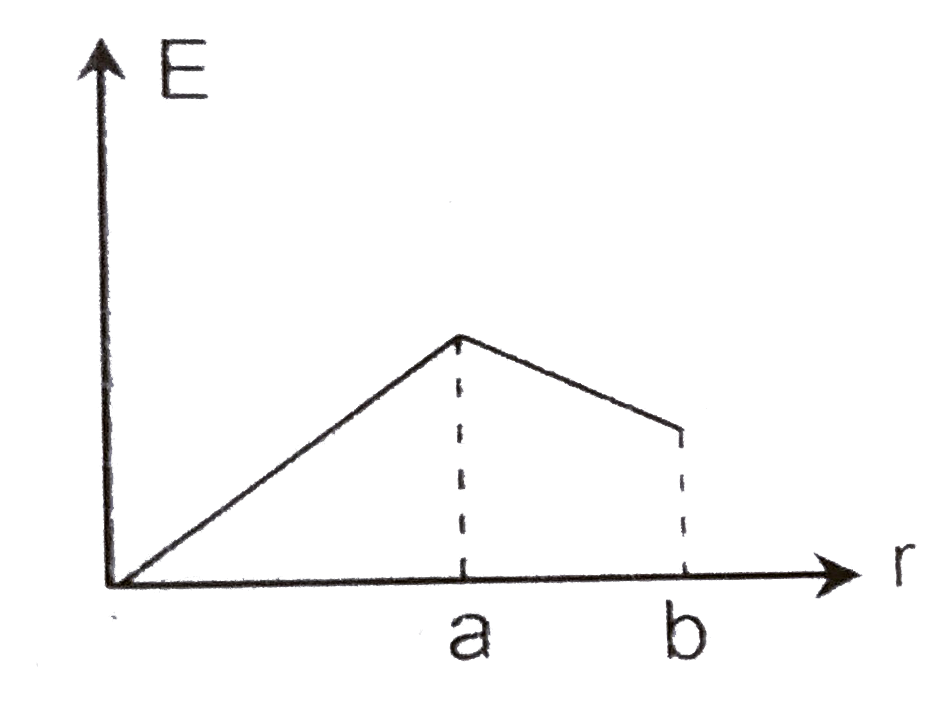
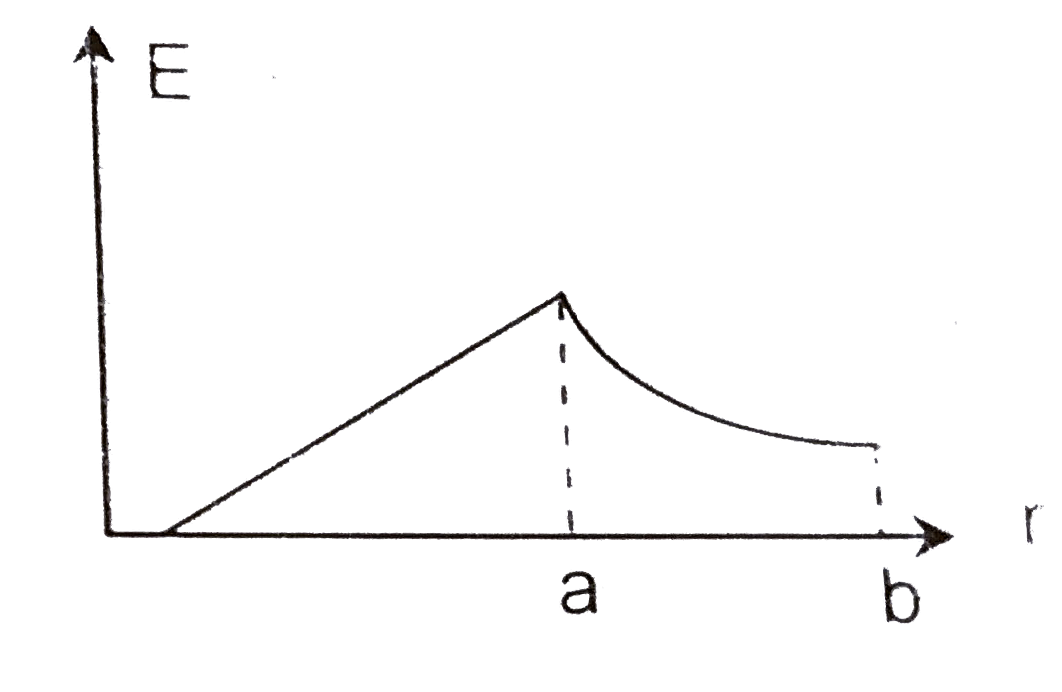
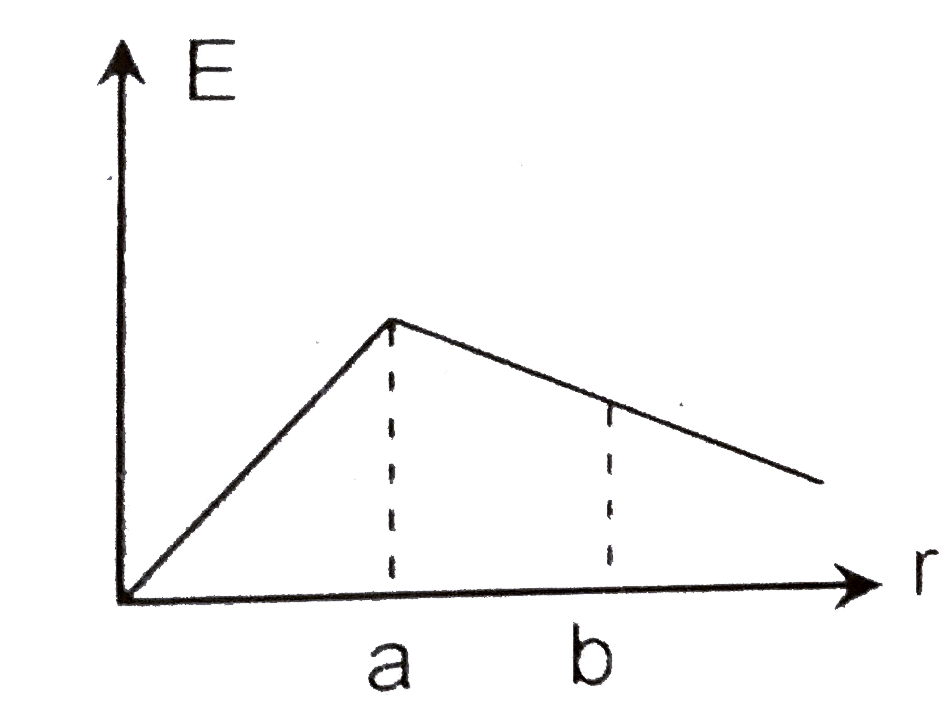
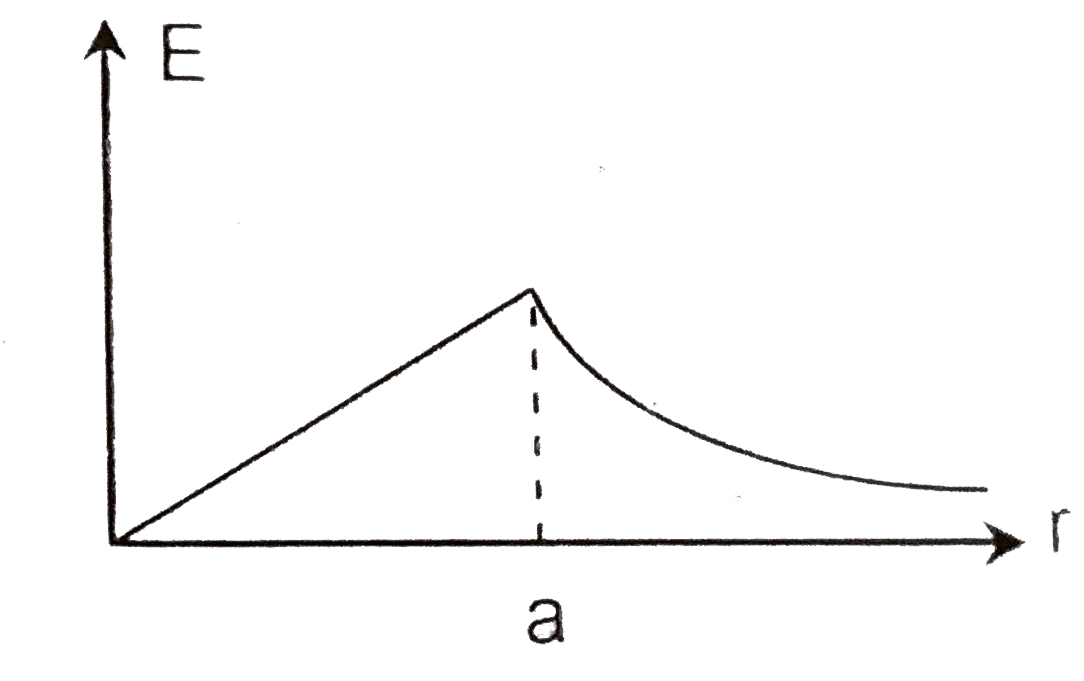
A capacitor is made of two concentric spherical shells A and B of radii a and b respectively. Where a lt b. The external shell B is grounded (V_(B) = 0) Inner shel i.e (r le a ) is filled with a uniform positive charge of density rho. Variation of electric field versus distance from the centre. |
|
Answer»
Where Q is total CHARGE INSIDE A and `Q^(1)` is charge on shell B therefore field outside B will be zero and electric field inside A will be `E = (KQ)/(a^(3))r` (linearly INCREASE ) between spherical shell A and B `E = KQ//r^(2)` |
|
| 18. |
Graphically, the pair of equations 7x - y = 5, 21x - 3y = 10 represent two lines which are- |
|
Answer» INTERSECTING at ONE point |
|
| 19. |
Magnetic moment is equal to the product of_____ and _____ |
| Answer» SOLUTION :POLE STRENGTH, MAGNETIC LENGTH | |
| 20. |
From the angle of deviation formula we get_____gt_____ |
| Answer» SOLUTION :`deltagtdelta` | |
| 21. |
Two identical and coherent sources of light are used in Young's double-slit experiment and resulatant intensity at the centre of the screen is found to be I_1. When two identical sources of intensity same as before but incoherent are used for the experiment, then resultant intensity at the centre of the screen is found to be I_2. What is the value of I_1//I_2? |
|
Answer» 1 `I_1 = 4I` But when sources are incoherent, then phase difference at all points changes randomly and very fast so that intensity keeps changing randomly between 0 and 4I. Change in intensity is so frequent that resultant becomes 2I every where. `I_2 = 2I` Hence, `I_1//I_2 = 2`. |
|
| 22. |
Figure shows a solenoid current of I- ampere Its area is 'A' and number of turns n. a. What is the flux density of the solenoid field inside ? b. If magnetic material in the form of a rod of area 'a' (a lt lt A) is inserted into the solenoid, what is the magnetising field strength ? c. Find the total flux density inside the specimen. |
|
Answer» Solution :a. `B_0=mu_0nI` (taking n number ber turns/unit length ) b. H = nI c. `B=B_0+B_m` TOTAL flux density B. Total flux density free space `=B_0` `B_m` - induction due to magnetisation of material. d. Susceptibility , `X_m=I/H` `muH=mu_0H+mu_0I "":.mu=mu(I+I/H)=mu_0(I+X_m)` c. `B=B_0+B_m` Total flux density B. Total flux density free space `B_0` `B_m` - induction due to magnetisation of material . d. Susceptibility ,`X_m=I/H` `muH=mu_0H+mu_0I"":.mu=mu_0(1+I/H)=mu_0(I+X_m)` LET `mu_r` be the relative permeability , then `mu_rmu_0=mu_0(I+X)"":.mu_r=(I+X)` e. Diamagnetic `-1lexlt0,0lemu_rlt1,multmu_0` Paramagnetic `0ltxlt,mu_rgt1,mugtmu_0` Ferromagnetic `X gtgt1,mu_rgtgt1,mugtgtmu_0` Examples : diamagnetic - Bismuth , lead , gold , mercury , SILVER etc. Paramagnetic - Aluminium , chromium , oxygen etc. Ferromagnetic - Aluminium , chromium, oxygen etc. |
|
| 23. |
A ring of radius 1 cm is placed at 1.0 m infront of a spherical glass ball of radius 25 cm with u=1.5. Determine the position of the final image of the ring and its magnification |
|
Answer» at 29 cm to the right of 2ND face, m = -0.44 |
|
| 24. |
When a current loop is placed in a uniform magnetic field i) barF_(R)=0 and bartau=0 ii)barF_(R)=0 but bartaune0 iii)barF_(R)ne0 but bartau=0 iv)barF_(R)ne0 and bartaune0 |
|
Answer» Only i & II are true |
|
| 25. |
Thesignificantresult deduced fromtheRutherford'sscatteringexperimentis that |
|
Answer» a) wholeof thepositivecharge is concentratedat thecentreof ATOM |
|
| 26. |
Figure shows a straight wire of length L carrying a current i. Find the magnitude of magnetic field produced by the current at point P. |
| Answer» Solution :`(sqrt(2) mu_0 i)/(4 PI L)` | |
| 27. |
The output from a logic gate is 1 when inputsA, B and C are such that |
|
Answer» `A = 1, B = 0 ,C = 1 ` |
|
| 28. |
Draw the ray diagram to construct a real inverted image by a concave mirror. |
Answer» SOLUTION :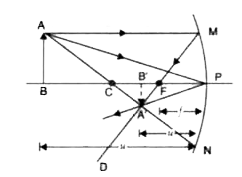
|
|
| 29. |
The circuit shown here has two batteries of 8.0 V and 16.0 V and three resistors 3 Omega , 9Omegaand 9 Omega and a capacitor 5.0 mu F. How much is the current I in the circuit in steady state ? |
|
Answer» `1.6 A` |
|
| 31. |
The temperature of a body is increased from −73^(@)C" to "327^(@)C. Then the ratio of emissive power is |
|
Answer» `1//9` |
|
| 32. |
(i) Define modulation index. (ii) Why is the amplitude of modulating signal kept less than the amplitude of carrier wave ? |
|
Answer» Solution :(i) Modulation index is defined as the ratio of AMPLITUDE of modulating SIGNAL and amplitude of carrier wave ALTERNATIVELY, `MU = (A_m)/(A_c)` (ii) The amplitude of modulating signal is kept less than amplitude of carrier wave to avoid / minimize distortion / noise. |
|
| 33. |
A parallel beam of monochromatic light is incident on the surface of water having refractive index 4/3. The direction of the incident beam bisects the angle between the normal to the water surface and the water surface. The angles of incidence and refraction are : |
|
Answer» `i = 30^@`, `r = 20^@` |
|
| 34. |
A 2u mu C charge moves in a circular orbit of radius 2cm around the nucleus at a frequency 10 rev/sec. Find the magnetic moment associated with the orbital motion of the particle. |
| Answer» SOLUTION :` 4 XX 10^(-9)Amp-m^2` | |
| 35. |
For television broadcasting, the frequency employed is normally |
|
Answer» 30HZ -30 MHz |
|
| 36. |
A chargedmetallic spere A is suspended by a nylon thread another charged metallic spere b heldby an insulating centres is 10 cmc and dare then removed and b is brought closer to a to a what is txpectd repulsionofa on the basis of columb law sphereaandc speres b and dhave indentical sizes ignore the sizes ofa and b in comparision to the separation between theircentres |
|
Answer» Solution :Letthe originalcharge on spere a be q and that on b beq at a DISTANCE r beteen theircentres the magnitude of the `F=(1)/(4piepsilon_(0))(qq)/(r^(2))` neglecting the sizes of sperhers aand b in comparionsto r when an IDENTICAL but UNCHANGED spere c TOUCHES a the chargesredisitribute on a and c and by SYMMETRY each sprere carries a charge `q//2`similary after d touchesb the rredistributedcharge on each isof the electrosatic force on each is `F=(1)/(4pi epsilon_(0))((q//2)(q//2))/(r//2)^(2)=(1)/(4piepsilon_(0))(qq)/(r^(2))=F` Thus the electrostaticforce on a due to b remainsunaltered |
|
| 37. |
The range of a projectilefor a fixed angle of projection theta and fixed projection u varies |
|
Answer» DIRECTLY as u |
|
| 38. |
Two waves A & B of frequencies 2 MHz & 3 MHz & 3 MHz respectively are beamed in the same direction for communication via sky wav. Which one of these is likely to travel longer distance in the ionosphere before suffering TIR |
|
Answer» A travels LONGER DISTANCE |
|
| 39. |
What is packing efficiency of FCC |
|
Answer» 0.74 |
|
| 40. |
Back emf of a cell is due to |
|
Answer» ELECTROLYTIC polarizations |
|
| 41. |
A rectangular coil of sides 12cm and 8cm having 1000 turns and carrying current of 100mA is held in a uniform magnetic field of 0.1 Tesla. What is the maximum torque the coil can experience ? |
| Answer» SOLUTION :`0.096 NM` | |
| 42. |
A positively charged oil drop is in equilibrium in the electric field existing in the space between two horizontal plates separated by a distance of 1cm. The charge of the oil drop is 3.2 xx 10^(-19)C and its mass is 10^(-17)g. (i) The potential difference between the plates is |
|
Answer» 1020 V |
|
| 43. |
Obtain the formula for the 'power loss' (i.e., power dissipated) in a conductor of resistance R, carrying a current I. |
|
Answer» <P> Solution : Consider a conductor with end points A and B in which acurrent I is flowing from A to B. Let electric potential at pointsA and B be V(A) and V(B) respectively. As current is flowing from A to B, obviously V(A) > V(B). Let V(A) – V(B) = V. In a time interval `Delta t`, a charge `Delta q = I. Delta t ` travels from A to B. Thus, potential energy of charge at A and B is` U(A) = Delta q.V(A)` and U(B)` = DeltaqV(B)` respectively. ` therefore ` Change in potential energy `DeltaU = U(B) - U(A) = Deltaq[V(B) - V(A)]=- Delta_q.V=-l Delta t. V` If charges were moving freely through the conductor under the action of an applied electric field then in accordance with law of conservation of energy, change in potential energy leads to a change in KINETIC energy too such that, ` Delta U = Delta K = 0` or ` Delta K = - Delta U = I.V Delta t ` In practice, charge carriers in a conductor move with a steady drift velocity. This is because of their collisions with ions and atoms during transit. During collisions, the energy gained by the charges is shared with the atoms. The atoms vibrate more vigourously and the conductor heats up. Thus, in a conductor energy DISSIPATED as heat during a time interval `Delta t` is ` I.V. Delta t`. The energy dissipated per unit time is called the “power loss”. Thus, Power loss `P = (IV Delta t)/(Delta t) = VI` As per Ohm.s law V =IR , hence `P = VI = (V^2)/( R) = I^2 R` |
|
| 44. |
A galvanometer is shunted by 1/n th of its resistance. Find the fraction of the total current passing through the galvanometer. |
|
Answer» |
|
| 45. |
What spped should a galaxy move with respect to us so that the sodim line at 589.0nm is observed at 589.6nm? |
|
Answer» SOLUTION :SINCE `vlamda=c, (Deltav)/(v)=(Deltalambda)/lambda` (for small changes in v and `lambda)`.For `Deltalamda=589.6-589.0=+0.6nm` we get `["using Equation "(Deltav)/(v)=(upsilon_("radical"))/(c)]` `or, upsilon_("radical")approx +c ((0.6)/(589.0))=+3.06xx10^(5)m s^(-1)` =306 km/s THEREFORE, the galaxy is MOVING away from us |
|
| 46. |
A convergent beam of light is incident on a convex mirror so as to converge to a distance 12 cm from the pole of the mirror. An inverted image of the same size is formed coincident with the virtual object. What is the focal length of the mirror |
|
Answer» 24 cm |
|
| 47. |
Explain particle-wave (dual) nature of matter. |
|
Answer» SOLUTION :Optical phenomena like interference ,differaction and polarization can be explained by wave nature of LIGHT. PHOTOELECTRIC EFFECT and compton effect can be explained by particle nature of light. Thus when light is in motion it behaves as wave.Its absorption and emission TAKES place in from of particle. Thus light posses dual nature. |
|
| 48. |
Which of the following statement is wrong regarding a p - n junction diode |
|
Answer» Diode MAY illuminate light |
|
| 49. |
In a double slit experiment, the separation between slits is d = 0.25 cm and the distance of screen D = 120 cm from the slits.If I_(0) is intensity of central bright fringe, what is the intensity at distance x = 4.8 xx 10^(-5) m from central max ? Given lambda = 6000 Å : |
|
Answer» `I_(0)` At the central fringe, `delta= 0` `I_(0) = I_(1) + I_(2) + 2I_(1) = 4I_(1)` At a distance x, PATH difference = `(xd)/(D)` Corresponding phase difference, `delta = (2pi)/(lambda).(xd)/(D)` `therefore I. = I_(1) + I_(2) + 2I_(1) cos (2pixd)/(lambda D)` ` = (I_(0))/(4) + (I_(0))/(4) + (2I_(0))/(4) cos(2pixd)/(lambda D)` `I. = (I_(0))/(2) [1 + cos (2pixd)/(lambda D)] = I_(0) cos^(2)(pixd)/(lambda D)` On solving = `I_(0) cos^(2)(pi)/(6) = (3I_(0))/(4)`. |
|
| 50. |
The dimensional formula of torque is identical to that of |
|
Answer» KINETIC energy |
|