

Saved Bookmarks
This section includes 7 InterviewSolutions, each offering curated multiple-choice questions to sharpen your Current Affairs knowledge and support exam preparation. Choose a topic below to get started.
| 1. |
Consider a situation shown in the figure. Show that if the blocks are displaced slightly in opposite directions and released, they will execute S.H.M. calculate the time period. |
| Answer» SOLUTION :`2PI SQRT((m)/(K))` | |
| 2. |
When the room temperature becomes equal to the dew point , the relative humidity of the room is |
|
Answer» SOLUTION :Relative HUMIDITY ` = " Saturation vapour pressure at dew point temperature "/"Saturation vapour pressure at room temperature " ` Now, room temperature = dew point temperature (given) ` :.` Relative humidity ` = 1 xx 100% = 100 %`. |
|
| 3. |
(a) State the principle of working of a galvonometer. (b) A galvonometer of resistance G is converted into a voltmeter to measure upto V volts by connecting a resistance R_1 in series with the coil. If a resistance R_2 is connected in series with it, then it can measure upto V/2 volts. Find the resistance, in terms of R_1 and R_2, required to be connected to convert it into a voltmeter that can read upto 2 V. Also find the resistance G of the galvanometer in terms of R_1 and R_2 . |
|
Answer» Solution :(b) As per question a galvanometer of RESISTANCE G is converted into a voltmeter of range V by connecting a series resistance `R_1`, so `V = I_(g) (G + R_1) ""…..(i)` And it is converted into a volmeter of range `V/2` by connecting a series resistance `R_2`, so, `V/2 = I_(g) (G + R_2)"".......(II)` To convert into a voltmeter of range 2 V we should connect a resistance R in series of it. Then, `2V = I_(g)(G + R) ""......(iii)` DIVIDING (i) by (ii), we have `2 = (G + R_1)/(G + R_2) = G = (R_1 - 2R_2)` Again dividing (iii) by (i), we GET `2 = (G + R)/(G + R_1) implies R = (G + 2R_1) = (R_1 - 2R_2) = (R_1 - 2R_2) = (3R_1 - 2R_2)`. |
|
| 4. |
Which one of the following statement is true, in respect of the usual quantitates represented by DeltaQ,DeltaU and DeltaW. |
|
Answer» `DELTAU and DeltaW` are path DEPENDENT |
|
| 5. |
The maximum kinetic energy of the photoelectrons veries |
|
Answer» Inversely with the INTENSITY ANDIS independent of the frequency of the incident RADIATION |
|
| 6. |
A simple penduulum of length l is suspended from the roof of a train which moves in a horizontal direction with an acceleration a. Then the time period T is given by : |
|
Answer» `2pi SQRT((L)/(G))` |
|
| 7. |
Figure 5-44 shows an overhead view of a 0.0250 kg lemon half and two of the three horizontal forces that act on it as it is on a fric tionless table. Force vec(F)_(1) has a magnitude of 6.00 N and is at theta_(1)=30.0^(@). Force vec(F)_(2) has a magnitude of 7.00 N and is at theta_(2)=30.0^(@). In unit-vector notation, what is the third force if the lemon half (a) is stationary, (b) has the constant velocity vec(v)=(13.0hati-14.0hatj) m/s, and ( c ) has the varying velocity bar(v)=(13.0t hati-14.0t hatj)" m"//"s"^(2), where t is time? |
| Answer» SOLUTION :(a) `(1.70N)HATI+(3.06N)HATJ,` (B) same, ( C ) `(2.02N)hati+(2.71N)hatj`. | |
| 8. |
Thefollowing instrument i.e. used to measure magnetic field |
|
Answer» Thermometer |
|
| 9. |
A narrow stream of electrons with kinetic enrgy T= 10keV passes through a polycrystalline aluminium foil, forming a system of diffraction fringes on a screen. Calculate tha interplanar distacne corresponding to the reflection of third order from a certain system of crystal planes if it is responsible for a diffraction ring of diameter D= 3.20cm. The distacnce between the foil and the screen is l=10.0cm. |
|
Answer» Solution :See the analogous problem with `X`- rays (5.156) The glancing angle is obtained from `TAN 2 THETA=(D)/(2l)` where `D =` diameter of the ring, `l=` distance from the foil to the screen. Then for the third order Bragg REFLECTION `2 d SIN theta=k lambda=k(2pi ħ)/(sqrt(2mT)),(k=3)` Thus `d=(pi ħk)/(sqrt(2mTsin theta))=0.232nm` |
|
| 10. |
A prism is made of glass which has a higher index of refraction for violet light than for red light. Which diagram best indicates the paths of red and violet light rays through the prism ? |
|
Answer»
|
|
| 11. |
SrO (strontium oxide) is coated on tungsten for thermionic emission in values because : |
|
Answer» it can be HEATED up to high temperature |
|
| 12. |
Draw a graph showing the variation of decay rate with number of active nuclei. |
Answer» Solution :As `-(dN)/(dt)=lambdaN and lambda` is CONSTANT for a given RADIOACTIVE material, therefore GRAPH between N and `(dN)/(dt)` is a straight line as shown in FIG. 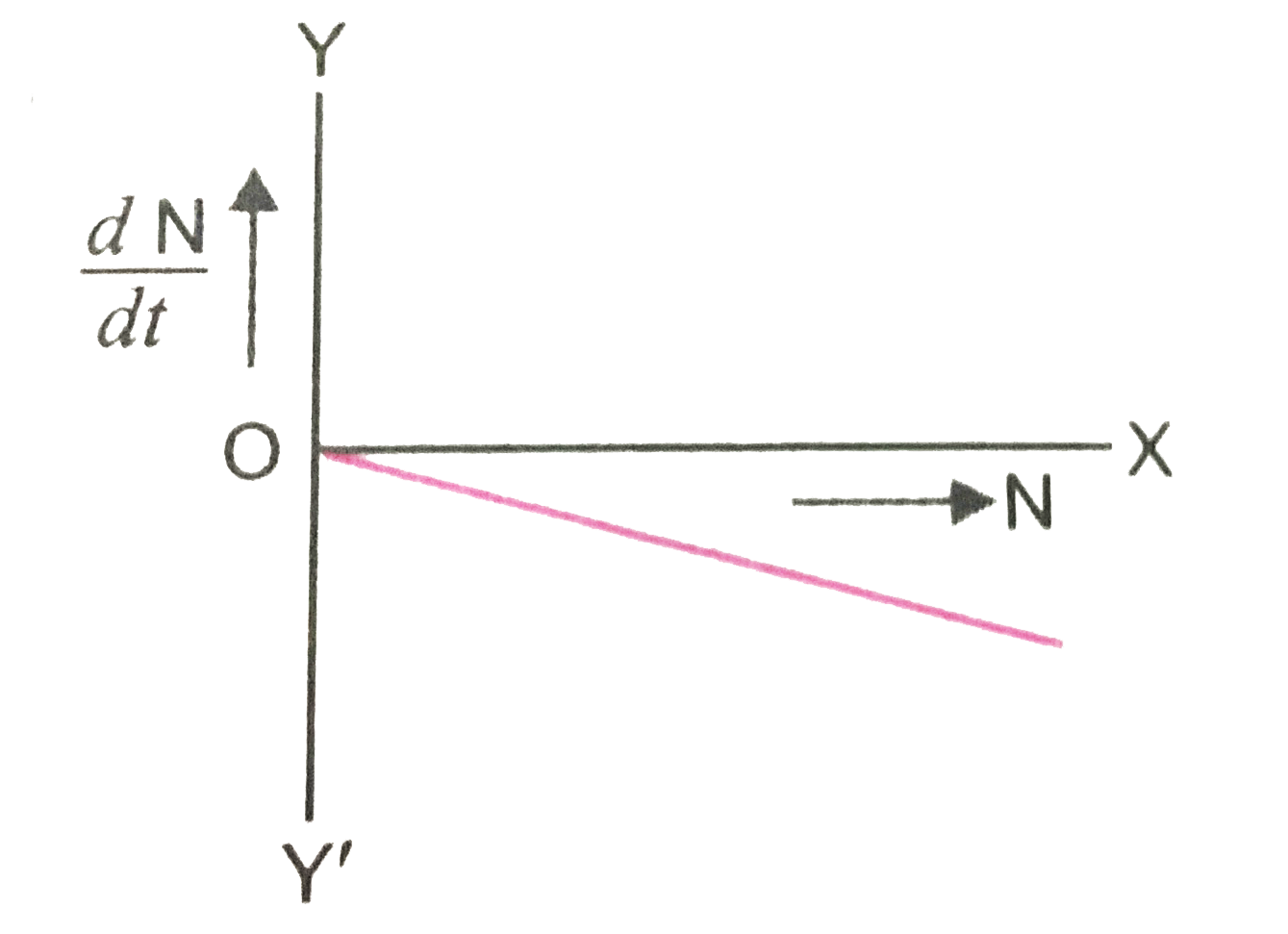
|
|
| 13. |
(A) : The electron passing parallel to both magnetic and electric field is always deflected from its path (R) : If velocity of electrons is equal to ratio of magnetic and electric field in crossed fields applied then electron beam remains undeflected. |
|
Answer» Both 'A' and 'R' are TRUE and 'R' is the CORRECT explanation of 'A'. |
|
| 14. |
Which of the following waves can be polarised (i) Heat waves (ii) Sould waves ? Give reason to support your answer. |
| Answer» SOLUTION :Heat waves can be POLARISED but SOUND waves cannot be polarised. Polarisation is POSSIBLE only in transverse waves. As heat waves are transverse waves, these can be polarised. However, sound waves are longitudinal waves and cannot be polarised. | |
| 15. |
From molecular view point, discuss the temperature dependence of susceptibility for diamagnetism, paramagnetism and ferromagnetism. |
|
Answer» Solution :Susceptibility of magnetic MATERIALS `chi = (M)/( H)`, where M = magnetisation intensity. H = magnetising FORCE Diamagnetism is due to the orbital motion of ELECTRONS in an atom developing magnetic moment opposite to applied field. Thus, resultant magnetic moment is zero and hence the susceptibility of DIAMAGNETIC material is not much affected by temperature. Para and FERROMAGNETISM is due to alignments of atomic magnetic moments in the direction of the applied field. As the temperature raised, the alignment is disturbed, resulting decrease in susceptibility of both with increase in temperature. |
|
| 16. |
When a body of mass 'm' moves with uniform speed V in a circle of radius r ,the centripetal force on the body is . |
| Answer» SOLUTION :Zero, the DIRECTION of motion of the BODY moving along the circular TRACK is always at RIGHT angles to centripetal force. | |
| 17. |
A spring weighing machine inside a stationary lift reads 50kg when a man stands on it. What would happen to the scale reading if the lift is moving upward with constant velocity |
| Answer» SOLUTION :(i) The reading of the machine will be 50kg wt. In this case, there will be no reaction, THEREFORE Apparent WEIGHT=Actual weight. | |
| 18. |
Some relations and laws related to fluids are given in column A, while the physical reasons behind them are given in column B. |
|
Answer» |
|
| 19. |
Distinguish between uniform and non-uniform magnetic fields. Give examples? |
|
Answer» SOLUTION :Uniform MAGNETIC field: If the strength of the magnetic induction field is same in magnitude and direction at all points in it, it is said to be uniform. 1) Magnetic field between two strong electro magnetic POLE pieces. 2) Horizontal component of earth.s magnetic field in a GIVEN place. Non-uniform magnetic field: If the strength of the magnetic induction field at all points in it differ in magnitude and direction it is said to be non-uniform. eg. : Magnetic field DUE to a bar magnet. |
|
| 20. |
Direction : The questions 57, 58 and 59 are based on following paragraph : Radiation emitted when an electron jumps from n = 3 to n=1 orbit in H_(2) atom, fall on a metal to produce photoelectrons. Electrons fall on the metal surface with maximum K.E. in a direction perpendicular to a magnetic field of 1/320 T in a radius of 10m^(-3). Wavelength of radiation is |
|
Answer» 5200 A |
|
| 21. |
Direction : The questions 57, 58 and 59 are based on following paragraph : Radiation emitted when an electron jumps from n = 3 to n=1 orbit in H_(2) atom, fall on a metal to produce photoelectrons. Electrons fall on the metal surface with maximum K.E. in a direction perpendicular to a magnetic field of 1/320 T in a radius of 10m^(-3). Work function of metal |
|
Answer» 1 eV `K.E.=1//2` `mv^(2)=1//2 m((Ber)/(m))^(2)=1.378xx10^(-19)Js` Now `(K.E.)_("max")= hv-phi_(0)` `:. phi_(0)=hv-(K.E.)_("max")=1.03eV` |
|
| 22. |
A spring weighing machine inside a stationary lift reads 50kg when a man stands on it. What would happen to the scale reading if the lift is moving upward with constant acceleration? |
|
Answer» Solution :In this case, when the LIFT is moving upward with CONSTANT acceleration, the reaction R (=ma )acts DOWNWARD. Apparent weight ` W' = W+R=m(g+a)`Newton. |
|
| 23. |
In SI system of value G is6.67xx10^3Nm^2//kg^2.Is it true? |
|
Answer» |
|
| 24. |
Charges 1 mu c are placed at each of the four corners of a square of side 2sqrt(2) m.The potential at the point of Intersection of the diagonals is ...... (K = 9 xx 10^(9) SI unit) |
|
Answer» `18 xx10^(3)` V 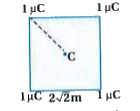 `:.` Distance from point of intersection of diagonal of each vertices `r=(4)/(2) = 2 m` `:.` Potential at point of intersection `V = (4kq)/(r)= (4xx9xx10^(9)xx10^(-6))/(2)` `V = 18 xx10^(3)` V |
|
| 25. |
The maximum electron density in the ionospherein the mornong is 10^(10)m^(-3). At noon time it increases to 2xx10^(10)m^(-3). Find the ratio of critical frequency at noon and the critical frequency in the morning. |
|
Answer» 2 |
|
| 26. |
What type of modulation is employed in India for radio transmission ? |
|
Answer» PULSE MODULATION |
|
| 28. |
What is packing efficiency of BCC |
|
Answer» 0.74 |
|
| 29. |
Stopping potential depends on |
|
Answer» FREQUENCY of INCIDENT LIGHT |
|
| 30. |
Why can we say that charge of any body is always an integral multiple of e ? |
|
Answer» Solution :If the protons and ELECTRONS are the only basic charges in the universe, all the observable charges have to be integral multiples of e. If a body containss `n_(1)`electrons and `n_2` protons, the total amount of CHARGE on the body is `n_(2)e + n_(1)(-e) = (n_(2) - n_(1))e` where `n_(1)`and `n_2` is integral multiples. and their DIFFERENCE = `n_(2)e - n_(1) (-e)` `=(n_(2) + n_(1))e` also an integer. Thus, the charge on any body is always an integral MULTIPLE of e and can be increased or decreased also in STEPS of e. |
|
| 31. |
The binding energy of an electron in the ground state of He atom is E_(0)=24.7eV. The energy required to remove both the elements from the atom is |
|
Answer» 24.6eV `= (24.6+13.6xx2^2)eV` `=(24.6 +54.4)e V =79eV` |
|
| 32. |
Which of the following is not the advantage of PN junction diode over tube value ? |
|
Answer» UNLIMITED life |
|
| 33. |
A ray of light enters a glass slab from air as shown in figure. If refractive index of glass slab is given by mu=A-Bt, where A and B are constants and t is the thickness of slab measured from the top surface. Find the maximum depth travelled by ray in the slab. Assume thickness of slab to be sufficiently large. |
| Answer» SOLUTION :`1/B (A-(SQRT(3))/(2))` | |
| 34. |
Current in a circuit falls from 5.0 A to 0.0 A in 0.1 s. If an average emf of 200 V induced, give an estimate of the self-inductance of the circuit. |
|
Answer» SOLUTION :Average self INDUCED emf is given by formula, `LT epsilon gt =-L ((DeltaI)/(Deltat))` `therefore 200=-L((0-5)/0.1)` `therefore` L=4H |
|
| 35. |
A square planer complex represented as: |
|
Answer» GEOMETRICAL isomerism |
|
| 36. |
Calculate the binding energy of a deutron. Given that mass of proton = 1.007825 a.m.u mass of neutron = 1.008665 a.m.u. mass of a deutron = 2.014103 a.m.u. |
|
Answer» |
|
| 37. |
The ratio of the root mean square velocity of H_2 and O_2 maintained at the same temperature is |
|
Answer» 4:1 |
|
| 38. |
Two particles A_1 & A_2 of masses m_1 & m_2(m_1gtm_2) have the same de Broglie wavelength. Then |
|
Answer» their MOMENTS are the same |
|
| 39. |
A 60muF capacitor is connected to a 110V, 60 Hz ac supply , determine the rms value of the current circuit . |
| Answer» Solution :`I_(rms) = (V_(rms) )/(X_C) = ( V_(rms) )/( (1)/(2pi v C) ) = 2pi v C XX V_(rms) = 2pi xx 60 xx 60 xx 10^(-6) xx 110 = 2.5 A` | |
| 40. |
When a ray of light enter from one medium to another, its velocity gets doubled. The critical angle for the ray for total internal reflection will be |
| Answer» ANSWER :A | |
| 41. |
A potentiometer wire of length 10m and resistance 30 ohm is connected in series with a battery of emf 2.5V, internal resistance 5 ohm and external resistance R. If the fall of potential along the potentiometer wire is 50mV/m, the value of R is ohms is |
|
Answer» 115 |
|
| 42. |
If two springs S, and S, of force constants k, and ky, respectively, are stretched by the same force, it is found that more work is done on spring S, than on spring S.Statement 1: If stretched by the same amount, work done on S, will be more than that on S. Statement 2: k_1 ltk_2 |
|
Answer» Statement 1 is true, Statement 2 is true, Statement 2 is not the correct explanation of Statement 1. `w_1=1/2k_1x_1^2=((k_1x_1)^2)/(2k_1)=(F^2)/(2k_1)` SIMILARLY, `w_2=(F^2)/(2k_2)` `IMPLIES W prop 1/k` `k_1ltk_2 :. W_1gtw_2` Statement 2 is true. Statement `1:w_1=1/2k_1x^2` `w_2=1/2k_2x^2` `implies w prop k` `because k_2gtk_1` `:.w_2gtw_1` `:.` Statement 1 is false. |
|
| 43. |
Direction : The questions 57, 58 and 59 are based on following paragraph : Radiation emitted when an electron jumps from n = 3 to n=1 orbit in H_(2) atom, fall on a metal to produce photoelectrons. Electrons fall on the metal surface with maximum K.E. in a direction perpendicular to a magnetic field of 1/320 T in a radius of 10m^(-3). The K.E. of the electrons is |
|
Answer» `2xx10^(-19)J` `[-(1.51)+3.4]eV=1.89eV` |
|
| 44. |
A spring of force constant 800 N/m has an extension of 5 cm. The workdone in extending it from 5 cm to 15 cm is : |
|
Answer» 16 J Thus, `W=1/2kx_2^2-1/2kx_1^2` = `1/2k(x_2^2-x_1^2)` =`1/2xx800[(15/100)^2-(5/100)^2]` =`1/2xx(800)/(10^4)[225-25]` =`4XX10^(-2)xx200=8 J` |
|
| 45. |
What are n-type and p-type semiconducts ?How is a semiconductorjunction formed ? |
|
Answer» Solution :n-type semiconductor `:` When a pure semiconductor is doped with pentavalent atomslike Arsenic, Antimony , Bismuth, then n-type semiconductor is formed. p-type semiconductor `:` When a pure semiconductor is doped with trivalent AOMS like Indium, Gallium, Al, p-type semiconductor is formed. Formation of p-n junction diode `:` When p-typeand n-type semiconductors are formed side by side, at the junction ,holes from p side diffuse to the n-side and ELECTRONS from n-side to p-side. Hence positive CHARGEIS established at the p-side. At the junction, the electrons and holes recombine and the REGION is FREE from charge carriers. This region which is free from charge carriers is called depletion layer. The potential developed near the p-n junction is called barrier potential. The potential barrier stops further diffusion of holes and electron across the junction. 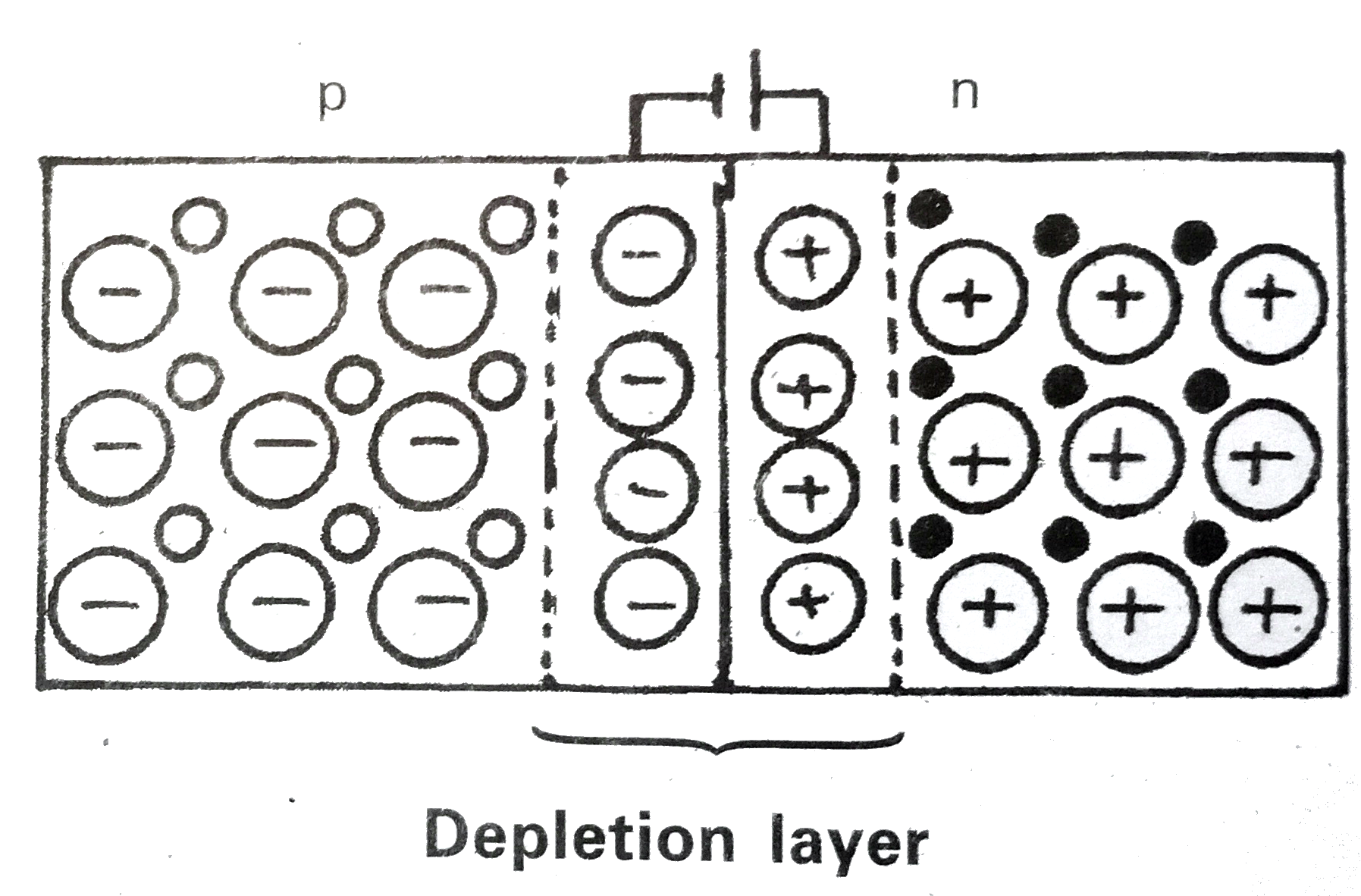
|
|
| 46. |
किसी माध्यम के अपवर्तनांक का मान होता है |
|
Answer» `SIN i/sin R` |
|
| 47. |
Moving particles of matter should display wavelike properties under suitable conditions. Calculate the frequency associated with a photon of energy 3.3xx10^-20J, h=6.6xx10^-34 Js |
| Answer» SOLUTION :ENERGY HV,`V=E/h=(3.3xx10^-20)/(6.6xx10^-34)=0.5xx10^14 HZ` | |
| 48. |
किसी पूर्णांक m के लिए प्रत्येक विषम पूर्णांक निम्न रूप में होता है: |
|
Answer» m |
|
| 49. |
The image formed by an objective of a compound microscope is : |
|
Answer» VIRTUAL and diminished |
|
| 50. |
Two identical metal spheres with +12 muF and -8 muF are kept at certain distance in air . They are brought into contact and then kept at the same distance . The ratio of the magnitudes of electrostaticforces between them beforeand after contact is |
|
Answer» `24:1` 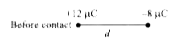 FORCE `F_(1)=-(1)/(4piepsilon_(0))*((12XX10^(-6)xx8xx10^(-6)))/(d^(2))` 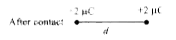 `thereforeF_(2)=+(1)/(4piepsilon_(0))*((2XX10^(-6)xx2xx10^(-6)))/(d^(2)` `therefore(F_(1))/(F_(2))=(96)/(4)=(24)/(1)`. |
|


