

Saved Bookmarks
This section includes 7 InterviewSolutions, each offering curated multiple-choice questions to sharpen your Current Affairs knowledge and support exam preparation. Choose a topic below to get started.
| 1. |
Identify the electromagnetic waves whose wavelengths vary as (a) 10^(-12)m lt lambda lt 10^(-8)m (b) 10^(-3)m lt lambda lt 10^(-1)m Write one use for each. |
|
Answer» Solution :(a) ELECTROMAGNETIC waves of wavelengths range `10^(-12)m lt LAMBDA lt 10^(-8)m` are kwon as X - rays. These are used as diagnostic tool in medicine, for scientific research and crystallography. (B) Electromagnetic waves of wavelengths `10^(-3) lt lambda lt 10^(-1)m` are the microwaves which are used in radar, microwavetelecommunication and MICROWAVE ovens etc. |
|
| 2. |
Considerthe followingstatements (A) The co - efficient of friction between twosurfaceswill increase if the surfaces are made rough . (B) rolling friction is more than slidingfriction |
|
Answer» BothA and B are TRUE |
|
| 3. |
A copper rod with length 1.4 mand area of cross-section of 2 cm^2 is fastenedto a steel rod with length L and cross-sectional area 1 cm^2. The compound rod is subjected to equal and opposite pulls to magnitude6.00xx10^4 N at its ends .(a) Find the length L of the steel rod if the elongation of the two rods are equal . (b) What is stress in each rod ? (c ) What is the strain in each rod ? [Y_"steel"=2xx10^11 Pa , Y_(Cu)=1.1xx10^11 Pa] |
|
Answer» SOLUTION :`Deltal_(CU)=Deltal_(steel)` `(Fl_C)/(A_CY_C)=(Fl_S)/(A_S Y_S)RARR l_S=(A_S/A_C)(Y_S/Y_C)l_C` or `L=(1.0/2.0)((2XX10^11)/(1.1xx10^11))1.40` =1.27 m (B) `sigma_C=F/A_C=(6xx10^4)/(2xx10^(-4))=3xx10^8 N//m^2` and `sigma_S=F/A_S=(6xx10^(4))/(1xx10^(-4))=6xx10^6 N//m^2` (c ) `epsilon_c=sigma_c/Y_c=2.7xx10^(-3)` `epsilon_s=sigma_S/Y_s=3.0xx10^(-3)` |
|
| 4. |
Who spotted Evelyn's potential? |
|
Answer» her father |
|
| 5. |
Newton's law of cooling applies when a body is losing heat to its surroundings by |
|
Answer» Conducting |
|
| 6. |
In given figure when input voltage increases, |
|
Answer» the current through `R_(S),R_(L)` and zener incresases |
|
| 7. |
A block of mass M, with a semicircular track of radius R rest on a horizontal frictionless surface. A uniform cylinder of radius r and mass m is released from rest at the point of the semicircular track. The cylinder slips in the semicircular frictionless track. How far the block moved when the cylinder reaches the bottom of the track ? |
|
Answer» |
|
| 8. |
The component of a vectoris |
|
Answer» always LESS than its magnitude |
|
| 9. |
A spherical shell of radius R_(1) with uniformly distributed charge q has a point charge q_(0) at its centre. Find the work performed by the electric forces during the expansion of the shell from R_(1) to R_(2). [Hint: W=W_(1)(decrease in self potential energy)+W_(2)(work done by electrical force of q_(0) on q)] |
|
Answer» |
|
| 10. |
A ball is released from the top of a tower of height h metre. It takes T second to reach the ground. What is the position of the ball in T//3sccond? |
|
Answer» h/9 metre from the GROUND `:. h=0+(1)/(2)gT^(2) or 2H=gT^(2)` After `T//3s, s=0+(1)/(2)xxg((T)/(3))^(2)=(gT^(2))/(18)` or `18 s - gT^(2)` From (i) and (ii) 18 s =2h or m from top. `:.` Height from ground `- h - (h)/(9)=(8h)/(9)` m . |
|
| 11. |
Verify the Ampere's law for magnetic field of a point dipole of dipole moment overset(to)(M) = M hat(k). Take C as the closed curve running clockwise along (i) the z-axis from z=a gt 0 to z= R, (ii) along the quarter circle of radius R and centre at the origin, in the first quadrant of x-z plane, (iii) along the x-axis from x = R to x = a and (iv) along the quarter circle of radius a and centre at the origin in the first quadrant of x-z plane. |
|
Answer» Solution :From P to Q, every point on the z-axis lies at the axial line of magnetic dipole of moment `overset(to)(M)`. Due to this magnetic moment the point (0, 0, Z) at z distance the magnetic field induction, `B = 2 ((mu_0)/( 4 pi)(M)/( z^3))` `B= (mu_0 M)/(2 pi z^3)`  (i) From Ampere.s law, At point from P to Q along z-axis `int_(P)^(Q) overset(to)(B). overset(to)(d) l = int_(P)^(Q) B dl cos 0^(@) = int_(a)^(R) B dz` `= int_(a)^(R) (mu_0)/( 2pi ) (M)/(z^3)dz = (mu_0 M)/( 2pi) (-(1)/(2) ) ((1)/(R^2) - (1)/(a^2) )` `= (mu_0 M)/( 4 pi ) ((1)/( a^2) - (1)/(R^2))` (ii) Along the QUARTER circle QS of radius R is GIVEN in the figure below.  The point A lies on the equatorial line of the magnetic dipole of moment M `sin theta`. Magnetic field at point A on the circular arc is, `B =(mu_0)/( 4pi ) (M sin theta)/( R^3) dl and dl =R d theta` `therefore d theta = (dl)/( R) ` From Ampere.s law, `therefore int overset(to)(B). overset(to)(dl)= int B dl cos theta` `= int_(0)^(pi //2) ((mu_0)/(4pi ) (M sin theta)/(R^3)) R d theta` `= (mu_(0) M)/( 4 pi R^2) int_(0)^(pi //2)sin theta d theta` `= (mu_0)/( 4pi ) (M)/( R) [ - cos theta ]_(0)^(pi//2)` `= (mu_0)/( 4pi ) (M)/(R ) [- cos (pi)/(2) + cos 0^(@) ]` `= (mu_0 M)/(4pi R^2 ) = [0+1]` `= (mu_0 M)/( 4pi R^2)` (iii) From Ampere.s law, along X-axis over the path ST, consider the figure given ahead.  From figure, every point lies on the equatorial line of magnetic dipole. Magnetic field induction at a point distance x from the dipole is, `B= (mu_0)/( 4pi ) (M)/( x^3)` `therefore int_(S)^(T) overset(to)(B). overset(to)(d) l = int_(R)^(a) - (mu_0 overset(to)(M) )/( 4pi x^3) . overset(to)(d) l = 0""(because "Angle between" overset(to)(M) and overset(to)(d) l "is" 90^@)` `int_(S)^(T) overset(to)(B). overset(to)(d) l = (- mu_0)/( 4pi x^3) int_(R)^(a) dl cos 90^@` (IV) Along the quarter circle TP of radius a. Consider the figure given below,  From case II line integral of `overset(to)(B)` along the quarter circle TP of radius a is circular arc TP. `int overset(to)(B). overset(to)(d) l = int_(pi//2)^(0) (mu_0)/( 4pi ) (M sintheta )/( a^3) ad theta` `= (mu_0)/( 4pi ) (M)/(a^2) int_(pi//2)^(0) sin thetad theta = (mu_0 M)/( 4pi a^2) [ - cos theta ]_(pi//2)^(0)` `=(mu_0 M)/(4pi a^2) [- cos 0^@ +cos (pi)/(2) ]` `= (mu_0 M)/( 4pi a^2) [-1 + 0]` `= - (mu_0)/(4pi) (M)/(a^2)` `therefore` For whole closed path PQST, `therefore oint_("PQST") overset(to)(B).overset(to)(d) l = int_(P)^(Q) overset(to)(B).overset(to)(d) l + int_(Q)^(S) overset(to)(B). overset(to)(d) l + int_(T)^(P) overset(to)(B). overset(to)(d)l` `(mu_0 M)/(4pi) [ (1)/(a^2) - (1)/(R^2) ] + (mu_0)/(4pi ) (M)/(R^2) + 0 + (-(mu_0)/( 4pi ) (M)/( a^2) )` `therefore oint_("PQST") overset(to)(B). overset(to)(d)l = (mu_0 M)/( 4pi a^2) - (mu_0 M)/( 4pi R^2) + (mu_0 M)/( 4pi R^2) - (mu_0 M)/( 4pi a^2) ` `=0` |
|
| 12. |
Two electric dipoles each of dipole moment P = 6.2 xx 10^(-30)C-m are placed with their axis along the same line and their centres at a distanced = 10^(-8)cm. The force of attraction between dipoles is |
|
Answer» `2.1 XX 10^(-16)N` |
|
| 13. |
In a astronomical telescope, the focal length of the objective is made : |
|
Answer» HALF of the eyepiece |
|
| 14. |
Magnetic force cannot do any work Do you agree with this statement? Justify your answer. |
| Answer» Solution :YES. The DIRECTION of the magnetic force on a MOVING CHARGE is always perpenticular to direction of motion. Hence workdone by magnetic force on a moving charge is ZERO. e | |
| 15. |
A filament bulb (500W, 100V) is to he used in a 230 V main supply. When a resistance R connected in series, it works perfectly and the bulb consumes 500W. The value of R is |
|
Answer» `26 OMEGA` Resistance of bulb, `R_(B) = (V^(2))/(P) = ((100)^(2))/(500)` `therefore R_(B) = 20 Omega` CURRENT is same in series, therefor , R `prop` V `therefore(R)/(R_(B)) = (V_(R))/(V_(B))` `therefore R = R_(B) xx (V_(R))/(V_(B))` `= 20 xx (130)/(100)` `therefore R =26 Omega` 
|
|
| 16. |
Define average value of an alternating current. |
| Answer» Solution :The average VALUE of alternating CURRENT is DEFINED as the average of all values of current over a POSITIVE half-cycle or negative half-cycle. | |
| 17. |
For given values to Tand m, resonance length in winter is x_(1) cm, and in summer, it is x_(2) cm. Then |
|
Answer» `x_(1) = x_(2)` Is summer, `upsilon` is more. Therefore, resonance LENGTH `(l)` is more , and vice- VERSA. Therefore, `x_(2) gt x_(1)` |
|
| 18. |
Find the magnetization of a bar magnet of length 10 cm and cross-sectional area 3 cm^2. Magnetic moment of the magnet is 1 Am^2. |
|
Answer» SOLUTION :MAGNETISATION(I) =`M_net/V` `=1//10xx10^(-2)xx3xx10^(-4)=10^5//3=0.33xx10^5A//m` |
|
| 19. |
If the incident ray falls normally on the refracting surface then |
|
Answer» Refraction do not take place |
|
| 20. |
The displacement of a particle in a wave is represented by y=10^-7sinpi[20t-0.1x]meter, where t is in second and x is in meter. The velocity of this wave is |
|
Answer» 2m/s |
|
| 21. |
The messages fed to the transmitter are generally |
|
Answer» RADIO SIGNALS |
|
| 22. |
A radionuclide A_(1) with decay constant lambda_(1) transforms into a radionuclide A_(2) with decay constant lambda_(2). Assuming that at the initial moment the preparation contained only the radionuclide A_(1), find: (a) the equation describing accumulation of the radionuclide A_(2) with time, (b) the time interval after which the activity value. |
|
Answer» Solution :(a)Suppose `N_(1)` and `N_(2)` are the number of TWO radionuclides `A_(1),A_(2)` at time `t`. Then `(dN_(1))/(dt)= 0lambda_(1)N_(1)` (1) `(dN_(2))/(dt)= lambda_(1)N_(1)-lambda_(2)N_(2)` (2) From (1) `N_(1)= N_(10)E^(-lambda_(1 t)` where `N_(10)` is the inital number of nuclides `A_(1)` at time `t=0` From (2) `((dN_(2))/(dt)+lambda_(2)N_(2))e^(lambda_(2)t)=lambda_(1)N_(10)e^(-(lambda_(1)-lambda_(2))t` or `(N_(2)e^(lambda_(2t)))= CONST(lambda_(1)N_(0))/(lambda_(1)-lambda_(2))e^(-(lambda_(1)-lambda_(2))t)` since `N_(2)=0 at t=0` Constant `N_(2)=(lambda_(1)N_(10))/(lambda_(1)-lambda_(2))` Thus `=(lambdaN_(10))/(lambda_(1)-lambda_(2))(e^(-lambda_(2)t)-e^(-lambda_(1)t))` (b) The activity of nuclie `A_(2)` is `lambda_(2)N_(2)`. This is maximum when `N_(2)` is maximum. That hapens when `(dN_(2))/(dt)=0` This requires `lambda_(2)e^(-lambda_(2)t+_(m))` or `t_(m)=(In(lambda_(1)//lambda_(2)))/(lambda_(1)-lambda_(2))` |
|
| 23. |
When a body is projected at an angle with the horizontal in the uniform gravitational field of the earth the angular momentumof the body about the point of projection as it proceeds along its path _______ . |
|
Answer» Remains CONSTANT L = rp sin `theta` = MVR sin `theta` = mr (V sin theta) As vertical component of velocity (v sin `theta` ) initially decreases and after its highest point increases `implies ` L, initially decreases and after highest point it increases. |
|
| 24. |
Assertion In He-Nelaser, population inversion takes place between energy levels of neon atoms. Reason Helium atoms have a metastable energy level. |
|
Answer» Both ASSERTIN and reason are TRUE and reason is the correct explanation of assertion 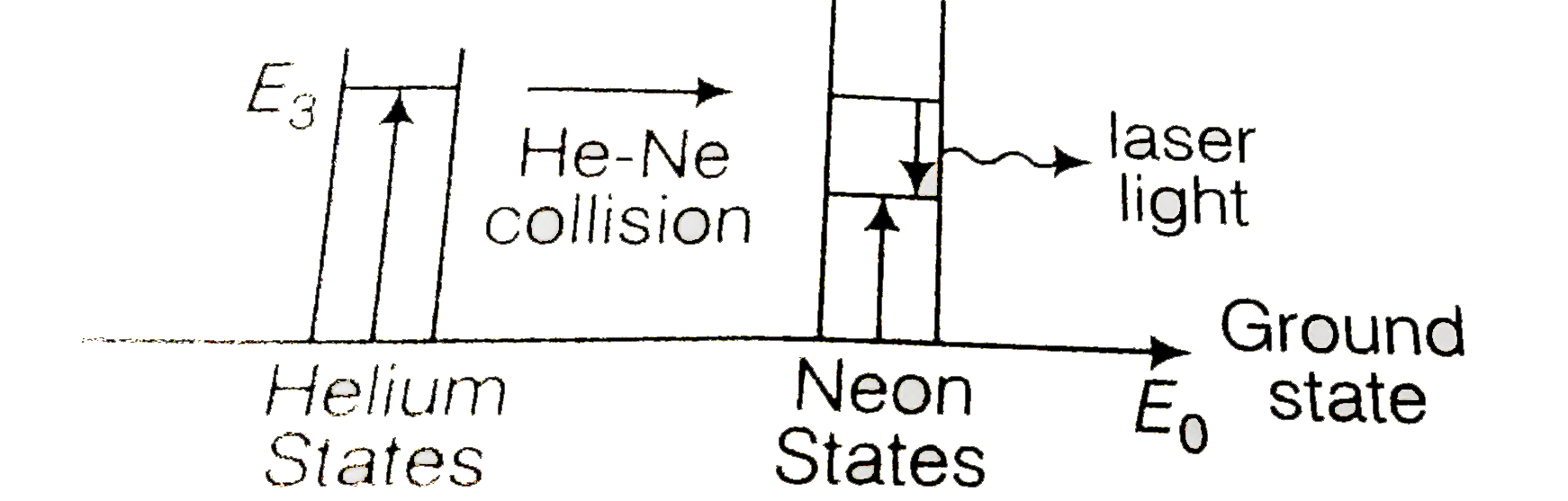 An electric discharge is the gas pump the helium atom to hgher ENERGY states .These He atoms COLLIDE with the ground STATE atoms and excite to higher states and prodcue population inversion causing a directional photon beam. |
|
| 25. |
Statement-1 : in standing wave average rate of transfer of energy at any cross-section is zero. because Statement-2 : instantaneous rate of energy transfer at node is equal to zero. |
|
Answer» STATEMENT -1 is True, statement -2 is True, Statement -2 is a correct EXPLANATION for Statement -1. |
|
| 26. |
Explain : "For some uses Ampere's circuital law ointvecB*vec(dl)=mu_(0)I is easy". |
|
Answer» Solution :1. For some uses, a closed loop (which is CALLED Amperian loop) is supposed in which at all POINTS EITHER, (i) `vecB` is tangential for this loop and B is NON zero. 2. Thus, Ampere.s law and Biot-Savart.s law associate magnetic field and electric current. These laws explain the results due to steady currents. |
|
| 27. |
In the Bainbridge mass spectrometer (Fig. 28.13) the distance between the velocity filter (selector) exit and the entrance slit of the detecting device (collector slit) is fixed and equal to l= 400 mm. The magnetic induction in both sections of the device is the same, being equal to 5.00 xx 10^(-2)T. When the electric field in the velocity filter is varied continuously the anode current peaks are observed at field strengths of 1.20 xx 10^4" V/m and "1.60 xx 10^4 V//m. Assuming the ions to be singly charged, identify them (i.e. find the element to which they belong). |
|
Answer» `m (el B^2)/(2E) (kg)=(el B^2)/(2 xx 1.66 xx 10^(-27)E) ("amu")=(4.82 xx 10^(4))/(E) ("amu")`. |
|
| 28. |
(A) : Electromagnetic radiations exert pressure.(R) Electromagnetic-waves carry both momentum and energy. |
|
Answer» Both 'A' and 'R' are TRUE and 'R' is the CORRECT explanation of 'A'. |
|
| 29. |
The number ofalpha-particles and beta -particles emitted in the reaction are _88A^196 to _78Ba^164 are |
|
Answer» 8 and 8 |
|
| 30. |
The reading on a high resistance voltmeter, when a cell is connected across it, is 2.2 V. When a 5 Omegaresistance is connected across the terminals of the cell in parallel with the voltmeter, the reading is 1.8 V. Determine the internal resistance of the cell. |
|
Answer» Solution :Here reading of voltmeter when connected directly to a cell = emf of cell `epsi` =2.2 V. External resistance R=5`OMEGA`and terminal voltage V = 1.8 V. ` therefore `Internal resistance of cell `r = (epsi - V)/(V) .R = (2.2 - 1.8)/(1.8) xx 5 = 1.1 Omega` |
|
| 31. |
The critical angle of a transparent crystal is 45^(@). Then its polarizing angle is |
|
Answer» `THETA = TAN^(-1)(sqrt(2))` |
|
| 32. |
In which of the following system will the radius of the first orbit (n = 1) be minimum ? |
|
Answer» HYDROGEN atom |
|
| 33. |
A small town with a demand of 800 kw of electric power at 220V is situated 15 km away from an electric plant generating power at 440 V. The resistance of the two line wires carrying power is Omega 0.5//km. The town gets power from the lines through a 4000 - 220 V step down transformer at a substation in the town. |
Answer» Solution : Power requirement of the twon is given by EI, where E is the voltage at the receiving end of the line and I is the line current Here `P = 800 xx 1000 W` `E = 4000 V` then `I = (P)/(E) = (800 xx 1000)/(4000) = 200A` (a) Line power loss `= I^(2)R = (200)^(2) xx (2 xx 15 xx 0.5)` `= 600,000 W = 600 kW` (b) Total power delivered by power plant `= 800 + 600 = 1400 kW` (c) Voltage at sending end of line = Receiving end line voltage + voltage drop in line `= 4000 + (I R) = 4000 + 200(2 xx 15 xx 0.5)` `= 4000+ 3000 = 7000 V` `therefore` Step up transformer of `(7000 V)/(440V)` is required |
|
| 34. |
A siren emitting sound of frequency 800 Hz is going away from a static listener with a speed of 30 m/s. The frequency of sound heard by listener is (velocity of sound = 300 m/s) : |
|
Answer» 727.3 HZ = 727.3 Hz CORRECT choice is (a). |
|
| 35. |
Which of the following must always be true ? I. If an object's acceleration is constant, then it must move in a striaght line. II. If an object's acceleration is zero, then its speed must remain constant. III. If an object's speed remains constant, then its acceleration must be zero. |
|
Answer» I and II only |
|
| 36. |
what is NOR gate ? write the truth table and boolean expression. |
| Answer» | |
| 37. |
A current of 3A flows in a circuit the potential difference between the junctions of 6Omega & 4Omega and 4Omega & 2Omega. |
|
Answer» 1 v |
|
| 38. |
If the speed of a rod moving at a relativistic speed is parllel , to its length is doubled, |
|
Answer» the LENGTH will BECOME HALF of the original value. |
|
| 39. |
In a common emitter (CE) amplifier having a voltage gain G, the transistor used has transconductance 0.03 mho and current gain 25. If the above transistor is replaced with another one with transconductance 0.02 mho and current gain 20, the voltage gain will be |
|
Answer» `2/3G` `G=((beta)/(R_(l)))R_(L) (g_(m)=(beta)/(R_(l)))` `g_(m)R_(L) implies G prop g_(m)` `(G_(2))/(G_(1))=(g_(m_(2)))/(g_(m_(1))) implies G_(2)=0.02/0.03xxG=2/3G` |
|
| 40. |
At a hydroelectric power plant, the water pressure head is at a height of 300 m and the water flow available is 100 m^2 s^(-1). If the turbine generator efficiency is 60%, estimate the electric power available from the plant (g = 9.8 m s^(-2)?). |
|
Answer» Solution :Here HEIGHT of water HEAD h = 300 m, VOLUME of water flow `V = 100 m^(3)s^(-1)` `therefore `Mass of water flow m = V`rho = 100 xx 10^(3) = 10^(5) kg m^(-1)` [`therefore` Density of water `rho = 10^(3) kg m^(-3)`] `therefore` Input power = Loss of potential ENERGY PER unit time = mgh `=10^(3) xx 9.8 xx 300 = 2.94 xx 10^(8)` As efficiency of turbine generator `eta = 60% = 60/100 = 0.6` `therefore` Power output `= eta xx ` input power `=0.6 xx 2.94 xx 10^(5) W = 176` MW. |
|
| 41. |
On itroducing a thin mica sheet of thickness 2 xx 10^(-6) m and refractive index 1.5 in the path of one of the waves, central bright maxima shifts by n fringes.Wavelength of the wave ised is 5000 Å, then n is : |
|
Answer» 1 `N lambda = (MU - 1)t` `THEREFORE n = ((mu - 1)t)/(lambda) = 2` |
|
| 42. |
Two metallic wires. A and B of equal dimensions but made of different materials, having resistivities p and 2p temperature coefficients of resistivities 2aipha and alpha, are connected in series. The temperature coefficient of resistance of the composite wire equals |
|
Answer» `rho_(eq)=(3)/(2)rho` |
|
| 43. |
Coefficient of mutual induction between 2 coils is 0.4 H. If a current of 4A in the primary is cut off in 1/15000 second, the emf induced in the secondary is |
| Answer» Answer :A | |
| 44. |
Consider . The potential difference V_(A)-V_(B) is. |
|
Answer» `E[(C_(1)C_(4)-C_(2)C_(3))/((C_(1)+C_(2))(C_(3)+C_(4)))]` Taking loop containing `C_(1),C_(2),` and `E`, we GET `q/C_(1)+q/C_(2)-E=0` or `q=E[(C_(1)C_(2))/(C_(1)+C_(2))]` Similarly, from loop containing `C_(3), C_(4)`, and `E`, we get `(q')/C_(3)+(q')/C_(4)-E=0` or `q'=E[(C_(3)C_(4))/(C_(3)+C_(4))]` Now, `V_(A)-V_(B)=q/C_(2)-(q')/C` `=E[C_(1)/(C_(1)+C_(2))-C_(3)/(C_(3)+C_(4))]` `=E[(C_(1)C_(4)-C_(3)C_(2))/((C_(1)+C_(2))(C_(3)+C_(4)))]` Now `V_(A)-V_(B)=ErArrC_(1)C_(4)-C_(2)C_(3)=0` or `C_(1)/C_(2)=C_(3)/V_(4)`. |
|
| 45. |
An electron and a photon each have a wavelength of 1.00nm. Find (i) their momentum (ii) the energy of the photon and (iii) K.E of electron |
|
Answer» Solution :`lambda_(e)=lambda_("photon")=1.00 nm=10^(-9)m` (i) For electron or photon, momentum `p=p_(e)=p_(p)=(h)/(lambda)` `p=((6.63xx10^(-34)))/(10^(-9))=6.63xx10^(-25)kg m//s` (ii) Energy of photon `E=(HC)/(lambda)` `=((6.63xx10^(-34))xx(3xx10^8))/(10^(-9))J` `~~19.89xxxx10^(-17)J` `(~~1243eV)` (iii) Kinetic energy of electron `=(p^(2))/(2M)` `(1)/(2)xx((6.63xx10^(-25)))/(9.1xx10^(-31))J ~~ 2.42xx10^(-19)J` `(~~1.51eV)` |
|
| 46. |
A neutron is absorbed by a ._(3)^(6)Li nucleus with the subsequent emission of an alpha particle. (i) Write the corresponding nuclear reaction. (ii) Calculate the energy released, in MeV, in this reaction. [Given: mass ._(3)^(6)Li=6.015126u, mass (neutron)=1.0086654 u mass (alpha particle) =0.0026044 u and mass (triton) =3.010000 u. Take i u=931 MeV//c^(2)] |
|
Answer» `10.92 MEV` |
|
| 47. |
For what value of k do the equations kx − 2y = 3 and 3x + y = 5 represent two lines intersecting at a unique point? |
| Answer» Answer :D | |
| 48. |
Two capillary tubes P and Q are dipped in water. The height of water level in the capillarity P is 2/3th height in capillarity B. What is the ratio of their diameters? |
|
Answer» SOLUTION :`r_P XX h_P = r_Q h_Q` `THEREFORE r_P xx 2/3 h_Q = r_Q xx h_Q` `therefore (r_P)/(r_Q)` = 3/2 |
|
| 49. |
How can the light of the lamp change evil into good? |
|
Answer» God's LIGHT will come and give the POET knowledge |
|
| 50. |
After the capacitor gets fully charged, S_(1) is opened and S_(2) is closed so that the inductor is connected in series with the capacitor. Then, |
|
Answer» at t=0,ENERGY stored in the CIRCUIT is purely in the formed of magnetic energy. `I=(dQ)/(dt)=-omegaCV SINOMEGAT` `I_(max)=omegaCV=1/(LC) C.V=Vsqrt(C/L)` `I=-Vsqrt(C/L) sinomegat` |
|