

Saved Bookmarks
This section includes 7 InterviewSolutions, each offering curated multiple-choice questions to sharpen your Current Affairs knowledge and support exam preparation. Choose a topic below to get started.
| 1. |
Determine the current flowing through the galvanometer G of the Wheatstone bridge shown in figure. . |
|
Answer» |
|
| 2. |
In Fig., sound waves A and B, both of wavelength lamda , are initially in phase and traveling rightward, as indicated by the two rays. Wave A is reflected from four surfaces but ends up traveling in its original direction. Wave B ends in that direction after reflecting from two surfaces. Let distance L in the figure be expressed as a multiple q of lamda: L = q lamda. What are the (a) smallest and (b) third smallest values of q that put A and B exactly out of phase with each other after the reflections? |
| Answer» SOLUTION :(a) 0.5 , (B) 2.5 | |
| 3. |
A double convex lens forms a real image of an object on a screen which is fixed. Now the lens is given a constant velocity 1 m/s along its axis and away fromthe screen. For the purpose of forming a sharp image always on the screen, the object is also required to be given appropriate velocity. The velocity of the object at the instant the size of the image is half the size of the object. |
|
Answer» 1 m/s |
|
| 4. |
The figure shows an energy level diagram for the hydrogen atom. Several transition are marked as I, II, III, …………. The diagram is only indicative and not to scale. |
|
Answer» The TRANSITION in which a Balmer series PHOTON absorbed is VI `:.` In transition (VI), photon of Balmer series is absorbed. In transition II `E_(2)=-3.4 eV, E_(4)=-0.85eV` `/_\E=2.55eV` `/_\E=(hc)/(lamda)implieslamda=(hc)/(/_\E)` `lamda=486nm` Wavelength of radiation `=103 nm =1030 A^(@)` ` :. /_\ 12400/1030~~12.0eV` So DIFFERENCE of energy should be `12.0 eV` (approx.) Hence `n_(1)=1` and `(n_(2)=3` `(-13.6)eV (-1.51) eV` `:.` Transition is `V`. For longest wavelength, energy difference should be minimum. So, in visible portion of hydrogen atom, minimum energy emitted is in transition IV. |
|
| 5. |
Suppose that the electric field amplitude of an electromagnetic wave is E_(0)=120N/C and that its frequency is v=50.0 MHz.Find expressions for E and B. |
|
Answer» SOLUTION :(a) `400 nT. 3.14 xx10^(8)" rad//s"1.05" rad//m ".6.00 m`. (B) `E={(120 N//C) sin (1.05" rad/m ")]x-(3.14xx10^(8)" rad/s")t]} HAT J` `B={(400 nT) sin (1.05" rad/m")]x-(3.14xx10^(8)" rad/s")t]} hat K` |
|
| 6. |
If the wavelength of light incident on a convex lens is increased, how will its focal length change? |
| Answer» Solution :If the WAVELENGTH of light incident on a convex LENS is increased, its focal LENGTH will ALSO INCREASE. | |
| 7. |
If two coils of negligible mutual induction and having coefficient of inductance L_(1) and L_(2) (L_(1) gt L_(2)) are arranged in parallel , the value of the equivalent self-induction will be __ |
|
Answer» `L_(1)L_(2)//(L_(1)-L_(2))` |
|
| 8. |
Franz looked for opportunities to skip school to do what? |
| Answer» Answer :D | |
| 9. |
Keeping the voltage of the charging source constant, what would be the percentage change in the energy stored in a parallel plate capacitor if the separation between its plates is decreased by 10%? |
|
Answer» Solution :Energy stored in the capacitor is given by `E=1/2 CV^(2) and C=(epsi_(0)A)/(d)`, where d is the separation by between the parallel plate capacitor. When d is DECREASED by 10% = 0.10 New capacitance, `C_1=(epsi_(0)A)/(0.90) =(10 epsi_(0) A)/(9)=(10)/(9)C` New energy stored, `E_(1)=1/2. (10)/(9) CV^(2)=(10)/(9) E` Change `=E_(1)-E` `"% change"=(E_(1)-E)/(E) xx 100=((10)/(9)-1) xx 100=11.1%` |
|
| 10. |
What is (a) electric dipole moment , (b) dielectric strength ? |
|
Answer» Solution :(a)It is product of the either of the charge and distance between the CHARGES. (b)It is minimum electric FIELD applied above which dielectric breakdown just occurs . It is the maximum electric field below which it BEHAVE as dielectric . It us maximum electric field below which dielectric breakdown does not OCCUR. |
|
| 11. |
Calculate the magnetic field at the center of a square loop which carries a current of1.5 A , length of each loop is 50 cm . |
|
Answer» Solution :Current through the square loop , I = 1.5 A Length of each loop, l = 50 cm = `50 xx 10^(-2)` m According to biot-Savarth law , Magnetic field due to a current carrying straight WIRE B = `(mu_(0)I)/(4 pi a ) ( sin alpha +Sin beta) = (4 pi xx 10^(-7) xx 1.5)/(4 pi xx ((l)/(2)) )(sin 45^(@) + sin 45^(@) )` = `(2 xx 1.5 xx 10^(-7))/(l) ((1)/(sqrt(2)) + (1)/(sqrt(2)) ) = ( 2xx 1.5 xx 10^(-7))/(50 xx 10^(-2)) ((2)/(sqrt(2)) ) ` B = 0.084866 `xx 10^(-5)` T Magnetic field at a point .P.of CENTRE of current carrying square loop `B.= 4 "sides" xx B ` = 4 `xx 0.08487 xx 10^(-5) = 0.33948 xx 10^(-5)` `B. = 3.4 xx 10^(-6) `T 
|
|
| 12. |
You are give four converging lenses of focal length 4cm, 8cm and 200cm. Which two would you prefer for a microscope and telescope. |
|
Answer» Solution :For a MICROSCOPE, `f_0` = 2CM: `f_0` = 8cm for TELESCOPE `f_0` = 200cm: = 2cm. |
|
| 13. |
For what angle of incidence the lateral shift produced by a parallel sided glass plate is maximum? |
|
Answer» |
|
| 14. |
In the network shown in figure, points A,B and C are at potentials of 70N, 0V and 10V respectively which of the following statements are not true. |
|
Answer» Point D is at a volt of 40V |
|
| 17. |
Identify the part of electromagnetic spectrum to which the following wavelngth belong. (i) 1 mm (ii) 10^(-1)m |
| Answer» SOLUTION :(i) RADIOWAVES (II) GAMMA RAYS | |
| 18. |
Figure shows a two slit arrangement withslits S_(1), S_(2), P_(1), P_(2) are the two minima ponts on either side of P(Fig). At P_(2) on the screen, there is a hole and behind P_(2) is a second 2-slit arranngement with slits S_(3), S_(4) and a second screen behind them |
|
Answer» There WOULD be no interference pattern on the SECOND SCREEN but it would be lighted. |
|
| 19. |
The refractive index of a certain glass is 1.5 for light whose wavelength in vacuum is 6000Å. The wavelength of this light when it passes through glass is |
|
Answer» `4000Å` |
|
| 20. |
State the principle of working of a cyclotron. Write two used of this machine. |
|
Answer» SOLUTION :A cyctotron is used for the following: (i) to bombard nuclei with ACCELERATED energetic particles and study the resulting NUCLEAR reactions. (ii) In hospitals to produce radioactive substances which are used in DIAGONSIS and TREATMENT. |
|
| 21. |
निम्नलिखित में से किस प्रांत में सीढ़ीदार (सोपानी) खेती की जाती है? |
|
Answer» पंजाब |
|
| 22. |
A circular loop enters a uniform magnetic field as shown in the figure. The current induced in the coil____ |
|
Answer» is zero |
|
| 23. |
पंजाब में भूमि निम्नीकरण का निम्न में से मुख्य कारण क्या है? |
|
Answer» गहन खेती |
|
| 25. |
क्रिस्टल में विद्युत चालकता उत्पन्न करने हेतु अशुद्धि मिलाने की क्रिया कहलाती है |
|
Answer» शॉटकी दोष |
|
| 26. |
Potential energy of a dipole in an electric field with its axis making an angle 0 w.r.t. electric field is : |
|
Answer» |
|
| 27. |
A man of mass 60 kg, carrying a load of mass 40 kg on his head, climbs up a 15 m long staircase to the top of a building 5 m high. What is the work done by the man? |
|
Answer» 49 KJ =`4.9xx10^(3)` |
|
| 28. |
An electric dipole is placed along x–axis at the origin as shown in the figure. Electric field at the point Pis parallel to the y–axis. If x–coordinate of P sqrt2 ism, what is its y–coordinate? |
Answer» Solution :`E_"net"` along y-axis `rArr (KP sin^2 alpha)/r^2 = (2KPcos^2alpha)/r^2`  `rArr` y =2m |
|
| 29. |
Pressure inside two soap bubbles are 1.01 and 1.02 atmosphere. Ratio between their volumes is : |
|
Answer» `102:101` `rArrR_(1)=(4T)/(1.01-1)=(4T)/(0.01)` Similarly for SECOND bubble, `R_(2)=(4T)/(1.02-1)=(4T)/(0.02)` Now `(R_(1))/(R_(2))=(0.02)/(0.01)=2` `therefore(V_(1))/(V_(2))=((R_(1))/(R_(2)))^(3)=8` Hence the CORRECT choice is (C). |
|
| 30. |
(A): If the P.D applied to a conductor doubles, the drift velocity of electrons also doubles. (R): Doubling the potential difference, doubles the current flow in a conductor. |
|
Answer» Both 'A' and 'R' are true and 'R' is the CORRECT explanation of 'A' |
|
| 31. |
For sustained interference fringes in duble slit experiment, essential condition/s is /are 1. sources must be coherent. 2. the intensities of the two sources must be equal. Here, the correct option/s is /are |
|
Answer» NEITHER (1) nor (2) |
|
| 32. |
Each questions contains statements given in two columns, which have to be matched. Statements in column - I are labelled as A,B,C and D, whereas statements in column-II are labelled as p,q,r and s. Match the entries of column-I with appropriate entries of colomn-II . Each entry in column-I may have one or more than one correct option from column - II. The answers to these questions have to be appropriately bubbled as illustrated in the given example, if the correct matches are A to (q,r), B to (p,s), C to (r,s) and D to (q). |
|
Answer» |
|
| 33. |
On the basis of your understanding of the following paragraphand the related studied concepts. An equipotential surface is a surface with a constant value of electric potential at all points on the surface. The component of electric field parallel to an equipotential surface is zero, as the potential does not change in this direction. Thus, the electric field is perpendicular to the equipotential surface at each point of the surface. Further, say the direction of electric field electrical potential gradually fall with distance. If a charge of 2 nC is taken from equipotential surface number 2 to 3, what is the amount of work done ? |
| Answer» SOLUTION :Work done `W = q(V_3-V_2) = (2 xx 10^(-9)C) xx (30-20) V = 2XX 10^(-8)J` | |
| 34. |
A Carnot engine work as refrigerator in between 0^@C and 27^@C. How much energy is needed to freeze10kgat 0^@C Work efficiency coefficient in above question, |
|
Answer» Solution :Work efficiency coefficient (cofficient of performance) `BETA = (Q_(2))/( Q _(1) - Q _(2))` `= (800xx 10^(3))/((879 -800) xx 10^(3))=10.13` |
|
| 35. |
The current through a 1.0 H inductor varies sinusoidally with an amplitude of 0.5 A and a frequency of 50 Hz. Calculate the potential difference across the terminals of the inductor. |
|
Answer» |
|
| 36. |
In the nuclear decay given below " "_(Z)^(A)X to " "_(Z+1)^(A)Y to " "_(Z-1)^(A-4)B^(*) to " "_(Z-1)^(A-4)B, the particles emitted in the sequence are : |
|
Answer» `BETA, ALPHA, GAMMA` |
|
| 37. |
A body projected from the ground reaches a point 'X' in its path after 3 seconds and from there it reaches the ground after further 6 seconds. The vertical distance of the point 'X' from the ground is (acceleration due to gravity =10ms^(-2)) |
|
Answer» 30m |
|
| 38. |
If alpha - current gain of a transistor is 0.98 What is the value of beta - current gain of the transistor ? |
|
Answer» 0.49 `beta=alpha/(1-alpha)=(0.98)/(1-0.98) ` where, `alpha = 0.98 , beta = ? ` `=(0.98)/(0.02)=98/2=49` |
|
| 39. |
A whistle of frequency f_(0) = 1300 Hzis dropped from a height H = 505 m above the ground. At the same time, a detector is projected upwards with velocity v = 50 ms^(-1)along the same line. If the velocity of sound is c = 300ms^(-1) , find the frequency detected by the detector after t = 5s. |
|
Answer» 500 Hz |
|
| 40. |
Radius of curvature of a plano-convex lens of focal length 0.2 m made up of glass of refractive index 1.5 is : |
|
Answer» 0.2 m |
|
| 41. |
On the basis of your understanding of the following paragraphand the related studied concepts. An equipotential surface is a surface with a constant value of electric potential at all points on the surface. The component of electric field parallel to an equipotential surface is zero, as the potential does not change in this direction. Thus, the electric field is perpendicular to the equipotential surface at each point of the surface. Further, say the direction of electric field electrical potential gradually fall with distance. Four equipotential surfaces are shown in the adjoining figure. Find the magnitude and direaction of the electric field. |
|
Answer» Solution :As SHOWN in figure for any two consecutive equipo tential surfaces `DeltaV = 10V` and normal distance between then `Delta r = Deltax sin 30^@ = 10 sin 30^@ cm = 5 cm = 0.05 m` `:. absvecE= (DeltaV)/(DELTAR) = (10V)/(0.05m) = 200 V m^(-1)` Direction of `VECE` is at right angle to an equipotential SURFACE along the direction of decreasing potential, hence `vecE` is directed at an angle of `102^@` from x-axis. 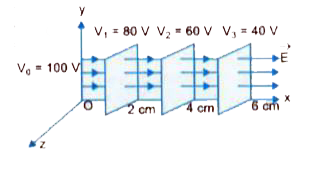
|
|
| 42. |
Two identical capacitors when joined in series have an effective capacitance of 3 muF. When connected in parallel, the effective capacitance becomes 12 muF. What is the capacitance of each capacitor ? |
|
Answer» `6 MU F` |
|
| 43. |
Pipe A is open at both ends and has length L_A = 0.343 m. We want to place it near three other pipes in which standing waves have been set up, so that the sound can set up a standing wave in pipe A. Those other three pipes are each closed at one end and have lengths L_B = 0.500L_A,L_C = 0.250L_A and L_D = 2.00L. For each of these three pipes, which of their harmonics can excite a harmonic in pipe A? |
|
Answer» Solution : (1) The sound from one pipe can SET up a standing wave it another pipe only if the harmonic frequencies match. (2) Equation gives the harmonic frequencies in a pipe with two open ends (a symmetric pipe) as f = nv/2L, for n 1,2,3,..., that is, for any positive integer. (3) Equation 17-40 gives the harmonic frequencies in a pipe with only one open END (an asymmetric pipe) as f= nv/4L, for n = 1, 3, 5, ..., that is, for only odd positive integers. Pipe A: Let.s first FIND the resonant frequencies of symmetric pipe A (with two open ends) by evaluating Eq. `f_A = (n_Av)/(2L_A) = (n_A(343 m//s))/(2(0.434 m))` ` = n_A (500 Hz) = n_A (0.50 kHz) ," for" on_A = 1, 2 ,3 ,.......... ` The first six harmonic frequencies are shown in the top plot in Fig. Pipe B: Next let.s find the resonant frequencies of asymmetric pipe B (with only one open end) by evaluating Eq., being careful to use only odd integers for the harmonic numbers: ` f_B = (n_B v)/(4L_B) = (n_B v)/(4(0.500 L_A)) = (n_B (343 m//s))/(2(0.343 m))` `n_B (500 Hz) = n_B (0.500 kHz) ,"for" n_B = 1, 3, 5,.....` Comparing our two results, we see that we get a match for each choice of`n_B` : `f_A = f_B "for" n_A = n_B"with" n_B = 1,3,5 ............` For example, as shown in Fig. , if we set up the FIFTH harmonic in pipe B and bring the pipe close to pipe A,the fifth harmonic will then be set up in pipe A. HOWEVER, no harmonic in B can set up an even harmonic in A. Pipe C: Let.s continue with pipe C (with only one end) by writing Eq. as `f_C = (n_Cv)/(4L_C ) = (n_Cv)/(4(0.250L_A)) = (n_C (343 m//s))/(0.343 m//s)` `n_C (1000 Hz) = n_C (1.00 kHZ ),"for "n_C = 1,3,5,......` From this we see that C can excite some of the harmonics of A but only those with harmonic numbers n, that are twice an odd integer: `f_A = f_C "for" n_A = 2n_C ,"with"n_C = 1,3,5,.......` Pipe D: Finally, let.s check D with our same procedure: `f_v = (n_Dv)/(4L_D) = (n_D v)/(4(2L_A)) = (n_D (343 m//s))/(8(0.343 m//s))` ` = n_D (125 Hz) = n_D (0.125 kHz),"for" n_D = 1,3,5,.....` As shown in Fig., none of these frequencies match a harmonic frequency of A. (Can you see that we would get a match if `n_D = 4n_A`? But that is impossible because `4n_A` cannot yield an odd integer, as required of `n_D`.) Thus D cannot set up a standing wave in A. 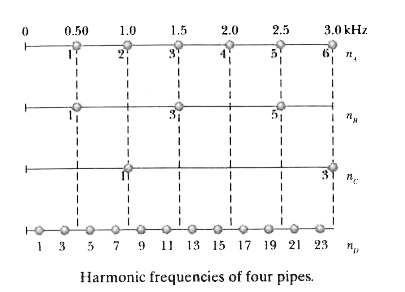
|
|
| 44. |
Derive equation of magnetic field inside a long straight solenoid. |
Answer» Solution :1. Figure shows the sectional view of a long solenoid. At various turns of the solenoid, current COMES out of the plane of paper at points marked  and enters the plane of paper at points marked and enters the plane of paper at points marked  . .  2. To determine the magnetic field `vecB` at any inside point, consider a rectangular closed path abcd as the Amperean LOOP. 3. According to Ampere.s circuital law, `ointvecB*vec(dl)=int_(a)^(b)vecB*vec(dl)+int_(b)^(c)vecB*vec(dl)+int_(c)^(d)vecB*vec(dl)+int_(d)^(a)vecB*vec(dl)""...(1)` 4. cd part is outside the solenoid. Outside magnetic field `|vecB|=O` so that, `int_(c)^(d)vecB*vec(dl)=O` 5. d -a and b - c parts are perpendicular to `vecB` so, `int_(b)^(c)vecB*vec(dl)=int_(d)^(a)vecB*vec(dl)=O` 6. So equation (1) will be like this, `ointvecB*vec(dl)=int_(a)^(b)vecB*vec(dl)=int_(a)^(b)BdlcosO=Bint_(a)^(b)dl` `thereforeointvecB*vec(dl)=B(h)""...(2)`(Where h = length of part ab) 7. SUPPOSE, number of TURN per unit length be n. So total number nh in h length. 8. I be current to each turn, so nhI current for nh turns current enclosed by loop `I_(e)=I(nh)""...(3)` 9. According to Ampere.s circuital law, `ointvecB*vec(dl)=mu_(0)I_(e)""...(4)` `therefore` Substitute equation (2) and (3) in equation (4), `B(h)=mu_(0)Inh` `thereforeB=mu_(0)nI""...(5)` 10. The direction of the field is given by the right hand rule. 11. The solenoid is commonly used to obtain uniform magnetic field. |
|
| 45. |
If the banking angle of a curved road is given by tan^(-1) (3/5) and the radius of the road is 6m, then the safe driving speed should not exceed- |
|
Answer» 21.6 km/hours |
|
| 46. |
The charge 3.0 xx 10^(-5) Care placed on a metal sphere of radius 3.0 m, then the energy stored in it will be........ . |
|
Answer» `(3)/(8 pi) in_(0) xx10^(10)J` `U = (Q^(2))/(2C) = ((3xx10^(-5))^(2))/(8 pi epsilon_(0)xx3)=(3)/(8pi epsilonxx3)=(3)/(8 pi epsilon_(0))xx10^(-10)` J |
|
| 47. |
A ray of monochromatic light is incident on one refracting face of a prism of angle 75^@. It passesthrough the prism and is incident on the other face at the critical angle. If the refractive index of the material of the prism is sqrt2 , the angle of incidence on the first face of the prism is, |
| Answer» Answer :B | |
| 48. |
The Kirchhoff's first law (sum i = 0) and second law (sum iR = sum epsi) , where the symbols have their usualmeanings, are respectively based on |
|
Answer» CONSERVATION of charge, conservation of MOMENTUM. |
|
| 49. |
A point charge q is held at the centre of a circle of radius r. B,C are two points on the circumference of the circle and A is a point outsdie the circle . If W_("AB") charge q_(e )from A to B and W_("AC") represents the workdone from A to C ,then |
|
Answer» `W_("AB") gt W_("AC")` |
|


