Saved Bookmarks
This section includes 7 InterviewSolutions, each offering curated multiple-choice questions to sharpen your Current Affairs knowledge and support exam preparation. Choose a topic below to get started.
| 2. |
A plank is rotating in a vertical plane about one of its ends with a constant angular velocity omega=sqrt(2)rad//s. A block of mass m=2kg is placed at a distance l=1m from its end A (see figure) which is hinged. The block starts sliding down when the plank makes an angle theta=30^(@) with the horizontal. If coefficient of friction between the plank and the block is mu and given that mu^(2)=k//25. Find the value of k. |
|
Answer» Solution :`(1)/(V)-(1)/(u)=(1)/(F)` `v-u=x`, `(1)/(u+x)-(1)/(u)=(1)/(f)` `rArr (1)/(u+x)=(1)/(u)+(1)/(f)` `u+x=(UF)/(u+f)` `x=(uf)/(u+f)-u=u[(f)/(u+f)-1]` `x=(-u^(2))/(u+f)` differentiating w.r.t. `x`, `:. deltax=[(-2u)/(u+f)+(u^(2))/((u+f)^(2))]DELTAU` `=(-2u(u+f)+u^(2))/((u+f)^(2))deltau` `=-(u^(2)+2uf)/((u+f)^(2))deltau` `deltax=((u+f)^(2)+f^(2))/((u+f)^(2))=[((f)/(u+f))-1]deltau` `deltau=a lt lt |u|=|3f|` `deltax=[((f)/(-3f+f))^(2)-1]a=-(3)/(4)a` Amplitude `=|deltax|=(3)/(4)a` 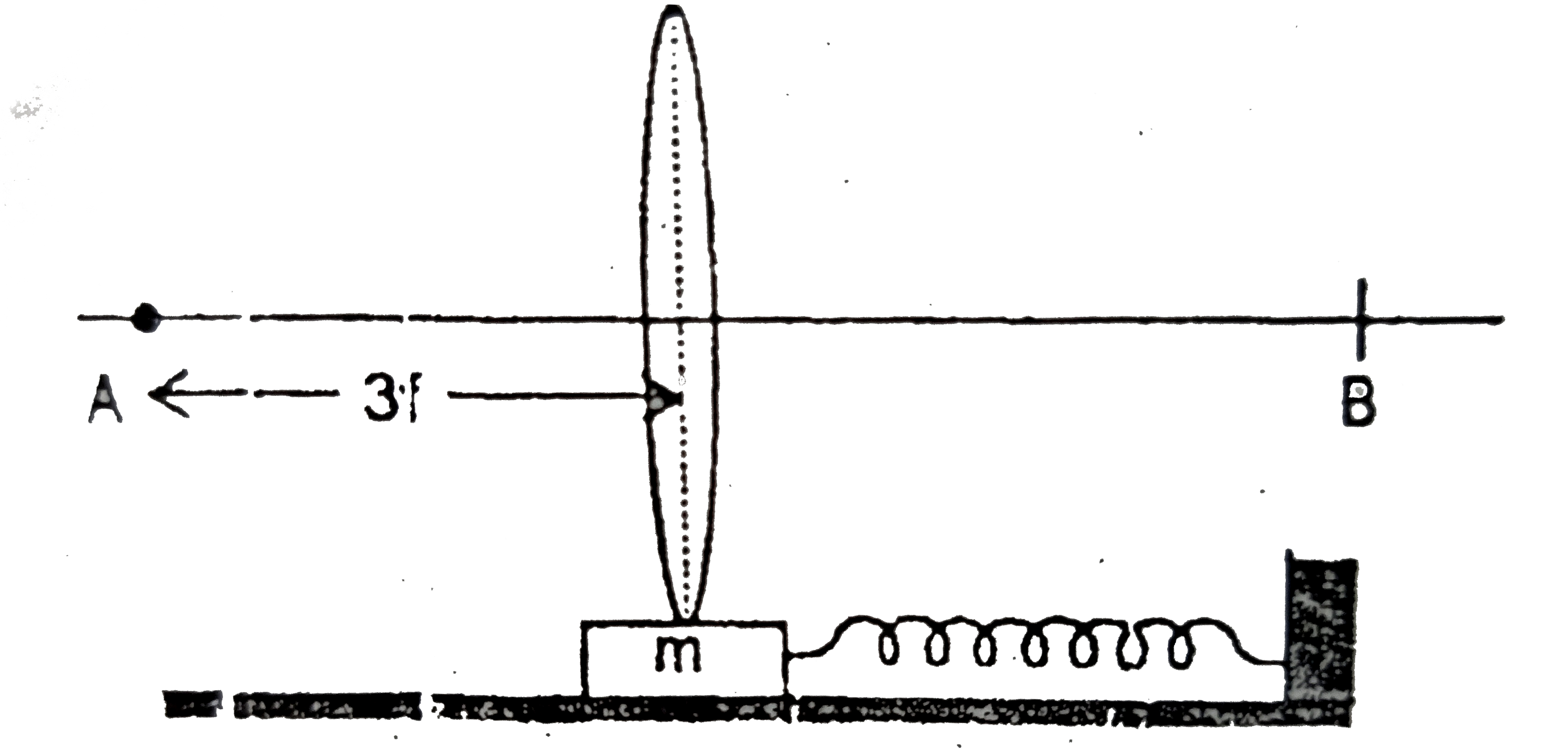
|
|
| 3. |
What is the minimum energy that must be given to a H atom in ground state so that it can emit an H_(gamma) line in Balmer series?If the angular momentum of the system is conserved, what would be the angular momentum of such H_(gamma) photon ? |
|
Answer» Solution :For Balmer series of atomic spectrum of hydrogen, `(1)/(lambda)=R((1)/(2^(2))-(1)/(n^(2)))` where `n=3,4,5,6,....oo` respectively for `H_(ALPHA) , H_(beta), H_(gamma), H_(delta),....H_(oo)` lines ). Here for `H_(gamma)` lines n=5 and so minimum energy to be supplied to an electron LYING in n = 1 energy LEVEL will be equal to, `E_(5)-E_(1)=-(13.6)/(n^(2))-(13.6)` `=13.6-(13.6)/(n^(2))` `=13.6-(13.6)/(n^(2))` `=13.6-(13.6)/((5)^(2))( :.n=5)` `=13.6(1-(1)/(25))` `=(13.6xx24)/(25)` `=13.056eV` Angular momentum of emitted `H_(gamma)` photon, = decrease in angular momentum of electron `=l_(5)-l_(2)` `=(5h)/(2pi)-(2h)/(2pi)` `=(3h)/(2pi)` `=(3xx6.625xx10^(-34))/(2xx3.14)` `=3.165xx10^(-34)Js` |
|
| 4. |
Give any one advantage of LEDs over conventional incandescent low power lamps. |
| Answer» Solution :Operating VOLTAGE is LOW,power CONSUMPTION is less and no warm up TIME is needed. | |
| 5. |
The co-ordinates of a moving particle at any time t are give by x = at^2 and y=bt^2 . The speed of the particle is |
|
Answer» 2T (a+B) |
|
| 6. |
Two blocks of masses m_(1) and m_(2) are kept touching each other on a rough fixed inclined plane of inclinationalpha. Coefficients of kinetic friction between the inclined plane and the block m_(1) is k_(1)and between the inclinedplane and block m_(2) is k_(2). Find the force ofinteraction between the blocks in the process of motion. |
|
Answer» Solution :`m_(1)G sin alpha +N-K_(1)N_(1)=m_(1)a "" (i)` `N_(1)=m_(1)g COS alpha "" (ii)` `m_(2)g sin alpha-N-K_(2)N_(2)=m_(2)a "" (iii)` `N_(2)=m_(2)g cos alpha "" (iv) ` 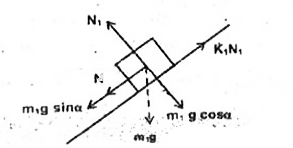 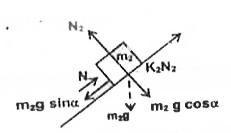 SOLVING these FOUR equations for N `N=((K_(1)-K_(2)))/(m_(1)+m_(2))m_(1)m_(2)g cos alpha`. |
|
| 7. |
In the circuit shown, current (in A) through the 50 V and 30V batteries are, respectively : |
|
Answer» 3 and 2.5 |
|
| 8. |
____Scanning Electron Micrograph (SEM) showing the nano structures on the surface of a leaf fom a lotus plant. |
|
Answer» PARROT fish |
|
| 9. |
A passanger sitting in a train moving with constant horizontal velocity drops a ball vertically downward what is the path observed by a man standing on the ground near the train and |
| Answer» SOLUTION :PARABOLA | |
| 10. |
At the magnetic poles of the earth, a compass needle will be[ |
|
Answer» Vertical |
|
| 11. |
Kamla peddles a stationary bicycle. The pedals of the bicycle are attached to a 100 turn coil of area 0.10 m^2. The coil rotates at half a revolution per second and it is placed in a uniform magnetic field of 0.05 T perpendicular to the axis of rotation of the coil. What is the maximum voltage generated in the coil ? |
|
Answer» |
|
| 12. |
The number of turns in the coil of an ac generator is 5000 and the area of the coil is 0.25 m^(2) The coil is rotated at the rate of 100 "cycles" // "sec" in a magnetic field of 0.2 T. The peak value of the emf generated is nearly |
|
Answer» 786 kV |
|
| 13. |
In a p-type semiconductor the acceptor energy level is slightly ______ |
| Answer» SOLUTION :above the TOP of VALANCE BAND | |
| 14. |
The magnetic moment of a bar magnet of length 0.2m is 1 Am^(2). If it is cut into two equal pieces along its 8. axis, what is the magnetic moment of each piece. |
| Answer» SOLUTION :`0.5Am^(2)` | |
| 15. |
An electron falls freely in electric field of 9.1 xx 10^3 NC^(-1), then acceleration of electron is ....... |
|
Answer» `1.6 xx 10^(13) MS^(-2)` `=1.6 xx 10^(15) m//s^(2)` |
|
| 16. |
A person sitting in a train moving with constant velocity along a straight line throws a ball vertically upward. Will the ball return to thrower's hand? Why? |
| Answer» SOLUTION :(I) a STRAIGHT LINE (VERTICALLY up WARDS) | |
| 17. |
For a planet moving around the sun in an elliptical orbit, which of the following quantities remain constant ? |
|
Answer» The total energy of the sun plus planet system |
|
| 18. |
Taking the Bohr radius as a_(0)= 53 pm the radius of Li^(++) ion in its ground state, on the basis of Bohr's model, will be about. |
|
Answer» 53 pm `r_(n)=(a_(0)n^(2))/(Z)` TAKING `Z=3` for `Li^(++)` ION and n=1 for its ground state, `r_(1)=(53)XX((1)^(2))/(3)` `:. r_(1)(53)xx((1)^(2))/(3)` `:.r_(1)=17.67` pm `~~18` pm (picometer) |
|
| 19. |
How to use devastate properly? |
|
Answer» He is DEVASTATE |
|
| 20. |
The applied input ac power to a half wave rectifier is 100 W. The dc output power obtained is 40W. Find the rectifier efficiency. |
|
Answer» <P> Solution :AC input POWER= 100 W, dc output power = 40 W.`"RECTIFIER efficiency "=("dc power output")/("Input ac power")=(P_(dc))/(P_(ac))=(40)/(100)=0.4` `therefore` PERCENTAGE efficiency of the half wave rectifier `= 40%` |
|
| 21. |
Statement(A) : In P-type semi conductor Fermi - energy level lies nearer to the conduction band Statement(B) : In n-type semi conductor Fermienergy level lies above the middle of the Forbidden Band. |
|
Answer» A is TRUE, B is FALSE |
|
| 22. |
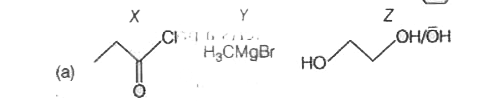
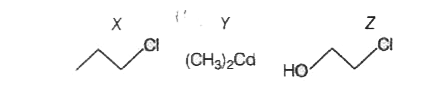
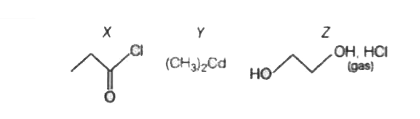
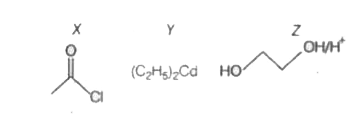
Identify X,Y,Z in the following reactions sequence. |
|
Answer»
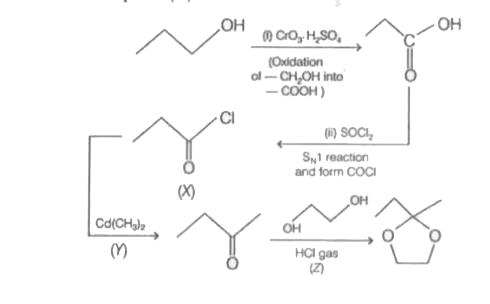 HENCE, OPTION ( C) is CORRECT. |
|
| 23. |
माना A = {0, 1, 2 , 3} तथा A में एक सम्बन्ध R निम्नलिखित प्रकार से परिभाषित कीजिए R=((0,0),(0,1),(0,3), (1,0), (1,1),(2,2),(3,0),(3,3)} |
|
Answer» स्वतुल्य तथा सममित |
|
| 24. |
A : The angle subtended at the eye by an object is equal to the angle subtended at the eye by the virtual image produced by a magnifying glass so the magnification produced is one. R : During image formation through magnifying glass, the object as well as its image are at the same position. |
|
Answer» If both ASSERTION & Reason are true and the reason is the CORRECT EXPLANATION of the assertion, then mark (1). |
|
| 25. |
Derive the laws of refraction from the concept (Huygen's principle) of the wavefront. |
Answer» Solution :According to Huygen.s principle of wavefront is as follow.  LET PP. represent the surface separating medium-1 and medium-2, as shown in figure. And `v_(1)`, and `v_(2)` represent the speed of light in medium-l and medium-2 respectively and `v_(2)ltv_(1)`. And a plane wavefront AB propagating in the direction AA. incident on the interface of two medium at an angle i. Let `tau` be the time taken by the wavefront to travel the distance BC. `:.BC=v_(1)tau` In order to determine the shape of the refracted wavefront, draw a sphere of radius `v_(2)tau` from the point A in the second medium (the speed of the wave in the second medium is `v_(2)`and the distance covered in time `tau`is `v_(2)t`.) Let CE represent a tangent plane drawn from the point C on the sphere. Then `AE=v_(2)tau` and CE would represent the refracted wavefront. In `DeltaABCandDeltaAEC,` `sini=(BC)/(AC)=(v_(1)tau)/(AC)".........(1)` and `sini=(AE)/(AC)=(v_(2)tau)/(AC)".........(2)` where i and r are the angles of incidence and refraction respectively. Taking ratio of equation (1) and (2), `(sini)/(sinr)=(v_(1))/(v_(2))""......(3)` From this equation, we get the important result that if `rlti` (i.e., if the ray bends toward the normally), then `(sini)/(sinr)gt` [`:.i` is increasing function in first QUADRANT] `:.(v_(1))/(v_(2))gt1impliesv_(1)gtv_(2)` the medium-1. This predication is opposite to the prediction from the corpuscular model of light but predication is as according to wave theory. Suppose the speed of light in vacuum is c, absolute refractive index `n_(1)=(c)/(v_(1))` where the speed in medium-1 is `v_(1)` and `n_(2)=(c)/(v_(2))` where the speed in medium-2 is `v_(2)`. `:.(n_(2))/(n_(1))=(v_(1))/(v_(2))""......(4)` From equation (3) and (4), `(sini)/(sinr)=(v_(1))/(v_(2))=(n_(2))/(n_(1))` `:.n_(1)sini=n_(2)sinr` This is the Snell.s law of refraction. For more information : Speed, `v=(lamda)/(t)` `:.vt=lamda` `:.v_(1)tau=lamda_(1)andv_(2)tau=lamda_(2)` `:.(lamda_(1))/(lamda_(2))=(v_(1))/(v_(2))` or `(v_(1))/(lamda_(1))=(v_(2))/(lamda_(2))` This relationship shows that when the wave refracted in denser medium `(v_(1)gtv_(2))`, its WAVELENGTH and speed decreases but the its wavelength `lamda` and speed decreases but the frequency remains constant. |
|
| 26. |
If an extermal electric field (E) is applied on the system, write the expression for the total energy of this system. |
|
Answer» Solution :If an external ELECTRIC field E is applied on the SYSTEM then the total ENERGY of the system will be `U = q_(1)V_(A)+q_(2)V_(B) +(1)/(4piin_(0)).(q_(1)q_(2))/(r_(12))` |
|
| 27. |
Unit of "Pascal " is the same as |
|
Answer» `10^6 "dyne/cm"^2` |
|
| 28. |
A hunter has a machine gun that can fire 50 gm bullets with velocity 900 m/s. A 40 kg tiger springs at him with velocity 10 m/s. How many bullets must the hunter fire into the tiger in order to stop him in the track. |
|
Answer» 7 |
|
| 29. |
In a hysteresis cycle , the value of reverse magnetic field ( H) required to make the intensity of magnetization I is called the _____ |
| Answer» SOLUTION :COERCIVITY | |
| 30. |
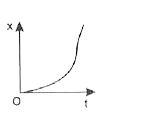
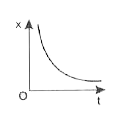
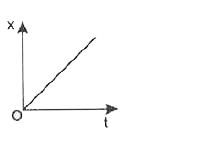
Which of the following position-time graph represent uniform motion ? |
|
Answer»
|
|
| 31. |
If an electron jumps from 1^(st) orbit to 3^(rd) orbit, then it will |
|
Answer» not LOSE energy |
|
| 32. |
Radiations of wavelength 200 nm propagating in the form of a parallel beam, fall normally on a plane metallic surface. The intensity of the beam is 5mW and its cross sectional area 1.0mm^(2). Find the pressure exerted by the radiation on the metallic surface, if the radiation is completely reflected. |
|
Answer» SOLUTION :`E=(12400)/(lamda)=(12400)/(2000)=6.2eV~~10^(-18)J` Number of photons passing a POINT per second is `n=(P)/(E)=(5xx10^(-3))/(10^(-18))=5xx10^(15)` MOMENTUM of each photon `p=(E)/(C)=3.3xx10^(-27)J//s` Change in momentum after each strike `=2p=6.6xx10^(-27)J//s` TOTAL momentum change per second is `F=(dp)/(dt)=(nxx2p)/(t)=5xx10^(15)xx6.6xx10^(-27)` `=33xx10^(-12)N` `:.` pressure `=(F)/(A)=33xx10^(-6)N//m^(2)` |
|
| 33. |
Ampere’s theorem helps to find the magnetic field in a region around a current carrying conductor. Draw the variation of intensity of magnetic field with the distance from the axis of a current carrying conductor. |
| Answer» SOLUTION :`[B=mu_0Nl /2A]` | |
| 34. |
Show that if 'p' and 'q' are distance of object and image from the principal focus of a concave mirror, then what is relation between p,q and f? |
|
Answer» `PQ = sqrt(f)` v = - (q + f) `therefore(1)/(f)=(1)/(v)+(1)/(u)=-(1)/(p+f)=(p+q+2f)/((p+f)(q+f))` SOLVING, pq = `f^(2)` |
|
| 35. |
Finding focal length by displacement method In an experiment for finding focal length of a convex lens the object and screen are kept fixed. There are two position of lens between the object and screen for which an image is obtained on the screen. These positions are separated by 20cm. Also, the magnification in first situation is -2. Find the distance between the object and the screen, that is the focal length of the lens. |
|
Answer» Solution :As we can see from the analysis persented before, this refers to the situation of DISPLACEMENT method of finding the focal length of lens (Fig 34-47) Calculation : `(1)/(d-x)+(1)/(x)=(1)/(f)` From Fig. 34-47 , it is clear that in the first situation , object is at a distance x from the lens and in second situation screen is at a distance x from the lens. Therefore, `d-2x=20cm` Also `m_(1)=(d-x)/(-x)=-2` `d=3x` So, `x=20cm` and `d=60cm` . Therefore, `(1)/(40)+(1)/(20)=(1)/(f)` ,br> `f=40//3cm` We stated previously that d must be greater than 4f . This can be easily seen from the ANSWER. |
|
| 36. |
A particle moves in a closed orbit around the origin, due to a force which is directed towards the origin. The de Broglie wavelength of the particle varies cyclically between two values lamda_(1), lamda_(2) " with " lamda_(1) gt lamda_(2). Which of the following statements are true? |
|
Answer» The particle COULD be moving in a circular orbit with origin as centre |
|
| 37. |
What are photoelectrons ? |
| Answer» SOLUTION :These are the electrons emitted from a metal SURFACE when it is exposed to electro MAGNETIC RADIATIONS of a SUITABLE frequency. | |
| 39. |
An aluminum piece is subjected to varying temperature. What is the effect oftemperature on its susceptibility? |
| Answer» SOLUTION :The SUSCEPTIBILITY DECREASES with INCREASE in TEMPERATURE. | |
| 40. |
For angles of projection of projectiles at (45° -theta) and (45° + theta) the horizontal ranges described by the projectile are in the ratio |
|
Answer» `2:1` or `R_(1)=(u^(2)COS2THETA)/g,R_(@)=(u^(2)cos2theta)/g` `:.R_(1)/R_(2)=1` or `R_(1):R_(2)::1:1`. |
|
| 41. |
An object is placed between two plane at an angle Theta with each other. What is the total number of image formed? |
|
Answer» Solution :If `Theta` is a sub multiple of `180^@` then the number of IMAGES formed is `eta = (360/theta-1)` if `theta` is not a SUBMULTIPLE of `180^@` then the number of images formed is theinteger NEXT HIGHER than (360/theta-1)` |
|
| 42. |
R_(1) and R_2 (R_(1) lt R_(2))are radii of two isolated sphere A and B respectively having same surface density. Hence the intensity of electric field at the surface is ......... |
|
Answer» more on SPHERE A `therefore`ELECTRIC FIELD on the surface, `E = (kQ)/R^(2)` But `sigma =Q/(4piR^(2)) rArr Q = 4piR^(2)sigma` and `k=1/(4piepsilon_(0))` `therefore E = sigma/epsilon_(0)` Hence the electric field does not depend on radius or area of the surface. Therefore, the intensity of electric field is same on both spheres. |
|
| 43. |
The phase difference between the current and voltage of L-C-R circuit in series combination at resonance is ...... |
|
Answer» 0 `therefore|Z|=SQRT(R^2+(omegaL-1/(omegaC))^2)` `=sqrt(R^2+0)` |Z|=R Thus, in this circuit only resistor is present and the A.C. circuit containing only R. The phase DIFFERENCE between V and I is zero. |
|
| 44. |
Energy is measured in the same units as that of |
|
Answer» force |
|
| 45. |
The displacement of particles is given by y = 2 x 10^-4sin(100t - 50x) in S.I. unit . The wave velocity is |
|
Answer» 5000m/s |
|
| 46. |
Which one of the following is correct statement? |
|
Answer» ELECTRIC FIELD is alwas conservative |
|
| 47. |
The forbidden energy gap in conductors , semiconductors and insulators are EG_1 , EG_2 and EG_3respectively . The relation among them is : |
|
Answer» `EG_1 =EG_2=EG_3` |
|
| 48. |
What is forbidden energy gap? |
| Answer» SOLUTION :The energy band formed due to the valence orbitals is CALLED valence band and that formed due to the UNOCCUPIED orbitals is called the conduction band. The energy gap between the valence band and the conduction band is called FORBIDDEN energy gap. | |
| 49. |
A wire is moving ini the magnetic field of B, if the cross sectional area of wire becomes double, then what will be the direction of induced emf? |
| Answer» Answer :A | |
| 50. |
Assertion : When a metallic plate is partially inserted between the plates of a capacitor its capacity increases. Reason : If conductivity of conducting plate is more, then increase in capacity will be more. |
|
Answer» If both ASSERTION and Reason are TRUE and Reason is the correct explanation of Assertion. |
|