Saved Bookmarks
This section includes 7 InterviewSolutions, each offering curated multiple-choice questions to sharpen your Current Affairs knowledge and support exam preparation. Choose a topic below to get started.
| 1. |
The internal resistance of a 2.1 V cell which gives a current of 0.2 A through a resistance of 10Omega is …………….. . |
|
Answer» `0.2Omega` |
|
| 2. |
When electric bulbs of same power, but different marked voltage are connected in series across the power line, their brightness will be : |
|
Answer» proportional to their MARKED VOLTAGE |
|
| 3. |
Inteference fringes are firmed using a monochromatic Iight in Young's doubIe sIit experiment. Due to insertion of a mica pIate of thichkness 1.964 muand having refractive index 1.6 in the path of an interfering wave, the fringes are shifted by some distance. Now themica pIate is removed andthe distance between the sIits and the screen is dou-bIed. Now it is seen that the distance between two consec-utive bright or dark bands dands becomes equaI to the dispIacement of the fringes due to insertion of the mica pIate. Determine the waveIength of the monochromatic Iight used in this experiment. |
|
Answer» |
|
| 4. |
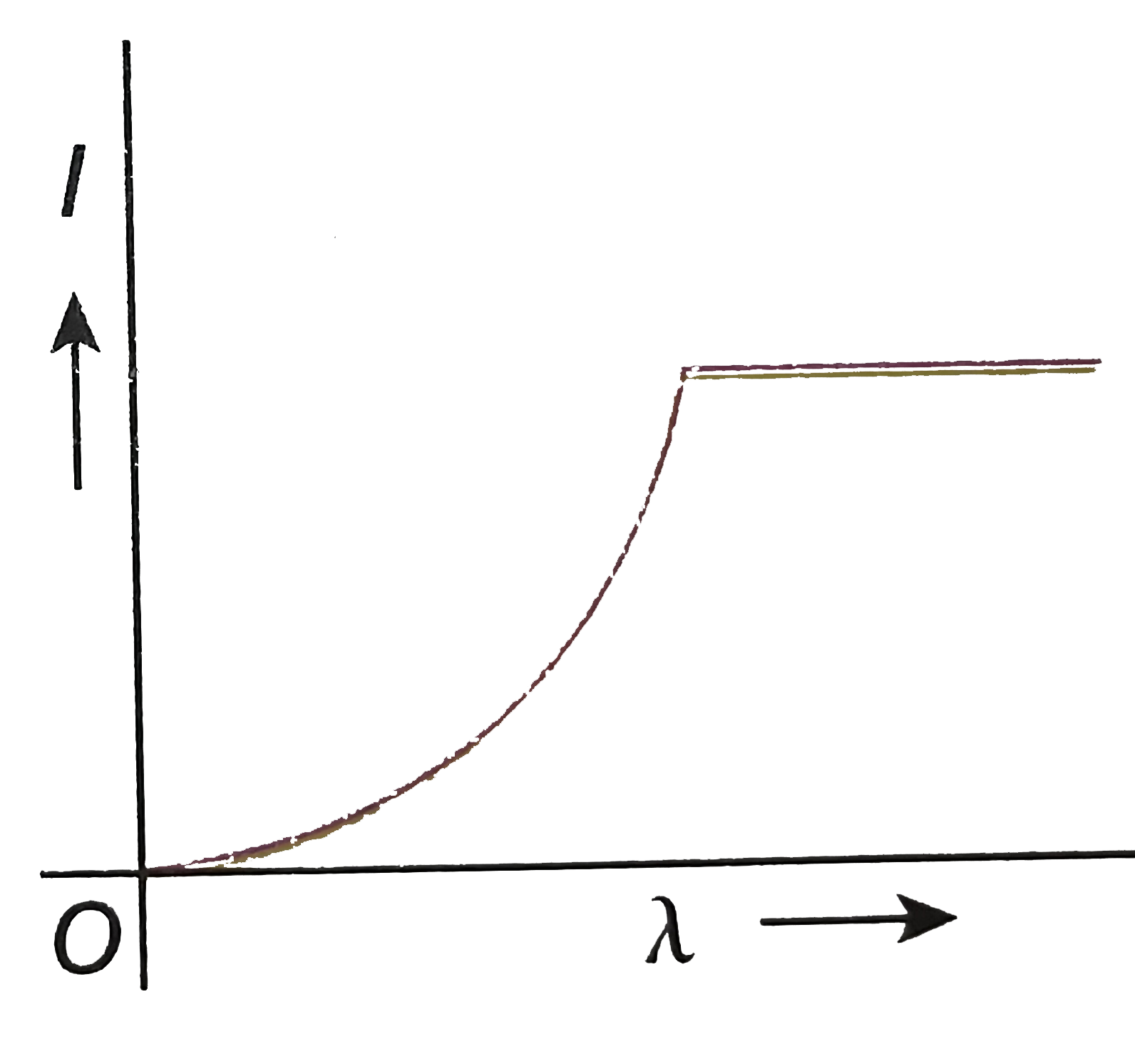
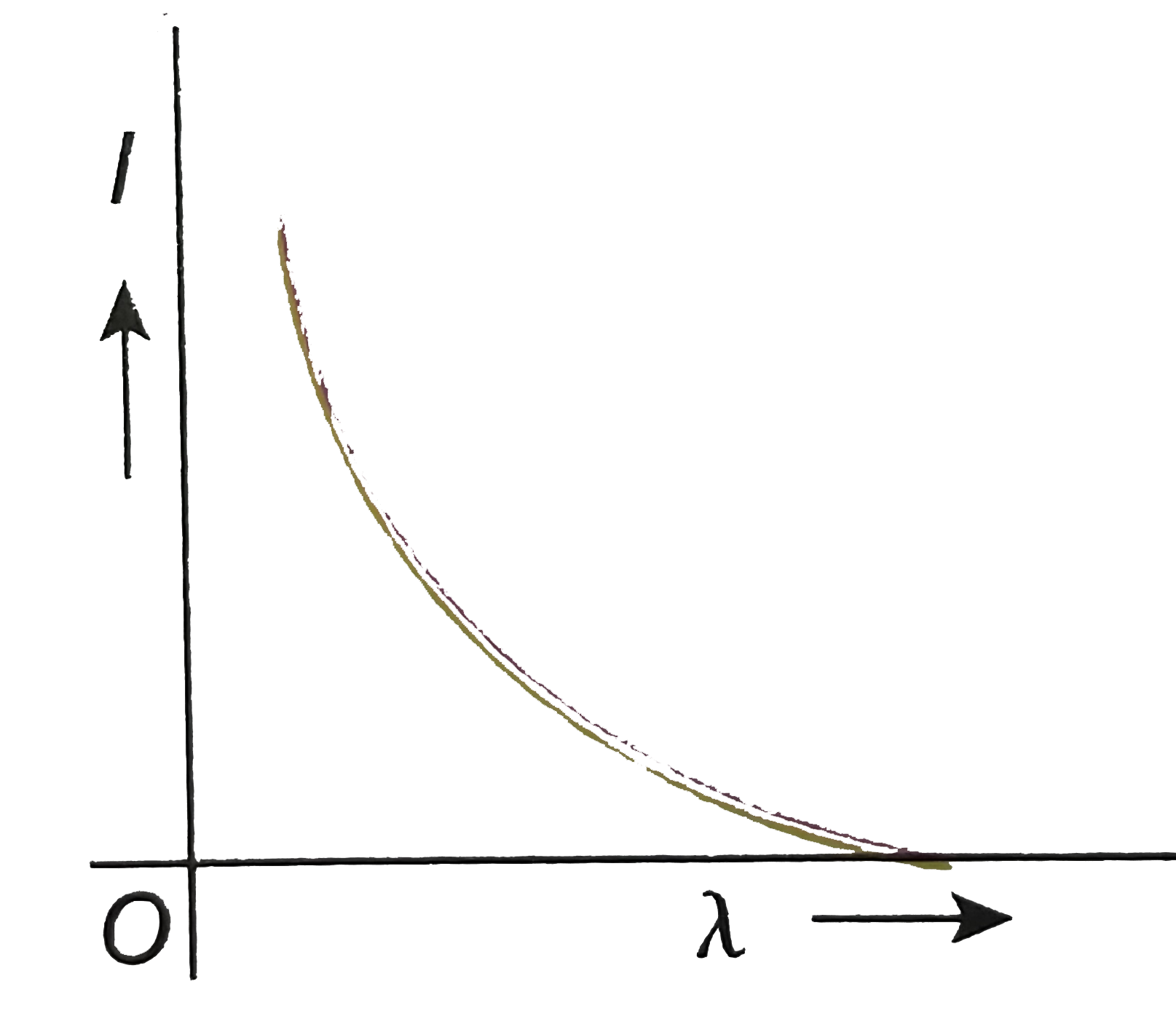
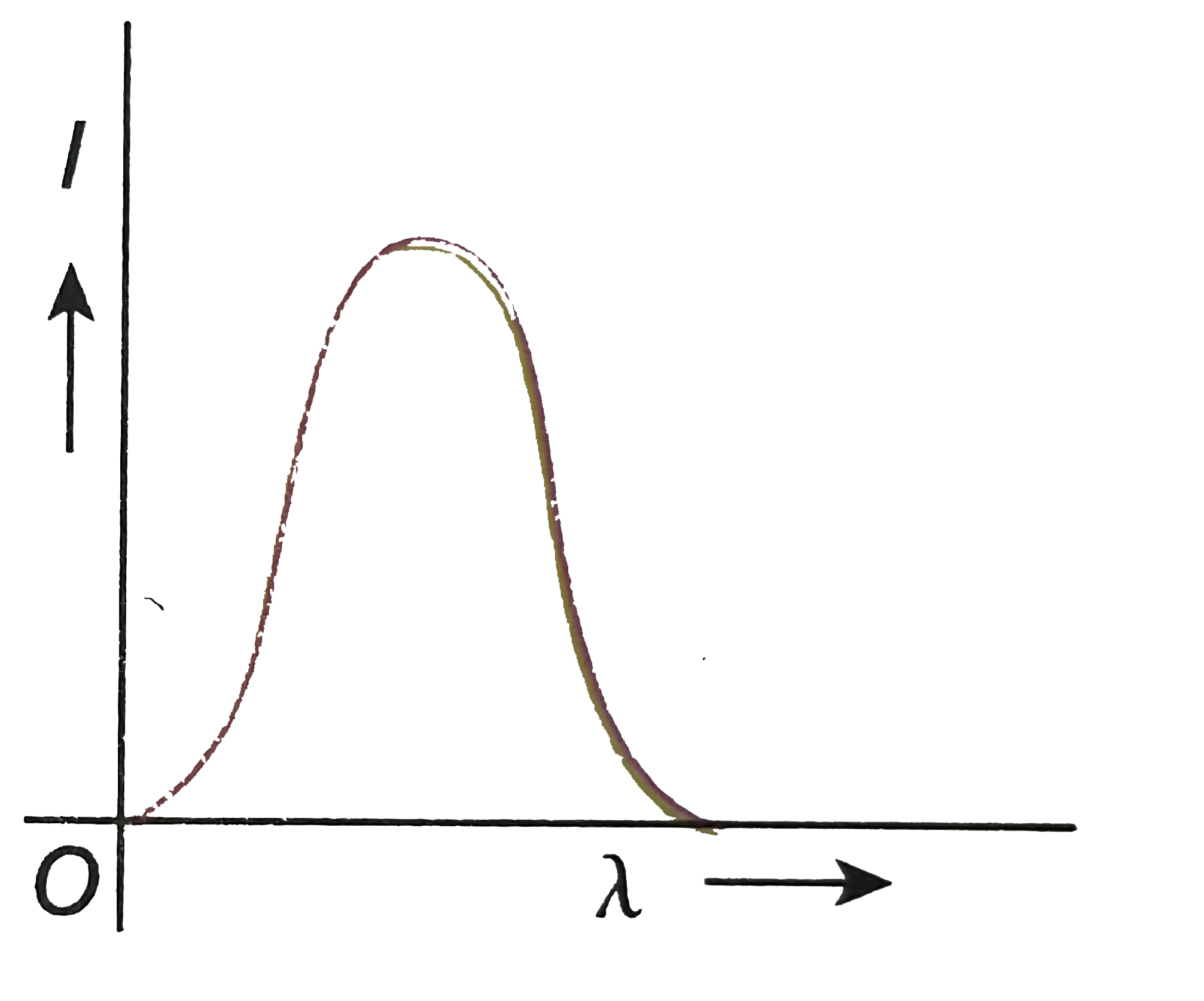
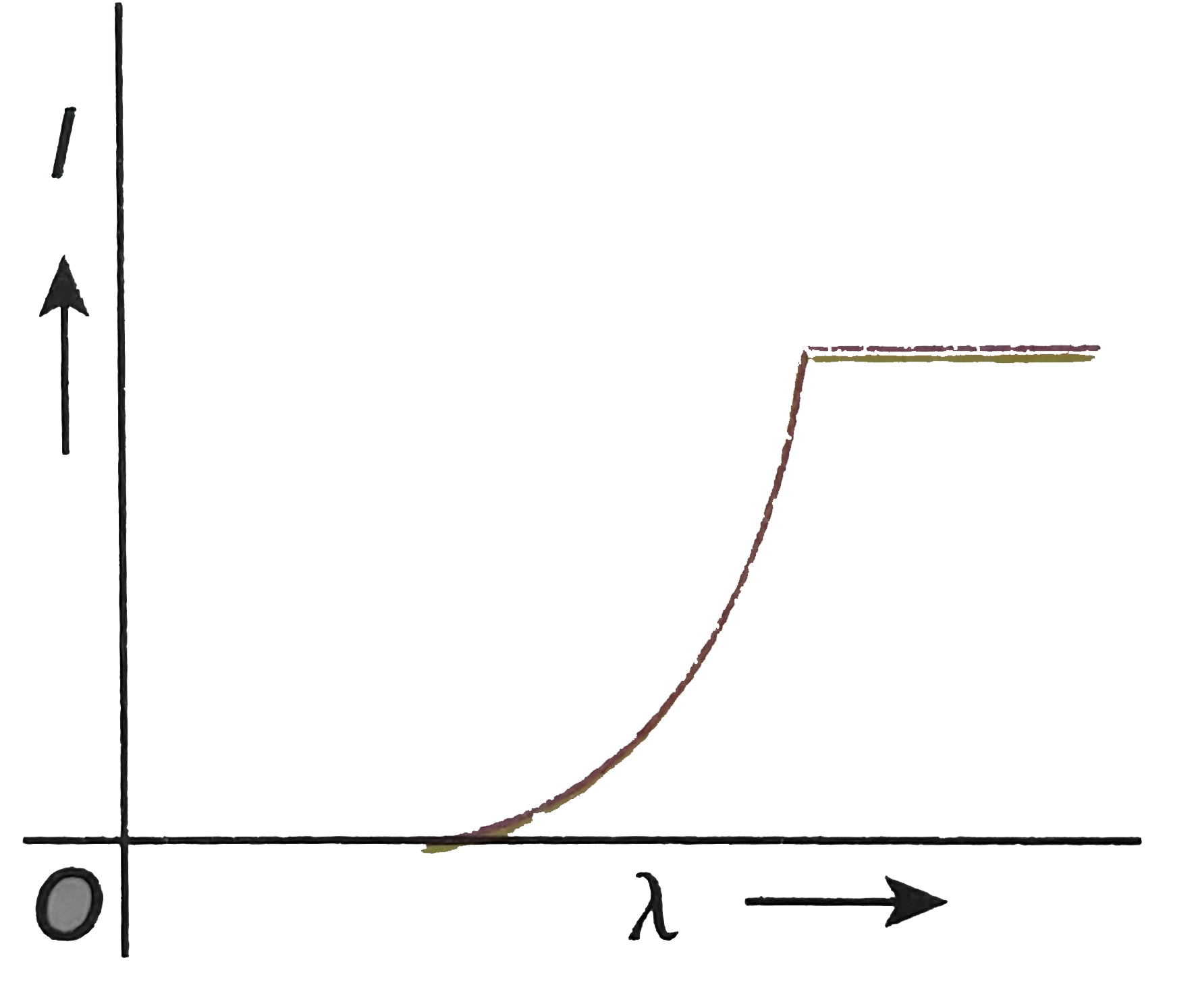
The anode voltage of a photocell is kept fixed. The wavelength lamda of the light falling on the cathode is gradully changed. The plate current I of the photocell varies as follows. |
|
Answer»
|
|
| 5. |
What is a wavefront? How does it propagate? Using Huygens' principle, explain reflection of a plane wavefront from a surface and verify the laws of reflection. |
|
Answer» Solution :A wavefront is defined as a surface of constant phase. Propagation of a wavefront is based on following two points: (i) Every point on a given wavefront acts as fresh SOURCE of secondary wavelets, which travel in all directions with the speed of wave (i.e., of light) in the medium. (ii) The common envelope (tangent) of these secondary wavelets in the forward direction gives the new wavefront at that instant. Let US consider a plane wavefront AB incident obliquely on a plane reflecting surface MM.. Let one end A of wavefront strikes the mirror at an angle i but the other end B has still to cover distance BC. Time required for this will be `t=(BC)/(c )`, where c is the speed of light. According to Huygen.s principle point A starts emitting secondary wavelets and in time t, these will cover a distance `ct=c.(BC)/(c )=BC` and spread. Hence, with point A as centre and BC as RADIUS, draw a circular arc. Draw tangent CD on this arc from the point C. Obviously, CD is the reflected wavefront inclined at an angle r. Obviously the incident and reflected both are in the plane of paper.  Again in `DELTAABC and DeltaADC`, we have `BC=AD` (by construction) `angleABC=angleADC=90^(@)` and AC is common. So, the two triangles are congruent and, hence, `angleBAC=angleDCA` or `angle i=angler` i.e., the angle of reflection is equal to the angle of incidence. |
|
| 6. |
Each molecule in a gas has an average kinetic energy. What is the total average kinetic energy of all the molecules in 3.0 mol of a gas whose temperature is 320 K? |
| Answer» Answer :A | |
| 7. |
A small ball of mass M=1 kg is attached to two identical springs of constant 100N//m, which are attached to floor and roof. The springs are initially unstretched. By what distance ball comes down to attain equilibrium? (in cm) |
|
Answer» |
|
| 8. |
Consider the following statements (A) The refractive index of the extraordinary ray depends on the angle of incidence in double refraction (b) The vibrations of light waves acquire one-sideness for both ordinary and extraordinary rays in double refraction (c ) Diffraction fringes will be always unequally spaced |
|
Answer» A and B are true |
|
| 9. |
You are given n wires, each of resistance R. What is the ratio of maximum to minimum resistance obtainable from these wires ? |
| Answer» SOLUTION :The resistance is MAXIMUM when wires are connected in series and minimun when connected in PARALLEL.`R_s=NR` and `R_P=R/n,R_s/R_P=((nR)/r)/n=n^2` | |
| 10. |
An electron moves in the X-Y plane with a speed of m/s. Its velocity vector vec v makes an angle 60^(@) with X axis. There is a magetic field of magnitude 10 Weber/m^(2) directed along the Y axis. Calculate the magnetic force vector acting on the electron. (electron charge = – 1.6 xx 10^(-1) coul.) |
|
Answer» Solution :`vec V= (V cos 60) cap i + (V sin 60) cap J` = `(10^(6) xx 0.5)cap i +(10^(6)xxsqrt(3)/2) cap j` `vec B=+(10^(-2) cap j``vec F_(mag)=(e) vec V xx vec B=(-1.6 xx 10^(-19))[(5XX10^(5)cap i+5sqrt(3)xx10^(5) cap j)xx(10^(-2))cap j]` `=(-1.6 xx 10^(-19))[(5xx10^(5))(10^(-2))(ixxj)] =(-8xx10^(-16)) cap k` N The force is directed along the negative direction of Z-axis. |
|
| 11. |
Charge on electrons having total mass of 75 kg is ......C. |
|
Answer» `-1.32 xx 10^(13)` `therefore n = M/m_(e) = 75/(9.1 xx 10^(-31))` `therefore n=8.24 xx 10^(31)` And electric charge Q = ne `=8.24 xx 10^(31) xx (-1.6 xx 10^(-19))` `=-13.184 xx 10^(12)` `=-13.2 xx 10^(13)` C |
|
| 12. |
Two clocks are being tested against a standard clock located in a national laboratory. At 12:00:00 noon by the standard clock, the readings of the two clocks are : If you are doing an experiment that requires 'precision time interval' measurements , which of the two clocks will you prefer ? |
| Answer» Solution :The RANGE of variation over the seven DAYS of observations is 164 s for clock 1 , and 32 s for clock 2. The average reading of clock 1 is much closer to the standard time tan the average reading of clock 2. The important point is that a clock is ZERO error is not as significant for precision work as its variation , because a .zero-error. can ALWAYS be easily corrected. Hence clock 2 is to be preferred to clock 1. | |
| 13. |
Deduce an expression for the frequency of revolution of a charged particle in a magnetic field and show that it is independent of velocity or energy of the particle. |
|
Answer» Solution :When a charged particle having charge q and moving with a velocity `vecv` enters a uniform magnetic field `vecB`, it experiences a Lorentz FORCE `vecF = q(vecv xx vecB)` whose direction is given by Fleming.s left hand rule. The force is MAXIMUM when charged particle is moving perpendicular to the magnetic field. In that case `F = q v B SIN 90^@ = q v B` As the force is acting perpendicular to both `vecv and vecB`, it does not change the magnitude of velocity but changes its direction from a straight from a straight line path to a circular path of radius r such that the magnetic force - centripetal force needed. `:. B q v = (mv^2)/(r) implies r = (mv)/(Bq)` The time period and frequency of the charged particle in its circular path will be `T = (2 pi r)/(v) = (2pi ((mv)/(Bq)))/(v) = (2 pi m)/(Bq) , ` Frequency `v = 1/T = (Bq)/(2 pi m)` and angular frequency `omega = 2 pi v = (qB)/(m)`. From this RELATION it is clear that the time period (as well as frequency) is independent of the velocity (energy) of the charged particle as well as the radius of the circular path. 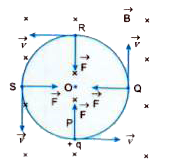
|
|
| 14. |
STATEMENT-1 The two silts in YDSE are illuminated by two different sodium lamps emitting light of same wavelength .No interference pattern will be observed. STATEMENT-2Two independent light sources (except LASER)cannot be coherent. |
|
Answer» STATEMENT-1 is TRUE Statemetnt-2 is True,Statement -2 is a correct explanation for statement -1. |
|
| 15. |
Plota graph showing the variation of photo current vs collector potential for three difference intensities I_(1) gt I_(2) gt I_(3) two of which (I_(2) and I_(2)) have the same frequency v and the third has frequency v_(1) gt v. |
Answer» SOLUTION :
|
|
| 16. |
Statement-1 : Communication is UHF/VHF regions can be established by space wave of tropospheric wave. Statement -2 : Communication is UHF/VHF regions is limited to line of sight distance. |
|
Answer» Statement-1 is TRUE, Statement-2 is FALSE. |
|
| 17. |
Which of following result gives correct relation between charge induced (q) and inducing charge (q_(0)) : - |
|
Answer» `q_(0) = Q(1-(1)/(in_(r )))` |
|
| 18. |
Half-life of a substance is 20 minutes. What is the time between 33% decay and 67% decay ? |
|
Answer» 20 MINUTES `or 1/3=2/3 (1/2)^(n)` `1/2=(1/2)^(n) or n=1` So half-life period=20 minutes |
|
| 19. |
The number of circular divisions on the shown screw gauge is 50 it moves 0.5mm on main scale for moone complete rotation Main scale reading is 2 The diameter of the balls is . |
|
Answer» `2.25 mm` Actual MEASUREMENT `=2 xx 0.5 mm + 25 xx (0.5)/(50) - 0.05 mm` `=1mm + 0.25 mm - 0.05mm = 1.2 mm` . |
|
| 20. |
In the vernier caliperse 9 main scale divisions matches with 10 vernier scale divisions The thickness of the object using the defected vernier calliperse will be Excess reading = 0.3mm If we put an object between the jaws |
| Answer» SOLUTION :It GIVES `13.8mm` READING in which there is `0.3mm` EXCESS reading which has to be REMOVED (substructed) | |
| 21. |
In the vernier caliperse 9 main scale divisions matches with 10 vernier scale divisions The thickness of the object using the defected vernier calliperse |
|
Answer» Solution :From first Excess READING (ZERO error) = 0.6mm If an OBJECT is placed vernier GIVES `14,6mm` in which there is `0.6mm` excess reading which has to be subtracted So actual thickness `= 14.6 - 0.6 = 14.0 mm` we can also do it using the formula `=14.6 - 0.6 = 14.0mm`  . .
|
|
| 22. |
Consider a circuit consists of resistors, inductor, battery and a switch as shown. Resistance of resistors, inductance of inductor and EMF of battery are indicated. The switch is closed at t=0. After a long time switch is opened. Find heat generated through the resistor R_(0) |
|
Answer» `(Lepsilon^(2))/(32R^(2))` |
|
| 23. |
Adam Smith took Kailash Satyarthi's interview over : |
|
Answer» A PHONE call |
|
| 24. |
An ammeter of range 5A has a resistance of 20Omega.To extended its range to 20A the necessary shunt required is : |
|
Answer» `1/4Omega` |
|
| 25. |
A uniform wire of length I and mass M is stretched between two fixed points, keeping a tension F. A sound of frequency mu is impressed on it. Then the maximum vibrational energy is existing in the wire when mu |
|
Answer» `(1)/(2)sqrt((ML)/(F))` |
|
| 26. |
Two different wires have specific resistivity, Tengths, area of cross-sections are in the ratio 3: 4, 2 : 9 and 8:27. Then the ratio of resistance of two wires is |
|
Answer» `16:9` |
|
| 27. |
A man going east in a car with a velocity of 20 km/hr, a train appears to him to move towards north with a velocity of 20 sqrt(3) km/hr. What is the actual velocity and direction of motion of train? |
| Answer» SOLUTION :40 kmfhr, `60^(@)`N of E | |
| 28. |
In a step-up transformer, use of 120 V line provides a potential difference of 2400 V. If th primary coil has 75 turns, number of turns i secondary coil is …………….. |
|
Answer» 150 `epsilon_2/epsilon_1=N_2/N_1` `THEREFORE N_2=N_1 epsilon_2/epsilon_1` `=(75xx2400)/120` `therefore N_2`= 1500 |
|
| 29. |
In an interference pattern, the ratio of maximum intensity to minimum intensity is 25:1. Find the ratio of the amplitudes and intensities of the two interfering waves. |
|
Answer» SOLUTION :We have `(I_("max"))/(I_("MIN"))=((a_(1)+a_(2))^(2))/((a_(1)-a_(2))^(2))=25/1=((a_(1)+a_(2))^(2))/((a_(1)-a_(2))^(2))` `:.(a_(1)+a_(2))/(a_(1)-a_(2))=5/1` `5a_(1)-5a_(2)=a_(1)+a_(2)""4a_(1)=6a_(2)""(a_(1))/(a_(2))=6/4=3/2` As `I_(1)PROP a_(1)^(2)` and `I_(2) prop a_(2)^(2)` `(I_(1))/(I_(2))=(a_(1)^(2))/(a_(2)^(2))=(3/2)^(2)=9/4""I_(1):I_(2)=9:4` |
|
| 30. |
A rod of mass M and length L is placed on a smooth horizontal surface. It is hinged at one end so that it can rotate freely in a horizontal circle about this end. There exists a uniform magnetic field vecB perpendicular, into the horizontal surface everywhere. The strength of magnetic field starts varying as B=B_(0)t. (i) Find the torque acting on the rod about its hinged end. (ii) Find the reaction produced at hinge at t = 0. (A charge Q is distributed uniformaly on the rod) |
|
Answer» SOLUTION :(a) `(QB_(0)L^(2))/(6)` (b) zero |
|
| 31. |
Two concave mirrors are placed face to face and they have the same centre of curvature. Where will the image be formed? |
|
Answer» |
|
| 32. |
Give any two differences between a half wave rectifier and a full wave rectifer. |
Answer» SOLUTION :DIFFERENCE between HWR and FWR. 
|
|
| 33. |
In the circuit shown in figure R_(1) = R_(1) = 6R_(3) = 300M Omega,C = 0.01muF and E - 10V. The switch is closed at t =0, find (a) Charge on capacitor as a function of time (b) enegry of the capacitor at t = 20s |
Answer» 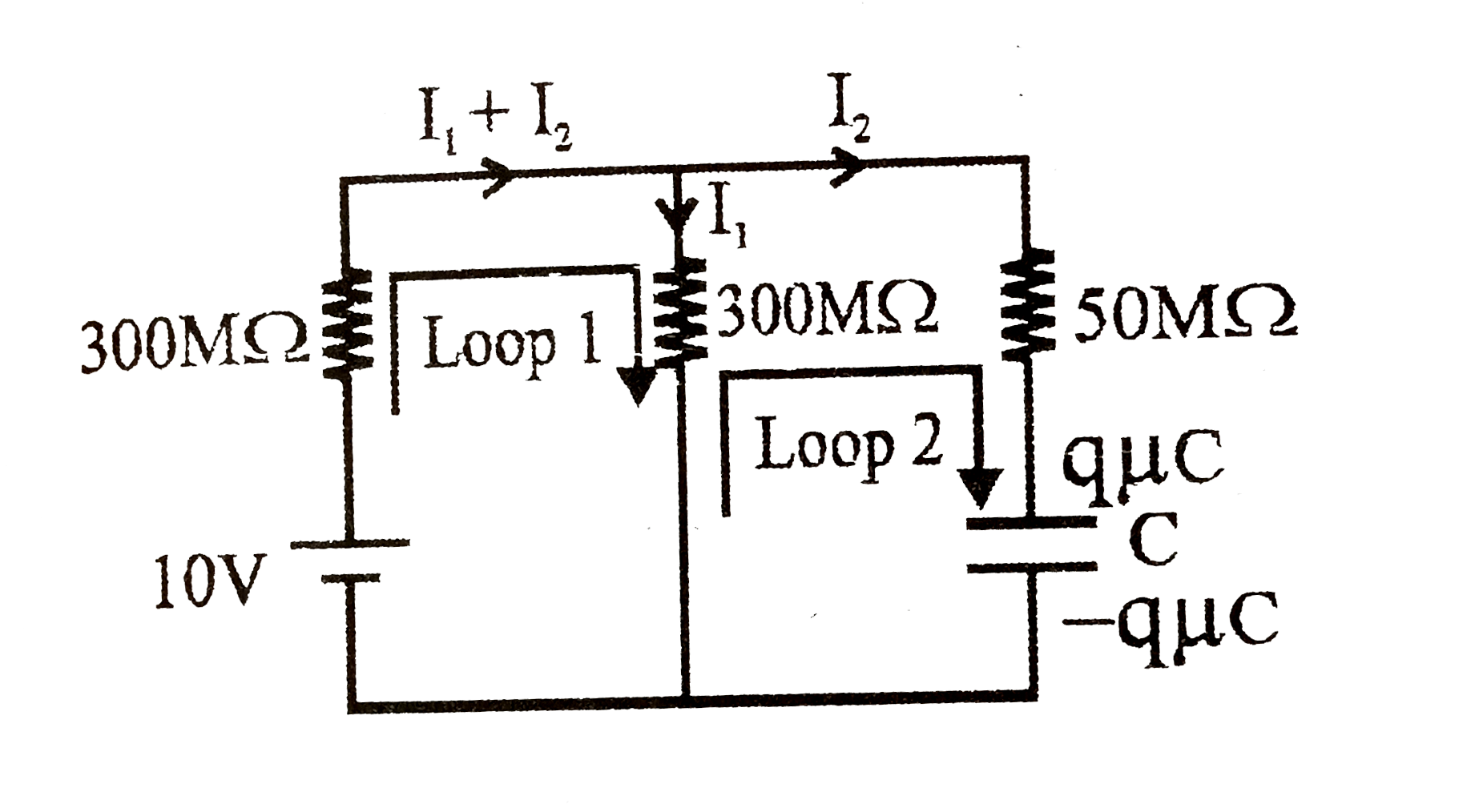 `R_(1) = R_(2) = 300M Omega, R_(3) = 50M Omega` for loop `1` `10 - 300 (I_(1) +I_(2)) - 300I_(1) = 0` `I - 60I_(1) = 30I_(2) …(1)` for loop `2` `300I_(1) - 50I_(2) -(q)/(0.01) =0` `6I_(1) - I_(2)- 2q = 0 ...(2)` from `(1)` and `(2)` `I -40I_(2) = 20q ...(3)` Put `I_(2) = (dq)/(dt)` and integrating `q = (1)/(20)(1-e^(-t//2))` time constant `tau = ((R_(1)R_(2))/(R_(1)+R_(2))+R_(3)) C = 2sec` `q_(0) = (CER_(2))/(R_(1)+R_(2)) = 0.05muC` `q = 0.05 (1-e^(-t//c)) rArr q=0.05 (1-e^(-t//2))` (b) at `t = 20s = 10tau`, circuit behave like STEADY STATE condition `V_(C ) = ((R_(2))/(R_(1)+R_(2))) xxR_(2) = 5V` `U = (1)/(2)CV_(C)^(2) = 0.125muJ` |
|
| 34. |
For constant in S.H.M. is a restoring force per unit |
|
Answer» Time |
|
| 35. |
Angle of dip delta and latitude lambda on earth's surface are related as |
|
Answer» `tan delta = 2 tan lambda` `B_(theta) =(mu_(0))/(4pi) (M SIN theta)/(r^(3))` SINCE `theta = 90^(@) + lambda` , thus `B_(r) = (mu_(0))/(4pi) (2M cos (90 + lambda))/(r^(3)) = - (mu_(0))/(4pi)(2M sin lambda)/(r^(3))` `B_(theta) = (mu_(0))/(4pi) (M sin (90 + lambda))/(r^(3)) = (mu_(0))/(4pi) (M cos lambda)/(r^(3))` `therefore tan delta = (B_(V))/(B_H) = 2 tan lambda` |
|
| 36. |
The value of electric potential at any point due to any electric dipole is (k = 1/(4 pi epsilon_0)) |
|
Answer» `K.(vec(p) xx vec(R))/(r^2)` |
|
| 37. |
since the period fo revolution of electronsin a unifrommagnetic fieldrapidlyincreaseswith the growthof energy, acyclotron in unsuitable for theiraccelearation. Thisdrawbackis rectifiedin a microton(Fig) in which a changeDelta Tin theperiod of revolutionof an electronis made multipilewith theperiodof accleratingfield T_(0). How many timeshas anelectronto crossthe acceratinggap of a microtronto acquirean energyW = 4.6 MeV if DeltaT = T_(0) the magneticinduction is equalto B = 107 mT, andthe frequency of accelerating field tov = 3000 MHz ? |
|
Answer» Solution :In the nth oribit, `(2pi r_(n))/(v_(n)) = n T_(0) = (n)/(v)`. We igonre the rest mass of the electronand write `v_(n) = c`. Also `W = cp = cBer_(n)`. THUS, `(2pi W)/(B EC^(2)) = (n)/(v)` or, `n = (2pi W v)/(Be c^(2)) = 9` |
|
| 38. |
A convex & a concave lens are brought it close contact along their optical axes. The focal length of the convex lens is 10 cm. When the system is placed at 40 cm from an object, a sharp image of the object is formed on a screen on the other side of the system. Determine the optical power of the concave lens if the distance betweenthe object & the screen is 1.6m. |
|
Answer» |
|
| 39. |
In equation varepsilon =A sin (omegat-kx) where t is in second and x is in meter, the dimensional formula for |
|
Answer» `OMEGA "is" [M^0L^0T^(-1)]` |
|
| 40. |
A flat glass slab of thickness 6cm and index 1.5 is placed in front of a plane mirror . An observer is standing behind the glass slab and looking at the mirror. The actual distance of the observer from the mirror is 50cm. The distance of his image from himself, as seen by the observer is |
|
Answer» 94cm |
|
| 41. |
alpha-particle and deuteron moves with speed v and 2v respectively .What will be ratio of de-Broglie wavelength ? |
|
Answer» `1:1` `THEREFORE lambda PROP (1)/(mv)` `therefore (lambda_(1))/(lmbda_(d))=(m_(d)v_(d))/(m_(alpha)v_(alpha))` `=(2m_(p))/(4m_(p))xx(2v)/(v)=(4m_(p)v)/(4m_(p)v)=(1)/(1)` |
|
| 42. |
For a given medium, the speed of light and the polarising angle are V and (i_p) respectivly. Then from Brewster,s law: [ is the speed of light in vacuum] |
|
Answer» V sin `i_p` = C cos `i_p` |
|
| 43. |
In input in a full - wave rectifier is e=50 sin(314t)" volt", diode resistance is 100Omega and load resistance is 1kOmega then, pulse frequency of output voltage is |
|
Answer» 50 Hz |
|
| 44. |
A network of resistance is formed as follows : AB=9 Omega, BC=1Omega, CA=1.5Omega forming a delta and AD=6 Omega, BD= 4 Omega, CD= 3 Omega forming a star. Compute the network resistance measured between (i) A and B (ii) B and C and (iii) C and A. |
|
Answer» `(18)/(11)Omega, (621)/(550)Omega, (12)/(11)Omega` |
|
| 45. |
What is the meaning of confessed? |
|
Answer» To tell the TRUTH that ONE is guilty |
|
| 46. |
What is astronomical telescope? |
| Answer» SOLUTION :It is used to view heavenly objects since inversion of their IMAGE CREATES no problem. | |
| 47. |
___________a _____________b 'a' and 'b' are two conducting wires of the same meterial having the same length. Which one has higher resistance? Furnish relevant equation for justification. |
| Answer» SOLUTION :Wire .a. has HIGHER resistance. R=pl/A. Here p and L are the same. So the one with LESSER AREA will have higher resistance. | |
| 48. |
Find the emf and internal resistance of a single battery which is equivalent to a combination of three batteries as shown in figure. |
| Answer» Answer :B | |
| 49. |
If the peak value of a.c. current is 4.24A, what is its root mean square value ? |
| Answer» Solution :`I_(RMS)=I_0/sqrt2 = 4.24/1.41=2.9981 A approx 3A` (`because I_0`= maximum or peak CURRENT) | |
| 50. |
Two point-like charge a and b whose strengths are equal in absolute value are positioned at a certain distance from each other. Assumeing the field strenght is positive in he direction of the r axis. Determine the sign of the charge for each distribution of the field strenght between charge for each distribution of the field strenght between charges shwon in fig. |
|
Answer» Solution :(a) As electric fild tends AWAY at a and towards at b, there should be positive charge at a and NEGATIVE charge at b, i.e., `q_(a)` is '+' and `q_(b)` is '-'. (b) The NEUTRAL point EXISTS between a and b only when both `q_(a)` and `q_(b)` are of same sign. As direction of electric FIELD is away from both, both charges are positive, i.e., `q_(a)` is '+' and `q_(b)` is '+' (c ) `q_(a)` is '-' and `q_(b)` is '+'`. (d) `q_(a)` is '-' and `q_(b)` is '-'. |
|