

Saved Bookmarks
This section includes 7 InterviewSolutions, each offering curated multiple-choice questions to sharpen your Current Affairs knowledge and support exam preparation. Choose a topic below to get started.
| 1. |
The magnetic induction at a point on an equator of a magnetic dipole is : |
|
Answer» ` B = mu_0/(4PI )2M/r^3` |
|
| 2. |
Calculate the energy released in fusion reaction : " "_(1)^(2)H + " "_(1)^(2)H to " "_(2)^(3)He +n, where BE of " "_(1)^(2)H = 2.23 MeV and of " "_(2)^(3)He = 7.73 MeV. |
|
Answer» Solution :For the fusion reaction `" "_(1)^(2)H + " "_(1)^(2)H to " "_(2)^(3)He + n`, as per question binding energy of `" "_(1)^(2)H` is 2.23 MeV and that of `" "_(2)^(3)He` is 7.73 MeV. `THEREFORE` Total binding energy of reactants `E_(1) = 2.23 + 2.23 = 4.46 MeV` and total binding energy of products `E_(2) = 7.73 + 0 = 7.73 MeV``therefore` Energy released in fusion reaction `E = E_(2) - E_(1) = 7.73 - 4.46 = 3.27 MeV` |
|
| 3. |
The time taken by an A.C. of frequency 50 Hz to reach from 0 to positive maximum is: |
|
Answer» `1/100 s` |
|
| 4. |
A 250 turn rectangular coil of length 2.1 cm and width 1.25 cm carries a current Of 0.85 mu_A and subjected to a magnetic field of strength 0.85 T. Work done for rotating the coil by 180° against the torque is ....... |
|
Answer» `4.55 mu J` `W= mB [ cos theta_(1) - cos theta_(2) ]` `= mB [ cos 0^(@) - cos 180^(@) ]` `= mB [1 - (-1) ]` `= mB [2]` `= 2mB = 2 NIAB""[because m= NIA]` `2 xx 250 xx 85 xx 10^(-6) xx 2.1 xx 10^(-2)xx 1.25 xx 10^(-2) xx 0.85` `= 94828.125 xx 10^(-10) ~~ 9.5 xx 10^(-6)` J `= 9.5 mu`J nearer value is in OPTION (D). |
|
| 5. |
(A): potential near infinite sheet is not defined (B): potential near finite charged sheet is not defined. |
|
Answer» A & B are true |
|
| 6. |
An oscillator is an amplifier with |
|
Answer» a LARGE gain |
|
| 7. |
Which property of nuclear forces is responsible for the constancy of binding energy per nucleon? |
| Answer» Solution :NUCLEAR FORCES are saturated in character. This PROPERTY MAKES B.E./nucleon constantfor most of the nuclei | |
| 8. |
A p.d. of 280V is applied to 2muF and 5muF capacitors in series. Find the p.d. across each capacitors. |
|
Answer» |
|
| 9. |
Explain the modes of vibration of a streched string with examples. |
|
Answer» SOLUTION :Modes of vibrations of a streched string `:` (1) In sitar of Guitar, a streched string can vibratein different frequencies and form STATIONARY waves. This mode of vibrations are known as harmonics. (2) If it vibrates in one segment,which is known as fundamental harmonic.The higher harmonics are called the overtones. (3) It vibrates in two segments then the secondharmonic is called first overtone. Similarly the pattern of vibrations are shonw figure. (4) If a stretched string vibrates with P segments ( loop ) then frequencyof vibration `v =( P)/( 2l ) sqrt((T) /(mu))`Where T = tension in the string, `mu =` LINEAR density `= ( "mass")/( "LENGTH")` (5) In first mode of vibration, P=1, then `v =(1)/( 2l) sqrt((T)/(mu))` ( `1^(st)` harmonic ( or) fundamental frequency) (6) In second mode of vibration , P =2, then `v_(1)=(2)/(2l) sqrt((T)/( mu)) =2v ` `( 2^(nd)` harmonic ( or ) `1^(st)` overtone ) (7) In thirdmode of vibration, P =3, then `v_(2) =(3)/(2l) sqrt((T)/( mu)) 3v( 3^(rd ) ` harmonic ( or) `2^(nd) ` overtone ) .The ratio of the frequency of Harmonicsare, `v: v_(1) : v_(2) =v: 2v: 3v=1: 2:3` 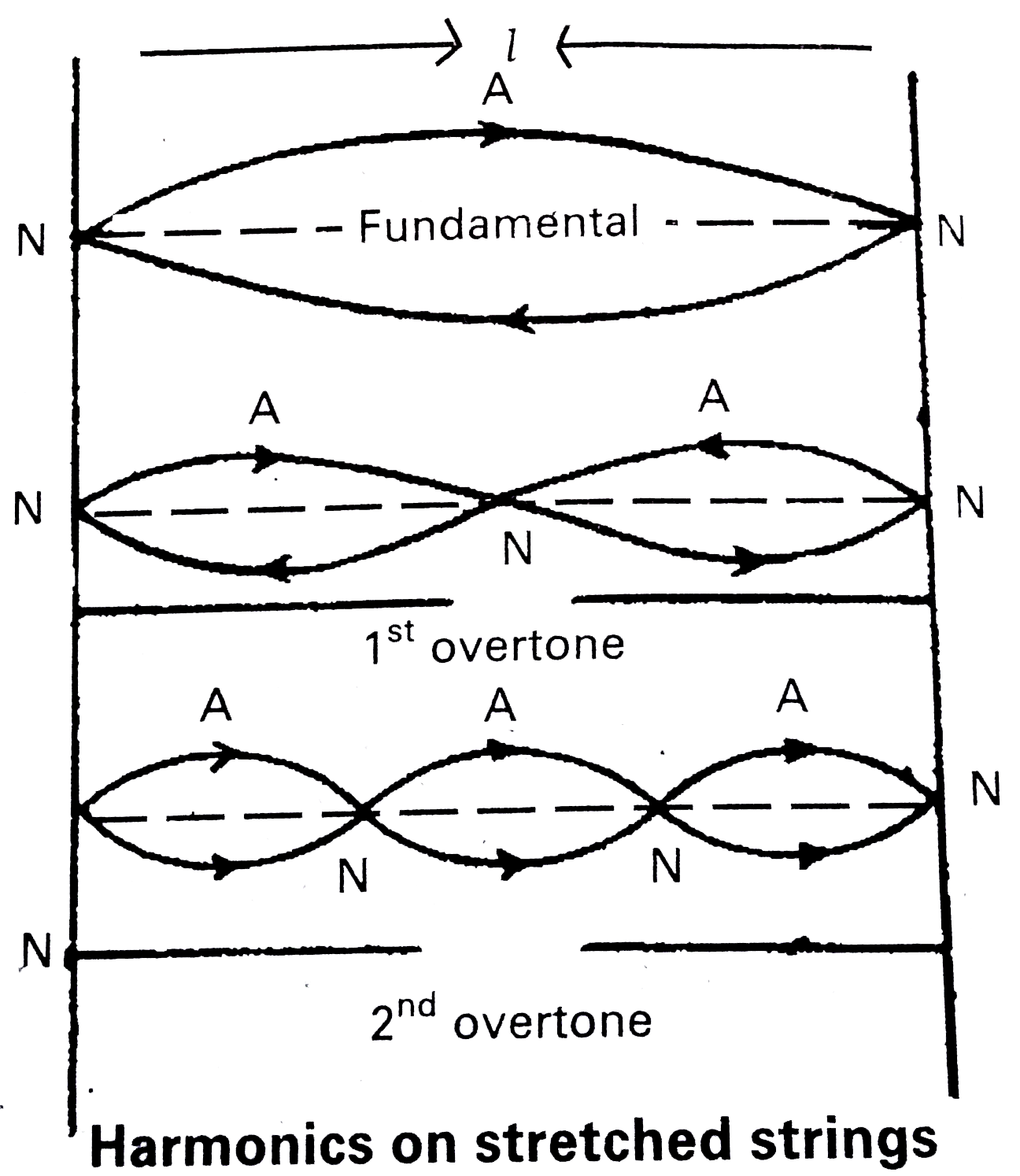
|
|
| 10. |
A battery is charged at a potential of 15V for 8hours when thecurrent flowing is 10A . The battery on discharge supplies a currentof 5A for 15hours . The meanerminal voltage during discharge is14 V. The "Watt-hour" efficiency of the battery is |
| Answer» ANSWER :D | |
| 12. |
A device X is connected across an a.c. source of voltage V=V_(m) sin omega t.The current through X is given asI = I_(@)sin (omegat + pi/2) (a) Identify the device X and write the expression for its reactance. (b) Draw graphs showing variation of voltage and current with time over one cycle of a.c. for X. (C) How does the reactance of the device X vary with frequency of the a.c. ? Show this variation graphically. (d) Draw the phasor diagram for the device X. |
|
Answer» Solution :(a) The device X is a capacitor whose reactance is GIVEN as :`X_(C) =1/(Comega) =1/(C.2piv)` (b) GRAPHS showing VARIATION of voltage and current with time are shown in FIG. 7.16. (C) The reactance of device X is inversely proportional to its frequency i.e.,`X_(C) =1/v`. The variation is graphically shown in Fig. 7.46. (d) Phasor diagram is shown in Fig. 7.16. |
|
| 13. |
Who was the earliest to attempt a more scientific basis for classification ? |
|
Answer» R.H. Whittaker |
|
| 14. |
Find the distance between third and first maxima. (d = 0.5mm, D = 0.5m, lambda = 5890 A^0) |
|
Answer» |
|
| 15. |
The magnetic flux of 500 mu Wb per turn passing through a 200 turn coil is reversed in 20 xx 10^(-3) seconds. The average e.m.f. induced in the coil in volt is |
|
Answer» 2.5 |
|
| 16. |
Which of the following is not electromagnetic waves ? |
|
Answer» COSMIC RAYS |
|
| 17. |
By increasing the temperature, the specific resistance of a conductor and semi conductor |
|
Answer» INCREASES for both |
|
| 18. |
Two pith balls of mass 10mg each are suspended by two threads from the samesupport are charged identically. They move apart by 0.08m and threads make an angle 60^@with each other. Find the charge on each pith ball |
Answer» SOLUTION : In the fig `F = T SIN 30^@ `…(1) `MG = T cos 30^@`…(2) equation `1/2 RARR (F)/(mg) = tan 30^@` ` F = mg tan 30^@` `(1)/(4pi epsi_0) (Q^2)/(r^2) = mg tan 30^@` `9 xx 10^9 xx (q^2)/(r^2) = 10 xx 10^(-6) xx 9.8 xx 0.5773` `9 xx 10^9 xx (q^2)/((0.08)^2) = 56.58 xx 10^(-6)` `q^2 = 0.0402 xx 10^(-15)` ` q^2 = 40.2 xx 10^(-18)` `q = 6.34 nC` |
|
| 19. |
The simple Bohr model is not applicable to He^(4) atom because |
|
Answer» `He^(4)`is an inert gas. `RARR` Thus, option (C) is correct. He nucleus has two PROTONS but they do not lie at the same position and so electrostatic attractive force on electron is not POINTING towards single central position and so it does not REMAIN central force. Hence option (D) is correct. |
|
| 20. |
Rate of Diffusion is maximum in |
|
Answer» Solids |
|
| 21. |
Guess a possible reason why water has a much greater dielectric constant (= 80) than say, mica (=6). |
| Answer» Solution :Water MOLECULES are polar MOLECULE. Hence these molecules have their own DIPOLE moments which contributes to the HIGH value of its dielectric constant. But the molecules of mica are not polar. | |
| 22. |
Two small spheres each having equal positive charge Q(Coulomb) on each are suspended by two insulating strings of equal length L (meter) from a rigid hook (shown in Fig.). The whole set up is taken into satellite where there is no gravity. The two balls are now held by electrostatic forces in horizontal position, the tension in each string is then |
|
Answer» `(Q^2)/(16pi epsi_0 L^2)` |
|
| 23. |
Find the maximum value of current when an inductance of 2H is connected to 150 V, 50 cycle supply. |
|
Answer» Solution :Here `L = 2H , E_(rms) = 150 V, v = 50 HZ` `X_(L) = L omega = L xx 2pi v` `2 xx 2 xx 3.14 xx 50 = 628` ohm RMS value of current through the INDUCTOR, `I_(rms) = (E_(rms))/(X_(L)) = (150)/(628) = 0.24` Maximum value (or PEAK value) of current is given by `I_(rms) = (I_(0))/(SQRT(2))` or `I_(0) = sqrt(2)I_(rms)` `= 1.414 xx 0.24= 0.339 A` |
|
| 24. |
A body of M.I. of 3 kg xx m^2 rotation with an angular speed of 2 rad/sec has the same K.E. as a mass of 12 kg moving with a speed of |
|
Answer» 2m/sec |
|
| 25. |
Find the torque due to force vec(F)=2g=hat(i) -3hat(j)+4hat(k) newton acting a point with position vector vec(r )=3hat(i) + 2hat(j) + 3hat(k) metre about the origin : |
|
Answer» `17hat(i) + 6hat(j) -13hat(k)` `vec(tau)=` `HATI(8-)(-9)+hatj(6-12)+hatk (-9-4)` `17hati - 6hatj -13hatk` |
|
| 26. |
An electron in an electric field is made static and prevented from falling under gravity. Write the equation satisfying the above condition. |
Answer» SOLUTION :
|
|
| 27. |
A sinusoidal voltage of peak value 283 V and frequency 50 Hz is applied to a series LCR circuit in which R=3Omega, L=25.48mH and C=796muF. Find (a) the impendence of the circuit, (b) the phase difference between the voltage across the source and the circuit, (c) the power dissipated in the circuit, and (d) the power factor. |
|
Answer» Solution :a) To find the IMPEDANCE of the circuit, we first CALCULATE `X_(L) and X_(C)` `X_(L)=2pivL=2xx3.14xx50xx25.48xx10^(-3)Omega=8Omega` `X_(L)=(1)/(2pivC)=(1)/(2xx3.14xx50xx796xx10^(-6))=4Omega` Therefore, `Z=sqrt(R^(2)+(X_(L)-X_(C))^(2))=sqrt(3^(2)+(8-4)^(2))=5Omega` b) Phase difference, `phi=tan^(-1)(K_(C)-X_(L))/(R)=tan^(-1)((4-8)/(3))=-53.1^(@)` Since `phi` is negative, the current in the circuit lags the voltage across the source. c) The power dissipated in the circuit is `P=I^(2)R` Now, `I=(i_(m))/(sqrt2)=(1)/(sqrt2)((283)/(5))=40A` Therefore, `P=(40A)^(2)xx3Omega=4800W` d) Power factor `=cos phi=cos53.1^(0)=0.6` |
|
| 28. |
Consider a circuit consists of resistors, inductor, battery and a switch as shown. Resistance of resistors, inductance of inductor and EMF of battery are indicated. The switch is closed at t=0. Find current through at steady state |
|
Answer» `EPSILON/(2R)` |
|
| 29. |
Correct exposure for a photographic print is 10 seconds at a distance of one metre from a point source of 20 candela . For an equal fogging of the print placed at a distance of 2 m from a 16 candela source, the necessary time for exposure is |
|
Answer» `100 sec` |
|
| 30. |
When a semiconductor is heated, its resistance |
|
Answer» decreases. |
|
| 31. |
Water (density 1 gm//c) is to be sucked upto point A. The area of the barrow tube is 1 cm^(2). In this situation, minimum work required to be done is w_(1). When the tube is inverted and water is to be sucked upto point B, the minimum work required to be done is w_(2).Find (w_(2)-w_(1)) in Joule Fill 100 (w_(2)-w_(1)) in OMR sheet. |
|
Answer» `=(99xx10xx1)xx10^(-3)xx10xx0.3` `=9.9xx0.3=2.97` J |
|
| 32. |
Out of following which will have minimum first orbital radius? |
|
Answer» `He^(+)` Here `Li^(++)` have minimum atomic Z=3 HENCE, its radius in first orbit will be minimum. |
|
| 33. |
Consider the three formation processes shown for the compound nucleus ""^(20)Ne in Fig. 40-14. Here are some of the atomic and particle masses: What energy must (a) the alpha particle, (b) the proton, and (c) the gamma ray photon have to provide 25.0 MeV of excitation energy to the compound nucleus? |
|
Answer» |
|
| 34. |
An electric current has both A.C. and D.C. components . The value of D.C. component is equal to 12A while the A.C. component is given as 1 = 9 sin omega tA. Determine the formula for the resultant current and also calculate the value of I_(rms). |
|
Answer» Solution :At time t, resultant current `:` `I = 12 + 9 sin omega t ` Now `I_(rms ) = sqrt( LT I^(2) gt ) = sqrt( lt ( 12 + 9 sin omega t)^(2))` `:. I_(rms) = sqrt( lt 144 gt + 216 sin omega t + 81 sin^(2) omega t gt )`....(1) Here, the AVERAGE is taken over a time interval equal to the periodic time. `:. lt 144 gt = 144` `:. 216 lt sin omega t gt = 0` and `81 lt sin^(2) omega t gt= 81 xx (1)/(2) = 40.5 ` PUTTING these VALUES in equ. (1), ` :. I_(rms) = sqrt( 144 + 0 + 40.5 )` `= sqrt( 184. 5 )` = 13.583 `~~ 13.58` A |
|
| 35. |
The question has a paragraph followed by two statements, Statement - 1 and Sstatement - 2. Of the given four alternatives after the statements, choose the one that describes the statements. A thin air film is formed by putting the convex surface of a plane - convex lens over a planeglass plate. With monochromatic light, this film gives an interference pattern due to light reflected from the top (convex) surface and the bottom (glass plate) surface of the film. Statement - 1: When light reflects from the air - glass plate interface, the reflected wave suffers a phase changing of pi. Statement - 2 : The centre of the interference pattern is dark. |
|
Answer» Statement -1 is true, statement -2 is true, Statement - 2 is the correct EXPLANANTION of Statement - 1. |
|
| 36. |
A moving coil galvanometer has coil of 100 turns and effective area 10^(-2)m^2 suspended in radial magnetic field of 2.5xx10^(-4)(Wb)//m^2.Torsional constant is 2.5xx10^(-9)Nm//degree. |
|
Answer» `10^(-5)deg//A` |
|
| 37. |
The number of tubes of induction origination from a point charge of 8.85 xx 10^(-9)C in a medium of dielectric constant 5 are : |
|
Answer» 100 |
|
| 38. |
In a glass sphere, there is a small bubble 2xx10^(-2)m from its centre, if the bubble is viewed along a diameter of the sphere, from the side on which it lies, how far from the surface will it appear, the radius of glass sphere is 5xx10^(-2)m and refractive index of glass is 1.5? |
|
Answer» `2.5xx10^(-2)m` `(mu_(2))/v-(mu_(1))/u=(mu_(2)-mu_(1))/R` Here `mu_(1)=1.5, mu_(2)=1` `u=(5xx10^(-2)xx10^(-2))` `=3xx10^(-2)cm` and `R=5xx10^(-2)cm` `:. 1/v-1.5/(3xx10^(-2))=(1-1.5)/(5xx10^(-2))` `v=2.5xx10^(-2)m` 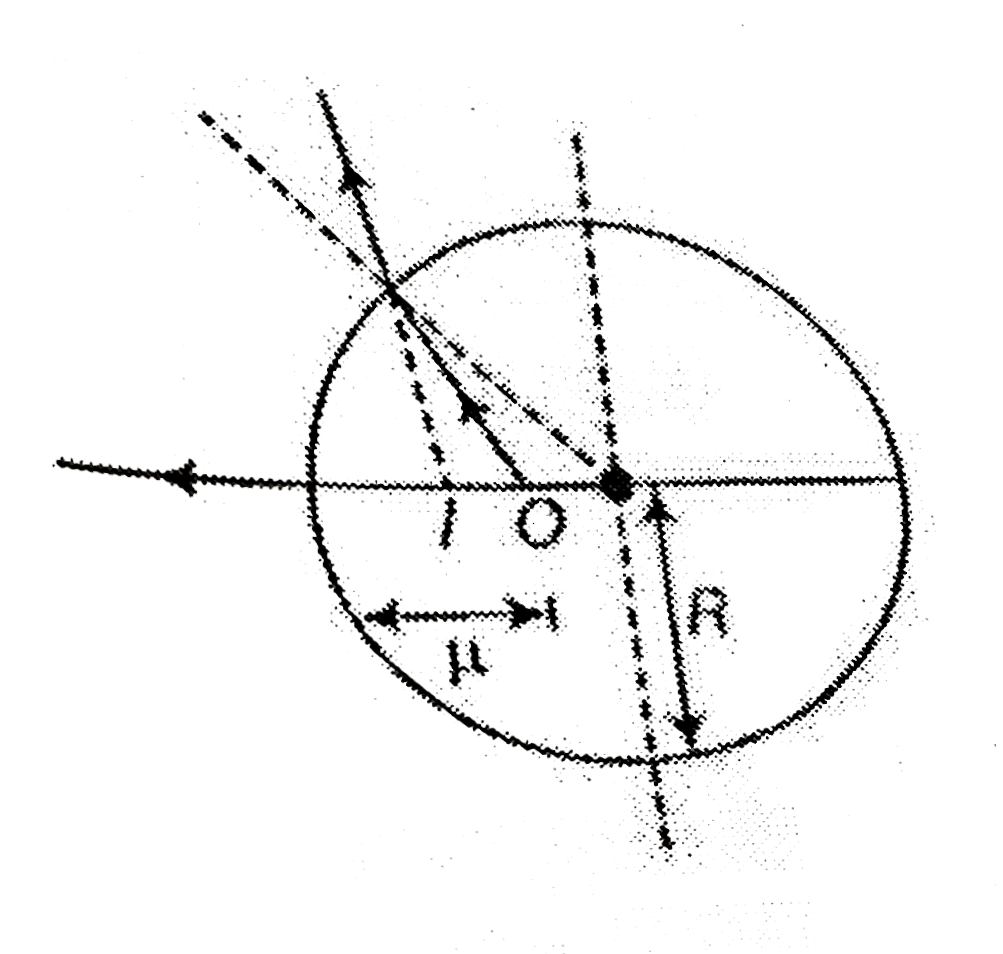 IMAGE will FORM at a distance of `2.5xx10^(-2)m` to the right of nearer surface. |
|
| 39. |
Mi of a disc about an axis passing through its diameter in given by I_D= _____ |
| Answer» SOLUTION :[`(MR^2)/4]` | |
| 40. |
If the polar ice caps of earth melt, how will the length of the day be affected ? |
| Answer» SOLUTION :of satellite revolving round the EARTH (is equal to G). So, the acceleration of the person with respect to satellite is zero. Therefore, the person is weightless with respect of satellite. Here it will be ''remembered that a person feels his weight only when the surface on which he is standing EXERTS reactionary force on him. | |
| 41. |
The value of 'g' is maximum at the surface of earth.Is it true? |
|
Answer» |
|
| 42. |
Which of the following is close to an ideal black body ? |
|
Answer» BLACK LAMP |
|
| 43. |
Let the X - Z plane be the boundary between two transparent media. Medium 1 in Z ge 0 hasrefractive index ofsqrt(2) and medium 2 with Z lt 0 has a refractive index of sqrt(3). A ray of light in medium 1 given by the vertor overset(rarr)(A)=6sqrt(3hat(i))+8sqrt(3)hat(j)-10hat(k) is incident on the plane of separation. The angle of refraction in medium 2 is : |
|
Answer» `45^(@)`  `cosi(A_(Z))/(|A|)=(-10)/((sqrt(6sqrt3))^(2)+(8sqrt(3))^(2)+(-10)^(2))=-(1)/(2)` `therefore I = 60^(@) ("since I lies between" 0^(@) and 90^(@) "HENCE" 120^(@) "is not possible")` By using Snell.s LAW, `mu_(1) sin I = mu_(2) sin R` `sqrt(2) sin 60^(@) = sqrt(3) sin r` `rArr "" sin r = (1)/(sqrt(2)) rArr r = 45^(@)` |
|
| 44. |
A spherical conducting shell of inner radius r_1and outer radius r_2 has a charges 'Q' A charges 'q' is placed at the centre of the shell. What is the surface charges density on the (i) inner surface (ii)outer surface of the shell? (b) A spherical conducting shell of inner radius r_1and outer radius r_2 has a charges 'Q' A charges 'q' is placed at the centre of the shell. Write the expression for the electric field at a pointx gt r_2 from the centre of the shell. |
|
Answer» Solution :Let US have a conducting shell of inner radius `r_1 `and outer radius `r_2` . When it is given a charge Q, the charge spreads on its outer surface and there is no charge on inner surface of shell. When a charge q is placed at the centre of the shell, it indducess a charge -q on inner surface 1 of the shell and a charge +q on outer surface 2 of the shell. (i) The surface charge density on the inner surface `SIGMA _1= ( -q)/( 4pi r_1^(2)) ` (ii)The surface charge density on the outer surface ` ""sigma _2= +( Q+q)/( 4 pi r_2^(2)) ` ` (##U_LIK_SP_PHY_XII_C01_E09_026_S01##) ` (b) For a POINT lying outside the spherical shell`( x gt r_2) `. ELECTRIC field E is given by ` "" E = ("Total charge on spherical shell")/( 4 pi in_0 x^(2)) =(Q+q)/( 4 pi in_0 x^(2)) ` ` (##U_LIK_SP_PHY_XII_C01_E09_026_S01.png" width="80%"> |
|
| 45. |
Derive the expression for resultant capacitance when capacitors are connected in series and in parallel . |
|
Answer» Solution :Capacitor in series and parallel: (i) Capacitor in series : Consider three capacitors of capacitance `C_(1), C_(2)` and `C_(3)` connected in series with a battery of voltage V as shown in the figure (a). As soon as the battery is connected to the capacitor in series the electrons of charge -Q are transferred from negative terminal to the right plate of ` C_(3)` which pushes the electrons of same amount `(-Q)` from left plate of `C_(3)` to the right plate of `C_(2)` due to ELECTROSTATIC induction. Similarly the left plate of `C_(2)` pushes the charges of `(-Q)` to the right plate of `C_(1)` which INDUCES the positive charge `(+O)` on the left plate of `C_(1)` . At the same time electrons of charge `(-Q)` are transferred from left plate of `C_(1)` to positive terminal of the battery . 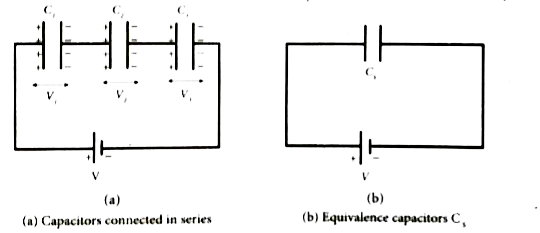 By these processes each capacitor STORES the same amount of charge Q. The capacitances of the capacitors are in general different so that the voltage across each capacitor is also different and are denoted as `V_(1) , V_(2)` and `V_(3)` respectively . The TOTAL voltage across each capacitor must be equal to the voltage of the a battery. `V=V_(1) +V_(2) +V_(3)` Since Q=CV we have `V= (Q)/(C_(1))+(Q)/(C_(2))+(Q)/(C_(3))` `= Q((1)/(C_(1))+(1)/(C_(2))+(1)/(C_(3)))` If three capacitors in series are considered to form an equivalent single capacitor `C_(5)` shown in figure (b) then we have `V= (Q)/(C_(s))` Substituting this expression into equation (2) we get `(Q)/(C_(s))=Q((1)/(C_(1))+(1)/(C_(2))+(1)/(C_(3)))` `(1)/(C_(s))=(1)/(C_(1))+(1)/(C_(2))+(1)/(C_(3))` Thus the inverse of the equivalent capacitance `C_(s)` of three capacitors connected in series is equal to the sum of the inverses of each capacitance . This equivalent capacitance `C_(s)` is ALWAYS less than the smallest individual capacitance in the series. (ii) Capacitance in parallel : Consider three capacitors of capacitance `C_(1), C_(2) ` and `C_(3)` connected in parallel with a battery of voltage V as shown in figure (a) 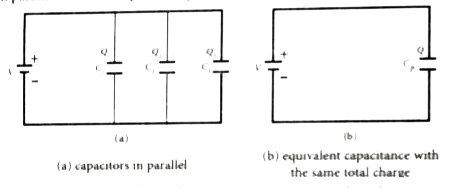 Since corresponding sides of the capacitors are connected to the same positive and negative terminals of the battery the voltage across each capacitor is equal to the battery.s voltage . Since capacitance of the capacitors is different the charge stored in each capacitor is not the same . Let the charge stored in the three capacitors be `Q_(1), Q_(3)` and `Q_(3)` respectively . According to the law of conservation of total charge the sum of these three charges is equal to the charge Q transferred by the battery, `Q=Q_(1)+Q_(2)+Q_(3)` Now since Q= CV we have `Q=C_(1)V+C_(2)V+C_(3)V` If these three capacitors are considered to form a single capacitance `C_(p)` which stores the total charge Q as shown in the figure (b) then we can write Q= CPV . Substituting this in equation (2) 2we get `C_(p)V= C_(1)V+C_(2)V+C_(3)V` Thus the equivalent capacitance of capacitors connected in parallel is equal to the sum of the individual capacitances . The equivalent capacitance `C_(p)` in a parallel connected is always greater than than the largest individual capacitance. In a parallel connection it is equivalent as area of each capacitance adds to give more effective area such that total capacitance increases. |
|
| 46. |
In Young'sdouble slit experiment an electron ray is used If the velocity of theelectron is increased then fringe width |
|
Answer» will increase |
|
| 47. |
In an experiment the electric field was found to oscillate with an amplitude of 18Vm^(-1). The amplitude of oscillations of the magnetic field will be |
|
Answer» `4XX10^(-6)T` |
|
| 48. |
There are three concentric metallic spherical shells of radii R, 2R and 3q, respectively. The middle spherical shell is connected to earth. Let q_(1) be the charge appearing on the inner surface of the middle sphere and q_(2) be the charge on outer surface of the middle sphere. Similarly q_(3) is the charge appearing on inner surface of outermost sphere and q_(4) is the charge appearing on outer surface of outermost sphere. |
|
Answer» `{:(P,Q,R,S),(4,3,1,2):}` 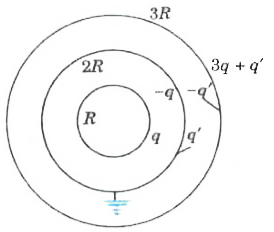 Since electric field intensity inside the innermost sphere is zero so no charge can stay on the inner surface and all charge q of inner sphere will stay on its outer surface only as shown in the figure. Metal faces parallel to each other must carry equal and opposite charges and hence charge appearing on inner surface of middle sphere must be -q. Let charge on outer surface of middle sphere be q. so that its electric potential may become zero. We shall calculate q. later by equating potential of middle sphere to zero. For now charge -q. must appear on inner surface of the outermost sphere, which is isolated. Hence, the net charge on it must remain 3q and hence the charge on outer surface must be `3q+q.`. Now we can calculate the value of q. by equating potential of middle sphere equal to zero because this sphere is connected to earth and the conductor connected to earth always ACQUIRE zero potential. `V_("middle-sphere")=(1)/(4pi epsilon_(0))[(q)/(2R)+(q.-q)/(2R)+(3q)/(3R)]` Note that we have used only the net charge on spheres to calculate potential of the middle sphere. We know that middle sphere is earthed hence: `V_("middle-sphere")=(1)/(4pi epsilon_(0))[(q)/(2R)+(q.-q)/(2R)+(3q)/(3R)]=0 rArr q.=-2q` Now we can WRITE the charges appearing on different faces: `q_(1)= -q` `q_(2)=-2q` `q_(3)=2q` `q_(4)=q` We can see that option (a) is correct. |
|
| 49. |
Electric field at a point of distance from a uniformly charged wire of infinite length having linear charge density lambda is directly proportional to |
| Answer» ANSWER :A | |
| 50. |
Two charges +3muC and +4muC are placed in free space 12m apart. What is the potential at the midpoint on the line joining these two charges? |
|
Answer» Solution :Data supplied, `q_(1)=+3MUC =+3 xx 10^(-6)C, q_(2)=4muC=4 xx 10^(-6)C` `r_(1)=6CM,""r_(2)=6cm` POTENTIAL at C, `(1)/(4pi epsi_(0)).(q_(1))/(r_(1)) +(1)/(4pi epsi_(0)) .q_(2)/r_(2)=(9 xx 10^(9) xx 3 xx 10^(-6))/(6)+(9 xx 10^(9) xx 4 xx 10^(-6))/(6)` `=4.5 xx 10^(3)+6 xx 10^(3)=10.5 xx 10^(3)"volts"=10.5kV` |
|