

Saved Bookmarks
This section includes 7 InterviewSolutions, each offering curated multiple-choice questions to sharpen your Current Affairs knowledge and support exam preparation. Choose a topic below to get started.
| 1. |
A particle traversed along a straight line for first half time with velocity V_0. For the remaining part, half of the distance is traversed with velocity V_1 and other half distance with veloctity V_2. Find the mean velocity of the pariticle for the total journey. |
|
Answer» `(2v_0 (v_1 + v_2))/(v_1 + v_2 + 2v_0)` |
|
| 2. |
A:Relation between energy of photon (E ) and momentum (P) is P=(E )/(c ) R:Photon behaves as particle. |
|
Answer» Both assertion and reason are TRUE and the reason is correct explanation of the assertion. Momentum of photon `p=(h)/(lambda)=(HF)/(c )`…..(1)`[lambda=(c )/(f)]` Photon is bundle of ENERGY which ACT as particle Energy of particle is E=nhf If n=1 and f=`(c )/(lambda)` `E=(hc)/(lambda)` ......(2) From result (1) and (2) `P=(E )/(c )` or `(hf)/(c )` |
|
| 3. |
Select correct order : |
|
Answer» `s-sgts-pgtp-p` Order of C-Obond length:`CO_(3)^(-2)gt CO_(2)gt CO` |
|
| 4. |
State Huygens' wave principle and describe the formation of primary wavefront and secondary wavelets geometrically. |
|
Answer» Solution :Assumptions on which Huygens. principle is based are: (i) The medium is homogeneous. (ii) The medium is isotropic. Huygens. principle (a) Each point of a wavelength becomes a SOURCE of new DISTURBANCE called the SECONDARY WAVELETS which travel in all directions with the same speed provided the medium remains the same. (b) The secondary wavefront is the tangent plane JOINING all the wavefronts. Fig. (a) represents the trace of secondary wavefront at a certain instant and fig. (b) represents the trace when the light has travelled a great distance. Rays of light are perpendicular to the wavefront. 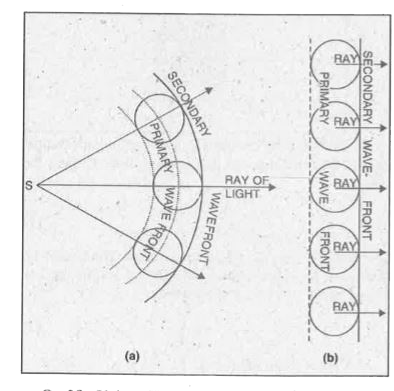
|
|
| 5. |
Displacement current goes through the gap between the plates of a capacitor when the charge of the capacitor : |
|
Answer» is zero |
|
| 6. |
The work done in moving a charge particle between two points in a uniform electric field, does not depend on the path followed by the particle . Why ? |
| Answer» SOLUTION :Becausean ELECTRIC FIELD is a CONSERVATIVE field. | |
| 7. |
The number of images formed between two parallel plane mirrors are .......... . |
|
Answer» 0 number of IMAGES n = `(360^@)/(theta)-1` For two PARALLEL mirrors `theta=0^@` `THEREFORE`The number of images n = `(360^@)/(0^@)-1`=infinite |
|
| 8. |
In pure semiconductor the number of conduction electrons 6xx10^18per cubic meter. How many holes are there in a sample size 1cmxx1cmxx1mm |
|
Answer» `3xx10^10` |
|
| 9. |
Two electric bulbs marked 40 W, 220 V and 60 W, 220 V when connected in series, across same voltage supply of 220 V, the effective power is P_(1) and when connected in parallel, the effective power is P_(2). Then (P_(1))/(P_(2)) is |
|
Answer» `0.5` `R_(B_(1))=((220)^(2))/(40)OmegaandR_(B_(2))=((220)^(2))/(60)Omega` When the BULBS are connected in series, `R_(S)=R_(B_(1))+R_(B_(2))=((220)^(2))/(40)+((220)^(2))/(60)=(220)^(2)[(1)/(40)+(1)/(60)]` `=(220)^(2)[(60+40)/(60xx40)]=(220)^(2)((100)/(2400))=((220)^(2))/(24)` `therefore P_(1)=(V_(S)^(2))/(R_(S))=(220)^(2)xx(24)/((220)^(2))=24W` When the bulbs are connected in PARALLEL `(1)/(R_(P))=(1)/(R_(B_1))+(1)/(R_(B_(2)))or(1)/(R_(P))=(40)/((220)^(2))+(60)/((220)^(2))` `(1)/(R_(P))=(100)/((220)^(2))orR_(P)=((220)^(2))/(100)` `therefore P_(2)=(V_(S)^(2))/(R_(P))=(220)^(2)xx(100)/((220)^(2))=100W therefore (P_(1))/(P_(2))=(24W)/(100W)=0.24` |
|
| 10. |
If earth suddenlystop rotating , then the weight ofan objectof massm at equatorwill [ omegais angularspeed of earth and R is its radius . ] |
|
Answer» Decrease by `MOMEGA^(2)R` |
|
| 11. |
which is a scalar quantity |
|
Answer» Force |
|
| 12. |
Two concave mirrors have he same focal length but the aperture of one is larger than that of other. Which mirrors forms a sharp image and why? |
| Answer» Solution :The CONCAVE mirror with smaller aperture forms the SHARPER image because it is free from spherical abervation | |
| 13. |
A number N_(0) of atoms of a radio active element are placed inside a closed volume. The radioactive decay constant for the nucleus of this element is lambda_(1). The daughter nucleus that form as a result of the decay process are assumed to be radioactive too with a radioactive decay constant lambda_(2). Determine the time variation of the number of such nucleus. Consider two limiting cases lambda_(1) gt gtlambda_(2) and lambda_(1) lt lt lambda_(2). |
|
Answer» |
|
| 14. |
A simple pendulum has length L and period T. As it passes through its equilibrium position, the string is suddenly clamped at its midpoint. The period then becomes |
| Answer» Answer :D | |
| 15. |
SI unit of magnetic field is called tesla, where 1 T = 1 N/A-m |
|
Answer» |
|
| 16. |
FeCI_(3)+ "Pot . This o cyanate rarr productcolour of above product is" |
|
Answer» Red BLOOD red colour |
|
| 17. |
The wavelength of electron in ground state is 2.116Å, then its momentum will be ...... |
|
Answer» <P>`313gcms^(-1)` `=3.1285xx10^(-24)=3.13xx10^(-24)kgms^(-1)` |
|
| 18. |
Fourteen identical resistors each of resistance r are connected as shown. Calculate equivalent resistance between A and B. |
| Answer» Answer :C | |
| 19. |
A particle is projected vertically upwards with a velocity of 20m/sec. Find the time at which distqance travelled is twice the displacement |
|
Answer» `2 + sqrt(4//3) sec` |
|
| 20. |
The rms value of the function shown in figure if it its given that for 0 lt t lt 0.1, y = 10 (1 - e^(-100t) and for 0.1 lt t lt 0.2, y = 10e^(-50(t - 0.1) is |
|
Answer» 6.2 |
|
| 21. |
Two block of mass 2 kg and M kg are at rest on an inclined plane and are separated by a distance of 6.0 m as a showm in figure. The coefficient of friction between each of the blocks and the inclined plane is 0.25. The 2 kg block is given a velocity of 10.0 m/s up the inclined plans. It collides with M, comes back and has a velocity of 10 m/s when it reaches its initial position. The other block of mass M after the collision moves 0.5 m up and comes to rest. Calculate the coefficient of restitution between the 2 kg block and the mass M.["Take " sin theta ~~ tan theta = 0.5, cos theta = 1 " and " g = 10 m//sec^(2)] |
|
Answer» Solution :For the block of mass 2 kg (=m) in going from the A to B `(KE+PE)_("initial")=(KE+PE)_("final")+W_("friction")` `(1)/(2)mv_(1)^(2)+0=(1)/(2)mv_(F)^(2)+mgh_(1)+F_(f)s` of `v_(f)^(2)=2[(1)/(2)v_(L)^(2)-gh_(1)-mu GS]` Substituting the given data, we get `v_(f)^(2)=2[(1)/(2)(10.0 m//s^(2))-(10m//s^(2))(0.30m)-(0.25)(10m//s^(2))(6.0m)]` Or, `v_(f)=8 m//s` For the block of mass 2 kg (=m) coming back from the position B to A `(KE+PE)_("initial")=(KE+PE)_("final")+W_("friction")` `(1)/(2)mu_(l)^(2)+mgh_(1)=(1)/(2)mu_(f)^(2)+0+F_(f)s` `u_(l)^(2)=2[(1)/(2)u_(f)^(2)+ mu gs-gh_(l)]` Substituting the given data, we get `u_(l)^(2)=2[(1)/(2)(-1.0m//s^(2))+(0.25)(10 m//s^(2))(6.0m)-(10m//s^(2))(0.30m)]` Or `u_(l)=-5.0 m//s` 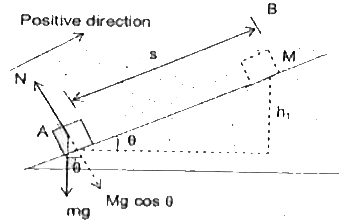 For the block of Mass M in going from the position B to C `(KE+PE)_("initial")=(KE+PE)_("final")+W_("friction")` `(1)/(2)Mc_(1)^(2)+Mgh_(1)=(1)/(2)Mc_(r )^(2)+Mg(h_(1)+h_(2))+F_(f)S_(2)` or `(1)/(2)c_(1)^(2)=(1)/(2)c_(1)^(2)+gh_(2)+mu gs_(2)` `(1)/(2)c_(i)^(2)=(1)/(2)(0)+(10 m//s^(2))(0.25 m)+(0.25)(10 m//s^(2))(0.5m)` `c_(i)=sqrt(3)m//s` `e=(u_(i)-c_(i))/(v_(f)-c_(i))=((-5.0m//s)-(-sqrt(3)m//s))/((8.0 m//s)-0)=(5+sqrt(3))/(8)=0.84` 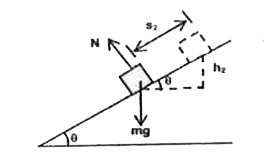
|
|
| 22. |
Calculate the average energy required to extract a nucleon from the nucleus of an alpha- particle ,proton and neutron are 4.00150 a.m.u 1.00728 a.m.u and 1.00867 amu respectively . |
|
Answer» Solution :Mass defect, `(DELTAM)=2(m_p+m_n)-m_N` =4.0319-4.00150=0.0304 amu BINDING energy of `ALPHA`-particle = `Deltamxx931.5` MeV =0.034 x 931.5 = 28.3 MeV Average energy required to extract nucleon `=28.3/4` = 7.07 MeV |
|
| 23. |
A number of capacitors, each of capacitance 1 mu F and each one of which gets punctured if a potential difference just exceeding 500 volt is applied are provided. Then an arrangement suitable for giving a capacitor of capacitance 3 mu F across which 2000 V may be applied requires at least |
|
Answer» 4 COMPONENT capacitors |
|
| 24. |
What is visible light ? Write various view on it. |
|
Answer» Solution :The portion of wavelength `4000Å` to `8000Å` in electromagnetic spectrum is visible light. The light itself is invisible and with it things can be seen. Views on the light are as follows: (1) Corpuscular model of light (Newton.s particle theory of light) : The corpuscular theory of light set by Descartes in 1637 and derived Snell.s law and explained the laws of reflection and refraction of light at SURFACE that separates two mediums. he corpuscular model predicted that if the ray of light (on refraction) bends TOWARDS the normal then the speed of light would be greater in the second medium. According to this theory, the speed of light is LOWER in rarer medium and higher in dense medium. The corpuscular theory of light was considered Newton.s corpuscular theory. In this theory light is considered to be COMPOSED of corpuscular. (2) Huygen.s wave theory : In 1678, Christian Huygen.s put the wave theory of light. This theory explain the phenomena of reflection and refraction and it predicted that on refraction if the wave bends towards the normal then the speed of light would be less in the second medium. This is in contradiction to the prediction made by using the corpuscular model of light. In 1850, Foucault carried out the experiment and predicated that the speed of light in water is less than the speed in AIR. |
|
| 25. |
The distance between the two slits in a Young.s double slit experiment is d and the distance of the screen from the plane of the slits is b, P is a point on the screen directly infront of one of the slits . The path difference between the waves arriving at P from the two slits is |
| Answer» Answer :B | |
| 26. |
Energy density in an electrostatic field E is |
|
Answer» `1/2 CV^2` |
|
| 27. |
Two materials Si and Cu are cooled from 300K to 60K. What will be the effect on their resistivity ? |
| Answer» Solution :The RESISTIVITY of SI (a semi CONDUCTOR) increases and that of CU (a METALLIC conductor) decreases. | |
| 28. |
The minimum distance from centre of zero order maxima to where the intensity in half that at the centre is |
|
Answer» `0.15 mm` `therefore I = 2a^(2) (1 + cos theta) = 4a^(2) cos^(2)(theta)/(2)` `Rightarrow I = I_(0)cos^(2)(theta)/(2)` `therefore cos^(2) (theta)/(2) = (I)/(I_(0)) = 1/2`,"`cos theta/2 = 1/sqrt2` `therefore theta = 90^(@) = (pi)/(2)` radian. `therefore` path difference `x = (pi)/(2) xx (lambda)/(2pi) = (lambda)/(4)` DISTANCE of point from CENTRE = `(lambda )/(4).(D)/(2d)` ` = 1/4(Dlambda)/(2d) = 1/4 xx 6 mm = 0.15 mm` |
|
| 29. |
The point charge is placed outside a spherical shell as shown i the figure. Find the electric potential (in kilo volt) on the surface of shell (Take: q=1 mu c and R=50cm) |
|
Answer» FIELD INSIDE the SHELL is zero, so potential is UNIFORM `V=(KQ)/(2R)=9` kilo volts |
|
| 30. |
A steady current flows in a metallic conductor of non uniform cross-section. The quantity quautities constant along the length of the conductor is / are |
|
Answer» DRIFT SPEED |
|
| 31. |
Charge Q is distributed non uniformly over a ring of radius R,P is a point on the axis of ring at a distance sqrt(3)R from its centre, Which of the following is a wrong statement |
|
Answer» Potential at p is `(KQ)/(2R)` |
|
| 32. |
In a Young's double slit experiment, 12 fringes are observed to be formed in a certain region of the screen when light of wavelength 600 nm is used. If the light of wavelength 400 nm is used, the number of fringes observed in the same region of the screen will be: |
|
Answer» 12 |
|
| 33. |
A stone of mass 4 kg whirled in a horizontal circle of radius 1 m and makes 2 revolutions/s. Moment of inertia of the stone about the axis of rotation is : |
|
Answer» `65kgm^(2)` |
|
| 34. |
An earlymodel for an atom consideredit to have a positivelychargedpointnucleasof charge Ze,surrounded by a unifromdensity of negative chargeupto a radius R. The atomas a wholeis neutral. For this model, What is the electricfieldat a distancer from the nucleas ? |
|
Answer» Solution :The charge distributionfor this model of atomis shown in Fig. Chargeon nucleas `= +Ze` , As atom is neutral, total NEGATIVE charge `= -Ze` `:.` Negativechargedensity, `p = (charg e)/(Volume)` 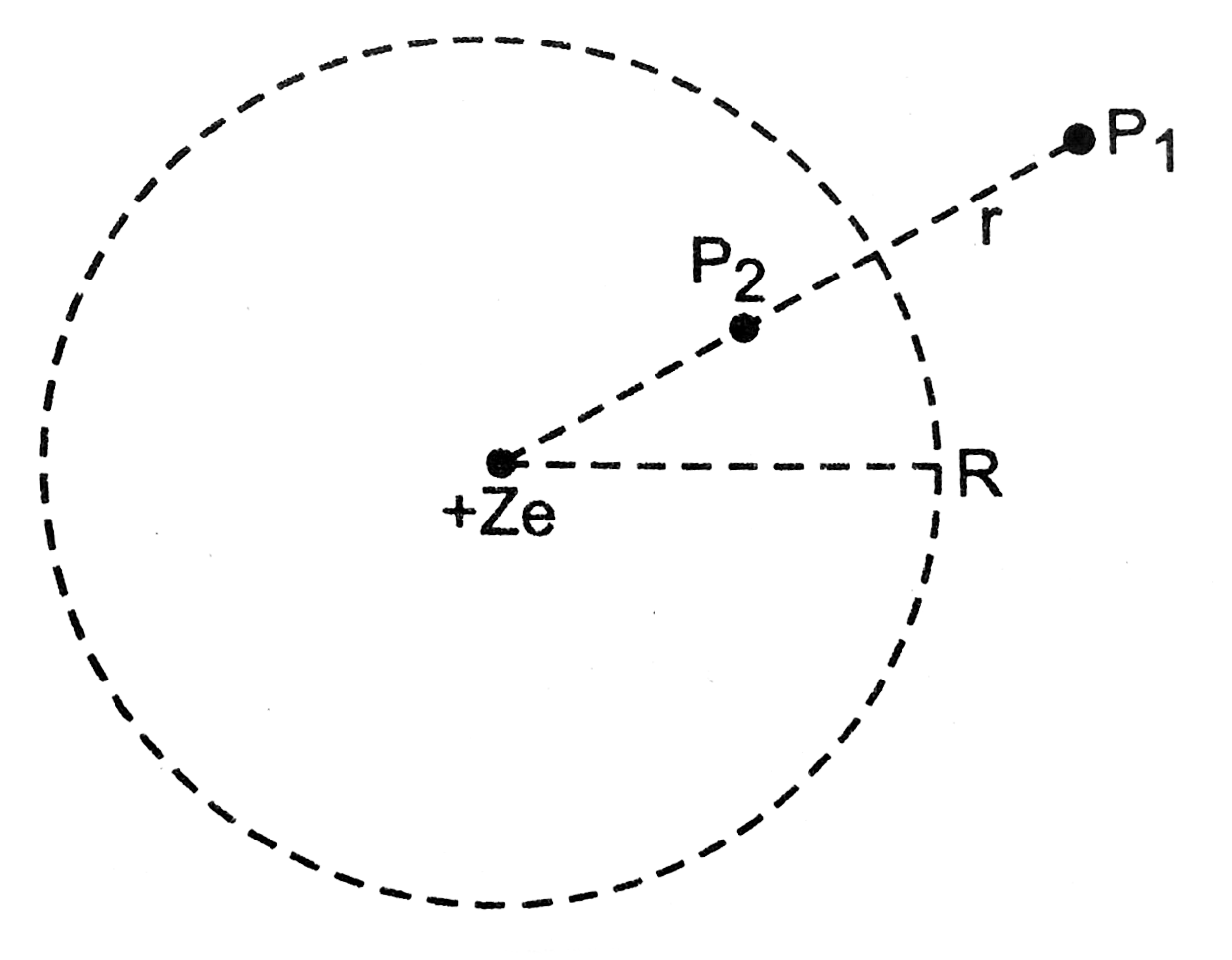 `p = (-Ze)/((4)/(3) 4pi R^(3)) = (-3Ze)/(4pi R^(3))`...(i) IMAGINE a GAUSSIAN surface- which is a spherical surface of radius r withcenterat thenucleaus (not shown). According to Gauss's theorem in electrostatics. `phi = E(r)xx4pi r^(2) = (q)/(in_(0))` ...(ii) (i) When point `P_(1)` is outside, i.e., `r gt R, q = Ze - Ze = 0 :. E(r) = 0`. (ii) When point `P_(2)` is inside, i.e., `r gt R`, Chargeenclosed by Gaussain surface. `q' = Ze + (4pi r^(3))/(3) p = Ze - Ze (r^(3))/(R^(3))` ...using (i) From(ii), `E (r)= (q')/(4pi in_(0) r^(2)) = (Ze-Ze r^(3) // R^(3))/(4pi in_(0) r^(2))` `= (Ze)/(4pi in_(0)) ((1)/(r^(2)) - (r)/(R^(3)))` |
|
| 35. |
Derive the expression for electric field at a point on the equatorial line of an electric dipole. (b) Depict the orientation of the dipole in (i) Stable (ii) unstable equilibrium in a uniform magnetic field |
|
Answer» Solution :For definition of dipole moment, see point Number 29 under the heading "Chapter At a Glance"Dipole moment is a vector. Let us calculate the electrostatic field at a point P on the EQUATORIAL LINE at a distance .r. form MID- point O of an electric dipole AB. Obviously, `""|oversetto (E_A) |=|oversetto (E_B)| =(1)/(4 pi in _0).(q)/( (a^(2) + r^(2))) ` Resultant field at pointP is `oversetto E =oversetto (E_A) +oversetto (E_B) ` Let us resolve ` oversetto (E_A) and oversetto (E_B) ` along and perpendicular to the dipole axis. We find that components `E_A sin theta and E_B sin theta ` nullify each other and HENCE ` |oversetto E| =(oversetto (E_A) +oversetto (E_B)) cos theta =2 .(1)/(4 pi in _0) .(q)/((a^(2) + r^(2)) ).(a)/(sqrt(a^(2) +r^(2)) ) ` where p=q.2a =dipole moment of electric dipole This direction of ` oversetto E ` is opposite to that of ` oversetto p i.e. , oversetto E =-(oversetto p)/( 4 pi in _0( r^(2) +a^(2)) ^(3//2)) ` If` r gt gt a , `then teh above relation may be modified as ` "" oversetto E =-(oversetto p)/( 4 pi in _0 r^(3)) ` (b) Orientation of an electric dipole in (i)stable (ii) UNSTABLE equilibrium in a uniform electric field E has been depicted ` (##U_LIK_SP_PHY_XII_C01_E10_003_S01.png" width="80%"> |
|
| 36. |
In an A.C. circuit the inductive reactance isdefined as ...... |
|
Answer» `Z_L=-J OMEGAL` |
|
| 37. |
Suppose your car's headlights are turned on when you start the ignition. Will the headlights become dimmer or brighter while the car is starting ? Explain with proper reasoning . |
| Answer» Solution :When you ingnite the starter motor it drawn a significant AMOUNT of current from battery while the car is starting . This in addition to internal resistance of the batteryh, will DECREASE its output below its nominal value. The currents in the headlights will thus decrease and HENCE, the headlights will BECOME DIMMER. | |
| 38. |
A sound wave has frequency 500 Hz and velocity 350 m/s . What is the distance between the two particles having phase diff. of 60^(@) . |
|
Answer» 0.7 CM `LAMBDA = (v)/(v) = (350)/(500) = 0.7 ` m Now x = `(lambda)/(2 PI ) . Phi = (0.7)/(2 pi ) . (pi)/(3) = 0.116 m = 11.60 m.` or x = 11.6 cm . Hence the correct choice is (b). |
|
| 39. |
Sun rays are reflected from a horizontal mirror and fall on a vertical screen. A vertical object of height h is placed on the mirror as shown in the figure. Length of the shadow on the screen is |
|
Answer» h |
|
| 40. |
State Snell's law for refraction of light. |
| Answer» SOLUTION :For a GIVEN wavelength of light and for a given PAIR of MEDIA,the ratio of sine of ANGLE of incidence to the sine of angle of refraction is constant. | |
| 41. |
A stone thrown into still water creates a circular wave pattern moving radially outwards. If r is the distance measured from the centre of the pattern, the amplitude of the wave varies as ..... |
|
Answer» `r^((-1)/(2))` `E^(2) prop (P)/(4PI r^(2)) [ :. I prop E^(2)]` where E is amplitude `E^(2) prop (I1)/(r^(2)) ""` [ all terms are constant ] `:.E prop (1)/(r)` |
|
| 42. |
In the above problem, the value of weight W will be :- |
|
Answer» 59,16 N |
|
| 43. |
What is an unpolarised light ? Explain with the help of suitable ray diagram how an unpolarised light can be polarised by reflected from a transparent medium. Write the expression for Brewster angle in terms of the refractive index of denser medium. |
|
Answer» SOLUTION :Ordinary light propagating in a GIVEN direction consists of many independent waves whose planes of vibration are randomly oriented in all directions in a transverse plane. Such light is said to be unpolarised light. In an unpolarised light the electric vector takes all possible directions is the transverse plane. Plane polarised light can be obtained by reflection from a transparent surface (say a plane glass plate) when the light is incident on the surface at the polarising angle `i_(p)`. In such a CONDITION, the reflected light contains vibrations of electric vector PERPENDICULAR to the plane of incidence only and is, thus, completely plane polarised one. when light is incident at the polarising angle `i_(p)`, the reflected and refracted rays make a right angle with each other i.e., `angler=angle(90^(@)-i_(p))`. therefore, as per Snell.s law, we have `n=(sini_(p))/(sinr)=(sini_(p))/(sin(90^(@)-i_(p)))=(sini_(p))/(cosi_(p))=tani_(p)` The condition `n=tani_(p)` is referred as Brewster.s law.  . .
|
|
| 44. |
Can radioactivity be controlled? |
| Answer» SOLUTION :No, it cannot be CONTROLLED by any PHYSICAL or CHEMICAL CONDITIONS. | |
| 45. |
Draw the output signal C_(1) and C_(2) in the given combination of gates (Fig.) |
|
Answer» SOLUTION :Here, In circuit, `C_(1)=bar(bar(barA.barB))=bar(bar(baAr)+bar(barB))=bar(A+B)` In circuit, `C_(2)=bar(barA+barB)=4bar(barA).bar(barB)=A.B` For the given SIGNALS shown in Fig. and , we have the following values for `A,B, C_(1)` and `C_(2)`. (i) For time 0TO`1s, A=1, B=0, C_(1)=0, C_(2)=0` (ii) For time `1s`to`2s, A=1, B=1, C_(1)=0, C_(2)=1` (iii) For time `2sto3s, A=0, B=1, C_(1)=0, C_(2)=0` (iv) For time `3sto4s, A=1, B=0, C_(1)=0, C_(2)=0` (v) For time `4sto5s, A=0, B=0, C_(1)=1, C_(2)=0`. The output signal `C_(1)` and `C_(2)` are shown in Fig. |
|
| 46. |
The diagram shows the energy levels for an electron in a certain atom. Which transition shown represent the emission of a photon with the most energy ? |
|
Answer» I (I) For transtions n=1 to n=4 energy is absorbed (II) `DeltaE_(2)prop((1)/(3^(2))-(1)/(4^(2)))prop((1)/(9)-(1)/(16))prop(7)/(144)prop0.0486` (III) `DeltaE_(3)prop((1)/(1^(2))-(1)/(4^(2)))prop((1)/(1)-(1)/(16))prop(15)/(16)prop0.9375` (IV) `DeltaE_(4)prop((1)/(2^(2))-(1)/(4^(2)))prop((1)/(4)-(1)/(16))prop(12)/(64)prop0.1875` `:.` In option III energy of emitted photon is maximum |
|
| 47. |
The frequency of a given a.c. single is 100 Hz. When it is connected to a half wave rectifier, the number of output pulses given by the rectifier in one second are |
|
Answer» 100 |
|
| 48. |
Two blocks are in contact on a frictionless table. A horizontal force is applied to one block as shown in fig. If m_1=10kg and m_2=5kg and F=15N. Find the force of contact between the two bodies. |
|
Answer» |
|
| 49. |
The work function of a substance is 4.0 eV. The longest wavelength of light that can cause photoelectron emission from this substance is approximately |
|
Answer» 540 nm `therefore lamda_(0)=(hc)/(e*phi_(0))=(6.63xx10^(-34)xx3xx10^(8))/(1.6xx10^(-19)xx4.0)=3.1xx10^(-7)=310nm`. |
|
| 50. |
In Melde's experiment ,when the tension decreases by 0.011 kg-wt, the number of loop changes from 5 to 6, then what is the initial tension ? |
|
Answer» `0.036` kg-wt |
|