

Saved Bookmarks
This section includes 7 InterviewSolutions, each offering curated multiple-choice questions to sharpen your Current Affairs knowledge and support exam preparation. Choose a topic below to get started.
| 1. |
Phase difference between two particles of a medium lying between two consecutives nodes is, |
| Answer» ANSWER :D | |
| 2. |
Energy generation in stars is due to nuclear fusion. How does a nuclear fusion occur ? |
| Answer» Solution :At high TEMPERATURE, LIGHTER NUCLEI COMBINED to form a heavier nuclear fusion occurs ? | |
| 3. |
Figure shows a conductor of length l having a circular cross - section. The radius of cross - section varies linearly from a to b. The resistivity of the materia is rho. Assuming that b-a lt lt l, find the resistance of the conductor. |
|
Answer» Solution :`TAN phi=(b-a)/(1)=(y-a)/(x)` `yl-al=bx-ax`  `1((dy)/(DX))=(b-a)rArrdx=((1)/(b-a))dy rarr(1)` Resistance across the elemental disc under consideration `dR=rho(dx)/(A)rarr(2)` from (1) and (2) `dR=rho((1)/(b-a))(dy)/(piy^(2))` `rArr"Resistance across the given conductor,"` `R=int_(y=a)^(b)dR rArr R=rho(1)/(pi(b-a)).int_(y=a)^(y=b)(dy)/(y^(2)) THEREFORE R=rho(1)/(piab)` |
|
| 4. |
Wavelength of particle moving with momentum 2xx10^(-28) kg ms^(-1) will be …… |
|
Answer» `3.3xx10^(-6)m` `lambda=(h)/(MV)=(h)/(p)` `THEREFORE lambda=(6.6xx10^(-34))/(2xx10^(-28))` `therefore lambda=3.3xx10^(-6)m` |
|
| 5. |
A transverse wave is represented by the equation y = y sin (2pi)/lambda (vt -x)For what value of lambda , is the maximum particle velocity equal to two times the wave velocity? |
|
Answer» `lambda = (pi y_(0))/2` `y =y_(0)sin (2pi)/lambda (vt -X)` Particle VELOCITY `=(DY)/(dt) = y_(0)COS (2pi)/lambda (vt-x) .(2PIV)/lambda` `((dy)/(dt))_("max") = y_(0).(2pi)/lambda v` `therefore y_(0) =(2pi)/lambda v =2 v` or `lambda = pi y_(0)` |
|
| 6. |
If an object is placed 10 cm in front of a concavemirror of focal length 20 cm, the image will be. |
|
Answer» DIMINISHED, UPRIGHT, virtual |
|
| 7. |
How mathematically the radii of stationary orbits are represented ? |
| Answer» SOLUTION :It is GIVEN by `r_n = (0.53xx10^-10)n^2/Z` METER. | |
| 8. |
A tube of length L is filled completely with an incompressible liquid of mass M and closed at both the ends. The tube is then rotated in a horizontal plane about one of its ends with a uniform angular velocity omega. The force exerted by the liquid at the other end is |
|
Answer» `(Momega^(2)L)/2` `therefore` Mass in eIement dx=`(Mdx)/L` `therefore` Centripetal force =`((Mdx)/L)xomega^(2)` or `dF=(Momega^(2))/Lxdx` `thereforeintdF=int_(0)^(L)(Momega^(2))/Lxdx` or `F=(Momega^(2))/L[(x^(2))/2]_(0)^(L)=(ML^(2)omega^(2))/(2L)` or `F=(MLomega^(2))/2` 
|
|
| 9. |
Monochromatic green light, of wavelength 550 nm, illuminates two parallel narrow slits 5.60 mu m apart. Calculate the angular deviation of the third-order (m=3) bright fringe (a) in radians and (b) in degrees. |
| Answer» SOLUTION :(a) 0.299 RAD, (B) `17.1^(@)` | |
| 10. |
In a Cassegrain telescope a large aperture _____mirror and a small aperture __________mirror is used. |
|
Answer» |
|
| 11. |
If path difference between two wave superposing at a point is (3)/(2) lambda interference of ...... type and ...... order will be formed there. |
|
Answer» destructive, second |
|
| 12. |
Nuclear fusion is called thermonuclear reaction. Why ? |
| Answer» Solution :SINCE the reaction TAKES place at a very high temperature of the order of million degree CELSIUS, it is CALLED THERMONUCLEAR reaction . | |
| 13. |
In the given circuit , the potential difference across the capacitor is 12 V. Each resistance is of 3 Omega. The cell is ideal. The emf of the cell is |
|
Answer» 15 V |
|
| 14. |
Out of crown and flint glass prisms which has the larger refrangibility? |
| Answer» SOLUTION :FLINT GLASS PRISM. | |
| 15. |
Magnifying power of objective of compound microscope is 5. If magnifying power of compound microscope is 30, then magnifying power of eye-piece will be ...... |
|
Answer» 1 `m_e` = magnifying power of eye-piece m = 30 = magnifying power of COMPOUND MICROSCOPE Magnifying power of compound microscope, `m=m_0xxm_e` `thereforem_e=(m)/(m_0)` `THEREFORE m_e=(30)/(5)=6` |
|
| 16. |
In fig.25-25 a potential arrangement with capacitances applied across a capacitor arrangement with capacitances C_1=10.0 mu F,C_2=5.00 mu F, and C_3=4.00 mu F. IF capacitor 3 undergoes electrical breakdown so that is becomes equivalent to conducting wire, then for capacitor 1 what are the increase in (a) charge, (b) potential difference, and ( c) stored energy |
| Answer» SOLUTION :`a) 5.13 TIMES 10^-4 C B) 51.3 V c) 20.1 mJ` | |
| 17. |
A short magnet of magnetic moment 2.0 Weber-metre is lying in a horizontal plane with its north pole pointing 60^(@) east of north. Find the net magnetic field at a point north of the magnet 0.2 m away from it. Horizontal component of earth's magnetic field = 0.3 xx 10^(-4) T. |
|
Answer» Solution :Herer=0.2m,`theta=60^(@)` `B_(1)[due to bar ]=mu_(0)/4pi M/r^(3) sqrt(3cos^(2)theta +1)` `=4pixx10^(-7)/4pi xx 2/(0.2)^(3) sqrt(3cos^(2)60^(@)+1)=3.3xx10^(-5)T` `TAN Beta=tan theta/2=tan 601^(@)/2=sqrt(3)/2 RARR Beta = 40^(@)` At `P_(1)` direction of `B_(B)` as shown, whereas `B_(H)` (due to earth acts along North). So net field B is resultant of `B_(I) and B_(H)`. `B=sqrt(B_(I)^(2)+ B_(H)^(2)+2B_(I)B_(H)cos 41^(@))`=`10^(-5)sqrt((3.3)^(2)+(3.0)^(2)+2xx3.3xx3.0xx0.756)=5.9xx10^(-5)T` 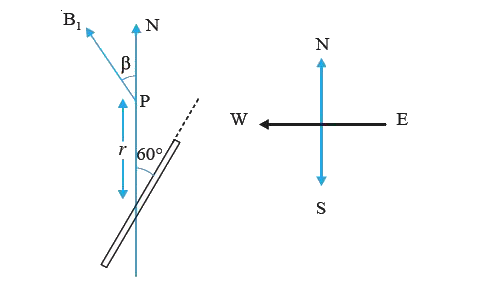
|
|
| 18. |
A point mass m and charge q is connected with a spring of negligible mass with natural length L. Initially spring is in its natural length. Now a horizontal uniform electric fiedl E is switched on as shown. Find (a) the maximum separation between the mass and the wall (b) Find the separation of the point mass and wall at the equilibrium position of mass. (c ) FInd the enery stored in the spring at the equilibrium position of the point mass |
|
Answer» Solution :At maximum separation, velocity of point MASS is zero. From work energy theorem, `W_("spring") + W_("field") = 0` `qEx_(0) - (1)/(2) kx_(0)^(2) = 0` (`x_(0)` is maximum elongation) `rArr x_(0) = (2qE)/(K) therefore` separation `= L + (2qE)/(k)` (b) At EQUILIBRIUM position, Eq = `kx rArr x = (QE)/(k) rArr` separation `= L + (qE)/(k)` (c ) `U= (1)/(2) kx^(2) = (1)/(2) k ((qE)/(k))^(2) = (q^(2)E^(2))/(2k)` |
|
| 19. |
A charged particle describes a circle under the influence of the magnetic field. The quantities that remain constant are i) K. E ii) Velocity iii) Time period iv) Momentum |
|
Answer» Only i & III are true |
|
| 20. |
A projectile is fired at 45° with a speed of 200 ms^(-1) . Its maximum height will be the same as that for a projectile fired vertically upwards with a speed of: |
|
Answer» `400ms^(-1)` Now for vertical THROW `h_(max)=v^(2)/(2g)` As given `^(2)/(2g)=u^(2)/(4g)=(200xx200)/(4g)` or `v^(2)=200xx100` `v=200/sqrt(2)ms^(-1)` |
|
| 21. |
A metre stick held vertically with one end on the floor is allowed to fall. Speed of the other end when it hits the floor is : |
|
Answer» Nearly 3 m/s `mg((l)/(2))=(1)/(2)IOMEGA^(2)=(1)/(2).(1)/(3)ML^(2)omega^(2)` `=MGL=(1)/(3)mv^(2)""[therefore v=lomega]` `therefore v=sqrt(3gl)=sqrt(3xx10xx1)=5.5m//s` |
|
| 22. |
Two particles A and B (both initially at rest) start moving towards each other under a mutual force of attraction. At the instant when the speed of A is v and the speed of B is 2v, the speed of the centre of mass is |
|
Answer» zero |
|
| 23. |
(A): In a simple battery circuit, the point of the lowest potential is negative terminals of the battery (R): The current flows towards the point of the higher potential, as it does in such a circuit from the negative to the positive terminal. |
|
Answer» Both 'A' and 'R' are true and 'R' is the CORRECT EXPLANATION of 'A' |
|
| 24. |
The angle between normal inaction (N) and force of friction(F_f) is |
| Answer» Answer :C | |
| 25. |
In the shown figure, the wedge A is fixed to the ground. The prism B of mass M and the block C of mass m is placed as shown. Find the acceleration of the block C w.r.t. B when the system is set free. Neglect any friction. |
|
Answer» |
|
| 26. |
Moment of inertia of a solid sphere about a diameter is 8 g cm^(2) (mass = 5 g, radius = 2 cm). Moment of inertia of the solid sphere about a tangent shall be : |
|
Answer» `28 g cm^(2)` |
|
| 27. |
A semiconductor has the electron concentration 0.45 xx 10^(12) m^(-3) and hole concentration 5 xx 10^(29) m^(-3) . Find its conductivity . Given electron mobility = 0.135 m^(2) V^(-1) s^(-1) and hole mobility = 0.048 m^(2) V^(-1) s^(-1) , e = 1.6 xx 10^(-19) C |
| Answer» SOLUTION :`3.845 OMEGA^(-1) m^(-1)` | |
| 28. |
In the case of light waves the angle between plane of vibration and plane of polarization is |
| Answer» Answer :D | |
| 29. |
In a potentiometer experiment when a battery of e.m.f . 2 V is included in the secondary circuit, the balance point is at 500 cm . Find the balancing length from the same end when a cadmium cell is e.m.f 1.018V is connected to the secondary circuit. |
|
Answer» Solution :e.m.f of first CELL `E_1 = 2V` e.m.f of second cell `E_2 = 1.018 V` First balancing length `l_1 = 500 cm` Let second balancing length =` l_2` `E prop l` `(E_1)/(E_2) = (l_1)/(l_2)` `l_2 = (E_2)/(E_1) xx l_1 = (1.018)/2 xx 500 = 254.5 cm` |
|
| 30. |
Two coils have a mutual inductance 0.005 H. The current changes in the first coil according to the equation I = I_(0) sin omegat "where" I_(0) = 10 A and omega = 100pi rad s^(-1). The maximum value of emf induced in the second coil is |
|
Answer» `2PIV` `epsi_(2)=M"" (d I_(1))/(dt) =M I_(0) omega cos omegat` `rArr |epsi_(2)|_("MAX")=M I_(0) omega=0.005 xx 10 xx 100pi =5piV` |
|
| 31. |
Two wires of same length are shaped into a square and a circle. If they carry same current, ratio of the magnetic moment is |
| Answer» ANSWER :C | |
| 32. |
How fast a person should drive his car so that the red signal of light appears green? (Wavelength of red colour = 6200 Å and wavelength for green colour = 5400 Å) |
|
Answer» `1.5 XX 10^(8)m/s` `LAMBDA . = lambda(1 - (V)/(C))` `5400 Å = 6200 Å(1 - (V)/(C))` `V = [1 - (54)/(62)]C = 3.9 xx 10^(7)` approx. |
|
| 33. |
A conductor of lengh l is placed in the east-west line on a table. Suddenly a certain amount of charge is passed through it when it, is found to jump to a height h. Calculate the amount of charge passed through it. The earth's horizontal magnetic induction is B. [Hint: idt=q] |
|
Answer» |
|
| 34. |
A car of mass 1000 kg is moving at a speed pf 30 m/s. Brakes are applied to bring the car to rest. If the net retardation force is 5000 N, the car comes to stop after travelling d m in ts. Then |
|
Answer» `d = 150, t = 5` |
|
| 35. |
If in the circuit shown below. The internal resistance of the battery is 1.5.Omegaand V_p and V_Q are the potentials at Pand Q respectively, the potential difference between the points P and Q is |
|
Answer» ZERO |
|
| 36. |
The nucleus _6C^12 absorbs an energetic neutron and emits a beta- particle. The resulting nucleus is : |
|
Answer» `_7N^14` |
|
| 37. |
A ray of light is incident on a medium at an angle i. It is found that the reflected ray is right angles to the refracted ray. The refractive index of the medium is given by : |
|
Answer» SIN i |
|
| 38. |
A metallic shell has a point charge .q. kept inside its cavity. Which one of the following diagrams correctly represents electric lines of forces |
|
Answer»
|
|
| 39. |
Derive the relation N_(t) =N_(0)e^(-lambdat) for radioactive decay. Obtain the relation between disintegration constant and half-life. |
|
Answer» SOLUTION :According to the LAW of radioactive decay, we know that rate of disintegration of a radioactive sample is directly PROPORTIONAL to the actual quantity of that material at that instant. Mathematically, `-(dN)/(DT)=lambdaN` where `lambda` is the disintegration (or decay) constant of given radioactive substance `therefore (dN)/(dt)=lambdadt` On integration, we have `int_(N_(0))^(N_(t))(dN)/N=-lambdaint_(0)^(t)dt implies [log_(e)N]_(N_(0))^(N_(t))=-lambda[t]_(0)^(t) implies log_(e)N_(t)-log_(e)N_(0)=-lambdat " or" log_(e)(N_(t))/(N_(0))=-lambdat " or" N_(t)/N_(0)=e^(-lambdat) implies N_(t)=N_(0)e^(-lambdat)` For relation between `T_(1/2)` and `lambda`, see Short Answer QUESTION Number 14. |
|
| 40. |
If chi stands for the magnetic susceptibility of a given material, identify the class of material for which (i)-1 ge chi lt 0 (ii) 0 chi lt in (in "stands for a small positive number") |
|
Answer» SOLUTION :`(i)"For "-1 ge x lt 0.` material is diamagnetic (ii) `"For "0 lt chi lt in`, material is paramagnetic. |
|
| 41. |
In the circuit shown, the switch S has been close for a long time. At time t=0 the switch is opened. It remains open for a long time T, after which it is closed again. |
|
Answer» voltage drop across `100 k Omega` RESISTER is `10e^(-t//1.5)V` for `tltT` `tau=RC=1.5`sec Voltage across the capacitor `V_(C)=10(1-e^(-t/1.5))` for `tltT` The CURRENT `i=(dQ)/(DT)=C(dV_(c))/(dt)` `=200/3xx10^(-6)(e^(-t//1.5))` for `tltT` Voltage drop across `100k mu` resister, `V=iR=20/3e^(-t//1.5)` for `t lt T` After `t=T`, `tau=100xxkOmegaxx10 mu F=1` sec Voltage across capacitor `V_(c)=V_(@)t^(-[(t-T)//tau])=10(1-e^(-T//1.5)),e^(-[(t-|T)//1])` The charge on capaclitor, `Q=V_(c).C` The current thorugh `100 k mu` resistor `i=-C(dV_(c))/(dt)=10^(-3)(1-e^(-T//1.5))(1-e^(-(t/T)//1))` |
|
| 42. |
A radioactive X decays to Y. In the radionuclide, the ratio of mass of element X to that of Y is n at t=0. It is observed that at time t=t_(0), this ratio becomes equal to 1//n. Assuming that all the decay products (except gamma- photons) remain in the sample, calculate half life of X. |
|
Answer» |
|
| 43. |
A photon has same wavelength as the de Broglie wavelength of electrons. Given C=speed of light, v=speed of electron. Which of the followitg relation is correct? [Here E_e= kinetic energy of electron, E_(ph)= energy of photon, P_e= momentum of electron and P_(ph)= momentum of photon] |
|
Answer» `(E_e)/(E_(ph))=(2C)/(v)` `(h)/(p_(ph))=(h)/(p_e)` `(E_e)/( C)=(2E_e)/(v)` `(E_e)/(E_(ph))=(v)/(2C)` |
|
| 44. |
The types of sensitivity in galvanometers are (a)____(b)______. |
| Answer» SOLUTION :CURRENT VOLTAGE | |
| 45. |
How you would arrange 24 cells, each of emf 1.5V and internal resistance 0.5Omega, to deliver maximum current to a resistor of 4Omega? What is the maximum current? |
|
Answer» |
|
| 46. |
When a conductor is heated due to the passage of current through it, the resistivity (or resistance) of the conductor increases. What happens to the drift speed V_d of conduction electrons in this case? |
| Answer» SOLUTION :The DRIFT speed decreases. This is due to increase in energy of FREE electrons, which RESULTS in more number of collisions with lattice ions over a given time and consequent LOSS of more energy. | |
| 47. |
A proton is placed in a uniform electric field directed along the positive x-axis . In which direction will it tend to move? |
| Answer» SOLUTION :Proton will tend MOVE ALONG the positive x-axis in the direction of UNIFORM electric field. | |
| 48. |
A carbon resistor is used in a circuit, at different constant temperatures, T_(1) and T_(2)(T_(1) gt T_(2)) for different voltages. Which of the following graphs are correct ? [ i is the current through the resistor, V is the voltage applied across it] |
|
Answer»
|
|
| 50. |
Two polaroids are aligned with their axes of transmission making an angle of 45^(@). They are followed by a third polaroid whose axis of transmission makes an angle of 90^(@) with the first polaroid. What fraction of the maximum possible light (if all polaroid were at the same angle) passes through all three ? |
|
Answer» 1 |
|


