

Saved Bookmarks
This section includes 7 InterviewSolutions, each offering curated multiple-choice questions to sharpen your Current Affairs knowledge and support exam preparation. Choose a topic below to get started.
| 1. |
A uniform rod of maass m and length L is placed on the fixed cylindrical surface of radius R at an small angular position theta from the vertical (vertical means line joining centre and vertex of the cylindrical path) as shown in the figure and released from rest. Find the angular velocity omega of the rod at the instant when it crosses the horizontal position (Assume that when rod comes at horizontal position its mid point and vertex of the circular surface coincide). Friction is sufficient to prevent any slipping. |
|
Answer» Solution :Gain in KINETIC ENERGY `=` loss in potential energy `(1)/(2)(ml^(2))/(12)OMEGA^(2)=mgR[theta sintheta+costheta-1]` `omega=(2)/(l)sqrt(6gR(theta sintheta+costheta-1))` 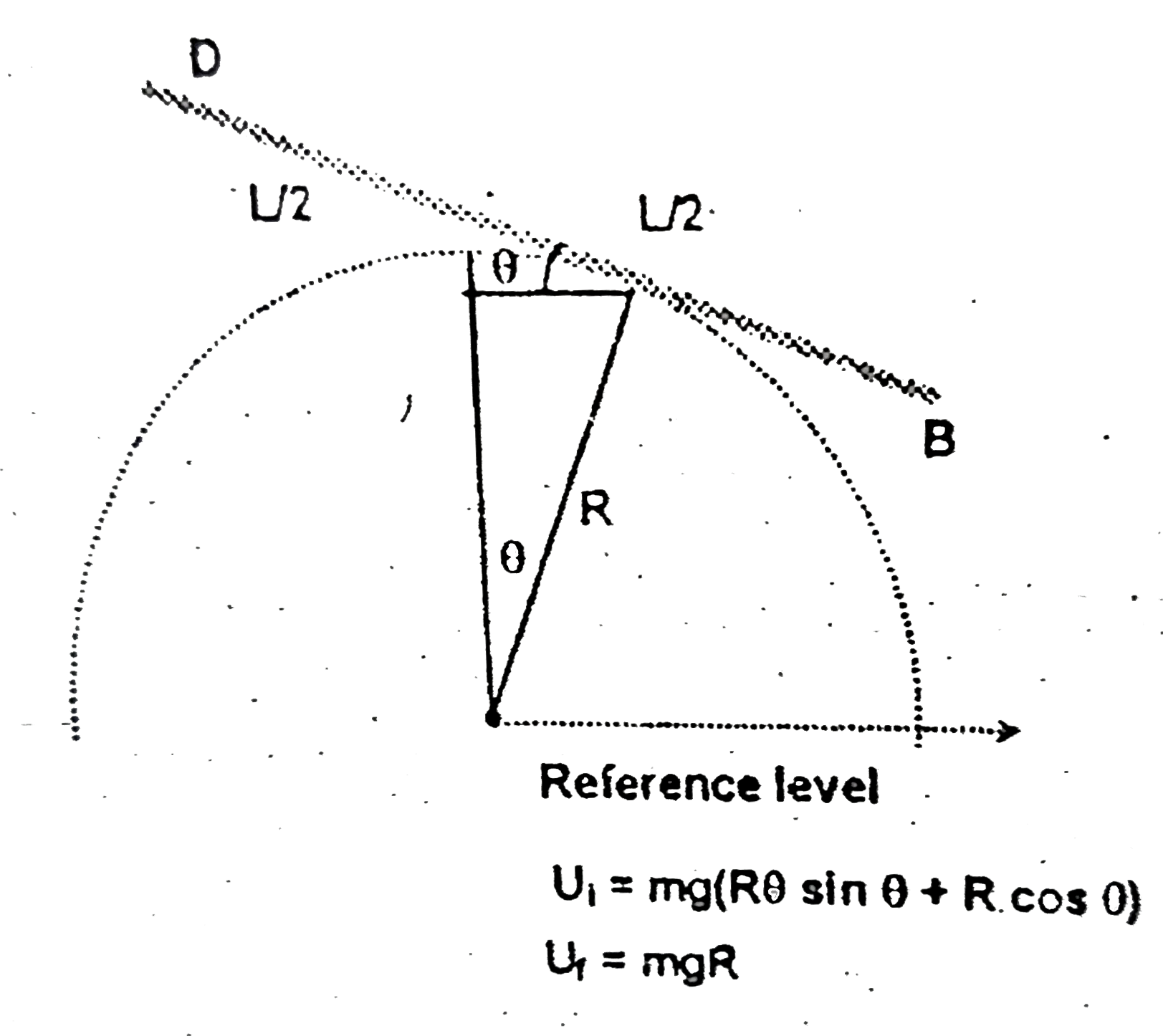
|
|
| 2. |
A simple pendulum has time period T. Charges are now fixed at the point of suspension of the pendulum and on the bob. If the pendulum continues to oscillate, its time period will now be |
|
Answer» GREATER than `T` |
|
| 3. |
A capacitor of plate area A and separation d is filled with two dielectrics of dielectric constant K_(1) = 6 and K_(2) = 4 . New capacitance will be |
|
Answer» `4 (A epsilon_(0))/(d )` |
|
| 4. |
Calculate the gain ofa positive feedback amplifier |
|
Answer» SOLUTION :Forpositvefeedback `A_f=(A )/(1- Abeta) = (100)/( 1-100 XX ((1)/(1000)) )=( 100 )/( 1-0.1) ` ` = (100)/( 0.9 ) = 111.1` |
|
| 5. |
One of the harmonic frequencies of tube A with two open ends is 400 Hz. The next-highest harmonic frequency is 480 Hz. (a) What harmonic frequency is next highest after the harmonic frequency 160 Hz? (b) What is the number of this next-highest harmonic? One of the harmonic frequencies of tube B with only one open end is 1080 Hz. The next-highest harmonic frequency is 1320 Hz. (c) What harmonic frequency is next highest after the harmonic frequency 600 Hz? (d) What is the number of this next-highest harmonic? |
| Answer» SOLUTION :`(a) 240 HZ , (B) 3, (c ) 840 Hz, (d) 7` | |
| 6. |
A solenoid 1.0 m long and 0.05 m in diameter, has 700 turns. Another solenoid of 50 turns is tightly wound over the first solenoid. Find (i) the mutual inductance of the two solenoinds and (ii) the induced emf in the second solenoid, when the current in the first changes from 0 to 5.0 A in 0.01 s |
|
Answer» |
|
| 7. |
The refractive index of a prism material is cot A/2 where A is the angle of prism. The minimum angle of deviations is |
|
Answer» `180^@-A` |
|
| 8. |
The primary and secondary coils of a transformer have 50 and 1500 turns respectively. If the magnetic flux phi, linked with the primary coil is given by phi = phi_(0)+4t, where phi is in webers, t is time in seconds and phi_(0) is a constant, the output voltage across the secondary coil is |
|
Answer» 120 VOLTS Number of turns across secondary `N_(s) = 1500` Magnetic flux linked with primary, `PHI=phi_(0)+4t``therefore` Voltage across the primary, `|V_(P)|=(d phi)/(dt)=(d)/(dt)(phi_(0)+4t)=4 volt`.Also, `(V_(s))/(V_(p))=(N_(s))/(N_(p))` `therefore V_(s)=((1500)/(50))xx 4=120 V`. |
|
| 9. |
The electric field due to an electric dipole at a distance from its centre position is E. If the dipole is rotated through an angle of 90^@ about its perpendicular axis, electric field at the same point will be |
| Answer» ANSWER :C | |
| 10. |
A body executes S.H.M. with an amplitude A. At what displacement from the mean position is the potential energy of the body is one-fourth of its total energy ? |
|
Answer» `(A)/(4)` |
|
| 11. |
What is fermi level ? |
| Answer» SOLUTION :The highest ENERGY LEVEL which can be occupied by an electron in VALENCE band is called fermi level. | |
| 12. |
The quantity that remains unchanged in the output with respect to the input in an ideal transformer is ……….. |
|
Answer» frequency |
|
| 13. |
A small object of height 0.5 cm is placed in front of a convex surface of glass (mu=1.5) of radius of curvature 10 cm on its principal axis a distance of 30 cm from the pole. Find the height, nature and position of image |
|
Answer» 1 cm real, INVERTED, magnified, FORMED in the glass |
|
| 14. |
One particle has a mass of 3.0 xx 10^(-3) kg and a charge of +8.00 mu C. A second particle has a mass of 6.0 xx 10^(-3) kg and place and then released. The particles fly apart, and when the separation between them is 0.100 m, the speed of the 3.00 xx 10^(-3) kg particle is 125 mis. Find the initial separation between the particles. |
|
Answer» `6.63 XX 10^(-2)`m |
|
| 15. |
Sound signal is sent through a composite tube as shown in the figure. The radius of the semicircular portion of the tube is r. Speed of sound in air is v. The source of sound is capable of giving varied frequencies in the range of v_(1)and v_2 (where v_(2) gt v_(1)) If n is an integer then frequency for maximum intensity is given by: |
|
Answer» `(NV)/R` |
|
| 16. |
A coil of area 100 cm^2 having 500 tuns carries a current of 1 mAl. It is suspended in a uniform magnetic field of induction10^(-3)Wb//m^2 . Its plane makes an angleof 60^@ with the lines of induction. Find the torque acting on the coil. |
|
Answer» Solution :Given i = 1 `mA = 10^(-3)` A , N= 500`B = 10^(-3) Wb//m^2` `theta = 60^@ , tau = ? A = 100 cm^2 = 100 xx 10^(-4) m^2` Couple acting on the COIL is given by `tau = BiA N SIN phi` where `phi` is angle made by normal to the plane of coil with B. `phi = 90 - 60 = 30^@` `therefore C = 10^(-3) xx 10^(-3) xx 100 xx 10^(-4) xx 500 xx sin 30^@` `= 250 xx 10^(-8)` Nm |
|
| 17. |
The sun has a power of P=3.85xx10^(26) W and the only source of energy in it is the following reaction 4^(1)Hrarr.^(4)He+2e^(+)+2v_(0) The 'electron neutrinos (V_(e))' are nearly mass less and carry negligible energy. However, they are able to escape from the sun and have been detected on the earth. The Earth-sun distance is r=1.5xx10^(11)m and masses of a hydrogen ato, helium atom and a positron are 1.6740xx10^(-27)kg,6.6450xx10^(-27)kg and 0.0009xx10^(-27)kg respectively. (a) Calculate the flux density (i.e. number of neutrinos arriving at the Earth) in units of m^(-2)s^(-1). (b) While travelling from the Sun to the Earth, some of the electron neutrinos (V_(e)) are converted into other types of neutrinos -v_(0). the dectector on the Earth has (1)/(5) th efficiency for detecting v_(0) as compared to its efficiency to detect v_(0) Had there been no conversions of v_(e). we expect to detect N_(1) neutrinos in a year. However, due to conversion, we detect only N_(2) neutrinos (v_(0) and v_(e) combined) per year. what fraction (f) of v_(e) gets convertedinto v_(0). express your answer in terms of N_(1) and N_(2). |
|
Answer» |
|
| 18. |
Focal length of a biconvex lens is f. Regarding the focal lengths and match the following two columns. |
|
Answer» |
|
| 19. |
Determine the current drawn from a 12 V supply with internal resistance 0.5 Omega by the infinite network shown in Fig. Each resistor has 1 Omega resistance. |
|
Answer» Solution :FIRST calculate net RESISTANCE of `oo` NETWORK `x=2+(x)/(x+1)`, `x^(2)-2x-2=0` on solving, `x=1+sqrt3=2.73Omega` TOTAL resistance `=2.73+0.5` `=3.23Omega`  `I=(12)/(3.23)=3.73A` |
|
| 20. |
Kirchoff's current law is generalisation of what ? |
| Answer» SOLUTION :CONSERVATION of CHARGE | |
| 21. |
A series LCR AC circuit has great practical importance. It is used for tuning radio, TV, wireless sets etc. : Obtain an expression for current in a series LCR ac circuit using phasor diagram. |
| Answer» SOLUTION :PHASOR DIAGRAM | |
| 22. |
A point charge 50 muC is located at a point 2 hat(i) + 3 hat(j). Find the electric field vector bar(E ) at a point with position vector 8 hat(i)- 5hat(j), when the position vectors are expressed in metre |
|
Answer» Solution :here `q= 50 xx 10^(-6)C` `vec(r ) = (vec(r )_(2)-vec(r )_(1)) = (8 HAT(i) - 5hat(j)) - (2hat(i) + 3HAT(j)) = (6 hat(i) - 8hat(j))` `bar(E )= (1)/(4pi in_(0)) (q)/(r^(3)) bar(r )RARR (9 xx 10^(9) xx 50 xx 10^(-6))/(1000) xx (6 hat(i) - 8hat(j))` then `bar(E )= 450 (6 hat(i) - 8hat(j))NC^(-1) = 900(3 hat(i) - 4hat(j))NC^(-1)` |
|
| 23. |
In the circuit diagram shown in the figure, |
|
Answer» The potential difference between the POINTS (a and d) is 16 V |
|
| 24. |
Compute the values of i_(1),i_(2),i_(3) and V in the circuit, shown in figure. The emf and the internal resistance of the upper cell are 11V and 2Omega, and of the lower cell are 9 V and 1Omega. |
|
Answer» |
|
| 25. |
Light of wavelength 5000Å falls on a sensitive plate with photoelectric work function of 1.9 eV. The K.E. of the photo electron emitted will be |
|
Answer» Solution :Here `lambda = 5000 Å = 5 xx 10^(-7)m` `W_(0) = 1.9 EV` (i) Energy of a photon, `E = (hc)/(lambda) = (6.6 xx 10^(-34) xx 3 xx 10^(8))/(5 xx 10^(-7))J = (6.6 xx 10^(-34) xx 3 xx 10^(8))/(5 xx 10^(-7) xx 1.6 xx 10^(-19))eV` E = 2.475 eV (ii) K.E of a photoelectron, `K.E = h UPSILON - W_(0) = 2.475 - 1.9 = 0.575 eV` (iii) LET `V_(0)` be the STOPPING potential. Then `eV_(0) = (1)/(2) mv^(2) =` K.E of a photoelectron `V_(0) = (0.575)/(e) eV` `V_(0) = 0.575 V` |
|
| 26. |
In a three dimensional coordinate system (OXYZ), a concave mirror of radius of curvature 40 cm is placed at x = 80 cm. An object placed at origin is given a velocity v_(0) =(9i + 6j+ 3k) cm/s . The magnitude of velocity of its image is given by sqrt(n cm/s), find out the value of n. |
| Answer» | |
| 27. |
A stationary wave of amplitude A is generated between the two fixed ends x = 0 and x = L. The particle at x=(L)/(3) is a node. There are only two particle between x=(L)/(6) and x=(L)/(3) which have maximum speed half of the maximum speed of the anti-node. Again there are only two particles between x= 0 and x=(L)/(6) which have maximum speed half of that at the antibodes. The slope of the wave function at x=(L)/(3) changes with respect to time according to the graph shown. The symbols mu, omega and A are having their usual meanings if used in calculations. The time period of oscillations of a particle is |
|
Answer» T |
|
| 28. |
(a) Obtain an expression for the effective focal length of a combination of two lenses placed in contact coaxially with each other. (b) By drawing a diagram, show how can a totally reflecting prism to be used to deviate a ray of light through 180^@. |
Answer» Solution :(a) Two thin lenses placed in contact. Consider an object O placed at a distance u on the principle axis of a LENS A. The ray of light starts from O and forms an image `I_1` as shown in the figure. 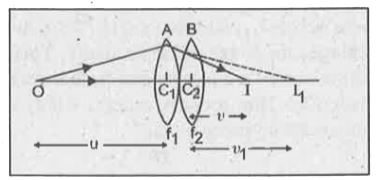 `:. 1/v_1 - 1/u = 1/(f_1)…(i)` Now place lens B in contact with A. The image `I_1`, will SERVE as virtual object and form a real image From lens formula, we have. `-1/v_1 + 1/v = 1/(f_2)...(ii)` ADDING (i) and (ii), we get `1/v - 1/u= 1/f_1 + 1/(f_2)...(iii)` But `1/v -1/u = 1/f` where f is effective focal length of the combination. So, Eq. (iii) becomes `1/f = 1/f_1 + 1/f_2` (b) We know that the critical ANGLE of glass is about `42^@`. if a prism is so designed that its angles are `45^@, 45^@,90^@`,if is said to be a totally reflecting prism. Its principal section is a RIGHT angled isosceles triangle. Since the rays are incident at angle of `45^@` i.e. greater than critical angle of glass (`42^@` nearly), the rays suffer total internal reflection and the plane surface acts as mirror. In the given figure, the face ac acts as a mirror and inverts the image without producing any deviation i.e. deviation of light through `180^@`. 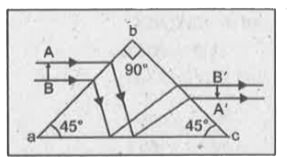
|
|
| 29. |
A conducting circualrloop is placed in aunifrom magenticfield, B= 0.025 T with its plane perpendicularto the loop .Theradius of the loop is made to shrink at a constantrate of 1 mms^(-1).The induced emf when the radius is 2cm ,is |
|
Answer» `2pimuV` |
|
| 30. |
An applied signal consists of super position of de voltage and ac voltage of high frequency. The circuit consists of an inductor L and a capacitor 'c' in series, then |
|
Answer» DE signal appear across C and AC signal across L |
|
| 31. |
he cations and anions are arranged in alternate form in |
|
Answer» METALLIC crystal |
|
| 32. |
Two plane mirrors at an angle such that a ray incident on a mirror undergoes a total deviation of 240^@ after two reflections. |
|
Answer» the angle between the mirror is `60^@` |
|
| 34. |
A fully charged parallel plate capacitor is connected across an unchanged identical capacitor . Show that the energy stored in the combination is less than that stored initially in the single capacitor . |
|
Answer» Solution :Let a parallel plate capacitor of capacitance C is fully charged to a potential V so that electrostatic energy STORED in it is `U = (1)/(2) CV^(2)` When this capacitor is connected across an unchanged identical capacitor , it shares its charge with that and COMMON potential of two capacitors become : `V. = (C_(1) V_(1) + C_(2) V_(2))/(C_(1) + C_(2)) = (CV + 0)/(C + C) = (V)/(2)` `therefore` Electrostatic energy stored in the capacitor combination now is `U. = (1)/(2) C. V^(2) = 1/2 (2 C) ((V)/(2))^(2) = (1)/(4) CV^(2)` This shows that U. `LT U` . In fact `U. = (U)/(2)` |
|
| 35. |
Explain emission lines and absorption lines. |
|
Answer» Solution :When an electron in an atom transits from a HIGHER energy state to a lower energy state then in both the states they produce light (photon) with corresponding energy difference which produces coloured bright lines. These coloured lines get a spectrum of wavelengths or FREQUENCY that are sorted according to the pattern. The lines of the spectrum OBTAINED in this way are called emission lines. When an electron in a atom transits from a lower energy state to a higher energy state so the electron absorbs the photon having the same energy difference between two states. This process is called absorption. Thus if photons with a continuous range of frequencies pass through a rarefied gas and then are analysed with a spectrometer, a series of dark spectral absorption LINE appear in the continuous spectrum. The dark lines indicate the frequencies that have been absorbed by the atoms of the gas. |
|
| 36. |
A particle of mass m moves in a certain plane P due to a force F whose magnitude is constant and whose vector rotates in that plane with a constant angular velocity omega. Assuming the particle to be stationary at the moment t=0, find: (a) its vecocity as a function of time, (b) the distance covered by the particle between two successive stops, and the mean velocity over this time. |
|
Answer» Solution :Let US FIX x-y co-ordinate system to the given plane, taking x-axis in the direction along which the force vector was oriented at the moment `t=0`, then the fundamental equation of DYNAMICS expressed via the projection on x and y-axes gives, `Fcos omegat=m(dv_x)/(dt)` (1) and `Fsin omegat=m(dv_y)/(dt)` (2) (a) Using the condition `v(0)=0`, we obtain `v_x=(F)/(momega)sin omegat` (3) and `v_y=(F)/(momega)(1-cosomegat)` (4) Hence, `v=sqrt(v_x^2+v_y^2)=((2F)/(momega))|sin ((omegat)/(2))|` (b) It is seen from this that the velocity `v` turns into zero after the time interval `Deltat`, which can be found from the relation, `omega(Deltat)/(2)=pi`. Consequently, the sought distance, is `s=underset(0)overset(Deltat)intvdt=(8F)/(momega^2)` Average velocity, `lt v ge(intvdt)/(intdt)` So, `lt v geunderset(0)overset(2pi//omega)int (2F)/(momega)sin ((omegat)/(2))dt//(2piomega)=(4F)/(pimomega)` 
|
|
| 37. |
What is toroid ? Obtain formula for the magnitude of magnetic field due to current carrying toroid. |
Answer» Solution :1. "Toroid is a device having very close wire of insulated wire on a hollow ring".  2. A solenoid bent into a form of a closed ring is called a toroidal solenoid. 3. It carrying a current I. 4. We shall see that the magnetic field in the open space inside (Point p) and exterior to the toroid (Point Q) is zero. The field `vecB` inside the toroid is constant in MAGNITUDE for the ideal toroid of closely WOUND turns.  5. Figure shows a sectional view of the toroid. The direction of the magnetic field inside a clockwise as per the right hand THUMB rule for circular loops. 6. Three circular loops 1, 2 and 3 are SHOWN by a dashed lines. 7. By symmetry, the magnetic field should be tangential to each of them and constant in magnitude for a given loop. 8. The circular areas bounded by loops 2 and 3 both cut the toroid, so that each turn off current carrying wire is cut once by the loop 2 and twice by the loop 3. 9. Let the magnetic field along loop 1 be `B_(1)` in magnitude, then in Ampere.s CIRCUITAL law, `L=2pir_(1)` However, the loop encloses no current, so `I_(e)=0`. Thus, `thereforeB_(1)(2pir_(1))=mu_(0)I_(e)` `thereforeB_(1)=(mu_(0)I_(e))/(2pir_(1))` Substitute `I_(e)=0` in this equation, `thereforeB_(1)=0` Thus, the magnetic field at any point P in the open space inside the toroid is zero. 10. Let the magnetic field along loop 3 be `B_(3)` again from Ampere.s law, `L=2pir_(3)`. 11. However from the sectional cut, we see that the current coming out of the plane of the paper is cancelled exactly by the current going into it. Thus, `I_(e)=0` `thereforeB_(3)(2pir_(3))=mu_(0)I_(e),I_(e)=0` `thereforeB_(3)=(mu_(0)I_(e))/(2pir_(3)),I_(e)=0` `thereforeB_(3)=0` 12. Let `L=2pir` at point S and `I_(e)=NI` `thereforeB(2pir)=mu_(0)I_(e)` `thereforeB=(mu_(0)(NI))/(2pir)` Here, `N=2pirn` where n = number of turn per unit length `B=(mu_(0)xx2pirnxxI)/(2pir)` `thereforeB=mu_(0)nI` which is magnetic field inside solenoid. 13. In an ideal toroid the coils are circular. 14. In reality the turns of the toroidal coil form a helix and there is always a small magnetic field external to the toroid. |
|
| 38. |
To obtain sustained oscillation in an oscillator |
|
Answer» FEEDBACK should be positive |
|
| 39. |
At certain place, the horizontal component of earth.s magnetic field is 3.0 G and the angle dip at that place is 30^(@). The magnetic field of earth at that location |
|
Answer» `4.5G` `Bcos30^(@)=3` `B=3sec30^(@)` `=3xx(2)/(SQRT(3))=(6)/(1.732)impliesB=3.5G` |
|
| 40. |
In amplitude modulation, the total modulation index should not exceed 1, if not, |
|
Answer» the SYSTEM will fail |
|
| 41. |
Why did the neighbourhood children not play with Mini? |
|
Answer» They were BUSY with their school |
|
| 42. |
A capacitor of capacitance 'C' is being charged by connecting it across a dc source along with an ammeter. Will the ammeter show a momentary deflection during the process of charging? If so, how would you explain this momentary deflection and the resulting continuity of current in the circuit? Write the expression for the current inside the capacitor. |
| Answer» Solution :As SOON as the capacitor is charged its plates are at same POTENTIAL defference as emf of battery. So, AMMETER show deflection during charging only after that current BECOME zero in circuit. | |
| 43. |
What is the phase relationship between voltage and current in case of AC circuit containing only capacitor ? |
| Answer» Solution :The VOLTAGE LAGS behind the current by a phase angle of `90^(@)` . | |
| 44. |
A packet of weight W is dropped with the help of a parachuate and on striking the ground comes to rest with retardation equal twice the acceleration due to gravity. What is the force exerted on the ground |
|
Answer» W |
|
| 45. |
lodine molecules are held in the crystal lattice by |
|
Answer» LONDON Forces |
|
| 46. |
As shown in fig. a metal ring is held horizontally and a bar magnet is dropped through the ring with its length along the axis of the ring. The acceleration of the falling magnet is …… |
|
Answer» equal to G |
|
| 47. |
Find the electric field intensity at a point P which is at a distance R (point lying on the perpendicular drawn to the wire at one of its end) from a semi-infinite uniformly charged wire. (Linear charge density = lambda). |
|
Answer» SOLUTION :Field at point P is due to an ELEMENTAL charge. `dq(=lambdadl)` `dE=k(dq)/((R^(2)+L^(2)))` The COMPONENT along x-axis `dE_(x)=(kdqcostheta)/((R^(2)+l^(2)))=(k(dq)R)/((R^(2)+l^(2))^(3//2))` `therefore E_(x)=underset(0)overset(oo)int(1)/(4piepsilon_(0))(lambdadlR)/((R^(2)+l^(2))^(3//2))impliesE_(x)=(lambda)/(4piepsilon_(0)R)` Similarly, `E_(y)=underset(0)overset(oo)int(1)/(4piepsilon_(0))(lambda(dl)l)/((R^(2)+l^(2))^(3//2))` `therefore E_(y)=(lambda)/(4piepsilon_(0)R)` `therefore E=sqrt(E_(X)^(2)+E_(Y)^(2))=(lambda)/(2.sqrt(2)piepsilon_(0)R),tantheta=(E_(y))/(E_(x))` `implies theta=45^(@)` 
|
|
| 48. |
Total energy of electron in an excited state of hydrogen atom is -3.4eV . The kinetic and potential energy of electron on this state |
|
Answer» `K=-3.4eV U=-6.8eV` `U=(-ze)/(4piepsilon_(0)r)(eV)=2E_(K)` `E_(K)=(-ze)/(8piepsilon_(0)r)` |
|
| 49. |
Define atomic mass unit. Write its energy equivalentin MeV. |
|
Answer» Solution :1 a.m.u is `1/(12)` of the MASS of a carbon ISOTOPE `""^(12)C_6 1U = 931 MEV` |
|
| 50. |
The equation y=4cos2pix/50sin100pit/1 represents the displacement of particle at distance x from the origin at the time t, then node will occur at distance of |
|
Answer» 12.5cm |
|