

Saved Bookmarks
This section includes 7 InterviewSolutions, each offering curated multiple-choice questions to sharpen your Current Affairs knowledge and support exam preparation. Choose a topic below to get started.
| 2. |
______ is known as voltage sensitivity of galvanometer. |
|
Answer» VOLTAGE per unit ANGULAR DEFLECTION |
|
| 3. |
What is the wavelength of light for the least energetic photoa emitted in the Lyman series of the hydrogen spectrum. (take hc = 1240 eV nm): |
|
Answer» 102nm `n_(1)=1 and n_(2)=2` then `E_(1)=-13.6eV and E_(2)=-3.4eV` `E=E_(2)-E_(1)=-3.4 +13.6=10.2eV` Now `E=hv=(HC)/(lambda)` `lambda=(hc)/(E)=(1240eV)/(10.2eV)NM` `lambda=122nm`. |
|
| 4. |
A soap bubble is charged to a potential 12 V. If its radius is doubled, the potential of the bubble becomes |
|
Answer» a. 12V |
|
| 5. |
The magnetic flux in coil is phi = 4t^2+4t+4. What is the magnetic of induced e.m.f. at t =3 sec.? |
|
Answer» SOLUTION :`PHI` = 4t^2+4t+4` `therefore e = dphi/dt = 8t+4` `therefore` for t = 3S, e = 24+4 = 28V |
|
| 6. |
An aircraft with wingspan of 40 m flies with a speed of 1000 kmh^(-1) in the eastward direction at a constant altitude in the northern hemiphere where the horizontal component of earth 's field is 1.6xx10^(-5) T and the angle of dip is 71.6 ^(@). Find the emf that develops between the tips of the aircraft. |
|
Answer» |
|
| 7. |
In an electromagnetic wave, the average energy density associated with magnetic field is : |
|
Answer» `Li_(0)^(2) // 2` |
|
| 8. |
In Fig., three forces, each of magnitude 2.0 N, act on a particle. The particle is in the xz' plane at point A given by position vector vecr, where r = 3.0 m and theta=30^(@). What is the torque, about the origin O, due to each force? |
|
Answer» Solution :Because the three force vectors do not lie in a plane, we MUST use cross products, with magnitudes GIVEN by Eq. `(tau=rFsinphi)` and DIRECTION given by the right-hand rule. Calculations: Because we want the torque with respect to the origin O, the vector `vecr` required for each cross product is the given position vector. To determine the angle `phi` between `vecr` and each force, we shift the force vectors of Fig. each in turn, so that their tails are at the origin. Fig., c, and d, which are direct VIEWS of the xz plane, show the shifted force vectors `vecF_(1),vecF_(2)andvecF_(3)`, 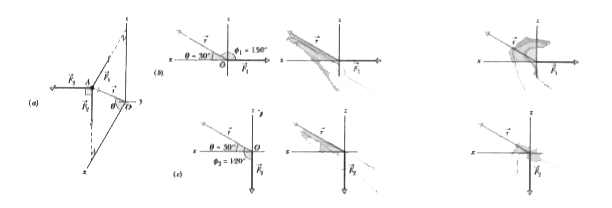  respectively. In the angle between the direction of `vecr` and `vecF_(3)" is "90^(@)` and the symbolmeans `vecF_(3)` is directed into the page. `tau_(1)=rF_(1)sinphi_(1)=(3.0m)(2.0N)(sin150^(@))=3.0N*m`, `tau_(2)=rF_(2)sinphi_(2)=(3.0m)(2.0N)(sin120^(@))=5.2N*m` and `tau_(3)=rF_(3)sinphi_(3)=(3.0m)(2.0N)(sin90^(@))=6.0N*m`. |
|
| 9. |
The drift velocity of electrons in a conducting wire is of the order of 1mm//s, yet the bulb glows very quickly after the switch is put on because |
|
Answer» The random SPEED of electrons is very high, of the ORDER of 10^6 m/s |
|
| 10. |
Astigmatism for a human eye can be removed by using……. |
|
Answer» CONCAVE LENS |
|
| 11. |
(A): Electrical power through transmission lines is transmitted at high voltage. (R): At high voltage theft of power is checked |
|
Answer» Both A and R are true and R is the CORRECT EXPLANATION |
|
| 12. |
A block of metals weighing 2 kg and 1kg are in contact with each other on a frictionless table. When a horizontal force of 3.0N is applied to the block of mass 2 kg. The value of force constant between the blocks is |
|
Answer» 4 N |
|
| 13. |
The body moves under the action of force due to _____ and it is a _____ falling body. |
|
Answer» |
|
| 14. |
Chaitanya pedals a stationary bicycle at one revolution per second. The pedals are attached to 100 turns coil of area 0.1m. and placed in a uniform magnetic field of 0.1 T. What is the maximum voltage generated in the coil ? |
|
Answer» Solution :`epsi_0 NBA omega = NBA (2PI f) (because f = 1)` `epsi_0 = 100 xx 0.1 xx 0.1 (2 xx 3.14 xx 1) V = 6.28 V` |
|
| 15. |
Young' s double slit experiment is carried out using two bulbs instead of using two slits and one source. Then |
|
Answer» INTERFERENCE FRINGES will be coloured |
|
| 16. |
वैद्युत द्विध्रुव का आघूर्ण एक वेक्टर (सदिश) होता है जिसकी दिशा होती है: |
|
Answer» उत्तर से दक्षिण की ओर |
|
| 17. |
Two point charges+ 4 muC and -2 muC are separated by a distance of 1 m in air. Calculate at what point on the line joining the two charges is the electric potential zero. |
Answer» SOLUTION :Here `q_1= 4 mu C , q_2 = -2 muC ` and distance between them r = 1 m  As shown in figure net electric potential is zero at point `C_1` situated between the two charges and at point `C_2` situated on extension of line JOINING the two charges. If distance of point `C_1 or C_2` from `q_1` be X, then For point `C_1 : V_1 + V_2= 1/(4pi epsi_0) [q_1/x+ q_2/((r - x))] = 0 rArr (4muC)/x + ((-2 muC))/((1-x)) = 0 rArrx = 2/3 m` Similarly for point `C_2 : q_1/x + 1/((x -r)) = 0 rArr (4 muC)/x + ((-2 muC))/((x + 1)) = 0 rArr x = 2M` |
|
| 18. |
In a single slit diffraction experiment, the width of the slit is made double the original width. How does this affect the size and intensity of the central diffraction band. |
| Answer» Solution :The SIZE REDUCES by HALF according to the relation: size `~lambda//d`. Intensity increases four fold. | |
| 19. |
One capacitor and ammeter connected in series are connected to an ideal battery. Reading of the ammeter is plotted against time. Which graph represents it the best? |
|
Answer»
`q= q_(0) (1- e^(-t//tau))` Here `tau` is time constant of the circuit, `tau= RC` On differentiating the charge will respect to time we can calculate current as a function of time `i= (dq)/(dt) = q_(0) (0 + (1)/(tau) e^(-t//tau)) = (q_(0))/(tau) e^(-t//tau)` `rArr i= i_(0) e^(-t//tau)` There is an EXPONENTIAL decay of current and hence option a is correct |
|
| 20. |
Which of the following electromagnetic waves has the longest wavelength ? |
|
Answer» Radiowaves |
|
| 21. |
A half-wave rectifier is used to convert 'n' Hz a.c into d.c, then the number of pulses per second present in the rectified voltage is |
|
Answer» N |
|
| 22. |
The susceptibility of a magnetic material is - 0.085. Identify the magnetic type of the material. |
| Answer» SOLUTION :A DIAMAGNETIC MATERIAL because only a diamagnetic material has-ve VALUE of SUSCEPTIBILITY. | |
| 23. |
Where was Mrs. Greene piling newspaper? |
|
Answer» NEXT to her GARBAGE bag |
|
| 24. |
Relative permittivity and permeability of a material are in_(r) and mu_(r), respectively. Which of the following values of these quantities are allowed for a diamagnetic material ? |
|
Answer» `in_(R) = 1.5, mu_(r) =1.5` |
|
| 25. |
A 10sqrt3 kg box has to move up an inclined slope of 60^(@) to the horizontal at a uniform velocity of 5 ms^(-1) If the frictional force retarding the motion is 150N, the minimum force applied parallel to inclined plane to move up is (g=10 ms^(-2)) |
|
Answer» `300 XX (2)/(SQRT3) N` |
|
| 26. |
Constanton or manganin is widely used in wire wound standard resistors because of their |
|
Answer» temperature independent RESISTIVITY. |
|
| 28. |
If a very small resistance (eg, copper wire) is used to convert moving coil galvanometer in to voltmeter, will it work properly? |
| Answer» Solution :No, A HIGH resistance is REQUIRED to convert GALVANOMETER in to VOLTMETER | |
| 29. |
A block of mass 200 g is suspended by a vertical spring. The spring is stretched by 1.0 cm when the block is in equilibrium. A particle of mass 120 g is dropped on the block from a height of 45 cm. The particle sticks to the block after the impact. Find the maximum extension of the spring. Take g = 10 m//s^(2). |
|
Answer» |
|
| 30. |
Three semi-infinite mutually perpendicular conductors are joined at the origin O as shown in figure. A current 2I enters through the conductor along Z-axis towards the origin O and leaves through the other two as shown in the figure. What is the magnetic field at a point P with position vector vec(r ) = hat(i) + hat(j) + hat(k) ? |
|
Answer» Solution :VISUALIZE the geometry in three dimensions. Field due to current on Z-axis `VEC(B_(z)) = (mu_(0))/(4 pi) xx 2I [sin ((pi)/(2)) - sin (sin^(-1) ((1)/(SQRT(3))))] (sin 45^(@) hat(i) - COS 45^(@) hat(j))` `vec(B_(x)) = (mu_(0))/(4 pi) xx I [sin ((pi)/(2)) + sin (sin^(-1) ((1)/(sqrt(3))))] (cos 45^(@) hat(j) + sin 45^(@) hat(k))` `vec(B_(y)) = (mu_(0))/(4 pi) xx I [sin ((pi)/(2)) + sin (sin^(-1) ((1)/(sqrt(3))))](cos 45^(@) hat(i) - sin 45^(@) hat(k))` `vec(B) = vec(B_(X)) + vec(B_(z)) = (mu_(0))/(4 sqrt(2)) [sqrt(3) - 1](-hat(i) + hat(j))` |
|
| 31. |
Two persons ordered tea in a restaurant and waited for a friend to arrive. The first person mixed hot tea and cold milk in the cup and wated for the fried and the second mixed hot tea and hot milk in the cup after the arrival of the friend. Milk in the cup after the arrival of the friend. If the temperature of the two cups of tea are T_(1) and T_(2) respectively, then. |
|
Answer» `T_(1) lt T_(2)` |
|
| 32. |
A monkey of mass 20 kg is holding a vertical rope which breaks under a force of 25 kgf. What is the maximum acceleration with which the monkey can climb up the rope ? |
|
Answer» `10 ms^(-2)` `a = 2.5 ms^(-2)` (b) is the choice |
|
| 33. |
If an electron is accelerated by 8.8xx10^(14)ms^(-2), then electric field required for this acceleration is (given specific charge of the electron =1.76xx10^(11)Ckg^(-1)): |
|
Answer» `40Vcm^(-1)` |
|
| 34. |
The magnetic flux linked with a coil varies with time as phi = 3t^2, 4t 9weber. What is the induced e.m.f. at t = 2? |
|
Answer» 3V |
|
| 35. |
The Balmer series for the H-atorn can be observed a) if we measure the frequencies of light emitted when an excited atom falls to the ground state (b) if we measure the frequencies of light emitted due to transitions between excited slates and the first excited state c) in any transition in a H-atom d) as a sequences of frequencies with the higher frequencies getting closely packed |
|
Answer» Both a&B are TRUE |
|
| 36. |
Snapshot of a string carrying a progressive wave is shown in figure at time t = 0. The wave moves along positive x - axis: |
|
Answer» |
|
| 37. |
A charged ball B hangs from a silk thread S. Which makes an angle 0 with a large charge conducting sheet P as shown in the figure. The surface charge density sigmaof the sheet is proportional to |
|
Answer» `cos theta` 1) Weight mg (DOWNWARD direction). (2) Electric force F = Eq (in horizontal direction) (3) Tension Force T (0 towards P) Taking TWO correspondence of tension force (i) `Tcostheta` = (in UPWARD direction) (ii) `Tsintheta` = (towards mean position) For balance from figure, `Tsintheta = qE` and `Tcostheta = mg` taking ratio `(qE)/(mg) = q/(mg)(sigma/(2epsilon_(0))) [therefore E = sigma/(2epsilon_(0))]` `therefore tantheta prop sigma` (rest term const) `therefore sigma prop tantheta` 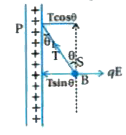
|
|
| 38. |
The figure shows the variation of specific heat capacity (C ) of a solid as a function of temperature (T). The temperature is increased continuously from 0 to 500 K at a constant rate. Ignoring any volume change, the following statements(s) is/are correct to a reasonable approximation. |
|
Answer» The rate at which heat is ABSORBED in the range 0-100 K varies linearly with temperature T `C=(DeltaQ)/(mDeltaT)orDeltaQ=mCDeltaT` `therefore (DeltaQ)/(Deltat)=mC(DeltaT)/(Deltat)` Rate of heat absorbed = `R=(DeltaQ)/(Deltat)` `therefore RpropC` (a) In 0-100 K, C increases with T but not linearly. So R increases but not linearly. (B) As `DeltaQ=mCDeltaT` `therefore Q=m intCDeltaT=m` AREA under C-T curve From the graph it is clear that area under C-T is more in 400-500 K than in 0-100 K. Therefore, heat absorbed in 0-100 K is less than in 400 - 500 K. (c ) In 400-500 K, C REMAINS constant, so there is no change in R. (d) In 200-300 K, C increases so R increases. 
|
|
| 39. |
किसी बिन्दु आवेश +Q के कारण r दूरी पर स्थित किसी बिन्दु पर विधुत क्षेत्र की तीव्रता E होती है. |
|
Answer» `E PROPR` |
|
| 40. |
A double slit is illuminated by light of wave length 6000 A^(@). The slits are 0.1 cm apart and the screen is placed 1m away. Then the angular position of 10^(th) maxima is |
| Answer» Answer :A | |
| 41. |
What phenomenon can be observed in a tuned circuit? |
| Answer» Solution :We GET maximum CURRENT for resonance FREQUENCY. (Resonance TAKES place) | |
| 42. |
In the following dimensionally consistent equation F=X/(density)+y while F is the force, then the dimensional formula for X and Y will be respectively equal to |
|
Answer» `ML^-2T^-2,MLT^-2` |
|
| 43. |
There is some water in a beaker placed on the pan of spring balance. If we dip our finger in this water without touching the bottom of the beaker, then what would be the effect on the reading of the balance. |
| Answer» Solution :The water exert upthrust on the FINGER and the finger will exert EQUAL reationary force on the water in downward DIRECTION (on the BOTTOM of beaker). So, the reading will INCREASE. | |
| 44. |
Lyman series is in _____ region. Balmwr is in visible and paschen, Bracket and P-fund series in _____ region. |
| Answer» SOLUTION :ULTRAVIOLET, INFRARED | |
| 45. |
We thank all of our distinguished international guests for having come to take possession with the people of our country of what is, after all, a common victory for......... |
|
Answer» justice |
|
| 46. |
The binding energy per nucleon of deuterium and helium atom is 1.1 MeV and 7.0 MeV. If two Deuterium nuclei fuse to form helium, the energy released is |
|
Answer» 19.2MeV |
|
| 47. |
If abs(vec A xx vec B)=vec A. vec B, then angle theta between vectors vec A and vec B is |
| Answer» ANSWER :B | |
| 48. |
The combination of gates shown below produces |
|
Answer» AND gates 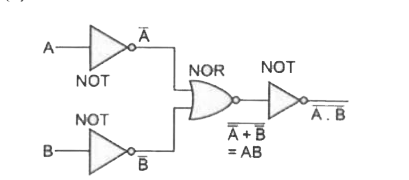
|
|
| 49. |
A bulb connected to 50 V d.c. consumes 20 W power. Then the bulb is connected to a capacitor in an a.c. power supply of 250 V, 50 Hz. Find the value of the capacitor required so that the bulb drows the same amount of current. Data : P = 20 W, V = 50 V, v = 50 Hz, C = ? |
|
Answer» <P> Solution :`P = VI``:. I = (P)/(V) = (20)/(50) = 0.4A` `:.` Resistance, `R = (V)/(I) = (50)/(0.4) = 125 Omega`  The IMPEDANCE, `Z = (V)/(I) = (250)/(0.4) = 625 Omega` `:. Z = SQRT(R^(2) + ((1)/(omega C))^(2)) = sqrt(R^(2) + ((1)/(2pi v C))^(2))` |
|
| 50. |
Twelve wires, each having resistance r. are joined to form a cube as shown in figure. Find the equivalent resistance between the ends of a face diagonal such as a and c. |
|
Answer» Solution :Suppose a potential difference V is applied between the points a and c so that a current `i` enters at a and the same current leaves at c. The current distribution is SHOWN in figure  By symmetry, the paths ad and ab are equivalent and hence will carry the same current `i_(1)`. The path ah will carry the REMAINING current `i-2i_(1)` (using Kirchoff.s JUNCTION law). Similarly at junction c, currents coming from dc and bc will be `i_(1)` each and from fc will be `i-2i_(1)`. Kirchoff.s junction law at b and d shows that currents through be and dg will be zero and hence may be igonored for further analysis. Omitting these TWO wires, the circuit is redrawn in figure. The wire hef and joined in parallel and have equivalent resistance `((2r)(2r))/((2r)+(2r))=r` between h and f. This is joined in series with ah and fc giving equivalent resistance `r+r+r=3r` This `3r` is joined in parallel with adc (2r) and abc (2r) between a and c. The equivalent reistance R between a and c is, therefore, given by `(1)/(R)=(1)/(3r)+(1)/(2r)+(1)/(2r)` `therefore"Equivalent resistance, R"=(3)/(4)r.` |
|


