Saved Bookmarks
This section includes 7 InterviewSolutions, each offering curated multiple-choice questions to sharpen your Current Affairs knowledge and support exam preparation. Choose a topic below to get started.
| 1. |
One face of a rectangular glass plate 6 cm thick is silvered. An object held 8 cm in front of the front face forms an image 12 cm behind the silvered face. Find the refractive index of glass. |
| Answer» SOLUTION :`mu=1.2` | |
| 2. |
The folllowing reading are obtained in a meter bridge experiment to find the resistivity of the material of a given wire. Calculate the resistivity of the material of the wire. Diameter of the wire =d =0.36 mm,length of the wire L = 60 cm. |
|
Answer» SOLUTION :Tr 1. `R _(1)=(Sl _(1))/( 1 - l _(1)) = ( 3 xx 0. 59 )/( 0.41) = 4.32 OMEGA` Tr 2. `R _(2) = ( Sl _(2))/( 1 - l _(2)) = ( 6 xx 0. 43 )/( 0. 57 )= 4. 52 Omega ` Now : ` (##OSW_SP_PHY_XII_C03_E02_011_S01.png" width="80%"> `R _(av) = 4.42 Omega` `rho = ( PI d ^(2) R _(av ))/( 4 L )` A `rho = ( 3. 14 xx 4. 4 2xx ( 0. 36 xx 10 ^(-3)^(2)))/( 4 xx0.6)` `rho = 0. 748 xx 10 ^(-6) Omega -m` |
|
| 3. |
When a glass rod is rubbed with a slik cloth , charges appear on both. A similar phenomenon is observed with many other pairs of of bodies. Explainhow this observation is consistent with the law of conservation of charges. |
| Answer» Solution :When a glass ROD is rubbed with a slik CLOTH ,a charges +q appears on glassrod an equal but opposite charges -q appears on the slik cloth on account of transfer of electrons fromglass rod to slik cloth. THUS , net charges on the combined system `[q+(-q)=0] `remains unchanged at ZERO , which is consistent with the law of conservation of charges. | |
| 4. |
Four identical plates 1, 2, 3 and 4 are placed parallel to each other at equal distance as shown in the figure. Plates 1 and 4 are joined together and the space between 2 and 3 is filled with a dielectric of dielectric constant k = 2. The capacitance of the system between 1 and 3 & 2 and 4 are C_1 and C_2 respectively . The ratio C_1/C_2 is |
|
Answer» `5/3` |
|
| 5. |
A ring shaped conductor with radius a carries a net positive charge q uniformly distributed on it as shown in figure. A point P is situated at a distance x from its centre. Which of following graph shows the correct variation of electric field (E) wilth distance (x)? |
|
Answer»
`E=(qx)/(4pi epsilon_(0)(X^(2)+a^(2))^(3//2)HATI` `:.` At the centre of ring `x=0=0E_(0)` If `x gt gt a, E=1/(4pi epsilon_(0))q/(x^(2))` 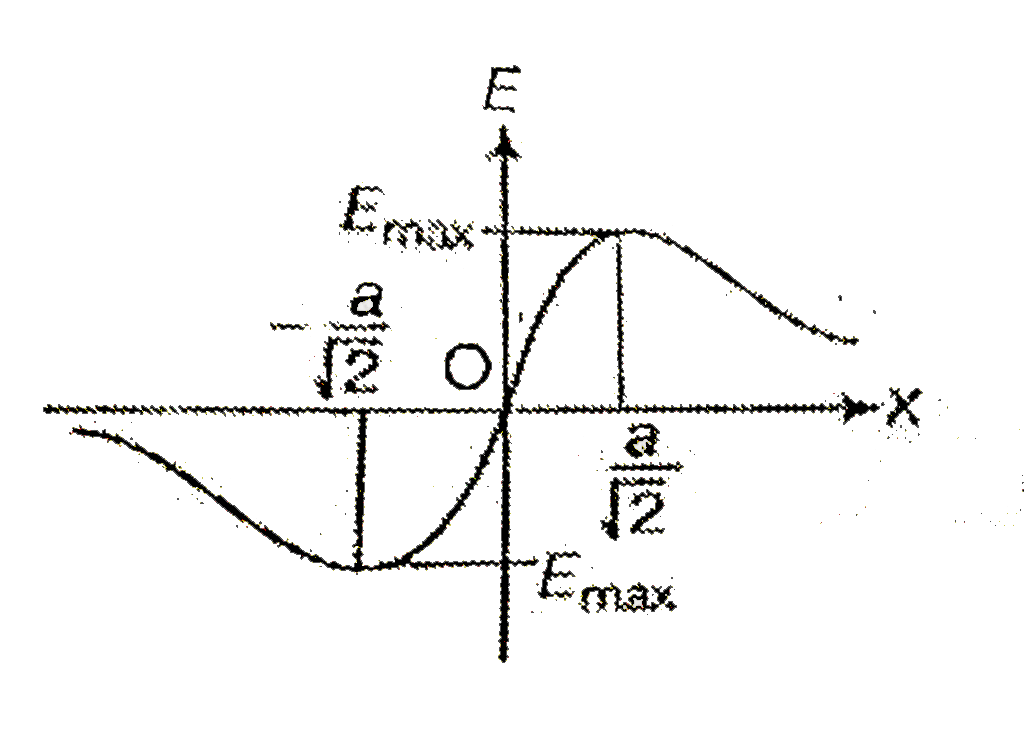 and `E` will be maximum where, `(dE)/(dx)=0` or `x=+-a/(sqrt(2))` and `E_("max")=1/(4piepsilon_(0)(2q)/(3sqrt(3)a^(2))` |
|
| 6. |
What does a polaroid consist of ? |
| Answer» Solution :A polaroid CONSISTS of long chain molecules aligned in a PARTICULAR direction. If ordinary LIGHT is incident on a polaroid, the light WAVE will GET linearly polarised. | |
| 7. |
Two point charges q_A =3 mu C and q_B = -3muCare located 20 cm apart in vacuum. What is the electric field at themidpoint O of the line AB joining the two charges? If a negative test charges of magnitude1.5 xx 10^(-9)C(##U_LIK_SP_PHY_XII_C01_E01_008_Q01.png" width="80%"> |
|
Answer» Solution :Here ` q_A =3 mu C = 3xx 10 ^(-6)C, q_B =-3mu C` `= -3 xx 10 ^(-6) C,AB =20 cm = 0.2 m and AO =OB = ` ` therefore "" oversetto (E_O)=oversetto (E_A) + oversetto (E_B)=9xx 10 ^(9)[( 3xx10 ^(-6) )/( (0.1)^(2) ) +(3xx10 ^(-6))/( (0.1)^(2)) ]` along OB `= 5.4 xx 10 ^(6)NC^(-1)` along OB Whena CHARGES ` q_0 =-1.5 xx10 ^(-9)C ` is placed at point O,then ` oversetto (F_O) =q_0 oversetto (E_O)= ( - 1.5 xx 10^(-9))xx 5.4 xx10 ^(6)` ` =- 8.1 xx 10 ^(-3)N ` alongOB `=8.1 xx 10 ^(-3)N ` along OA. |
|
| 8. |
Three closed vessels A, B and C are at the same temperature T and contain gases which obey the Maxwell distribution of speed. Vessel A contains only O_(2), B only N_(2) and C a mixture of equal quantities of O_(2) and N_(2). If the average speed of O_(2) molecules in vessel A is v_(1), that of the N_(2) molecules in vessel B is v_(2), the average speed of the O_(2) molecules in vessel C will be |
|
Answer» `(v_(1)+v_(2))//2` `v_(AV)=sqrt((8RT)/(piM_(0))),v_(av)propsqrt(T)` It depends on temperature and molecules mass. At same temperature average speed of `O_(2)` molecule is same in vessel A and C and is EQUAL to `v_(1)`. |
|
| 9. |
Two rain drops falling through air have radii in te ratio 1:2. They will have terminal velocity in the ratio : |
|
Answer» `4:1` |
|
| 10. |
The height y and horizontal distance x covered by a projectile in a time 1 seconds are given by the equations y = 8t - 5t^(2) and x = 6t. If x and y are measured in metres, the velocity of projection is |
| Answer» Answer :D | |
| 11. |
What is the difference between thermionic emission and photoelectric emission. |
| Answer» SOLUTION :Thermionic EMISSION is TEMPERATURE dependent and in photoelectric emission , the free electrons in metal ABSORB light photons and ACQUIRE energy . | |
| 12. |
A battery is used to charge a parallel plate capacitor till the PD between the plates becoines equal to the emf of the battery. The ratio of energy stored in tiie capacitor and the work done by the battery will be : |
|
Answer» `1/2` |
|
| 13. |
In a series L-R circuit, connected with a sinusoidal ac source, the maximum potential difference across L and R are respectivaly 3 volts and 4 volts. At the same instant, the magnetitude of the potential difference in volt, across the ac source may be |
|
Answer» `4+3sqrt(3)` |
|
| 14. |
Three identical capacitors C_1 , C_2 and C_3 of capacitance 6 mu Feach are connected to a 12 V battery as shown in Fig equivalent capacitance of the network |
| Answer» Solution :EQUIVALENT CAPACITANCE of network `C = C_(12) + C_(3) = 3 mu F = 9 mu F ` | |
| 15. |
The error in the measurement of length and radius of a cylinder are 1% and 2% respectively. The maximum percentage of error in its volume is |
|
Answer» 0.03 |
|
| 16. |
Three identical capacitors C_1 , C_2 and C_3 of capacitance 6 mu Feach are connected to a 12 V battery as shown in Fig energy stored in the network of capacitors . |
Answer» Solution :Energy should in the NETWORK of capacitors `U= 1/2 CV^2 = 1/2 xx 9 mu F xx (12 V)^(2) = 648 mu J or 6.48 xx 10^(-4) J` 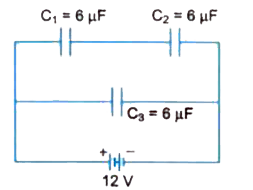
|
|
| 17. |
(a) Find the current in the 20(Omega)resistor shown in figure.(b)If a capacitor of capacitance 4(mu)F is joined between the point A and B,what would be the electrostatic energy stored in it in steady state? |
|
Answer» Solution :Taking circuit ABEDA, ` 10i + 20(i-i_1) - 5 = 0 ` ` rArr10i + 20I - 20i -5 =0 ` ` rArr 30i - 20i_1 -5 = 0 ` Taking circuit abfca, ` 20(i-i_1)- 5 - 10i_1 = 0 ` ` rArr 20i -10i_1 - 20i_1 - 5 =0 ` ` rArr 20i - 30i_1 -5 =0 ` ` (30i-20i_1 -5 =0 )2 ` ` (20i - 30i_1-5 =0 )3 ` ` (90-40)i_1 =0 ` ` rArr i_1 = 0 ` `rArr30i - 5 = 0 ` ` i = 5/30 = 0.16A` ` CURRENT through 20 Omega is 0.16A. ` |
|
| 18. |
Three identical capacitors C_1 , C_2 and C_3 of capacitance 6 mu Feach are connected to a 12 V battery as shown in Fig charge on each capacitor |
|
Answer» Solution :The capacitor arrangement can be redrawn as shown in FIG Combined capacitance of series arrangement of `C_1` and `C_2` is `C_(12) = (C_(1) XX C_(2))/(C_(1) + C_(2)) = (6 xx 6)/(6 + 6) MU F = 3 mu F ` `therefore q_1 = q_2 = C_(12) . V = 3 mu F xx 12 V = 36 mu C` and `q_(3) = C_(3) V = 6 mu F xx 12 V = 72 mu C` |
|
| 19. |
In Fig. , two speakers separated by distance d_1 = 2.00 m are in phase. Assume the amplitudes of the sound waves from the speakers are approximately the same at the listener's ear at distance d_2 = 4.00 m directly in front of one speaker. Consider the full audible range for normal hearing, 20 Hz to 20 kHz. (a) What is the lowest frequency f_("min".1) that gives minimum signal (destructive interference) at the listener's ear? By what number mustf_("min".1) be multiplied to get (b) the second lowest frequency f_("min".2)that gives signal and (c) the third lowest frequency f_("min".3)that givesr minimum signal? (d) What is the lowest frequency f_(max.1) that gives maximum signal (constructive interference) at the listener's ear? By what number must f_(max.1)be multiplied to get (e ) the second lowest frequency f_(max.2)that gives maximum signal and (f) the third lowest frequency f_(max.3)that gives maximum signal? |
| Answer» Solution :(a) 363 HZ , (B) factor of 3 , ( C) factor of 5 , (d) 726 Hz , (e ) factor of 2, (F ) factor of 3 | |
| 21. |
At a distance of 10 cm from a long staright wire carrying a current I, the magnetic field is 0.04 T. At a distance of 40 cm from the wire, the magnetic field will be |
|
Answer» `0.01 T` `:. B_2 = (B_1 r_1)/(0.4) = 0.01 T` |
|
| 22. |
The output of two input OR gate is 1 |
|
Answer» if both INPUTS are ZERO |
|
| 23. |
A galvanometer has a resistance G and requires a current I_(g) for full scale deflection. How do you convert it into (i) an ammeter? (ii) a voltmeter? |
| Answer» SOLUTION :(a) `S=(I_(G)G)/(I-I_(g))" i.e., " I propto I_(g)` where 'S' is the SHUNT RESISTANCE connected in parallel to the galvanometer and (b) `R=V/I_(g)-G " i.e., " I_(g) propto V` where 'R' is a resistance connected in series with the galvanometer. | |
| 24. |
One coulomb equals to |
|
Answer» `3xx10^9esu` |
|
| 25. |
y=x का अवकलज का मान होगा |
|
Answer» 0 |
|
| 26. |
The mean free path of electrons in a metal is 5xx10^(-8)m. The electric field which can give on an average 2ev energy to an electron in the metal will be (in v/m) |
|
Answer» `4XX10^7` |
|
| 27. |
If an LCR series circuit is connected to an ac source, then at resonance the voltage across |
|
Answer» a) R is zero |
|
| 28. |
Given y=5e^(3x) +sinx, (dy/dx)is- |
|
Answer» `5e^(3X) +cosx` |
|
| 29. |
For a P - N junction diode which of the following statements is true about the order of magnitude of the various currents ? |
|
Answer» FORWARD CURRENT is in mA and REVERSE current is in `MUA` |
|
| 30. |
The initial and final temperatures are recorded as (40.6 +- 0.3)^@C and (50.7+-0.2)^@C. The rise in temperature is |
|
Answer» `10.1^@C` |
|
| 31. |
Distinguish between polar and non-polar molecules. |
Answer» SOLUTION :
|
|
| 32. |
A) In multiplication or division, the final result should retain only that many significant figures as are there in the original number with the least number of significant figures. B) In addition or subtraction the final result should retain only that many decimal places as are there in the number with the least number of decimal places. |
|
Answer» Only A is CORRECT |
|
| 33. |
An ammeter has a resistance of G ohm and a range of 'I' amere. The value of resistanceused in parallel, to convert into an ammeter of range 'ni' ampere is |
| Answer» ANSWER :4 | |
| 34. |
A block of mass M is pulled down along a horizontal frictionless surface by a rope of mass m. If a force F is applied at one end of the rope, the force which the rope exerts on the block |
|
Answer» MF/M+m |
|
| 35. |
A galvanometer has an internal resistance 1.0Omega. It given maximum deflection for a current of 50 mA. Show how this instrument can be converted into (i) a voltmeter with a maximum reading of 2.5 V and (ii) an ammeter with a maximum reading of 2.5 A |
|
Answer» |
|
| 36. |
An electron is moving with an initial velocity vecv=v_(0)hati and is in a magnetic field vecB=B_(0)hatj Then it's de-Broglie wavelength |
|
Answer» remains constant `vecF_(m)=(vecBxxvecv)` `=E{B_(0)hatjxxv_(0)hati}` `=eB_(0)v_(0)(hatjxxhati=eB_(0)v_(0) (-HATK))` `implies` Direction of `vecF_(m)` would be along-Z axis which is PERPENDICULAR to `VECV`.Hence,given electron would perform circular motion with constant speed `v_(0)` in a plane perpendicular to magnetic field.Hence ,its de-Broglie wavelength would be constant equal to `lambda=(h)/(mv_(0))` .In above eqution h,m ,`v_(0)` are same hence wavelength `lambda` will remian constant. |
|
| 37. |
In an RC series circuit, emf epsi= 12.0 V, resistance R =1.40 MOmega and capacitance C= 2.70 muF. (a) Calculate the time constant. (b) Find the maximum charge that will appear on the capacitor during charging. (C) How long does it take for the charge to build up to 16.0 muC? |
|
Answer» |
|
| 38. |
In the circuit shown initially C_(1), C_(2)are uncharged. After closing the switch |
|
Answer» The CHARGE on `C_(2)`is GREATER that on `C_(1)` |
|
| 39. |
Two insulated charged copper spheres A and B have their centress separated by a distance of 50 cm . What is the mutualforce of electrostatic repulsion if the charges on each is 6.5 xx10^(-7) C?The radii of A and B are neglible compared to the distance of separation (b) What is the force of repulsion if each sphere is charged bouble the above amount, and the distance between them is halved? |
|
Answer» Solution :Here `q=3xx10^(-7) C ` (negative )and e`=1.6 xx 10^(-19) C ` `therefore`Numberof electrons transferred `n =(q)/(e)=(3xx10^(-7))/(1.6xx 10^(-19))= 1.875xx10 ^(12) =2xx10^(12) ` As polythene piece when rubbed with wool acquires a negative CHARGES, hence electrons have been transferredfrom wool to polythene. (b) YES, there is a transfer of mass from wool to polythene because electrons have mass. The mass transferred `DELTA m=n,(m_e) ` ` =1.875 xx10 ^(12)xx9.1 xx10^(-31) kg =1.7xx 10 ^(-18)kg infty 2xx10 ^(-18) kg `. However , this mass transferredis negligible and cannot be DETECTED experimentally. |
|
| 40. |
The track shown in the figure is frictionless. The block B of mass 4kg is lying at rest and block A of mass 2kg is pushed along the track with some speed. The collision between A and B is perfectly elastic. With that velocity should the block Astart such that block B just reaches at point P ? |
|
Answer» `10m//s` |
|
| 41. |
There in fairly long solenoid whose length is l and radial of its cross section is b. This solenoid is connected to a battery of emf V and a, resistor of resistance R in series with it along with a key which is initially open. A thin wire ring of radius a and resistance r is kept inside the solenoid in such a manner that axis of solenoid coincides with axis of ring. Assume thay there in no self-inductance at the ring. Find the value of radical force per unit length of the ring as a function of time if key is closed at t=0. What would be the maximum value of this radical force per unit length? |
|
Answer» Solution :When current GROWS in solenoid, then FLUX linked with the ring also changes which induces emf in the ring and it causes flow of current in it. This ring is placed in magnetic feild of solenoid which is acting PERPENDICULAR to the plane of ring. When current flows in the ring, then it experiences radical FORCE everywhere on its length. We can write self-inductance L of the solenoid as follows: `L=mu_(0) n^(2)b^(2)l` ...(i) Current as a function of time in the solenoid can be written as follows: `i=(V)/(R)(1-E^((-tR)/(L)))` Magnetic field inside the solenoid can be written as `B=mu_(0)ni` `implies B=(mu_(0) nV)/(R)(1-e^((-tR)/(L)))` ...(ii) Magnetic flux linked with the ring can be written as follows: `phi=B(pia^(2))=(mu_(0)nVpia^(2))/(R)(1-e^((-tR)/(L)))` emf induced can be be written as follows: `epsilon=|(dphi)/(dt)|=(mu_(0)nVpia^(2))/(R)((R)/(L)e^((-tR)/(L)))` `epsilon=(mu_(0)nVpia^(2))/(L)e^((-tR)/(L))` We know that r is resistance of ring and hence current flowing in the ring can be written as follows: `I=(epsilon)/(r)=(mu_(0)nVpia^(2))/(rL)e^((-tR)/(L))` ...(iii) If we select a segment of length dl on the circumference of ring then radial force acting on this segment can be written as follows: dF = IdlB Hence radial force acting per unit length of the ring can be written as `(dF)/(dt)=IB` `implies (dF)/(dt)=((mu_(0)nVpia^(2))/(rL)e^((-tR)/(L)))[(mu_(0)nV)/(R)(1-e^((-tR)/(L)))]` We can also substitute value of self-inductance L from equation (i) to get the following: `implies (dF)/(dl)=((mu_(0)nVpia^(2))/(rmu_(0)pin^(2)b^(2)l)e^((-tR)/(L)))[(mu_(0)nV)/(R)(1-e^((-tR)/(L)))]` `implies (dF)/(dl)=(mu_(0) V^(2)a^(2))/(rb^(2)lR)[e^((-tR)/(L))(1-e^((-tR)/(L)))]` Above expression represents radial force acting on the ring per unit length as a function of time. To calculate maximum value of this force, we need to differentiate it and put it equal to zero. After calculation we get that above force per unit length is maximum when `e^(-tR // L) = 1 // 2`. Substituting this above relation we get maximum value of this force per unit length as follows: `implies ((dF)/(dl))_("maximum")=(mu_(0)V^(2)a^(2))/(4rb^(2)lR)` |
|
| 42. |
The distance travelled by a falling body in the last second of its motion ,to that in the last but one second is 7:5,the velocity with which body strikes the ground is |
|
Answer» 19.6 m/s |
|
| 43. |
In a nuclear reaction, moderator used to slow down neutrons have lighter nuclei. Heavy nuclei will not serve the purpose. It is because |
|
Answer» HEAVY NUCLEI will break up |
|
| 44. |
(a) The number of nuclei of a given radioactive nucleus, at times t=0 and t=T, are N_0 and (N_(0)//n) respectively. Obtain an expression for the half life (T_(1//2)) of this nucleus in terms of n and T. (b) Identify the nature of the 'radioactive radiations', emitted in each step of the 'decay chain' given below: ""_(Z)^(A) X to ""_(Z-2)^(A-4) Y to ""_(Z-2)^(A-4) Yto""_(Z-1)^(A-4)W |
|
Answer» Solution :(a) According to the ( exponential) law of radioactive decay `N=N_(0)e^(-lambda t)` Given, `N=N_(0) //n and t=T` `therefore ((N_0)/(n)) = N_(0) e^(- lambda t)` or `n=e^(lambda t)` `therefore lambda = (1 n (n))/( T)` `therefore` Half life `T_(1//2) (0.693)/( lambda) = (0.693 T)/( 1 n (n))` (b) (i) `alpha`-RAYS (ii) `GAMMA`-rays (iii) `beta`- rays. |
|
| 45. |
A flywheel of moment of inertia 250 kg m^(2) is rotating at an angular speed of 12 rad s^(-1). What torque is needed to stop the wheel in 6 s ? |
|
Answer» Solution :`omega_(2)=12" rad/s, "omega=0,t=6s` `THEREFORE alpha=(omega-omega_(0))/(t)=(0-12)/(6)=-2" rad/"s^(2)` `therefore` retardation = `2" rad/"s^(2)` `therefore` RETARDING TORQUE, `tau=Ialpha=250xx2=500Nm` |
|
| 46. |
Two light sources of equal amplitudes interfere with each other. Calculate the ratio of maximum and minimum intensities. |
|
Answer» Solution :LET the amplitude be a. The intensity is, `(I_(max))/(I_(MIN))=((8)^(2))/((2)^(2))=(64)/(4)=16(or)I_(max):I_(min)=16:1` Resultant intensity is maximum when, `phi = 0, COS 0 = I, I_(max) PROP 4a^(2)` Resultant amplitude is minimum when, `phi=pi,cos(pi//2)=0,I_(min)=0` `I_(max):I_(min)=4a^(2):0` |
|
| 47. |
Consider 3 identical balls, each having mass of 0.1 kg. The ball A has an initial velocity of 10 sqrt( 3) m//s. It then collides simultaneously with balls B and C, whose centres are on a line perpendicular to the initial velocity of the ball A. They are initially in contact with each other and are at rest. The ball A is aimed directly at the contact point of B and C. After the collision, if the ball A comes to rest, then |
|
Answer» Collision in elastic. |
|
| 48. |
A ray of light is incident on the face AB of a glass prism ABC having vertex anlge A equal to 30^(@). The face AC is silvered and a ray of light incident on the face AB retraces its path. If the refractive index of the material of prism is sqrt(3) find the angle of incidence on the face AB. |
| Answer» Answer :C | |
| 49. |
Derive an expression for de Broglie wavelength of electrons. |
|
Answer» Solution :(i) An electron of mass m is accelerated through a potential different of V volt. The kinetic energy energy ACQUIRED by the electron is given by `(1)/(2) mv^(2) = eV` (ii) Therefore, the speed v of the electron is`v= SQRT((2EV)/(m))` Hence,the de Broglie wavelength of the electron is `lambda = ( h)/(mv) = ( h )/(sqrt(2emV))` (iii) Substituting the known VALUES in the above equation, we get `lambda = ( 6.626 xx 10^(-34))/( sqrt(2V xx 1.6 xx 10^(-19) xx 9.11 xx 10^(-31)))` ` = ( 12.27 xx 10^(-10))/( sqrt( V )) ` meter ( or ) `lambda = ( 12.27 ) /( sqrt( V )) Å` (iv) SINCE the kinetic energy of the electron, K = eV, then the de Broglie wavelength associated with electron can be also written as ` = lambda = ( h )/(sqrt(2mK))` |
|
| 50. |
A beam of unpolarised light is incident on a tourmaline crystal C_1. The intensity of the emergent light is I_0 and it is incident on another tourmaline crystal C_2. It is found that no light emerges from C_2. If now C_1 is rotated through 45^(@) towards C_2, the intensity of the light emerging from C_2 is |
|
Answer» ZERO |
|